

|
시장보고서
상품코드
2116732
미국의 맘모그래피 시장 : 점유율 분석, 업계 동향과 통계, 성장 예측(2026-2031년)United States Mammography - Market Share Analysis, Industry Trends & Statistics, Growth Forecasts (2026 - 2031) |
||||||
 Mordor Intelligence
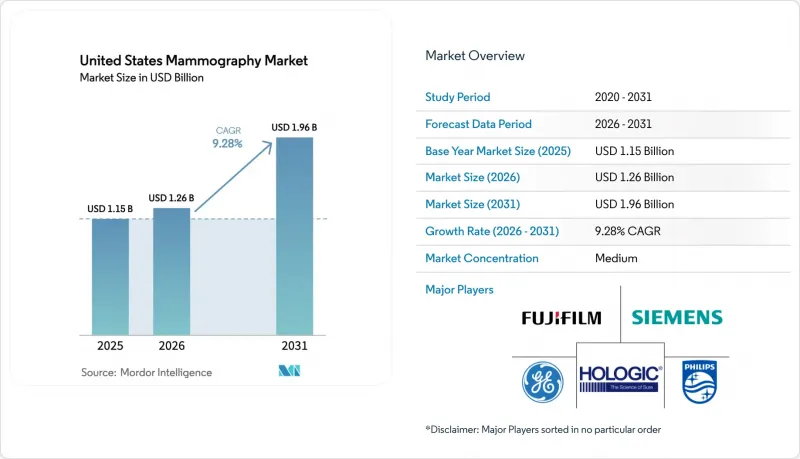
Mordor Intelligence에 의하면, 2026년 미국 맘모그래피 시장 규모는 12억 6,000만 달러로 추정되고 있어 2025년 11억 5,000만 달러에서 확대해, 2031년에는 19억 6,000만 달러에 이를 것으로 예측됩니다.
2026년부터 2031년까지의 연평균 성장률(CAGR)은 9.28%가 될 것으로 전망됩니다.
본 보고서는 제품 유형(디지털 시스템, 3D 유방 토모신테시스 시스템, 아날로그 시스템 등), 기술(2D 풀필드 디지털 등), 용도(스크리닝, 진단), 최종 사용자(병원, 영상의학 센터, 외래수술센터(ASC), 기타)별로 분류되어 있습니다. 시장 전망은 금액(달러) 기준으로 제시되어 있습니다.
미국 맘모그래피 시장 동향 및 인사이트
증가하는 유방암 부담
40-49세 여성의 발병률이 2015년부터 2019년까지 연평균 2% 증가함에 따라, 미국 예방 서비스 태스크포스(USPSTF)는 선별 검사 대상 연령을 40세로 하향 조정했습니다. 이 결정으로 인해 미국의 맘모그래피 시장은 약 2,000만 명의 여성이 새로 대상에 포함되면서 순식간에 확대되었으며, 이미 방사선과 전문의 부족에 직면해 있던 의료 기관에 대한 수요가 증가했습니다. 흑인 여성의 사망률은 백인 여성보다 여전히 40% 높은데, 이러한 상황을 반영하여 도시 지역의 프로그램에서는 표준 2D 영상 진단의 민감도 27.8%에 비해 88.9%의 민감도를 실현하는 조영 맘모그래피의 도입이 진행되고 있습니다. 펠로우십 공석이 1,400건에 달할 것으로 추정되는 인력 부족으로 인해, 검사 처리 능력을 유지하기 위한 AI 의사결정 지원에 대한 의존도가 높아지고 있습니다. 40세 이상 여성의 최대 절반에서 나타나는 고밀도 유방 조직은 잠재적 병변을 가시화하는 토모신테시스 및 광자 계수 시스템 도입의 근거를 강화하고 있습니다. 이러한 역학적 요인들이 복합적으로 작용하여 설비 투자를 증가시키고, 미국 맘모그래피 시장의 장기적인 성장세를 뒷받침하고 있습니다.
3D 토모신테시스에 대한 연방 정부의 보험 적용
메디케어·메디케이드 서비스 센터(CMS)는 디지털 유방 토모신테시스에 대한 전국적인 보험 적용을 도입하여, 그동안 보급을 저해하던 50-80달러의 본인 부담 차액을 해소했습니다. 민간 보험사들도 신속히 CMS의 조치를 따랐으며, 현재는 민간 보험 가입자의 95%가 사전 승인 없이 3차원 검사를 받을 수 있습니다. 이러한 보험 적용 확대는 설득력 있는 임상적 증거와 일치합니다. DBT는 재검사율을 41% 감소시키고, 암 검출률을 29% 향상시킵니다. 수익 전망이 명확해짐에 따라 기존 2D 장치의 교체가 가속화되어, 장비의 수명 주기가 9년에서 6년 가까이 단축되었습니다. 플로리다주, 애리조나주, 펜실베이니아주에서 메디케어 가입자가 주류를 차지하는 지역을 관할하는 의료 기관들이 가장 먼저 업그레이드를 추진하고 있으며, 그 파급 효과는 경쟁상의 평등을 추구하는 2차 시장까지 확산되고 있습니다.
방사선 피폭량의 안전성에 대한 우려
DBT의 경우, 2D 검사에 비해 환자가 받는 선량이 15-25% 더 높으며, 선조직에 대한 평균 선량은 2.04-2.33 mGy인 반면, FFDM에서는 1.40-1.89 mGy입니다. 환자 옹호 단체들은 특히 새로 선별 검사 대상에 포함된 40세 연령층의 경우, 향후 수십 년에 걸쳐 매년 선별 검사를 받게 될 것이기 때문에 누적 피폭량에 대한 우려를 더욱 크게 하고 있습니다. 시설의 검사 건수가 증가함에 따라 FDA의 MQSA 검사관들은 선량 위반을 더 빈번하게 지적하고 있습니다. 제조업체 측은 2 mGy 미만의 성능을 실현하는 AI 강화형 재구성 기술이나 광자 계수형 검출기로 대응하고 있지만, 뿌리 깊은 선입견이 소아 병원이나 가정의학 클리닉에서의 신속한 도입을 방해하고 있습니다. 선량에 대한 우려가 미국 맘모그래피 시장을 다소 억제하고 있지만, 기술의 발전으로 그 격차는 꾸준히 좁혀지고 있습니다.
부문 분석
2025년에는 디지털 장비가 시장의 60.78%를 차지하며, 필름 장비가 시장에서 거의 완전히 철수한 상황을 반영하고 있습니다. 그러나 업데이트 추세는 3D 토모신테시스로 이동하고 있으며, 보험사의 환급액 균일화와 임상적 증거 축적에 따라 2031년까지 연평균 성장률(CAGR) 9.88%로 확대될 것으로 예측됩니다. 아날로그 시스템은 주로 독립된 진료소에 남아 있지만, 레트로핏 키트를 통해 기능이 연장되고는 있으나 규제 압력이 높아짐에 따라 그 존재 의의는 꾸준히 사라지고 있습니다. SCEMAM을 통해 유효성이 입증된 프리미엄 조영 플랫폼은 진단의 우위를 추구하는 3차 의료 기관을 위해 차별화된 새로운 길을 열어가고 있습니다. 전반적으로, 체적 영상 및 조영 영상에 대한 선호도 증가가 미국 맘모그래피 시장의 성장을 견인하고 있습니다.
디지털화를 통한 업그레이드의 가치 제안에는 선명한 영상, 워크플로 자동화, AI 분석이 결합되어 있어, 이를 통해 판독 시간이 30-40% 단축됩니다. 의료 서비스 제공업체들은 프리미엄 패키지를 단순한 대체품이 아닌, 의뢰 환자를 유치하고 더 높은 기술료를 정당화할 수 있는 경쟁적 자산으로 인식하고 있습니다. 이동식 유방촬영 차량의 탑재 장비가 현대화됨에 따라, 디지털 기기 제조업체들은 소프트웨어 라이선스 및 검출기 교체를 통한 애프터마켓 수익을 확대하고 있으며, 이로 인해 미국의 유방촬영 시장이 더욱 심화되고 있습니다.
풀 필드 디지털은 50.40%의 점유율을 유지하고 있지만, 초고해상도와 방사선 노출 감소를 동시에 실현하는 광자 계수 검출기가 혁신의 주역으로 떠오르고 있습니다. 조기 도입 기관들로부터 미세 석회화의 가시성이 향상되었습니다는 보고가 있으며, 이로 인해 위음성률 감소 및 재검사율 감소로 이어지고 있습니다. ‘ProFound Detection 4.0’과 같은 AI 기반 CAD(컴퓨터 보조 진단) 및 트리아지 도구는 판독 시간을 단축하고 특이도를 향상시킴으로써 미국 맘모그래피 시장 전반에 걸쳐 AI 도입을 가속화하고 있습니다.
3D 토모신테시스는 보험 적용 대상으로 주목받고 있는 반면, Clairity Breast의 예측 기능은 향후 ‘검출’에서 ‘위험도 계층화 선별검사’로의 전환을 시사하고 있습니다. 각 벤더사는 복잡한 증례를 펠로우십을 수료한 전문의에게 자동으로 배정하는 스마트 워크리스트 기능을 탑재하여, 방사선과 의사 부족 문제를 완화하고 있습니다. 클라우드 도입과의 통합을 통해 여러 거점을 보유한 체인에서 확장성을 확보하고 있으며, 현재 소프트웨어에 의한 차별화가 미국 맘모그래피 시장에서 경쟁 우위를 결정짓고 있다는 점이 부각되고 있습니다.
기타 혜택:
- 엑셀 형식 시장 예측(ME) 시트
- 3개월간의 애널리스트 지원
자주 묻는 질문
목차
제1장 서론
제2장 조사 방법
제3장 주요 요약
제4장 시장 구도
제5장 시장 규모와 성장 예측
제6장 경쟁 구도
제7장 시장 기회와 향후 전망
JHS 26.08.28According to Mordor Intelligence, the United States mammography market size in 2026 is estimated at USD 1.26 billion, growing from 2025 value of USD 1.15 billion with 2031 projections showing USD 1.96 billion, growing at 9.28% CAGR over 2026-2031.
This report is Segmented by Product Type (Digital Systems, 3-D Breast Tomosynthesis Systems, Analog Systems, and More), Technology (2-D Full-Field Digital, and More), Application (Screening, Diagnostic), End User (Hospitals, Diagnostic Imaging Centers, Ambulatory Surgical Centers, Others). The Market Forecasts are Provided in Terms of Value (USD).
United States Mammography Market Trends and Insights
Growing Burden of Breast Cancer
The incidence among women aged 40-49 years increased by 2% annually from 2015 to 2019, prompting the USPSTF to lower the screening age to 40 years. The decision instantly widened the United States mammography market by roughly 20 million newly eligible women and increased demand on facilities already contending with radiologist shortages. Mortality among Black women remains 40% higher than that of White women, spurring inner-city programs to adopt contrast-enhanced mammography that delivers 88.9% sensitivity versus 27.8% for standard 2-D imaging. Workforce gaps estimated at 1,400 unfilled fellowship positions intensify reliance on AI decision support to maintain throughput. Dense breast tissue in up to half of women over 40 strengthens the case for tomosynthesis and photon-counting systems that reveal occult lesions. Together, these epidemiological pressures elevate capital expenditure and reinforce the long-run momentum of the United States mammography market.
Federal Reimbursement for 3-D Tomosynthesis
The Centers for Medicare & Medicaid Services (CMS) instituted national coverage for digital breast tomosynthesis, eliminating the historical USD 50-80 out-of-pocket differential that had suppressed uptake . Commercial insurers quickly mirrored CMS, and today, 95% of privately insured members can access 3-D exams without prior authorization. Parity coincides with compelling clinical proof: DBT lowers callback rates by 41% and improves cancer detection by 29%. Revenue visibility accelerates the replacement of legacy 2-D units, shortening equipment lifecycles from 9 years to nearer 6 years. Providers serving Medicare-dominant catchments in Florida, Arizona, and Pennsylvania are upgrading first, creating a ripple effect that extends to second-tier markets, which are seeking competitive parity.
Radiation-Dose Safety Concerns
DBT exposes patients to 15-25% higher dose than 2-D exams, with a mean glandular dose at 2.04-2.33 mGy versus 1.40-1.89 mGy for FFDM. Patient advocates amplify concerns about cumulative exposure, especially for the newly included 40-year-old cohort, who face decades of annual screening. FDA MQSA inspectors flag dose violations more frequently as facilities increase exam volumes. Manufacturers counter with AI-enhanced reconstruction and photon-counting detectors that deliver sub-2 mGy performance, yet lingering perceptions hinder rapid adoption in children's hospitals and family clinics. Dose anxiety marginally tempers the United States mammography market, although technology improvements are steadily narrowing the gap.
Other drivers and restraints analyzed in the detailed report include:
- Rapid Technology Upgrades
- Expansion of Breast Density-Notification Laws
- High Capital & Service Costs of DBT Units
For complete list of drivers and restraints, kindly check the Table Of Contents.
Segment Analysis
Digital equipment captured 60.78% of the market in 2025, mirroring the near-complete exit of film units. Yet replacement momentum is shifting toward 3-D tomosynthesis, projected to advance at 9.88% CAGR through 2031 as payers equalize reimbursement and clinical evidence grows. Analog systems primarily remain in isolated clinics; retrofit kits prolong function but steadily lose relevance as regulatory pressure intensifies. Premium contrast-enhanced platforms, validated by SCEMAM, open a differentiated lane for tertiary centers seeking diagnostic superiority. Overall, rising preference for volumetric and contrast imaging is driving growth in the United States mammography market.
The value proposition of digital upgrades combines image clarity, workflow automation, and AI analytics, which reduce reading time by 30-40%. Providers view premium packages as not simple replacements, but rather as competitive assets that attract referrals and justify higher technical fees. As mobile fleets modernize their onboard suites, digital manufacturers enlarge after-market revenues for software licenses and detector swaps, further deepening the United States mammography market.
Full-field digital retains 50.40% share, but photon-counting detectors headline innovation because they pair ultra-high resolution with reduced exposure. Early adopters report sharper microcalcification visualization, translating to fewer false negatives and lower recall rates. AI-guided CAD and triage tools, such as ProFound Detection 4.0, reduce reading time and improve specificity, accelerating AI adoption across the United States mammography market.
3-D tomosynthesis gains reimbursement traction, while Clairity Breast's predictive capability signals a future shift from detection to risk-stratified screening. Vendors embed smart-worklist features that auto-route complex cases to fellowship specialists, easing the radiologist shortage. Integration of cloud deployment secures scalability for multisite chains, underscoring how software differentiation now defines competitive positioning in the United States mammography market.
Complete Report Scope:
- By Product Type
- Digital Systems
- 3-D Breast Tomosynthesis Systems
- Analog Systems
- Computed-Radiography Retrofit Kits
- Contrast-Enhanced Mammography Systems
- By Technology
- 2-D Full-field Digital
- 3-D / Tomosynthesis
- Photon-Counting Digital
- AI-enabled CAD & Image-triage
- By Application
- Screening
- Diagnostic
- By End User
- Hospitals
- Diagnostic Imaging Centers
- Ambulatory Surgical Centers
- Others
List of Companies Covered in this Report:
- Hologic
- GE Healthcare
- Siemens Healthineers
- Fujifilm Holdings Corp.
- Canon
- Carestream Health
- Konica Minolta
- Planmed
- Agfa-Gevaert
- IMS Giotto
- Metaltronica
- iCAD Inc.
- Delphinus Medical Technologies
- Sectra
- Volpara Health
- ScreenPoint Medical
- Hitachi
- Aurora Imaging Technology
- Dilon Technologies
- PerkinElmer
Additional Benefits:
- The market estimate (ME) sheet in Excel format
- 3 months of analyst support
TABLE OF CONTENTS
1 Introduction
- 1.1 Study Assumptions & Market Definition
- 1.2 Scope of the Study
2 Research Methodology
3 Executive Summary
4 Market Landscape
- 4.1 Market Overview
- 4.2 Market Drivers
- 4.2.1 Growing Burden of Breast Cancer
- 4.2.2 Federal Reimbursement for 3-D Tomosynthesis
- 4.2.3 Rapid Technology Upgrades
- 4.2.4 Expansion of Breast Density-Notification Laws
- 4.2.5 Ai-Enabled Triage & Workflow Automation
- 4.2.6 Rise Of Mobile Outreach Vans in Rural U.S.
- 4.3 Market Restraints
- 4.3.1 Radiation-Dose Safety Concerns
- 4.3.2 High Capital & Service Costs of DBT Units
- 4.3.3 Shortage of Fellowship-Trained Breast Radiologists
- 4.3.4 Consolidation of Imaging Centers Delaying Purchases
- 4.4 Supply-Chain Analysis
- 4.5 Regulatory Landscape
- 4.6 Technological Outlook
- 4.7 Porter's Five Forces Analysis
- 4.7.1 Threat of New Entrants
- 4.7.2 Bargaining Power of Buyers/Consumers
- 4.7.3 Bargaining Power of Suppliers
- 4.7.4 Threat of Substitute Products
- 4.7.5 Intensity of Competitive Rivalry
5 Market Size & Growth Forecasts (Value)
- 5.1 By Product Type
- 5.1.1 Digital Systems
- 5.1.2 3-D Breast Tomosynthesis Systems
- 5.1.3 Analog Systems
- 5.1.4 Computed-Radiography Retrofit Kits
- 5.1.5 Contrast-Enhanced Mammography Systems
- 5.2 By Technology
- 5.2.1 2-D Full-field Digital
- 5.2.2 3-D / Tomosynthesis
- 5.2.3 Photon-Counting Digital
- 5.2.4 AI-enabled CAD & Image-triage
- 5.3 By Application
- 5.3.1 Screening
- 5.3.2 Diagnostic
- 5.4 By End User
- 5.4.1 Hospitals
- 5.4.2 Diagnostic Imaging Centers
- 5.4.3 Ambulatory Surgical Centers
- 5.4.4 Others
6 Competitive Landscape
- 6.1 Market Concentration
- 6.2 Market Share Analysis
- 6.3 Company Profiles (includes Global level Overview, Market level overview, Core Segments, Financials as available, Strategic Information, Market Rank/Share for key companies, Products & Services, and Recent Developments)
- 6.3.1 Hologic Inc.
- 6.3.2 GE HealthCare
- 6.3.3 Siemens Healthineers
- 6.3.4 Fujifilm Holdings Corp.
- 6.3.5 Canon Medical Systems
- 6.3.6 Carestream Health
- 6.3.7 Konica Minolta Inc.
- 6.3.8 Planmed Oy
- 6.3.9 Agfa-Gevaert Group
- 6.3.10 IMS Giotto
- 6.3.11 Metaltronica SpA
- 6.3.12 iCAD Inc.
- 6.3.13 Delphinus Medical Technologies
- 6.3.14 Sectra AB
- 6.3.15 Volpara Health
- 6.3.16 ScreenPoint Medical
- 6.3.17 Hitachi Ltd.
- 6.3.18 Aurora Imaging Technology
- 6.3.19 Dilon Technologies
- 6.3.20 PerkinElmer Inc.
7 Market Opportunities & Future Outlook
- 7.1 White-space & Unmet-Need Assessment


