
|
시장보고서
상품코드
2116756
개인 건강 기록(PHR) 소프트웨어 시장 : 점유율 분석, 업계 동향과 통계, 성장 예측(2026-2031년)Global Personal Health Records Software - Market Share Analysis, Industry Trends & Statistics, Growth Forecasts (2026 - 2031) |
||||||
 Mordor Intelligence
Mordor Intelligence에 의하면, 개인 건강 기록(PHR) 소프트웨어 시장 규모는 2025년 96억 6,000만 달러에서 2026년에는 105억 6,000만 달러로 확대되어 2026-2031년까지 CAGR 9.32%로 성장을 지속하여, 2031년에는 164억 7,000만 달러에 이를 것으로 예측됩니다.
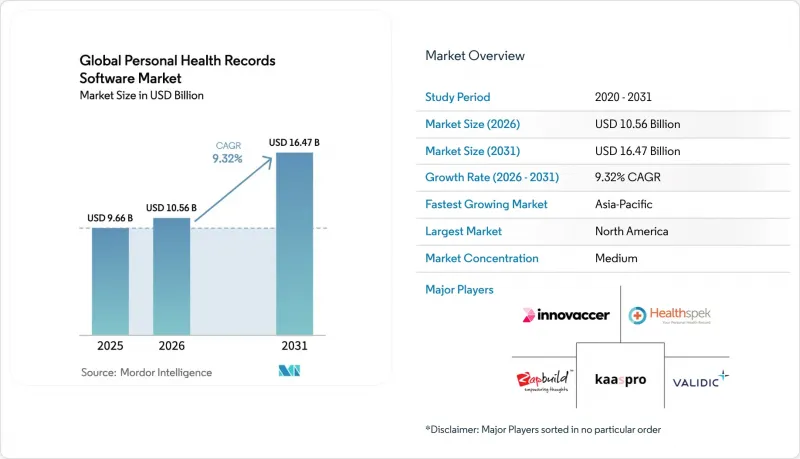
본 보고서는 구성 요소 유형(소프트웨어·모바일 앱, 서비스), 배포 방식(클라우드 기반, 웹 기반),아키텍처(지불자 연계형, 의료 제공업체 연계형, 독립형, 상호운용형·제3자형), 지역(북미, 유럽, 아시아태평양, 중동 및 아프리카, 남미)별로 분류되어 있습니다. 시장 예측은 금액(달러)으로 제시되어 있습니다.
전 세계 개인 건강 기록(PHR) 소프트웨어 시장 동향 및 인사이트
의료 정보 효율화에 대한 수요 증가와 환자 중심의 맞춤형 치료를 촉진하는 노력의 확대
의료 데이터는 여러 사일로에 분산되어 있어, 환자들은 투약 정보, 검사 결과, 진료 기록을 한 곳에서 확인할 수 있기를 원하고 있습니다. '21세기 치료법(21st Century Cures Act)'은 정보의 차단이 금지하고 있으며, 포털에 로그인하여 사용자의 90%가 검사 수치를 확인하고, 70%가 임상 기록을 열람하고 있는 것으로 밝혀졌습니다. 스마트폰 이용에 대한 친화도는 여전히 높으며, 미국인의 51%가 모바일 앱을 통해 기록에 접근하고 있습니다. 직관적인 포털을 도입한 의료기관에서는 만족도 지표가 높게 나타나고 있으며, 산업 전반에 걸친 소비자의 기대가 대응이 뒤처진 시스템에 계속해서 압력을 가하고 있습니다. 따라서 PHR 소프트웨어 시장은 임상 워크플로우 개선, 데이터 집약의 용이화, 가치 기반 계약에 연동된 의료기관에 대한 인센티브 확대로부터 혜택을 받고 있습니다.
온라인 데이터 통합을 위한 정부의 이니셔티브 확대
현재 공공 부문 정책에서는 소비자가 데이터에 대해 마찰 없이 관리할 수 있도록 표준화된 API를 의무화하고 있습니다. CMS(미국 의료보험·의료서비스 센터)의 ‘환자 접근(Patient Access)’, ‘의료 제공업체 접근(Provider Access)’, ‘지급자 간(Payer-to-Payer)’ API는 모두 2027년까지 운영을 시작해야 합니다. 인도의 ‘아유슈만 바라트 디지털 미션(Ayushman Bharat Digital Mission)’은 이미 73억 건 이상의 건강 계정을 생성하여 모바일 우선 등록 모델의 실제 사례가 되고 있습니다. CDC의 5억 달러 규모의 ‘데이터 현대화 이니셔티브’는 감시 및 보고 파이프라인을 현대화하고 있습니다. 인도네시아의 FHIR 기반 ‘Satusehat’ 플랫폼은 HL7 FHIR 표준이 전 세계적으로 지지를 받고 있음을 입증하고 있습니다. 이러한 의무화 조치는 벤더 간 통합 장벽을 낮춤으로써 PHR 소프트웨어 시장의 도입 곡선을 전반적으로 가속화하고 있습니다.
소프트웨어 관련 보안 우려
2024년에는 의료 기관의 92%가 사이버 공격을 받았으며, 정보 유출로 인한 피해액은 평균 980만 달러에 달했습니다. Change Healthcare의 사고만으로도 1억 9,000만 명의 개인정보가 유출되었습니다. 다크웹 시장에서는 의료 기록의 가격이 금융 데이터의 최대 50배에 달하고 있으며, 이에 따라 CIO(최고정보책임자)는 IT 예산의 19%를 보안에 할당하고 있습니다. 인력 부족은 여전히 지속되고 있으며, 53%의 기업이 사내 전문 지식이 부족하다고 지적하고 있습니다. 블록체인 시범 프로젝트는 HIPAA 요건을 충족하면서 환자에게 세밀한 동의 관리 권한을 부여함으로써 신뢰 회복을 목표로 하고 있습니다. 이러한 위협에 대처하지 않으면 PHR 소프트웨어 시장의 전환 속도가 둔화될 가능성이 있습니다.
부문 분석
2025년, 소프트웨어 및 모바일 앱 부문은 높은 스마트폰 보급률과 AI를 활용한 맞춤형 대시보드의 지원에 힘입어 PHR 소프트웨어 시장의 54.10%를 차지했습니다. 그러나 현재 여러 포털의 정보를 통합하고 있는 사용자는 고작 2%에 불과하여 상호 운용성 측면에서 과제가 부각되고 있습니다. 현재 예측 알고리즘은 검사 결과를 요약하고, 약물 상호작용을 경고하며, 생활 습관 개선 방안을 권장함으로써 환자의 참여도와 지속 이용률을 높이고 있습니다. 각 벤더는 UX 디자인, 로우코드 기반 설정, 원활한 FHIR API를 통해 차별화를 꾀하고 있습니다.
서비스 부문은 2025년에 45.90%의 점유율을 차지했으나, 조직들이 워크플로우 재설계, 직원 교육, 데이터 품질 감사를 위해 도입 파트너를 찾음에 따라 연평균 11.12%라는 더 빠른 속도로 성장할 전망입니다. 관리형 서비스 모델은 소규모 클리닉이 자본 투자를 피하는 데 도움이 되는 반면, 대규모 의료 시스템은 가치 기반 보고 요건을 충족하기 위해 컨설턴트에 의존하고 있습니다. 생성형 AI를 활용한 문서 작성은 임상의의 부담을 줄여주며, 문제 해결 핫라인은 사용자 충성도를 강화합니다. 서비스 부문 내 PHR 소프트웨어 시장 규모는 소프트웨어 부문보다 빠르게 확대될 것으로 예상되며, 2031년까지 전문 서비스 기업이 차지하는 매출 점유율은 더욱 확대될 전망입니다.
지역별 분석
북미는 HITECH법에 따른 자금 지원을 받은 인프라와 조기에 도입된 소비자용 포털 사이트의 의무화를 배경으로, 2025년에는 PHR 소프트웨어 시장의 53.30%를 차지했습니다. 환자 접근 API를 의무화하는 CMS의 최종 규정에 따라, 2027년까지 통합 기준이 더욱 엄격해질 전망입니다. 사이버 보안은 여전히 우려 사항이며, 2024년에는 미국인 4명 중 3명이 정보 유출의 영향을 받았습니다. 시장의 회복력은 보험사의 인센티브, 성숙한 클라우드 생태계, 모바일 우선 접근을 선호하는 기술에 정통한 소비자층에 의해 뒷받침되고 있습니다.
아시아태평양은 연평균 성장률(CAGR) 11.60%로 가장 빠르게 성장하고 있는 지역입니다. 인도의 ‘아유슈만 바라트 디지털 미션’에는 73억 건의 건강 ID가 등록되었으며, 인도네시아의 ‘사투세핫’ 플랫폼은 FHIR의 확장 가능한 도입을 입증하고 있습니다. 스마트폰 보급률이 높고 정부의 e-헬스 보조금 덕분에 도시 지역 클리닉에서의 시범 도입이 가속화되고 있습니다. 국내 벤더들은 통신사와 제휴하여 SMS 기반 알림 서비스를 제공함으로써 피처폰 사용자 확보를 확실히 하고 있습니다. 2030년까지 이 지역의 PHR 소프트웨어 시장 규모는 유럽의 현재 수준에 필적할 것으로 예측됩니다.
유럽은 일반 데이터 보호 규정(GDPR(EU 개인정보보호규정))과 향후 도입될 ‘유럽 헬스 데이터 스페이스’를 기반으로 상당한 시장 점유율을 차지하고 있습니다. 에스토니아는 이미 CDA에서 FHIR로의 전환을 완료하여 국가 차원의 시맨틱 상호운용성을 입증하고 있습니다. 데이터 현지화에 관한 규제는 벤더의 규정 준수 비용을 증가시키는 한편, 소비자의 신뢰도도 조성하고 있습니다. 프랑스와 독일의 통신 규제 당국은 접근 효율화를 위해 모바일 SIM 인증 프레임워크 평가를 진행하고 있습니다. 한편, 중동 및 아프리카와 남미는 디지털화의 초기 단계에 있지만, 모바일 전략을 통한 비약적인 발전의 혜택을 누리고 있습니다. 난민 및 이민자를 위한 의료 프로그램에서는 의료의 연속성에 어려움이 있는 가운데, 휴대 가능한 전자건강기록(EPHR)의 유용성이 두드러지고 있습니다.
기타 혜택
- 엑셀 형식 시장 예측(ME) 시트
- 3개월간의 애널리스트 지원
자주 묻는 질문
목차
제1장 서론
제2장 조사 방법
제3장 개요
제4장 시장 구도
제5장 시장 규모와 성장 예측
제6장 경쟁 구도
제7장 시장 기회와 향후 전망
JHS 26.09.01According to Mordor Intelligence, the personal health records software market size is expected to grow from USD 9.66 billion in 2025 to USD 10.56 billion in 2026 and is forecast to reach USD 16.47 billion by 2031 at 9.32% CAGR over 2026-2031.
This report is Segmented by Component Type (Software and Mobile Apps, and Services), Deployment Mode (Web-Based and Cloud-Based), Architecture (Payer Tethered, Provider Tethered, Standalone, and Interoperable / Third-Party), and Geography (North America, Europe, Asia-Pacific, Middle East and Africa and South America). The Market Forecasts are Provided in Terms of Value (USD).
Global Personal Health Records Software Market Trends and Insights
Streamlined information & patient-centric care
Healthcare data sit in multiple silos, pushing patients to demand one-stop visibility into medications, test results, and visit notes. The 21st Century Cures Act bans information blocking, triggering portal log-ins that show 90% of users reviewing lab values and 70% reading clinical notes. Smartphone comfort levels remain high, with 51% of Americans accessing records on mobile apps. Providers deploying intuitive portals report higher satisfaction metrics, and cross-industry consumer expectations continue to pressure laggard systems. The personal health records software market therefore benefits from better clinical workflows, easier data aggregation, and growing provider incentives tied to value-based contracts.
Government online data-integration mandates
Public-sector policies now require standardized APIs that give consumers friction-free control over data. The CMS Patient Access, Provider Access, and Payer-to-Payer APIs must all be live by 2027. India's Ayushman Bharat Digital Mission has already created more than 7.3 billion health accounts, providing a model of mobile-first enrollment. The CDC's USD 500 million Data Modernization Initiative is modernizing surveillance and reporting pipelines. Indonesia's FHIR-based Satusehat platform underscores the global preference for the HL7 FHIR standard. These mandates collectively accelerate the adoption curve in the personal health records software market by lowering vendor integration barriers.
Security concerns regarding software
Ninety-two percent of healthcare organizations suffered cyberattacks in 2024, and breaches cost an average USD 9.8 million. The Change Healthcare incident alone exposed data on 190 million individuals. Health records fetch up to 50 times the price of financial data on dark web markets, prompting CIOs to assign 19% of IT budgets to security. Staffing shortages persist, with 53% of firms citing inadequate in-house expertise. Blockchain pilots aim to restore trust by giving patients granular consent controls while meeting HIPAA requirements. Unless addressed, these threats may slow conversions in the personal health records software market.
Other drivers and restraints analyzed in the detailed report include:
- Rising chronic-disease burden
- Telehealth & RPM expansion
- Lack of awareness among rural patients
For complete list of drivers and restraints, kindly check the Table Of Contents.
Segment Analysis
The Software & Mobile Apps segment commanded 54.10% of the personal health records software market in 2025, buoyed by high smartphone penetration and AI-enabled personalization dashboards. Yet only 2% of users currently combine information from multiple portals, revealing interoperability pain points. Predictive algorithms now summarize lab results, flag medication conflicts, and recommend lifestyle interventions, thereby lifting patient engagement scores and retention. Vendors differentiate through UX design, low-code configuration, and seamless FHIR APIs.
Services held 45.90% in 2025 but will grow faster at 11.12% annually as organizations seek implementation partners for workflow redesign, staff training, and data-quality audits. Managed-service models help smaller clinics bypass capital outlays, while large systems rely on consultants to meet value-based reporting demands. Generative-AI documentation reduces clinician burden, and troubleshooting hot-lines strengthen user loyalty. The personal health records software market size for services is projected to expand more quickly than that for software, giving professional-services firms a larger revenue slice by 2031.
Complete Report Scope:
- By Component Type
- Software and Mobile Apps
- Services
- By Deployment Mode
- Cloud-Based
- Web-Based
- By Architecture
- Provider-Tethered
- Payer-Tethered
- Standalone
- Interoperable / Third-Party
- By Geography
- North America
- United States
- Canada
- Mexico
- Europe
- Germany
- United Kingdom
- France
- Italy
- Spain
- Rest of Europe
- Asia-Pacific
- China
- Japan
- India
- Australia
- South Korea
- Rest of Asia-Pacific
- Middle East & Africa
- GCC
- South Africa
- Rest of Middle East & Africa
- South America
- Brazil
- Argentina
- Rest of South America
- North America
Geography Analysis
North America secured 53.30% of the personal health records software market in 2025 on the back of HITECH-funded infrastructure and early consumer portal mandates. The CMS final rule forcing Patient Access APIs promises to tighten integration baselines further by 2027. Nonetheless, cybersecurity remains a caveat; three in four Americans were touched by a breach in 2024. Market resilience stems from payer incentives, mature cloud ecosystems, and a tech-savvy consumer base favoring mobile-first access.
Asia-Pacific is the fastest-growing territory at 11.60% CAGR. India's Ayushman Bharat Digital Mission enrolled 7.3 billion health IDs, while Indonesia's Satusehat platform demonstrates scalable FHIR adoption. High smartphone penetration and government e-health grants accelerate pilot rollouts in urban clinics. Domestic vendors partner with telecom operators to deliver SMS-based reminders, ensuring inclusion of feature-phone users. By 2030 the regional personal health records software market size is expected to rival Europe's current level.
Europe commands considerable share anchored by the General Data Protection Regulation and the forthcoming European Health Data Space. Estonia already migrated from CDA to FHIR, proving national-scale semantic interoperability. Data-localization rules increase vendor compliance costs yet also engender consumer trust. Communications regulators in France and Germany are evaluating mobile-SIM authentication frameworks to streamline access. Meanwhile, Middle East & Africa plus South America are in the early digitization phase but benefit from leapfrog mobile strategies. Refugee and migrant health programs highlight the utility of portable EPHRs amid continuity-of-care challenges.
- Epic Systems
- Oracle Health (Cerner)
- Veradigm (Allscripts)
- Validic
- Healthspek
- NoMoreClipboard
- Patient Ally
- Health Companion
- Knapsack Health
- Zapbuild
- Records For Living Inc.
- kaaspro (Health Cure)
- SoftClinic (JVS Group)
- 75Health
- Practice Fusion
- Medfusion
- NextGen Healthcare
- Apple Health Records
- Innovaccer
Additional Benefits:
- The market estimate (ME) sheet in Excel format
- 3 months of analyst support
TABLE OF CONTENTS
1 Introduction
- 1.1 Study Assumptions & Market Definition
- 1.2 Scope of the Study
2 Research Methodology
3 Executive Summary
4 Market Landscape
- 4.1 Market Overview
- 4.2 Market Drivers
- 4.2.1 Increasing Need for Streamlined Healthcare Information and Rising Initiatives to Encourage Patient Centric Personal Care
- 4.2.2 Rising Government Initiatives for Online Data Integration
- 4.2.3 Surging Chronic Disease Burden Driving Continuous Patient Engagement Needs
- 4.2.4 Telehealth & Remote Monitoring Expansion Requiring Seamless Data Exchange
- 4.2.5 Smartphone Surge Enabling Mobile-First PHR Adoption
- 4.2.6 Cloud Cost-Optimization Expanding SaaS PHRs
- 4.3 Market Restraints
- 4.3.1 Security Concerns Regarding the Software
- 4.3.2 Lack of Awareness Among Rural Patients
- 4.3.3 Cyber-Liability Insurance Cost Spike Limiting SME Adoption
- 4.3.4 Fragmented HIT Standards Hindering Payer-Tethered Interoperability
- 4.4 Porter's Five Forces Analysis
- 4.4.1 Threat of New Entrants
- 4.4.2 Bargaining Power of Buyers/Consumers
- 4.4.3 Bargaining Power of Suppliers
- 4.4.4 Threat of Substitute Products
- 4.4.5 Intensity of Competitive Rivalry
5 Market Size & Growth Forecasts (Value in USD)
- 5.1 By Component Type
- 5.1.1 Software and Mobile Apps
- 5.1.2 Services
- 5.2 By Deployment Mode
- 5.2.1 Cloud-Based
- 5.2.2 Web-Based
- 5.3 By Architecture
- 5.3.1 Provider-Tethered
- 5.3.2 Payer-Tethered
- 5.3.3 Standalone
- 5.3.4 Interoperable / Third-Party
- 5.4 By Geography
- 5.4.1 North America
- 5.4.1.1 United States
- 5.4.1.2 Canada
- 5.4.1.3 Mexico
- 5.4.2 Europe
- 5.4.2.1 Germany
- 5.4.2.2 United Kingdom
- 5.4.2.3 France
- 5.4.2.4 Italy
- 5.4.2.5 Spain
- 5.4.2.6 Rest of Europe
- 5.4.3 Asia-Pacific
- 5.4.3.1 China
- 5.4.3.2 Japan
- 5.4.3.3 India
- 5.4.3.4 Australia
- 5.4.3.5 South Korea
- 5.4.3.6 Rest of Asia-Pacific
- 5.4.4 Middle East & Africa
- 5.4.4.1 GCC
- 5.4.4.2 South Africa
- 5.4.4.3 Rest of Middle East & Africa
- 5.4.5 South America
- 5.4.5.1 Brazil
- 5.4.5.2 Argentina
- 5.4.5.3 Rest of South America
- 5.4.1 North America
6 Competitive Landscape
- 6.1 Market Concentration
- 6.2 Strategic Moves
- 6.3 Market Share Analysis
- 6.4 Company Profiles (includes Global level Overview, Market level overview, Core Segments, Financials as available, Strategic Information, Market Rank/Share for key companies, Products & Services, and Recent Developments)
- 6.4.1 Epic Systems Corporation
- 6.4.2 Oracle Health (Cerner)
- 6.4.3 Veradigm (Allscripts)
- 6.4.4 Validic
- 6.4.5 Healthspek
- 6.4.6 NoMoreClipboard
- 6.4.7 Patient Ally
- 6.4.8 Health Companion
- 6.4.9 Knapsack Health
- 6.4.10 Zapbuild
- 6.4.11 Records For Living Inc.
- 6.4.12 kaaspro (Health Cure)
- 6.4.13 SoftClinic (JVS Group)
- 6.4.14 75Health
- 6.4.15 Practice Fusion
- 6.4.16 Medfusion
- 6.4.17 NextGen Healthcare
- 6.4.18 Apple Health Records
- 6.4.19
Innovaccer, Inc.
7 Market Opportunities & Future Outlook
- 7.1 White-Space & Unmet-Need Assessment