

|
시장보고서
상품코드
2100002
포인트 오브 케어(POC) 의료 소프트웨어 시장 : 점유율 분석, 업계 동향 및 통계, 성장 예측(2026-2031년)Point-of-Care Medical Software - Market Share Analysis, Industry Trends & Statistics, Growth Forecasts (2026 - 2031) |
||||||
 Mordor Intelligence
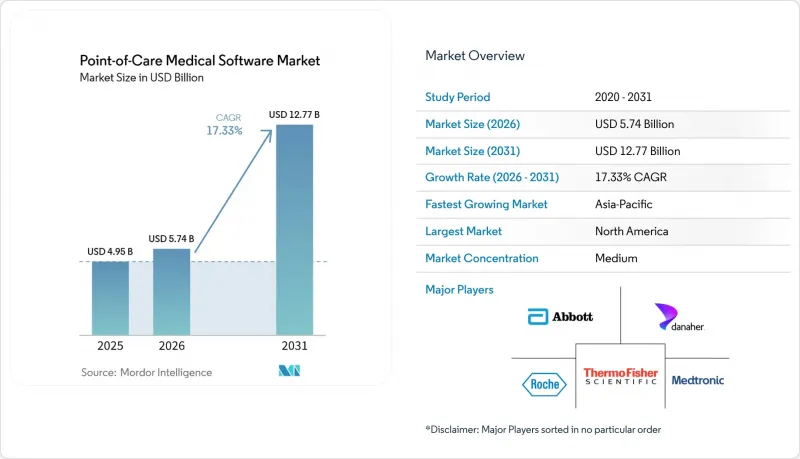
Mordor Intelligence에 의하면, 포인트 오브 케어 의료 소프트웨어 시장 규모는 2025년 49억 5,000만 달러에서 2026년에는 57억 4,000만 달러로 확대되어 2026년부터 2031년까지 CAGR 17.33%로 성장을 지속하여, 2031년에는 127억 7,000만 달러에 이를 것으로 예측됩니다.
본 보고서는 구성 요소(소프트웨어 플랫폼, 미들웨어, 서비스), 배포 방식(On-Premise, 클라우드 기반, 하이브리드), 최종 사용자(병원·중환자실, 진단센터, 재택 간호), 용도(혈당 모니터링, 심대사 모니터링, 혈액학), 지역(북미, 유럽, 아시아태평양, 남미)별로 분류되어 있습니다.
전 세계 포인트 오브 케어 의료 소프트웨어 시장 동향과 인사이트
분산형 포인트 오브 케어 워크플로우에서의 클라우드 전환
포인트 오브 케어 의료 소프트웨어 시장에서의 클라우드 도입은 얼리 어답터 단계를 넘어, 기존에는 로컬 미들웨어에 의존하던 병원 네트워크 사이에서도 보급이 확대되고 있습니다. 그 주된 매력은 운영 측면에 있습니다. 클라우드 호스팅형 플랫폼이라면 각 검사 거점에서 기술 지원 없이도 소프트웨어 업데이트, 운영자 인증 정보 갱신, 그리고 거점 간 품질 동향 추적이 가능하기 때문입니다. 이는 의료 시스템이 동일한 거버넌스 요건을 공유하는 곳, IT 인력의 수준이 균일하지 않은 진료소, 의사 사무실, 외래 센터 및 병원 각 부서에 걸쳐 POCT 프로그램을 운영하는 경우에 특히 중요합니다. 2026년 1월, WellSpan Health는 자사의 기술 포트폴리오를 AWS로 대규모로 이전할 것이라고 발표했습니다. 그 주된 이유로 AI 통합을 위한 확장성을 꼽았으며, 이는 클라우드 네이티브 임상 소프트웨어 환경으로의 전환이라는 방향성을 뒷받침하는 것입니다. EMR 벤더들이 아키텍처 현대화를 추진하는 가운데, 포인트 오브 케어(POCT) 의료 소프트웨어 시장에서는 단순한 검사실 규정 준수 도구로서 기능할 뿐만 아니라, 보다 광범위한 클라우드 데이터 계층 내에 통합될 수 있는 플랫폼의 가치가 높아지고 있습니다.
LIS, EMR 및 POCT 기기 간의 상호 운용성 요구 사항
병원 측은 LIS, EMR 및 원격 의료 워크플로우 간에 기기 데이터가 원활하게 연동되기를 요구하고 있으므로, 상호 운용성은 포인트 오브 케어 의료 소프트웨어 시장에서 구매 결정의 기준이 되고 있습니다. 2027년 1월의 CMS-0057-F 일정은 미국에서 특히 중요합니다. 이는 FHIR R4 API를 지원하는 특정 워크플로우를 의무화하고 있으며, 많은 레거시 스택은 대규모 재설계 없이는 이에 대응할 수 없기 때문입니다. 2024년에 실시된 ‘Hospital&Home’ 워크플로우에 관한 조사에 따르면, 클라우드 인프라와 HL7 FHIR을 결합함으로써 포인트 오브 케어 검사 결과를 여러 이해관계자의 시스템 간에 동시에 공유할 수 있는 것으로 나타났습니다. 이는 기존 시스템에서는 충분히 지원되지 않는 기능입니다. 따라서 의료 기관이 혼재된 디바이스 환경에서 장기적인 통합 옵션을 비교할 때, 개방적이고 벤더 중립적인 미들웨어가 우위를 점하고 있습니다. 이에 따라 포인트 오브 케어 의료 소프트웨어 시장에서는 이미 도입된 디바이스군 및 기존 검사 워크플로우와의 하위 호환성을 유지하면서, 현재의 메시징 표준을 지원하는 플랫폼이 높이 평가받고 있습니다.
높은 도입·검증·통합 비용
포인트 오브 케어 의료 소프트웨어 시장은 여전히 심각한 경제적 장벽에 직면해 있습니다. 그 이유는 기업 규모에서의 도입 비용이 미들웨어 라이선스 비용만으로는 가늠할 수 없을 정도로 고액이기 때문입니다. 의료 기관은 LIS(검사 정보 시스템)와의 통합 작업, 거점별 워크플로우 검증, 기기 인터페이스 인증, 사용자 교육, 그리고 기기 유형나 설치 장소가 늘어날 때마다 확대되는 정기적인 지원 계약 비용을 부담해야 합니다. 의료 제공업체 네트워크가 여러 기기 제조업체의 제품을 사용하는 경우, 플랫폼을 대규모로 가동하기 전에 각 인터페이스별로 개별적인 개발 및 테스트 작업이 필요하기 때문에 이러한 비용은 급격히 증가합니다. POCT 통신에 관한 CLSI 지침에서는 멀티 벤더 환경이 지속적인 인터페이스 오버헤드를 발생시킨다는 점이 강조되고 있으며, 이것이 프로젝트 팀이 총 도입 공수를 과소평가하기 쉬운 이유 중 하나입니다(CLSI.ORG). 이러한 비용 부담은 포인트 오브 케어 의료 소프트웨어 시장의 구매 결정을 지연시키며, 미리 구축된 인터페이스 라이브러리가 충실하고 도입 서비스 역량이 뛰어난 벤더가 유리한 위치에 서는 경향이 있습니다.
부문 분석
소프트웨어 플랫폼은 2025년 포인트 오브 케어 의료 소프트웨어 시장 규모의 64.8%를 차지하며, 2031년까지 연평균 성장률(CAGR) 17.2%를 나타낼 것으로 예측됩니다. 이러한 시장 점유율 1위와 가장 높은 성장률의 일치는 의료 기관들이 여전히 플랫폼 계층을 운영자 관리, 품질 워크플로우, 이용 현황 추적 및 하류로 데이터 라우팅의 핵심 제어 지점으로 간주하고 있음을 보여줍니다. 포인트 오브 케어 의료 소프트웨어 시장에서 이러한 기능이 중요시되는 이유는 병원이 단순한 데이터 뷰어를 구매하는 것이 아니라, 여러 부서와 거점에 분산된 검사 활동을 표준화해야 하는 거버넌스 시스템을 구매하고 있기 때문입니다. 미들웨어는 구형 장치 인터페이스와 새로운 상호 운용성 요구 사항 사이에 위치하기 때문에 전략적으로 중요한 역할을 계속 수행하고 있으며, API 주도형 연결 요구 사항에 대비하는 의료 시스템에서 핵심적인 존재가 되고 있습니다. 서비스는 가장 작은 구성 요소이지만, 검증, 교육, 도입 지원, 규정 준수 대응 준비를 내부 팀만으로 처리하기가 점점 더 어려워지고 있기 때문에 그 중요성은 여전히 흔들림이 없습니다.
플랫폼의 지배력이 가져오는 두 번째 효과는 경쟁 측면에서의 것입니다. 기존 벤더는 자사의 도입 실적을 활용하여 분석 도구, 예측 품질 관리 도구, 추가 연결 계층과 같은 관련 모듈을 판매할 수 있기 때문입니다. 지멘스 헬스니어스는 2025년 6월에 UniPOC 버전 1.9를 출시했는데, 이 플랫폼은 정기적인 디바이스 인터페이스 업데이트는 물론, 운영자의 검증 및 재인증 워크플로우 자동화 측면에서 계속해서 주목받고 있습니다. 이 제품은 2025년 하반기 미국 정부의 기술 문서에서도 언급되었으며, 이는 플랫폼이 규제 대상인 의료 현장에 정착한 후 확고한 기업 존재감이 지속될 것임을 뒷받침합니다. FDA의 품질 관리 시스템 규정은 2026년 2월 2일에 발효되어, ISO 13485의 개념을 미국의 의료기기 품질 관리에 보다 직접적으로 도입함으로써 소프트웨어 설계, 문서화 및 사이버 보안 대책의 정비 상태에 대한 감시 체계를 한층 더 강화했습니다. 포인트 오브 케어(Point-of-Care) 의료 소프트웨어 업계에서 이는 새로운 기능을 제공할 수 있는 능력과, 대형 플랫폼이 이미 보유하고 있는 감사 이력, 철저한 문서화, 장기적인 고객 관계에서 뒤처진 중소규모의 신규 진출기업들에게 진입 장벽을 높이는 요인이 될 것입니다.
클라우드 기반 도입은 2025년에 56.4%의 점유율을 차지할 것으로 예상되며, 2031년까지 연평균 성장률(CAGR)이 18.4%에 달하고, 가장 빠르게 성장하는 도입 모델이기도 합니다. 포인트 오브 케어(POCT) 의료 소프트웨어 시장에서는 클라우드 옵션이 선호되고 있습니다. 이는 의료 제공업체가 현장 개입을 기다릴 필요 없이 분산된 검사 거점 전체에 보안 패치, 장치 드라이버, 규제 관련 업데이트를 적용할 수 있기 때문입니다. 이는 상당한 양의 POCT 검사를 처리하고 있거나, 현지 IT 지원 체계가 취약한 외래 진료 시설 및 위성 사이트가 테스트 네트워크에 포함된 경우에 특히 유용합니다. 2024년 Hospital&Home의 조사에 따르면, HL7 FHIR과 결합된 클라우드 아키텍처가 여러 이해관계자의 시스템 간 실시간 결과 교환을 지원할 수 있는 것으로 나타났으며, 이는 분산형 진료 환경에서 클라우드 호스팅 모델의 실용적 가치를 입증합니다. 데이터 주권에 관한 요건이 더 엄격한 시설, 외부로의 데이터 전송 규제가 여전히 엄격한 정부 및 군사 환경에서는 On-Premise 배포가 여전히 중요하게 여겨지고 있습니다.
하이브리드 배포는 단일 자본 주기 내에서 구형 미들웨어를 교체할 수 없는 대규모 의료 제공업체 시스템에 있어 전환 경로로 부상하고 있습니다. 포인트 오브 케어(Point-of-Care) 의료 소프트웨어 시장에서 이 모델을 사용하면 특정 기기에서 LIS로 전송되는 데이터 흐름을 로컬 인프라 내에 유지하면서, API 변환 및 원격 관리는 클라우드에 맡길 수 있습니다. 이 접근 방식은 2027년까지 상호 운용성을 부분적으로라도 향상시켜야 하지만, 여전히 상당수의 On-Premise 시스템 도입 기반이 남아 있는 조직에 적합합니다. 또한, 감사 담당자나 사내 팀이 클라우드 계층과 로컬 계층 모두에 대해 동일한 품질 및 규정 준수 요건에 따라 검증을 수행해야 하므로 거버넌스와 관련된 추가 업무가 발생합니다. 그 결과, 의료 현장용 소프트웨어 업계에서는 신규 도입에 있어 클라우드가 계속해서 주도적인 역할을 수행하는 한편, 실용적인 가교 수단으로서 하이브리드 방식을 통한 입찰이 성공하는 사례가 증가하고 있습니다.
지역별 분석
2025년, 북미는 포인트 오브 케어(POCT) 의료 소프트웨어 시장 점유율의 38.1%를 차지하며 지역별로는 가장 큰 기여도를 보였습니다. 이 지위의 대부분은 미국이 주도하고 있으며, 이는 높은 POCT 검사 밀도, 성숙한 보험 환급 제도, 그리고 활발한 병원 IT 현대화가 결합된 결과입니다. 또한, 이 지역에서는 의료 제공업체가 2027년 1월까지 CMS-0057-F에 기반한 FHIR R4 상호운용성 의무에 대비해야 할 뿐만 아니라, HIPAA 보안 규정안(CMS)에 따른 더욱 엄격한 사이버 보안 요건에도 대응해야 하기 때문에 장비 교체 주기가 가속화되고 있습니다. 캐나다에서는 각 주의 네트워크가 원격 의료 환경에서 분산형 POCT 프로그램 관리를 위해 클라우드 도구를 활용하고 있어, 그 기여도는 작지만 성장을 지속하고 있습니다. 미국에서도 포인트 오브 케어 의료 소프트웨어 시장은 가치 기반 의료 인센티브의 혜택을 받고 있으며, 휴마나(Humana)사의 보고에 따르면, 가치 기반 의료를 채택한 메디케어 어드밴티지 가입자의 경우, 동등한 비가치 기반 의료 가입자에 비해 응급실 방문 횟수가 13.4% 감소했습니다.
유럽은 포인트 오브 케어 의료 소프트웨어 시장에서 여전히 2위의 규모를 유지하고 있으며, 수요는 독일, 영국, 프랑스, 이탈리아, 스페인에 집중되어 있습니다. 독일과 영국은 병원 내 디지털 기술 도입이 활발히 진행되고 있으며, 검사 보고서의 구조화 요건이 엄격하다는 점이 두드러지는데, 이러한 요인으로 인해 조달 협의 과정에서 POCT 소프트웨어의 거버넌스가 더욱 중요시되고 있습니다. 프랑스와 이탈리아도 공립 병원의 현대화 프로그램을 통해 진전을 보이고 있지만, 스페인은 단일한 전국적 조달 체계보다는 지역별 의료 시스템이 구매 패턴을 좌우하고 있어 여전히 분산된 상황이 지속되고 있습니다. 이 지역 전체적으로 볼 때, 포인트 오브 케어(POCT) 의료 소프트웨어 시장의 보급은 환급 제도가 더 세분화되어 있고 다국적 의료 제공업체 그룹이 각 지역의 서로 다른 운영 조건에 대응해야 하는 북미에 비해 여전히 뒤처져 있습니다.
아시아태평양은 가장 빠르게 성장하는 지역으로, 2026년부터 2031년까지 연평균 성장률(CAGR) 34.5%로 확대될 것으로 예측됩니다. 이 지역에서는 의료 디지털화를 위한 지출이 증가하고 있으며, 의료 제공업체 네트워크가 주요 도시의 병원을 넘어 확장되고 있고, 커넥티드 케어 프로그램을 통해 분산된 의료 현장에서의 검사 활동이 증가하고 있어, 포인트 오브 케어 의료 소프트웨어 시장이 탄력을 받고 있습니다. 소프트웨어가 대규모 온사이트 IT 인프라 없이도 지리적으로 분산된 시설을 지원할 수 있는 지역에서 수요가 가장 강하며, 따라서 클라우드 호스팅형 대시보드와 원격 관리가 특히 중요합니다. 한국과 호주에서는 고품질의 문서화 및 구조화된 데이터 교환을 중시하는 병원 시스템 수요가 증가하고 있습니다. 남미, 중동 및 아프리카는 현재 시장 규모가 작지만, 민간 병원 그룹이나 진단 체인, 그리고 의료 IT에 대한 광범위한 투자로 인해 기반 인프라 구축이 진행되고 있어, 이 지역들의 포인트 오브 케어 의료 소프트웨어 시장에는 장기적인 성장 여지가 있습니다.
기타 혜택:
- 엑셀 형식 시장 예측(ME) 시트
- 3개월간의 애널리스트 지원
자주 묻는 질문
목차
제1장 서론
제2장 조사 방법
제3장 주요 요약
제4장 시장 구도
제5장 시장 규모 및 성장 예측(금액;주요 분석 대상 물질 출하량)
제6장 경쟁 구도
제7장 시장 기회와 향후 전망
JHS 26.08.11According to Mordor Intelligence, the point-of-Care medical software market size is expected to grow from USD 4.95 billion in 2025 to USD 5.74 billion in 2026 and is forecast to reach USD 12.77 billion by 2031 at 17.33% CAGR over 2026-2031.
This report is Segmented by Component (Software Platform, Middleware, Services), Deployment Mode (On-Premise, Cloud-Based, Hybrid), End User (Hospitals & Critical Care, Diagnostic Centers, Home Care), Application (Glucose Monitoring, Cardiometabolic Monitoring, Hematology), and Geography (North America, Europe, Asia-Pacific, South America).
Global Point-of-Care Medical Software Market Trends and Insights
Cloud Migration for Distributed Point-of-Care Workflows
Cloud adoption in the point-of-care medical software market has moved beyond early adopters and is gaining traction among hospital networks that previously depended on local middleware. The main attraction is operational, because cloud-hosted platforms can push software updates, renew operator credentials, and track cross-site quality trends without requiring technical support at every testing location. This matters most when a health system runs POCT programs across clinics, physician offices, ambulatory centers, and hospital departments that share the same governance requirements but do not share the same IT staffing depth. In January 2026, WellSpan Health announced a broad migration of its technology portfolio to AWS, with scalability for AI integration highlighted as a key rationale, which supports the direction of travel toward cloud-native clinical software environments. As EMR vendors continue to modernize their architectures, the point-of-care medical software market is placing more value on platforms that can sit inside a larger cloud data layer instead of serving only as a narrow laboratory compliance utility.
Interoperability Requirements Across LIS, EMR, and POCT Devices
Interoperability is becoming a purchasing filter in the point-of-care medical software market because hospitals want device data to move cleanly across LIS, EMR, and remote care workflows. The January 2027 CMS-0057-F timeline is especially important in the United States because it requires specified workflows to support FHIR R4 APIs, which many legacy stacks cannot deliver without major redesign work. A 2024 study on Hospital@Home workflows showed that combining cloud infrastructure with HL7 FHIR enables point-of-care results to flow across several stakeholder systems at the same time, which is a capability older implementations do not support as effectively. That is giving open, vendor-neutral middleware an advantage when provider organizations compare long-term integration options across mixed device environments. The point-of-care medical software market is therefore rewarding platforms that support current messaging standards while preserving backward compatibility with installed device fleets and existing laboratory workflows.
High Deployment, Validation, and Integration Costs
The point-of-care medical software market still faces a hard economic barrier because enterprise rollouts cost much more than middleware license fees alone suggest. Health systems must pay for LIS integration work, site-by-site workflow validation, device interface qualification, user training, and recurring support contracts that expand with every instrument type and location. Those costs rise quickly when a provider network uses several device brands, because each interface adds separate development and testing work before the platform can run at scale. CLSI guidance on POCT communications underlines how multi-vendor environments create recurring interface overhead, which helps explain why project teams often underestimate total implementation effort CLSI.ORG. That cost burden slows purchasing decisions in the point-of-care medical software market and tends to favor vendors with larger prebuilt interface libraries and stronger implementation service capabilities.
Other drivers and restraints analyzed in the detailed report include:
- Expansion of Remote and Home-Based Point-of-Care Testing
- AI-Enabled Analytics for Antimicrobial Stewardship and Quality Control
- Legacy Device Fragmentation and Vendor Lock-In
For complete list of drivers and restraints, kindly check the Table Of Contents.
Segment Analysis
Software platforms accounted for 64.8% of the point-of-care medical software market size in 2025 and are projected to grow at a 17.2% CAGR through 2031. That alignment between leading share and fastest growth shows that providers still see the platform layer as the core control point for operator management, quality workflows, utilization tracking, and downstream data routing. In the point-of-care medical software market, these functions matter because hospitals are not only buying a data viewer, they are buying a governance system that must standardize decentralized testing activity across many departments and sites. Middleware remains strategically important because it sits between older device interfaces and newer interoperability demands, which makes it central to health systems preparing for API-led connectivity requirements. Services form the smallest component, but they retain steady relevance because validation, training, deployment support, and compliance preparation are getting harder for internal teams to absorb on their own.
The second effect of platform dominance is competitive, because incumbent vendors can use their installed base to sell adjacent modules such as analytics, predictive quality tools, and extra connectivity tiers. Siemens Healthineers released UniPOC version 1.9 in June 2025, and the platform remained notable for automated operator validation and recertification workflows together with regular device interface updates. The same product was also referenced in U.S. government technology documentation in late 2025, which reinforces the staying power of established enterprise footprints once a platform is embedded in regulated care settings. FDA's Quality Management System Regulation took effect on February 2, 2026 and brought ISO 13485 concepts more directly into U.S. device quality controls, adding another layer of scrutiny around software design, documentation, and cybersecurity readiness. In the point of care medical software industry, that raises the barrier for smaller challengers that may offer new features but lack the audit history, documentation discipline, and long-cycle customer relationships that large platforms already possess.
Cloud-based deployment held 56.4% share in 2025 and is also the fastest-growing deployment model with an 18.4% CAGR through 2031. The point-of-care medical software market favors cloud options because they let providers push security patches, device drivers, and regulatory updates across distributed testing locations without waiting for on-site intervention. This is especially valuable when the testing network includes outpatient facilities and satellite sites that run important POCT volumes but have thin local IT support. A 2024 Hospital@Home study showed that cloud architecture combined with HL7 FHIR can support real-time result exchange across multiple stakeholder systems, which supports the practical value of cloud-hosted models in distributed care environments. On-premise deployments still matter in facilities with stricter data-sovereignty expectations and in government or military environments where external routing controls remain tight.
Hybrid deployment is emerging as the migration route for large provider systems that cannot replace older middleware in a single capital cycle. In the point-of-care medical software market, this model lets the cloud handle API translation and remote administration while keeping certain device-to-LIS flows inside local infrastructure. That approach fits organizations that need partial interoperability progress before 2027 but still have a meaningful installed base of on-premise systems. It also introduces extra governance work, because auditors and internal teams must validate both the cloud layer and the local layer against the same quality and compliance expectations. As a result, the point of care medical software industry is seeing hybrid win bids as a practical bridge, even while cloud continues to take the leading role in new deployments.
Complete Report Scope:
- By Component
- Software
- Hardware
- Services
- By Application
- In Vivo Diagnostics
- In Vitro Diagnostics
- By Deployment Mode
- Cloud Based
- Hybrid
- On Premises
- By End User
- Hospitals
- Diagnostic Imaging Centers
- Diagnostic Laboratories
- Clinics and Other Healthcare Providers
- By Geography
- North America
- United States
- Canada
- Mexico
- Europe
- Germany
- United Kingdom
- France
- Italy
- Spain
- Rest of Europe
- Asia-Pacific
- China
- India
- Japan
- South Korea
- Australia
- Rest of Asia-Pacific
- Middle East & Africa
- GCC
- South Africa
- Rest of Middle East and Africa
- South America
- Brazil
- Argentina
- Rest of South America
- North America
Geography Analysis
North America held 38.1% of the point-of-care medical software market share in 2025, making it the largest regional contributor. The United States drove most of that position because it combines high POCT test density, mature reimbursement systems, and active hospital IT modernization. The region is also moving faster on replacement cycles because providers must prepare for FHIR R4 interoperability obligations under CMS-0057-F by January 2027, while also responding to tighter cybersecurity expectations under the HIPAA Security Rule proposal CMS. Canada adds a smaller but growing contribution as provincial networks use cloud tools to manage distributed POCT programs across remote care settings. In the United States, the point-of-care medical software market also benefits from value-based care incentives, with Humana reporting 13.4% fewer emergency department visits among value-based care Medicare Advantage members than comparable non-value-based-care members.
Europe remained the second-largest region in the point-of-care medical software market, with demand centered on Germany, the United Kingdom, France, Italy, and Spain. Germany and the United Kingdom stand out for stronger digital hospital adoption and structured laboratory reporting requirements, which make POCT software governance more important in procurement discussions. France and Italy are also moving forward through public hospital modernization programs, while Spain remains more fragmented because regional health systems shape purchasing patterns more than a single national buying structure. Across the region, the point-of-care medical software market continues to face slower adoption than North America where reimbursement remains more fragmented and where multi-country provider groups must manage different local operating conditions.
Asia Pacific is the fastest-growing region and is projected to expand at a 34.5% CAGR between 2026 and 2031. The point-of-care medical software market is gaining momentum there because healthcare digitization spending is rising, provider networks are broadening beyond major urban hospitals, and connected care programs are pulling more testing activity into decentralized settings. Demand is strongest where software can support geographically dispersed facilities without a large on-site IT footprint, which makes cloud-hosted dashboards and remote administration especially relevant. South Korea and Australia add premium demand from hospital systems that place a high value on quality documentation and structured data exchange. South America and the Middle East and Africa remain smaller today, but the point-of-care medical software market has long-term room to expand there as private hospital groups, diagnostic chains, and wider healthcare IT investment continue to build out the underlying infrastructure.
List of Companies Covered in this Report:
- Alphabet Inc. (Google Health / DeepMind)
- Microsoft
- NVIDIA
- Siemens Healthineers
- GE HealthCare Technologies Inc.
- Koninklijke Philips
- Roche
- Tempus AI, Inc.
- Aidoc Medical Ltd.
- Qure.ai Technologies Private Limited
- Heartflow
- PathAI, Inc.
- Paige.AI, Inc.
- Ada Health GmbH
- AliveCor
- Butterfly Network, Inc.
- Digital Diagnostics
- Lunit
- Ibex Medical Analytics Ltd.
Additional Benefits:
- The market estimate (ME) sheet in Excel format
- 3 months of analyst support
TABLE OF CONTENTS
1 Introduction
- 1.1 Study Assumptions & Market Definition
- 1.2 Scope of the Study
2 Research Methodology
3 Executive Summary
4 Market Landscape
- 4.1 Market Overview
- 4.2 Market Drivers
- 4.2.1 Rising Demand for Faster Triage and Early Disease Detection
- 4.2.2 Expansion of AI-Enabled Radiology and Pathology Workflows
- 4.2.3 Multi-Modal Clinical Data Convergence Improves Diagnostic Confidence
- 4.2.4 Provider Push Toward Workflow Automation in Overburdened Health Systems
- 4.2.5 Integration With Wearables and Remote Monitoring Expands Diagnostic Reach
- 4.2.6 Growing Investment in Clinical Validation and Interoperable AI Platforms
- 4.3 Market Restraints
- 4.3.1 Algorithm Explainability and Liability Concerns Slow Clinical Trust
- 4.3.2 High Integration Cost Across PACS, EHR, and Hospital IT Stacks
- 4.3.3 Data Privacy, Sovereignty, and Cross-Border Model Training Constraints
- 4.3.4 Regulatory Heterogeneity and Revalidation Burden for Model Updates
- 4.4 Value / Supply-Chain Analysis
- 4.5 Regulatory Landscape
- 4.6 Technological Outlook
- 4.7 Porters Five Forces
5 Market Size & Growth Forecasts (Value; volume for key analytes)
- 5.1 By Component
- 5.1.1 Software
- 5.1.2 Hardware
- 5.1.3 Services
- 5.2 By Application
- 5.2.1 In Vivo Diagnostics
- 5.2.2 In Vitro Diagnostics
- 5.3 By Deployment Mode
- 5.3.1 Cloud Based
- 5.3.2 Hybrid
- 5.3.3 On Premises
- 5.4 By End User
- 5.4.1 Hospitals
- 5.4.2 Diagnostic Imaging Centers
- 5.4.3 Diagnostic Laboratories
- 5.4.4 Clinics and Other Healthcare Providers
- 5.5 By Geography
- 5.5.1 North America
- 5.5.1.1 United States
- 5.5.1.2 Canada
- 5.5.1.3 Mexico
- 5.5.2 Europe
- 5.5.2.1 Germany
- 5.5.2.2 United Kingdom
- 5.5.2.3 France
- 5.5.2.4 Italy
- 5.5.2.5 Spain
- 5.5.2.6 Rest of Europe
- 5.5.3 Asia-Pacific
- 5.5.3.1 China
- 5.5.3.2 India
- 5.5.3.3 Japan
- 5.5.3.4 South Korea
- 5.5.3.5 Australia
- 5.5.3.6 Rest of Asia-Pacific
- 5.5.4 Middle East & Africa
- 5.5.4.1 GCC
- 5.5.4.2 South Africa
- 5.5.4.3 Rest of Middle East and Africa
- 5.5.5 South America
- 5.5.5.1 Brazil
- 5.5.5.2 Argentina
- 5.5.5.3 Rest of South America
- 5.5.1 North America
6 Competitive Landscape
- 6.1 Market Concentration
- 6.2 Market Share Analysis
- 6.3 Company Profiles
- 6.3.1 Alphabet Inc. (Google Health / DeepMind)
- 6.3.2 Microsoft Corporation
- 6.3.3 NVIDIA Corporation
- 6.3.4 Siemens Healthineers AG
- 6.3.5 GE HealthCare Technologies Inc.
- 6.3.6 Koninklijke Philips N.V.
- 6.3.7 F. Hoffmann-La Roche Ltd
- 6.3.8 Tempus AI, Inc.
- 6.3.9 Aidoc Medical Ltd.
- 6.3.10 Qure.ai Technologies Private Limited
- 6.3.11 Heartflow, Inc.
- 6.3.12 PathAI, Inc.
- 6.3.13 Paige.AI, Inc.
- 6.3.14 Ada Health GmbH
- 6.3.15 AliveCor, Inc.
- 6.3.16 Butterfly Network, Inc.
- 6.3.17 Digital Diagnostics, Inc.
- 6.3.18 Lunit Inc.
- 6.3.19 Ibex Medical Analytics Ltd.
7 Market Opportunities & Future Outlook
- 7.1 White Space and Unmet Need Assessment


