
|
시장보고서
상품코드
2116795
미국의 HVAC 장비 : 시장 점유율 분석, 업계 동향과 통계, 성장 예측(2026-2031년)United States HVAC Equipment - Market Share Analysis, Industry Trends & Statistics, Growth Forecasts (2026 - 2031) |
||||||
 Mordor Intelligence
Mordor Intelligence에 따르면 미국의 HVAC 장비 시장 규모는 2025년에 585억 5,000만 달러로 평가되며, 2026년 609억 8,000만 달러에서 성장하며, 2031년까지 752억 달러에 달할 것으로 예측됩니다.
예측 기간(2026-2031년) 동안의 연평균 성장률(CAGR)은 4.30%에 달할 것으로 전망됩니다.
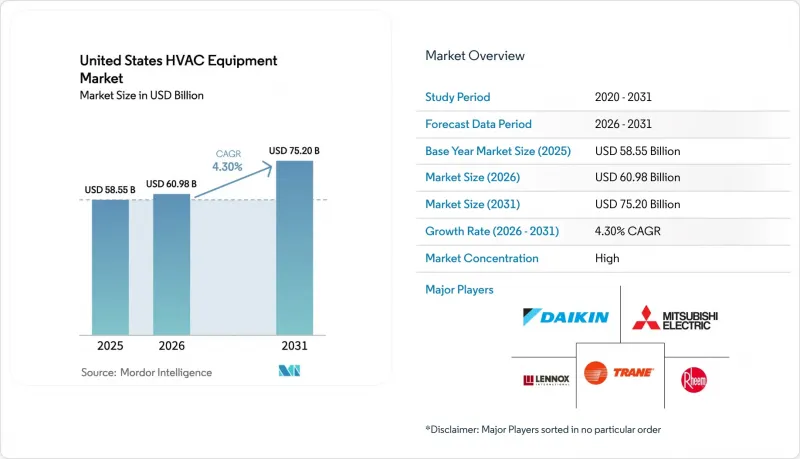
이 보고서는 장비 유형(공조 장비, 난방 장비, 환기 장비), 최종사용자(주거용, 상업용, 산업용), 도입 형태(신축, 개보수·교체), 효율 등급(저효율 등급, 고효율 등급) 및 지역별로 분류되어 있습니다. 시장 전망은 금액(달러) 기준으로 제시되어 있습니다.
미국 HVAC 장비 시장의 동향 및 인사이트
주택 및 빌딩 자동화 시스템 도입 확대
상업용 부동산 개발업자 및 대규모 주택 소유자는 현재 새로운 기기를 평가할 때 효율성뿐만 아니라 표준 연결 기능도 중요하게 여기고 있습니다. 오픈 API를 갖춘 시스템은 시설 관리 플랫폼과 원활하게 통합되어 일정 최적화 및 예측 유지보수를 가능하게 하며, 에너지 사용량을 15-20% 절감합니다. IoT 지원 온도 조절기 및 구역 설정 키트는 표준 사양으로 자리 잡고 있으며, 구형 기기는 최신 소프트웨어와 통신할 수 없어 교체 주기가 단축되고 있습니다. ESG 목표 달성을 지향하는 기업은 네트워크 접속형 HVAC를 측정 가능한 탄소 배출 감축을 위한 ‘즉각적인 성과’로 간주하며, 자본 계획 주기내 일괄 조달을 촉진하고 있습니다. 통합 업체들은 롱테일 소프트웨어 구독을 통해 수익을 창출하고 있으며, 이 모델은 장비의 전체 수명 주기 동안 수익을 창출하는 방식을 재구성하고 있습니다.
고효율 HVAC 장비에 대한 수요 증가
'타이틀 24' 개정, SEER(계절 성능 비율) 최저 기준 상향, 그리고 스마트 그리드 상호 운용성에 관한 규정으로 인해 현장 수준의 사양이 프리미엄 장비로 전환되고 있습니다. 고효율 장비는 15-25%의 가격 프리미엄이 붙지만, 전기 요금 상승과 시간대별 요금제로 인해 수명 주기 전반에 걸친 경제성은 고효율 장비에 유리하게 작용하고 있습니다. 현재 전력 회사는 수요 반응(Demand Response)을 통한 보상과 장비 구매시 리베이트를 결합하여 소유주들이 가변 속도 압축기나 한랭지용 히트펌프를 도입하도록 장려하고 있습니다. 전기화가 진행됨에 따라 피크 수요 요금이 두드러지게 나타나고 있으며, 설계 단계에서 킬로와트 단위의 성능에 대한 관심이 높아지고 있습니다. 이에 대응하여 각 제조사는 규제 기준과 재무 지표를 동시에 충족하기 위해 가변 냉매 유량(VRF) 기능을 주류 제품 라인에 단계적으로 도입하고 있습니다.
첨단 HVAC 시스템의 높은 초기 비용
네트워크 접속형 고SEER 히트펌프는 기존 난방로보다 30-50% 비싸며, 네트워크 제어 시스템을 추가하면 프로젝트 예산이 15-20% 더 증가합니다. 단독주택 소유자의 경우, 보조금이 지원되는 자금 조달 수단이 없어 투자 회수 기간이 ‘3년’이라는 심리적 문턱을 넘은 상태로 남아 있습니다. 상업용 부동산 운영자들은 투자 회수 기간(ROI) 요건을 5년 이하로 단축하고 있으며, 그 결과 많은 최첨단 제품이 선택지에서 제외되고 있습니다. 리베이트를 통해 부담은 다소 경감되지만, 자금 상한선 설정으로 인해 장기적인 계획에 불확실성이 초래되고 있습니다. 그 결과, 많은 구매자들은 업그레이드를 단계적으로 진행하며, 최적이라고 할 수 없는 해결책을 한 시즌 더 계속 사용하게 됩니다.
부문 분석
미국 HVAC 장비 시장에서 공조 제품 시장 규모는 2025년에 정점을 찍으며 총 가치의 47.35%를 차지했습니다. 냉방은 미국의 모든 기후대에서 특히 급속한 성장을 달성하고 있는 선벨트 주에서 여전히 핵심적인 수요로 남아 있습니다. 그러나 연방 정부의 세금 공제 혜택에 힘입은 히트펌프는 2031년까지 연평균 성장률(CAGR) 6.21%를 기록할 것으로 예상되며, 이는 전체 카테고리 중 가장 높은 성장률입니다. 한랭 지역에서의 성능이 향상됨에 따라 이러한 기기들은 가스식 난방로 및 순수 냉방용 스플릿형 에어컨 모두로부터 시장 점유율을 빼앗고 있습니다.
냉매 규제에 따른 사용 금지로 인해 칠러 교체가 가속화되고 있으며, R-32 및 R-454B를 지원하는 제품을 제공하는 공급업체들은 사이클 초기 단계에서 판매량을 늘릴 것으로 예상됩니다. 한편, 공기질 기준의 발전에 따라 환기 설비의 중요성이 높아지고 있으며, UV-C 및 MERV-13 필터가 호텔 및 의료 시설용 패키지형 유닛에 점점 더 많이 탑재되고 있습니다. 실내 환경 품질에 대한 포괄적인 전환으로 인해 신축 공사 속도가 둔화되더라도 수요는 견고한 추세를 유지하며, 미국 HVAC 장비 시장의 장기적인 성장 궤도를 지원하고 있습니다.
2025년, 주택 구매자들은 미국 HVAC 장비 시장 점유율의 45.68%를 계속 차지하며, 스마트 제어 시스템을 놀라운 속도로 도입하고 있습니다. 신축 단독 주택의 3분의 1 이상에는 최대 8,000달러의 IRA 세액 공제 대상이 되는 히트펌프와 원활하게 연동되는 네트워크 접속형 온도 조절기가 기본으로 장착되어 있습니다. 초기 비용에 대한 민감성은 여전히 남아 있지만, 저금리의 공공 서비스 대출 덕분에 고급 기기를 구매하기가 더 쉬워지고 있습니다.
상업 분야의 수요는 빌딩 자동화, 재실 상황에 따른 환기, 그리고 ESG를 준수하는 에너지 보고에 집중되어 있습니다. 사무실과 소매점에서는 유휴시 에너지 소비를 줄이는 적응형 운영 전략으로의 전환이 진행되고 있습니다. 산업용 사용자는 생산의 일관성을 확보하기 위해 더욱 엄격한 온도 및 습도 관리를 필요로 하고 있으며, 이로 인해 특수한 대용량 설계에 대한 수요가 증가하고 있습니다. 의사결정 주기는 장기화되고 있지만 개별 거래 규모는 확대되고 있으며, 미국 HVAC 장비 시장 전체의 수익 구조에 안정성을 가져다주고 있습니다.
기타 혜택:
- 엑셀 형식의 시장 예측(ME) 시트
- 3개월간의 애널리스트 지원
자주 묻는 질문
목차
제1장 서론
제2장 조사 방법
제3장 개요
제4장 시장 구도
제5장 시장 규모와 성장 예측
제6장 경쟁 구도
제7장 시장 기회와 향후 전망
KSA 26.08.26According to Mordor Intelligence, the United States HVAC equipment market size was valued at USD 58.55 billion in 2025 and is estimated to grow from USD 60.98 billion in 2026 to reach USD 75.20 billion by 2031, at a CAGR of 4.30% during the forecast period (2026-2031).
This report is Segmented by Equipment Type (Air-Conditioning Equipment, Heating Equipment, and Ventilation Equipment), End User (Residential, Commercial, and Industrial), Implementation Type (New Construction, and Retrofit/Replacement), Efficiency Rating (Low-Efficiency Tier, and High-Efficiency Tier), and Geography. The Market Forecasts are Provided in Terms of Value (USD).
United States HVAC Equipment Market Trends and Insights
Growing Adoption of Home and Building Automation Systems
Commercial developers and large homeowners now evaluate new units by their native connectivity as much as by efficiency. Systems with open APIs integrate seamlessly with facility management platforms, enabling schedule optimization and predictive maintenance that trim energy use by 15-20%. IoT-ready thermostats and zoning kits are becoming base-spec items, shortening replacement cycles because legacy units cannot communicate with modern software. Corporations chasing ESG targets view connected HVAC as low-hanging fruit for measurable carbon cuts, driving bulk procurement during capital-planning cycles. Integrators profit from long-tail software subscriptions, a model that reshapes how revenue is earned throughout the equipment life cycle.
Increasing Demand for Energy-Efficient HVAC Equipment
Title 24 updates, minimum SEER uplifts, and smart-grid interoperability rules have triggered field-level specification shifts toward premium gear. While high-efficiency units carry a 15-25% price premium, rising electricity tariffs and time-of-use billing tilt life-cycle economics in their favour. Utilities now pair demand-response payments with equipment rebates, nudging owners toward variable-speed compressors and cold-climate heat pumps. As electrification marches forward, peak-demand fees become pronounced, sharpening attention on kilowatt-level performance during design. Manufacturers, in response, phase variable refrigerant flow (VRF) features into mainstream product lines to satisfy code and financial metrics simultaneously.
High Upfront Cost of Advanced HVAC Systems
Connected, high-SEER heat pumps cost 30-50% more than legacy furnaces, and adding networked controls lifts project budgets by another 15-20%. For single-family homeowners, the absence of subsidized financing keeps payback periods outside a three-year psychological threshold. Commercial real-estate operators have shortened ROI requirements to five years or less, excluding many cutting-edge offerings. While rebates alleviate some pain, funding caps inject uncertainty into long-term planning. Consequently, many buyers stage upgrades, holding on to sub-optimal solutions for another season.
Other drivers and restraints analyzed in the detailed report include:
- Stringent Federal and State Energy-Efficiency Regulations
- Accelerated Equipment Replacement Cycles in Aging Building Stock
- Skilled Labour Shortages for Installation and Service
For complete list of drivers and restraints, kindly check the Table Of Contents.
Segment Analysis
The United States HVAC equipment market size for air-conditioning products stood highest in 2025, when they delivered 47.35% of total value. Cooling remains the core need across U.S. climates, especially in rapidly growing Sun Belt states. Yet heat pumps, aided by federal credits, are forecast to register a 6.21% CAGR through 2031, the fastest among all categories. As cold-climate performance improves, these units take share from both gas furnaces and straight-cool splits.
Regulatory refrigerant bans will accelerate chiller replacements, and vendors that offer R-32 or R-454B compatibility are set to gain volume early in the cycle. Meanwhile, ventilation equipment rises in priority as air-quality norms evolve, and UV-C or MERV-13 filtration is increasingly embedded in packaged units for hospitality and health-care projects. The holistic turn toward indoor environmental quality keeps demand resilient even when new construction slows, supporting the long-run trajectory of the United States HVAC equipment market.
Residential buyers retained a 45.68% slice of the United States HVAC equipment market share in 2025 and are embracing smart controls at an exceptional pace. More than one-third of new single-family homes shipped with connected thermostats that link seamlessly to heat pumps eligible for up to USD 8,000 in IRA credits. While upfront cost sensitivity remains, low-interest utility loans improve the affordability of premium gear.
Commercial demand centers on building automation, occupancy-based ventilation, and ESG-aligned energy reporting. Offices and retail stores pivot toward adaptive operation strategies that cut idle energy draw. Industrial users require tighter temperature and humidity windows for production consistency, reinforcing demand for specialized, high-capacity designs. Though decision cycles lengthen, each transaction is larger, injecting stability into the overall revenue profile of the United States HVAC equipment market.
Complete Report Scope:
- By Equipment Type
- Air-Conditioning Equipment
- Unitary Air Conditioners
- Room Air Conditioners
- Packaged Terminal Air Conditioners
- Chillers
- Heating Equipment
- Warm-Air Furnaces (Gas and Oil)
- Boilers
- Room and Zone Heating Equipment
- Heat Pumps (Air-Source and Geo-thermal)
- Ventilation Equipment
- Air Handling Units
- Fan Coil Units
- Building Humidifiers and Dehumidifiers
- Air-Conditioning Equipment
- By End User
- Residential
- Commercial
- Industrial
- By Implementation Type
- New Construction
- Retrofit / Replacement
- By Efficiency Rating
- Low-Efficiency Tier
- High-Efficiency Tier
List of Companies Covered in this Report:
- Carrier Global Corporation
- Daikin Industries Ltd.
- Trane Technologies plc
- Johnson Controls International plc
- Lennox International Inc.
- Rheem Manufacturing Company
- Mitsubishi Electric Corporation
- Nortek Air Solutions LLC
- NIBE Industrier AB
- LG Electronics Inc.
- Midea Group Co., Ltd.
- Systemair AB
- Greenheck Fan Corporation
- TROX GmbH
- Goodman Manufacturing Company LP
- Bosch Thermotechnology Corp.
- AAON Inc.
- Fujitsu General America Inc.
- Samsung Electronics America Inc.
- Danfoss A/S
Additional Benefits:
- The market estimate (ME) sheet in Excel format
- 3 months of analyst support
TABLE OF CONTENTS
1 INTRODUCTION
- 1.1 Study Assumptions and Market Definition
- 1.2 Scope of the Study
2 RESEARCH METHODOLOGY
3 EXECUTIVE SUMMARY
4 MARKET LANDSCAPE
- 4.1 Market Overview
- 4.2 Market Drivers
- 4.2.1 Growing adoption of home and building automation systems
- 4.2.2 Increasing demand for energy-efficient HVAC equipment
- 4.2.3 Stringent federal and state energy-efficiency regulations
- 4.2.4 Accelerated equipment replacement cycles in aging building stock
- 4.2.5 IRA-driven heat-pump electrification incentives
- 4.2.6 Micro-fulfilment centre boom boosting compact HVAC demand
- 4.3 Market Restraints
- 4.3.1 High upfront cost of advanced HVAC systems
- 4.3.2 Skilled labour shortages for installation and service
- 4.3.3 Electrical-grid capacity constraints for all-electric retrofits
- 4.3.4 Uncertain compliance costs from refrigerant phase-down
- 4.4 Industry Value-Chain Analysis
- 4.5 Porter's Five Forces Analysis
- 4.5.1 Bargaining Power of Suppliers
- 4.5.2 Bargaining Power of Buyers
- 4.5.3 Threat of New Entrants
- 4.5.4 Threat of Substitute Products
5 MARKET SIZE AND GROWTH FORECASTS (VALUE)
- 5.1 By Equipment Type
- 5.1.1 Air-Conditioning Equipment
- 5.1.1.1 Unitary Air Conditioners
- 5.1.1.2 Room Air Conditioners
- 5.1.1.3 Packaged Terminal Air Conditioners
- 5.1.1.4 Chillers
- 5.1.2 Heating Equipment
- 5.1.2.1 Warm-Air Furnaces (Gas and Oil)
- 5.1.2.2 Boilers
- 5.1.2.3 Room and Zone Heating Equipment
- 5.1.2.4 Heat Pumps (Air-Source and Geo-thermal)
- 5.1.3 Ventilation Equipment
- 5.1.3.1 Air Handling Units
- 5.1.3.2 Fan Coil Units
- 5.1.3.3 Building Humidifiers and Dehumidifiers
- 5.1.1 Air-Conditioning Equipment
- 5.2 By End User
- 5.2.1 Residential
- 5.2.2 Commercial
- 5.2.3 Industrial
- 5.3 By Implementation Type
- 5.3.1 New Construction
- 5.3.2 Retrofit / Replacement
- 5.4 By Efficiency Rating
- 5.4.1 Low-Efficiency Tier
- 5.4.2 High-Efficiency Tier
6 COMPETITIVE LANDSCAPE
- 6.1 Market Concentration
- 6.2 Strategic Moves
- 6.3 Market Share Analysis
- 6.4 Company Profiles (includes Global level overview, Market level overview, Core Segments, Financials as available, Strategic Information, Market Rank/Share, Products and Services, Recent Developments)
- 6.4.1 Carrier Global Corporation
- 6.4.2 Daikin Industries Ltd.
- 6.4.3 Trane Technologies plc
- 6.4.4 Johnson Controls International plc
- 6.4.5 Lennox International Inc.
- 6.4.6 Rheem Manufacturing Company
- 6.4.7 Mitsubishi Electric Corporation
- 6.4.8 Nortek Air Solutions LLC
- 6.4.9 NIBE Industrier AB
- 6.4.10 LG Electronics Inc.
- 6.4.11 Midea Group Co., Ltd.
- 6.4.12 Systemair AB
- 6.4.13 Greenheck Fan Corporation
- 6.4.14 TROX GmbH
- 6.4.15 Goodman Manufacturing Company LP
- 6.4.16 Bosch Thermotechnology Corp.
- 6.4.17 AAON Inc.
- 6.4.18 Fujitsu General America Inc.
- 6.4.19 Samsung Electronics America Inc.
- 6.4.20 Danfoss A/S
7 MARKET OPPORTUNITIES AND FUTURE OUTLOOK
- 7.1 White-Space and Unmet-Need Assessment