|
시장보고서
상품코드
2116825
베트남의 사이버 보안 시장 : 시장 점유율 분석, 업계 동향 및 통계, 성장 예측(2026-2031년)Vietnam Cybersecurity - Market Share Analysis, Industry Trends & Statistics, Growth Forecasts (2026 - 2031) |
||||||
 Mordor Intelligence
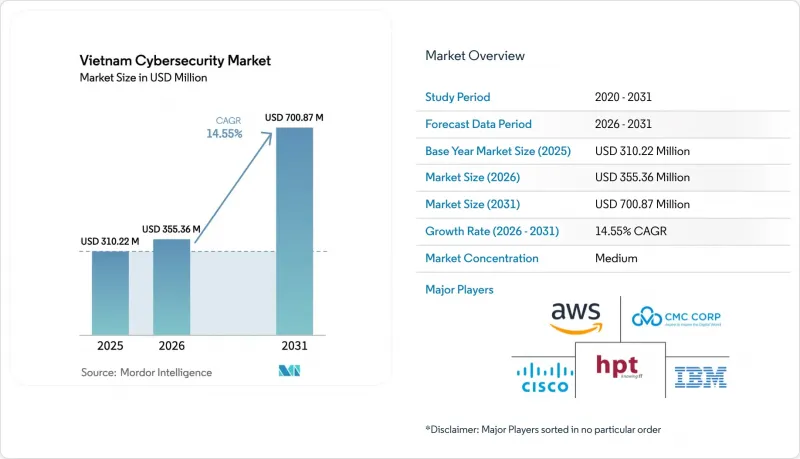
베트남의 사이버 보안 시장 규모는 2025년 3억 1,022만 달러로 평가되었고, 2026년에는 3억 5,536만 달러로 추정되고, 2026-2031년 CAGR 14.55%로 성장을 지속할 전망이며, 2031년에는 7억 87만 달러에 이를 것으로 예측됩니다.
본 보고서에서는 업계를 제공 형태별(솔루션, 서비스), 도입 형태별(클라우드, 온프레미스), 조직 규모별(중소기업, 대기업), 그리고 최종 사용자별(금융 및 보험·증권, 의료, IT 및 통신, 산업·국방, 소매, 에너지·유틸리티, 제조, 기타)로 분류하고 있습니다. 시장 예측은 금액(달러) 기준으로 제시되어 있습니다.
베트남의 사이버 보안 시장 동향 및 인사이트
정부의 디지털 전환(DX) 추진에 힘입어 보안 관련 지출이 가속화되고 있습니다.
국가 디지털 전환 프로그램에서는 사이버 보안에 1억 달러를 배정하고 있으며, 2025년까지 모든 공공 서비스가 온라인 성숙도 레벨 4를 달성하도록 의무화했습니다. 서던 파워 코퍼레이션이 거의 모든 계약을 전자 계약으로 전환하고 2024년 12월까지 560만 건의 계약을 체결한 것은 공공 부문의 도입이 공급업체들에게 유사한 보안 기준을 충족하도록 요구하고 있음을 보여줍니다. 2023년에 인증을 받은 8개의 ‘메이크 인 베트남(Make in Vietnam)’ SOC 플랫폼은 전문 지식과 자금의 추가적인 현지화를 촉진하여, 공공 기관이 보안 기술을 조달할 때 국내 공급업체가 우대받는 입지를 확보할 수 있도록 하고 있습니다. 정부의 도입 사례마다 민간 기업에 기준이 되는 보안 대책을 마련하도록 촉구하는 신호 효과가 발생하여 시장 수요를 확대되고 있습니다.
무현금 결제의 급증으로 BFSI의 공격 표면 확대
2024년 7월, 1,000만 VND를 초과하는 거래에 대해 생체 인증이 의무화되었으나, 사기 그룹은 사진을 이용한 우회 수법을 악용해 여러 은행에서 1조 VND 이상을 부정 인출했습니다. 이는 얼굴 인식 정확도의 문제점을 여실히 드러내고 있습니다. Vietcombank의 AI 기반 부정 방지 엔진은 한 달 동안 총액 1,600억 VND에 달하는 4만 건의 의심스러운 송금을 차단하며, 실시간 위협 분석이 가져오는 구체적인 성과를 입증했습니다. 그 결과, BFSI(은행 및 금융 및 보험) 기관들은 지속적인 인증, 행동 분석, 거래 모니터링 솔루션에 더 많은 예산을 할당하게 되었으며, 이는 베트남의 사이버 보안 시장을 확대시키고 있습니다.
인증된 인재 부족
베트남에서는 2028년까지 70만 명 이상의 사이버 보안 전문가가 필요할 것으로 예상되지만, 이미 76%의 기업이 인력 부족을 보고하고 있어 인건비가 증가하고 도입 주기가 장기화되고 있습니다. 해외 기업으로의 인재 유출이 인력 부족을 더욱 심화시키고 있는 반면, 대학 커리큘럼은 실무 중심의 교육에서 뒤처지고 있습니다. 베트남 사이버보안 협회(National Cybersecurity Association)의 ‘2025 nCademy’ 플랫폼은 AI를 활용한 맞춤형 과정을 제공하고 있지만, 인력 공급량에 미치는 단기적인 영향은 여전히 제한적입니다. 각 벤더사는 원격 관리 서비스나 관리가 간편한 SaaS 도구를 번들로 제공하며 대응하고 있지만, 프로젝트 일정은 여전히 장기화되고 있습니다.
부문 분석
2025년, 베트남 사이버 보안 시장에서 솔루션이 67.12%의 점유율을 차지했으며, 그 중심에는 정부령 53/2022에 의해 의무화된 네트워크 보안 장비 및 인프라 보호가 있었습니다. 기업들이 워크로드를 이전하고 생체 인증 관련 규정을 준수함에 따라 애플리케이션, 클라우드, ID 및 액세스 보안에 대한 수요가 가속화되고 있습니다. 네트워크 보안의 업데이트 주기는 하이퍼스케일 데이터센터의 출범과 연동되어 있으며, 엔드포인트 방어는 원격 근무 추세에 따라 확대되고 있습니다.
서비스 부문은 규모는 작지만, 조직이 인력 부족을 보완하기 위해 보안 운영을 외부에 위탁하는 추세에 따라 2031년까지 연평균 성장률(CAGR) 14.86%로 제품 부문을 상회하는 성장이 예상됩니다. 매니지드 SOC, 사고 대응 정액제 계약, 규정 준수 컨설팅이 이러한 급성장의 원동력이 되고 있습니다. 베트남 사이버 보안 시장에서 서비스 부문의 규모는 2031년까지 두 배로 증가할 것으로 예측되며, 자본 지출에서 운영비로 재분배된 예산을 흡수해 나갈 전망입니다. 국내 공급업체는 지리적 근접성과 규제에 대한 정통성을 강점으로 활용하는 한편, 세계 벤더는 복잡한 변혁 프로젝트에서 우위를 점하고 있습니다.
2025년, 베트남 사이버 보안 시장 점유율의 56.02%를 클라우드 도입이 차지했습니다. 이는 데이터 현지화 조항을 충족하는 Viettel사의 140MW 시설과 CMC사의 2억 5,000만 달러 규모 캠퍼스가 주도적인 역할을 했습니다. 중소기업은 SaaS의 민첩성을 중시하는 반면, 은행 및 정부 부처는 기밀 데이터에 대한 관리 권한을 유지하기 위해 프라이빗 클라우드를 선택하고 있습니다. 이에 따라 클라우드 네이티브 방화벽, 컨테이너 보안, 워크로드 보호 플랫폼에 대한 수요도 확대되고 있습니다.
국방, 에너지 및 레거시 시스템이 다수 존재하는 산업에서는 온프레미스 환경이 여전히 주류를 이루고 있지만, 이러한 산업에서도 하이브리드 설계를 도입하고 있습니다. 멀티 클라우드, 엣지, 온프레미스 환경에 걸친 통합된 정책 오케스트레이션이 조달의 필수 요건이 되었으며, 벤더들의 로드맵은 단일 창 관리로 향하고 있습니다. 2031년까지 베트남 사이버 보안 시장에서 클라우드 기반 보안 솔루션 시장 규모는 온프레미스 지출을 2대 1의 비율로 앞지를 것으로 예측됩니다.
기타 혜택 :
- 엑셀 형식 시장 예측(ME) 시트
- 3개월간의 애널리스트 지원
자주 묻는 질문
목차
제1장 서론
제2장 조사 방법
제3장 개요
제4장 시장 구도
제5장 시장 규모 및 성장 예측
제6장 경쟁 구도
제7장 시장 기회 및 향후 전망
AJY 26.09.01According to Mordor Intelligence, the Vietnam cybersecurity market size is expected to grow from USD 310.22 million in 2025 to USD 355.36 million in 2026 and is forecast to reach USD 700.87 million by 2031 at 14.55% CAGR over 2026-2031.
This report Segments the Industry Into by Offering (Solutions, Services), by Deployment Mode (Cloud, On-Premise), by Organization Size (SMEs, Large Enterprises), and by End User (BFSI, Healthcare, IT and Telecom, Industrial and Defense, Retail, Energy and Utilities, Manufacturing, Others). The Market Forecasts are Provided in Terms of Value (USD).
Vietnam Cybersecurity Market Trends and Insights
Government digital-transformation agenda accelerating security spend
The National Digital Transformation Programme earmarks USD 100 million for cybersecurity and requires every public service to reach level-4 online maturity by 2025. Southern Power Corporation's near-total shift to electronic contracts, 5.6 million executed by December 2024, shows how public-sector adoption forces suppliers to meet the same security standards. Eight "Make in Vietnam" SOC platforms certified in 2023 further localize expertise and funding, ensuring domestic vendors secure a preferential foothold when public agencies procure security technology. Each government deployment creates a signaling effect that nudges private firms to match baseline controls, amplifying market demand.
Cashless-payment boom raising BFSI attack surface
Biometric verification became compulsory for transactions above VND 10 million in July 2024, yet fraud rings manipulated photo-based bypasses to siphon over VND 1,000 billion from multiple banks, underscoring gaps in facial-recognition accuracy. Vietcombank's AI-enabled anti-fraud engine stopped 40,000 suspicious transfers worth VND 160 billion within one month, demonstrating tangible returns on real-time threat analytics. Consequently, BFSI institutions channel higher budgets toward continuous authentication, behavioral analytics and transaction-monitoring suites, widening the Vietnam cybersecurity market.
Certified-talent shortage
Vietnam will need more than 700,000 cybersecurity specialists by 2028, yet 76% of firms already report staffing shortages, inflating salary costs and elongating deployment cycles.Brain drain to overseas employers worsens scarcity, while university curricula lag on hands-on training. The National Cybersecurity Association's 2025 nCademy platform offers AI-personalized courses, but its near-term impact on workforce volume remains limited. Vendors compensate by bundling remote managed services and low-touch SaaS tools, but project timelines still extend.
Other drivers and restraints analyzed in the detailed report include:
- SME cloud-migration wave post-2023
- Mandatory compliance with Cybersecurity Law and Decree 53/2022
- Price-sensitive SME segment
For complete list of drivers and restraints, kindly check the Table Of Contents.
Segment Analysis
Solutions held 67.12% of the Vietnam cybersecurity market in 2025, led by network-security equipment and infrastructure protection mandated under Decree 53/2022. Demand for application, cloud, and identity-access security accelerates as enterprises migrate workloads and comply with biometric rules. Network-security refresh cycles align with hyperscale datacenter launches, while endpoint defenses expand alongside remote-work trends.
Services, though smaller, are projected to outpace products at a 14.86% CAGR through 2031 as organizations outsource security operations to bridge workforce shortages. Managed SOC, incident response retainer and compliance consulting anchor this surge. The Vietnam cybersecurity market size for Services is forecast to double by 2031, capturing budgets reallocated from capital purchases to operating expenses. Domestic providers leverage proximity and regulatory fluency, whereas global vendors win complex transformation projects.
Cloud deployments captured 56.02% of Vietnam cybersecurity market share in 2025, catalyzed by Viettel's 140 MW facility and CMC's USD 250 million campus that satisfy data-localization clauses.Small firms prize SaaS agility, while banks and ministries choose private clouds to retain custody of sensitive data. Demand for cloud-native firewalls, container security and workload-protection platforms scales in parallel.
On-premise estates persist in defense, energy and legacy-system heavy sectors, but even these embrace hybrid designs. Unified policy orchestration across multicloud, edge and premises environments becomes a procurement prerequisite, steering vendor roadmaps toward single-pane management. By 2031 the Vietnam cybersecurity market size for cloud-deployed controls is projected to eclipse on-premise spending by a two-to-one margin.
Complete Report Scope:
- By Offering
- Solutions
- Application Security
- Cloud Security
- Data Security
- Identity and Access Management
- Infrastructure Protection
- Integrated Risk Management
- Network Security Equipment
- Endpoint Security
- Services
- Professional Services
- Managed Services
- Solutions
- By Deployment Mode
- Cloud
- On-Premise
- By End-User Industry
- BFSI
- Healthcare
- IT and Telecom
- Industrial and Defense
- Retail
- Energy and Utilities
- Manufacturing
- Other End-User Industries
- By Organization Size
- SMEs
- Large Enterprises
List of Companies Covered in this Report:
- Viettel Cyber Security
- FPT Information System
- CMC Cyber Security
- VNPT Information Security Center
- CyRadar (Bkav)
- BKAV Corporation
- HPT Vietnam Corporation
- Savis Technology Group
- IBM Vietnam Co., Ltd.
- Cisco Systems Vietnam
- Microsoft Vietnam
- Dell Technologies Vietnam
- Palo Alto Networks VN Rep. Office
- Fortinet Vietnam
- Amazon Web Services Vietnam
- Kaspersky Lab Vietnam
- Check Point Indochina
- Trend Micro Vietnam
- Mandiant (Google Cloud) Vietnam
- Secureworks (SG and VN)
Additional Benefits:
- The market estimate (ME) sheet in Excel format
- 3 months of analyst support
TABLE OF CONTENTS
1 INTRODUCTION
- 1.1 Study Assumptions and Market Definition
- 1.2 Scope of the Study
2 RESEARCH METHODOLOGY
3 EXECUTIVE SUMMARY
4 MARKET LANDSCAPE
- 4.1 Market Overview
- 4.2 Market Drivers
- 4.2.1 Government Digital-Transformation Agenda Accelerating Security Spend
- 4.2.2 Cashless-Payment Boom Raising BFSI Attack Surface
- 4.2.3 SME Cloud-Migration Wave Post-2023
- 4.2.4 Mandatory Compliance with Vietnam Cybersecurity Law and Decree 53/2022
- 4.2.5 Hyperscale Datacenter Build-outs (Viettel, AWS, FPT)
- 4.2.6 Rising State-sponsored APT Attacks on Critical Infrastructure
- 4.3 Market Restraints
- 4.3.1 Certified-Talent Shortage
- 4.3.2 Price-Sensitive SME Segment
- 4.3.3 Fragmented Regulatory Enforcement
- 4.3.4 High Import Tariffs on Security Appliances
- 4.4 Industry Value Chain Analysis
- 4.5 Regulatory Outlook
- 4.6 Technological Outlook
- 4.7 Porter's Five Forces Analysis
- 4.7.1 Bargaining Power of Suppliers
- 4.7.2 Bargaining Power of Buyers
- 4.7.3 Threat of New Entrants
- 4.7.4 Threat of Substitutes
- 4.7.5 Competitive Rivalry
- 4.8 Investment Analysis
- 4.9 Assessment of Macroeconomic Factors
5 MARKET SIZE AND GROWTH FORECASTS (VALUE)
- 5.1 By Offering
- 5.1.1 Solutions
- 5.1.1.1 Application Security
- 5.1.1.2 Cloud Security
- 5.1.1.3 Data Security
- 5.1.1.4 Identity and Access Management
- 5.1.1.5 Infrastructure Protection
- 5.1.1.6 Integrated Risk Management
- 5.1.1.7 Network Security Equipment
- 5.1.1.8 Endpoint Security
- 5.1.2 Services
- 5.1.2.1 Professional Services
- 5.1.2.2 Managed Services
- 5.1.1 Solutions
- 5.2 By Deployment Mode
- 5.2.1 Cloud
- 5.2.2 On-Premise
- 5.3 By End-User Industry
- 5.3.1 BFSI
- 5.3.2 Healthcare
- 5.3.3 IT and Telecom
- 5.3.4 Industrial and Defense
- 5.3.5 Retail
- 5.3.6 Energy and Utilities
- 5.3.7 Manufacturing
- 5.3.8 Other End-User Industries
- 5.4 By Organization Size
- 5.4.1 SMEs
- 5.4.2 Large Enterprises
6 COMPETITIVE LANDSCAPE
- 6.1 Market Concentration
- 6.2 Strategic Moves
- 6.3 Market Share Analysis
- 6.4 Company Profiles (includes Global level Overview, Market level overview, Core Segments, Financials as available, Strategic Information, Market Rank/Share for key companies, Products and Services, and Recent Developments)
- 6.4.1 Viettel Cyber Security
- 6.4.2 FPT Information System
- 6.4.3 CMC Cyber Security
- 6.4.4 VNPT Information Security Center
- 6.4.5 CyRadar (Bkav)
- 6.4.6 BKAV Corporation
- 6.4.7 HPT Vietnam Corporation
- 6.4.8 Savis Technology Group
- 6.4.9 IBM Vietnam Co., Ltd.
- 6.4.10 Cisco Systems Vietnam
- 6.4.11 Microsoft Vietnam
- 6.4.12 Dell Technologies Vietnam
- 6.4.13 Palo Alto Networks VN Rep. Office
- 6.4.14 Fortinet Vietnam
- 6.4.15 Amazon Web Services Vietnam
- 6.4.16 Kaspersky Lab Vietnam
- 6.4.17 Check Point Indochina
- 6.4.18 Trend Micro Vietnam
- 6.4.19 Mandiant (Google Cloud) Vietnam
- 6.4.20 Secureworks (SG and VN)
7 MARKET OPPORTUNITIES AND FUTURE OUTLOOK
- 7.1 White-Space and Unmet-Need Assessment