

|
시장보고서
상품코드
2116846
인도의 원격의료 서비스 : 시장 점유율 분석, 업계 동향과 통계, 성장 예측(2026-2031년)India Telehealth Services - Market Share Analysis, Industry Trends & Statistics, Growth Forecasts (2026 - 2031) |
||||||
 Mordor Intelligence
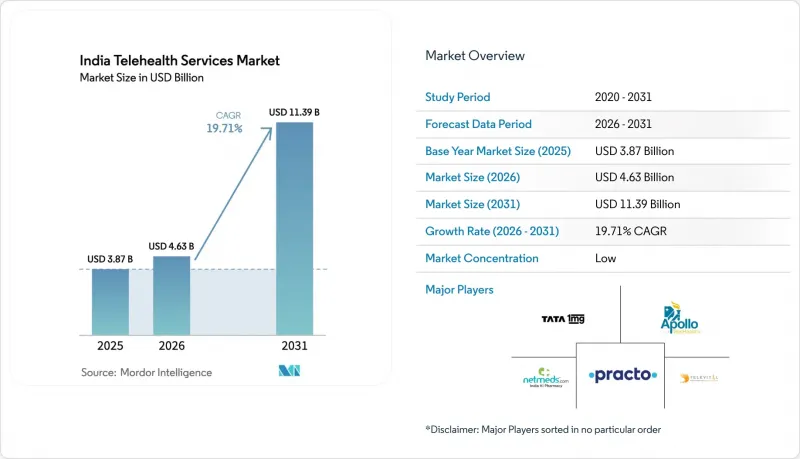
Mordor Intelligence에 따르면 2026년 인도의 원격의료 서비스 시장 규모는 46억 3,000만 달러로 추정되고 있으며, 2025년 38억 7,000만 달러에서 확대하며, 2031년에는 113억 9,000만 달러에 달할 것으로 예측됩니다.
2026-2031년의 연평균 성장률(CAGR)은 19.71%에 달할 것으로 전망됩니다.
이 보고서는 유형(서비스 및 소프트웨어), 기술(스토어 앤 포워드, 실시간, 기타), 용도(원격 정신과 진료, 일반 진료, 원격 방사선 진단 등), 최종사용자(의료 제공자, 환자 등), 제공 형태(음성·영상, 음성만 등)별로 분류되어 있습니다. 시장 예측은 금액(달러)으로 표시되어 있습니다.
인도 원격의료 서비스 시장의 동향 및 인사이트
정부의 원격의료 및 ABDM 추진
'아유슈만 바라트 디지털 미션(ABDM)'을 통해 단일 동의 기반 아키텍처 하에서 환자, 의료 제공자, 보험사를 연결하는 상호 운용 가능한 의료 데이터 인프라가 구축되었습니다. 현재 1,000개 이상의 민간 기업이 ABDM 인증을 획득했으며, 이를 통해 온라인 약국과 병원이 표준화된 API를 통해 데이터를 교환할 수 있게 되어 신규 진입자 개개인의 네트워크 효과가 향상되고 있습니다. eSanjeevani의 누적 3억 4,000만 건의 진료 실적은 정부가 지원하는 원격 진료 경로가 널리 받아들여지고 있음을 입증하고 있습니다. 2023년 디지털 개인 데이터 보호법 및 향후 제정될 규정은 법적 확실성을 제공하지만, 의료 제공자들은 여전히 동의 절차 및 정보 유출시 책임에 관한 상세한 지침을 요구하고 있습니다. 175,338곳의 ‘아유슈만 아로기야 만디르’에 원격의료 거점이 확대됨에 따라 라스트 마일(last mile)의 서비스 범위가 더욱 넓어지고 있습니다. 이러한 정책들이 맞물리면서 디지털 케어는 인도 원격의료 서비스 시장에서 주류 서비스 제공 채널로서의 입지를 공고히 하고 있습니다.
스마트폰과 광대역 인터넷 보급률의 급증
저렴한 가격의 스마트폰과 전국적인 4G/5G망 구축으로 영상 품질에 대한 기술적 제약이 해소되어 대도시권 이외의 지역에서도 실시간 진단이 가능해졌습니다. 모바일 우선 워크플로우를 통해 오프라인 진료소의 의사 부족 문제를 해결할 수 있게 됨에 따라 농촌 지역 주민들도 전문 의료 서비스를 더 신속하게 받을 수 있게 되었습니다. TatvaCare가 Microsoft Azure에서 16개 언어를 지원하는 사례에서 볼 수 있듯이, 현지 언어로된 인터페이스는 영어를 구사하지 못하는 사용자들에게 사용 편의성을 높여주고 있습니다. 원활한 UPI 결제를 통해 구매 시의 장벽이 제거되면서, 소비자 직판 모델이 활성화되고 있습니다. 웨어러블 기기와 연동되어 실시간 생체 신호가 클라우드 대시보드로 전송됨에 따라 의사는 더 조기에 개입할 수 있게 되어 입원 건수가 감소하고 있습니다. 이러한 기술적 요소들이 결합되어 인도 원격의료 서비스 시장 전반의 확산을 가속화하고 있습니다.
데이터 개인정보 보호 및 전자 약국 규제의 미비
‘디지털 개인 데이터 보호법’이 법적 기준을 규정하고는 있지만, 업계 고유의 규정은 여전히 미성숙한 단계에 머물러 있으며, 임상 현장에서의 동의 유효성에 대한 불확실성이 발생하고 있습니다. 전자 약국 면허 제도에 존재하는 이와 유사한 모호함은 악질적인 공급업체의 만행을 방치하여 소비자의 신뢰를 훼손하고 있습니다. 현재 병원은 IT 예산의 최대 10%를 사이버 보안에 할당하고 있지만, 공격은 끊이지 않고 있으며, 의료 업계는 인도에서 정보 유출 피해가 가장 많은 상위 5개 업계 중 하나로 꼽히고 있습니다. 통일된 인증 기준이 없어 소규모 원격 약국은 규정 준수 비용 부담으로 어려움을 겪고 있으며, 사업 규모 확대가 정체되어 있습니다. 이러한 과제들이 복합적으로 작용하여, 본래라면 활기를 띠고 있어야 할 인도의 원격의료 서비스 시장 성장을 둔화시키고 있습니다.
부문 분석
2025년 매출의 84.68%를 서비스가 차지하고 있으며, 인도 원격의료 서비스 시장이 플랫폼 중심이라는 특성을 여실히 보여주고 있습니다. 높은 수익률을 자랑하는 구독 모델을 통해 제공업체는 분기 단위가 아닌 몇 주 만에 기능을 업데이트할 수 있으며, 진화하는 ABDM API와의 호환성을 확보하고 있습니다. 소프트웨어의 연평균 성장률(CAGR) 20.38%는 원격의료 분야의 다양한 소프트웨어 솔루션에 대한 수요 증가를 반영하고 있습니다.
의료기기를 위한 생산 연계 인센티브(PLI) 제도는 국내 제조를 촉진하고, 수입 의존도를 낮추며, 공급망을 단축시키고 있습니다. 원활한 펌웨어 업데이트와 ISO-13485 준수를 통해 현지 OEM(Original Equipment Manufacturer)는 수출에 필요한 충분한 신뢰성을 확보하고 있습니다. 기기의 보급에 따라 첨단 분석 엔진이 여러 매개변수 스트림을 통합하여 임상의용 성과 기반 대시보드를 생성하는 동시에, 환자가 만성질환을 자가 관리할 수 있도록 지원하고 있습니다.
2025년, 인도의 원격의료 서비스 시장에서 실시간 플랫폼이 58.97%의 점유율을 차지했습니다. 이는 사용자들의 대면 상호작용 선호도와 급성 증례에서 필요한 동기식 진료의 임상적 필요성을 반영한 결과입니다. 한편, 연평균 성장률(CAGR) 20.12%로 확대되고 있는 ‘스토어 앤 포워드(Store-and-Forward)’ 방식의 워크플로는 특히 방사선과, 피부과, 병리학 분야에서 대역폭 효율화와 상세한 기록 작성을 실현하고 있습니다. 하이브리드형 트리아지 엔진은 긴급도, 사용 가능한 대역폭, 임상의의 업무 부하를 종합적으로 평가하는 AI 스코어링을 통해 최적의 진료 모드를 추천합니다.
5G로 인해 도시 지역의 네트워크 밀도가 높아짐에 따라 지연 시간은 안과에서 망막 영상 진단의 최소 허용 임계값 아래로 떨어져 거의 실시간으로 진단이 가능해집니다. 반면, 여전히 3G에 의존하고 있는 지역에서는 비동기 방식으로 전송되는 압축 DICOM 파일을 통해 전문의의 피드백 주기를 6시간 이내로 단축할 수 있습니다. 인도의 원격의료 서비스 시장에서 스토어 앤 포워드 방식이 차지하는 비중은 크게 확대될 것으로 예상되며, 비동기형 통신 방식은 라이브 영상의 경쟁상대가 아니라 필수적인 보완 수단으로서의 입지를 공고히 할 것입니다.
기타 혜택:
- 엑셀 형식의 시장 예측(ME) 시트
- 3개월간의 애널리스트 지원
자주 묻는 질문
목차
제1장 서론
제2장 조사 방법
제3장 개요
제4장 시장 구도
제5장 시장 규모와 성장 예측
제6장 경쟁 구도
제7장 시장 기회와 향후 전망
KSA 26.08.26According to Mordor Intelligence, India telehealth services market size in 2026 is estimated at USD 4.63 billion, growing from 2025 value of USD 3.87 billion with 2031 projections showing USD 11.39 billion, growing at 19.71% CAGR over 2026-2031.
This report is Segmented by Type (Services and Software), Technology (Store and Forward, Real Time, and Others), Application (Tele-Psychiatry, General Consultations, Tele-Radiology, and More), End-User (Providers, Patients, and More), Delivery Mode (Audio-Visual, Audio Only, and More). The Market Forecasts are Provided in Terms of Value (USD).
India Telehealth Services Market Trends and Insights
Government Telemedicine and ABDM Push
The Ayushman Bharat Digital Mission has created an interoperable health-data backbone that links patients, providers, and payers under a single consent-driven architecture. More than 1,000 private firms are now ABDM-certified, letting e-pharmacies and hospitals exchange data through standardized APIs, which boosts network effects for every new participant. eSanjeevani's 340 million cumulative consultations prove mass acceptance of government-backed teleconsultation pathways. The Digital Personal Data Protection Act 2023 and its forthcoming rules offer legal certainty, yet providers still seek granular guidance around consent flows and breach liabilities. Expanded telemedicine nodes at 175,338 Ayushman Arogya Mandirs further widen the last-mile footprint. Collectively, these policies cement digital care as a mainstream delivery channel within the India telehealth services market.
Smartphone and Broadband Penetration Surge
Affordable handsets and nationwide 4G/5G rollout lift the technical ceiling on video quality, making real-time diagnostics viable outside metros. Rural residents gain faster access to specialty care because mobile-first workflows bypass the scarcity of brick-and-mortar clinicians. Vernacular interfaces boost usability among non-English speakers, as illustrated by TatvaCare's 16-language deployment on Microsoft Azure. Seamless UPI payments remove purchasing friction, allowing direct-to-consumer models to flourish. Wearable integrations feed real-time vitals into cloud dashboards, letting physicians intervene earlier and reducing hospital admissions. These technology layers collectively accelerate adoption across the India telehealth services market.
Data-Privacy and E-Pharmacy Regulation Gaps
While the Digital Personal Data Protection Act lays a statutory baseline, sector-specific rules remain nascent, creating uncertainty over consent validity in clinical contexts. Parallel ambiguity in e-pharmacy licensing enables rogue vendors, eroding consumer trust. Hospitals now allocate up to 10% of IT budgets to cybersecurity, yet attacks persist, with healthcare ranking among India's top five breached sectors. Absent a unified accreditation standard, smaller tele-pharmacies struggle to meet compliance costs, stalling scale. These gaps collectively shave growth from the otherwise buoyant India telehealth services market.
Other drivers and restraints analyzed in the detailed report include:
- Growing Chronic Disease Burden
- Vernacular AI Triage Bots Rollout
- Low Digital Literacy Among Rural Elderly
For complete list of drivers and restraints, kindly check the Table Of Contents.
Segment Analysis
Services represented 84.68% of 2025 revenue, underscoring the platform-centric nature of the India telehealth services market. High-margin subscription models let providers update features in weeks rather than quarters, ensuring alignment with evolving ABDM APIs. Software's 20.38% CAGR reflects growing demand for various software solutions in telehealth.
The production-linked incentive (PLI) scheme for medical devices boosts domestic manufacturing, reducing import dependence and shortening supply chains. Seamless firmware updates and ISO-13485 compliance give local OEMs export-ready credibility. As devices proliferate, advanced analytics engines synthesize multi-parameter streams, generating outcome-based dashboards for clinicians and empowering patients to self-manage chronic conditions.
Real-time platforms held 58.97% of the India telehealth services market share in 2025, reflecting user preference for face-to-face interaction and the clinical necessity of synchronous examination in acute cases. Yet store-and-forward workflows, expanding at 20.12% CAGR, offer bandwidth efficiency and richer documentation, especially for radiology, dermatology, and pathology. Hybrid triage engines recommend the optimal mode via AI scoring that weighs urgency, available bandwidth, and clinician workload.
As 5G densifies urban clusters, latency falls below ophthalmology's minimum threshold for retinal imaging, enabling near-real-time diagnostics. Conversely, in regions still reliant on 3G, compressed DICOM files sent asynchronously keep specialist feedback cycles under 6 hours. The India telehealth services market size contribution from store-and-forward is projected to climb substantially, cementing asynchronous modalities as a vital complement rather than a competitor to live video.
Complete Report Scope:
- By Type
- Services
- Software
- By Technology
- Store and Forward
- Real-Time
- Others
- By Application
- Tele-Psychiatry
- General Consultations
- Tele-Radiology
- Tele-Pathology
- Tele-Dermatology
- Others
- By End-User
- Providers
- Patients
- Payers
- Others
- By Delivery Mode
- Audio-Visual
- Audio Only
- Text / Written
List of Companies Covered in this Report:
- Apollo TeleHealth Services
- Tata 1mg Healthcare Solutions
- Practo Technologies
- Netmeds Marketplace
- Medibuddy
- MFine
- DocOnline Health India
- Portea Medical
- Cloudphysician Healthcare
- Lybrate India
- Remedo Clinitech
- Cure.fit (Cult.fit)
- eSanjeevani (MoHFW/C-DAC)
- DocPrime Technologies
- Dhanush Digital Healthcare
- Novocura Tech Health Services
- TeleVital
- Netdox Health
- CallHealth Services
- HealthPlix Technologies
Additional Benefits:
- The market estimate (ME) sheet in Excel format
- 3 months of analyst support
TABLE OF CONTENTS
1 Introduction
- 1.1 Study Assumptions & Market Definition
- 1.2 Scope of the Study
2 Research Methodology
3 Executive Summary
4 Market Landscape
- 4.1 Market Overview
- 4.2 Market Drivers
- 4.2.1 Smartphone and Broadband Penetration Surge
- 4.2.2 Government Telemedicine and ABDM Push
- 4.2.3 Growing Chronic Disease Burden
- 4.2.4 Tier-2/3 Digital-Payment Adoption
- 4.2.5 Vernacular AI Triage Bots Rollout
- 4.2.6 ONDC Integration for Telehealth
- 4.3 Market Restraints
- 4.3.1 Data-Privacy and E-Pharmacy Regulation Gaps
- 4.3.2 Low Digital Literacy Among Rural Elderly
- 4.3.3 Doctor Attrition Over Payment Delays
- 4.3.4 Rising Cyber-Insurance Premiums
- 4.4 Regulatory Landscape
- 4.5 Technological Outlook
- 4.6 Porter's Five Forces Analysis
- 4.6.1 Threat of New Entrants
- 4.6.2 Bargaining Power of Buyers
- 4.6.3 Bargaining Power of Suppliers
- 4.6.4 Threat of Substitutes
- 4.6.5 Intensity of Competitive Rivalry
5 Market Size & Growth Forecasts (Value)
- 5.1 By Type
- 5.1.1 Services
- 5.1.2 Software
- 5.2 By Technology
- 5.2.1 Store and Forward
- 5.2.2 Real-Time
- 5.2.3 Others
- 5.3 By Application
- 5.3.1 Tele-Psychiatry
- 5.3.2 General Consultations
- 5.3.3 Tele-Radiology
- 5.3.4 Tele-Pathology
- 5.3.5 Tele-Dermatology
- 5.3.6 Others
- 5.4 By End-User
- 5.4.1 Providers
- 5.4.2 Patients
- 5.4.3 Payers
- 5.4.4 Others
- 5.5 By Delivery Mode
- 5.5.1 Audio-Visual
- 5.5.2 Audio Only
- 5.5.3 Text / Written
6 Competitive Landscape
- 6.1 Market Concentration
- 6.2 Market Share Analysis
- 6.3 Company Profiles (includes Global level Overview, Market level overview, Core Segments, Financials as available, Strategic Information, Market Rank/Share for key companies, Products & Services, and Recent Developments)
- 6.3.1 Apollo TeleHealth Services
- 6.3.2 Tata 1mg Healthcare Solutions
- 6.3.3 Practo Technologies
- 6.3.4 Netmeds Marketplace
- 6.3.5 Medibuddy
- 6.3.6 MFine
- 6.3.7 DocOnline Health India
- 6.3.8 Portea Medical
- 6.3.9 Cloudphysician Healthcare
- 6.3.10 Lybrate India
- 6.3.11 Remedo Clinitech
- 6.3.12 Cure.fit (Cult.fit)
- 6.3.13 eSanjeevani (MoHFW/C-DAC)
- 6.3.14 DocPrime Technologies
- 6.3.15 Dhanush Digital Healthcare
- 6.3.16 Novocura Tech Health Services
- 6.3.17 TeleVital
- 6.3.18 Netdox Health
- 6.3.19 CallHealth Services
- 6.3.20 HealthPlix Technologies
7 Market Opportunities & Future Outlook
- 7.1 White-space & Unmet-Need Assessment


