

|
시장보고서
상품코드
2116870
선형 저밀도 폴리에틸렌(LLDPE) 시장 : 시장 점유율 분석, 업계 동향 및 통계, 성장 예측(2026-2031년)Linear Low-Density Polyethylene (LLDPE) - Market Share Analysis, Industry Trends & Statistics, Growth Forecasts (2026 - 2031) |
||||||
 Mordor Intelligence
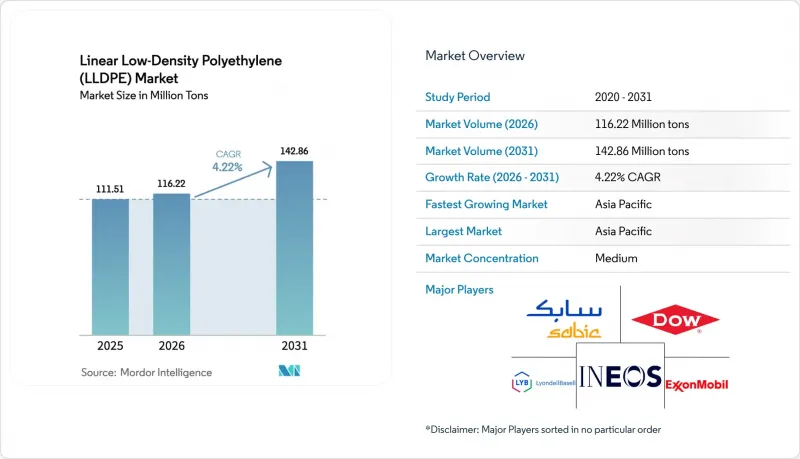
선형 저밀도 폴리에틸렌(LLDPE) 시장 규모는 2025년에 1억 1,151만 톤으로 평가되었고, 2026년 1억 1,622만 톤에서 2031년까지 1억 4,286만 톤에 이를 것으로 추정되며, 2026-2031년 CAGR 4.22%의 성장이 전망되고 있습니다.
본 보고서는 용도별(필름, 성형, 사출 성형, 기타 용도), 최종 사용자 산업별(농업, 전기 및 전자, 포장, 건설, 기타 최종 사용자 산업), 지역별(아시아태평양, 북미, 유럽, 남미, 중동 및 아프리카)로 분류되어 있습니다. 시장 전망은 수량(톤) 기준으로 제시되어 있습니다.
세계의 선형 저밀도 폴리에틸렌(LLDPE) 시장 동향 및 인사이트
포장 식품용 필름 수요 증가
스낵 및 즉석식품의 연포장재는 경질 용기에서 경량 파우치로 전환되고 있으며, 메탈로센 수지를 활용한 박막화를 통해 밀봉 강도를 유지하면서 수지 사용량을 90% 가까이 절감하고 있습니다. 2024년에 엑슨모빌이 출시한 ‘Exceed XP 7’ 등급은 밀도가 0.912 g/cc에 가까운 상태에서 더트 충격값 900 g,천공 에너지 2.3 J/밀을 달성하여, 가공업체는 차단 성능을 저해하지 않으면서 필름 두께를 15%-20% 얇게 만들 수 있습니다. 이러한 성능의 비약적인 향상은 2024년 폴리에틸렌 수요가 전년 대비 20% 증가했고, 매립지 공간이 제한적인 인도에서 매우 중요합니다. 스탠드업 파우치 적용에 있어서는 LDPE보다 LLDPE가 선호됩니다. 이는 단쇄 분지 구조 덕분에 고속 성형·충진·밀봉(FFS) 라인에서 뛰어난 핫택 강도를 얻을 수 있기 때문입니다. 아시아 전역에서 중산층의 식품 지출이 증가하는 가운데, 브랜드 소유자들은 LLDPE의 박막화 능력을 비용 절감과 지속가능성이라는 두 가지 목표를 모두 달성하기 위한 주요 수단으로 보고 있습니다.
전자상거래용 스트레치/수축 필름의 급증
세계 온라인 소매 시장은 계속해서 GDP 성장률을 상회하며, 팔레트 포장 및 소포 보호 사양 개선에 대한 수요를 견인하고 있습니다. 메탈로센계 LLDPE가 배합된 스트레치 필름은 밀착성과 내천자성을 극대화하여, 직접적인 재료비를 상회하는 화물 안정성에 대한 요구를 충족시키고 있습니다. 리요넬바셀(LyonellBasell)은 AFA Nord와의 2023년 합작 투자를 통해, 확대 생산자 책임(EPR) 규정에 따라 2026년까지 연간 5만 톤의 재생 LLDPE 및 LDPE 연포장재 생산을 목표로 하고 있습니다. 2024년 하반기 북동아시아 크래커의 마진이 마이너스로 돌아섰음에도 불구하고, 스트레치 필름의 소비량은 소포 처리량과 거의 완벽한 상관관계를 보이기 때문에 견조한 모습을 유지했습니다. 또한 소매업체들도 염소계 폴리머를 배제하고 재활용 수율을 높이기 위해 음료 및 전자제품의 수축 포장 분야에서 PVC에서 LLDPE 블렌드로의 전환을 추진하고 있습니다.
강도 향상을 위한 m-LLDPE/HDPE로의 전환
메탈로센계 LLDPE 및 HDPE는 높은 내천자성과 강성을 갖추고 있어 10%-15%의 가격 프리미엄이 붙어 있으며, 튼튼한 봉투나 산업용 라이너 분야에서 기존 등급을 대체하고 있습니다. 엑슨모빌의 데이터에 따르면, C6-메탈로센 LLDPE는 분자량 분포가 좁기 때문에 밀봉 개시 온도가 낮아져 고속 라인에서 발생하는 트림 폐기물이 감소합니다. HDPE의 뛰어난 환경 응력 균열 저항성은 화학 약품 용기나 IBC에 적합하며, 가공업체가 설비를 재구성할 수 있는 북미와 유럽에서는 LLDPE 시장 점유율을 잠식하고 있습니다. 구형 압출기를 사용하는 신흥 시장에서는 여전히 비용 중시 경향이 강해, 대체 효과의 진전은 더딘 임베디드니다.
부문 분석
2025년에는 필름이 전 세계 생산량의 62.89%를 차지했습니다. 이는 가공업체들이 밀봉 강도를 저해하지 않으면서도 박막화를 가능하게 하는 메탈로센 계열 등급을 선호했기 때문입니다. 메탈로센계 촉매 시스템은 핫택 강도를 향상시키고, 다층 스탠드업 파우치의 생산 라인 속도를 높이는 동시에, 패키지당 총 재료 소비량을 줄일 수 있게 해줍니다. 각 스트레치 필름 제조업체들은 팔레트당 수지 사용량을 최대 50%까지 줄여주는 프리 스트레치 롤을 채택하고 있으며, 이를 통해 LLDPE가 공급망의 지속가능성 프로그램에 더욱 통합되고 있습니다. 염소 관련 폐기물 처리 책임으로 인해 PVC가 기피되는 가운데, 전자기기 포장에 특수 수축 필름의 채택이 진행되고 있습니다.
기타 용도 분야의 경우, 2031년까지 시장 평균을 상회하는 연평균 성장률(CAGR) 5.68%를 나타낼 것으로 예측됩니다. 이러한 특수 용도에서 선형 저밀도 폴리에틸렌(LLDPE) 시장 점유율은 여전히 소규모이지만, 그 가치 제안은 점차 높아지고 있습니다. 회전 성형된 저수 탱크는 누수 지점을 제거하는 LLDPE의 일체형 성형 구조를 활용하여 아프리카의 Off-grid 지역 사회에서 보급이 확대되고 있습니다. 가전제품 포장용 초경량 보호 폼도 새로운 성장 분야로 부상하고 있습니다. 이는 마이크로 스케일의 두께에서도 유연성을 유지하는 초박형 폴리에틸렌 시트의 제조 방법이 『Nature』지에 보고된 것이 뒷받침되고 있습니다. 반도체 물류 분야에서는 정전기 방지 필름에 대한 수요가 증가하고 있으며, 이 틈새 시장에서 전도성 첨가제와 혼합되었을 때 LLDPE 특유의 낮은 표면 저항률이 유리하게 작용하고 있습니다.
지역별 분석
아시아태평양은 2025년 세계 생산량의 46.10%를 차지했으며, 2031년까지 연평균 성장률(CAGR) 5.07%를 나타낼 것으로 예측됩니다. 중국에서는 2025년에 연간 500만 톤(t/y), 2026년에 650만 t/y 규모의 폴리에틸렌 생산 능력이 가동에 들어감에 따라 수입 수요는 연평균 30만 t/y로 축소될 것이며, 중동 및 미국에서 들어오는 화물은 인도네시아, 베트남,필리핀으로 흘러가게 될 것입니다. 인도에서는 석유화학제품 수요가 연평균 7%로 증가하고 있으며, 잠나가르로의 원료 공급을 확보하기 위한 ‘가상 에탄 파이프라인’ 확장을 배경으로, 향후 3년 동안 연간 240만 톤의 생산 능력이 가동될 것으로 전망됩니다. 일본과 한국은 시장이 성숙한 상태이긴 하지만, 농업용 필름과 같은 틈새 시장에 대응하기 위해, 또한 수입 에탄을 통합함으로써 나프타 가격 변동 위험을 헤지하기 위해 촉매 기술 업그레이드를 추진하고 있습니다.
북미는 에탄을 원료로 사용하는 비용 면에서의 우위 덕분에 여전히 수급 조절자로서의 지위를 유지하고 있습니다. 보레알리스(Borealis)사는 연산 64만 톤 규모의 베이스타(Baystar) 공장을 가동하여 멕시코만 연안의 수출 터미널로의 신속한 접근을 확보했습니다. 엑슨모빌(ExxonMobil)은 포인트 컴포트(Point Comfort)에 86억 달러 규모의 복합 시설 건설을 계속 검토하고 있는 반면, 프랑스 그라브종(Gravillon)에 있는 연간 40만 톤 규모의 생산 라인을 폐쇄하여 대륙 간 원료 경제성의 차이가 두드러지고 있습니다. USMCA(미국-멕시코-캐나다 협정)에 따라 멕시코의 재수출 역할은 확대되고 있지만, 캐나다의 성장은 앨버타주 및 온타리오주에서 신규 석유화학 플랜트 허가에 대한 장벽으로 인해 제약을 받고 있습니다. 유럽에서는 높은 에너지 비용과 엄격한 환경 규제를 배경으로 생산 능력이 축소되고 있습니다. SABIC은 연간 생산량 40만 톤 규모의 헤렌 크래커를 폐쇄했으며, 리온델바셀은 재활용 및 바이오 수지 사업에 집중하기 위해 70억-90억 달러 규모의 자산 매각을 검토하고 있습니다. 그럼에도 불구하고 이 지역은 순환형 경제의 혁신을 주도하고 있습니다. 리욘델바셀의 연포장재 재활용 사업은 2026년까지 연간 5만 톤 처리를 목표로 하고 있으며, 유럽을 화학 재활용의 기술 거점으로 자리매김하고 있습니다. 남미 및 중동 및 아프리카는 성장의 새로운 전초기지가 되고 있습니다. 브라스켐(Braskem)은 리우데자네이루의 복합 시설을 연간 생산량 54만 톤을 초과하는 규모로 확장하기 위한 가스 공급 협상을 진행 중이며, 한편,보레알리스사의 아부다비 연간 140만 톤 폴리에틸렌 프로젝트는 기계적 완공까지 절반 이상이 진행되었으며, 아시아 및 아프리카의 가공업체에 대한 저비용 공급이 확보되었습니다.
기타 혜택 :
- 엑셀 형식 시장 예측(ME) 시트
- 3개월간의 애널리스트 지원
자주 묻는 질문
목차
제1장 서론
제2장 조사 방법
제3장 개요
제4장 시장 구도
제5장 시장 규모 및 성장 예측
제6장 경쟁 구도
제7장 시장 기회 및 향후 전망
AJY 26.09.01According to Mordor Intelligence, the linear low-Density polyethylene market size was valued at 111.51 million tons in 2025 and estimated to grow from 116.22 million tons in 2026 to reach 142.86 million tons by 2031, at a CAGR of 4.22% during the forecast period (2026-2031).
This report is Segmented by Application (Films, Molding, Injection Molding, and Other Application Types), End-User Industry (Agriculture, Electrical and Electronics, Packaging, Construction, and Other End-User Industries), and Geography (Asia-Pacific, North America, Europe, South America, and Middle East and Africa). The Market Forecasts are Provided in Terms of Volume (tons).
Global Linear Low-Density Polyethylene (LLDPE) Market Trends and Insights
Escalating Packaged-Food Film Demand
Flexible snack and ready-meal packaging is shifting from rigid to lightweight pouches, trimming resin use by nearly 90% while preserving seal integrity through metallocene-enabled downgauging. ExxonMobil's Exceed XP 7 grade introduced in 2024 delivers dart-impact values of 900 g and puncture energy reaching 2.3 J per mil at densities near 0.912 g/cc, allowing converters to thin film gauges by 15%-20% without sacrificing barrier performance. The performance leap is crucial in India, where polyethylene demand increased by 20% year-over-year in 2024 and landfill space is limited. Stand-up pouch adoption favors LLDPE over LDPE because short-chain branching supplies superior hot-tack strength for high-speed form-fill-seal lines. As middle-class food spending rises throughout Asia, brand owners view LLDPE's downgauging capability as the primary lever for both cost and sustainability goals.
E-commerce Stretch-/Shrink-Film Surge
Global online retail continues to outpace GDP, driving the need for enhanced pallet-wrap and parcel-protection specifications. Stretch film incorporating metallocene LLDPE maximizes cling and puncture resistance, addressing load-stability demands that outweigh direct material costs. LyondellBasell's 2023 venture with AFA Nord aims to produce 50,000 t/y of recycled LLDPE and LDPE flexible packaging by 2026, in line with extended producer responsibility rules. Although Northeast Asian cracker margins turned negative in late 2024, stretch-film consumption showed resilience due to its near-perfect correlation with parcel volumes. Retailers are also migrating from PVC to LLDPE blends for beverage and electronics shrink-bundling to eliminate chlorinated polymers and improve recycling yields.
Shift Toward m-LLDPE/HDPE for Strength
Metallocene LLDPE and HDPE command 10%-15% price premiums by delivering higher puncture resistance and stiffness, displacing conventional grades in heavy-duty sacks and industrial liners. ExxonMobil's data show that C6-metallocene LLDPE provides narrower molecular-weight distributions, which lower seal-initiation temperatures and reduce trim waste on high-speed lines. HDPE's superior environmental stress-crack resistance favors chemical containers and IBCs, drawing share away from LLDPE in North America and Europe where converters can reconfigure equipment. Emerging markets with legacy extruders remain cost-sensitive, slowing the substitution effect.
Other drivers and restraints analyzed in the detailed report include:
- Solar-Panel Encapsulation Film Uptake
- Downgauging and Circular-Economy Mandates
- Volatile Naphtha/Ethane Feedstock Cost
For complete list of drivers and restraints, kindly check the Table Of Contents.
Segment Analysis
Films represented 62.89% of the global volume in 2025, as converters favored metallocene grades that enabled thinner gauges without compromising seal integrity. Metallocene catalyst systems provide enhanced hot-tack strength, enabling multilayer stand-up pouches to operate at higher line speeds and reduce total material consumption per package. Stretch-film producers are adopting pre-stretched rolls that reduce resin usage per pallet by up to 50%, further integrating LLDPE into supply-chain sustainability programs. Specialty shrink-film adoption in electronics bundling is advancing as PVC falls out of favor due to chlorine-related disposal liabilities.
Other application types are forecast to grow at a market-leading 5.68% CAGR through 2031. The Linear Low-Density Polyethylene market share of these specialty applications remains modest, yet the value proposition is rising. Rotomolded water tanks are gaining traction in off-grid African communities, leveraging LLDPE's one-piece construction that eliminates leak points. Ultralight protective foams for consumer electronics packaging are another emerging outlet, supported by a method reported in Nature for producing ultrathin polyethylene sheets that preserve flexibility at micro-scale thicknesses. Semiconductor logistics are stimulating demand for antistatic films, a niche that benefits from LLDPE's inherently low surface resistivity when compounded with conductive additives.
Complete Report Scope:
- By Application
- Films
- Molding
- Injection Molding
- Other Application Types
- By End-user Industry
- Agricultute
- Electrical and Electronics
- Packaging
- Constrution
- Other End-user Industries
- By Geography
- Asia-Pacific
- China
- India
- Japan
- South Korea
- ASEAN Countries
- Rest of Asia-Pacific
- North America
- United States
- Canada
- Mexico
- Europe
- Germany
- United Kingdom
- Italy
- France
- Russia
- Rest of Europe
- South America
- Brazil
- Argentina
- Rest of South America
- Middle-East and Africa
- Saudi Arabia
- South Africa
- Rest of Middle-East and Africa
- Asia-Pacific
Geography Analysis
The Asia-Pacific region accounted for 46.10% of the global 2025 volume and is expected to deliver a 5.07% CAGR through 2031. China's commissioning of 5 million tonnes per year (t/y) of polyethylene capacity in 2025 and 6.5 million t/y in 2026 will narrow its import requirement to an average of 300,000 t/y, redirecting Middle Eastern and US cargoes toward Indonesia, Vietnam, and the Philippines. India is expected to bring 2.4 million tonnes per year online over the next three years, driven by 7% annual growth in petrochemical demand and an expanded virtual ethane pipeline that secures feedstock for Jamnagar. Japan and South Korea, while mature, are upgrading catalyst technology to serve agricultural-film niches and to hedge against naphtha volatility by integrating imported ethane.
North America remains a swing supplier thanks to ethane-based cost advantages. Borealis started up its 640,000 t/y Baystar unit and gained rapid access to Gulf export terminals. ExxonMobil continues to evaluate a USD 8.6 billion complex in Point Comfort, yet the company shuttered its 400,000 tonnes per year Gravenchon line in France, highlighting the continental divergence in feedstock economics. Mexico's re-export role is expanding under USMCA, while Canada's growth is capped by permitting hurdles for greenfield petrochemical sites in Alberta and Ontario. Europe is contracting capacity amid high energy costs and stringent environmental rules. SABIC closed its 400,000 t/y Geleen cracker, and LyondellBasell is exploring USD 7-9 billion in asset divestitures to focus on recycling and bio-based resins. Nonetheless, the region leads circular-economy innovation; LyondellBasell's flexible-packaging recycling venture targets 50,000 t/y by 2026, positioning Europe as a technology hub for chemical recycling. South America and the Middle East-Africa represent growth frontiers. Braskem is negotiating gas supply to expand its Rio complex beyond 540,000 t/y, while Borealis's 1.4 million t/y polyethylene project in Abu Dhabi is more than halfway to mechanical completion, assuring low-cost supply to Asian and African converters.
- Borealis GmbH
- Braskem
- Chevron Phillips Chemical Company
- Dow
- Exxon Mobil Chemical
- Formosa Plastic Corporation
- INEOS
- LG Chem
- Lyonde Bassells Industries Holdings BV
- Mitsui Chemicals Inc.
- Nova Chemicals Corporate
- PTT Global Chemical Public Company Limited.
- Reliance Industries Limited
- Repsol
- SABIC
- SINOPEC (China Petroleum & Chemical Corporation)
- Tasnee
- TotalEnergies
- Westlake Corporation
Additional Benefits:
- The market estimate (ME) sheet in Excel format
- 3 months of analyst support
TABLE OF CONTENTS
1 Introduction
- 1.1 Study Assumptions
- 1.2 Scope of the Study
2 Research Methodology
3 Executive Summary
4 Market Landscape
- 4.1 Market Overview
- 4.2 Market Drivers
- 4.2.1 Escalating packaged-food film demand
- 4.2.2 E-commerce stretch-/shrink-film surge
- 4.2.3 Solar-panel encapsulation film uptake
- 4.2.4 Downgauging and circular-economy mandates
- 4.2.5 Agricultural mulch and greenhouse films
- 4.3 Market Restraints
- 4.3.1 Shift toward m-LLDPE/HDPE for strength
- 4.3.2 Volatile naphtha/ethane feedstock cost
- 4.3.3 Global single-use-plastic restrictions
- 4.4 Value Chain Analysis
- 4.5 Porter's Five Forces
- 4.5.1 Bargaining Power of Suppliers
- 4.5.2 Bargaining Power of Buyers
- 4.5.3 Threat of New Entrants
- 4.5.4 Threat of Substitutes
- 4.5.5 Degree of Competition
5 Market Size & Growth Forecasts (Volume)
- 5.1 By Application
- 5.1.1 Films
- 5.1.2 Molding
- 5.1.3 Injection Molding
- 5.1.4 Other Application Types
- 5.2 By End-user Industry
- 5.2.1 Agricultute
- 5.2.2 Electrical and Electronics
- 5.2.3 Packaging
- 5.2.4 Constrution
- 5.2.5 Other End-user Industries
- 5.3 By Geography
- 5.3.1 Asia-Pacific
- 5.3.1.1 China
- 5.3.1.2 India
- 5.3.1.3 Japan
- 5.3.1.4 South Korea
- 5.3.1.5 ASEAN Countries
- 5.3.1.6 Rest of Asia-Pacific
- 5.3.2 North America
- 5.3.2.1 United States
- 5.3.2.2 Canada
- 5.3.2.3 Mexico
- 5.3.3 Europe
- 5.3.3.1 Germany
- 5.3.3.2 United Kingdom
- 5.3.3.3 Italy
- 5.3.3.4 France
- 5.3.3.5 Russia
- 5.3.3.6 Rest of Europe
- 5.3.4 South America
- 5.3.4.1 Brazil
- 5.3.4.2 Argentina
- 5.3.4.3 Rest of South America
- 5.3.5 Middle-East and Africa
- 5.3.5.1 Saudi Arabia
- 5.3.5.2 South Africa
- 5.3.5.3 Rest of Middle-East and Africa
- 5.3.1 Asia-Pacific
6 Competitive Landscape
- 6.1 Market Concentration
- 6.2 Strategic Moves
- 6.3 Market Share(%)/Ranking Analysis
- 6.4 Company Profiles {(includes Global level Overview, Market level overview, Core Segments, Financials as available, Strategic Information, Market Rank/Share, Products & Services, Recent Developments)}
- 6.4.1 Borealis GmbH
- 6.4.2 Braskem
- 6.4.3 Chevron Phillips Chemical Company
- 6.4.4 Dow
- 6.4.5 Exxon Mobil Chemical
- 6.4.6 Formosa Plastic Corporation
- 6.4.7 INEOS
- 6.4.8 LG Chem
- 6.4.9 Lyonde Bassells Industries Holdings BV
- 6.4.10 Mitsui Chemicals Inc.
- 6.4.11 Nova Chemicals Corporate
- 6.4.12 PTT Global Chemical Public Company Limited.
- 6.4.13 Reliance Industries Limited
- 6.4.14 Repsol
- 6.4.15 SABIC
- 6.4.16 SINOPEC (China Petroleum & Chemical Corporation)
- 6.4.17 Tasnee
- 6.4.18 TotalEnergies
- 6.4.19 Westlake Corporation
7 Market Opportunities and Future Outlook
- 7.1 White-space and Unmet-Need Assessment


