

|
시장보고서
상품코드
2116942
HTP(High Throughput Process) 개발 : 시장 점유율 분석, 업계 동향과 통계, 성장 예측(2026-2031년)High Throughput Process Development - Market Share Analysis, Industry Trends & Statistics, Growth Forecasts (2026 - 2031) |
||||||
 Mordor Intelligence
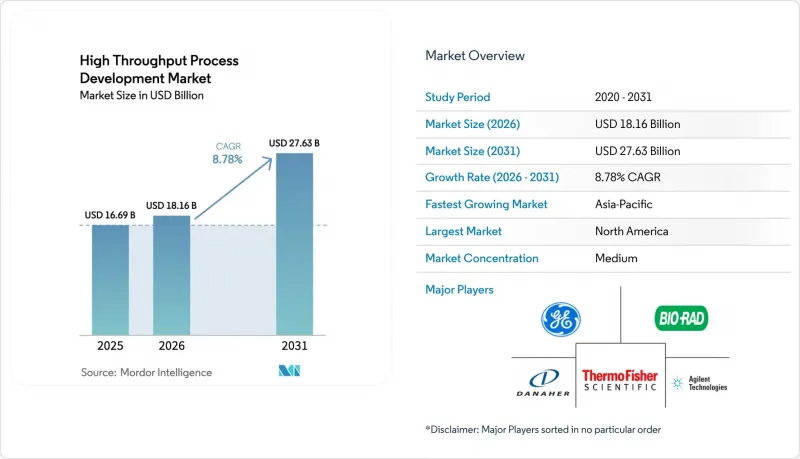
Mordor Intelligence에 따르면 2026년 HTP(High Throughput Process) 개발 시장의 규모는 181억 6,000만 달러로 추정되고 있으며, 2025년 166억 9,000만 달러에서 성장하며, 2031년에는 276억 3,000만 달러에 달할 것으로 예측됩니다.
2026-2031년의 연평균 성장률(CAGR)은 8.78%에 달할 것으로 전망됩니다.
이 보고서에서는 업계를 제품 유형(소모품, 장비, 서비스, 소프트웨어), 기술(크로마토그래피 등), 최종사용자(바이오의약품·바이오기술 기업 등), 지역(북미, 유럽, 아시아태평양, 중동 및 아프리카, 남미)별로 분류하고 있습니다. 시장 전망은 금액(달러) 기준으로 제시되어 있습니다.
글로벌 고처리량 공정 개발 시장의 동향 및 인사이트
차세대 바이오의약품에 대한 수요 가속화
FDA는 2024년에 몇 가지 유전자 치료 및 세포 치료를 포함한 33개의 신규 생물제제를 승인하여 치료 파이프라인의 급속한 진화를 부각시켰습니다. 복잡한 치료법에는 병렬 실험이 가능한, 더 소형이고 구성이 변경 가능한 개발 플랫폼이 필요하며, 이로 인해 고처리량 바이오리액터 어레이의 도입이 확대되고 있습니다. 유연한 시설을 통해 제조업체는 장시간의 전환 작업 없이 소량 생산의 맞춤형 치료와 대규모 상업 생산을 전환할 수 있게 됩니다. 각 기업은 차세대 항체 전용 모듈식 공장을 건설하고 있으며, 교와 키린이 노스캐롤라이나주에 건설 중인 5억 3,000만 달러 규모의 시설이 그 예입니다. 이러한 투자를 통해 개발 주기가 단축되고 원자재 낭비가 줄어들기 때문에 마이크로스케일 스크리닝 툴의 도입이 촉진되고 있습니다.
바이오 제조 분야의 비용 압박
의료제도에 따른 가격 규제와 격화되는 바이오시밀러 경쟁으로 인해 이익률은 계속해서 압박을 받고 있으며, 기업은 공정 집약화 및 아웃소싱으로 내몰리고 있습니다. 연속식 바이오 프로세싱 플랫폼은 플랜트의 설치 면적과 유틸리티 비용을 절감하는 한편, 아시아의 CDMO에 대한 전략적 업무 위탁은 자본 위험을 낮춥니다. WuXi나 삼성 등의 기업은 지역의 비용 우위를 활용하여 전 세계 수요에 부응하기 위해 포유류 세포배양 및 항체-약물 접합체(ADC)용 생산 라인을 확충하고 있습니다. 감시 제어 시스템에 통합된 인공지능(AI) 엔진은 자원 활용률을 두 자릿수 비율로 향상시키고, 실시간 비용 관리를 지원합니다. 일회용 부품은 자재비가 비싸지만, 세척 검증 비용을 절감하고 다중 제품 라인에서의 교차 오염 위험을 낮춥니다.
막대한 설비 투자 및 인프라 수요
포괄적인 고처리량 공정 개발 센터를 설립하려면 설비, 클린룸, 분석 장비에 5,000만-1억 달러가 필요할 수 있습니다. 여러 규제 체계를 준수해야 하므로 검증 및 문서화에 드는 비용도 추가로 발생합니다. 모듈형 플랜트 개념에서는 건설을 단계적으로 진행할 수 있는 개별 스키드로 분할함으로써 위험을 완화합니다. Resilience사는 서로 다른 모달리티로 신속하게 재구성할 수 있는 모듈형 의약품 제조 복합 시설에 2억 2,500만 달러를 배정했습니다. 클라우드 기반 데이터 환경은 온프레미스 IT 비용을 절감하지만, 사이버 보안 및 적합성 평가에 드는 간접비는 여전히 존재하므로 소규모 신생 기업의 시장 진입을 제한하고 있습니다.
부문 분석
소프트웨어 분야는 실시간 분석 및 디지털 트윈에 대한 수요 증가를 배경으로 연평균 성장률(CAGR) 11.42%로 성장하고 있으며, 고처리량 공정 개발 시장에서 가장 빠르게 확대되고 있는 분야입니다. 소모품은 신속한 설정에 필수적인 일회용 백,필터, 프리팩 컬럼이 계속해서 수요를 지원하고 있으며, 2025년에도 고처리량 공정 개발 시장에서 42.78%의 점유율을 유지했습니다. 장비 분야는 워크플로우 효율화를 지원하는 자동 액체 핸들러와 멀티컬럼 크로마토그래피 스키드를 통해 꾸준한 성장을 유지하고 있습니다. 기업이 전문적인 통계 모델링, 케모메트릭스, 검증 업무를 외부에 위탁하고 자본을 핵심 자산에 집중시키는 경향이 강해지고 있으며, 서비스의 매력이 높아지고 있습니다.
디지털 플랫폼은 분산된 데이터 소스를 통합하고, 머신러닝 모델을 적용하여 매개변수를 최적화하며, 전 세계에 흩어진 팀 간의 원격 협업을 가능하게 합니다. 소프트웨어 보증에 관한 규제 지침으로 인해 알고리즘의 투명성에 대한 기대가 명확해지면서 도입에 대한 주저함이 줄어들고 있습니다. 소프트웨어 애플리케이션용 고처리량 공정 개발 시장의 규모는 제어 알고리즘이 상류 공정과 하류 공정의 운영을 거의 실시간으로 조정해야 하므로 연속 처리의 보급에 따라 확대될 것으로 예상됩니다. 소모품 시장의 성장은 유연한 시설로의 전환과 여전히 밀접한 관련이 있으나, 공급업체들은 강화되는 환경 기준을 충족하기 위해 플라스틱 제품의 재설계를 추진하고 있습니다.
지역별 분석
북미는 2025년 매출의 39.12%를 차지하며 고처리량 공정 개발 시장을 주도했습니다. 이는 론자(Lonza)의 12억 달러 규모의 바카빌(Vacaville) 인수 등, 33만 리터의 포유류 세포배양 능력을 추가하는 대규모 설비 투자에 힘입은 결과입니다. 미국은 첨단 제조를 지원하는 유연한 규제 체계의 혜택을 받고 있으며, 이를 통해 연속 바이오 공정 및 AI 기반 제어 소프트웨어의 조기 도입이 촉진되고 있습니다. 정부의 보조금 및 인재 육성 노력 또한 이 지역의 경쟁력을 더욱 높이고 있습니다.
유럽에서는 정제 화학, 분석 기술 및 지속가능성 실천 분야에서 강력한 혁신이 지속되고 있습니다. 환경 지침에 따라 재활용 가능한 일회용 시스템 및 저탄소 운영으로의 전환이 가속화되고 있습니다. 또한 이 지역은 국제 표준의 조화에 기여하고 있으며, 이는 신흥 시장으로의 기술 수출을 지원하고 있습니다. 투자 흐름은 독일과 아일랜드의 기존 거점뿐만 아니라, 경쟁력 있는 비용 구조를 제공하는 중동부 유럽의 확장되는 클러스터로도 향하고 있습니다.
아시아태평양은 중국의 41억 7,000만 달러 규모의 국가 바이오 제조 프로그램과 일본의 바이오기술 활성화 로드맵에 힘입어 2031년까지 연평균 성장률(CAGR) 10.67%라는 가장 빠른 성장세를 보이고 있습니다. 싱가포르와 한국은 세포·유전자 치료 분야에서 지역내 탁월한 거점 역할을 하고 있습니다. 현지 CDMO 기업은 유리한 비용 기반과 규제 투명성 향상에 힘입어 전 세계적인 계약을 수주하고 있습니다. 사업 확장이 진행되는 한편, 숙련된 자동화 엔지니어 부족이 프로젝트 일정에 제약을 주고 있습니다. 남미 및 중동 및 아프리카는 다른 지역에 비해 뒤처져 있지만, 각국 정부가 수입 의존도를 낮추고 보건 안보를 강화하기 위해 국내 바이오의약품 생산을 모색하고 있으며, 관심이 높아지고 있습니다.
기타 혜택:
- 엑셀 형식의 시장 예측(ME) 시트
- 3개월간의 애널리스트 지원
자주 묻는 질문
목차
제1장 서론
제2장 조사 방법
제3장 개요
제4장 시장 구도
제5장 시장 규모와 성장 예측
제6장 경쟁 구도
제7장 시장 기회와 향후 전망
KSA 26.08.26According to Mordor Intelligence, high throughput process development market size in 2026 is estimated at USD 18.16 billion, growing from 2025 value of USD 16.69 billion with 2031 projections showing USD 27.63 billion, growing at 8.78% CAGR over 2026-2031.
This report Segments the Industry Into by Product and Services Type (Consumables, Instruments, Services, and Software), Technology (Chromatography, and More), End User (Biopharmaceutical and Biotechnology Companies, and More), and Geography (North America, Europe, Asia-Pacific, Middle East and Africa, South America). The Market Forecasts are Provided in Terms of Value (USD).
Global High Throughput Process Development Market Trends and Insights
Accelerated Demand for Next-Gen Biologics
The FDA cleared 33 new biological products in 2024, including several gene and cell therapies, underscoring the rapid evolution of therapeutic pipelines.Complex modalities require smaller, configurable development platforms capable of parallel experimentation, which is expanding uptake of high-throughput bioreactor arrays. Flexible facilities let manufacturers pivot between low-volume personalized treatments and larger commercial runs without lengthy changeovers. Companies are building modular plants dedicated to next-generation antibodies, such as Kyowa Kirin's USD 530 million site in North Carolina. These investments shorten development cycles and reduce material waste, boosting adoption of micro-scale screening tools.
Cost Pressure in Biomanufacturing
Health-system price controls and intensifying biosimilar rivalry continue to squeeze margins, pushing firms toward process intensification and outsourcing. Continuous bioprocessing platforms decrease plant footprints and utility costs, while strategic offloading to Asian CDMOs lowers capital exposure. Firms such as WuXi and Samsung have added mammalian and antibody-drug conjugate suites to meet global demand, leveraging regional cost advantages. Artificial-intelligence engines embedded in supervisory control systems improve resource utilization by double-digit percentages, supporting real-time cost governance. Although single-use components carry higher material prices, they remove cleaning validation expenses and limit cross-contamination risk for multi-product lines.
High Capital Investment and Infrastructure Needs
Setting up a full-scope high-throughput process development center can demand USD 50-100 million in equipment, cleanrooms, and analytics. Compliance with multiple regulatory regimes adds validation and documentation expenses. Modular plant concepts mitigate risk by breaking construction into discrete skids deployable in phases. Resilience allocated USD 225 million for a modular drug-product complex that can be reconfigured rapidly to different modalities. Cloud-based data environments lower on-premise information-technology costs, but cybersecurity and qualification overhead persist, limiting smaller entrants.
Other drivers and restraints analyzed in the detailed report include:
- Shift Toward Continuous and Intensified Processing
- Rising Demand for Miniaturized, Single-Use Technologies
- Talent Shortage in Automation and Data Science
For complete list of drivers and restraints, kindly check the Table Of Contents.
Segment Analysis
The software category represents the fastest-expanding component of the high throughput process development market, growing at an 11.42% CAGR on rising demand for real-time analytics and digital twins. Consumables preserved a 42.78% share of the high throughput process development market in 2025 as single-use bags, filters, and prepacked columns remain indispensable for rapid setup. Instruments maintain steady momentum with automated liquid handlers and multicolumn chromatography skids supporting intensified workflows. Services are becoming more attractive as firms outsource specialized statistical modeling, chemometrics, and validation tasks to concentrate capital on core assets.
Digital platforms integrate disparate data sources, apply machine-learning models to optimize parameters, and enable remote collaboration among globally distributed teams. Regulatory guidance on software assurance clarifies expectations for algorithm transparency, reducing adoption hesitancy. The high throughput process development market size for software applications is projected to widen in tandem with continuous processing because control algorithms must reconcile upstream and downstream operations in near real time. Consumables growth remains tied to the transition toward flexible facilities, though suppliers are redesigning plastics to meet tightening environmental standards.
Complete Report Scope:
- By Product & Services Type
- Consumables
- Instruments
- Automated Liquid Handlers
- Chromatography Systems
- Other Instruments
- Services
- Software
- By Technology
- Chromatography
- Affinity
- Ion-exchange
- Size-Exclusion & Membrane Chromatography
- UV-Visible Spectroscopy
- Other Technologies
- Chromatography
- By End User
- Biopharmaceutical & Biotechnology Companies
- Contract Research & Manufacturing Organization
- Academic & Government Labs
- By Geography
- North America
- United States
- Canada
- Mexico
- Europe
- Germany
- United Kingdom
- France
- Italy
- Spain
- Rest of Europe
- Asia-Pacific
- China
- Japan
- India
- Australia
- South Korea
- Rest of Asia-Pacific
- Middle East & Africa
- GCC
- South Africa
- Rest of Middle East & Africa
- South America
- Brazil
- Argentina
- Rest of South America
- North America
Geography Analysis
North America led the high throughput process development market with a 39.12% revenue contribution in 2025, supported by sizeable capacity investments such as Lonza's USD 1.2 billion Vacaville acquisition that added 330,000 L of mammalian capacity. The United States benefits from responsive regulatory pathways that endorse advanced manufacturing, spurring early adoption of continuous bioprocessing and AI-driven control software. Government grants and workforce initiatives further bolster the region's competitiveness.
Europe sustains strong innovation in purification chemistry, analytics, and sustainability practices. Environmental directives accelerate the pivot toward recyclable single-use systems and carbon-efficient operations. The region also contributes to global harmonization of standards, which supports technology exports to emerging markets. Investment flows target both legacy hubs in Germany and Ireland and expanding clusters in Central and Eastern Europe that offer competitive cost structures.
Asia-Pacific delivers the fastest growth at a 10.67% CAGR through 2031, propelled by China's USD 4.17 billion national biomanufacturing program and Japan's biotech revitalization roadmap. Singapore and South Korea act as regional centers of excellence for cell and gene therapies. Local CDMOs secure global contracts, reinforced by advantageous cost bases and improving regulatory transparency. Despite expansion, shortages in experienced automation engineers temper project timelines. South America and the Middle East & Africa trail but show rising interest as governments seek domestic biologics production to lower import dependency and strengthen health security.
List of Companies Covered in this Report:
- Danaher
- Sartorius Stedim Biotech SA
- Merck
- Thermo Fisher Scientific
- Agilent Technologies
- Waters Corporation
- Bio-Rad Laboratories
- PerkinElmer
- Eppendorf
- Tecan Group
- Repligen
- 3M
- GE Healthcare Life Sciences
- Pall
- Shimadzu
- Hamilton Company
- KBI Biopharma
- WuXi App Tec
- BioCentriq
- Premas Biotech
Additional Benefits:
- The market estimate (ME) sheet in Excel format
- 3 months of analyst support
TABLE OF CONTENTS
1 Introduction
- 1.1 Study Assumptions & Market Definition
- 1.2 Scope of the Study
2 Research Methodology
3 Executive Summary
4 Market Landscape
- 4.1 Market Overview
- 4.2 Market Drivers
- 4.2.1 Accelerated Demand for Next-Gen Biologics
- 4.2.2 Cost Pressure in Biomanufacturing
- 4.2.3 Shift Toward Continuous and Intensified Bioprocessing
- 4.2.4 Rising Demand for Miniaturized, Single-Use Technologies
- 4.2.5 AI-Driven Analytics and Automation
- 4.2.6 Near-Shoring and Supply Chain Resilience
- 4.3 Market Restraints
- 4.3.1 High Capital Investment and Infrastructure Needs
- 4.3.2 Talent Shortage in Automation and Data Science
- 4.3.3 Data Integration Challenges Across Scales
- 4.3.4 Environmental Concerns Over Single-Use Plastics
- 4.4 Porter's Five Forces Analysis
- 4.4.1 Threat of New Entrants
- 4.4.2 Bargaining Power of Buyers
- 4.4.3 Bargaining Power of Suppliers
- 4.4.4 Threat of Substitutes
- 4.4.5 Intensity of Competitive Rivalry
5 Market Size & Growth Forecasts (Value in USD)
- 5.1 By Product & Services Type
- 5.1.1 Consumables
- 5.1.2 Instruments
- 5.1.2.1 Automated Liquid Handlers
- 5.1.2.2 Chromatography Systems
- 5.1.2.3 Other Instruments
- 5.1.3 Services
- 5.1.4 Software
- 5.2 By Technology
- 5.2.1 Chromatography
- 5.2.1.1 Affinity
- 5.2.1.2 Ion-exchange
- 5.2.1.3 Size-Exclusion & Membrane Chromatography
- 5.2.2 UV-Visible Spectroscopy
- 5.2.3 Other Technologies
- 5.2.1 Chromatography
- 5.3 By End User
- 5.3.1 Biopharmaceutical & Biotechnology Companies
- 5.3.2 Contract Research & Manufacturing Organization
- 5.3.3 Academic & Government Labs
- 5.4 By Geography
- 5.4.1 North America
- 5.4.1.1 United States
- 5.4.1.2 Canada
- 5.4.1.3 Mexico
- 5.4.2 Europe
- 5.4.2.1 Germany
- 5.4.2.2 United Kingdom
- 5.4.2.3 France
- 5.4.2.4 Italy
- 5.4.2.5 Spain
- 5.4.2.6 Rest of Europe
- 5.4.3 Asia-Pacific
- 5.4.3.1 China
- 5.4.3.2 Japan
- 5.4.3.3 India
- 5.4.3.4 Australia
- 5.4.3.5 South Korea
- 5.4.3.6 Rest of Asia-Pacific
- 5.4.4 Middle East & Africa
- 5.4.4.1 GCC
- 5.4.4.2 South Africa
- 5.4.4.3 Rest of Middle East & Africa
- 5.4.5 South America
- 5.4.5.1 Brazil
- 5.4.5.2 Argentina
- 5.4.5.3 Rest of South America
- 5.4.1 North America
6 Competitive Landscape
- 6.1 Market Concentration
- 6.2 Market Share Analysis
- 6.3 Company Profiles (includes Global level Overview, Market level overview, Core Segments, Financials as available, Strategic Information, Market Rank/Share for key companies, Products & Services, and Recent Developments)
- 6.3.1 Danaher
- 6.3.2 Sartorius Stedim Biotech SA
- 6.3.3 Merck KGaA
- 6.3.4 Thermo Fisher Scientific Inc.
- 6.3.5 Agilent Technologies Inc.
- 6.3.6 Waters Corporation
- 6.3.7 Bio-Rad Laboratories Inc.
- 6.3.8 PerkinElmer Inc.
- 6.3.9 Eppendorf SE
- 6.3.10 Tecan Group AG
- 6.3.11 Repligen Corporation
- 6.3.12 3M
- 6.3.13 GE Healthcare Life Sciences
- 6.3.14 Pall Corporation
- 6.3.15 Shimadzu Corporation
- 6.3.16 Hamilton Company
- 6.3.17 KBI Biopharma
- 6.3.18 WuXi AppTec
- 6.3.19 BioCentriq
- 6.3.20 Premas Biotech
7 Market Opportunities & Future Outlook
- 7.1 White-space & Unmet-need Assessment


