

|
시장보고서
상품코드
2116963
인도의 염소 : 시장 점유율 분석, 업계 동향과 통계, 성장 예측(2026-2031년)India Chlorine - Market Share Analysis, Industry Trends & Statistics, Growth Forecasts (2026 - 2031) |
||||||
 Mordor Intelligence
Mordor Intelligence에 따르면 인도의 염소 시장 규모는 2025년에 492만 톤으로 평가되며, 2026년 526만 톤에서 2031년까지 734만 톤에 달할 것으로 예측되고 있으며, 예측 기간(2026-2031년)에 CAGR은 6.89%에 달할 전망입니다.
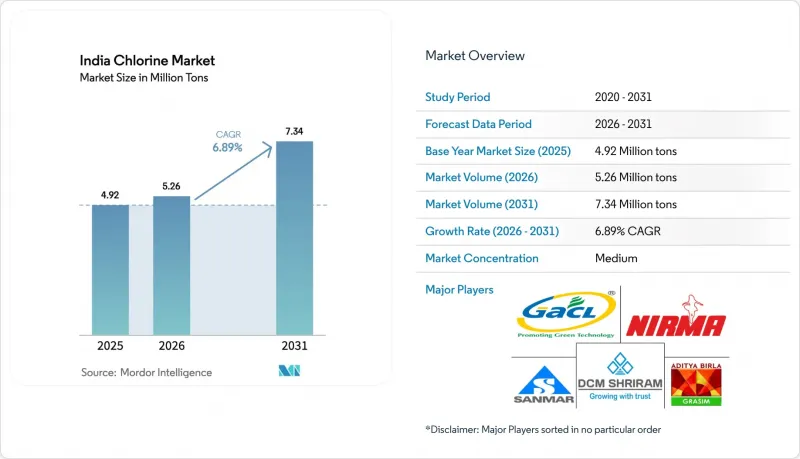
이 보고서는 형태(액체 염소, 기체 염소(가스통) 및 파생 차아염소산나트륨 용액),제조 공정 및 기술(막식 전지, 다이어프램식 전지, 수은식 전지(구형)), 용도(EDC/PVC, 클로로메탄 등), 최종사용자 산업(화학, 수처리 등)별로 분류되어 있습니다.
인도 염소 시장의 동향 및 인사이트
PVC 및 CPVC 생산 능력 확대 계획
새로운 PVC 및 CPVC 플랜트는 인도 염소 시장의 다음 성장 물결의 중심이 될 것입니다. 2024년 국내 PVC 수요가 9% 증가한 데 따라, 아다니(Adani)와 릴라이언스(Reliance)와 같은 기업은 자사 수요를 위한 염소 인수량을 늘리는 다단계 비닐 사업 확장을 계획하고 있습니다. 에피그랄의 CPVC 수지 생산 능력은 2024년에 75,000 TPA로 약 3배 확대되어, 고온 배관용 국내 공급을 확대함과 동시에 수입 의존도를 낮췄습니다. 이러한 생산 능력 확대 계획은 일반용 염소를 흡수하고, 통합형 생산자의 실현 가격을 안정시킴으로써 수급 균형을 변화시키고 있습니다. 세계 비닐 가격 주기에 따른 마진 변동 위험은 여전히 남아 있지만, 에너지 효율이 높은 플랜트와 항만에 인접한 물류망을 통해 서부 클러스터는 구조적인 우위를 점하고 있습니다. 정책 입안자들은 비닐 수입 대체를 인프라 구축의 전략적 과제로 간주하고 있으며, 이를 통해 염소 생산자의 판매량 안정성이 더욱 강화될 것입니다.
지방 자치단체의 수처리 인프라 급속한 확대
‘자르-지반 미션(Jal-Jivan Mission)’을 통해 2025년 3월까지 농촌 지역의 상수도 보급률은 가구의 79.74%에 달하게 되어, 염소계 소독제에 대한 비순환적 수요 채널이 창출되었습니다. 지방 자치단체의 운영 사업자들은 분산형 시스템에서 보관 및 투여가 간소화되므로 차아염소산염을 선호하고 있습니다. 도시 지역의 배수량 증가에 따라 인도 표준국(BIS)이 정한 병원체 기준치를 충족하기 위해 하수 처리장에서의 염소 주입도 필요해지고 있습니다. 상수도 공급 서비스가 미치지 않는 동부 지역으로 확대됨에 따라 염소 사용이 지역적으로 분산되어, 구자라트주를 중심으로 한 산업 회랑 지역의 기존 집중 경향이 완화되고 있습니다. 장기적인 예산 배분으로 인해 수처리 수요는 범용 화학제품에 영향을 미치는 거시경제의 변동으로부터 더욱 격리되고 있습니다.
엄격한 환경 및 산업 안전 규제
중앙공해관리위원회는 크롤 알칼리를 ‘레드 카테고리’로 분류하고 있으며, 확장에 있으며, 포괄적인 영향 평가를 의무화하고 있습니다. 액체 배출 제로 기준에 따라 고비용의 증발 장치나 결정화 장치의 도입이 필요해져, 단위당 설비 투자 비용이 상승하고 있습니다. 구식 수은 셀을 사용하는 공장은 좌초 자산 문제에 직면해 있으며, 규제를 준수하기 위해 염수 여과, 막, 가스 처리 설비에 막대한 투자를 해야 합니다. 산업안전 기준에 따라 전용 개인 보호 장비, 누출 감지 시스템 및 현장 비상 대응팀의 구성이 의무화되어 있습니다. 소규모 단독 생산자들은 대개 자본 부담에 어려움을 겪고 있으며, 그 결과 인도의 염소 산업은 규모가 더 크고 자금력이 풍부한 사업자에게 편중되는 경향을 보이고 있습니다.
부문 분석
2025년, 인도 염소 시장에서 액체 염소는 64.55%의 점유율을 차지했습니다. 이는 구자라트주의 생산 거점과 하류 소비자를 연결하는 잘 정비된 철도 및 탱커 인프라에 힘입은 결과입니다. 그러나 지방 자치 단체의 계획에서는 물류가 간편하고 안전성이 높은 희석 제품이 선호되므로 인도의 차아염소산나트륨 용액 시장 규모는 급속히 확대될 전망입니다. 가스통은 대량 취급의 경제성보다 정확한 투여를 중시하는 소규모 사용자에게 여전히 틈새 시장에서의 선택지로 남아 있습니다.
액체 염소는 끊김 없는 고순도 원료가 필요한 대규모 EDC 공장에서 여전히 주류를 이루고 있습니다. 서부 항구는 천일염의 공급을 용이하게 하며, 다헤지 및 발루치 파이프라인을 통해 비닐 제조 시설로의 직접 이송이 가능해졌습니다. 한편, 저위험 염소 취급을 요구하는 의료 시설 및 공공 사업 분야에서는 차아염소산염의 도입이 진행되고 있습니다. 각 주의 수도국은 현지 생산된 차아염소산염의 공급을 명시적으로 우선시하는 입찰을 시행하고 있으며, 이로 인해 가압 가스 형태의 수요 일부가 차아염소산염으로 전환되고 있습니다. 전반적으로 형태에 대한 선호도가 다양화됨에 따라 통합형 생산자에게 제공되는 가치 제안이 더욱 풍부해지고 있습니다.
막 기술은 2025년에 총 생산량의 69.70%를 차지할 것으로 예상되며, 2031년까지 연평균 6.94%의 성장률이 전망되어 인도 염소 시장에서 그 중요한 역할을 반영하고 있습니다. 다이어프램식 전해조는 염수의 순도 관리가 비교적 용이한 일부 플랜트에서 여전히 사용되고 있지만, 수은식 전해조는 빠르게 도태되고 있습니다.
인도의 염소 시장 규모는 막식 플랜트가 과열 없이 전류 밀도를 높이는 첨단 정류기를 도입함에 따라 효율이 향상되고 있습니다. 사업자들은 황산염과 칼슘을 제거하기 위해 나노 여과에 투자하고 있으며, 이를 통해 염수 배출량을 최대 90%까지 줄이고 있습니다. 막식 플랜트에서 제품별로 생성되는 수소는 신설된 과산화수소 생산 라인이나 공장내 보일러에 공급되어 새로운 수입원을 확보하고 있습니다. 다이어프램식 설비 개량에 주력해 왔던 장비 공급업체들은 전기 요금이 급등하는 상황에서 신속한 투자 회수가 기대되는 턴키식의 막식 패키지로 사업 초점을 전환하고 있습니다.
기타 혜택:
- 엑셀 형식의 시장 예측(ME) 시트
- 3개월간의 애널리스트 지원
자주 묻는 질문
목차
제1장 서론
제2장 조사 방법
제3장 개요
제4장 시장 구도
제5장 시장 규모와 성장 예측
제6장 경쟁 구도
제7장 시장 기회와 향후 전망
KSA 26.08.26According to Mordor Intelligence, the india chlorine market size was valued at 4.92 Million tons in 2025 and estimated to grow from 5.26 Million tons in 2026 to reach 7.34 Million tons by 2031, at a CAGR of 6.89% during the forecast period (2026-2031).
This report is Segmented by Form (Liquid Chlorine, Gaseous Chlorine (Cylinders), and Derived Hypochlorite Solutions), Production Process and Technology (Membrane Cell, Diaphragm Cell, and Mercury Cell (legacy)), and Application (EDC/PVC, Chloromethanes, and More), End-User Industry (Chemical, Water Treatment, and More)
India Chlorine Market Trends and Insights
Expansion of PVC and CPVC Capacity Pipeline
New PVC and CPVC plants are central to the next growth wave in the India chlorine market. Domestic PVC demand climbed 9% in 2024, encouraging firms such as Adani and Reliance to schedule multi-stage vinyl expansions that will lift captive chlorine offtake. CPVC resin capacity at Epigral nearly tripled to 75,000 TPA in 2024, widening domestic supply for high-temperature piping and lowering import dependence. The capacity pipeline shifts the supply-demand balance by absorbing merchant chlorine and stabilizing realizations for integrated producers. Margin exposure to global vinyl price cycles remains, yet energy-efficient plants and port-adjacent logistics give western clusters a structural edge. Policymakers view vinyl import substitution as strategic for infrastructure, reinforcing offtake security for chlorine producers.
Rapid Growth in Municipal Water-Treatment Infrastructure
The Jal Jeevan Mission lifted rural piped-water coverage to 79.74% of households by March 2025, creating a non-cyclical demand channel for chlorine disinfectants. Municipal operators favor hypochlorite because it simplifies storage and dosing in decentralized schemes. Rising urban wastewater volumes also require chlorine dosing at sewage plants to meet pathogen limits prescribed by the Bureau of Indian Standards. As water coverage expands into underserved eastern districts, chlorine usage disperses geographically and lowers the historic concentration in Gujarat-centered industrial corridors. Long-term budget allocations further insulate water-treatment demand from macro swings that affect commodity chemicals.
Stringent Environmental and Worker-Safety Regulations
The Central Pollution Control Board includes chlor-alkali in its red category, requiring comprehensive impact assessments for any expansion. Zero-liquid-discharge norms add costly evaporators and crystallizers, pushing up unit capital cost. Plants using legacy mercury cells face stranded assets and must invest heavily in brine-filtration, membranes, and gas handling equipment to comply. Worker-safety norms mandate specialized personal protective gear, leak-detection systems, and on-site emergency response teams. Smaller standalone producers often struggle with the capital load, tilting the India chlorine industry toward larger, better-funded operators.
Other drivers and restraints analyzed in the detailed report include:
- Strong Pharmaceuticals and Agro-Chemicals Output Linkage
- Captive Consumption Strategy Amid Negative Chlorine Pricing
- Excess Caustic-Soda Capacity Creating Chlorine Oversupply
For complete list of drivers and restraints, kindly check the Table Of Contents.
Segment Analysis
Liquid chlorine accounted for 64.55% of the India chlorine market share in 2025, anchored by well-developed rail and tanker infrastructure between Gujarat's production hubs and downstream consumers. The India chlorine market size for hypochlorite solutions is, however, set to expand briskly as municipal schemes prefer safer, diluted products with simpler logistics. Gaseous cylinders remain a niche choice for small-scale users who value precise dosing over bulk-handling economics.
Liquid chlorine continues to dominate large EDC plants that require uninterrupted, high-purity feedstock. Western ports simplify raw salt supply, and pipelines in Dahej and Bharuch enable direct transfers to vinyl units. Meanwhile, hypochlorite gains ground in health-care facilities and public utilities seeking low-risk chlorine handling. State water boards issue tenders that explicitly favor local hypochlorite supply, redirecting some volume away from pressurized gas formats. Overall, diversifying form preferences enrich the value proposition for integrated producers.
Membrane technology captured 69.70% of overall output in 2025 and is projected to grow at 6.94% through 2031, reflecting its critical role in the India chlorine market. Diaphragm cells hang on in a few plants where brine purity is easier to manage, while mercury cells are fast approaching retirement.
The India chlorine market size gains efficiency as membrane units roll out advanced rectifiers that raise current density without overheating. Operators invest in nanofiltration to strip sulfates and calcium, cutting brine purge volumes by up to 90%. Hydrogen co-produced from membrane plants feeds new hydrogen-peroxide lines and onsite boilers, securing incremental revenue streams. Equipment suppliers betting on diaphragm retrofits are pivoting toward turnkey membrane packages that promise quick payback under high power tariffs.
Complete Report Scope:
- By Form
- Liquid Chlorine
- Gaseous Chlorine (Cylinders)
- Derived Hypochlorite Solutions
- By Production Process and Technology
- Membrane Cell
- Diaphragm Cell
- Mercury Cell (legacy)
- By Application
- EDC/PVC
- Isocyanates and Oxygenates
- Chloromethanes
- Solvents and Epichlorohydrin
- Inorganic Chemicals
- Other Applications
- By End-user Industry
- Chemical
- Water Treatment
- Pharmaceutical
- Pulp and Paper
- Plastics
- Pesticides
- Other End-user Industries
List of Companies Covered in this Report:
- Chemfab Alkalis Limited
- Chemplast Sanmar Limited
- DCM Shriram
- DCW Ltd.
- De Nora India Limited
- Durgapur Chemicals Ltd.
- Epigral Limited
- Finolex Industries Limited (FIL)
- Grasim Industries Limited (Aditya Birla)
- Gujarat Alkalies and Chemicals Limited
- Gujarat Fluorochemicals Ltd.
- Kutch Chemical Industries Ltd.
- Lords Chloro Alkali Limited
- Meghmani Finechem Limited
- NIRMA
- Reliance Industries Limited
- Tata Chemicals Limited
- The Andhra Sugars Limited
Additional Benefits:
- The market estimate (ME) sheet in Excel format
- 3 months of analyst support
TABLE OF CONTENTS
1 Introduction
- 1.1 Study Assumptions and Market Definition
- 1.2 Scope of the Study
2 Research Methodology
3 Executive Summary
4 Market Landscape
- 4.1 Market Overview
- 4.2 Market Drivers
- 4.2.1 Expansion of PVC and CPVC Capacity Pipeline
- 4.2.2 Rapid Growth in Municipal Water-Treatment Infrastructure
- 4.2.3 Strong Pharmaceuticals and Agro-Chemicals Output Linkage
- 4.2.4 Captive Consumption Strategy Amid Negative Chlorine Pricing
- 4.2.5 Accelerated Switch to Membrane-Cell Technology Lowering Energy Cost
- 4.3 Market Restraints
- 4.3.1 Stringent Environmental and Worker-Safety Regulations
- 4.3.2 Excess Caustic-Soda Capacity Creating Chlorine Oversupply
- 4.3.3 Limited Downstream Integration (Disposal Logistics Cost)
- 4.4 Value Chain Analysis
- 4.5 Regulatory Landscape
- 4.6 Porter's Five Forces
- 4.6.1 Threat of New Entrants
- 4.6.2 Bargaining Power of Suppliers
- 4.6.3 Bargaining Power of Buyers
- 4.6.4 Threat of Substitutes
- 4.6.5 Degree of Competition
5 Market Size and Growth Forecasts (Volume)
- 5.1 By Form
- 5.1.1 Liquid Chlorine
- 5.1.2 Gaseous Chlorine (Cylinders)
- 5.1.3 Derived Hypochlorite Solutions
- 5.2 By Production Process and Technology
- 5.2.1 Membrane Cell
- 5.2.2 Diaphragm Cell
- 5.2.3 Mercury Cell (legacy)
- 5.3 By Application
- 5.3.1 EDC/PVC
- 5.3.2 Isocyanates and Oxygenates
- 5.3.3 Chloromethanes
- 5.3.4 Solvents and Epichlorohydrin
- 5.3.5 Inorganic Chemicals
- 5.3.6 Other Applications
- 5.4 By End-user Industry
- 5.4.1 Chemical
- 5.4.2 Water Treatment
- 5.4.3 Pharmaceutical
- 5.4.4 Pulp and Paper
- 5.4.5 Plastics
- 5.4.6 Pesticides
- 5.4.7 Other End-user Industries
6 Competitive Landscape
- 6.1 Market Concentration
- 6.2 Strategic Moves
- 6.3 Market Share (%)/Ranking Analysis
- 6.4 Company Profiles (includes Global level Overview, Market level overview, Core Segments, Financials as available, Strategic Information, Market Rank/Share, Products and Services, Recent Developments)
- 6.4.1 Chemfab Alkalis Limited
- 6.4.2 Chemplast Sanmar Limited
- 6.4.3 DCM Shriram
- 6.4.4 DCW Ltd.
- 6.4.5 De Nora India Limited
- 6.4.6 Durgapur Chemicals Ltd.
- 6.4.7 Epigral Limited
- 6.4.8 Finolex Industries Limited (FIL)
- 6.4.9 Grasim Industries Limited (Aditya Birla)
- 6.4.10 Gujarat Alkalies and Chemicals Limited
- 6.4.11 Gujarat Fluorochemicals Ltd.
- 6.4.12 Kutch Chemical Industries Ltd.
- 6.4.13 Lords Chloro Alkali Limited
- 6.4.14 Meghmani Finechem Limited
- 6.4.15 NIRMA
- 6.4.16 Reliance Industries Limited
- 6.4.17 Tata Chemicals Limited
- 6.4.18 The Andhra Sugars Limited
7 Market Opportunities and Future Outlook
- 7.1 White-space and Unmet-Need Assessment


