
|
시장보고서
상품코드
2117225
아이트래킹 솔루션 시장 : 시장 점유율 분석, 업계 동향 및 통계, 성장 예측(2026-2031년)Eye Tracking Solutions - Market Share Analysis, Industry Trends & Statistics, Growth Forecasts (2026 - 2031) |
||||||
 Mordor Intelligence
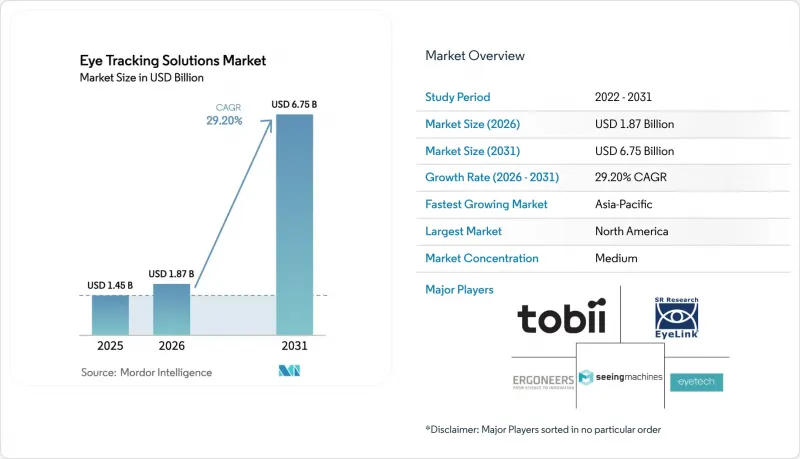
Mordor Intelligence에 의하면, 아이트래킹 솔루션 시장 규모는 2025년 14억 5,000만 달러로 평가되었고, 2026년에는 18억 7,000만 달러로 추정되고, 2026-2031년 CAGR 29.2%로 성장을 지속할 전망이며, 2031년까지 67억 5,000만 달러에 이를 것으로 예측됩니다.
본 보고서는 솔루션별(하드웨어, 소프트웨어), 추적 유형별(원격/데스크톱, 헤드마운트형, 아이어태치형, 모바일/임베디드형), 용도별(의사소통 지원, 운전자 모니터링, AR/VR 게임, 조사), 최종 사용자 산업별(자동차, 가전제품, 의료, 소매, 항공우주, 미디어), 그리고 지역별로 분류되어 있습니다. 시장 예측은 금액(달러) 기준으로 제시되어 있습니다.
세계의 아이트래킹 솔루션 시장 동향 및 인사이트
EU 일반 안전 규정(EU-GSR)에 따른 운전자 모니터링 카메라 장착 의무화
EU 일반 안전 규정(General Safety Regulation)에 따르면, 2024년 7월 이후 판매되는 모든 신차에 카메라 기반의 운전자 졸음 및 주의 산만 경고 기능을 탑재해야 하며, 2026년 7월부터는 고급 주의 산만 경고 기능의 탑재가 의무화됩니다. 이에 따라 자동차 제조업체들은 아이트래킹을 핵심 기술로 삼고, 규모의 경제를 실현하기 위해 지역에 관계없이 단일 운전자 모니터링 플랫폼을 표준화하고 있습니다. Euro NCAP의 ‘Vision 2030’ 로드맵은 규제 준수를 경쟁력 지표로 전환하고, 최소 기준을 뛰어넘는 추가 투자를 촉진하고 있습니다. ams OSRAM의 TARA2000-AUT와 같은 자동차용 VCSEL 어레이에 대한 하드웨어 수요가 급증하고 있으며, 이는 눈에 안전한 적외선 이미터의 양산을 견인하고 있습니다.
VR/AR 헤드셋 OEM의 ‘포비에이트 렌더링’ 효율에 대한 수요
헤드셋 제조업체들은 아이트래킹 기술을 활용하여 GPU 리소스를 중심 시야 영역에 집중시킴으로써, 지각상의 화질 저하를 초래하지 않으면서 픽셀 예산을 대폭 절감하고 있습니다. 학술 연구에 따르면, 레이 트레이싱이 적용된 장면에서 최대 25배의 처리 속도 향상이 확인되었습니다. 애플의 ‘Vision Pro’가 시선 기반 내비게이션을 주류로 만들면서, 메타(Meta)와 HTC에서도 경쟁 제품이 등장했습니다. 동시에 각 OEM 업체들은 GDPR(EU 개인정보보호규정) 및 유사한 법률에 따른 생체 인증의 개인정보 보호 제약에 대응해야 하며, 그 결과 시선 벡터의 기기 내 전처리 및 암호화가 진행되고 있습니다. 테라헤르츠 센싱 및 안구 카메라를 통한 심박수 추출에 관한 특허 출원은 시선을 이용한 상호작용과 보다 광범위한 생리학적 모니터링의 융합을 예고하고 있습니다.
어두운 홍채를 가진 사람들의 정확도 저하가 아시아태평양에서의 확산을 제한하고 있습니다.
대조 시험에 따르면, 아시아계 피험자의 경우 정확도가 떨어지는 것으로 보고되었습니다. 이는 홍채가 어두워 대비가 낮아지는 데다, 평균 동공 크기의 편차가 적외선 이미지에서 임계값 설정을 복잡하게 만들기 때문입니다. 스마트폰 기반 동공 측정 기술은 원적외선 파장 대역으로의 전환을 통해 이러한 명암 차이를 완화하고 있지만, 완전한 균일성을 실현하기 위해서는 여전히 인종에 적응된 모델이 필요합니다. ISO/IEC 19795-10 준수에 따라 공급업체는 인구통계학적 코호트별 성능 데이터를 공개해야 할 의무가 있어 알고리즘의 투명성이 높아지고 있습니다. 알고리즘과 광학 기술이 성숙해지기 전까지는 동아시아에서의 대규모 도입이 규제 동향이 시사하는 것보다 더 완만한 속도로 진행될 가능성이 있습니다.
부문 분석
2025년, 아이 트래킹 솔루션 시장 규모 중 하드웨어는 9억 8,000만 달러를 차지하여 67.40%의 점유율을 유지하며 소프트웨어를 크게 앞질렀습니다. 차량 안전 인증이나 VR의 지연 시간 제한에 있어 타협의 여지가 없는 경우, 카메라, 광학 시스템 및 전용 추론용 ASIC은 여전히 필수적입니다. 특히 고급 차량의 경우, 운전자 모니터링 시스템이 중복성을 확보하기 위해 듀얼 VCSEL 어레이를 채택함에 따라 일루미네이터는 하드웨어 제품군 중 가장 빠르게 성장하고 있습니다. 각 공급업체는 OEM의 생산 주기에서 발생하는 위험을 줄이기 위해 장기적인 공급 보장을 중시하고 있으며, 이로 인해 신규 시장 진출기업에 대한 진입 장벽이 높아지고 있습니다.
소프트웨어 분야는 연평균 성장률(CAGR) 29.7%로 더욱 빠르게 확대되고 있습니다. SDK 구독 모델은 지속적인 수익을 창출하며, 소규모 개발자가 독자적인 광학 시스템을 구축하지 않고도 앱에 시선 제어 기능을 통합할 수 있게 해줍니다. Tobii사의 Nexus 프레임워크는 단품 판매에서 플랫폼 경제로의 전환을 상징하며, 동일한 라이선스 내에서 분석 대시보드와 A/B 테스트 모듈을 제공합니다. 하드웨어 부품이 상품화되는 가운데, 정교한 알고리즘, 데이터 파이프라인 및 클라우드 보안 제어 기능이 아이트래킹 솔루션 시장에서 가격 결정력을 유지하는 결정적인 요인이 되고 있습니다.
2025년에는 학술 연구소 및 소비자 조사에서의 확고한 활용으로 인해 원격 또는 데스크톱 구성이 아이트래킹 솔루션 시장의 51.30% 점유율을 차지했습니다. 이러한 시스템은 조명이 제어되고 머리 위치가 고정되어 있다는 장점이 있어, 처음 도입하는 사용자의 경우 알고리즘의 복잡성과 총 소유 비용을 줄여줍니다. 헤드 마운트형 트래커는 VR의 몰입감이나 차량용 기능에서 여전히 매우 중요하지만, 인체공학적 제약과 배터리 한계로 인해 틈새 시장 이외의 분야에서는 성장이 억제되고 있습니다.
눈에 착용하는 안구전도(EOG)는 떠오르고 있는 주목할 만한 요소입니다. ElectraSight사의 7.75 mW 프로토타입과 같은 실증 실험은 스마트 워치급 배터리로 하루 종일 작동시키는 것이 가능함을 입증하고 있습니다(arxiv.org). 뉴로모픽 이벤트 카메라와 결합함으로써, 이러한 센서들은 마이크로초 단위의 지연 시간을 실현하여 실시간 혼합 현실(MR) 오버레이를 가능하게 합니다. 각 ODM 업체들은 시선 데이터에 웰니스 지표를 중첩한 서비스에 대해 프리미엄 가격 책정을 예상하고 있으며, 이는 웨어러블 EOG가 향후 아이트래킹 솔루션 시장에서 카메라 중심 아키텍처에 도전할 가능성을 시사합니다.
지역별 분석
북미는 2025년에도 매출의 47.50%를 차지하며 선도적 지위를 유지했습니다. 이는 실리콘 밸리의 투자, 광범위한 VR 게임 생태계, 그리고 첨단 상품화 분석에 자금을 지원하고자 하는 소매 부문의 의지에 힘입은 결과입니다. Tier 1 자동차 부품 공급업체들이 디트로이트와 서부 해안의 기술 허브 인근에 연구개발(R&D) 센터를 공동으로 설립하고 있기 때문에 미국은 여전히 매우 중요한 위치를 차지하고 있습니다. 캐나다는 공공 연구 보조금을 활용하여 임상용 아이트래킹 프로토콜의 상용화를 추진하고 있는 반면, 멕시코의 OEM 공장에서는 수출 시장을 겨냥한 운전자 모니터링 모듈의 탑재가 진행되고 있습니다.
유럽의 동향은 규제에 크게 좌우됩니다. 2026년으로 다가온 첨단 주의 산만 경고 시스템 도입 기한으로 인해 카메라 제조업체와 소프트웨어 공급업체에 대한 수요가 확고해질 것입니다. 독일의 자동차 제조업체들은 5성급 안전 등급을 확보하기 위해 초기 단계의 높은 부품 비용을 감수하고 있는 반면, 북유럽의 의료 시스템에서는 시선 조작을 통한 재활 프로그램이 시범적으로 도입되고 있습니다. GDPR(EU 개인정보보호규정) 규제가 엄격해지는 가운데, 유럽 공급업체들은 엣지 측에서 데이터 최소화 아키텍처를 선구적으로 도입하여 전 세계 개인정보 보호 대책의 청사진에 영향을 미치고 있습니다.
아시아태평양은 연평균 성장률(CAGR) 30.4%로 가장 빠르게 성장하고 있습니다. 중국에서 운전자의 주의력 감지 정확도 95%를 의무화함에 따라 차량 개조가 가속화되고, 성능 기준이 표준화되고 있습니다. 일본의 자동차 Tier 1 공급업체들은 AI 스타트업과 협력하여 레벨 3 자율주행 플랫폼에 시선 분석 기능을 통합하고 있으며, BLUESKEYE AI의 시뮬레이터 도입이 그 대표적인 예입니다. 한국은 스마트폰 및 디스플레이 제조거점을 활용하여 접이식 기기에서 아이트래킹 기술의 활용 방안을 모색하고 있습니다. 한편, 인도의 대규모 도입 기회는 저비용 광학 스택과 클라우드에 대한 보조금에 의존하고 있습니다. 이러한 동향은 지역별 전략의 차이를 부각시키는 한편, 전체적으로 아이트래킹 솔루션 시장의 세계 매출 확대를 뒷받침하고 있습니다.
기타 혜택 :
- 엑셀 형식 시장 예측(ME) 시트
- 3개월간의 애널리스트 지원
자주 묻는 질문
목차
제1장 서론
제2장 조사 방법
제3장 개요
제4장 시장 구도
제5장 시장 규모 및 성장 예측
제6장 경쟁 구도
제7장 시장 기회 및 향후 전망
AJY 26.09.01According to Mordor Intelligence, the eye-tracking solutions market size is expected to grow from USD 1.45 billion in 2025 to USD 1.87 billion in 2026 and is forecast to reach USD 6.75 billion by 2031 at 29.2% CAGR over 2026-2031.
This report is Segmented by Solution (Hardware, Software), Tracking Type (Remote/Desktop, Head-Mounted, Eye-Attached, Mobile/Embedded), Application (Assistive Communication, Driver Monitoring, AR/VR Gaming, Research), End-User Industry (Automotive, Consumer Electronics, Healthcare, Retail, Aerospace, Media), and by Geography. The Market Forecasts are Provided in Terms of Value (USD).
Global Eye Tracking Solutions Market Trends and Insights
Mandatory EU-GSR Integration of Driver-Monitoring Cameras
The EU General Safety Regulation requires all new vehicles sold from July 2024 to include camera-based driver drowsiness and attention warning, followed by advanced distraction warning from July 2026 . Automakers therefore treat eye tracking as foundational, standardizing a single driver monitoring platform across regions to achieve scale benefits. Euro NCAP's Vision 2030 roadmap turns compliance into a competitive metric, compelling additional investment beyond minimum thresholds.Hardware demand spikes for automotive-grade VCSEL arrays such as ams OSRAM's TARA2000-AUT, driving volume production of eye-safe infrared emitters.
VR/AR Headset OEM Demand for Foveated Rendering Efficiency
Headset makers deploy eye tracking to concentrate GPU resources on the foveal region, slashing pixel budgets without perceptible quality loss; academic work shows up to 25x acceleration in ray-traced scenes. Apple's Vision Pro mainstreamed gaze-based navigation, triggering competitive responses from Meta and HTC. Concurrently, OEMs must address biometric privacy constraints under GDPR and similar laws, leading to on-device preprocessing and encryption of gaze vectors. Patent filings covering terahertz sensing and heart-rate extraction from eye cameras foreshadow convergence between gaze interaction and broader physiological monitoring.
Accuracy Loss from Dark-Iris Populations Limiting APAC Roll-Outs
Controlled studies report lower precision for Asian participants because darker irises reduce contrast, while average pupil size variations complicate thresholding in infrared imagery. Smartphone-based pupillometry mitigates the contrast gap by shifting to far-red wavelengths, but full parity still demands ethnicity-adaptive models. Compliance with ISO/IEC 19795-10 forces vendors to publish performance by demographic cohort, elevating algorithm transparency. Until algorithms and optics mature, large-scale deployments in East Asia may progress more slowly than regulatory momentum would otherwise imply.
Other drivers and restraints analyzed in the detailed report include:
- Retail Eye-Tracking Becoming De-Facto Standard for Shelf Testing
- In-Cockpit DMS Retrofits Driven by Chinese Safety Regulations
- High BOM Cost of Active Illumination in Automotive-Grade Modules
For complete list of drivers and restraints, kindly check the Table Of Contents.
Segment Analysis
Hardware contributed USD 0.98 billion to the eye-tracking solutions market size in 2025 and retained a 67.40% share in 2025, well ahead of software. Cameras, optics, and dedicated inference ASICs remain indispensable when vehicle safety certifications or VR latency budgets leave no room for compromise. Illuminators are the fastest-growing hardware line as driver monitoring systems adopt dual-VCSEL arrays for redundancy, especially in premium vehicle trims. Suppliers emphasize long-term supply guarantees to de-risk OEM production cycles, deepening entry barriers for new entrants.
The software segment is scaling faster at 29.7% CAGR. SDK subscription models generate recurring revenue and let smaller developers extend gaze interaction to apps without building custom optics. Tobii's Nexus framework typifies the shift from unit sales to platform economics, offering analytics dashboards and A/B testing modules within the same licence. As hardware components head toward commoditisation, refined algorithms, data pipelines, and cloud security controls become decisive levers in sustaining pricing power inside the eye-tracking solutions market.
Remote or desktop configurations captured 51.30% of the eye tracking solutions market share in 2025, owing to entrenched use in academic labs and consumer research. These systems benefit from controlled lighting and fixed head positions, reducing algorithmic complexity and total cost of ownership for first-time adopters. Head-mounted trackers remain pivotal for VR immersion and in-cabin automotive functions, but ergonomic limits and battery constraints temper growth outside niche segments.
Eye-attached electrooculography is the emerging wildcard. Demonstrations such as ElectraSight's 7.75 mW prototype underscore the viability of day-long operation on a smartwatch-class battery arxiv.org. When paired with neuromorphic event cameras, these sensors deliver microsecond latency, unlocking real-time mixed-reality overlays. ODMs foresee premium pricing for wellness metrics layered onto gaze data, suggesting that wearable EOG could challenge camera-centric architectures in future iterations of the eye tracking solutions market.
Complete Report Scope:
- By Solution
- Hardware
- Cameras and Optics
- Processors and ASICs
- Illuminators (IR LEDs/Laser)
- Software
- Software SDK and Analytics
- Hardware
- By Tracking Type
- Remote/Desktop
- Head-Mounted
- Eye-Attached (Electro-oculography)
- Mobile/Embedded
- By Application
- Assistive Communication and AAC
- Driver Monitoring and Automotive Safety
- AR/VR and Gaming
- Consumer and Neuromarketing Research
- Academic and Clinical Research
- By End-User Industry
- Automotive and Transportation
- Consumer Electronics
- Healthcare and Research Labs
- Retail and Advertisement
- Aerospace and Defense
- Media and Entertainment
- Others
- By Geography
- North America
- United States
- Canada
- Mexico
- South America
- Brazil
- Argentina
- Rest of South America
- Europe
- Germany
- United Kingdom
- France
- Italy
- Spain
- Rest of Europe
- Asia-Pacific
- China
- Japan
- India
- South Korea
- ASEAN
- Australia
- Rest of Asia-Pacific
- Middle East and Africa
- Middle East
- GCC
- Turkey
- Israel
- Rest of Middle East
- Africa
- South Africa
- Nigeria
- Egypt
- Rest of Africa
- Middle East
- North America
Geography Analysis
North America maintained 47.50% revenue dominance in 2025, driven by Silicon Valley investment, an expansive VR gaming ecosystem, and a retail sector willing to fund advanced merchandising analytics. The United States remains pivotal as Tier-1 automotive suppliers co-locate R&D centers near Detroit and West Coast tech hubs. Canada leverages public research grants to commercialize clinical eye-tracking protocols, while Mexico's OEM plants integrate driver monitoring modules destined for export markets.
Europe's trajectory rests heavily on regulation. The impending 2026 deadline for advanced distraction warning cements volume for camera makers and software vendors. Germany's carmakers absorb early component premiums to secure five-star safety ratings, while Nordic healthcare systems pilot gaze-driven rehabilitation programs. As GDPR restrictions sharpen, European providers pioneer on-edge data minimization architectures, influencing global privacy blueprints.
Asia-Pacific is the fastest riser at 30.4% CAGR. China's 95% driver-attention accuracy mandate accelerates fleet retrofits and standardizes performance benchmarks . Japan's automotive Tier-1s collaborate with AI start-ups to embed gaze analytics into Level-3 autonomous platforms, evidenced by BLUESKEYE AI's simulator rollout. South Korea taps its smartphone and display manufacturing base to explore eye tracking in foldable devices, whereas India's volume opportunity depends on low-cost optical stacks and cloud subsidies. These dynamics underscore divergent regional strategies yet collectively reinforce global revenue expansion for the eye tracking solutions market.
- Tobii AB
- Seeing Machines Ltd.
- SR Research Ltd.
- iMotions A/S
- EyeTech Digital Systems Inc.
- Ergoneers GmbH
- FOVE Inc.
- Gazepoint Research Inc.
- Eyegaze Inc.
- Noldus Information Technology BV
- Pupil Labs GmbH
- SmartEye AB
- AdHawk Microsystems Inc.
- SMI SensoMotoric Instruments
- LC Technologies Inc.
- BrainCo Inc.
- EyeSquare GmbH
- Emotiv Inc.
- Optalert Australia
- Tobii Dynavox LLC
- EyeTracking Inc.
Additional Benefits:
- The market estimate (ME) sheet in Excel format
- 3 months of analyst support
TABLE OF CONTENTS
1 INTRODUCTION
- 1.1 Study Assumptions and Market Definition
- 1.2 Scope of the Study
2 RESEARCH METHODOLOGY
3 EXECUTIVE SUMMARY
4 MARKET LANDSCAPE
- 4.1 Market Overview
- 4.2 Market Drivers
- 4.2.1 Mandatory EU-GSR integration of driver-monitoring cameras (Europe)
- 4.2.2 VR/AR headset OEM demand for foveated rendering efficiency
- 4.2.3 Retail eye-tracking becoming de-facto standard for shelf testing in North America
- 4.2.4 In-cockpit DMS retrofits driven by Chinese safety regulations
- 4.2.5 Low-friction SDKs accelerating app developer adoption (global)
- 4.2.6 Neuroscience-based UX testing spend by Big Tech firms (U.S.)
- 4.3 Market Restraints
- 4.3.1 Accuracy loss from dark-iris populations limiting APAC roll-outs
- 4.3.2 High BOM cost of active illumination in automotive-grade modules
- 4.3.3 GDPR constraints on gaze-data retention (EU)
- 4.3.4 Limited battery life for mobile eye-tracking glasses
- 4.4 Value / Supply-Chain Analysis
- 4.5 Regulatory and Technological Outlook
- 4.5.1 Emerging ISO?/TR 21965 for unobtrusive eye-monitoring devices
- 4.5.2 AI-on-edge gaze-estimation chips (16-TOPS class)
- 4.6 Porter's Five Forces
- 4.6.1 Bargaining Power of Suppliers
- 4.6.2 Bargaining Power of Buyers
- 4.6.3 Threat of New Entrants
- 4.6.4 Threat of Substitutes
- 4.6.5 Intensity of Competitive Rivalry
5 MARKET SIZE AND GROWTH FORECASTS (VALUE)
- 5.1 By Solution
- 5.1.1 Hardware
- 5.1.1.1 Cameras and Optics
- 5.1.1.2 Processors and ASICs
- 5.1.1.3 Illuminators (IR LEDs/Laser)
- 5.1.2 Software
- 5.1.2.1 Software SDK and Analytics
- 5.1.1 Hardware
- 5.2 By Tracking Type
- 5.2.1 Remote/Desktop
- 5.2.2 Head-Mounted
- 5.2.3 Eye-Attached (Electro-oculography)
- 5.2.4 Mobile/Embedded
- 5.3 By Application
- 5.3.1 Assistive Communication and AAC
- 5.3.2 Driver Monitoring and Automotive Safety
- 5.3.3 AR/VR and Gaming
- 5.3.4 Consumer and Neuromarketing Research
- 5.3.5 Academic and Clinical Research
- 5.4 By End-User Industry
- 5.4.1 Automotive and Transportation
- 5.4.2 Consumer Electronics
- 5.4.3 Healthcare and Research Labs
- 5.4.4 Retail and Advertisement
- 5.4.5 Aerospace and Defense
- 5.4.6 Media and Entertainment
- 5.4.7 Others
- 5.5 By Geography
- 5.5.1 North America
- 5.5.1.1 United States
- 5.5.1.2 Canada
- 5.5.1.3 Mexico
- 5.5.2 South America
- 5.5.2.1 Brazil
- 5.5.2.2 Argentina
- 5.5.2.3 Rest of South America
- 5.5.3 Europe
- 5.5.3.1 Germany
- 5.5.3.2 United Kingdom
- 5.5.3.3 France
- 5.5.3.4 Italy
- 5.5.3.5 Spain
- 5.5.3.6 Rest of Europe
- 5.5.4 Asia-Pacific
- 5.5.4.1 China
- 5.5.4.2 Japan
- 5.5.4.3 India
- 5.5.4.4 South Korea
- 5.5.4.5 ASEAN
- 5.5.4.6 Australia
- 5.5.4.7 Rest of Asia-Pacific
- 5.5.5 Middle East and Africa
- 5.5.5.1 Middle East
- 5.5.5.1.1 GCC
- 5.5.5.1.2 Turkey
- 5.5.5.1.3 Israel
- 5.5.5.1.4 Rest of Middle East
- 5.5.5.2 Africa
- 5.5.5.2.1 South Africa
- 5.5.5.2.2 Nigeria
- 5.5.5.2.3 Egypt
- 5.5.5.2.4 Rest of Africa
- 5.5.5.1 Middle East
- 5.5.1 North America
6 COMPETITIVE LANDSCAPE
- 6.1 Market Concentration
- 6.2 Strategic Moves
- 6.3 Market Share Analysis
- 6.4 Company Profiles {(includes Global level Overview, Market level overview, Core Segments, Financials as available, Strategic Information, Market Rank/Share for key companies, Products and Services, and Recent Developments)}
- 6.4.1 Tobii AB
- 6.4.2 Seeing Machines Ltd.
- 6.4.3 SR Research Ltd.
- 6.4.4 iMotions A/S
- 6.4.5 EyeTech Digital Systems Inc.
- 6.4.6 Ergoneers GmbH
- 6.4.7 FOVE Inc.
- 6.4.8 Gazepoint Research Inc.
- 6.4.9 Eyegaze Inc.
- 6.4.10 Noldus Information Technology BV
- 6.4.11 Pupil Labs GmbH
- 6.4.12 SmartEye AB
- 6.4.13 AdHawk Microsystems Inc.
- 6.4.14 SMI SensoMotoric Instruments
- 6.4.15 LC Technologies Inc.
- 6.4.16 BrainCo Inc.
- 6.4.17 EyeSquare GmbH
- 6.4.18 Emotiv Inc.
- 6.4.19 Optalert Australia
- 6.4.20 Tobii Dynavox LLC
- 6.4.21 EyeTracking Inc.
7 MARKET OPPORTUNITIES AND FUTURE OUTLOOK
- 7.1 White-space and Unmet-Need Assessment