

|
시장보고서
상품코드
2117240
통합 위협 관리 : 시장 점유율 분석, 업계 동향과 통계, 성장 예측(2026-2031년)Unified Threat Management - Market Share Analysis, Industry Trends & Statistics, Growth Forecasts (2026 - 2031) |
||||||
 Mordor Intelligence
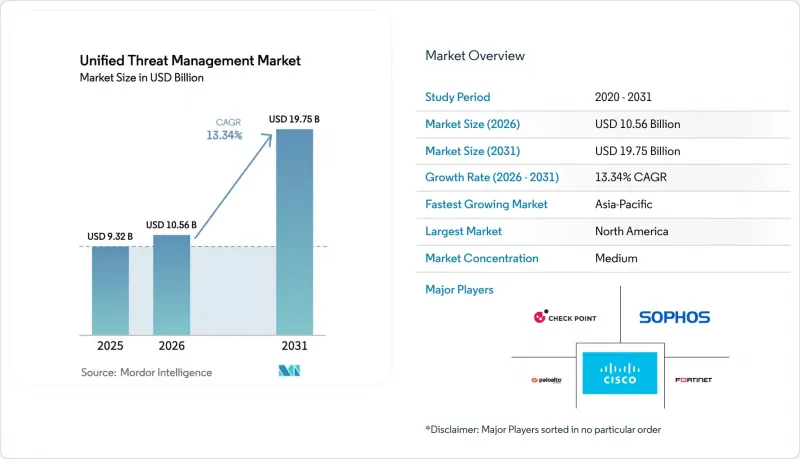
Mordor Intelligence에 따르면 통합 위협 관리(UTM) 시장 규모는 2025년에 93억 2,000만 달러로 평가되며, 2026년 105억 6,000만 달러에서 2031년까지 197억 5,000만 달러에 달할 것으로 예측되며, 예측 기간(2026-2031년) 동안 CAGR은 13.34%가 될 전망입니다.
본 보고서는 구성요소(소프트웨어 및 서비스), 도입 형태(클라우드 및 온프레미스), 최종사용자의 기업 규모(대기업 및 중소기업(SME)), 최종사용자의 업종(BFSI, 통신, 미디어 등), 그리고 지역별로 분류되어 있습니다. 시장 예측은 금액(달러) 기준으로 제시되어 있습니다.
세계 통합 위협 관리(UTM) 시장 동향 및 인사이트
중소기업에서 비용 효율성이 뛰어난 통합 보안 어플라이언스의 급속한 도입
중소기업에서는 개별 방화벽, 침입 방지 시스템, 콘텐츠 필터링이 제한된 예산과 인력에 부담을 주기 때문에 UTM 어플라이언스로의 전환이 진행되고 있습니다. 2024년에는 중소기업의 43%가 공격을 겪었으나, 이들 중 상당수는 소수의 IT 팀으로 운영되고 있습니다. 올인원형 장비는 기본적인 규제 요건을 충족하면서 자본 투자와 일상적인 관리 부담을 줄여줍니다. 관리형 서비스 제공업체(MSP)는 현재 UTM 장치를 정액제 패키지에 포함시키고 있으며, 경우에 따라 지속적인 수익을 두 배로 늘리고 있습니다. 엔터프라이즈급 제어 기능을 간소화된 어플라이언스에 패키지로 묶은 벤더들은 가격에 민감한 부문에서 고객 충성도를 확보하고 있습니다.
SD-WAN/SASE 아키텍처와의 융합
네트워크 및 보안 팀은 트래픽을 제어하고 동시에 검사를 수행할 수 있는 단일 관리 화면을 원하고 있습니다. 시스코는 Catalyst SD-WAN과 Microsoft Security Service Edge를 통합하여, 사용자가 동일한 클라우드 에지에서 정책 기반 라우팅과 위협 방지를 모두 활용할 수 있도록 했습니다. 조사 대상 기업의 79%가 2025년까지 웹, 클라우드 서비스, 사설 애플리케이션에 대한 액세스를 통합형 SASE 하에 통합할 의향을 나타내고 있으며, 이로 인해 레거시 UTM 벤더들은 어플라이언스의 틀을 넘어 사업을 확장할 수밖에 없게 되었습니다. 포티넷의 ‘Unified SASE’ 연간 경상 수익은 2025년에 25.7% 증가한 11억 5,000만 달러에 달할 것으로 예상되며, 이는 통합형 클라우드 제공을 향한 모멘텀을 뒷받침하고 있습니다.
모든 서비스를 활성화했을 때 발생하는 성능 병목 현상
하드웨어 UTM 어플라이언스는 침입 방지, SSL 검사, 샌드박스 기능이 활성화되면 처리량이 저하되는 경우가 많습니다. 실험실 테스트에 따르면, 모든 기능이 활성화된 경우 일부 디바이스에서는 정격 속도의 20-30%가 저하되는 것으로 나타났습니다. 예를 들어, 850 Mbps 게이트웨이의 경우에도 딥 패킷 검사(DPI)가 활성화되면 600 Mbps까지 저하될 수 있습니다. 따라서 높은 대역폭이 필요한 기업은 속도와 완벽한 보호 간의 균형을 고려하여, 경우에 따라 검사 작업을 클라우드 프록시로 오프로드함으로써 어플라이언스 업그레이드를 보류하기도 합니다.
부문 분석
소프트웨어는 2025년 매출의 65.72%를 차지하며, 이 비율은 연평균 성장률(CAGR) 14.93%로 상승하고 있습니다. 소프트웨어 분야의 통합 위협 관리(UTM) 시장 규모는 2025년에 61억 3,000만 달러에 달할 것으로 예상되며, 2031년까지 2배로 증가할 것으로 전망됩니다. 기업들은 데이터센터나 엣지 노드에서 몇 분 만에 시작할 수 있는 다운로드 가능한 이미지나 가상 어플라이언스를 선호하고 있습니다. 지속적인 패치 적용을 통해 현장 출장 대응 없이도 제로데이 공격으로부터 방어할 수 있습니다. 현재 서비스는 여전히 소수이지만, 기술 인력 부족이 심화됨에 따라 관리형 탐지 및 대응(MDR)의 매출이 제품 판매를 앞지르고 있으며, 위협 인텔리전스 보안 서비스에 대한 수요가 증가하고 있습니다. 각 벤더는 온보딩, 정책 최적화, 연중무휴 24시간 모니터링을 묶어 제공함으로써 유지율이 높은 구독 기반 수익을 확보하고 있습니다. 전문 서비스 팀은 특히 NIS2 및 해양 관련 규제 요건에 대한 규정 준수 매핑 지원도 수행하고 있습니다. 통합 위협 관리(UTM) 시장에서는 소프트웨어 기반의 혁신을 축으로 삼으면서, 옵션 서비스 기능을 결합하여 구매자에게 민첩성과 전문 지식을 모두 보장하는 벤더가 계속해서 높은 평가를 받고 있습니다.
두 번째 혁신의 물결로 인해 소프트웨어 정의 엔진이 컨테이너 형식으로 전환되어 애플리케이션 수요에 따라 자동으로 확장되고 있습니다. 체크포인트의 ‘Infinity’ 아키텍처는 단일 코드베이스를 통해 온프레미스, 클라우드, 지사 에지 환경을 포괄하게 되었으며, IT 직원이 하나의 콘솔에서 관리할 수 있어 총 소유 비용(TCO)을 절감하고 있습니다. 이러한 접근 방식은 개별 포인트 제품이 아닌 플랫폼 통합을 추구하는 기업의 광범위한 추세와 부합합니다. 사실상, 이러한 소프트웨어의 급속한 증가는 통합 보안의 기준을 재정의하고, 원클릭 배포, 원활한 업그레이드, 그리고 동기화된 분석에 대한 기대치를 확립하고 있습니다. 이러한 추세로 인해 구독 경제가 하드웨어 재판매의 수익성을 대체하는 가운데, 통합 위협 관리(UTM) 시장은 계속해서 호황을 누리고 있습니다.
클라우드 모델은 2025년 출하액 기준으로 57.65%를 차지했으며, 2031년까지 연평균 성장률(CAGR) 13.92%를 기록할 전망입니다. 기업들은 SaaS로의 저지연, 무한한 확장성, 그리고 전 세계적인 정책 적용을 간소화할 수 있다는 점을 주요 동기로 꼽고 있습니다. 대역폭 수요가 임베디드 CPU의 한계를 초과하는 경우, 온프레미스형 어플라이언스의 통합 위협 관리(UTM) 시장 점유율은 하락 추세를 보이고 있습니다. 그럼에도 불구하고, 에어 갭이 적용된 공공 시설이나 국방 시설에서는 여전히 로컬 검사가 선호되고 있습니다. 그 결과, 하이브리드 설계가 보급되고 있습니다. 정책은 클라우드에 존재하지만, 규정 준수 요건에 따라 적용 지점은 가상 환경이나 물리적 환경 중 어느 쪽이든 설정할 수 있습니다.
클라우드 도입으로 인해 과거의 과제였던 성능 저하 문제도 완화되고 있습니다. 검사는 멀티 코어 처리를 위해 설계된 대규모 데이터센터에서 수행됩니다. 마린 크레딧 유니온(Marine Credit Union)과 같은 조직은 생산성 워크로드에 더 가까운 곳에 배치된 보안 웹 게이트웨이로 전환한 후 사용자 경험이 개선되었다고 보고하고 있습니다. 하드웨어 기반 벤더들은 정책의 연속성을 유지하기 위해 클라우드 노드에서 동일한 규칙 세트를 제공하게 되었습니다. 시간이 지남에 따라 과금 방식은 자본 지출에서 운영 지출로 전환되어, 공급업체에게는 예측 가능한 수익원이 강화되고, 구매자에게는 진입 장벽이 낮아집니다. 이러한 요인들이 통합 위협 관리(UTM) 시장의 성장세를 뒷받침하고 있습니다.
지역별 분석
북미는 성숙한 사이버 보험 의무화 및 통합 플랫폼의 조기 도입에 힘입어 2025년 매출의 36.62%를 차지했습니다. 연방 규정에 따라 해운 회사는 2025년 7월까지 문서화된 관리 조치를 도입해야 할 의무가 있으며, 해운 업계용 장비에 대한 수요는 견조한 추세를 보이고 있습니다. 캐나다의 중요 인프라에 관한 지침 역시 통합 로그 관리를 권장하고 있습니다. 안정적인 예산과 긴밀한 파트너 네트워크가 업그레이드와 구독 갱신을 지속적으로 뒷받침하고 있습니다.
아시아태평양은 성장의 원동력이 되고 있으며, 2031년까지 연평균 성장률(CAGR) 18.14%를 기록할 전망입니다. 싱가포르는 ‘사이버 보안법’의 적용 범위를 해외 시스템까지 확대하고 있어, 다국적 기업의 본사는 벌금이 부과되기 전에 통합 로그 관리 도입을 서둘러야 하는 상황입니다. 인도의 ‘디지털 개인 데이터 보호법’은 엄격한 기한 내 정보 유출 신고를 의무화하고 있어, 기업들은 사고 보고를 자동으로 처리하는 턴키 방식의 UTM 번들을 선택하도록 권장받고 있습니다. 일본 및 한국의 제조업체들은 스마트 팩토리를 통한 생산성 향상을 추진하는 과정에서 산업용 로봇을 모니터링하기 위해 UTM을 도입하고 있습니다. 이러한 시너지 효과로 인해 해당 지역 전체의 통합 위협 관리(UTM) 시장이 견인되고 있습니다.
유럽에서는 NIS2에 따라 에너지, 운송, 디지털 서비스 사업자의 사고 보고 의무가 확대됨에 따라 꾸준한 성장이 예상됩니다. 로테르담 및 함부르크 항만에서는 2024년 7월부터 선박에 대해 IACS UR E26/E27 규격에 준거한 UTM 도입을 증명할 것을 의무화하고 있습니다. 금융 서비스 분야에서 DORA 적용 대상인 조직들은 감독 당국에 실시간 대시보드 정보를 제공하는 통합 관리 기능에 투자하고 있습니다. 유럽에서는 개인정보 보호와 개방형 표준이 중요시되고 있지만, 중복되는 규제의 복잡성으로 인해 싱글 페인(single-pane)형 솔루션에 대한 수요가 증가하고 있습니다.
기타 혜택:
- 엑셀 형식의 시장 예측(ME) 시트
- 3개월간 애널리스트 지원
자주 묻는 질문
목차
제1장 소개
제2장 조사 방법
제3장 주요 요약
제4장 시장 구도
제5장 시장 규모와 성장 예측
제6장 경쟁 구도
제7장 시장 기회와 향후 전망
KSM 26.08.26According to Mordor Intelligence, the unified threat management market size was valued at USD 9.32 billion in 2025 and estimated to grow from USD 10.56 billion in 2026 to reach USD 19.75 billion by 2031, at a CAGR of 13.34% during the forecast period (2026-2031).
This report is Segmented by Component (Software and Services), Deployment Mode (Cloud and On-Premise), End-User Enterprise Size (Large Enterprises and Small and Medium Enterprises (SMEs)), End-User Vertical (BFSI, Telecom and Media and More) and by Geography. The Market Forecasts are Provided in Terms of Value (USD).
Global Unified Threat Management Market Trends and Insights
Rapid SMB adoption of cost-effective integrated security appliances
Small and medium businesses increasingly pivot toward UTM boxes because separate firewalls, intrusion prevention, and content filters strain limited budgets and staff. Forty-three percent of SMBs faced attacks in 2024, yet many run with lean IT teams. An all-in-one unit trims capital outlay and day-to-day management while still meeting regulatory basics. Managed service providers now bundle UTM devices into fixed-price packages, doubling recurring revenue in some cases. Vendors that package enterprise-grade controls in simplified appliances are capturing loyalty in a price-sensitive segment.
Convergence with SD-WAN / SASE architectures
Networking and security teams want a single control pane that steers traffic and inspects it at once. Cisco has blended Catalyst SD-WAN with Microsoft Security Service Edge so users gain policy-based routing plus threat prevention on the same cloud edge. Seventy-nine percent of enterprises surveyed intend to fold web, cloud service, and private-app access under converged SASE by 2025, forcing legacy UTM suppliers to extend beyond appliance footprints. Fortinet's Unified SASE annual recurring revenue rose 25.7% to USD 1.15 billion in 2025, underscoring momentum toward integrated cloud delivery Fortinet.
Performance bottlenecks when all services enabled
Hardware UTM boxes often throttle throughput once intrusion prevention, SSL inspection, and sandboxing are switched on. Lab tests show some devices losing 20-30% of rated speed when every feature is active. For example, an 850 Mbps gateway can dip to 600 Mbps after deep-packet inspection is engaged. High-bandwidth enterprises then weigh speed against full protection and sometimes offload inspection tasks to cloud proxies, curbing appliance upgrades.
Other drivers and restraints analyzed in the detailed report include:
- Surge in AI-driven polymorphic malware and need for unified analytics
- Regulatory push for consolidated audit trails
- Migration to cloud-native SSE reducing on-prem UTM refresh cycles
For complete list of drivers and restraints, kindly check the Table Of Contents.
Segment Analysis
Software captured 65.72% of 2025 revenue, and this slice is climbing at 14.93% CAGR. The Unified Threat Management market size for software reached USD 6.13 billion in 2025 and is forecast to double by 2031. Organizations prefer downloadable images or virtual appliances that spin up in minutes across data centers and edge nodes. Continuous patching guards against zero-day exploits without a truck-roll. Services remain the minority today, yet managed detection and response revenues are outpacing product sales as skills shortages worsen, increasing demand for threat intelligence security services. Vendors bundle onboarding, policy optimization, and 24 X 7 monitoring to lock in sticky, subscription-based income. Professional services teams also guide compliance mapping, especially for NIS2 and maritime mandates. The Unified Threat Management market continues to reward suppliers that anchor innovations in software while layering optional service wrap-arounds, assuring buyers of both agility and expertise.
A second wave of innovation is pushing software-defined engines into container form factors that auto-scale with application demand. Check Point's Infinity architecture now spans on-premise, cloud, and branch edges through a single code base, lowering total cost of ownership because IT staff manage one console. The approach aligns with broader enterprise preference for platform unification rather than separate point products. In effect, the software surge redefines the benchmark for integrated security, setting expectations for one-click deployment, frictionless upgrades, and synchronized analytics. Such dynamics keep the Unified Threat Management market vibrant as subscription economics supplant box resell margins.
Cloud models accounted for 57.65% of 2025 shipments on revenue terms and are tracking a 13.92% CAGR through 2031. Enterprises cite lower latency to SaaS destinations, infinite scalability, and simplified global policy enforcement as key motivations. The Unified Threat Management market share for on-premise appliances is slipping where bandwidth demands exceed embedded CPU limits. Still, air-gapped utilities and defense sites continue to favor local inspection. Hybrid designs therefore proliferate. Policies reside in the cloud, yet enforcement points can be virtual or physical, depending on compliance needs.
Cloud adoption also mitigates the earlier restraint of performance degradation. Inspection takes place in massive data centers engineered for multi-core processing. Organizations such as Marine Credit Union report smoother user experiences after migrating to secure web gateways that sit closer to productivity workloads. Vendors that originated in hardware now offer identical rule sets in cloud nodes to preserve policy continuity. Over time, billing flips from capital expenditure to operational expenditure, reinforcing predictable revenue streams for suppliers and lowering entry thresholds for buyers. These factors feed the forward momentum of the Unified Threat Management market.
Complete Report Scope:
- By Component
- Software
- Service
- Professional Services
- Managed Services
- By Deployment Mode
- On-premise
- Cloud
- By End-user Enterprise Size
- Small and Medium-sized Enterprises (SMEs)
- Large Enterprises
- By End-User Industry
- BFSI
- IT and Telecom
- Healthcare
- Retail and e-Commerce
- Manufacturing
- Utilities and Energy
- Transport and Logistics
- Government and Public Sector
- Others
- By Geography
- North America
- United States
- Canada
- Mexico
- South America
- Brazil
- Argentina
- Rest of South America
- Europe
- Germany
- United Kingdom
- France
- Italy
- Russia
- Spain
- Switzerland
- Rest of Europe
- Asia-Pacific
- China
- India
- Japan
- South Korea
- Malaysia
- Singapore
- Vietnam
- Indonesia
- Rest of Asia-Pacific
- Middle East and Africa
- Middle East
- Saudi Arabia
- United Arab Emirates
- Turkey
- Rest of Middle East
- Africa
- Nigeria
- South Africa
- Rest of Africa
- Middle East
- North America
Geography Analysis
North America generated 36.62% of 2025 revenue, driven by mature cyber insurance mandates and early adoption of integrated platforms. Federal rules compel shipping companies to install documented controls by July 2025, keeping demand steady for maritime-ready appliances. Canada's critical infrastructure guidelines similarly favor centralized log management. Stable budgets and dense partner networks continue to underpin upgrades and subscription renewals.
Asia-Pacific is the growth engine, posting an 18.14% CAGR through 2031. Singapore extends the Cybersecurity Act to overseas systems, pushing multinational headquarters to adopt unified logging before fines begin. India's Digital Personal Data Protection Act requires breach alerts within strict timelines, encouraging businesses to pick turnkey UTM bundles that handle incident reporting automatically. Japanese and South Korean manufacturers deploy UTM to watch industrial robots as they push for smart-factory productivity. The cumulative effect propels the Unified Threat Management market across the region.
Europe records steady expansion as NIS2 broadens incident-reporting duties for energy, transport, and digital-services operators. Ports in Rotterdam and Hamburg now require vessels to certify UTM deployment that aligns with IACS UR E26/E27 standards from July 2024. Organizations subject to DORA in financial services invest in unified controls that feed real-time dashboards to supervisors. Although the continent favors privacy and open standards, the complexity of overlapping regulations reinforces the appeal of single-pane solutions.
- Avast
- Barracuda Networks
- Check Point Software
- Cisco
- Comodo
- Dell SonicWall
- Fortinet
- Hillstone Networks
- Huawei
- A10 Networks
- SentinelOne
- Juniper Networks
- McAfee
- Sophos
- Trend Micro
- Trustwave
- Venustech
- WatchGuard
- Palo Alto Networks
- Versa Networks
- Proofpoint
- CrowdStrike
Additional Benefits:
- The market estimate (ME) sheet in Excel format
- 3 months of analyst support
TABLE OF CONTENTS
1 INTRODUCTION
- 1.1 Study Assumptions and Market Definition
- 1.2 Scope of the Study
2 RESEARCH METHODOLOGY
3 EXECUTIVE SUMMARY
4 MARKET LANDSCAPE
- 4.1 Market Overview
- 4.2 Market Drivers
- 4.2.1 Rapid SMB adoption of cost-effective integrated security appliances
- 4.2.2 Convergence with SD-WAN / SASE architectures
- 4.2.3 Surge in AI-driven polymorphic malware and need for unified analytics
- 4.2.4 Regulatory push for consolidated audit trails
- 4.2.5 Edge-cloud proliferation in Industry 4.0 networks
- 4.2.6 Maritime and fleet-secure mandates creating niche UTM demand
- 4.3 Market Restraints
- 4.3.1 Performance bottlenecks when all services enabled
- 4.3.2 Migration to cloud-native SSE reducing on-prem UTM refresh cycles
- 4.3.3 Channel conflict between direct vendors and VAR ecosystems
- 4.3.4 Skills shortage to fine-tune multi-function policies
- 4.4 Value / Supply-Chain Analysis
- 4.5 Regulatory Landscape
- 4.6 Technological Outlook (NGFW, XDR, SASE)
- 4.7 Porter's Five Forces
- 4.7.1 Threat of New Entrants
- 4.7.2 Bargaining Power of Suppliers
- 4.7.3 Bargaining Power of Buyers
- 4.7.4 Threat of Substitutes
- 4.7.5 Intensity of Competitive Rivalry
- 4.8 Investment Analysis
5 MARKET SIZE AND GROWTH FORECASTS (VALUE)
- 5.1 By Component
- 5.1.1 Software
- 5.1.2 Service
- 5.1.2.1 Professional Services
- 5.1.2.2 Managed Services
- 5.2 By Deployment Mode
- 5.2.1 On-premise
- 5.2.2 Cloud
- 5.3 By End-user Enterprise Size
- 5.3.1 Small and Medium-sized Enterprises (SMEs)
- 5.3.2 Large Enterprises
- 5.4 By End-User Industry
- 5.4.1 BFSI
- 5.4.2 IT and Telecom
- 5.4.3 Healthcare
- 5.4.4 Retail and e-Commerce
- 5.4.5 Manufacturing
- 5.4.6 Utilities and Energy
- 5.4.7 Transport and Logistics
- 5.4.8 Government and Public Sector
- 5.4.9 Others
- 5.5 By Geography
- 5.5.1 North America
- 5.5.1.1 United States
- 5.5.1.2 Canada
- 5.5.1.3 Mexico
- 5.5.2 South America
- 5.5.2.1 Brazil
- 5.5.2.2 Argentina
- 5.5.2.3 Rest of South America
- 5.5.3 Europe
- 5.5.3.1 Germany
- 5.5.3.2 United Kingdom
- 5.5.3.3 France
- 5.5.3.4 Italy
- 5.5.3.5 Russia
- 5.5.3.6 Spain
- 5.5.3.7 Switzerland
- 5.5.3.8 Rest of Europe
- 5.5.4 Asia-Pacific
- 5.5.4.1 China
- 5.5.4.2 India
- 5.5.4.3 Japan
- 5.5.4.4 South Korea
- 5.5.4.5 Malaysia
- 5.5.4.6 Singapore
- 5.5.4.7 Vietnam
- 5.5.4.8 Indonesia
- 5.5.4.9 Rest of Asia-Pacific
- 5.5.5 Middle East and Africa
- 5.5.5.1 Middle East
- 5.5.5.1.1 Saudi Arabia
- 5.5.5.1.2 United Arab Emirates
- 5.5.5.1.3 Turkey
- 5.5.5.1.4 Rest of Middle East
- 5.5.5.2 Africa
- 5.5.5.2.1 Nigeria
- 5.5.5.2.2 South Africa
- 5.5.5.2.3 Rest of Africa
- 5.5.5.1 Middle East
- 5.5.1 North America
6 COMPETITIVE LANDSCAPE
- 6.1 Market Concentration
- 6.2 Strategic Moves
- 6.3 Market Share Analysis
- 6.4 Company Profiles (includes Global level Overview, Market level overview, Core Segments, Financials as available, Strategic Information, Market Rank/Share for key companies, Products and Services, and Recent Developments)
- 6.4.1 Avast
- 6.4.2 Barracuda Networks
- 6.4.3 Check Point Software
- 6.4.4 Cisco
- 6.4.5 Comodo
- 6.4.6 Dell SonicWall
- 6.4.7 Fortinet
- 6.4.8 Hillstone Networks
- 6.4.9 Huawei
- 6.4.10 A10 Networks
- 6.4.11 SentinelOne
- 6.4.12 Juniper Networks
- 6.4.13 McAfee
- 6.4.14 Sophos
- 6.4.15 Trend Micro
- 6.4.16 Trustwave
- 6.4.17 Venustech
- 6.4.18 WatchGuard
- 6.4.19 Palo Alto Networks
- 6.4.20 Versa Networks
- 6.4.21 Proofpoint
- 6.4.22 CrowdStrike
7 MARKET OPPORTUNITIES AND FUTURE OUTLOOK
- 7.1 White-space and Unmet-need Assessment


