|
시장보고서
상품코드
2117251
아시아태평양의 구조화 배선 : 시장 점유율 분석, 업계 동향과 통계, 성장 예측(2026-2031년)Asia-Pacific Structured Cabling - Market Share Analysis, Industry Trends & Statistics, Growth Forecasts (2026 - 2031) |
||||||
 Mordor Intelligence
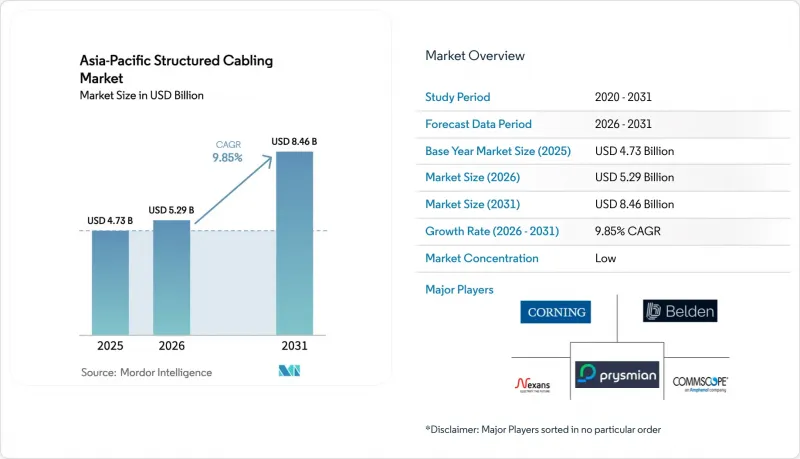
Mordor Intelligence에 따르면 아시아태평양의 구조화 배선 시장 규모는 2025년 47억 3,000만 달러에서 2026년에는 52억 9,000만 달러로 확대되고, 2026년부터 2031년까지 CAGR 9.85%로 성장하여 2031년에는 84억 6,000만 달러에 달할 것으로 예측됩니다.
본 보고서는 제공 내용(하드웨어, 서비스, 소프트웨어), 케이블 종류(구리선, 광섬유), 케이블 카테고리 규격(Cat 5e, Cat 6), 용도(LAN, 데이터센터,FTTx/캠퍼스 백본, 산업용 자동화 네트워크), 최종사용자 산업(IT·통신, 클라우드·코로케이션 데이터센터, BFSI 등), 및 지역별로 분류되어 있습니다. 시장 예측은 금액(달러) 기준으로 제시되어 있습니다.
아시아태평양 구조화 배선 시장의 동향 및 인사이트
하이퍼스케일 및 엣지 데이터센터 구축 가속화
하이퍼스케일 제공업체의 투자액은 동남아시아, 인도, 호주 전체에서 500억 달러를 초과하고 있습니다. AWS, Google, Microsoft, Alibaba Cloud, Oracle은 각각 144개 또는 288개의 광섬유를 갖춘 MPO 트렁크 및 Cat 6 탑 오브 랙 링크를 채택한 수 기가와트 규모의 캠퍼스를 운영하고 있습니다. 하이데라바드, 청두, 호치민시 등 2선 도시에서의 건설 증가는 스트리밍 및 게임 애플리케이션의 지연 시간을 단축하고, 벤더의 사업 전개 가능 범위를 확대하고 있습니다. 5MW 미만의 엣지 시설에서는 사전 종단 처리된 솔루션을 채택하여 설치 시간을 최대 40% 단축하고 있으며, 이로 인해 통합 업체들은 현장 종단 처리보다 공장에서 조립된 카세트를 선호하게 되었습니다. 2025년에 싱가포르와 시드니의 인건비가 3.8% 상승함에 따라, 계약업체들은 성능을 저하시키지 않으면서 현장 작업 시간을 단축할 수 있는 설계를 적극적으로 모색하고 있습니다. 케이블, 랙, 케이블 관리 솔루션을 세트로 제공하는 부품 공급업체는 확실한 완료 일정을 요구하는 하이퍼스케일 테넌트의 프로젝트 리스크를 완화함으로써 시장 점유율을 확대하고 있습니다.
정부의 FTTH(Fiber-To-The-Home) 이니셔티브
인도의 ‘BharatNet’은 2,200억 인도 루피(26억 달러)의 예산 범위 내에서 2025년 12월까지 692,676km의 광섬유를 부설하고, 214,323개의 그람 판차야트를 연결했습니다. 태국, 인도네시아, 베트남도 유사한 청사진을 채택하고 있으며, 보편적 서비스 기금과 국내 조달 규정을 결합함으로써 사이클론이 빈번한 지역에서 납기일을 준수할 수 있는 현지 제조업체와의 계약 유도를 도모하고 있습니다. 이러한 정책으로 인해 단일 모드 광섬유 수요가 증가하고 융착 접속기 판매가 촉진될 뿐만 아니라, 지방 통신 사업자들은 몬순으로 인한 홍수에도 견딜 수 있는 견고한 클로저를 도입해야 하는 상황에 직면해 있습니다. 각국 정부의 광대역 계획은 2030년 이후까지 장기적으로 이어지기 때문에 구조화 배선 공급업체는 10년에 걸친 수익 전망이 확보되며, 데이터센터 투자에 따른 주기적인 변동에 대한 헤지 역할도 합니다. 또한, 이러한 노력은 다크 파이버 임대와 스마트 시티 활용 사례를 결합한 민관 파트너십을 촉진하여 지방 도시의 캠퍼스 백본 업그레이드를 가속화하고 있습니다.
엔터프라이즈 WLAN 및 5G FWA 솔루션 도입 확대
Wi-Fi Alliance는 2,500대 이상의 Wi-Fi 6E 기기를 인증했으며, 현장 테스트 결과 평균 처리량이 1.7 Gbps를 상회하는 것으로 나타났습니다. 이에 따라 많은 사무실 설계 담당자들이 새로운 수평 케이블 배선 필요성을 줄여주는 ‘무선 우선(Wireless First)’ 전략을 채택하고 있습니다. 인도, 인도네시아, 필리핀의 통신 사업자들은 현재 100-300 Mbps의 5G 고정 무선 패키지를 판매하고 있으며, 릴라이언스 지오(Reliance Jio)만 해도 2025년 중 11만 5,000대의 FWA 단말기를 가동할 예정입니다. 이를 통해 비용 효율성을 중시하는 지역에서 라스트 마일의 구리선이나 광섬유를 우회할 수 있게 됩니다. 시스코의 벤치마크에 따르면, Wi-Fi 6E 액세스 포인트의 소비 전력은 약 28와트이며 90와트의 PoE 스위치 포트가 필요하지만, 층당 케이블 설치 개수는 여전히 적어, 이로 인해 중소규모 사무실에서의 Cat 6 수요가 억제되고 있습니다. 시스템 통합업체의 보고에 따르면, 개보수 프로젝트의 배선 예산 중 구리선 엔드포인트에 할당되는 비율은 2022년 45%에서 현재 25%로 감소했으며, 그만큼의 예산이 애그리게이션 링크 및 네트워크 서비스로 전환되고 있습니다. 데이터센터나 하이퍼스케일 환경은 고밀도 랙이 파이버 트렁크에 의존하고 있기 때문에 영향을 덜 받는 상황이 지속되고 있지만, 사무실 내 도입 감소는 호주, 태국, 그리고 인도의 도시 지역에 위치한 구조화 배선 벤더들에게 큰 역풍이 되고 있습니다.
부문 분석
아시아태평양의 구조화 배선 시장에서 하드웨어 시장 규모는 2025년에 33억 4,000만 달러에 달하여 총 지출의 63.12%를 차지했습니다. 이는 신축(그린필드) 예산에서 구리선 쌍, 광섬유 트렁크, 모듈러 패널 및 케이블 관리 시스템이 주류를 이루고 있기 때문입니다. 한편, 설계 및 설치 서비스는 연평균 성장률(CAGR) 10.22%로 성장하고 있습니다. 이는 기업들이 90와트 PoE, 10GBASE-T 처리량 및 Wi-Fi 6E 백홀을 지원하기 위해 기존 배선을 업그레이드해야 하기 때문입니다. 이러한 서비스의 급속한 성장은 BICSI Installer 2 인증을 받은 계약업체에 혜택을 주고 있으며, 해당 자격을 통해 하이퍼스케일 테넌트를 위한 조달 주기가 단축되고 있습니다. 각 벤더는 실측도 및 열 시뮬레이션을 유지보수 계약에 포함하고 있으며, 해당 계약 기간은 현재 7년에 달합니다. 이는 랙 밀도의 증가와 인도네시아 및 인도에서 숙련된 기술자 부족을 반영한 것입니다.
소프트웨어 매출에서 차지하는 비중은 여전히 미미하지만, 하이퍼스케일 기업들이 케이블 재고를 자동화하고 평균 수리 시간(MTTR)을 최대 40% 단축하려고함에 따라 그 중요성은 커지고 있습니다. Fluke 및 Viavi의 인증 장비에서 직접 테스트 결과를 가져오는 플랫폼은 ISO 준수 인도 패키지를 몇 분 만에 생성하여 관리 업무의 부담을 덜어줍니다. 하이브리드형 건설·운영 계약이 등장하면서, 통합 업체가 5년 동안의 가동률을 책임짐으로써 설치 후 단계에서도 지속적인 수익이 확보되고 있습니다. 아시아태평양의 구조화 배선 시장에서는 케이블 배선도에 디지털 트윈 기능을 중첩하여 PoE 스위치 포트 및 파이버 채널의 사용 현황에 대한 예측 유지보수를 가능하게 하는 부가가치 리셀러에게 비즈니스 기회가 생기고 있습니다.
광섬유는 2025년 시장 가치의 56.41%를 차지하며, 연평균 성장률(CAGR) 10.97%로 확대되고 있습니다. 이는 AI 클러스터 내의 스파인-리프 아키텍처에서 400G 이상의 광 모듈과 300미터를 초과하는 링크 버전을 유지할 수 있는 단일 모드 트렁크가 요구되기 때문입니다. OM4 및 OM5 멀티 모드는 여전히 서버 열 내의 단거리 링크에 사용되고 있지만, 하이퍼스케일러 기업들은 예비 부품의 표준화를 도모하기 위해 점점 더 싱글모드로의 전환을 추진하고 있습니다. 구리선은 수평 배선이나 Cat 6 차폐 케이블이 전자기 간섭에 내성을 갖는 산업 플랜트에서 여전히 중요한 역할을 하고 있습니다. 구리 가격의 급등과 칠레, 페루, 콩고 민주 공화국에서의 광업 집중화로 인해 가격 변동이 심화되고 있어, 예산에 제약이 있는 LAN에서는 알루미늄 피복 구리선이 매력적인 선택지가 되고 있습니다.
커넥터 기술도 이에 발맞춰 진화하고 있습니다. 데이터센터 패칭에서는 여전히 LC 듀플렉스가 주류를 이루고 있지만, 16파이버 MPO 및 새롭게 등장한 SN 인터페이스를 통해 800G 스위치의 포트 수가 감소하고 밀도 향상이 촉진되고 있습니다. 사전 종단 처리된 어셈블리는 설치 작업의 노동력을 25-35% 절감합니다. 이는 동남아시아에서 만성적인 인력 부족이 지속되는 가운데 중요한 판매 포인트가 되고 있습니다. 광섬유는 구리에 비해 원자재 가격 변동이 적기 때문에 장기적인 계획을 수립하는 통신 사업자들은 비용 리스크를 헤지하기 위해 싱글 모드를 선호하고 있으며, 이로 인해 아시아태평양의 구조화 배선 시장에서 광 연결의 시장 점유율 우위가 더욱 강화되고 있습니다.
기타 혜택:
- 엑셀 형식의 시장 예측(ME) 시트
- 3개월간의 애널리스트 지원
자주 묻는 질문
목차
제1장 소개
제2장 조사 방법
제3장 주요 요약
제4장 시장 구도
제5장 시장 규모와 성장 예측
제6장 경쟁 구도
제7장 시장 기회와 향후 전망
KSM 26.08.26According to Mordor Intelligence, the Asia-Pacific structured cabling market size is expected to grow from USD 4.73 billion in 2025 to USD 5.29 billion in 2026 and is forecast to reach USD 8.46 billion by 2031 at 9.85% CAGR over 2026-2031.
This report is Segmented by Offering (Hardware, Services, and Software), Cable Type (Copper, and Fiber), Cable Category Standard (Cat 5e, and Cat 6), Application (LAN, Data Center, FTTx/Campus Backbone, and Industrial Automation Networks), End-User Industry (IT and Telecom, Cloud and Colocation Data Centers, BFSI, and More), and Geography. Market Forecasts are Provided in Terms of Value (USD).
Asia-Pacific Structured Cabling Market Trends and Insights
Accelerating Hyperscale And Edge Data-Center Build-Outs
Investments from hyperscale providers exceed USD 50 billion across Southeast Asia, India, and Australia, with AWS, Google, Microsoft, Alibaba Cloud, and Oracle each commissioning multigigawatt campuses that rely on 144- or 288-fiber MPO trunks and Cat 6 top-of-rack links. Rising construction in secondary cities such as Hyderabad, Chengdu, and Ho Chi Minh City shortens latency for streaming and gaming applications and enlarges the addressable footprint for vendors. Edge facilities under 5 MW use pre-terminated solutions to cut installation time by up to 40%, leading integrators to favor factory-assembled cassettes over field terminations. Because labor costs in Singapore and Sydney rose 3.8% in 2025, contractors actively seek designs that trim onsite hours without sacrificing performance. Component suppliers that bundle cabling, racks, and cable management gain share by mitigating project risk for hyperscale tenants that demand reliable completion schedules.
Government Fiber-To-The-Home Initiatives
India's BharatNet installed 692,676 km of optical fiber and connected 214,323 gram panchayats by December 2025 under a INR 220 billion (USD 2.6 billion) allocation. Thailand, Indonesia, and Vietnam follow similar blueprints that pair universal service funds with domestic-content rules, steering contracts toward local manufacturers that meet delivery windows in cyclone-prone regions. These mandates elevate single-mode fiber demand, spur fusion splicer sales, and push rural operators to adopt hardened closures that withstand monsoon flooding. Because sovereign broadband plans stretch to 2030 and beyond, structured cabling vendors lock in decade-long revenue visibility and hedge against cyclical data-center spending. The initiatives also foster public-private partnerships that bundle dark-fiber leases with smart-city use cases, accelerating campus backbone upgrades in provincial towns.
Rising Adoption Of Enterprise WLAN And 5G FWA Solutions
Wi-Fi Alliance has certified more than 2,500 Wi-Fi 6E devices, and field trials show average throughputs above 1.7 Gbps, prompting many office planners to adopt a wireless-first strategy that trims the need for new horizontal cable drops. Telcos in India, Indonesia, and the Philippines now market 100-300 Mbps 5G fixed wireless packages, with Reliance Jio alone activating 115,000 FWA terminals during 2025, thereby bypassing last-mile copper or fiber in cost-sensitive locations. Cisco benchmarks indicate that Wi-Fi 6E access points draw roughly 28 watts, requiring 90-watt PoE switch ports but still fewer cable runs per floor, which compresses demand for Cat 6 in small and midsize offices. Systems integrators report that renovation projects now devote only 25% of cabling budgets to copper endpoints compared with 45% in 2022, redirecting spend toward aggregation links and network services. While data-center and hyperscale environments remain insulated because high-density racks depend on fiber trunks, reduced office installations constitute a meaningful headwind for structured-cabling vendors in Australia, Thailand, and urban India.
Other drivers and restraints analyzed in the detailed report include:
- Surge In PoE And Remote Powering Requirements
- Low-Latency Demand For AI And ML Cluster Interconnects
- Supply-Chain Volatility In Copper And Optical Fiber
For complete list of drivers and restraints, kindly check the Table Of Contents.
Segment Analysis
The Asia-Pacific structured cabling market size for hardware reached USD 3.34 billion in 2025, equal to 63.12% of total spend, thanks to copper pairs, fiber trunks, modular panels, and cable management systems that dominate greenfield budgets. Design and installation services, however, are growing at a 10.22% CAGR because enterprises must upgrade legacy cabling to support 90-watt PoE, 10GBASE-T throughput, and Wi-Fi 6E backhaul. This service boom benefits contractors certified under BICSI Installer 2, whose credentials shorten procurement cycles for hyperscale tenants. Vendors bundle as-built documentation and thermal simulation into maintenance contracts that now stretch seven years, reflecting higher rack densities and the scarcity of skilled technicians in Indonesia and India.
Software remains a sliver of revenue but is ascending as hyperscalers automate cable inventories to lower mean-time-to-repair by up to 40%. Platforms that ingest test results directly from Fluke or Viavi certifiers produce ISO-compliant handover packs in minutes, trimming administrative labor. Hybrid build-operate agreements are emerging, where integrators assume responsibility for uptime over a five-year horizon, thus embedding recurring revenue during the post-installation phase. The Asia-Pacific structured cabling market creates room for value-added resellers that overlay digital twin capabilities onto cabling blueprints, enabling predictive maintenance on PoE switch ports and fiber-channel utilization.
Fiber captured 56.41% of 2025 value and is expanding at a 10.97% CAGR because spine-leaf architectures inside AI clusters demand 400G-plus optics and single-mode trunks that sustain link budgets beyond 300 meters. OM4 and OM5 multimode still serve short-reach links inside server rows, yet hyperscalers increasingly leapfrog to single-mode to standardize spares. Copper retains relevance in horizontal runs and industrial plants where Cat 6 shielded cable tolerates electromagnetic interference. Rising copper prices and mining concentration in Chile, Peru, and the Democratic Republic of the Congo amplify price swings, making aluminum-clad copper attractive for budget-constrained LANs.
Connector technology evolves in tandem: LC duplex still dominates data-center patching, but 16-fiber MPO and emerging SN interfaces shrink port counts on 800G switches, driving density gains. Pre-terminated assemblies reduce installer labor by 25-35%, a key selling point amid chronic talent shortages in Southeast Asia. Because fiber boasts lower raw-material volatility than copper, telcos with long planning horizons prefer single-mode to hedge cost risk, reinforcing the Asia-Pacific structured cabling market share advantage for optical connectivity.
Complete Report Scope:
- By Offering
- Hardware
- Cabling (Copper, Fiber)
- Connectivity (Connectors, Patch-Panels, Jacks, Cords)
- Racks, Cabinets and Cable Management
- Services
- Design and Consulting
- Installation and Integration
- Maintenance and Support
- Software
- Hardware
- By Cable Type
- Copper
- Copper Cable
- Copper Connectivity
- Fiber
- Single-Mode Cable
- Multi-Mode Cable
- Fiber Connectivity
- Copper
- By Cable Category Standard
- Cat 5e
- Cat 6
- By Application
- LAN
- Data Center
- FTTx / Campus Backbone
- Industrial Automation Networks
- By End-User Industry
- IT and Telecom Service Providers
- Cloud and Colocation Data Centers
- BFSI and Enterprise Offices
- Healthcare Facilities
- Government and Defense
- Manufacturing and Industrial
- Education
- By Geography
- Asia-Pacific
- China
- India
- Japan
- South Korea
- ASEAN
- Australia
- New Zealand
- Rest of Asia-Pacific
- Asia-Pacific
List of Companies Covered in this Report:
- CommScope Holding Company Inc.
- Corning Incorporated
- Nexans SA
- Prysmian Group SpA
- Belden Inc.
- Legrand SA
- Schneider Electric SE
- Panduit Corp.
- TE Connectivity Ltd.
- Furukawa Electric Co. Ltd.
- Superior Essex Inc.
- The Siemon Company
- Datwyler IT Infra AG
- Reichle & De-Massari AG
- LS Cable & System Ltd.
- Sumitomo Electric Industries Ltd.
- ABB Ltd.
- Rosenberger Hochfrequenztechnik GmbH & Co. KG
- Molex LLC (Koch Industries Inc.)
- General Cable Corporation
Additional Benefits:
- The market estimate (ME) sheet in Excel format
- 3 months of analyst support
TABLE OF CONTENTS
1 INTRODUCTION
- 1.1 Study Assumptions and Market Definition
- 1.2 Scope of the Study
2 RESEARCH METHODOLOGY
3 EXECUTIVE SUMMARY
4 MARKET LANDSCAPE
- 4.1 Market Overview
- 4.2 Market Drivers
- 4.2.1 Accelerating Hyperscale and Edge Data-Center Build-Outs
- 4.2.2 Surge in PoE and Remote Powering Requirements
- 4.2.3 Increasing Retrofits for Smart Buildings and Campuses
- 4.2.4 Government Fiber-to-the-Home (FTTH) Initiatives
- 4.2.5 Low-Latency Demand for AI/ML Cluster Interconnects
- 4.2.6 Convergence of OT/IT Cabling in Industry 4.0 Factories
- 4.3 Market Restraints
- 4.3.1 Rising Adoption of Enterprise WLAN/5G FWA Solutions
- 4.3.2 Complex Standards Compliance and Testing Costs
- 4.3.3 Supply-Chain Volatility in Copper and Optical Fiber
- 4.3.4 Cap-Ex Deferrals Due to Cloud Colocation Shift
- 4.4 Industry Value-Chain Analysis
- 4.5 Regulatory Landscape
- 4.6 Technological Outlook
- 4.7 Porter's Five Forces Analysis
- 4.7.1 Bargaining Power of Suppliers
- 4.7.2 Bargaining Power of Buyers
- 4.7.3 Threat of New Entrants
- 4.7.4 Threat of Substitutes
- 4.7.5 Competitive Rivalry
- 4.8 Impact Assessment of Key Stakeholders
- 4.9 Key Use Cases and Case Studies
- 4.10 Impact of Macroeconomic Factors on the Market
- 4.11 Investment Analysis
5 MARKET SIZE AND GROWTH FORECASTS
- 5.1 By Offering
- 5.1.1 Hardware
- 5.1.1.1 Cabling (Copper, Fiber)
- 5.1.1.2 Connectivity (Connectors, Patch-Panels, Jacks, Cords)
- 5.1.1.3 Racks, Cabinets and Cable Management
- 5.1.2 Services
- 5.1.2.1 Design and Consulting
- 5.1.2.2 Installation and Integration
- 5.1.2.3 Maintenance and Support
- 5.1.3 Software
- 5.1.1 Hardware
- 5.2 By Cable Type
- 5.2.1 Copper
- 5.2.1.1 Copper Cable
- 5.2.1.2 Copper Connectivity
- 5.2.2 Fiber
- 5.2.2.1 Single-Mode Cable
- 5.2.2.2 Multi-Mode Cable
- 5.2.2.3 Fiber Connectivity
- 5.2.1 Copper
- 5.3 By Cable Category Standard
- 5.3.1 Cat 5e
- 5.3.2 Cat 6
- 5.4 By Application
- 5.4.1 LAN
- 5.4.2 Data Center
- 5.4.3 FTTx / Campus Backbone
- 5.4.4 Industrial Automation Networks
- 5.5 By End-User Industry
- 5.5.1 IT and Telecom Service Providers
- 5.5.2 Cloud and Colocation Data Centers
- 5.5.3 BFSI and Enterprise Offices
- 5.5.4 Healthcare Facilities
- 5.5.5 Government and Defense
- 5.5.6 Manufacturing and Industrial
- 5.5.7 Education
- 5.6 By Geography
- 5.6.1 Asia-Pacific
- 5.6.1.1 China
- 5.6.1.2 India
- 5.6.1.3 Japan
- 5.6.1.4 South Korea
- 5.6.1.5 ASEAN
- 5.6.1.6 Australia
- 5.6.1.7 New Zealand
- 5.6.1.8 Rest of Asia-Pacific
- 5.6.1 Asia-Pacific
6 COMPETITIVE LANDSCAPE
- 6.1 Market Concentration
- 6.2 Strategic Moves
- 6.3 Market Share Analysis
- 6.4 Company Profiles (includes Global Level Overview, Market Level Overview, Core Segments, Financials As Available, Strategic Information, Market Rank/Share For Key Companies, Products and Services, and Recent Developments)
- 6.4.1 CommScope Holding Company Inc.
- 6.4.2 Corning Incorporated
- 6.4.3 Nexans SA
- 6.4.4 Prysmian Group SpA
- 6.4.5 Belden Inc.
- 6.4.6 Legrand SA
- 6.4.7 Schneider Electric SE
- 6.4.8 Panduit Corp.
- 6.4.9 TE Connectivity Ltd.
- 6.4.10 Furukawa Electric Co. Ltd.
- 6.4.11 Superior Essex Inc.
- 6.4.12 The Siemon Company
- 6.4.13 Datwyler IT Infra AG
- 6.4.14 Reichle & De-Massari AG
- 6.4.15 LS Cable & System Ltd.
- 6.4.16 Sumitomo Electric Industries Ltd.
- 6.4.17 ABB Ltd.
- 6.4.18 Rosenberger Hochfrequenztechnik GmbH & Co. KG
- 6.4.19 Molex LLC (Koch Industries Inc.)
- 6.4.20 General Cable Corporation
7 MARKET OPPORTUNITIES AND FUTURE OUTLOOK
- 7.1 White-Space and Unmet-Need Assessment