

|
시장보고서
상품코드
2117279
중동 및 아프리카의 카본블랙 시장 : 시장 점유율 분석, 업계 동향 및 통계, 성장 예측(2026-2031년)Middle-East And Africa Carbon Black - Market Share Analysis, Industry Trends & Statistics, Growth Forecasts (2026 - 2031) |
||||||
 Mordor Intelligence
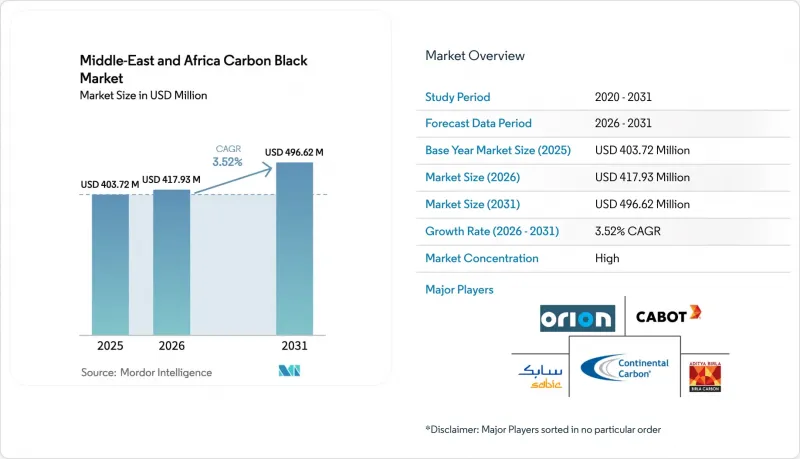
Mordor Intelligence에 의하면, 중동 및 아프리카의 카본블랙 시장 규모는 2025년 4억 372만 달러로 평가되었고, 2026년에는 4억 1,793만 달러로 추정되고, 2026-2031년 CAGR 3.52%로 성장을 지속할 전망이며, 2031년에는 4억 9,662만 달러에 이를 것으로 예측됩니다.
본 보고서는 공정 유형별(퍼니스 블랙, 가스 블랙, 램프 블랙, 기타), 용도별(타이어·산업용 고무 제품, 플라스틱, 토너·인쇄용 잉크, 페인트 및 코팅, 기타), 지역별(사우디아라비아, 아랍에미리트, 카타르, 쿠웨이트, 튀르키예, 남아프리카공화국, 이집트, 나이지리아, 기타)로 분류되어 있습니다. 시장 전망은 금액(달러) 기준으로 제시되어 있습니다.
중동 및 아프리카의 카본블랙 시장 동향 및 인사이트
섬유·텍스타일 산업에서의 용도 확대
첨단 섬유 개질 기술을 통해 현재 카본블랙 안료가 접목되어 황색포도상구균 및 대장균에 대한 항균 보호 효과를 발휘하고 있으며, 이를 통해 지역 방적 공장은 의료·위생용 섬유를 공급할 수 있게 되었습니다. 튀르키예는 이러한 기술을 제12차 개발 계획의 환경 목표와 연계함으로써 혜택을 보고 있는 반면, 이집트의 석유화학 단지는 업스트림 원료를 확보하고 있습니다. 나일론, 폴리에스터, 아크릴 섬유에 카본블랙을 배합함으로써 수요는 범용 의류에서 더 높은 부가가치를 지닌 기능성 섬유로 확대되고 있습니다. 브랜드들이 추적 가능성과 지속가능성을 갖춘 원료를 요구하는 가운데, 특수 블랙 등급의 카본블랙은 가격 결정력을 높여 장기 계약을 확보하고 있습니다.
자동차·타이어 부문의 확대
사우디아라비아의 킹 압둘라 경제 도시에 건설되는 5억 5,000만 달러 규모의 피렐리 공장은 2026년부터 연간 350만 개의 승용차용 타이어를 생산하여, 향후 20년 동안 퍼니스 등급 카본블랙 수요를 확보하게 될 것입니다. 현지 생산은 전기차 차체, 배터리 부품, 씰 시스템으로 확대되고 있으며, 이 모든 분야에 맞춤형 카본블랙 분산액이 채택되고 있습니다. 튀르키예는 EU와의 지리적 근접성을 활용하여 배기가스 규제를 준수하는 타이어 제품 라인을 공급하고 있는 반면, 아랍에미리트는 석유화학 중간체를 합성 고무로 전용하고 있습니다. 걸프 지역 및 아프리카 전역의 건설 및 광업 프로젝트로 인해 오프로드용 타이어 수요가 더욱 확대되면서, 내마모성 보강용 카본블랙의 안정적인 출하가 뒷받침되고 있습니다. 이러한 동향들이 종합적으로 작용함에 따라, 차량의 전동화가 소재 구성을 변화시키고 있는 상황에서도 장기적인 기초 소비량은 견조하게 유지되고 있습니다.
실리카계 ‘친환경’ 타이어로의 전환 가속화
구름 저항 감소를 요구하는 OEM의 요청에 따라, 카본블랙 대신 연료 소비량을 최대 7% 절감하는 침전 실리카나 실란 커플링제로의 대체가 진행되고 있습니다. 실리카는 젖은 노면 그립력을 향상시키지만, 타이어 재활용을 복잡하게 하고 컴파운드 비용을 상승시키기 때문에 튀르키예 공장에서는 믹서 개조 및 조달 물류 재검토가 시급한 상황입니다. 이러한 전환은 GCC 전역의 승용차 트레드에 사용되는 퍼니스 블랙의 기본 수요를 위협하고 있습니다. 이에 대응하여 각 제조업체들은 하이브리드 필러 시스템의 공동 개발을 추진하는 한편, 보강 기능을 유지하는 사이드월 및 내부 라이너용 특수 카본블랙 부문으로 사업을 확대되고 있습니다.
부문 분석
퍼니스 블랙은 2025년에 지역 매출의 71.62%를 차지한 것으로 평가되었으며, 폐열 회수 및 SOx 배출량 감축을 목적으로 한 설비 개보수에 힘입어 2031년까지 연평균 성장률(CAGR) 4.31%로 확대될 것으로 전망됩니다. 사우디아라비아와 아랍에미리트의 생산자들은 스팀 크래커에서 생산된 자체 원료를 활용하여 연속 가동과 엄격한 입자 크기 관리를 유지하고 있습니다. 가스 블랙은 고광택 잉크 및 리튬 이온 배터리용 전극 분야에서 틈새 시장 지위를 유지하고 있으나, 반응 장치의 복잡성으로 인해 공급은 여전히 제한되고 있습니다. 램프 블랙은 전자상거래에 따른 캔 생산량 증가의 호재를 타고, 금속 포장용 잉크 및 코팅 부문에서 꾸준히 성장하고 있습니다. 써멀 블랙과 아세틸렌 블랙은 전선 및 케이블의 절연재에 특수한 전도성을 제공합니다. 제조 공정의 현황은 배출 규제의 강화에 대응하면서도 부산물을 수익화할 수 있는 통합형 정제 업체에 유리하게 작용하고 있습니다.
기타 혜택
- 엑셀 형식 시장 예측(ME) 시트
- 3개월간의 애널리스트 지원
자주 묻는 질문
목차
제1장 서론
제2장 조사 방법
제3장 개요
제4장 시장 구도
제5장 시장 규모 및 성장 예측
제6장 경쟁 구도
제7장 시장 기회 및 향후 전망
AJY 26.09.01According to Mordor Intelligence, the middle-East and Africa Carbon Black Market size is expected to grow from USD 403.72 million in 2025 to USD 417.93 million in 2026 and is forecast to reach USD 496.62 million by 2031 at 3.52% CAGR over 2026-2031.
This report is Segmented by Process Type (Furnace Black, Gas Black, Lamp Black, and More), Application (Tires and Industrial Rubber Products, Plastics, Toners and Printing Inks, Paints and Coatings, and More), and Geography (Saudi Arabia, United Arab Emirates, Qatar, Kuwait, Turkey, South Africa, Egypt, Nigeria, and More). The Market Forecasts are Provided in Terms of Value (USD).
Middle-East And Africa Carbon Black Market Trends and Insights
Growing Application in Fiber and Textile Industries
Advanced fiber-modification techniques now embed carbon black pigments that deliver antimicrobial protection against Staphylococcus aureus and Escherichia coli, helping regional mills supply healthcare and hygiene fabrics. Turkey benefits by aligning these technologies with its Twelfth Development Plan green mandates, while Egypt's petrochemical complex secures upstream feedstock. The integration of carbon black in nylon, polyester, and acrylic fibers spreads demand beyond commodity apparel into higher-value technical textiles. As brands pursue traceable and sustainable inputs, specialty black grades gain pricing power and longer contracts.
Expansion of Automotive and Tire Sector
Saudi Arabia's USD 550 million Pirelli plant in King Abdullah Economic City will roll out 3.5 million passenger tires annually from 2026, locking in furnace-grade volumes for two decades. Localization extends into electric-vehicle housings, battery components, and sealing systems, all of which employ tailored carbon black dispersions. Turkey leverages EU proximity to supply emission-compliant tire lines, while the United Arab Emirates channels petrochemical intermediates into synthetic rubber. Construction and mining projects across the Gulf and Africa further enlarge off-highway tire demand, reinforcing steady shipments of abrasion-resistant reinforcement blacks. Collectively, these dynamics anchor long-term baseline consumption even as vehicle electrification reshapes materials mixes.
Accelerating Switch to Silica-Based "Green" Tires
OEM mandates for lower rolling resistance drive the replacement of carbon black with precipitated silica and silane coupling agents that cut fuel consumption by as much as 7%. While silica improves wet grip, it complicates tire recycling and raises compounding costs, forcing Turkish plants to retrofit mixers and sourcing logistics. The transition threatens baseline demand for furnace blacks used in passenger car treads across the GCC. Producers respond by co-developing hybrid filler systems and expanding into specialty blacks for sidewalls and inner liners that retain reinforcement roles.
Other drivers and restraints analyzed in the detailed report include:
- Surge in Conductive Carbon Black for Li-ion Battery Gigafactories
- Recovered Carbon Black Uptake in Circular-Economy Road Projects
- Volatile Feedstock Pricing and Supply Risk
For complete list of drivers and restraints, kindly check the Table Of Contents.
Segment Analysis
Furnace Black contributed 71.62% of regional revenue in 2025 and is projected to expand at 4.31% CAGR through 2031, supported by retrofits that recover waste heat and lower SOx emissions. Producers in Saudi Arabia and the United Arab Emirates leverage captive feedstock from steam crackers to maintain continuous operations and tight particle-size control. Gas Black retains niche status for high-jetness inks and Li-ion electrodes, yet supply remains constrained by reactor complexity. Lamp Black grows steadily in inks and coatings for metal packaging, benefiting from e-commerce-driven canning volumes. Thermal Black and Acetylene Black provide specialty conductivity in wire and cable insulation. The process landscape favors integrated refiners able to monetize by-product streams while meeting tightening emission caps.
Complete Report Scope:
- By Process Type
- Furnace Black
- Gas Black
- Lamp Black
- Thermal Black
- Hexamine
- By Application
- Tires and Industrial Rubber Products
- Plastics
- Films and Sheets
- Pressure Pipes
- Molded Parts
- Toners and Printing Inks
- Paints and Coatings
- Textile Fibres
- Nylon
- Polyester
- Acrylic
- Other Applications (Energy Storage Materials, etc.)
- By Geography
- Saudi Arabia
- United Arab Emirates
- Qatar
- Kuwait
- Turkey
- South Africa
- Egypt
- Nigeria
- Morocco
- Rest of Middle-East and Africa
- Saudi Arabia
List of Companies Covered in this Report:
- ADNOC (Abu Dhabi National Oil Co.)
- Balkrishna Industries Ltd.
- Birla Carbon
- Cabot Corporation
- Continental Carbon Company
- Datwyler Holding Inc.
- Epsilon Carbon Private Limited.
- Himadri Speciality Chemicals Limited
- Imerys
- Omsk Carbon Group
- Orion S.A
- PCBL Chemical Limited
- SABIC
Additional Benefits:
- The market estimate (ME) sheet in Excel format
- 3 months of analyst support
TABLE OF CONTENTS
1 Introduction
- 1.1 Study Assumptions and Market Definition
- 1.2 Scope of the Study
2 Research Methodology
3 Executive Summary
4 Market Landscape
- 4.1 Market Overview
- 4.2 Market Drivers
- 4.2.1 Growing Application in Fiber and Textile Industries
- 4.2.2 Expansion of Automotive and Tire Sector
- 4.2.3 Surge in Conductive Carbon Black for Li-ion Battery Gigafactories
- 4.2.4 Recovered Carbon Black Uptake in Circular-Economy Road Projects
- 4.2.5 Increasing Market Penetration of Specialty Black
- 4.3 Market Restraints
- 4.3.1 Accelerating Switch to Silica-Based "Green" Tires
- 4.3.2 Volatile Feedstock Pricing and Supply Risk
- 4.3.3 Competition from Low-Cost Asian Imports
- 4.4 Value Chain Analysis
- 4.5 Porter's Five Forces
- 4.5.1 Bargaining Power of Suppliers
- 4.5.2 Bargaining Power of Buyers
- 4.5.3 Threat of New Entrants
- 4.5.4 Threat of Substitutes
- 4.5.5 Degree of Competition
5 Market Size and Growth Forecasts (Value)
- 5.1 By Process Type
- 5.1.1 Furnace Black
- 5.1.2 Gas Black
- 5.1.3 Lamp Black
- 5.1.4 Thermal Black
- 5.1.5 Hexamine
- 5.2 By Application
- 5.2.1 Tires and Industrial Rubber Products
- 5.2.2 Plastics
- 5.2.2.1 Films and Sheets
- 5.2.2.2 Pressure Pipes
- 5.2.2.3 Molded Parts
- 5.2.3 Toners and Printing Inks
- 5.2.4 Paints and Coatings
- 5.2.5 Textile Fibres
- 5.2.5.1 Nylon
- 5.2.5.2 Polyester
- 5.2.5.3 Acrylic
- 5.2.6 Other Applications (Energy Storage Materials, etc.)
- 5.3 By Geography
- 5.3.1 Saudi Arabia
- 5.3.1.1 United Arab Emirates
- 5.3.1.2 Qatar
- 5.3.1.3 Kuwait
- 5.3.1.4 Turkey
- 5.3.1.5 South Africa
- 5.3.1.6 Egypt
- 5.3.1.7 Nigeria
- 5.3.1.8 Morocco
- 5.3.1.9 Rest of Middle-East and Africa
- 5.3.1 Saudi Arabia
6 Competitive Landscape
- 6.1 Market Concentration
- 6.2 Strategic Moves
- 6.3 Market Share(%)/Ranking Analysis
- 6.4 Company Profiles (includes Global level Overview, Market level overview, Core Segments, Financials as available, Strategic Information, Market Rank/Share, Products and Services, Recent Developments)
- 6.4.1 ADNOC (Abu Dhabi National Oil Co.)
- 6.4.2 Balkrishna Industries Ltd.
- 6.4.3 Birla Carbon
- 6.4.4 Cabot Corporation
- 6.4.5 Continental Carbon Company
- 6.4.6 Datwyler Holding Inc.
- 6.4.7 Epsilon Carbon Private Limited.
- 6.4.8 Himadri Speciality Chemicals Limited
- 6.4.9 Imerys
- 6.4.10 Omsk Carbon Group
- 6.4.11 Orion S.A
- 6.4.12 PCBL Chemical Limited
- 6.4.13 SABIC
7 Market Opportunities and Future Outlook
- 7.1 White-space and Unmet-Need Assessment
- 7.2 Growth in the Adoption of Electric Cars and Self-driving Cars


