|
시장보고서
상품코드
2117307
블루 수소 시장 : 시장 점유율 분석, 업계 동향 및 통계, 성장 예측(2026-2031년)Blue Hydrogen - Market Share Analysis, Industry Trends & Statistics, Growth Forecasts (2026 - 2031) |
||||||
 Mordor Intelligence
Mordor Intelligence에 의하면, 블루 수소 시장 규모는 2026년에 81만 톤으로 추정되고, 예측 기간(2026-2031년) CAGR 57.64%로 확대될 것으로 예상되며, 2031년에는 789만 톤에 이를 전망입니다.
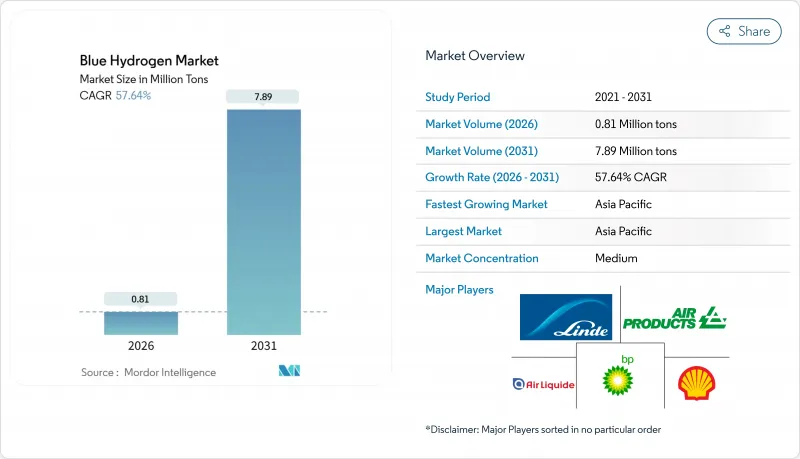
본 보고서는 기술별(수증기 메탄 개질 + CCS, 자가열 개질 + CCS, 가스 부분 산화 + CCS, 천연가스 열분해, 기타), 최종 사용자 산업별(정제, 화학, 철강, 운송, 기타 산업), 지역별(아시아태평양, 북미, 유럽, 남미, 중동 및 아프리카)로 분류되어 있습니다. 시장 예측은 수량(톤) 단위로 제시되어 있습니다.
세계의 블루 수소 시장 동향 및 인사이트
연료전지 전기차(FCEV)에서의 이용 급증
대형 트럭 부문에서는 실증 실험 단계를 벗어나고 있습니다. 니콜라(Nikola)는 2025년 상반기에 클래스 8 연료전지 트럭 72대를 납품할 예정이며, 현대자동차는 2027년까지 캘리포니아주와 스위스에서 총 1,600대의 ‘XCIENT’를 도입하겠다고 약속했습니다. 캘리포니아주의 저탄소 연료 기준(LCFS)에 따른 크레딧을 통해 90%의 CO2 포집율을 달성한 블루 수소는 경쟁력 있는 총 소유 비용(TCO)을 실현하고 있으며, 초기 차량 운영 사업자들은 수년에 걸친 공급 계약을 체결하고 있습니다. 해운 업계의 관심도 높아지고 있으며, 마르스크와 토탈에너지스는 로테르담에서 벙커링 시험을 완료하고 2028년 항로에서의 상용화를 목표로 하고 있습니다. 이러한 도입 기업들은 재생 에너지공급 과잉을 기다리지 않고 즉각적인 배출 규제 준수를 중시하고 있으며, 블루 수소 시장을 운송 부문의 전환점으로 이끌고 있습니다.
아시아 내 블루 암모니아 백홀 회랑의 확대
2024년 사우디 아람코(Saudi Aramco)에서 JERA로 이루어진 40톤 규모의 블루 암모니아 첫 선적은 암모니아 형태의 장거리 수소 수송의 상업적 실현 가능성을 입증했습니다. 한국의 포스코(POSCO)는 2028년까지 20만 톤의 수소 생산을 목표로 하는 크래킹 시설에 2025년에 12억 달러를 배정했습니다. 중동 생산자들은 블루 수소를 1kg당 1.20달러에 공급하고 있으며, 동북아시아에서는 1kg당 2.50달러 가까이 판매하고 있어, 이는 국내 그린 수소 공급에 비해 40%의 가격 경쟁력을 가지고 있습니다. 이 경로는 재생에너지 부지 확보에 제약이 있음에도 불구하고, 일본과 한국의 2030년 수소 목표를 달성 가능하게 하며, 블루 수소 시장에 장기적인 무역 경로를 확립하고 있습니다.
그레이 수소에 비해 높은 생산 비용
보조금이 없는 블루 수소의 가격은 1kg당 1.80-2.50달러인 반면, 가스가 풍부한 지역의 그레이 수소 가격은 1.00-1.30달러로, 40-90%의 가격 프리미엄이 유지되고 있습니다. EU의 탄소 가격이 톤당 80유로를 초과하면 그 차이는 10-20%로 축소되지만, 아시아의 구매자들은 여전히 가격에 민감합니다. SMR-CCS의 설비 투자액은 연간 생산 능력 1kg당 2.5-3달러로, 기존 SMR의 2배에 달할 전망입니다. 이는 주로 회수 설비 때문입니다. 소규모 산업 사용자는 이러한 비용을 상각할 수 없기 때문에 초기 도입은 정유시설, 암모니아, 철강 복합 시설로 제한되어 블루 수소 시장으로의 침투가 더딘 상황입니다.
부문 분석
CCS를 병용한 수증기 메탄 개질은 2025년에도 61.62%라는 압도적인 점유율을 유지할 전망입니다. 이는 정유시설이 기존 개질 설비를 개조함으로써, 신규 건설되는 ATR에 비해 40-50% 낮은 자본 비용으로 대응할 수 있기 때문입니다. 가스의 부분 산화는 높은 CO 열을 필요로 하는 석유화학 플랜트로만 국한되어 있으며, 천연가스 열분해는 아직 실용화 전 단계에 있습니다. 린데(Linde)사가 텍사스주에서 계획 중인 하이브리드형 SMR-ATR 플랜트는 회수 효율과 비용의 균형을 맞춘 현실적인 중간 방안을 제시하고 있습니다. CCS를 병용한 자가열식 개질(ATR)은 연평균 성장률(CAGR) 62.25%를 기록하며, 제조 공정 중 가장 빠른 성장이 예상됩니다. ATR은 산소 주입식 부분 산화와 고압 개질을 결합하여 95-98%의 CO₂ 회수율을 달성하고, 거의 순수한 CO₂ 스트림을 생성함으로써 용매 재생에 필요한 에너지를 대폭 절감합니다. 에어프로덕츠(Air Products)가 루이지애나주에 건설 예정인 70억 달러 규모의 복합 시설에서는 ATR을 채택해 연간 75만 톤의 수소를 생산하고, 500만 톤의 CO₂를 격리함으로써 IRA(인플레이션 억제법)의 티어 4 크레딧 획득을 목표로 하고 있습니다.
프로젝트의 경제성은 점점 더 보조금 제도에 좌우되고 있습니다. 탄소 크레딧을 최대한 확보할 수 있는 지역에서는 ATR이 우세하지만, 기존 시설과의 통합이라는 장점이 더 중요시되는 지역에서는 SMR을 통한 개조가 주류를 이루고 있습니다. 기술 라이선스 제공 기업 간의 경쟁은 격화되고 있습니다. 톱소(Topsoe)사는 건설 기간을 30% 단축하는 모듈식 SynCOR 유닛을 통해 2025년에 8건의 ATR 수주를 확보했습니다. 한편, 존슨 매세이사는 자사의 LCH 기술로 3건의 수주를 기록했으며, 이는 블루 수소 시장을 재편하는 기술 간의 도태가 진행되고 있음을 여실히 보여주고 있습니다.
지역별 분석
아시아태평양은 2025년 블루 수소 시장의 38.24%를 차지한 것으로 평가되었으며, 연평균 성장률(CAGR) 59.42%로 성장하여 지역별로는 가장 높은 성장 속도를 보일 것으로 전망됩니다. 중국은 2025년에 내몽골과 산시성의 3개 시설(수소 생산 능력 합계 18만 톤/년)을 가동하고, 이를 연간 120만 톤의 CO2 격리와 결합했습니다. 한국에서는 2026년에 첫 상용 크래킹 터미널이 가동을 시작하며, 부산과 광양이 지역 수입 허브로서의 입지를 확립할 전망입니다. 일본이 갱신한 수소 전략에서는 2030년까지 연간 300만 톤의 수입을 목표로 하고 있으며, 그 중 60%를 블루 암모니아에서 조달하고 기존 LNG 터미널을 하역에 활용할 방침입니다. 인도는 마투라에서 블루 수소의 시범 운영을 진행 중이지만, 2028년 이후 규모를 확대하기 위해서는 전국적인 탄소 가격 제도의 도입을 기다려야 합니다. kg당 1.20-1.50달러라는 경쟁력 있는 공급 비용 기준에 더해, 풍부한 CCS 적합지가 인증 지연으로 인해 유럽의 RFNBO 시장으로의 수출 접근이 제한된 상황에서도 아시아태평양의 비용 경쟁력을 뒷받침하고 있습니다.
북미에서는 IRA 45V 크레딧을 활용하여 지역 생산 능력의 대부분을 미국 내에서 확보하고 있습니다. 엑슨모빌(ExxonMobil)의 베이트타운 프로젝트와 에어프로덕츠(Air Products)의 루이지애나주 프로젝트를 합치면, 2028년까지 연간 150만 톤의 생산 능력이 추가될 것입니다. 캐나다 에드먼턴 지역에는 4개의 가동 시설이 있으며, ‘패스웨이즈 얼라이언스(Pathways Alliance)’를 통해 검증된 염수 대수층 저장을 활용하여 2030년까지 생산량을 3배로 확대할 계획입니다. 멕시코 진출은 현재로서는 시험적인 단계에 머물러 있습니다. 45V와 관련된 2032년 이후의 일몰 조항은 장기적인 정책 리스크를 야기하고 있으며, 승인되지 않은 계획의 40-50%가 무산될 가능성이 있습니다. 따라서 보조금의 지속성은 매우 중요한 변수가 됩니다.
유럽의 상황은 제각각입니다. RFNBO(재생에너지 의무)에 따라 수요는 보장되고 있지만, 가스 가격 급등과 메탄 인증 지연으로 인해 신규 프로젝트의 최종 투자 결정(FID)이 주춤하고 있습니다. 독일의 30억 유로 규모 기금은 현재 린데(Linde)사의 로이나(Leuna) 프로젝트와 유니파(Uniper)사의 빌헬름스하펜(Wilhelmshaven) 프로젝트만을 지원하고 있습니다. 영국의 하이넷(HyNet)과 이스트 코스트(East Coast) 클러스터는 1kg당 1.50파운드의 차액결제계약(CCP)에 따라 연간 8만 톤의 수소를 공급하고 있지만, 보다 광범위한 보급을 위해서는 CO₂ 저장 관련 책임 소재를 명확히 할 필요가 있습니다. 프랑스와 이탈리아는 그린 수소에 주력하고 있으며, 블루 수소에 대해서는 정유시설 개조를 통해 생산하고 있습니다. 중동 및 아프리카와 남미는 수출의 초기 단계에 있습니다. 사우디 아람코(Saudi Aramco)의 자프라(Jafra) 프로젝트는 2025년까지 연간 150만 톤의 블루 암모니아 생산으로 확대될 예정인 반면, 페트로브라스(Petrobras)는 브라질에서 CCS(이산화탄소 포집 및 저장)를 적용한 수소 시범 사업을 전개하고 있으며, 두 프로젝트 모두 동북아시아의 프리미엄 수요를 목표로 하고 있습니다.
기타 혜택
- 엑셀 형식 시장 예측(ME) 시트
- 3개월간의 애널리스트 지원
목차
제1장 서론
제2장 조사 방법
제3장 개요
제4장 시장 구도
제5장 시장 규모 및 성장 예측
제6장 경쟁 구도
제7장 시장 기회 및 향후 전망
AJYAccording to Mordor Intelligence, the blue hydrogen market size is estimated at 0.81 Million tons in 2026, and is expected to reach 7.89 Million tons by 2031, at a CAGR of 57.64% during the forecast period (2026-2031).
This report is Segmented by Technology (Steam Methane Reforming + CCS, Autothermal Reforming + CCS, Gas Partial Oxidation + CCS, Natural-Gas Pyrolysis, and More), End-User Industry (Refining, Chemicals, Iron and Steel, Transportation, and Other Industries), and Geography (Asia-Pacific, North America, Europe, South America, and Middle East and Africa). Market Forecasts are Provided in Terms of Volume (tons).
Global Blue Hydrogen Market Trends and Insights
Surging Application in Fuel-Cell Electric Vehicles
Heavy-duty trucking is moving beyond pilots. Nikola delivered 72 Class 8 fuel-cell trucks in 1H 2025, and Hyundai committed to 1,600 XCIENT units across California and Switzerland by 2027. California's Low Carbon Fuel Standard credits give blue hydrogen with 90% capture a competitive total cost of ownership, and early fleet operators lock in multi-year supply contracts. Maritime interest is rising as Maersk and TotalEnergies complete bunkering trials in Rotterdam, aiming for 2028 route commercialization. These adopters value immediate emissions compliance without waiting for renewable overbuild, pushing the blue hydrogen market toward transportation inflection.
Growing Blue-Ammonia Back-Haul Corridors in Asia
A first shipment of 40 tons of blue ammonia from Saudi Aramco to JERA in 2024 proved the commercial case for long-distance hydrogen carriage in ammonia form. South Korea's POSCO earmarked USD 1.2 billion in 2025 for cracking facilities targeting 200,000 tons of hydrogen by 2028. Middle-Eastern producers deliver blue hydrogen at USD 1.20 kg and sell into Northeast Asia near USD 2.50 kg, a 40% price advantage over domestic green supply. The corridor satisfies Japan and South Korea's 2030 hydrogen targets despite renewable-land constraints, embedding long-term trade lanes in the blue hydrogen market.
High Production Cost vs. Grey Hydrogen
Unsubsidized blue hydrogen ranges USD 1.80-2.50 kg versus USD 1.00-1.30 kg for grey in gas-rich regions, sustaining a 40-90% premium. EU carbon prices above EUR 80 t narrow the gap to 10-20%, but Asian buyers remain price-sensitive. SMR-CCS capex of USD 2.5-3.0 kg yr capacity is double conventional SMR, mainly from capture equipment. Small industrial users cannot amortize these costs, limiting early adoption to refineries, ammonia, and steel complexes and slowing penetration of the blue hydrogen market.
Other drivers and restraints analyzed in the detailed report include:
- Rising Demand from Chemical Feedstocks (Ammonia, Methanol)
- IRA 45V and EU RFNBO Incentives Compress Levelized Cost
- Energy-Intensity and Efficiency Losses
For complete list of drivers and restraints, kindly check the Table Of Contents.
Segment Analysis
Steam-methane reforming with CCS retains the bulk 61.62% share in 2025 because refineries can retrofit existing reformers at 40-50% lower capital cost than greenfield ATR. Gas partial oxidation remains confined to petrochemical sites needing high-CO heat, while natural-gas pyrolysis is pre-commercial. Linde's planned hybrid SMR-ATR plant in Texas signals a pragmatic middle ground, balancing capture efficiency and cost. Autothermal reforming with CCS is on track for a 62.25% CAGR, the quickest among production pathways. ATR achieves 95-98% CO2 capture by combining oxygen-blown partial oxidation with high-pressure reforming, producing a near-pure CO2 stream that slashes solvent-regeneration energy. Air Products' USD 7 billion Louisiana complex will use ATR to deliver 750,000 t yr hydrogen and sequester 5 million t CO2, targeting Tier 4 IRA credits.
Project economics increasingly hinge on subsidy structures. Where maximum carbon credits are available, ATR dominates; where brownfield integration advantages count more, SMR retrofits prevail. Technology licensors are locked in a competitive race, Topsoe captured eight ATR awards in 2025 thanks to modular SynCOR units that cut construction time 30%, while Johnson Matthey recorded three for its LCH, underscoring a technology shake-out that will reshape the blue hydrogen market.
Complete Report Scope:
- By Technology
- Steam Methane Reforming (SMR) + CCS
- Autothermal Reforming (ATR) + CCS
- Gas Partial Oxidation (GPOX) + CCS
- Natural-Gas Pyrolysis / NGD
- Integrated SMR-ATR Hybrid
- By End-user Industry
- Refining
- Chemicals
- Iron and Steel
- Transportation
- Other Industries (Cement, Glass, Food, and more)
- Geography
- Asia-Pacific
- China
- India
- Japan
- South Korea
- Rest of Asia-Pacific
- North America
- United States
- Canada
- Mexico
- Europe
- Germany
- United Kingdom
- France
- Italy
- Rest of Europe
- South America
- Brazil
- Argentina
- Rest of South America
- Middle-East and Africa
- Saudi Arabia
- South Africa
- Rest of Middle-East and Africa
- Asia-Pacific
Geography Analysis
Asia-Pacific commanded 38.24% of the 2025 blue hydrogen market and is forecast to grow 59.42% CAGR, the strongest regional pace. China commissioned three Inner Mongolia and Shaanxi facilities totaling 180,000 t yr hydrogen in 2025 and paired them with 1.2 million t yr CO2 sequestration. South Korea's first commercial cracking terminals come online in 2026, positioning Busan and Gwangyang as regional import hubs. Japan's updated hydrogen strategy targets 3 million t yr imports by 2030, 60% from blue ammonia, using legacy LNG terminals for offloading. India pilots blue hydrogen at Mathura but awaits a national carbon price before scaling beyond 2028. Competitive delivered-cost baselines of USD 1.20-1.50 kg, plus ample CCS geology, anchor Asia-Pacific's cost leadership even as certification lags restrict export access to European RFNBO markets.
North America leverages IRA 45V credits to secure most of the regional capacity within the United States. ExxonMobil's Baytown and Air Products' Louisiana projects together add 1.5 million t yr by 2028. Canada's Edmonton region hosts four operating facilities and plans to triple output by 2030 through the Pathways Alliance, capitalizing on proven saline aquifer storage. Mexico's participation is exploratory only. Post-2032 sunset clauses for 45V create long-term policy risk that could strand 40-50% of un-sanctioned plans, making subsidy durability the critical variable.
Europe presents a mixed picture. RFNBO mandates guarantee demand, yet high gas prices and methane-certification delays slow new FIDs. Germany's EUR 3 billion fund backed only Linde's Leuna and Uniper's Wilhelmshaven projects to date. United Kingdom clusters HyNet and East Coast supply 80,000 t yr hydrogen under GBP 1.50 kg contracts-for-difference, but broader uptake hinges on resolving liability for CO2 storage. France and Italy focus on green hydrogen, leaving blue to refinery retrofits. Middle East-Africa and South America are early-stage exporters: Saudi Aramco's Jafurah rises to 1.5 million t yr blue ammonia by 2025, while Petrobras pilots CCS-enabled hydrogen in Brazil, both targeting premium Northeast Asian demand.
- Air Liquide
- Air Products and Chemicals, Inc.
- ATCO Ltd.
- BP p.l.c.
- CERTIFHY CONSORTIUM.
- Cummins Inc.
- Equinor ASA
- Exxon Mobil Corporation
- Johnson Matthey
- Linde PLC
- Plug Power Inc.
- Reliance Industries Limited
- SABIC
- Saudi Arabian Oil Co.
- Shell plc
- Siemens Energy
- Suncor Energy Inc.
- Technip Energies N.V.
- Topsoe A/S
- TotalEnergies
- Uniper SE
- Xebec Adsorption Inc.
Additional Benefits:
- The market estimate (ME) sheet in Excel format
- 3 months of analyst support
TABLE OF CONTENTS
1 Introduction
- 1.1 Study Assumptions & Market Definition
- 1.2 Scope of the Study
2 Research Methodology
3 Executive Summary
4 Market Landscape
- 4.1 Market Overview
- 4.2 Market Drivers
- 4.2.1 Surging application in fuel-cell electric vehicles
- 4.2.2 Growing blue-ammonia back-haul corridors in Asia
- 4.2.3 Rising demand from chemical feedstocks (ammonia, methanol)
- 4.2.4 IRA 45V and EU RFNBO incentives compress levelised cost
- 4.2.5 Rapid CCS hub build-out lowers capture cost
- 4.3 Market Restraints
- 4.3.1 High production cost vs. grey hydrogen
- 4.3.2 Energy-intensity/efficiency losses
- 4.3.3 Methane-slip measurement and certification gaps
- 4.4 Value Chain Analysis
- 4.5 Porter's Five Forces
- 4.5.1 Bargaining Power of Suppliers
- 4.5.2 Bargaining Power of Buyers
- 4.5.3 Threat of New Entrants
- 4.5.4 Threat of Substitutes
- 4.5.5 Degree of Competition
5 Market Size & Growth Forecasts (Volume)
- 5.1 By Technology
- 5.1.1 Steam Methane Reforming (SMR) + CCS
- 5.1.2 Autothermal Reforming (ATR) + CCS
- 5.1.3 Gas Partial Oxidation (GPOX) + CCS
- 5.1.4 Natural-Gas Pyrolysis / NGD
- 5.1.5 Integrated SMR-ATR Hybrid
- 5.2 By End-user Industry
- 5.2.1 Refining
- 5.2.2 Chemicals
- 5.2.3 Iron and Steel
- 5.2.4 Transportation
- 5.2.5 Other Industries (Cement, Glass, Food, and more)
- 5.3 Geography
- 5.3.1 Asia-Pacific
- 5.3.1.1 China
- 5.3.1.2 India
- 5.3.1.3 Japan
- 5.3.1.4 South Korea
- 5.3.1.5 Rest of Asia-Pacific
- 5.3.2 North America
- 5.3.2.1 United States
- 5.3.2.2 Canada
- 5.3.2.3 Mexico
- 5.3.3 Europe
- 5.3.3.1 Germany
- 5.3.3.2 United Kingdom
- 5.3.3.3 France
- 5.3.3.4 Italy
- 5.3.3.5 Rest of Europe
- 5.3.4 South America
- 5.3.4.1 Brazil
- 5.3.4.2 Argentina
- 5.3.4.3 Rest of South America
- 5.3.5 Middle-East and Africa
- 5.3.5.1 Saudi Arabia
- 5.3.5.2 South Africa
- 5.3.5.3 Rest of Middle-East and Africa
- 5.3.1 Asia-Pacific
6 Competitive Landscape
- 6.1 Market Concentration
- 6.2 Strategic Moves
- 6.3 Market Share(%)/Ranking Analysis
- 6.4 Company Profiles (includes Global level Overview, Market level overview, Core Segments, Financials as available, Strategic Information, Market Rank/Share for key companies, Products & Services, and Recent Developments)
- 6.4.1 Air Liquide
- 6.4.2 Air Products and Chemicals, Inc.
- 6.4.3 ATCO Ltd.
- 6.4.4 BP p.l.c.
- 6.4.5 CERTIFHY CONSORTIUM.
- 6.4.6 Cummins Inc.
- 6.4.7 Equinor ASA
- 6.4.8 Exxon Mobil Corporation
- 6.4.9 Johnson Matthey
- 6.4.10 Linde PLC
- 6.4.11 Plug Power Inc.
- 6.4.12 Reliance Industries Limited
- 6.4.13 SABIC
- 6.4.14 Saudi Arabian Oil Co.
- 6.4.15 Shell plc
- 6.4.16 Siemens Energy
- 6.4.17 Suncor Energy Inc.
- 6.4.18 Technip Energies N.V.
- 6.4.19 Topsoe A/S
- 6.4.20 TotalEnergies
- 6.4.21 Uniper SE
- 6.4.22 Xebec Adsorption Inc.
7 Market Opportunities & Future Outlook
- 7.1 White-space & Unmet-need Assessment
- 7.2 Rising Government Initiatives to Shift Towards Clean Energy Sources