

|
시장보고서
상품코드
2117354
용접 소모품 시장 : 시장 점유율 분석, 업계 동향 및 통계, 성장 예측(2026-2031년)Welding Consumables - Market Share Analysis, Industry Trends & Statistics, Growth Forecasts (2026 - 2031) |
||||||
 Mordor Intelligence
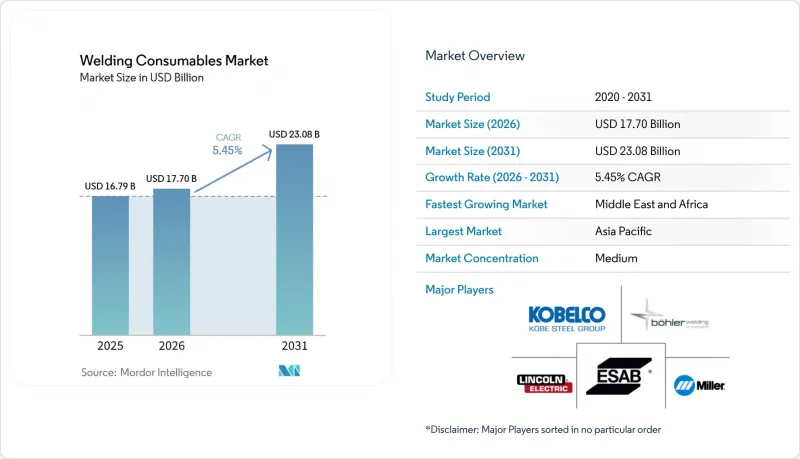
Mordor Intelligence에 의하면, 용접 소모품 시장 규모는 2025년에 167억 9,000만 달러로 평가되었고, 2026년 177억 달러에서 2031년까지 230억 8,000만 달러에 이를 것으로 예측되며, 예측 기간(2026-2031년) CAGR은 5.45%를 나타낼 전망입니다.
본 보고서는 제품 유형별(봉형 전극, 용접봉, 기타), 재료 유형별(강, 알루미늄, 니켈 기반 합금, 기타), 용접 공법별(아크 용접, 저항 용접, 기타), 최종 이용 산업별(건축 및 건설, 석유 및 가스, 기타), 지역별(북미, 유럽, 기타)로 분류되어 있습니다. 본 보고서에서는 상기 모든 부문에 대해 시장 규모 및 금액(달러)에 대한 예측을 제시하고 있습니다.
세계의 용접 소모품 시장 동향 및 인사이트
아시아태평양의 인프라 확충이 철강 가공 수요를 견인
아시아태평양은 중국, 인도, 일본의 인프라, 교통, 산업 시설, 에너지 프로젝트에 대한 지속적인 투자에 힘입어 용접 소모품 시장에서 여전히 최대 시장을 차지하고 있습니다. 중국에서는 2025년에 약 8억 9,200만 톤의 철강이 소비될 것으로 예상되며, 이러한 수요는 교통 인프라, 에너지 프로젝트, 산업 현대화 및 첨단 제조에 의해 주도되고 있습니다. 인도의 강재 소비량은 2025년에 9.8% 증가하여 2025-26 회계연도에는 1억 6,370만 톤에 달할 것으로 예측되며, 건설 및 인프라가 국내 철강 수요의 68%를 차지하고 있습니다. 인도의 ‘국가 인프라 파이프라인(NIP)’에는 34개 하위 부문에 걸친 9,142건의 프로젝트가 포함되어 있어, 구조용 강재 제조에 대한 지속적인 수요를 뒷받침하고 있습니다. 한편, 일본은 교통 인프라, 산업 현대화, 해상 풍력 발전, 재해에 강한 건설에 대한 투자를 지속하고 있으며, 이는 중량 구조물 제조 및 고품질 구조용도로 사용되는 고성능 용접 소모재 수요를 뒷받침하고 있습니다. 아시아태평양 전체에서 이러한 인프라 및 산업에 대한 투자로 인해, 두꺼운 구조물 용접용 저수소 전극, 플럭스 함유 와이어, 수중 아크 용접(SAW)용 소모재의 사용이 증가하고 있습니다. 교량, 철도, 해상 구조물, 산업 시설에 대한 엄격한 기술 사양으로 인해 기존 등급보다 고품질의 소모재가 계속해서 선택되고 있습니다.
용접 자동화가 프리미엄 와이어와 플럭스 수요를 끌어올리고 있습니다.
미국 용접 협회(AWS)는 2029년까지 미국에서 32만 500명의 용접 전문가가 추가로 필요할 것으로 예측했습니다. 2025년 시점에서 용접 종사자 총수는 77만 1,000명이었으나, 그중 15만 7,000명 이상이 정년 또는 정년에 가까웠습니다. 이러한 인력 부족으로 인해 제조업체들은 재현성이 높은 접합 설계를 실현하기 위해 로봇을 이용한 MIG/MAG 용접 및 플럭스 포함 아크 용접 셀을 도입하고 있습니다. 자동화 셀에서는 와이어 직경, 아크 안정성, 스패터 성능을 엄격하게 제어해야 합니다. 미국 노동부는 2025년, AWS(미국 용접 협회)의 ‘용접 자동화 전문가 견습 제도’를 승인했습니다. 이는 자동 용접 도입을 위한 교육을 지원하는 것입니다. HD 현대중공업은 한국의 조선소에 레일 주행형 용접 로봇을 도입하여, 한 명의 작업자가 최대 8대의 로봇을 감독할 수 있도록 했습니다.
원자재 가격 변동이 비용 상승을 초래한다.
니켈과 몰리브덴은 스테인리스 스틸, 듀플렉스강, 니켈 기반 용접 소모재에 있어 중요한 합금 원소입니다. 이 원료들 공급원은 지리적으로 집중되어 있어, 비용은 정책 변경, 광산 생산량, 하류 수요의 영향을 받기 쉽습니다. 니켈 가격은 2025년 대부분 동안 톤당 14,000-15,500달러 선에서 거래되었으며, 2026년 1월 23일에는 톤당 18,756달러에 도달했습니다. 316L 스테인리스 스틸이나 2205 듀플렉스 등의 등급은 페로몰리브덴 가격이 상승하면 합금 할증료가 높아집니다. 장기 공급 계약을 체결한 생산자는 정가 변경을 통해 이러한 비용 상승분을 반드시 회수할 수 있는 것은 아닙니다. 따라서 스테인리스 수요가 견조한 시기에 니켈과 몰리브덴 비용이 동시에 상승하면, 용접 소모품 시장은 이익률 압박에 직면하게 됩니다.
부문 분석
2025년, 용접 소모품 시장에서 봉형 전극은 34.20%를 차지했습니다. 이는 휴대성, 비교적 낮은 설비 요구 사항, AWS A5.1 및 ISO 2560에 따른 폭넓은 승인이 뒷받침된 결과입니다. 봉형 전극은 전원이나 차폐 가스 공급이 불안정하기 쉬운 현장의 수리, 배관 접합, 내진 기준을 충족하는 인프라 프로젝트에서 여전히 널리 사용되고 있습니다. 야외나 외딴 지역에서의 작업에 활용됨에 따라 와이어 공급식 공정의 보급이 가속화되고 있음에도 불구하고, 여전히 대규모 도입 기반을 유지하고 있습니다. GMAW 및 MIG 용도의 용접 와이어는 자동차 차체 접합 및 경량 구조물 제조에 힘입어 수량 기준으로 2위를 차지했습니다. 서브머지 아크(SAW) 와이어·플럭스 복합재는 두꺼운 부위의 해양 구조물이나 압력 용기의 용접에 사용되기 때문에 1kg당 매출액이 가장 높습니다. 인증된 SAW 세트의 용접 소모품 시장 규모는 두꺼운 두께의 중요한 접합부에 대한 엄격한 요구 사항에 힘입어 성장하고 있습니다.
플럭스 함유 와이어는 반복적인 용접에서 로봇과 반자동 셀이 수작업 SMAW를 대체함에 따라 연평균 성장률(CAGR) 8.20%를 기록하며 가장 빠르게 성장하는 제품 유형입니다. 가스 차폐형 FCAW 등급은 높은 용착률, 모든 자세에서 용접이 가능하다는 점, 아크 모니터링 시스템과의 호환성을 갖추고 있어 플럭스 함유 와이어 출하량에서 1위를 차지하고 있습니다. 자가 보호형 제품은 가스 공급이 어려운 야외 건설 및 보수 작업에서 여전히 유용합니다. 또한, 연결된 용접 플랫폼은 추적 가능한 용접 소모품 로트의 사용을 촉진하고 있습니다. QR 코드가 부착된 와이어 릴을 사용하면 용접 소모품 배치를 용접 기록과 연계할 수 있어, 원자력 및 항공우주 밸류체인의 조달 요건을 지원합니다. 이러한 자동화, 문서화, 안정적인 공급 성능의 조합이 용접 소모품 시장에서 고부가가치 플럭스 코어드 제품 라인을 뒷받침하고 있습니다.
2025년에는 탄소강, 고강도 저합금강, 스테인리스 스틸이 구조물, 용기, 파이프라인 제조에서 여전히 중심적인 역할을 수행하고 있기 때문에 강철 용접 소모품은 용접 소모품 시장의 45.60%를 차지했습니다. 전기 아크로(EAF) 제강으로의 전환에 따라, 두꺼운 두께의 미합금강 부재용 저수소 등급의 중요성이 높아지고 있습니다. 탄소 등가치가 엄격해지면, 용접 절차가 적절하게 관리되지 않을 경우 수소 유발 균열의 위험이 높아질 수 있습니다. 따라서 저수소 전극 및 인증된 와이어 조성은 친환경 강재 제조에 있어 여전히 중요합니다. 스테인리스 용가재는 EN ISO 14343 및 AWS A5.9 규격을 준수하며, 니켈 합금 와이어는 EN ISO 18274의 적용을 받습니다. 이러한 규격 요건은 기존 공급업체의 전환 비용을 높이는 요인이 됩니다.
알루미늄 제품은 용접 소모재 시장에서 가장 빠르게 성장하는 재료 범주로, 9.50%의 연평균 성장률(CAGR)을 기록하고 있습니다. 이는 전기차(EV) 배터리 케이스 및 차량의 경량화 구조에 기인한 것으로, 인증된 용가재에 대한 수요를 높이고 있습니다. 용가재를 사용한 레이저 용접은 특정 알루미늄 조립 부품의 기공 및 열간 균열을 억제하는 데 도움이 됩니다. 니켈 기반 제품은 취급량은 적지만, 석유 및 가스 연소식 열교환기, 원자력용 증기 발생기, 항공우주용 연소 부품 분야에서 가장 높은 단가를 자랑합니다. 구리, 티타늄, 코발트 재질의 용접 소모품은 전기 접합, 항공우주 구조물, 용사 등 보다 제한적인 용도로 사용됩니다. 이러한 특수 제품은 자본 프로젝트 및 인증 요건과 밀접한 관련이 있습니다. 이러한 재료 구성으로 인해 용접 소모품 산업 전반에 걸쳐 폭넓은 가격대가 형성되어 있습니다.
지역별 분석
2025년, 아시아태평양은 지역별 용접 소모품 시장의 44.50%를 차지했으며, 중국, 인도, 일본, 한국이 이를 주도했습니다. 인도의 철강 수요는 2025년에 9.8% 증가했으며, 2025-26 회계연도의 철강 제품 소비량은 1억 6,370만 톤에 달했습니다. 중국은 2025년에 전 세계적으로 신설된 9.3 GW의 해상 풍력 발전 용량 중 6.6GW를 가동했습니다. 일본과 한국은 KR, NK, DNV의 승인 요건을 충족하는 고품질 조선용 제품을 지원하고 있습니다. 인도네시아, 베트남, 태국, 필리핀에서는 제조업 및 상업 건축을 통해 수요가 확대되고 있습니다. 2025년 1월, voestalpine Bohler Welding은 인도 내 제조 및 응용 기술 부문에서의 사업 확장을 통해 솔리드 와이어 생산 능력을 증강할 것이라고 발표했습니다.
북미와 유럽은 용접 소모품 시장에서 기술 중심의 부문을 형성하고 있습니다. AWS의 인력 데이터에 따르면, 북미에서는 용접 기술 인력이 크게 부족하여 로봇 용접 시스템 및 협동형 용접 시스템의 도입을 촉진하고 있습니다. 캐나다에서는 파이프라인 및 수력 발전소 건설이 수요를 뒷받침하고 있으며, 멕시코에서는 미국과의 협력을 통한 자동차 생산이 수요를 견인하고 있습니다. 유럽의 제조업체들은 직업적 노출에 관한 규제 요건에 직면해 있으며, 이로 인해 인증을 받은 저연기 제품에 대한 수요가 증가하고 있습니다. 독일, 영국, 이탈리아는 자동차, 항공우주, 에너지 장비 제조에 주력하고 있습니다. 북유럽의 해상 풍력 발전 및 해저 파이프라인 건설 활동은 DNV와 로이드 레지스터의 승인을 받은 저온 충격 내성 인증 용접 소모품 수요를 뒷받침하고 있습니다.
중동 및 아프리카는 용접 소모품 시장에서 가장 빠르게 성장하는 지역으로, GCC(걸프협력회의) 국가들의 제조, 인프라, 토목 건설 프로젝트에 힘입어 연평균 성장률(CAGR) 7.80%로 성장을 지속하고 있습니다. 서아프리카와 오만만 지역의 심해 프로젝트에서는 해저 설비용 고니켈 함유 및 내식성 제품이 요구되고 있습니다. 튀르키예는 북아프리카, 걸프 국가, 사하라 이남 아프리카용 피복 전극의 주요 지역 공급국입니다. 남미에서는 브라질의 프레솔트층 해양 개발, 수력 발전소 건설, 자동차 공급망 등을 통해 투자 주도형 안정적인 수요가 나타나고 있습니다. 아르헨티나와 페루에서는 광산 설비 유지보수 및 파이프라인 제조를 통해 수요가 뒷받침되고 있습니다. 수입된 고품질 제품은 공공 부문 조달을 위해 AWS 또는 ISO 인증을 획득한 등급의 제품을 공급할 수 있는 공급업체에게 비즈니스 기회가 되고 있습니다.
기타 혜택
- 엑셀 형식 시장 예측(ME) 시트
- 3개월간의 애널리스트 지원
자주 묻는 질문
목차
제1장 서론
제2장 조사 방법
제3장 개요
제4장 시장 구도
제5장 시장 규모 및 성장 예측
제6장 경쟁 구도
제7장 시장 기회 및 향후 전망
AJY 26.09.01According to Mordor Intelligence, the welding consumables market size was valued at USD 16.79 billion in 2025 and is estimated to grow from USD 17.70 billion in 2026 to reach USD 23.08 billion by 2031, at a CAGR of 5.45% during the forecast period (2026-2031).
This report is Segmented by Product Type (Stick Electrodes, Welding Rods, and More), by Material Type (Steel, Aluminum, Nickel-Based, and Others), by Welding Technique (Arc Welding, Resistance Welding, and More), by End-Use Industry (Building & Construction, Oil & Gas, and More), and by Geography (North America, Europe, and More). The Report Offers Market Size and Value (USD) Forecasts for all the Above Segments.
Global Welding Consumables Market Trends and Insights
Infrastructure Build-Out Across Asia-Pacific Driving Steel Fabrication Demand
Asia-Pacific remains the largest market for welding consumables, supported by sustained investments in infrastructure, transportation, industrial facilities, and energy projects across China, India, and Japan. China is expected to consume approximately 892 million metric tons of finished steel in 2025, with demand driven by transportation infrastructure, energy projects, industrial upgrades, and advanced manufacturing. India's finished steel consumption is projected to increase by 9.8% in 2025, reaching 163.7 million metric tons in FY 2025-26, with construction and infrastructure accounting for 68% of domestic steel demand. The country's National Infrastructure Pipeline (NIP) includes 9,142 projects across 34 subsectors, supporting sustained demand for structural steel fabrication. Meanwhile, Japan continues to invest in transportation infrastructure, industrial modernization, offshore wind, and disaster-resilient construction, which supports demand for high-performance welding consumables used in heavy fabrication and high-quality structural applications. Across the Asia-Pacific region, these infrastructure and industrial investments are increasing the use of low-hydrogen electrodes, flux-cored wires, and submerged arc welding (SAW) consumables for thick-section structural welding. Stringent engineering specifications for bridges, railways, offshore structures, and industrial facilities continue to favor premium consumables over conventional grades.
Welding Automation Raising Premium Wire And Flux Demand
The American Welding Society projects a need for 320,500 additional welding professionals in the United States by 2029. The workforce totaled 771,000 workers, and more than 157,000 were at or near retirement age in 2025. This shortage encourages fabricators to use robotic MIG/MAG and flux-cored arc welding cells for repeatable joint designs. Automated cells require close control of wire diameter, arc stability, and spatter performance. The United States Department of Labor approved AWS's Welding Automation Specialist Apprenticeship in 2025, which supports training for deploying automated welding. HD Hyundai Heavy Industries is using rail-mounted welding robots in South Korean shipyards, where one operator can supervise up to 8 robots.
Raw-Material Price Volatility Raising Costs
Nickel and molybdenum are important alloying inputs for stainless, duplex, and nickel-based welding consumables. Their supply is geographically concentrated, which makes costs sensitive to policy changes, mine output, and downstream demand. Nickel traded near USD 14,000-15,500 per tonne for much of 2025 and reached USD 18,756 per ton on January 23, 2026. Grades such as 316L stainless and 2205 duplex carry higher alloy surcharges when ferro-molybdenum prices rise. Producers serving long-term supply contracts cannot always recover these increases through list-price changes. The welding consumables market, therefore, faces margin pressure when nickel and molybdenum costs rise together during periods of stronger stainless demand.
Other drivers and restraints analyzed in the detailed report include:
- Offshore Wind Foundations Requiring High-Toughness Consumables
- Lightweight Vehicles Increasing Aluminum Filler Metal Use
- Fume-Emission Rules Raising Compliance Spending
For complete list of drivers and restraints, kindly check the Table Of Contents.
Segment Analysis
Stick electrodes accounted 34.20% of the welding consumables market in 2025, supported by their portability, modest equipment requirements, and broad approval under AWS A5.1 and ISO 2560. They remain widely used in field repair, pipe joining, and seismic-grade infrastructure projects where power or shielding gas may be unreliable. Their use in outdoor and remote work helps maintain a large installed base despite the faster adoption of wire-fed processes. Welding wires for GMAW and MIG applications held the second-largest volume, supported by automotive body joining and light structural fabrication. Submerged-arc wire-flux combinations have the highest revenue intensity per kilogram because they serve heavy-section offshore and pressure-vessel welding. The welding consumables market size for certified SAW sets benefits from the demanding requirements of thick, critical joints.
Flux-cored wires are the fastest-growing product type, registering a 8.20% CAGR, as robotic and semi-automatic cells replace manual SMAW on repetitive welds. Gas-shielded FCAW grades lead flux-cored volumes because they provide high deposition rates, all-position capability, and compatibility with arc-monitoring systems. Self-shielded variants remain useful for open-site construction and repair work where gas delivery is impractical. Connected welding platforms are also encouraging the use of traceable consumable lots. QR-coded wire reels can link a consumable batch to a weld record, which supports procurement requirements in nuclear and aerospace supply chains. This combination of automation, documentation, and stable feed performance supports higher-value flux-cored product lines within the welding consumables market.
Steel consumables accounted for 45.60% of the welding consumables market in 2025 because carbon steel, high-strength low-alloy steel, and stainless steel remain central to structural, vessel, and pipeline fabrication. The shift toward electric arc furnace steelmaking raises the importance of low-hydrogen grades for thick microalloyed steel sections. Tighter carbon equivalents can increase the risk of hydrogen-induced cracking when welding procedures are not controlled. Low-hydrogen electrodes and qualified wire formulations, therefore, remain important in green steel fabrication. Stainless fillers are governed by EN ISO 14343 and AWS A5.9, while nickel-alloy wires are covered by EN ISO 18274. These qualifications raise switching costs for established suppliers.
Aluminum products are the fastest-growing material category in the welding consumables market, registering a 9.50% CAGR, driven by EV battery enclosures and lightweight vehicle structures, which increase demand for qualified fillers. Laser welding with filler can help manage porosity and hot cracking in selected aluminum assemblies. Nickel-based products represent a smaller-volume category but have the highest unit value in oil- and gas-fired heat exchangers, nuclear steam generators, and aerospace combustion parts. Copper, titanium, and cobalt consumables are used in narrower applications, including electrical joining, aerospace structures, and hardfacing. These specialties are closely tied to capital projects and qualification requirements. The material mix supports a wide range of price points across the welding consumables industry.
Complete Report Scope:
- By Product Type
- Stick Electrodes (SMAW)
- Welding Rods (TIG)
- Submerged Arc Welding (SAW) Flux & Wire Sets
- Flux-Cored Wires
- Welding Wires (GMAW/MIG/ Solid Wires)
- Others (Oxy-fuel Welding Rods, Welding Powder, Shielding Gases, Tips, etc.)
- By Material Type
- Steel Welding Consumables (carbon, Stainless)
- Aluminum Welding Consumables
- Nickel-Based Welding Consumables
- Others (Copper, Titanium, Cobalt)
- By Welding Technique
- Arc Welding (SMAW, MIG, TIG, SAW)
- Resistance Welding (Spot, Seam)
- Oxy-Fuel Welding
- Others (Laser Welding, Electron Beam Welding)
- By End-Use Industry
- Building & Construction
- Automotive & Transportation
- Shipbuilding & Offshore
- Oil & Gas, Energy Infrastructure
- Heavy Machinery & Industrial Equipment
- Aerospace & Defense
- Others (Railway, Consumer Goods)
- By Geography
- North America
- United States
- Canada
- Mexico
- South America
- Brazil
- Argentina
- Rest of South America
- Europe
- United Kingdom
- Germany
- France
- Italy
- Spain
- BENELUX (Belgium, Netherlands, and Luxembourg)
- NORDICS (Denmark, Finland, Iceland, Norway, and Sweden)
- Rest of Europe
- Asia-Pacific
- China
- India
- Japan
- Australia
- South Korea
- ASEAN (Indonesia, Thailand, Philippines, Malaysia, Vietnam)
- Rest of Asia-Pacific
- Middle East and Africa
- Saudi Arabia
- United Arab Emirates
- Turkey
- Egypt
- South Africa
- Rest of Middle East and Africa
- North America
Geography Analysis
Asia-Pacific accounted for 44.50% of the regional welding consumables market in 2025, led by China, India, Japan, and South Korea. India's steel demand grew 9.8% in 2025, while finished steel consumption reached 163.7 million tons in fiscal 2025-26. China commissioned 6.6 GW of the 9.3 GW of offshore wind capacity added globally in 2025. Japan and South Korea support premium shipbuilding products that meet KR, NK, and DNV approval requirements. Indonesia, Vietnam, Thailand, and the Philippines add demand through manufacturing and commercial construction. In January 2025, voestalpine Bohler Welding said it would expand its footprint in Indian manufacturing and application technology and add solid-wire capacity.
North America and Europe form the technology-focused portion of the welding consumables market. AWS workforce data indicates a large welding labor gap in North America, which is increasing the use of robotic and collaborative welding systems. Canada supports demand through pipelines and hydroelectric construction, while Mexico supplies automotive production linked to the United States. European fabricators face occupational exposure requirements that increase demand for certified low-fume products. Germany, the United Kingdom, and Italy concentrate on automotive, aerospace, and energy equipment fabrication. Nordic offshore wind and subsea pipeline activity supports low-temperature-impact-qualified consumables approved by DNV and Lloyd's Register.
The Middle East and Africa are the fastest-growing regions in the welding consumables market, registering a 7.80% CAGR, supported by manufacturing, infrastructure, and civil construction programs in the GCC. Deepwater projects in West Africa and the Gulf of Oman require high-nickel and corrosion-resistant products for subsea equipment. Turkey is a major regional supplier of coated electrodes to North Africa, Gulf markets, and sub-Saharan Africa. South America has steady investment-led demand from Brazil's offshore pre-salt work, hydroelectric construction, and automotive supply chain. Argentina and Peru support demand through mining equipment maintenance and pipeline fabrication. Imported premium products create an opportunity for suppliers that can offer AWS- or ISO-certified grades for public-sector procurement.
- Lincoln Electric Holdings Inc.
- ESAB Corporation
- Illinois Tool Works Inc. (Miller Welding)
- voestalpine Bohler Welding GmbH
- Kobe Steel Ltd. (Kobelco Welding)
- Hyundai Welding Co. Ltd.
- Tianjin Bridge Welding Materials Group Co., Ltd.
- Air Liquide S.A. (Welding Division)
- Ador Welding Ltd.
- Gedik Welding Inc.
- Welding Alloys Group
- Selectrode Industries Inc.
- Sandvik Materials Technology (Alleima)
- Panasonic Welding Systems
- TASETO Co., Ltd.
- Nippon Steel Welding & Engineering
- Oerlikon (CD&R-owned)
- Daihen Corporation
- Great Welding Ltd.
- Kiswel Co. Ltd.
Additional Benefits:
- The market estimate (ME) sheet in Excel format
- 3 months of analyst support
TABLE OF CONTENTS
1 Introduction
- 1.1 Study Assumptions & Market Definition
- 1.2 Scope of the Study
2 Research Methodology
3 Executive Summary
4 Market Landscape
- 4.1 Market Overview
- 4.2 Market Drivers
- 4.2.1 Infrastructure Build-Out Driving Steel Fabrication Demand
- 4.2.2 Welding Automation Raising Premium Wire And Flux Demand
- 4.2.3 Offshore Wind Foundations Requiring High-Toughness Consumables
- 4.2.4 Lightweight Vehicles Increasing Aluminum Filler Metal Use
- 4.2.5 Green-Steel Mandates Supporting Low-Hydrogen Electrode Innovation
- 4.2.6 High-Performance Alloy Demand in Aerospace and Oil and Gas
- 4.3 Market Restraints
- 4.3.1 Raw-Material Price Volatility Raising Costs
- 4.3.2 Fume-Emission Rules Raising Compliance Spending
- 4.3.3 Solid-State Joining Reducing Consumable Intensity
- 4.3.4 Near-Net Additive Parts Reducing Aerospace Welding Steps
- 4.4 Value / Supply-Chain Analysis
- 4.5 Technological Outlook
- 4.6 Regulatory Landscape
- 4.7 Welding Demand Landscape (2025-2031)
- 4.8 Impact of Geo-Political Events on the Market
5 Market Size & Growth Forecasts (Value, In USD Billion)
- 5.1 By Product Type
- 5.1.1 Stick Electrodes (SMAW)
- 5.1.2 Welding Rods (TIG)
- 5.1.3 Submerged Arc Welding (SAW) Flux & Wire Sets
- 5.1.4 Flux-Cored Wires
- 5.1.5 Welding Wires (GMAW/MIG/ Solid Wires)
- 5.1.6 Others (Oxy-fuel Welding Rods, Welding Powder, Shielding Gases, Tips, etc.)
- 5.2 By Material Type
- 5.2.1 Steel Welding Consumables (carbon, Stainless)
- 5.2.2 Aluminum Welding Consumables
- 5.2.3 Nickel-Based Welding Consumables
- 5.2.4 Others (Copper, Titanium, Cobalt)
- 5.3 By Welding Technique
- 5.3.1 Arc Welding (SMAW, MIG, TIG, SAW)
- 5.3.2 Resistance Welding (Spot, Seam)
- 5.3.3 Oxy-Fuel Welding
- 5.3.4 Others (Laser Welding, Electron Beam Welding)
- 5.4 By End-Use Industry
- 5.4.1 Building & Construction
- 5.4.2 Automotive & Transportation
- 5.4.3 Shipbuilding & Offshore
- 5.4.4 Oil & Gas, Energy Infrastructure
- 5.4.5 Heavy Machinery & Industrial Equipment
- 5.4.6 Aerospace & Defense
- 5.4.7 Others (Railway, Consumer Goods)
- 5.5 By Geography
- 5.5.1 North America
- 5.5.1.1 United States
- 5.5.1.2 Canada
- 5.5.1.3 Mexico
- 5.5.2 South America
- 5.5.2.1 Brazil
- 5.5.2.2 Argentina
- 5.5.2.3 Rest of South America
- 5.5.3 Europe
- 5.5.3.1 United Kingdom
- 5.5.3.2 Germany
- 5.5.3.3 France
- 5.5.3.4 Italy
- 5.5.3.5 Spain
- 5.5.3.6 BENELUX (Belgium, Netherlands, and Luxembourg)
- 5.5.3.7 NORDICS (Denmark, Finland, Iceland, Norway, and Sweden)
- 5.5.3.8 Rest of Europe
- 5.5.4 Asia-Pacific
- 5.5.4.1 China
- 5.5.4.2 India
- 5.5.4.3 Japan
- 5.5.4.4 Australia
- 5.5.4.5 South Korea
- 5.5.4.6 ASEAN (Indonesia, Thailand, Philippines, Malaysia, Vietnam)
- 5.5.4.7 Rest of Asia-Pacific
- 5.5.5 Middle East and Africa
- 5.5.5.1 Saudi Arabia
- 5.5.5.2 United Arab Emirates
- 5.5.5.3 Turkey
- 5.5.5.4 Egypt
- 5.5.5.5 South Africa
- 5.5.5.6 Rest of Middle East and Africa
- 5.5.1 North America
6 Competitive Landscape
- 6.1 Market Concentration
- 6.2 Strategic Moves
- 6.3 Market Share Analysis
- 6.4 Company Profiles (includes Global level Overview, Market level overview, Core Segments, Financials as available, Strategic Information, Products & Services, and Recent Developments)
- 6.4.1 Lincoln Electric Holdings Inc.
- 6.4.2 ESAB Corporation
- 6.4.3 Illinois Tool Works Inc. (Miller Welding)
- 6.4.4 voestalpine Bohler Welding GmbH
- 6.4.5 Kobe Steel Ltd. (Kobelco Welding)
- 6.4.6 Hyundai Welding Co. Ltd.
- 6.4.7 Tianjin Bridge Welding Materials Group Co., Ltd.
- 6.4.8 Air Liquide S.A. (Welding Division)
- 6.4.9 Ador Welding Ltd.
- 6.4.10 Gedik Welding Inc.
- 6.4.11 Welding Alloys Group
- 6.4.12 Selectrode Industries Inc.
- 6.4.13 Sandvik Materials Technology (Alleima)
- 6.4.14 Panasonic Welding Systems
- 6.4.15 TASETO Co., Ltd.
- 6.4.16 Nippon Steel Welding & Engineering
- 6.4.17 Oerlikon (CD&R-owned)
- 6.4.18 Daihen Corporation
- 6.4.19 Great Welding Ltd.
- 6.4.20 Kiswel Co. Ltd.
7 Market Opportunities & Future Outlook
- 7.1 White-space & Unmet-Need Assessment


