
|
시장보고서
상품코드
2117358
자동차 재활용 시장 : 시장 점유율 분석, 산업 동향 및 통계 데이터, 성장 예측(2026-2031년)Vehicle Recycling - Market Share Analysis, Industry Trends & Statistics, Growth Forecasts (2026 - 2031) |
||||||
 Mordor Intelligence
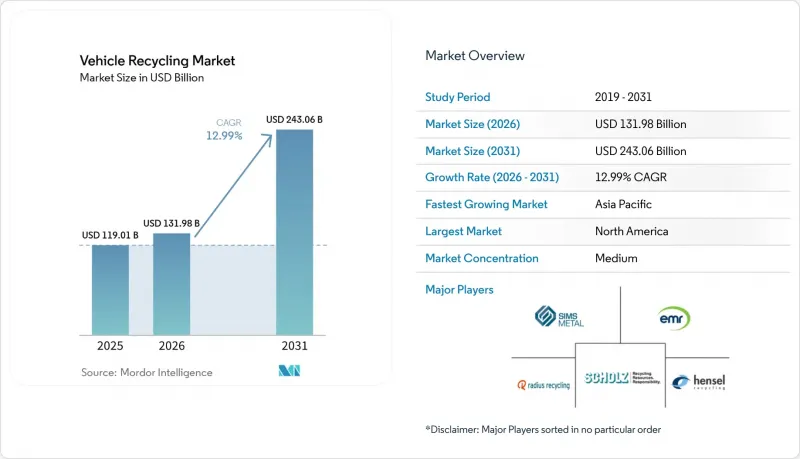
Mordor Intelligence에 의하면, 자동차 재활용 시장 규모는 2025년에 1,190억 1,000만 달러로 평가되었고, 2026년 1,319억 8,000만 달러에서 2031년까지 2,430억 6,000만 달러에 이를 것으로 추정되며, 예측 기간(2026-2031년) CAGR은 12.99%를 나타낼 전망입니다.
본 보고서는 차종별(승용차, 상용차), 소재별(철강, 알루미늄 등), 용도별(OEM, 애프터마켓 등), 재활용 공정별(수작업에 의한 해체·오염 물질 제거, 슈레더 처리·자력 분리/와전류 선별 등), 지역별(북미, 남미 등)로 분류되어 있습니다. 시장 예측은 금액(달러) 기준으로 제시되어 있습니다.
세계의 자동차 재활용 시장 동향 및 인사이트
EU, 중국, 인도의 엄격한 ELV 지침
유럽연합(EU)의 개정 규정에 따르면, 2032년까지 신차의 플라스틱 사용량 중 15%를 재활용해야 할 의무가 부과되었으며, 자동차 제조업체에게는 해체 가이드 공개가 요구되고 있습니다. 이에 따라 깨끗하고 추적 가능한 스크랩을 공급할 수 있는 인증 해체 업체로 협상력이 이동하고 있습니다. 인도의 ELV(폐차) 관리 규정에서는 철강 회수 목표를 단계적으로 상향 조정하고, 등록된 해체 시설로 차량을 유도하기 위한 중앙 집중형 추적 포털이 도입되었습니다. 광둥성 등 중국의 각 성에서는 보조금 지급을 인증된 재활용 증명과 연계함으로써, 소유자가 비공식 해체 업체를 이용하지 않도록 유도하고 있습니다. 이러한 지침으로 인해 규정 준수 격차가 확대되고, 출처가 확인된 자재의 프리미엄 가격이 상승하고 있습니다. 아세안(ASEAN)에서는 리튬 이온 배터리 셀에도 유사한 추적성을 적용하는 ‘배터리 여권’ 기준을 마련 중이며, 규제가 통일된 블록이 형성되고 있습니다.
EV의 경량 프레임에 필수적인 재활용 알루미늄과 철강
BYD와 Hantek은 다수의 프레스 성형 부품을 대체하여 차량 총중량을 줄이고, 재활용 소재를 접목한 일체형 알루미늄 프레임을 도입했습니다. 이는 경량화와 2차 금속 흐름 간의 연관성을 부각시키고 있습니다. 알루미늄 재활용은 자원을 보존할 뿐만 아니라 탄소 배출량을 대폭 줄여줍니다. 이러한 탄소 배출량 감축은 자동차 제조업체들이 자사 차종의 평균 배출량 공개 시 종종 강조하는 중요한 지표입니다. 리비안의 픽업 트럭은 스크랩에서 추출한 알루미늄을 사용함으로써 대형 배터리를 탑재하면서도 경쟁력 있는 무게를 유지하는 데 성공했습니다. 이 성과는 전기차의 적재량 목표와 재활용 소재 사용을 양립시킬 수 있는 가능성을 부각시키고 있습니다. 상용 트럭 분야에서는 누코어(Nucora)와 같은 미니밀 제철업체가 자동차 파쇄물을 용광로에 투입하고 있습니다. 이 전략은 비용 절감으로 이어질 뿐만 아니라, 스코프 3 배출량 감축에도 기여합니다. 전기차 보급이 급속히 확대되고 있는 아시아태평양에서는 현재 증가하는 수요를 충족하는 데 필요한 양보다 적은 양의 스크랩만 생산되고 있어, 그 결과 선별된 알루미늄의 태평양 횡단 무역이 급증하고 있습니다.
첨단 파쇄·불순물 제거 라인에는 막대한 설비 투자가 필요합니다.
오로비스(Aurovis)는 조지아주 구리 재활용 공장에 투자하여, 첨단 플라즈마 용광로를 통해 매우 높은 순도를 달성했습니다. 이러한 수준의 순도는 신흥 시장의 많은 사업자들에게 여전히 달성하기 어려운 수준입니다. 예를 들어, 광학 선별기와 규정을 준수하는 배터리 오염 물질 제거 베이를 갖춘 중규모 분쇄기는 막대한 비용이 듭니다. 인도나 나이지리아에서는 현지 금융 기관들이 이러한 프로젝트를 고위험으로 분류하고 있어 금리가 치솟고 있습니다. 이러한 재정적 부담으로 인해 저비용의 비공식 해체업자들의 지배력이 강화되고 있습니다. 비공식 해체업자들은 공식 시설에 비해 폐차에 대한 임베디드 가격이 낮습니다. 인증 시설은 낮은 가동률이라는 과제에 직면해 있습니다. 예를 들어, 인도의 등록 해체 업체들은 2024-2025 회계 연도 동안 최소한의 가동률로만 운영되었습니다. 우대 대출을 이용할 수 없기 때문에 이러한 시설의 확장은 증가하는 수요를 따라잡는 데 어려움을 겪고 있습니다.
부문 분석
상용차는 2031년까지 연평균 성장률(CAGR) 13.21%를 나타낼 것으로 예측되지만, 2025년 자동차 재활용 시장 매출의 76.15%는 승용차가 차지했습니다. 배터리식 전기 밴, 버스, 중형 트럭에는 고밀도 배터리 팩이 탑재되어 있어 차량당 고철 가치를 높이는 동시에 고전압 오염 물질 제거 시설에 대한 투자를 촉진하고 있습니다. 클래스 8 트럭은 소형 세단에 비해 훨씬 더 많은 재활용 가능한 금속을 생산하기 때문에 차량당 수익이 증가합니다. 북미에서는 2025년 승용차의 평균 차령이 사상 최고치를 기록함에 따라 자동차 재활용량이 안정세를 보이고 있습니다. 유럽에서는 내연기관(ICE) 차량의 급속한 단계적 폐지로 인해 폐차율이 가속화되며, 폐차된 차량의 재활용 시설 유입이 증가하고 있습니다. 규제로 인해 지역 간 차이가 더욱 두드러지고 있습니다. 인도에서는 정해진 연한을 초과한 차량은 차량 검사를 받아야 하며, 이는 재활용을 위한 차량의 안정적인 공급을 뒷받침하고 있습니다. 그러나 승용차는 종종 비공식 해체장으로 반입되며, 그곳에서 업자들은 적절한 재활용 절차를 따르지 않고 부품을 분리하고 있습니다.
이러한 추세는 2차적 영향으로 인해 더욱 강화되고 있습니다. 상용차 플릿 운영업체들은 리스 계약에 배터리 환매 보증을 포함시키는 사례가 늘어나고 있으며, 이로 인해 인증된 재활용 업체와의 제휴 관계가 강화되고 있습니다. 대형 차량에 대한 EU의 배기가스 규제가 강화됨에 따라 비공식 업체들의 규정 준수 비용이 증가했고, 시장 점유율은 점차 대규모 인증 시설로 이동하고 있습니다. 2025년에는 전기 버스의 대규모 출하로 인해 배터리 팩 처리량이 급증했습니다. 신흥 지역의 승용차 재활용은 기반이 크지만 여전히 세분화되어 있고 규제상의 지연에 직면하고 있어 연평균 성장률(CAGR)은 낮은 수준을 유지하고 있습니다.
2025년 자동차 재활용 시장 매출에서 철강이 차지하는 비중은 60.34%였으나, 자동차 제조업체들이 경량 구조를 우선시함에 따라 알루미늄은 2031년까지 연평균 13.68%의 성장률을 보일 것으로 전망됩니다. 차량 중량 감축이 전기차(EV)의 주행 거리를 향상시키기 때문에 알루미늄으로의 대체가 매력적인 선택지로 떠오르고 있습니다. 여러 부품을 단일 주조품으로 통합한 양왕(Yangwang) U8L의 프레임에는 재활용 소재가 채택되어, 순환성을 중시하는 설계 동향을 여실히 보여주고 있습니다. 포드는 노벨리스와 제휴하여 스크랩 코일을 몇 주 이내에 새로운 차체용 강판으로 재활용하는 폐쇄형 루프 시스템을 구축했습니다. 이를 통해 현물 가격 변동으로부터 이익률을 보호할 수 있을 뿐만 아니라 에너지 소비도 대폭 절감됩니다. 한편, 뉴콜의 미니 밀은 이러한 추세를 활용하여 자동차용 파쇄물을 전기로에 투입함으로써 원자재 수입 비용을 절감하고 있습니다.
지역별 수급 격차가 무역 동향에 영향을 미치고 있습니다. 전기차 보급이 급속히 진행되고 있는 아시아태평양에서는 사용 후 알루미늄 부족에 직면해 있습니다. 이러한 부족으로 인해 차량의 평균 사용 연수가 긴 북미나 유럽에서 선별된 스크랩을 수입하는 데 의존하는 상황이 되었습니다. 구리는 취급 톤수는 적지만 높은 가격에 거래되고 있습니다. 이러한 프리미엄 가격 책정으로 인해 모터나 하네스 회수는 수익성이 높은 사업이 되었습니다. 반면, 플라스틱과 유리는 본래 얻을 수 있어야 할 경제적 이익을 충분히 얻지 못하고 있습니다. 과제는 기계적 재활용의 효율을 저해하는 혼합 기질에 있습니다. 그러나 EU는 2032년에 설정된 재활용 플라스틱 사용 의무를 통해 이러한 격차를 해소하기 위해 적극적인 조치를 취하고 있습니다.
지역별 분석
2025년, 북미는 자동차 재활용 시장 매출의 44.27%를 차지했습니다. 이는 평균 차량 연식이 높아 폐차(ELV)가 해체 업체로 안정적으로 유입되고 있는 것이 배경입니다. 디지털 판매가 주류를 이루고 있으며, Insurance Auto Auctions의 거래 대부분이 온라인으로 이루어지기 때문에 재고 일수가 단축되고 수익성이 향상되고 있습니다. Copart사는 AI 기반 등급 평가를 도입하여, 차량 한 대를 게시하는 것만으로 NAFTA 지역 내 국경을 넘어 구매자를 유치함으로써, 디지털화 이전 수준을 상회하는 가격을 실현했습니다. LKQ사는 전략적 조치로 셀프서비스 부문을 매각하고, 충돌용 부품 및 배터리 모듈 사업에 집중함으로써 수익성이 더 높은 사업 분야로의 전환을 보여주었습니다. 한편, 연방 차원의 ELV 관련 법규가 존재하지 않기 때문에 각 주가 독자적인 규정을 도입하고 있어, 규정 준수상의 과제는 발생하고 있으나 실제 집행은 최소한으로 그치고 있습니다.
아시아태평양은 2031년까지 연평균 성장률(CAGR) 14.13%를 기록할 전망입니다. 2030년까지 인도의 ELV(폐차) 재고는 2배인 5,000만 대에 달할 전망이지만, 비공식 임베디드자와의 가격 격차가 해소되지 않아 정식 해체 업체가 처리하는 차량은 극히 일부에 그칠 것입니다. 중국에서는 광둥성이나 절강성 등 일부 지역에서 시행되고 있는 성 차원의 보조금 덕분에 전기차 폐차가 인증된 공장으로 유도되고 있지만, 국가 차원의 법규는 여전히 일관성이 부족합니다. BYD의 알루미늄을 많이 사용한 전기차 프레임은 깨끗한 2차 금속 수요를 견인하고 있습니다. 일본에서는 성숙한 법제도 덕분에 높은 회수율을 달성하고 있지만, 비용 압박으로 인해 업계 재편이라는 과제에 직면해 있습니다. 한편, 아세안(ASEAN)의 2025년판 ‘배터리 여권’ 초안에서는 국경을 초월한 셀 수준의 추적 가능성이 의무화될 예정이며, 이에 따라 정식 재활용 업체에 대한 기준이 강화될 것입니다.
2024년에 최종 확정된 유럽의 ‘폐차(ELV) 지침’ 개정안에서는 자동차 제조업체에게 순환형 설계 원칙을 채택하고 재활용 플라스틱 목표를 달성할 것을 요구하고 있으며, 이에 따라 화학 재활용에 대한 투자가 촉진되고 있습니다. 북유럽에서는 인증 시설 네트워크가 치밀하게 구축되어 있지만, 남유럽 및 동유럽에서는 여전히 폐차의 상당 부분이 비공식 해체업자에게 유입되고 있습니다. 오로비스(Aurobis)사는 대서양을 가로지르는 자재 동향을 반영하여, 새로 설립한 미국 제련소를 위해 유럽의 스크랩을 조달하고 있습니다. 대조적으로, 남미와 중동 및 아프리카은 뒤처져 있으며, 자발적인 회수 규제와 자금 부족으로 어려움을 겪고 있습니다. 브라질의 회수 의무화는 정체되어 있으며, 나이지리아에서는 비공식 스크랩 야드가 규제 없이 운영되며, 아무런 제재도 받지 않은 채 지하수를 오염시키고 있습니다.
기타 혜택 :
- Excel 형식 시장 예측(ME) 시트
- 3개월간의 애널리스트 지원
자주 묻는 질문
목차
제1장 서론
제2장 분석 방법
제3장 개요
제4장 시장 구도
제5장 시장 규모 및 성장률 예측
제6장 경쟁 구도
제7장 시장 기회 및 향후 전망
AJY 26.09.01According to Mordor Intelligence, the vehicle recycling market size was valued at USD 119.01 billion in 2025 and estimated to grow from USD 131.98 billion in 2026 to reach USD 243.06 billion by 2031, at a CAGR of 12.99% during the forecast period (2026-2031).
This report is Segmented by Vehicle Type (Passenger Cars, Commercial Vehicles), Material (Iron and Steel, Aluminum, and More), Application (OEMs, Aftermarket, and More), Recycling Process (Manual Dismantling and Depollution, Shredding and Magnetic/Eddy Sorting, and More), and Geography (North America, South America, and More). The Market Forecasts are Provided in Terms of Value (USD).
Global Vehicle Recycling Market Trends and Insights
Stringent ELV Directives in EU, China, India
Revised rules in the European Union mandate that 15% of plastic in new cars be recycled by 2032 and require automakers to publish disassembly guides, which shifts bargaining power toward certified yards able to supply clean, traceable scrap . India's ELV Management Rules introduce escalating steel-recovery targets and a centralized tracking portal to channel fleets to registered scrapping facilities. Chinese provinces such as Guangdong tie subsidies to proof of certified recycling, nudging owners away from informal dismantlers. The directives have widened the compliance gap, lifting premiums for provenance-verified material. ASEAN is drafting battery passport norms that extend similar traceability to lithium-ion cells, creating an aligned regulatory block.
Recycled Aluminum and Steel Critical for Lightweight EV Frames
BYD and Hantek have introduced a one-piece aluminum frame that replaces numerous stamped components, reduces curb mass, and incorporates recycled content, highlighting the connection between lightweighting and secondary metal flows. Recycling aluminum not only conserves resources but also significantly reduces carbon emissions, a key figure often highlighted by automakers in their fleet-average disclosures. Rivian's pickup, using scrap-sourced aluminum, manages to maintain a competitive weight even with a sizable battery. This achievement underscores the possibility of aligning EV payload objectives with the use of recycled materials. In the realm of commercial trucks, mini-mill steelmakers like Nucor are integrating automotive shred into their furnaces. This strategy not only reduces costs but also diminishes scope-3 emissions. The Asia-Pacific region, witnessing a rapid surge in electric vehicle adoption, is now producing less scrap than it needs to meet its growing demand, leading to a burgeoning trans-Pacific trade in sorted aluminum.
High CAPEX for Advanced Shredding and Depollution Lines
Aurubis invested in a Georgia copper-recycling plant, achieving exceptional purity levels with its advanced plasma furnaces. This level of purity remains out of reach for many operators in emerging markets. To illustrate, midsize shredders with optical sorters and compliant battery-depollution bays incur high costs. In India and Nigeria, local lenders classify such projects as high-risk, resulting in elevated interest rates. This financial burden reinforces the dominance of low-cost informal yards, which offer lower payouts for end-of-life vehicles than formal facilities. Certified sites face challenges with under-utilization; for example, India's registered yards operated at minimal capacity during the fiscal year 2024-2025. Without access to concessional finance, the expansion of these facilities struggles to keep pace with growing demand.
Other drivers and restraints analyzed in the detailed report include:
- Volatile Virgin-Metal Prices Push OEM Demand for Scrap Feedstock
- AI-Enabled Robotic Dismantling Boosts Recovery Yields
- Fragmented ELV Collection Channels in Emerging Countries
For complete list of drivers and restraints, kindly check the Table Of Contents.
Segment Analysis
Commercial vehicles are forecast to grow at a 13.21% CAGR through 2031, although passenger cars accounted for 76.15% of the vehicle recycling market revenue in 2025. Battery-electric vans, buses, and medium-duty trucks contain dense battery packs that increase per-unit scrap value and support investment in high-voltage depollution bays. Class 8 trucks generate significantly more recyclable metal than compact sedans, increasing revenue per vehicle. In North America, vehicle recycling volumes remain stable as the average passenger car age reached a record high in 2025. In Europe, the rapid phaseout of internal combustion engine (ICE) vehicles accelerates scrappage rates and increases the flow of end-of-life vehicles to recycling yards. Regulations further emphasize regional differences. In India, fleets exceeding a specified age must undergo fitness tests, supporting a steady supply of vehicles for recycling. However, private cars often enter informal yards, where operators strip parts without following proper recycling practices.
Secondary effects further reinforce these dynamics. Commercial fleet operators increasingly incorporate battery buyback guarantees into their lease structures, strengthening partnerships with certified recyclers. Stricter EU depollution regulations for larger vehicles increase compliance costs for informal operators, gradually shifting market share toward larger certified plants. In 2025, a major shipment of electric buses drove up battery pack volumes. Although passenger car recycling in emerging regions has a larger base, it remains fragmented and faces regulatory delays, contributing to its slower CAGR.
Iron and steel accounted for 60.34% of the vehicle recycling market revenue in 2025, but aluminum is set to expand by 13.68% annually through 2031 as automakers prioritize lightweight structures. Aluminum substitution becomes appealing as reducing vehicle mass enhances EV range. The Yangwang U8L frame, consolidating multiple parts into a single casting, incorporates recycled content, highlighting a design trend towards circularity. Ford, in collaboration with Novelis, has established a closed-loop system that reintroduces scrap coils into fresh body sheets within weeks. This not only shields margins from fluctuations in spot prices but also significantly reduces energy consumption. Meanwhile, Nucor's mini-mills are capitalizing on the trend, channeling automotive shred into electric furnaces, resulting in cost savings on raw material imports.
Regional supply-demand disparities influence trade dynamics. The Asia-Pacific region, witnessing a rapid surge in EV adoption, grapples with a shortage of end-of-life aluminum. This shortfall has led to a reliance on imports of sorted scrap from North America and Europe, where vehicles tend to be older. Copper, despite being lighter in tonnage, commands a premium price. This premium positioning turns the recovery of motors and harnesses into a lucrative venture. On the other hand, plastics and glass are not reaping their due financial rewards. The challenge lies in mixed substrates, which hinder the efficiency of mechanical recycling. However, the EU is taking proactive steps, aiming to bridge this gap with a recycled-plastic mandate set for 2032.
Complete Report Scope:
- By Vehicle Type
- Passenger Cars
- Commercial Vehicles
- By Material
- Iron and Steel
- Aluminum
- Rubber
- Copper
- Glass
- Plastic
- Others
- By Application
- Original Equipment Manufacturers (OEMs)
- Aftermarket
- Scrap Processors/Dismantlers
- By Recycling Process
- Manual Dismantling and Depollution
- Shredding and Magnetic/Eddy Sorting
- Advanced Li-ion Battery Recycling
- By Geography
- North America
- United States
- Canada
- Rest of North America
- South America
- Brazil
- Argentina
- Rest of South America
- Europe
- Germany
- France
- United Kingdom
- Italy
- Spain
- Russia
- Rest of Europe
- Asia-Pacific
- China
- Japan
- India
- South Korea
- Australia
- Rest of Asia-Pacific
- Middle East and Africa
- Saudi Arabia
- United Arab Emirates
- Turkey
- South Africa
- Nigeria
- Egypt
- Rest of Middle East and Africa
- North America
Geography Analysis
North America accounted for 44.27% of the vehicle recycling market revenue in 2025, supported by an average fleet age that funnels a steady stream of ELVs to dismantlers. Digital sales dominated, with a substantial portion of Insurance Auto Auctions' transactions occurring online, reducing inventory days and enhancing returns. Copart used AI grading, enabling a single car listing to attract buyers across NAFTA borders and resulting in prices that surpassed pre-digital benchmarks. In a strategic move, LKQ divested its Self Service division to focus on collision parts and battery modules, signaling a shift towards more profitable streams. Meanwhile, the lack of federal ELV legislation allowed states to implement varied rules, introducing compliance challenges but minimal enforcement.
Asia-Pacific is set for a 14.13% CAGR to 2031. By 2030, India's ELV stock will double to 50 million, yet formal yards will process only a small fraction of vehicles due to a persistent price gap with informal buyers . In China, provincial subsidies in regions like Guangdong and Zhejiang are directing EV scrap to certified plants, although national legislation remains inconsistent. BYD's aluminum-heavy EV frames are driving demand for clean secondary metals. Japan's mature law achieves high recovery rates but faces consolidation challenges due to cost pressures. Meanwhile, ASEAN's 2025 draft for a battery passport is set to mandate cell-level traceability across borders, raising standards for formal recyclers.
Europe's updated End-of-Life Vehicles (ELV) Directive, finalized in 2024, requires automakers to adopt circular design principles and meet recycled-plastic targets, thereby driving investment in chemical recycling. While Northern Europe boasts a dense network of certified facilities, Southern and Eastern regions still see a significant portion of ELVs funneled to informal yards. Aurubis, reflecting trans-Atlantic material dynamics, is sourcing European scrap for its newly established U.S. smelter. In contrast, South America and the Middle East & Africa lag, struggling with voluntary or under-funded take-back regulations. Brazil's take-back mandate has stalled, and in Nigeria, informal yards operate unchecked, contaminating groundwater without facing repercussions.
- ASM Auto Recycling Ltd.
- Ecobat
- Hensel Recycling Group
- INDRA Automobile Recycling
- Keiaisha Co., Ltd.
- Radius Recycling, Inc.
- Scholz Recycling GmbH
- Sims Metal
- European Metal Recycling Limited
- Nucor Corporation
- Aurubis AG
- Toyota Tsusho Corporation
- Hyundai Glovis
- Li-Cycle Holdings Corp.
Additional Benefits:
- The market estimate (ME) sheet in Excel format
- 3 months of analyst support
TABLE OF CONTENTS
1 Introduction
- 1.1 Study Assumptions & Market Definition
2 Research Methodology
3 Executive Summary
4 Market Landscape
- 4.1 Market Overview
- 4.2 Market Drivers
- 4.2.1 Stringent ELV Directives in EU, China, India
- 4.2.2 Recycled Aluminum and Steel Critical for Lightweight EV Frames
- 4.2.3 Volatile Virgin-Metal Prices Push OEM Demand for Scrap Feedstock
- 4.2.4 AI-Enabled Robotic Dismantling Boosts Recovery Yields
- 4.2.5 OEM Closed-Loop Traceability Pilots for Secondary Metals
- 4.2.6 Digital Salvage Auctions Speed up Parts Circulation
- 4.3 Market Restraints
- 4.3.1 High CAPEX for Advanced Shredding and Depollution Lines
- 4.3.2 Fragmented ELV Collection Channels in Emerging Countries
- 4.3.3 Safety Risks of High-Voltage Battery Packs During Dismantling
- 4.3.4 Uncertain Economics of Fiber-Reinforced Composite Recycling
- 4.4 Value / Supply-Chain Analysis
- 4.5 Regulatory Landscape
- 4.6 Technological Outlook
- 4.7 Porter's Five Forces
- 4.7.1 Bargaining Power of Buyers
- 4.7.2 Bargaining Power of Suppliers
- 4.7.3 Threat of New Entrants
- 4.7.4 Threat of Substitutes
- 4.7.5 Degree of Competition
5 Market Size & Growth Forecasts (Value, USD)
- 5.1 By Vehicle Type
- 5.1.1 Passenger Cars
- 5.1.2 Commercial Vehicles
- 5.2 By Material
- 5.2.1 Iron and Steel
- 5.2.2 Aluminum
- 5.2.3 Rubber
- 5.2.4 Copper
- 5.2.5 Glass
- 5.2.6 Plastic
- 5.2.7 Others
- 5.3 By Application
- 5.3.1 Original Equipment Manufacturers (OEMs)
- 5.3.2 Aftermarket
- 5.3.3 Scrap Processors/Dismantlers
- 5.4 By Recycling Process
- 5.4.1 Manual Dismantling and Depollution
- 5.4.2 Shredding and Magnetic/Eddy Sorting
- 5.4.3 Advanced Li-ion Battery Recycling
- 5.5 By Geography
- 5.5.1 North America
- 5.5.1.1 United States
- 5.5.1.2 Canada
- 5.5.1.3 Rest of North America
- 5.5.2 South America
- 5.5.2.1 Brazil
- 5.5.2.2 Argentina
- 5.5.2.3 Rest of South America
- 5.5.3 Europe
- 5.5.3.1 Germany
- 5.5.3.2 France
- 5.5.3.3 United Kingdom
- 5.5.3.4 Italy
- 5.5.3.5 Spain
- 5.5.3.6 Russia
- 5.5.3.7 Rest of Europe
- 5.5.4 Asia-Pacific
- 5.5.4.1 China
- 5.5.4.2 Japan
- 5.5.4.3 India
- 5.5.4.4 South Korea
- 5.5.4.5 Australia
- 5.5.4.6 Rest of Asia-Pacific
- 5.5.5 Middle East and Africa
- 5.5.5.1 Saudi Arabia
- 5.5.5.2 United Arab Emirates
- 5.5.5.3 Turkey
- 5.5.5.4 South Africa
- 5.5.5.5 Nigeria
- 5.5.5.6 Egypt
- 5.5.5.7 Rest of Middle East and Africa
- 5.5.1 North America
6 Competitive Landscape
- 6.1 Market Concentration
- 6.2 Strategic Moves
- 6.3 Market Share Analysis
- 6.4 Company Profiles (Includes Global Level Overview, Market Level Overview, Core Segments, Financials as Available, Strategic Information, Market Rank/Share for Key Companies, Products and Services, SWOT Analysis, and Recent Developments)
- 6.4.1 ASM Auto Recycling Ltd.
- 6.4.2 Ecobat
- 6.4.3 Hensel Recycling Group
- 6.4.4 INDRA Automobile Recycling
- 6.4.5 Keiaisha Co., Ltd.
- 6.4.6 Radius Recycling, Inc.
- 6.4.7 Scholz Recycling GmbH
- 6.4.8 Sims Metal
- 6.4.9 European Metal Recycling Limited
- 6.4.10 Nucor Corporation
- 6.4.11 Aurubis AG
- 6.4.12 Toyota Tsusho Corporation
- 6.4.13 Hyundai Glovis
- 6.4.14 Li-Cycle Holdings Corp.
7 Market Opportunities & Future Outlook
- 7.1 White-space & Unmet-Need Assessment