

|
시장보고서
상품코드
2117390
자동차 OEM 앱 스토어 시장 : 점유율 분석, 업계 동향과 통계, 성장 예측(2026-2031년)Automotive OEM App Store - Market Share Analysis, Industry Trends & Statistics, Growth Forecasts (2026 - 2031) |
||||||
 Mordor Intelligence
Mordor Intelligence에 의하면, 자동차 OEM 앱 스토어 시장 규모는 2025년 88억 6,000만 달러, 2025년 95억 9,000만 달러에서 2030년까지 142억 7,000만 달러로 확대된다고 예측되고 있어 2025년부터 2030년까지 연평균 성장률(CAGR)은 8.27%를 나타낼 전망입니다.
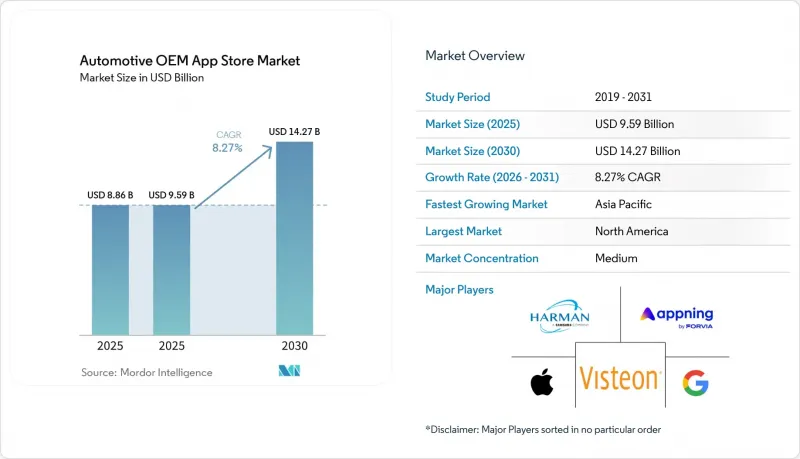
본 보고서는 서비스 유형(지도·내비게이션 등), 개발 형태(자체 개발 및 타사/외부 위탁), 차종(승용차 등), OS 유형(Android 및 iOS), 그리고 지역별로 분류되어 있습니다. 시장 예측은 금액(달러) 기준으로 제시되어 있습니다.
전 세계 자동차 OEM 앱 스토어 시장 동향 및 인사이트
OEM의 소프트웨어 정의 차량(SDV) 전환 및 지속적 수익
각 제조업체는 전기 아키텍처의 재정의에 박차를 가하고 있으며, 소프트웨어는 이제 주요 수익원으로 간주되고 있습니다. OTA(Over-the-Air)를 통한 기능 활성화를 가능하게 하는 제너럴 모터스(GM)의 ‘Ultifi’ 플랫폼은 가까운 미래에 설정된 대규모 이연 수익 목표의 핵심을 이루고 있으며, 경영진이 앱 주도 수익에 주력하고 있음을 여실히 보여줍니다. BMW의 ‘iDrive 9’ 및 향후 출시될 ‘Neue Klasse’는 자사에서 개발한 AOSP 코드만을 채택할 예정입니다. 한편, 메르세데스-벤츠는 향후 몇 년 동안 디지털 서비스를 통해 상당한 수익을 창출하는 것을 목표로, 소프트웨어의 대부분을 자체 개발하기 위해 대규모 엔지니어 팀을 동원하고 있습니다. 플랫폼에 대한 통제권을 유지함으로써, 이들 제조업체들은 기존 Tier 1 공급업체들이 얻고 있는 극히 미미한 이익률에 비해 훨씬 높은 소프트웨어 매출 총이익률을 누리고 있습니다. 그러나 이러한 변화로 인해 공급업체와의 긴장이 고조되고 있으며, 공급업체 측은 현재 수익 분배 계약의 재협상을 요구하고 있습니다.
커넥티드카 보급률의 급증
현재 커넥티드카에는 상시 접속이 가능한 모뎀이 기본으로 탑재되어 있으며, 이는 자동차 OEM 앱 스토어 시장 확대를 위한 기반 인프라를 형성하고 있습니다. 그러나 이러한 전략적 전환의 배경에는 EU 데이터법에 따른 “승인된 개발자라면 누구나 실시간 센서 데이터에 접근할 수 있도록 해야 한다”는 의무가 있으며, 각 브랜드는 데이터 독점이 아닌 사용자 경험으로 경쟁할 수밖에 없는 상황에 놓여 있습니다. 폭스바겐 그룹은 2023년에 여러 아우디 모델에서 앱 스토어를 출시했으며, 2030년까지 4,000만 대의 커넥티드카를 목표로 하고 있습니다. 규제 준수 기한에 앞서 이미 70개 이상의 세계 앱을 엄선해 놓았습니다. 맥킨지의 조사에 따르면, 프리미엄 부문 구매자의 38%가 더 풍부한 디지털 서비스를 원해 브랜드를 바꿀 의향을 나타내고 있으며, 이로 인해 차별화의 여지가 줄어들고 있습니다. 따라서 커넥티비티가 옵션 기능에서 규제상 필수 요건으로 전환되는 가운데, 타사 앱 도입 속도의 빠름이 성공 여부를 가르는 중요한 지표가 됩니다.
사이버 보안/개인정보 보호 승인 병목 현상
ISO/SAE 21434 및 UNECE WP.29 R155/R156은 2024년에 의무화되어, 신규 또는 갱신된 모든 앱에 대해 엄격한 위협 분석, 취약성 평가 및 무선(OTA) 검증 테스트가 의무화되었습니다. TISAX 평가에서는 공급업체의 보안 관련 증명 요건이 추가되었으며, 한편 미국의 조달 계약에서는 NIST 사이버 보안 프레임워크에 대한 언급이 증가하고 있어, 사실상 규정 준수의 최저 기준이 형성되고 있습니다. 시장에서 사전 심사를 거친 카탈로그를 활용하여 이러한 장벽을 우회하는 방법도 있지만, 독립 개발자의 경우 다중 관할권에 걸친 감사에 필요한 자원이 부족한 경우가 많아, 그 결과 대형 브랜드의 지배력이 공고해지고 출시 주기가 장기화되고 있습니다.
부문 분석
2025년, 지도 및 내비게이션 서비스는 자동차 OEM 앱 스토어 시장의 43.27%를 차지하며, 대부분의 인포테인먼트 스택에 번들로 제공되는 기본 기능으로서의 입지를 확고히 했습니다. HERE Technologies가 10년 동안 2억 3,800만 대의 차량에 데이터를 공급해 온 실적과, 10년 동안 10억 달러 규모의 AWS와의 제휴는 실시간 지도 업데이트가 지속적인 이용료 유지에 어떻게 기여하고 있는지를 보여줍니다.
결제 및 구매 앱은 가장 빠르게 성장하는 카테고리이며, 각 OEM 업체들이 결제 흐름을 통합함에 따라 2031년까지 연평균 성장률(CAGR) 8.29%로 확대될 전망이며, 이는 자동차 OEM 앱 스토어 시장에서 거래 수수료 확보를 향한 광범위한 전환을 뒷받침하고 있습니다. 엔터테인먼트, 뉴스, 생산성 향상 각 카테고리는 포트폴리오를 보완하고 있으나, 핸즈프리 자율주행이 보급되기 전까지는 운전 중 주의 산만을 방지하기 위한 제한으로 인해 그 성장이 제약될 전망입니다.
2025년에는 제3자 아웃소싱이 자동차 OEM 앱 스토어 시장 규모의 68.65%를 차지하며, 이는 FORVIA Appning, Harman Ignite, Visteon 등의 턴키 플랫폼을 통한 효율화가 반영된 결과입니다. FORVIA Appning만 해도 23개 이상의 브랜드를 지원하고 있으며, 2025년 말까지 커넥티드카의 20%를 지원하는 것을 목표로 하고 있습니다. 이는 중소규모 OEM이 제품 라인업을 신속하게 확대하기 위해 활용하고 있는 플랫폼의 영향력을 뒷받침하는 것입니다.
BMW의 iDrive 9, 메르세데스-벤츠의 MB.OS, 토요타의 Arene 등이 데이터 관리와 30-50%의 소프트웨어 이익률을 추구하는 가운데, 사내 개발은 연평균 성장률(CAGR) 8.31%로 가속화되고 있습니다. 따라서 자동차 OEM 앱 스토어 업계는 ‘속도 추구를 위한 외주화를 통한 폭의 확대’와 ‘차별화를 위한 사내 개발을 통한 깊이의 추구’라는 두 가지 궤도에 따라 진화를 거듭하고 있습니다.
지역별 분석
2025년, 북미는 자동차 OEM 앱 스토어 시장 매출의 38.54%를 차지했으며, GM의 OnStar, 포드의 SYNC, 그리고 테슬라의 수직 통합형 모델이 이를 주도했습니다. 그러나 해당 지역의 엄격한 ‘2초 시선 규칙’은 사용자 참여도가 높은 컨텐츠를 제한하고 있어, 규제가 완화된 지역에 비해 성장 여지를 억제하고 있습니다. 스텔란티스는 이미 약 200만 대의 차량에 ‘AppMarket’을 탑재하여, 성숙한 시장에서도 유서 깊은 브랜드가 소프트웨어 사업을 확장할 수 있음을 보여주고 있습니다.
유럽의 전망은 2026년 9월에 시행될 EU 데이터법에 의해 형성되고 있습니다. 이 법은 외부 개발자에게 실시간 데이터에 대한 접근을 의무화하는 것입니다. 폭스바겐의 앱 스토어에는 이미 70개 이상의 앱이 등록되어 있으며, 2030년까지 4,000만 대의 커넥티드카를 목표로 하고 있습니다. BMW의 ‘iDrive 9’ 확장 및 FORVIA Appning의 GDPR(EU 개인정보보호규정)을 준수하고 안전성이 검증된 앱 카탈로그는 개발자 시장 진입을 더욱 촉진하며, 자동차 OEM 앱 스토어 시장의 지속적인 성장을 뒷받침하고 있습니다.
아시아태평양은 소프트웨어 중심의 자동차를 수출하는 중국의 OEM과 인도의 커넥티드카 규제에 힘입어 2031년까지 연평균 성장률(CAGR) 8.41%라는 가장 높은 성장률을 기록할 전망입니다. BYD의 ‘DiLink’, 지리(Geely)의 크로스보더 앱, 도요타의 ‘Arene’은 5G, C-V2X, 스마트 홈의 융합을 실현한 이 지역만의 혁신을 구현하고 있습니다. 2025년 7월,SAIC가 MG 및 IM의 수출 차종에 ‘Appning’을 도입하기로 결정한 것은 중국 브랜드들이 화이트 라벨 스토어를 활용해 유럽, 남미, MEA(중동 및 아프리카) 시장에 진출함으로써 전 세계 자동차 OEM 앱 스토어 시장의 확장을 뒷받침하고 있음을 여실히 보여줍니다.
기타 혜택:
- 엑셀 형식 시장 예측(ME) 시트
- 3개월간의 애널리스트 지원
자주 묻는 질문
목차
제1장 서론
제2장 조사 방법
제3장 개요
제4장 시장 구도
제5장 시장 규모와 성장 예측
제6장 경쟁 구도
제7장 시장 기회와 향후 전망
JHS 26.09.01According to Mordor Intelligence, the automotive OEM app store market size is projected to expand from USD 8.86 billion in 2025 and USD 9.59 billion in 2025 to USD 14.27 billion by 2030, registering a CAGR of 8.27% between 2025 to 2030.
This report is Segmented by Service Type (Map & Navigation and More), Development Type (In-House and Third-party/Outsourced), Vehicle Type (Passenger Cars and More), Operating System Type (Android and IOS), and Geography. The Market Forecasts are Provided in Terms of Value (USD).
Global Automotive OEM App Store Market Trends and Insights
OEM Shift to Software-Defined Vehicles and Recurring Revenue
Electrical architectures are being redefined by manufacturers, with software now viewed as a key profit driver. General Motors' Ultifi platform, which enables over-the-air feature activations, is at the heart of a significant deferred-revenue target set for the near future, underscoring the C-suite's focus on app-driven profits. BMW's iDrive 9 and the upcoming Neue Klasse will exclusively utilize in-house AOSP code. Meanwhile, Mercedes-Benz has mobilized a substantial team of engineers to develop the majority of their software in-house, aiming for notable earnings from digital services in the coming years. By maintaining control over their platforms, these manufacturers are reaping considerably higher gross software margins compared to the minimal margins seen by traditional Tier-1 suppliers. However, this shift has intensified tensions with suppliers, who are now pushing for renegotiated revenue-sharing agreements.
Soaring Connected-Car Penetration
Connected vehicles now ship with always-on modems as standard, creating the baseline infrastructure for Automotive OEM App Store market expansion. The strategic pivot, however, stems from the EU Data Act's obligation to expose live sensor feeds to any authorized developer, compelling brands to compete on user experience instead of data hoarding . Volkswagen Group launched its Application Store across multiple Audi models in 2023 and targets 40 million connected cars by 2030, already curating more than 70 global apps to get ahead of the compliance cut-off. McKinsey research shows 38% of premium-segment buyers are willing to switch marques for richer digital services, compressing differentiation windows . Faster onboarding of third-party apps, therefore, becomes a make-or-break metric as connectivity shifts from an optional feature to a regulatory prerequisite.
Cyber-Security / Privacy Approval Bottlenecks
ISO/SAE 21434 and UNECE WP.29 R155/R156 turned mandatory in 2024, forcing every new or updated app through rigorous threat-analysis, vulnerability assessment, and over-the-air validation drills. TISAX assessments layer on supplier-security proof points, while U.S. procurement contracts increasingly cite the NIST Cybersecurity Framework, creating a de facto floor for compliance. Applying markets' pre-vetted catalogs to shortcut these hurdles, yet independent developers often lack the resources for multi-jurisdiction audits, entrenching big-brand dominance and lengthening launch cycles.
Other drivers and restraints analyzed in the detailed report include:
- Android Ecosystem Accelerating Third-Party App Availability
- EU Data Act Opening In-Vehicle Data Access
- Driver-Distraction Regulatory Ceilings
For complete list of drivers and restraints, kindly check the Table Of Contents.
Segment Analysis
Map and Navigation services controlled 43.27% of the Automotive OEM App Store market in 2025, confirming their role as baseline functionality bundled into most infotainment stacks. HERE Technologies' decade-long data supply to 238 million vehicles and its USD 1 billion, 10-year AWS alliance illustrate how live mapping upgrades help sustain recurring fees.
Payment and Purchase apps are the fastest risers, advancing at an 8.29% CAGR through 2031 as OEMs embed checkout flows, fueling a wider shift in the Automotive OEM App Store market toward transaction-fee capture. Entertainment, News, and Productivity categories round out portfolios but remain constrained by distraction limits until hands-free autonomy scales.
Third-party outsourcing captured 68.65% of the Automotive OEM App Store market size in 2025, reflecting efficiencies from turnkey platforms such as FORVIA Appning, Harman Ignite, and Visteon. FORVIA Appning alone powers more than 23 brands and intends to address 20% of connected vehicles by the end of 2025, evidencing platform leverage that smaller OEMs tap to scale catalogs quickly.
In-house coding is accelerating at an 8.31% CAGR as BMW's iDrive 9 and Mercedes-Benz's MB.OS and Toyota's Arene seek data control and 30-50% software margins. The Automotive OEM App Store industry, therefore, faces a dual-track evolution: outsourced breadth for speed, in-house depth for differentiation.
Complete Report Scope:
- By Service Type
- Map and Navigation
- In-vehicle Entertainment (podcast, music, audio)
- News and Magazines
- Payment and Purchase
- Business / Productivity
- Other Service Types (games, dealer locator, etc.)
- By Development Type
- In-house
- Third-party / Outsourced
- By Vehicle Type
- Passenger Cars
- Light Commercial Vehicles
- Medium and Heavy Commercial Vehicles
- By Operating System Type
- Android
- iOS
- By Geography
- North America
- United States
- Canada
- Rest of North America
- South America
- Brazil
- Argentina
- Rest of South America
- Europe
- Germany
- United Kingdom
- France
- Spain
- Italy
- Netherlands
- Russia
- Rest of Europe
- Asia-Pacific
- China
- India
- Japan
- South Korea
- ASEAN
- Australia
- New Zealand
- Rest of Asia-Pacific
- Middle East and Africa
- United Arab Emirates
- Saudi Arabia
- Turkey
- South Africa
- Nigeria
- Rest of Middle East and Africa
- North America
Geography Analysis
North America retained 38.54% of the Automotive OEM App Store market revenue in 2025, propelled by GM's OnStar, Ford SYNC, and Tesla's vertically integrated model. Yet the region's strict 2-second glance rule curtails high-engagement content, tempering upside relative to less-regulated arenas. Stellantis already embeds AppMarket across roughly 2 million vehicles, showing legacy brands can still scale software in a mature landscape.
Europe's outlook is shaped by the EU Data Act, effective September 2026, which forces real-time data access for external developers. Volkswagen's Application Store already hosts 70-plus apps and targets 40 million connected vehicles by 2030. BMW's iDrive 9 expansion and FORVIA Appning's GDPR-aligned, safety-verified catalog further catalyze developer onboarding, supporting sustained growth in the Automotive OEM App Store market.
Asia-Pacific is on track for the fastest 8.41% CAGR through 2031, driven by Chinese OEMs exporting software-centric cars and India's connected-car rules. BYD's DiLink, Geely's cross-border app, and Toyota's Arene showcase regional innovation that blends 5G, C-V2X, and smart-home convergence. SAIC's July 2025 decision to deploy Appning across MG and IM exports underscores how Chinese brands leverage white-label stores to penetrate Europe, South America, and MEA, expanding the Automotive OEM App Store market's global footprint.
- Harman International
- Tesla Inc.
- General Motors
- Ford Motor Company
- CognitiveClouds (Mahalo Digital)
- Cariad SE
- BMW Group
- Toyota Connected Corp.
- Amazon Web Services
- Mercedes-Benz Group
- Google Automotive Services
- Apple Inc.
- Stellantis N.V.
- Faurecia Aptoide Automotive
- Visteon Corp.
- Continental AG
- Robert Bosch GmbH
- HERE Technologies
- TomTom International
- Mapbox Inc.
Additional Benefits:
- The market estimate (ME) sheet in Excel format
- 3 months of analyst support
TABLE OF CONTENTS
1 Introduction
- 1.1 Study Assumptions & Market Definition
- 1.2 Scope of the Study
2 Research Methodology
3 Executive Summary
4 Market Landscape
- 4.1 Market Overview
- 4.2 Market Drivers
- 4.2.1 OEM Shift to Software-Defined Vehicles and Recurring Revenue
- 4.2.2 Soaring Connected-Car Penetration
- 4.2.3 Android Ecosystem Accelerating Third-Party App Availability
- 4.2.4 EU Data Act Opening In-Vehicle Data Access
- 4.2.5 Gen Z Demand for In-Car Digital Commerce and Payments
- 4.2.6 5G/Edge Apis Enabling Immersive Cockpit Apps
- 4.3 Market Restraints
- 4.3.1 OS Fragmentation Between Android and iOS
- 4.3.2 Cyber-Security / Privacy Approval Bottlenecks
- 4.3.3 OEM-Tier-1 Revenue-Share Conflicts
- 4.3.4 Driver-Distraction Regulatory Ceilings
- 4.4 Value / Supply-Chain Analysis
- 4.5 Regulatory Landscape
- 4.6 Technological Outlook
- 4.7 Porter's Five Forces
- 4.7.1 Threat of New Entrants
- 4.7.2 Bargaining Power of Suppliers
- 4.7.3 Bargaining Power of Buyers
- 4.7.4 Threat of Substitutes
- 4.7.5 Competitive Rivalry
5 Market Size & Growth Forecasts (Value (USD))
- 5.1 By Service Type
- 5.1.1 Map and Navigation
- 5.1.2 In-vehicle Entertainment (podcast, music, audio)
- 5.1.3 News and Magazines
- 5.1.4 Payment and Purchase
- 5.1.5 Business / Productivity
- 5.1.6 Other Service Types (games, dealer locator, etc.)
- 5.2 By Development Type
- 5.2.1 In-house
- 5.2.2 Third-party / Outsourced
- 5.3 By Vehicle Type
- 5.3.1 Passenger Cars
- 5.3.2 Light Commercial Vehicles
- 5.3.3 Medium and Heavy Commercial Vehicles
- 5.4 By Operating System Type
- 5.4.1 Android
- 5.4.2 iOS
- 5.5 By Geography
- 5.5.1 North America
- 5.5.1.1 United States
- 5.5.1.2 Canada
- 5.5.1.3 Rest of North America
- 5.5.2 South America
- 5.5.2.1 Brazil
- 5.5.2.2 Argentina
- 5.5.2.3 Rest of South America
- 5.5.3 Europe
- 5.5.3.1 Germany
- 5.5.3.2 United Kingdom
- 5.5.3.3 France
- 5.5.3.4 Spain
- 5.5.3.5 Italy
- 5.5.3.6 Netherlands
- 5.5.3.7 Russia
- 5.5.3.8 Rest of Europe
- 5.5.4 Asia-Pacific
- 5.5.4.1 China
- 5.5.4.2 India
- 5.5.4.3 Japan
- 5.5.4.4 South Korea
- 5.5.4.5 ASEAN
- 5.5.4.6 Australia
- 5.5.4.7 New Zealand
- 5.5.4.8 Rest of Asia-Pacific
- 5.5.5 Middle East and Africa
- 5.5.5.1 United Arab Emirates
- 5.5.5.2 Saudi Arabia
- 5.5.5.3 Turkey
- 5.5.5.4 South Africa
- 5.5.5.5 Nigeria
- 5.5.5.6 Rest of Middle East and Africa
- 5.5.1 North America
6 Competitive Landscape
- 6.1 Market Concentration
- 6.2 Strategic Moves
- 6.3 Market Share Analysis
- 6.4 Company Profiles (includes Global Level Overview, Market Level Overview, Core Segments, Financials as Available, Strategic Information, Market Rank/Share for Key Companies, Products and Services, SWOT Analysis, and Recent Developments)
- 6.4.1 Harman International
- 6.4.2 Tesla Inc.
- 6.4.3 General Motors
- 6.4.4 Ford Motor Company
- 6.4.5 CognitiveClouds (Mahalo Digital)
- 6.4.6 Cariad SE
- 6.4.7 BMW Group
- 6.4.8 Toyota Connected Corp.
- 6.4.9 Amazon Web Services
- 6.4.10 Mercedes-Benz Group
- 6.4.11 Google Automotive Services
- 6.4.12 Apple Inc.
- 6.4.13 Stellantis N.V.
- 6.4.14 Faurecia Aptoide Automotive
- 6.4.15 Visteon Corp.
- 6.4.16 Continental AG
- 6.4.17 Robert Bosch GmbH
- 6.4.18 HERE Technologies
- 6.4.19 TomTom International
- 6.4.20 Mapbox Inc.
7 Market Opportunities & Future Outlook
- 7.1 White-space & Unmet-Need Assessment


