

|
시장보고서
상품코드
2117392
중국의 전기차 충전 서비스 : 시장 점유율 분석, 산업 동향 및 통계 데이터, 성장 예측(2026-2031년)China EV Charging-as-a-Service - Market Share Analysis, Industry Trends & Statistics, Growth Forecasts (2026 - 2031) |
||||||
 Mordor Intelligence
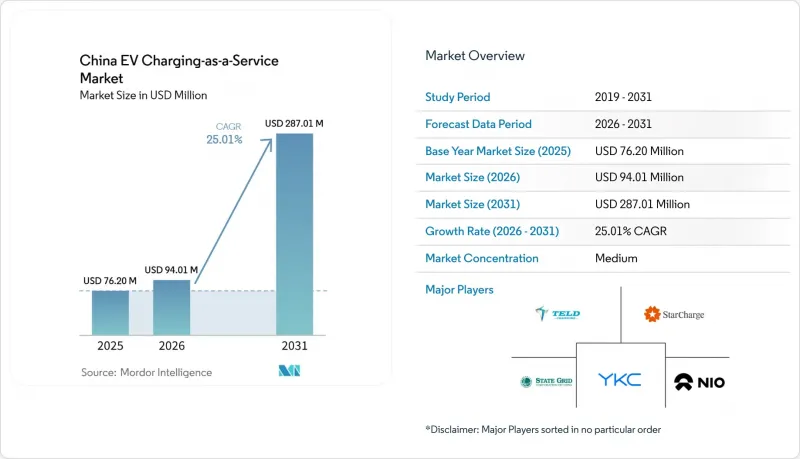
Mordor Intelligence에 의하면, 중국의 전기차 충전 서비스 시장은 2025년에 7,620만 달러 규모로 평가되었습니다. 2026년 9,401만 달러에서 2031년까지 2억 8,701만 달러에 이를 것으로 예상되며, 예측 기간(2026-2031년) CAGR은 25.01%를 나타낼 전망입니다.
본 보고서는 충전기 유형(AC 충전기, DC 충전기), 차량 서비스 유형(사용차·차량 풀, 배송·물류 등), 출력(레벨 1/AC(22kW 미만),레벨 2(22-50 kW) 등), 최종 용도(준공공 충전 설비, 공공 충전 설비)별로 분류되어 있습니다. 시장 예측은 금액(달러) 기준으로 제시되어 있습니다.
중국의 전기차 충전 서비스 시장 동향 및 인사이트
디포용 DC 급속 충전에 대한 정부 보조금 및 요금 우대 조치
2025년부터 2027년에 걸쳐 중앙 정부 및 각 성의 프로그램을 통해 충전 인프라에 대한 대규모 투자가 이루어질 전망입니다. 연안 지역 제조 거점에 위치한 차고 운영 사업자는 설비 및 설치 비용의 일부를 보전하기 위한 자본 보조금을 확보할 수 있습니다. 비피크 시간대의 전기 요금은 주간 상업용 요금에 비해 상당한 비용 절감을 가져와, 이용률이 높은 물류 센터의 내부 수익률을 향상시킵니다. GB/T 표준을 준수하는 전국적인 상호 운용성 규정은 벤더 종속을 방지하고 잠재적인 차량 기반을 확대함으로써 이러한 수익을 더욱 강화합니다. 이러한 인센티브들이 결합되면서, 중국의 전기차 충전 서비스 시장은 안정적인 유틸리티과 같은 현금 흐름을 추구하는 인프라 펀드에게 주요 투자 대상으로 부상하고 있습니다.
전자상거래의 당일 배송 붐으로 인해 야간 차량 충전이 필요해졌습니다.
2024년, 중국에서는 막대한 양의 소포가 처리되었으며, 2027년까지 그 대부분이 당일 또는 익일에 배송될 전망입니다. 이러한 엄격한 배송 기한을 맞추기 위해 사업자들은 주간 공공 충전기에 의존하기보다는 야간 6시간의 비수기 시간대에 밴을 교체하거나 충전하는 방식을 점점 더 많이 선택하고 있습니다. 높은 충전 용량을 갖춘 물류 센터(DC) 유닛은 차량의 주행 거리를 효율적으로 회복시킬 수 있습니다. 이러한 효율성 덕분에 트럭은 하루에 여러 번의 배송을 처리할 수 있게 됩니다. 광저우, 상하이, 우한, 창사 등의 주요 도시는 초고속 충전 거점의 집적지로 부상하고 있습니다. 그 주된 이유는 도심 내 배송 거점 외에도 대규모 전자상거래 물류 센터가 입지해 있기 때문입니다. 이러한 예측 가능한 야간 수요의 급증은 서비스 제공업체에 안정적인 수익원을 보장할 뿐만 아니라, 중국의 전기차 충전 서비스 시장의 장기적인 전망을 강화하는 결과로 이어집니다.
1급 도시 중심부의 배전 변압기 과부하 비용
메가시티에서 국지적인 전기차 밀도가 임계치를 초과하면, 기존 송전망은 과부하 문제에 직면하게 됩니다. 물류 거점 개발업자들은 변압기 교체 비용을 부담할 수밖에 없을 뿐만 아니라, 장기간 지속될 수 있는 인가 대기 문제에도 직면해 있습니다. 이러한 지연은 운전 자금을 묶어둘 뿐만 아니라 내부 수익률을 저하시키는 결과로 이어집니다. 그 결과, 단기적으로는 잉여 용량을 갖춘 교외 부지가 더 매력적인 대안으로 부상하고 있습니다. 이러한 병목 현상은 특히 수익성이 높은 수요 중심지에서 중국의 전기차 충전 서비스 시장의 당면한 확장을 저해하고 있습니다.
부문별 분석
2025년, 중국의 전기차 충전 서비스 시장에서 AC 하드웨어가 54.21%의 점유율을 차지했습니다. 이는 하드웨어 비용이 낮고, 송전망 업그레이드 요구 사항이 최소화되기 때문입니다. 기업 차량 기지의 야간 주차 시간은 7kW-40kW의 충전 속도에 적합하여, 이를 통해 사업자는 피크 시간대의 요금을 피할 수 있습니다. 한편, DC 급속 충전기는 2031년까지 연평균 26.33%의 성장률이 예상됩니다. 이러한 성장세는 50kW-150kW급 충전 설비를 차량 기지에 설치하여 밴을 3시간 이내에 완충시킴으로써, 2교대 근무 체제에서 차량 운행을 가능하게 하는 데 기인합니다. BYD가 TELD 및 Star Charge와 공동으로 전개한 1MW 규모의 시범 프로젝트에서는 1기의 초고출력 충전 건으로 하루에 40-50대의 밴을 충전할 수 있으며, AC 충전 베이에 비해 1제곱미터당 수익이 4배에 달한다는 사실이 입증되었습니다.
중국의 전기차 충전 서비스 시장에서 직류(DC) 캐비닛의 점유율은 물류 차량이 800V 또는 1,000V의 신형 차량 플랫폼을 도입할 때마다 상승하고 있습니다. 공개된 데이터에 따르면, 2026년 2월까지 전국 평균 공급 전력이 현저히 증가하여 전력 밀도 측면에서 큰 변화가 두드러지고 있습니다. 가정과 직장에서는 여전히 AC가 주류를 이루고 있지만, 물류 센터에서는 경제성 측면에서 DC가 점점 더 유리해지고 있습니다. 이러한 변화는 소포 처리량 증가와 배송 시간의 엄격화로 인해 가속화되고 있습니다.
기업용 차량 및 차량 풀은 2025년 매출의 41.33%를 차지하며, 예측 가능한 야간 충전 패턴을 동반한 안정적인 다년 계약을 제공했습니다. 그러나 대형 전자상거래 기업들이 ‘당일 배송 보장’을 가속화함에 따라, 배송 및 물류 차량 보유 대수는 연평균 성장률(CAGR) 27.04%로 증가하고 있습니다. 전기 소포 배송용 밴은 디젤 트럭에 비해 에너지 비용이 3분의 1 수준이지만, 이는 창고의 충전기가 한 번의 휴식 시간 동안 200km의 주행 거리를 확보할 수 있는 경우에 한합니다. 메가시티의 물류 단지에 차량이 집중됨에 따라, 서비스 제공업체들은 단일 거점에서 규모의 경제를 실현하고 투자 효율을 높이고 있습니다.
라이드셰어 차량은 이 두 극단 사이의 중간에 위치하며, 야간 충전에는 거점에서의 직류 급속 충전을, 주간 충전에는 공공 초급속 충전 세션을 결합하고 있습니다. DiDi의 충전 사업 부문인 Xiaoju Energy는 이미 전력 공급량의 대부분을 상용 차량에서 얻고 있으며, 이는 중국의 전기차 충전 서비스 시장에서 B2B 수요가 중심적인 역할을 하고 있음을 뒷받침합니다. 저배출 구역이 확대됨에 따라 택배 사업자들은 기업용 차량군을 수익 기여도 측면에서 앞지르게 될 것이며, 물류는 시장의 대표적인 이용 사례로서의 입지를 공고히할 것입니다.
기타 혜택 :
- 엑셀 형식 시장 예측(ME) 시트
- 3개월간의 애널리스트 지원
자주 묻는 질문
목차
제1장 서론
제2장 분석 방법
제3장 개요
제4장 시장 구도
제5장 시장 규모 및 성장률 예측
제6장 경쟁 구도
제7장 시장 기회 및 향후 전망
KTH 26.09.02According to Mordor Intelligence, the China EV charging-as-a-Service market was valued at USD 76.20 million in 2025 and estimated to grow from USD 94.01 million in 2026 to reach USD 287.01 million by 2031, at a CAGR of 25.01% during the forecast period (2026-2031).
This report is Segmented by Charger Type (AC Chargers, DC Chargers), Fleet Service Type (Company Vehicle and Motor Pools, Delivery and Logistics, and More), Power Output (Level 1/AC (Below 22 KW), Level 2 (22-50 KW), and More), and End-Use (Semi-Public Charging Setup, Public Charging Setup). Market Forecasts are Provided in Terms of Value (USD).
China EV Charging-as-a-Service Market Trends and Insights
Government Subsidies and Tariff Incentives for Depot DC Fast Charging
Between 2025 and 2027, central and provincial programs are set to invest significantly in charging infrastructure. Depot operators in coastal manufacturing hubs can secure capital grants to offset a portion of their equipment and installation expenses. Off-peak electricity rates offer substantial savings compared to daytime commercial tariffs, enhancing internal rates of return for high-utilization depots. Nationwide interoperability rules, adhering to the GB/T standard, further bolster these returns by preventing vendor lock-in and expanding the potential fleet base. With these combined incentives, the China EV Charging-as-a-Service market is emerging as a prime target for infrastructure funds seeking stable, utility-like cash flows .
E-Commerce Same-Day Delivery Boom Requiring Overnight Fleet Charging
In 2024, China processed a significant volume of parcels, with projections indicating that by 2027, a majority of these will be delivered the same or next day. To meet these tight delivery deadlines, operators are increasingly opting to swap or recharge their vans during the six-hour night shift lull, rather than depending on public chargers during the day. Depot DC units, offering high charging capacities, can replenish vehicle ranges efficiently. This efficiency allows trucks to be available for multiple delivery waves each day. Major cities like Guangzhou, Shanghai, Wuhan, and Changsha are emerging as hotspots for ultra-fast charging sites, largely because they house large e-commerce fulfillment centers alongside urban depots. This predictable surge in overnight demand not only guarantees a steady revenue stream for service providers but also strengthens the long-term prospects of China's EV Charging-as-a-Service market.
Distribution Transformer Congestion Costs in Tier-1 Urban Cores
As localized EV density in megacities surpasses critical thresholds, legacy grids face overload challenges. Depot developers are compelled to finance transformer replacements and grapple with approval waits that can extend for significant periods. Such delays not only tie up working capital but also diminish internal rates of return. Consequently, suburban plots boasting spare capacity emerge as a more appealing option in the short term. This bottleneck curtails the immediate expansion of China's EV Charging-as-a-Service market, particularly in its most lucrative demand centers.
Other drivers and restraints analyzed in the detailed report include:
- PPP Financing Models Enabling Rapid Semi-Public Charger Rollout
- Urban Low-Emission-Zone Mandates Accelerating Logistics Fleet Electrification
- Volatile Spot Electricity Prices Eroding CaaS Profit Margins
For complete list of drivers and restraints, kindly check the Table Of Contents.
Segment Analysis
AC hardware owned 54.21% of the China EV Charging-as-a-Service market in 2025, thanks to low hardware costs and minimal grid-upgrade requirements. Overnight dwell times in company motor pools align with 7 kW-40 kW charge rates, helping operators sidestep peak-demand tariffs. DC fast chargers, however, are projected to expand at 26.33% through 2031. That trajectory is anchored in 50 kW-150 kW depot installs that turn vans around in under three hours, unlocking double-shift vehicle utilization. BYD's 1 MW pilot, rolled out with TELD and Star Charge, shows how a single ultra-high-power gun can service 40-50 vans per day, quadrupling revenue per square meter versus AC bays.
The China EV Charging-as-a-Service market share of DC cabinets rises each time logistics fleets add a new wave of 800-V or 1,000-V vehicle platforms. Public data reveals that the nationwide average delivered power experienced a notable increase by February 2026, highlighting a significant shift in power density. While AC continues to dominate in homes and workplaces, the economics of depots are increasingly favoring DC. This shift is driven by rising parcel volumes and tightening delivery windows.
Company vehicle and motor pools generated 41.33% of 2025 revenue, offering stable, multi-year contracts with predictable overnight charging patterns. Yet delivery and logistics fleets are growing at a 27.04% CAGR as e-commerce giants accelerate same-day guarantees. Electrified parcel vans boast energy costs one-third those of diesel trucks, but only if depot chargers can deliver 200 km of range within a single shift break. Fleet concentration in mega-city logistics parks gives service providers scale at a single site, amplifying investment efficiency.
Ride-hailing fleets sit between the two poles, blending depot DC fast charging for overnight top-ups with public ultra-fast sessions during the day. Xiaoju Energy, Didi's charging arm, already derives a major share of its electricity volume from commercial fleets, validating the centrality of B2B demand to the China EV Charging-as-a-Service market. As low-emission zones proliferate, parcel operators will overtake corporate pools in revenue contribution, cementing logistics as the market's defining use-case.
Complete Report Scope:
- By Charger Type
- AC Chargers
- DC Chargers
- By Fleet Service Type
- Company Vehicle and Motor Pools
- Delivery and Logistics
- Passenger Fleets
- By Power Output
- Level 1 / AC (Below 22 kW)
- Level 2 (22 - 50 kW)
- Fast (50 - 150 kW)
- High-Power (Above 150 kW)
- By End-Use
- Semi-Public Charging Setup
- Public Charging Setup
List of Companies Covered in this Report:
- TELD New Energy Co., Ltd.
- StarCharge
- State Grid Corporation of China
- YKC Clean Energy Technologies
- Xiaoju Energy (Xiaoju Charging)
- NIO Power
- XCharge
- Shell Recharge China
- BP Pulse
- Tesla China
- Contemporary Amperex Technology Co. Ltd. (CATL)
- Gotion High-tech
- Xiaomi Auto
- GAC Energy Technology Company Ltd
Additional Benefits:
- The market estimate (ME) sheet in Excel format
- 3 months of analyst support
TABLE OF CONTENTS
1 Introduction
- 1.1 Study Assumptions & Market Definition
- 1.2 Scope of the Study
2 Research Methodology
3 Executive Summary
4 Market Landscape
- 4.1 Market Overview
- 4.2 Market Drivers
- 4.2.1 Government Subsidies and Tariff Incentives for Depot DC Fast Charging
- 4.2.2 E-Commerce Same-Day Delivery Boom Requiring Overnight Fleet Charging
- 4.2.3 PPP Financing Models Enabling Rapid Semi-Public Charger Rollout
- 4.2.4 Urban Low-Emission-Zone Mandates Accelerating Logistics Fleet Electrification
- 4.2.5 AI-Based Load Balancing Platforms Reducing Peak Demand Charges
- 4.2.6 Standardization of Battery-Swap-Ready Parking Bays
- 4.3 Market Restraints
- 4.3.1 Distribution Transformer Congestion Costs in Tier-1 Urban Cores
- 4.3.2 Volatile Spot Electricity Prices Eroding CaaS Profit Margins
- 4.3.3 OEM-Integrated Charging Networks Cannibalizing Utilization Rates
- 4.3.4 Land-Use Restrictions on Depot Expansion in Logistics Hubs
- 4.4 Value / Supply-Chain Analysis
- 4.5 Regulatory Landscape
- 4.6 Technological Outlook
- 4.7 Porter's Five Forces
- 4.7.1 Threat of New Entrants
- 4.7.2 Bargaining Power of Buyers
- 4.7.3 Bargaining Power of Suppliers
- 4.7.4 Threat of Substitutes
- 4.7.5 Competitive Rivalry
5 Market Size & Growth Forecasts (Value, USD)
- 5.1 By Charger Type
- 5.1.1 AC Chargers
- 5.1.2 DC Chargers
- 5.2 By Fleet Service Type
- 5.2.1 Company Vehicle and Motor Pools
- 5.2.2 Delivery and Logistics
- 5.2.3 Passenger Fleets
- 5.3 By Power Output
- 5.3.1 Level 1 / AC (Below 22 kW)
- 5.3.2 Level 2 (22 - 50 kW)
- 5.3.3 Fast (50 - 150 kW)
- 5.3.4 High-Power (Above 150 kW)
- 5.4 By End-Use
- 5.4.1 Semi-Public Charging Setup
- 5.4.2 Public Charging Setup
6 Competitive Landscape
- 6.1 Market Concentration
- 6.2 Strategic Moves
- 6.3 Market Share Analysis
- 6.4 Company Profiles (Includes Global Level Overview, Market Level Overview, Core Segments, Financials as Available, Strategic Information, Market Rank/Share for Key Companies, Products and Services, SWOT Analysis, and Recent Developments)
- 6.4.1 TELD New Energy Co., Ltd.
- 6.4.2 StarCharge
- 6.4.3 State Grid Corporation of China
- 6.4.4 YKC Clean Energy Technologies
- 6.4.5 Xiaoju Energy (Xiaoju Charging)
- 6.4.6 NIO Power
- 6.4.7 XCharge
- 6.4.8 Shell Recharge China
- 6.4.9 BP Pulse
- 6.4.10 Tesla China
- 6.4.11 Contemporary Amperex Technology Co. Ltd. (CATL)
- 6.4.12 Gotion High-tech
- 6.4.13 Xiaomi Auto
- 6.4.14 GAC Energy Technology Company Ltd


