|
시장보고서
상품코드
2117454
자동차용 유체 이송 시스템 시장 : 점유율 분석, 산업 동향 및 통계 데이터, 성장 예측(2026-2031년)Automotive Fluid Transfer System - Market Share Analysis, Industry Trends & Statistics, Growth Forecasts (2026 - 2031) |
||||||
 Mordor Intelligence
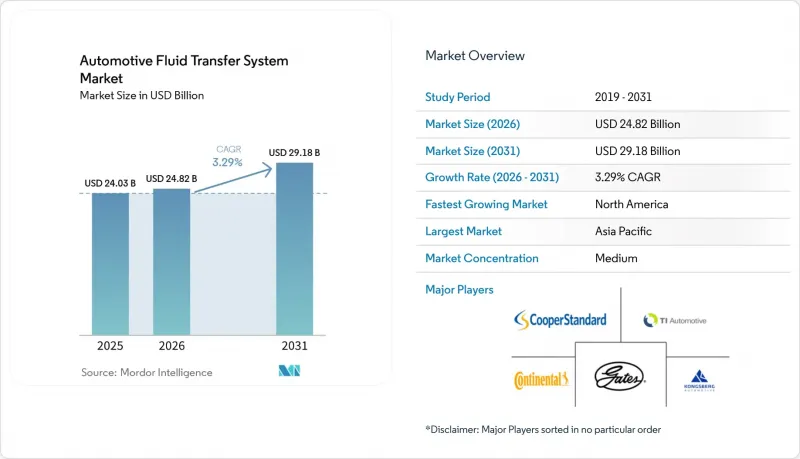
Mordor Intelligence에 의하면, 자동차용 유체 이송 시스템 시장 규모는 2025년 240억 3,000만 달러에서 2026년에는 248억 2,000만 달러로 확대되어 2031년까지 291억 8,000만 달러에 이를 것으로 예상되고 있어 2026년부터 2031년까지 CAGR 3.29%로 성장할 전망입니다.
본 보고서는 시스템 유형(연료 이송 시스템 등), 차종(승용차, 소형 상용차 등), 추진 방식(내연기관, 배터리식 전기차 등), 부품 유형(호스, 튜브 등), 유통 채널(OEM, 애프터마켓) 및 지역별로 분류되어 있습니다. 시장 전망은 금액(달러) 기준으로 제시되어 있습니다.
전 세계 자동차용 유체 이송 시스템 시장 동향 및 인사이트
BEV/HEV 판매 대수의 급격한 증가로 인해 멀티 루프식 열 관리 유체 회로가 보급되고 있습니다.
현재, 배터리식 전기차 및 하이브리드 차량 플랫폼에는 배터리 콜드 플레이트, 전력 전자 장치용 칠러, 그리고 차량 내 HVAC 모듈을 연결하는 멀티 루프 냉각수 네트워크가 통합되어 있습니다. 2026년 1월에 시행될 중국의 새로운 GB 규정은 2톤을 초과하는 차량에 대해 열 설계 최적화를 의무화하고 있으며, 이로 인해 가변 속도 전기 펌프 및 저투과성 호스에 대한 수요가 확고해지고 있습니다. 테슬라가 최근 취득한 듀얼 모드에 관한 특허는 2차 CO2 루프가 저온 충전을 어떻게 개선하는지를 보여줍니다. 1차 공급업체들은 누출 지점을 대폭 줄이고 조립 속도를 높이는 모듈식 냉각수 매니폴드를 통해 이에 대응하고 있습니다. BEV의 주행 거리가 늘어남에 따라, 유전성 유체에 대응하는 퀵 디스커넥트 커플링이 새로운 플랫폼 전반에 걸쳐 빠르게 표준화되고 있습니다.
배기가스 및 연비 기준의 강화로 인해 DPF/SCR용 유체 라인의 도입이 가속화되고 있습니다.
유로 7 규정은 2025년 7월 1일부터 신형 경차에 적용되었습니다. 이에 따라 NOx 상한치가 낮아지고 내구성이 200,000km로 연장됨에 따라, 각 OEM사는 -28°C에서의 사용에 견딜 수 있는 가열식 요소 호스 채택이 의무화되었습니다. 미국 EPA의 2025년 인센티브 갱신에서도 DEF 품질이 저하될 경우 차량 내 경고 및 출력 제한이 마찬가지로 의무화되었습니다. 인도의 BS-VII 초안은 실제 주행 배기가스 추적 측면에서 유로 7을 반영하고 있으며, 구형 트럭 차량군의 개조를 추진하고 있습니다. 이러한 조치들이 맞물려 전 세계적으로 고품질의 SCR 및 DPF 회로가 정착되고 있습니다.
내연기관(ICE)의 단계적 폐지 목표가 연료 및 오일 이송 라인에 대한 장기적인 수요를 억제하고 있습니다.
EU의 2035년 CO2 규제 및 캘리포니아주의 ZEV 로드맵은 내연기관(ICE)에 대한 신규 투자를 억제하고, 가솔린 및 디젤용 튜브의 잠재 시장을 축소시키고 있습니다. 자동차 제조업체들은 연구 개발을 배터리 및 열 관리 기술 혁신으로 전환하고 있으며, 이는 기존 연료 튜브 시스템의 단계적 폐지를 시사합니다. BEV(배터리 전기자동차) 중심의 제품 라인업으로 리스크 헤지를 하고 있는 공급업체는 유리한 입장에 있지만, 폐차 제도가 가속화됨에 따라 구형 연료 호스의 애프터마켓 재고는 노후화 위험에 노출되어 있습니다.
부문 분석
연료 이송 시스템은 여전히 가장 큰 하위 부문이며, 2025년에는 27.34%의 점유율을 차지할 것으로 예측됩니다. 이는 가솔린차 및 디젤차 플랫폼 전반에 걸쳐 널리 채택되고 있음을 반영합니다. 그러나 배터리 전기자동차(BEV) 및 하이브리드 차량에서 멀티 루프 열 관리 아키텍처로의 전환을 배경으로, 냉각수 회로는 연평균 성장률(CAGR) 3.91%로 확대되고 있습니다. 자동차 제조업체들은 배터리용 콜드 플레이트, 파워 일렉트로닉스용 칠러, 차량 내 공조(HVAC) 루프를 통합하고 있으며, 이 모든 것에는 고성능 호스, 펌프, 퀵 커넥터가 필수적입니다. 1차 공급업체들은 누출 경로를 줄이고 조립을 간소화하는 모듈식 냉각수 매니폴드로 이에 대응하고 있는 반면, 소재 전문 기업들은 유전체 유체용 저전도성 엘라스토머를 개발하고 있습니다.
유로 7 및 이에 상응하는 규제에 따른 플랫폼 재설계로 인해 첨단 냉각수 경로로의 전환이 더욱 가속화되고 있습니다. 엔지니어들은 벨트 구동식 펌프를 구동계 효율을 저하시키지 않으면서 열 부하를 최적화하는 스마트 가변 속도 전동 유닛으로 교체하고 있습니다. 동시에, 배터리 직접 침지 냉각에 관한 특허는 향후 개별 호스가 줄어들 것임을 시사하며, 팩 하우징 내부에 성형된 복합재 채널에 대한 실험을 촉진하고 있습니다. 각 공급업체는 글리콜-물 혼합액과 새로운 유전체 모두에 사용할 수 있는 호환성 있는 연결 부품을 제공함으로써 위험을 분산시키고 있습니다. 이러한 유연성 덕분에 향후 10년 동안 OEM 업체들이 배터리 전략을 지속적으로 개선해 나가는 과정에서 공급업체들은 부가가치를 창출할 수 있는 입지에 서게 됩니다.
2025년에는 전 세계 조립 라인의 막대한 생산 대수 덕분에 승용차가 시장 규모의 62.84%를 차지했습니다. 그럼에도 불구하고, 중형 및 대형 상용차의 경우, 차고 충전, 텔레매틱스, 그리고 더욱 엄격해진 배기가스 규제가 맞물려 연평균 성장률(CAGR) 4.73%를 나타낼 것으로 예측됩니다. 디젤 트럭에 선택적 촉매 환원(SCR) 시스템이나 미립자 필터 튜브를 사후 장착하는 차량은 애프터마켓에 즉각적인 호재를 가져다주고 있습니다. 이와 동시에, 장거리 전기 트럭에는 메가와트급 충전에 대응하는 절연성 퀵 커넥트가 필요하며, 이로 인해 고사양 커넥터를 위한 프리미엄 틈새 시장이 열리고 있습니다. 이러한 요인들이 결합되어 상용 차량 플랫폼은 대수상으로는 승용차보다 적음에도 불구하고, 엔지니어링 측면에서 주목도가 높아지고 있는 이유를 설명해 줍니다.
도시 물류의 성장은 상황을 더욱 복잡하게 만들고 있습니다. 소형 상용차는 운행 주기에 따라 내연 기관과 배터리식 전기 파워트레인을 전환하기 때문에 유체 시스템은 저점도 오일과 첨단 냉각 루프를 모두 지원할 수 있어야 합니다. 아시아와 유럽의 버스 사업자들은 제로 배출 구역을 위해 수소 또는 배터리 솔루션을 채택하고 있으며, 700바의 수소 튜브와 스택 쿨러가 필요합니다. 진동, 도로용 소금에의 노출, 24시간 가동과 같은 조건에 맞추어 호스 어셈블리를 맞춤 제작할 수 있는 부품 제조업체는 차량 구매자들로부터 높은 평가를 받고 있습니다. 이러한 서비스 지향적인 자세야말로 주로 출시 첫해의 판매 대수에 중점을 두는 승용차 중심의 경쟁사들과의 차별화 요소가 되고 있습니다.
지역별 분석
2025년, 아시아태평양은 자동차용 유체 이송 시스템 시장을 주도하며 매출의 48.87%를 차지했습니다. 중국에서는 2026년 1월 시행될 GB 기준에 따라 열 관리 시스템의 상설화가 의무화되어, 저투과성 냉각수 및 DEF 라인에 대한 지속적인 수요가 확보되고 있습니다. 인도에서는 2026년 4월 BS-VII 도입에 따라 모든 화물 차량에 DPF 및 SCR용 호스 개조가 필수화됩니다. 일본과 한국은 수소 버스 회랑을 우선시하고 있어, 700바르 연료 라인에 대한 조기 수주가 발생하고 있습니다. Tier 1 기업들은 수지 공급업체 인근에 압출 성형 및 컴파운딩 공장을 집적시켜 운송 비용과 수입 관세를 절감하고 있습니다.
북미에서는 2031년까지 연평균 성장률(CAGR) 4.17%로 가장 빠른 성장이 예상됩니다. 미국 환경보호청(EPA)의 2025년 대형 차량 인센티브 규제로 인해 모든 차량에 걸쳐 DEF 튜브의 업그레이드가 촉진될 것입니다. 주간 고속도로를 따라 진행되는 메가와트급 충전 시범 사업으로 인해, 기가와트급 펄스 부하에 대응 가능한 절연 퀵 커넥터에 대한 수요가 가속화되고 있습니다. 캐나다의 ZEV(무공해 차량) 규제로 인해 각 OEM 업체들은 배터리 및 열 관리 시스템공급망을 현지화해야 하는 압박을 받고 있습니다. 한편, 멕시코의 비용 경쟁력이 있는 공장들은 아시아에서 부과되는 관세의 영향을 더 이상 받지 않게 된 호스 제조 프로그램의 국내 복귀를 수용하고 있습니다.
유럽에서는 내연기관(ICE)의 단계적 폐지를 둘러싼 논의가 계속되고 있지만, 유로 7의 2025년 7월이라는 이정표가 단기적인 유체 라인 업그레이드를 확고히 하고 있습니다. 가열식 요소 회로와 20만 km의 내구성 기준으로 인해 사양의 최저 기준이 상향 조정되고 있습니다. 독일은 여전히 생산의 중심지로서, 다층 나일론·알루미늄 브레이크 튜브를 전 세계 플랫폼으로 수출하고 있습니다. 영국은 2026년 11월 이후 유로 7 규정을 준수하게 되어, 유럽 전역으로 규격 부품을 충족하는 부품에 대한 수요가 확대될 전망입니다.
기타 혜택:
- Excel 형식 시장 예측(ME) 시트
- 3개월간의 애널리스트 지원
자주 묻는 질문
목차
제1장 서론
제2장 분석 방법
제3장 주요 요약
제4장 시장 구도
제5장 시장 규모·성장률 예측
제6장 경쟁 구도
제7장 시장 기회와 향후 전망
JHS 26.09.03According to Mordor Intelligence, the automotive fluid transfer system market size is expected to increase from USD 24.03 billion in 2025 to USD 24.82 billion in 2026 and reach USD 29.18 billion by 2031, growing at a 3.29% CAGR over 2026-2031.
This report is Segmented by System Type (Fuel Transfer Systems, and More), Vehicle Type (Passenger Cars, Light Commercial Vehicles, and More), Propulsion Type (Internal Combustion Engine, Battery Electric Vehicle, and More), Component Type (Hoses, Tubing, and More), Distribution Channel (OEM and Aftermarket), and Geography. The Market Forecasts are Provided in Terms of Value (USD).
Global Automotive Fluid Transfer System Market Trends and Insights
Rapid BEV/HEV Sales Growth Creating Multi-Loop Thermal-Management Fluid Circuits
Battery-electric and hybrid platforms now integrate multi-loop coolant networks that link battery cold plates, power-electronics chillers, and cabin HVAC modules. China's new GB rules, effective January 2026, mandate thermal optimization for vehicles above 2 tonnes, cementing demand for variable-speed electric pumps and low-permeation hoses. Tesla's recent dual-mode patent demonstrates how secondary CO2 loops improve low-temperature charging. Tier-1 suppliers answer with modular coolant manifolds that slash leak points and expedite assembly. As BEV ranges edge higher, quick-disconnect couplings rated for dielectric fluids are rapidly standardizing across new platforms.
Tightening Emission and Fuel-Economy Norms Accelerating Adoption of DPF/SCR Fluid Lines
Euro 7 took effect for new light-duty vehicle types on 1 July 2025. It lowers NOx ceilings and extends durability to 200,000 km, obliging OEMs to specify heated urea hoses capable of -28 °C service. The U.S. EPA's 2025 inducement update likewise enforces in-cab warnings and speed derates when DEF quality sags. India's BS-VII draft mirrors Euro 7 with real-driving emissions tracking, driving retrofits across legacy truck fleets. Collectively, these measures are entrenching high-grade SCR and DPF circuits worldwide.
ICE Phase-Out Targets Curbing Long-Term Demand for Fuel and Oil Transfer Lines
The EU's 2035 CO2 mandate and California's ZEV roadmap discourage new ICE investments, shrinking the addressable pool for gasoline and diesel lines. Automakers redirect R&D toward battery-thermal innovation, signaling a gradual sunset for conventional fuel plumbing. Suppliers hedging with BEV-centric offerings are better positioned, while aftermarket inventories of legacy fuel hoses risk obsolescence as scrappage schemes accelerate.
Other drivers and restraints analyzed in the detailed report include:
- Turbo-GDI Engine Proliferation Raising Demand for High-Temperature Oil and Coolant Lines
- Smart Hoses With Embedded Fluid-Quality Sensors Enabling Predictive Maintenance
- Volatile PA-12 Supply Inflating High-Performance Polymer Costs
For complete list of drivers and restraints, kindly check the Table Of Contents.
Segment Analysis
Fuel transfer systems remain the largest sub-segment, capturing 27.34% share in 2025, reflecting their ubiquity across gasoline and diesel platforms. Even so, coolant circuits are expanding at a 3.91% CAGR, propelled by the shift to multi-loop thermal-management architectures in battery-electric and hybrid vehicles. Automakers are integrating battery cold plates, power-electronics chillers, and cabin HVAC loops, all of which depend on high-performance hoses, pumps, and quick connectors. Tier-1 suppliers respond with modular coolant manifolds that cut leak paths and simplify assembly, while material specialists develop low-conductivity elastomers for dielectric fluids.
Platform redesigns under Euro 7 and comparable regulations further accelerate the pivot toward advanced coolant routing. Engineers are replacing belt-driven pumps with smart, variable-speed electric units that optimize thermal loads without sapping driveline efficiency. At the same time, direct-immersion battery cooling patents hint at an eventual reduction in discrete hoses, driving experimentation with molded composite channels inside pack enclosures. Suppliers hedge by offering interchangeable fittings that serve both glycol-water and new dielectric formulations. This flexibility positions them to capture value as OEMs iterate battery strategies over the decade.
Passenger cars accounted for 62.84% of the market size in 2025 because of their sheer production volume across global assembly lines. Nevertheless, medium and heavy commercial vehicles are forecasted to record a 4.73% CAGR as depot charging, telematics, and stricter emissions rules collide. Fleets retrofitting diesel trucks with selective catalytic reduction and particulate filter plumbing provide an immediate aftermarket lift. In parallel, long-haul electric trucks require dielectric quick-connects rated for megawatt-class charging, opening a premium niche for high-spec connectors. These factors together explain why commercial platforms, though numerically smaller than cars, command growing engineering attention.
Urban logistics growth adds another layer of complexity. Light commercial vans toggle between internal-combustion and battery-electric powertrains depending on duty cycle, so their fluid architectures must support both low-viscosity oils and sophisticated coolant loops. Bus operators in Asia and Europe are adopting hydrogen or battery solutions for zero-emission zones, requiring 700-bar hydrogen lines and stack coolers. Component makers that can tailor hose assemblies for vibration, road-salt exposure, and 24-hour duty cycles gain an edge with fleet buyers. This service-orientation differentiates them from car-centric competitors focused mainly on launch-year volume.
Complete Report Scope:
- By System Type
- Fuel Transfer Systems
- Oil Transfer Systems
- Brake Fluid Systems
- Transmission Fluid Systems
- Coolant Transfer Systems
- By Vehicle Type
- Passenger Cars
- Light Commercial Vehicles (LCVs)
- Medium and Heavy Commercial Vehicles (M&HCVs)
- Buses and Coaches
- By Propulsion Type
- Internal Combustion Engine (ICE)
- Battery Electric Vehicle (BEV)
- Plug-in Hybrid Electric Vehicle (PHEV)
- Hybrid Electric Vehicle (HEV)
- Fuel-Cell Electric Vehicle (FCEV)
- By Component Type
- Hoses
- Tubing
- Connectors
- Clamps
- Reservoirs
- Pumps
- Others
- By Distribution Channel
- OEM
- Aftermarket
- By Geography
- North America
- United States
- Canada
- Rest of North America
- South America
- Brazil
- Argentina
- Rest of South America
- Europe
- United Kingdom
- Germany
- Spain
- Italy
- France
- Russia
- Rest of Europe
- Asia-Pacific
- India
- China
- Japan
- South Korea
- Rest of Asia-Pacific
- Middle East and Africa
- United Arab Emirates
- Saudi Arabia
- Turkey
- Egypt
- South Africa
- Rest of Middle East and Africa
- North America
Geography Analysis
Asia-Pacific led the automotive fluid transfer system market with 48.87% revenue in 2025. China's January 2026 GB standards hard-wire thermal management, ensuring continuous demand for low-permeation coolant and DEF lines. India's April 2026 BS-VII launch compels retrofits of DPF and SCR hoses across freight fleets. Japan and South Korea prioritize hydrogen bus corridors, generating early orders for 700-bar fuel lines. Tier-1 firms cluster extrusion and compounding plants near resin suppliers, curbing freight costs and import duties.
North America is forecasted to clock the swiftest 4.17% CAGR through 2031. The U.S. EPA's 2025 heavy-duty inducement rules trigger fleet-wide upgrades of DEF plumbing. Megawatt charging pilots along interstate corridors accelerate demand for dielectric quick-connects capable of gigawatt-class pulse loads. Canada's ZEV mandate pushes OEMs to localize battery-thermal supply chains, while Mexico's cost-competitive plants absorb reshored hose programs freed from Asian tariffs.
Europe faces an ICE phase-out debate, but Euro 7's July 2025 milestones anchor near-term fluid-line upgrades. Heated urea circuits and 200,000-km durability thresholds lift specification floors. Germany remains a production hub, exporting multilayer nylon-aluminum brake tubing to global platforms. The United Kingdom aligns with Euro 7 from November 2026 onward, extending compliant component demand across the continent.
- Cooper-Standard Holdings Inc.
- TI Automotive (TI Fluid Systems)
- Continental AG (ContiTech)
- Gates Corporation
- Kongsberg Automotive
- Akwel Group
- Hutchinson SA
- Tristone Flowtech
- Lander Automotive
- Castello Italia
- Parker Hannifin Corporation
- Sanoh Industrial Co., Ltd.
- Delfingen
- Eaton Corporation
- Kuriyama Holdings Corporation
- Transfer Oil S.p.A.
- Toyoda Gosei
- Manuli Hydraulics
- Trelleborg AB
Additional Benefits:
- The market estimate (ME) sheet in Excel format
- 3 months of analyst support
TABLE OF CONTENTS
1 Introduction
- 1.1 Study Assumptions & Market Definition
- 1.2 Scope of the Study
2 Research Methodology
3 Executive Summary
4 Market Landscape
- 4.1 Market Overview
- 4.2 Market Drivers
- 4.2.1 Rapid BEV/HEV Sales Growth Creating Multi-Loop Thermal-Management Fluid Circuits
- 4.2.2 Tightening Emission and Fuel-Economy Norms Accelerating Adoption of DPF/SCR Fluid Lines
- 4.2.3 Turbo-GDI Engine Proliferation Raising Demand for High-Temperature Oil and Coolant Lines
- 4.2.4 Smart Hoses With Embedded Fluid-Quality Sensors Enabling Predictive Maintenance
- 4.2.5 Laser-Welded Multilayer Nylon-Aluminum Brake Tubing Enabling 30% Weight Reduction
- 4.2.6 Megawatt Depot Charging for Electric Trucks Driving Dielectric-Coolant Quick-Connect Systems
- 4.3 Market Restraints
- 4.3.1 ICE Phase-Out Targets Curbing Long-Term Demand for Fuel and Oil Transfer Lines
- 4.3.2 Volatile PA-12 Supply Inflating High-Performance Polymer Costs
- 4.3.3 Low Replacement Rate Limiting Aftermarket Revenue
- 4.3.4 Direct-Immersion Battery Cooling Eliminating Discrete Coolant Hoses in Next-Gen EVs
- 4.4 Value / Supply-Chain Analysis
- 4.5 Regulatory Landscape
- 4.6 Technological Outlook
- 4.7 Porter's Five Forces
- 4.7.1 Threat of New Entrants
- 4.7.2 Bargaining Power of Suppliers
- 4.7.3 Bargaining Power of Buyers
- 4.7.4 Threat of Substitutes
- 4.7.5 Competitive Rivalry
5 Market Size & Growth Forecasts (Value (USD))
- 5.1 By System Type
- 5.1.1 Fuel Transfer Systems
- 5.1.2 Oil Transfer Systems
- 5.1.3 Brake Fluid Systems
- 5.1.4 Transmission Fluid Systems
- 5.1.5 Coolant Transfer Systems
- 5.2 By Vehicle Type
- 5.2.1 Passenger Cars
- 5.2.2 Light Commercial Vehicles (LCVs)
- 5.2.3 Medium and Heavy Commercial Vehicles (M&HCVs)
- 5.2.4 Buses and Coaches
- 5.3 By Propulsion Type
- 5.3.1 Internal Combustion Engine (ICE)
- 5.3.2 Battery Electric Vehicle (BEV)
- 5.3.3 Plug-in Hybrid Electric Vehicle (PHEV)
- 5.3.4 Hybrid Electric Vehicle (HEV)
- 5.3.5 Fuel-Cell Electric Vehicle (FCEV)
- 5.4 By Component Type
- 5.4.1 Hoses
- 5.4.2 Tubing
- 5.4.3 Connectors
- 5.4.4 Clamps
- 5.4.5 Reservoirs
- 5.4.6 Pumps
- 5.4.7 Others
- 5.5 By Distribution Channel
- 5.5.1 OEM
- 5.5.2 Aftermarket
- 5.6 By Geography
- 5.6.1 North America
- 5.6.1.1 United States
- 5.6.1.2 Canada
- 5.6.1.3 Rest of North America
- 5.6.2 South America
- 5.6.2.1 Brazil
- 5.6.2.2 Argentina
- 5.6.2.3 Rest of South America
- 5.6.3 Europe
- 5.6.3.1 United Kingdom
- 5.6.3.2 Germany
- 5.6.3.3 Spain
- 5.6.3.4 Italy
- 5.6.3.5 France
- 5.6.3.6 Russia
- 5.6.3.7 Rest of Europe
- 5.6.4 Asia-Pacific
- 5.6.4.1 India
- 5.6.4.2 China
- 5.6.4.3 Japan
- 5.6.4.4 South Korea
- 5.6.4.5 Rest of Asia-Pacific
- 5.6.5 Middle East and Africa
- 5.6.5.1 United Arab Emirates
- 5.6.5.2 Saudi Arabia
- 5.6.5.3 Turkey
- 5.6.5.4 Egypt
- 5.6.5.5 South Africa
- 5.6.5.6 Rest of Middle East and Africa
- 5.6.1 North America
6 Competitive Landscape
- 6.1 Market Concentration
- 6.2 Strategic Moves
- 6.3 Market Share Analysis
- 6.4 Company Profiles (Includes Global Level Overview, Market Level Overview, Core Segments, Financials as Available, Strategic Information, Market Rank/Share for Key Companies, Products and Services, SWOT Analysis, and Recent Developments)
- 6.4.1 Cooper-Standard Holdings Inc.
- 6.4.2 TI Automotive (TI Fluid Systems)
- 6.4.3 Continental AG (ContiTech)
- 6.4.4 Gates Corporation
- 6.4.5 Kongsberg Automotive
- 6.4.6 Akwel Group
- 6.4.7 Hutchinson SA
- 6.4.8 Tristone Flowtech
- 6.4.9 Lander Automotive
- 6.4.10 Castello Italia
- 6.4.11 Parker Hannifin Corporation
- 6.4.12 Sanoh Industrial Co., Ltd.
- 6.4.13 Delfingen
- 6.4.14 Eaton Corporation
- 6.4.15 Kuriyama Holdings Corporation
- 6.4.16 Transfer Oil S.p.A.
- 6.4.17 Toyoda Gosei
- 6.4.18 Manuli Hydraulics
- 6.4.19 Trelleborg AB
7 Market Opportunities & Future Outlook
- 7.1 White-space & Unmet-Need Assessment