

|
시장보고서
상품코드
2117501
안료 분산액 시장 : 점유율 분석, 업계 동향과 통계, 성장 예측(2026-2031년)Pigment Dispersion - Market Share Analysis, Industry Trends & Statistics, Growth Forecasts (2026 - 2031) |
||||||
 Mordor Intelligence
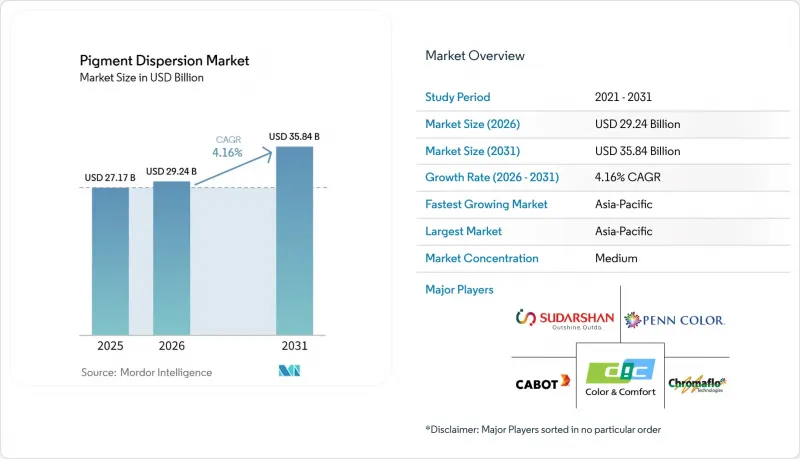
Mordor Intelligence에 의하면, 안료 분산액 시장 규모는 2025년 271억 7,000만 달러, 2026년 292억 4,000만 달러에서 2031년까지 358억 4,000만 달러로 확대된다고 예측되고 있어 2026년부터 2031년까지 CAGR 4.16%를 나타낼 전망입니다.
본 보고서는 안료의 유형(무기 안료 및 유기 안료), 분산제의 유형(수성 및 용제계), 용도(인쇄 잉크, 플라스틱 등), 최종 이용 산업(자동차, 포장 등), 지역(아시아태평양, 북미, 유럽, 남미, 중동 및 아프리카)별로 분류되어 있습니다. 시장 전망은 금액(달러) 기준으로 제시되어 있습니다.
세계 안료 분산액 시장 동향 및 인사이트
수성 안료 분산액 시스템에 대한 수요 증가
안료 분산액 시장에서 가장 두드러진 변화는 건축, 자동차 및 산업용 코팅 용도에서 용제형 시스템에서 수성형으로의 전환이 진행되고 있다는 점입니다. 유럽연합 집행위원회가 2025년 12월에 결정한 EU 에코라벨 기준 개정에 따라, 장식용 도료 및 관련 제품에 대한 기준이 엄격해졌으며, 특정 실내 용도에서 VOC(휘발성 유기 화합물) 및 SVOC(반휘발성 유기 화합물)의 허용 기준치가 낮아졌습니다. 공급업체들은 대개 전 세계 제품 플랫폼을 주요 기준 중 가장 엄격한 기준에 맞추기 때문에 이러한 변화는 유럽을 훨씬 넘어 조제 선택에 영향을 미치고 있습니다. 에보닉(Evonik)의 ‘TEGO Dispers 780 W’는 규제에 맞추어 기술 기반이 어떻게 진화하고 있는지를 보여줍니다. 이 제품은 무용제·무해하며, 고품질 수성 안료 농축액을 위해 설계되었으며, 관련 규정 준수 체계 하에서 식품 관련 용도를 포함하여 유기 및 무기 안료 모두에 적합합니다. 수성 시스템과 용제형 시스템 간의 성능 차이가 계속 좁혀지는 가운데, 안료 분산액 시장에서는 재조성, 시험, 생산 라인 전환을 통해 고객을 지원할 수 있는 제조업체가 우위를 점할 것으로 보입니다. 기존의 용제 화학에 의존하고 있는 중소규모의 배합 제조업체는 설비 및 기술 면에서 더 어려운 전환에 직면하게 될 것입니다.
건축 및 건설 분야 수요 증가
건축 및 건설 부문은 안료 분산체 시장의 성장을 뒷받침하고 있습니다. 이러한 수요는 불투명성, 내구성, 내후성 및 내외장 표면의 균일한 외관을 구현하기 위해 이산화티타늄과 산화철을 사용하는 건축용 도료 및 건축자재에 의해 주도되고 있습니다. 수요가 가장 높은 곳은 아시아태평양 및 일부 중동 시장이며, 이 지역에서는 도시화, 인프라 투자, 주택 개발이 광범위하고 지속적인 도료 소비를 뒷받침하고 있습니다. 이 지역들 외에도 친환경 건축 기준과 저배출 도료에 대한 선호도가 높아짐에 따라 사양 수준이 상향 조정되고 있으며, 용제를 많이 사용하는 대체품에 비해 부가가치가 높은 수성 분산액이나 기술적으로 정교한 분산액이 선호되고 있습니다. 그 결과, 안료 분산액 시장은 건설 활동으로부터 두 가지 측면에서 혜택을 받고 있습니다. 하나는 도료에 대한 직접적인 수요이며, 다른 하나는 보다 고도의 기술적 지식과 일관된 품질 관리를 필요로 하는 배합으로의 점진적인 전환입니다.
원자재 가격 변동
무기 안료 시스템에서 이산화티타늄 및 기타 광물 원료가 생산 비용의 상당 부분을 차지하고 있기 때문에 안료 분산체 시장은 여전히 원자재 가격 변동 위험에 노출되어 있습니다. 이산화티타늄은 무기 안료 생산 비용의 50%에서 70%를 차지하는 경우가 있으며, 이는 원자재 가격의 변동이 미미하더라도 안료 제조업체, 분산체 제조업체 및 하류 배합 업체 전체에 이익률에 대한 압박을 가한다는 것을 의미합니다. Tinox Chemie의 보고서에 따르면, 2026년 중반까지 루틸형 이산화티타늄의 가격은 톤당 1,821-1,959달러 범위로 예상됩니다. 한편, 유황 관련 가격 급등으로 인한 비용 압박은 황산염 공정 과정의 수익성에 계속해서 영향을 미치고 있으며, 2026년에도 비용의 불안정성이 운영상의 과제로 남아 있음을 반영하고 있습니다. 이는 안료 분산체 시장에도 중요한 사항입니다. 왜냐하면 건설 및 산업용도에서 무기계 제품이 매출의 대부분을 차지하고 있으며, 성능, 불투명도, 내후성에 영향을 주지 않고 이러한 원자재를 대체하는 것은 제조업체에게 어려운 일이기 때문입니다. 조달 체제가 견고하고, 공급업체 네트워크가 광범위하거나 업스트림 공정으로의 통합이 진행되고 있는 기업은 이익률을 지키는 데 유리한 입장에 있지만, 소규모 사업자일수록 이익률 하락이나 고객에 대한 비용 전가 지연이라는 위험에 직면하기 쉽습니다.
부문 분석
2024년, 무기 안료는 57.42%의 점유율을 차지하며 안료 분산체 시장에서 지배적인 부문이 되었습니다. 이러한 지위는 이산화티타늄과 산화철의 실용적인 성능에 의해 뒷받침되었습니다. 이는 건축용 및 산업용 코팅 용도에서 자외선 저항성, 열 안정성, 내화학성, 불투명성을 갖추면서도 비용 효율성도 제공했기 때문입니다. 이러한 특성 덕분에 무기 안료 분산액은 내후성과 수명이 중요한 구매 기준이 되는 건축용 외장 도료, 보호 시스템 및 PVC 계열 건축자재에서 계속해서 널리 사용되어 왔습니다. 안료 분산액 시장은 특히 건설용 및 산업 용도료의 연간 소비량이 막대한 지역에서 무기 화학에 크게 의존해 왔습니다. 이러한 집중 경향은 이산화티타늄 원자재 가격 변동이 밸류체인의 대부분에서 가격 책정 및 이익률 동향에 직접적인 영향을 미친 이유를 설명해 줍니다.
2025년 시점에서 유기 안료가 나머지 시장 점유율을 차지하고 있으며, 2031년까지 연평균 성장률(CAGR) 5.13%를 나타낼 것으로 예측되는데, 이는 해당 부문 내에서 가장 높은 성장률입니다. 유기 안료의 채택이 가장 활발한 분야는 채도, 휘도, 디자인의 유연성을 중시하고 중금속 관련 우려를 피할 수 있는 배합이 요구되는 최종 용도, 특히 인쇄 잉크, 특수 섬유 및 일부 화장품 시스템입니다. 2025년 3월, Sudarshan Chemical Industries Ltd는 Heubach Group 인수를 완료하여 전 세계 19곳으로 사업 거점을 확대하는 동시에 유기 안료, 무기 안료, 진주광 안료, 액체 분산액에 이르는 제품 포트폴리오를 강화했습니다. 이번 인수는 전 세계 최종 시장에서 특수 안료에 대한 지속적인 수요를 반영한 것입니다. 안료 분산체 시장에서 이 거래는 규모와 폭넓은 제품 포트폴리오를 결합하여, 더 큰 규모공급업체가 단일 플랫폼을 통해 범용 제품부터 고부가가치 컬러 시스템에 이르기까지 공급할 수 있게 했습니다. 따라서 무기 안료는 계속해서 주요 수익원이 될 전망이지만, 유기 안료는 제품 구성 및 이익률 향상에 지속적으로 영향을 미칠 것으로 보입니다.
수성 분산액은 2025년에 55.76%의 점유율을 차지하며, 2031년까지 연평균 성장률(CAGR) 4.82%로 성장할 것으로 전망되어, 안료 분산액 시장에서 가장 크고 가장 빠르게 성장하는 카테고리가 되고 있습니다. 이러한 성장은 환경 규정 준수 요건의 강화, 지속가능성 조달 기준의 확대, 그리고 안료의 습윤성, 안정성, 발색성, 내식성 분야의 기술적 진보에 의해 주도되고 있습니다. 수성 시스템으로의 전환은 건축용 도료, 포장용 잉크, 그리고 발색성이나 가공의 일관성을 해치지 않으면서 저배출 시스템을 원하는 고객이 존재하는 기타 용도에서 특히 중요해지고 있습니다. 이러한 전환에는 새로운 첨가제의 화학적 특성, 분쇄 제어의 개선, 그리고 보다 세밀한 배합 지원이 요구됩니다. 고객의 승인을 얻게 되면, 수성 시스템은 향후 규제 동향과 더욱 밀접하게 부합하기 때문에 더 긴 상업적 수명을 누릴 가능성이 있습니다.
BASF는 ‘Dispex Ultra PX 4290’을 수성 도료,인쇄 잉크, 접착제 분야의 유기 및 무기 안료용 무용제·고분자량 분산제로 포지셔닝하고 있으며, 안료 충전율 향상, 점도 감소, 응집 안정성 향상, 광택 향상 등의 장점을 갖추고 있습니다. 에보닉(Evonik)사 역시 ‘TEGO Dispers 780 W’를 고품질 수성 안료 농축액용 무용제 솔루션으로 포지셔닝하고 있습니다. 이 제품은 바인더 함유 및 바인더 프리 착색제 모두에 적합하며, 식품 용도와 관련된 요건도 준수합니다. 용제형 분산액은 접착성, 내화학성, 혹은 기존 공정 조건상 용제 화학이 선호되는 까다로운 산업용 및 특수 용도에서 여전히 일정한 역할을 하고 있습니다. 그러나 고객의 선호도와 규제가 휘발성 유기 화합물(VOC) 저감 및 규정 준수가 용이한 선택지로 계속 이동함에 따라, 안료 분산액 업계에서는 이러한 시스템이 일반 시장에서 차지하는 역할이 꾸준히 축소되고 있습니다. 그 결과, 용제계 제품은 특정 용도에서 전략적 중요성을 유지하고는 있으나, 과거와 같은 광범위한 시장에서의 입지는 상실되었습니다.
지역별 분석
아시아태평양은 2025년에 전 세계 매출의 37.55%를 차지하고, 2031년까지 연평균 성장률(CAGR) 5.42%로 성장하여 안료 분산액 시장에서 가장 크고 가장 빠르게 성장하는 지역이 되었습니다. 중국은 통합된 안료 생산, 광범위한 코팅 수요, 제조 규모, 그리고 포장, 플라스틱, 산업용 분야에 걸친 대규모 고객 기반에 힘입어 이 지위의 핵심으로 남아 있습니다. 인도 역시 주택 건설 확대, 도시 개발, 국내 제조업 활동이 도료 및 착색제 수요를 뒷받침함에 따라 그 중요성이 높아졌습니다. 아시아태평양 시장은 주요 소비 부문 전반에 걸쳐 더 높은 사양의 수성 및 특수 시스템으로의 점진적인 전환에 힘입어 더욱 탄력을 받았습니다. 동남아시아에서는 전자상거래 및 소비재 유통과 관련된 포장 수요가 여러 시장에서 잉크 및 관련 분산 시스템 수요를 견인하며, 이 지역은 추가적인 성장의 기반을 다지고 있습니다.
일본과 한국은 안료 분산액 시장에서 각각 다른 역할을 수행하고 있습니다. 일본은 지역 최대의 생산량이라기보다는 고사양 수요를 통해 더 큰 기여를 하고 있으며, 그 중요성은 안정적인 입자 제어와 일관된 배합 성능이 필요한 자동차 OEM용 도료, 전자 관련 용도, 첨단 산업용 마감, 그리고 정밀 인쇄 수요에 의해 뒷받침되고 있습니다. 북미와 유럽은 신축 건설의 현저한 성장보다는 리모델링 공사, 포장재 전환, 자동차 수리 도장 및 산업 용도료에 힘입어 계속해서 큰 가치의 원천이 되고 있습니다. 또한, 유럽은 중요한 규제적 벤치마크 역할도 하고 있습니다. 이는 휘발성 유기 화합물(VOC) 및 보다 광범위한 화학 물질 규정 준수 프레임워크에 의해 형성된 제품 요구 사항이 전 세계 공급업체의 기준과 수출용 배합 전략에 빈번하게 영향을 미치고 있기 때문입니다. 미국과 캐나다에서는 건설 및 리모델링 활동이 건축용 도료 수요를 뒷받침하는 한편, 포장 품질에 대한 기대가 높아짐에 따라 신뢰성이 높고 배출량이 적은 분산 기술에 대한 수요가 증가하고 있습니다.
DIC 주식회사의 자회사인 썬 케미컬(Sun Chemical)은 ‘European Coatings Show 2025’에서 수성 에멀젼, 수성 폴리우레탄 분산액, VOC 저감 솔루션 및 저모노머 소재를 중점적으로 소개하며, 유럽 및 북미 공급망에서 고품질 배합에 주력하고 있음을 보여주었습니다. 남미는 농업 관련 포장, 소비재, 주택 건설용 도료를 통해 기여하고 있으며, 특히 브라질은 이산화티타늄 및 산화철을 기반으로 한 건축용 시스템 분야에서 중요한 수요 거점으로 두각을 나타내고 있습니다. 중동 및 아프리카는 부가가치가 높은 현지 생산 규모는 여전히 작지만, 건설 프로젝트와 산업 개발이 수입 안료 분산액 및 농축액에 대한 수요를 지속적으로 뒷받침하고 있습니다. 이러한 시장에서는 고객이 수입된 시스템을 현지 기질, 기후 조건 및 시공 방법에 적응시키기 위한 지원을 자주 필요로 하기 때문에 기술 서비스 및 유통업체와의 관계는 가격만큼이나 중요할 수 있습니다. 전반적으로 안료 분산액 시장은 지역별로 다양성을 유지하고 있으며, 성장의 중심은 아시아태평양에 있는 반면, 유럽과 북미는 계속해서 기술 표준 및 규정 준수 방향을 결정하고 있습니다.
기타 혜택:
- 엑셀 형식 시장 예측(ME) 시트
- 3개월간의 애널리스트 지원
자주 묻는 질문
목차
제1장 서론
제2장 조사 방법
제3장 개요
제4장 시장 구도
제5장 시장 규모와 성장 예측
제6장 경쟁 구도
제7장 시장 기회와 향후 전망
JHS 26.09.01According to Mordor Intelligence, the pigment dispersion market size is projected to expand from USD 27.17 billion in 2025 and USD 29.24 billion in 2026 to USD 35.84 billion by 2031, and is expected to register a CAGR of 4.16% between 2026 and 2031.
This report is Segmented by Pigment Type (Inorganic Pigments and Organic Pigments), Dispersion Type (Water-Based and Solvent-Based), Application (Printing Inks, Plastics, and More), End-Use Industry (Automotive, Packaging, and More), and Geography (Asia-Pacific, North America, Europe, South America, and Middle-East and Africa). The Market Forecasts are Provided in Terms of Value (USD).
Global Pigment Dispersion Market Trends and Insights
Growing Demand for Waterborne Pigment Dispersion Systems
The most notable shift in the pigment dispersion market is the ongoing replacement of solvent-based systems with waterborne alternatives across architectural, automotive, and industrial coating applications. The European Commission's December 2025 EU Ecolabel decision tightened criteria for decorative paints and related products, including lower VOC and semi-volatile organic compound (SVOC) thresholds for certain interior applications. This change is influencing formulation choices well beyond Europe, as suppliers often align global product platforms to the strictest major standard. Evonik's TEGO Dispers 780 W illustrates how the technology base is evolving alongside regulations. The product is solvent-free, non-hazardous, designed for high-quality waterborne pigment concentrates, and suitable for both organic and inorganic pigments, including food-related uses under relevant compliance frameworks. As the performance gap between waterborne and solvent-based systems continues to narrow, the pigment dispersion market is likely to favor producers that can support customers through reformulation, testing, and line conversion. Smaller formulators that depend on legacy solvent chemistry will face a more demanding transition in terms of equipment and skills.
Rising Demand from the Building and Construction Sector
The building and construction segment supports growth in the pigment dispersion market. This demand is driven by architectural coatings and construction materials that use titanium dioxide and iron oxides for opacity, durability, weather resistance, and consistent appearance across interior and exterior surfaces. Demand is highest in Asia-Pacific and select Middle East markets, where urbanization, infrastructure spending, and residential development sustain broad and recurring coatings consumption. Beyond these regions, green building standards and low-emission coating preferences are raising specification levels, supporting higher-value water-based and technically refined dispersions over solvent-heavy alternatives. As a result, the pigment dispersion market benefits from construction activity in two ways: through direct coating demand, and through a gradual shift toward formulations that require greater technical input and more consistent quality control.
Raw Material Price Volatility
The pigment dispersion market remains exposed to raw material price volatility, as titanium dioxide and other mineral inputs account for a significant share of production costs in inorganic pigment systems. Titanium dioxide can account for 50% to 70% of inorganic pigment production costs, meaning even moderate input price fluctuations can pressure margins across pigment producers, dispersion manufacturers, and downstream formulators. Tinox Chemie reported rutile titanium dioxide prices in the range of USD 1,821 to USD 1,959 per ton through mid-2026, while elevated sulfur-related cost pressure continues to affect sulfate-process economics, reflecting ongoing cost instability as an operating challenge in 2026. This is relevant to the pigment dispersion market because inorganic systems account for a large share of revenue in construction and industrial applications, making it difficult for producers to substitute these inputs without affecting performance, opacity, or weather resistance. Companies with stronger procurement discipline, broader supplier networks, or upstream integration are better positioned to protect margins, while smaller participants face a greater risk of margin erosion or delayed cost pass-through to customers.
Other drivers and restraints analyzed in the detailed report include:
- Expansion of the Packaging Sector and E-commerce-Driven Demand
- Advancements in High-Performance Dispersion Technologies
- Compliance Burden from Environmental Regulations
For complete list of drivers and restraints, kindly check the Table Of Contents.
Segment Analysis
Inorganic pigments held a 57.42% share in 2024, making them the dominant segment in the pigment dispersion market. This position was supported by the practical performance of titanium dioxide and iron oxides, which offered cost efficiency alongside UV resistance, thermal stability, chemical resistance, and opacity in construction-grade and industrial coating applications. These properties kept inorganic dispersions widely used in exterior architectural coatings, protective systems, and PVC-based building materials, where weather exposure and service life were key purchasing criteria. The pigment dispersion market relied heavily on inorganic chemistry, particularly in regions where construction and industrial coatings consumed large quantities each year. This concentration also explained why raw material volatility in titanium dioxide directly affected pricing and margin performance across much of the value chain.
Organic pigments accounted for the remaining market share in 2025 and are projected to grow at a 5.13% CAGR through 2031, the fastest growth rate within this segment. Their adoption is strongest in end uses that prioritize chroma, brightness, design flexibility, and formulations that avoid heavy-metal-related concerns, particularly in printing inks, specialty textiles, and selected cosmetic systems. In March 2025, Sudarshan Chemical Industries Ltd completed the acquisition of Heubach Group, expanding its operations to 19 sites worldwide and strengthening its portfolio across organic, inorganic, pearlescent pigments, and liquid dispersions. This acquisition reflects continued demand for specialty pigments across global end markets. Within the pigment dispersion market, the transaction combined scale with portfolio breadth, enabling a larger supplier to serve both commodity and higher-value color systems through a single platform. Inorganic pigments are therefore likely to remain the primary revenue contributor, while organic pigments continue to influence product mix and margin development.
Water-based dispersions held a 55.76% share in 2025 and are forecast to grow at a 4.82% CAGR through 2031, making them both the largest and fastest-growing category within the pigment dispersion market. Their growth is driven by stricter environmental compliance requirements, broader sustainability procurement standards, and technical advances in pigment wetting, stabilization, color development, and corrosion performance. The shift toward waterborne systems is particularly relevant in architectural coatings, packaging inks, and other applications where customers require lower-emission systems without compromising color strength or process consistency. This transition requires new additive chemistry, improved milling control, and closer formulation support. Once approved by customers, water-based systems can benefit from longer commercial lifespans due to their closer alignment with future regulatory direction.
BASF describes Dispex Ultra PX 4290 as a solvent-free, high-molecular-weight dispersing agent for organic and inorganic pigments in aqueous coatings, printing inks, and adhesives, with benefits including higher pigment loading, reduced viscosity, improved flocculation stability, and improved gloss. Evonik similarly positions TEGO Dispers 780 W as a solvent-free solution for high-quality waterborne pigment concentrates, suitable across binder-containing and binder-free colorants, and compliant with claims relevant to food applications. Solvent-based dispersions retain a role in demanding industrial or specialty applications where adhesion, chemical resistance, or legacy process conditions favor solvent chemistry. Even so, the pigment dispersion industry is steadily reducing the broad-market role of these systems as customer preferences and regulations continue to shift toward lower volatile organic compound (VOC), more compliance-ready options. This leaves solvent-based products with strategic relevance in specific applications, but without the same broad market position they previously held.
Complete Report Scope:
- By Pigment Type
- Inorganic Pigments
- Organic Pigments
- By Dispersion Type
- Water-Based
- Solvent-Based
- By Application
- Paints and Coatings
- Printing Inks
- Plastics
- Textiles
- Paper
- Cosmetics
- Other Applications
- By End-Use Industry
- Building and Construction
- Automotive
- Packaging
- Paper and Printing
- Textile
- Consumer Goods
- Other End-Use Industries
- By Geography
- Asia-Pacific
- China
- India
- Japan
- South Korea
- Rest of Asia-Pacific
- North America
- United States
- Canada
- Mexico
- Europe
- Germany
- United Kingdom
- France
- Italy
- Russia
- Rest of Europe
- South America
- Brazil
- Argentina
- Rest of South America
- Middle-East and Africa
- Saudi Arabia
- South Africa
- Rest of Middle-East and Africa
- Asia-Pacific
Geography Analysis
Asia-Pacific accounted for 37.55% of global revenue in 2025 and grew at a 5.42% CAGR through 2031, making it the largest and fastest-growing region in the pigment dispersion market. China remained central to this position, supported by integrated pigment production, broad coatings demand, manufacturing scale, and a large customer base across packaging, plastics, and industrial applications. India also gained importance, as housing expansion, urban development, and domestic manufacturing activity sustained demand for coatings and colorants. The market in Asia-Pacific was further supported by a gradual shift toward higher-specification water-based and specialty systems across major consuming sectors. In Southeast Asia, packaging demand linked to e-commerce and consumer goods distribution drove the need for inks and associated dispersion systems across several markets, positioning the region for further growth.
Japan and South Korea play distinct roles in the pigment dispersion market. Japan contributes more through higher-specification demand than through the largest regional tonnage, with its importance driven by automotive OEM coatings, electronics-related applications, advanced industrial finishes, and precision printing needs that require stable particle control and consistent formulation performance. North America and Europe continue to represent substantial value pools, supported by renovation activity, packaging conversion, automotive refinishing, and industrial coatings rather than by high levels of new construction growth. Europe also serves as an important regulatory benchmark, as product requirements shaped by volatile organic compound (VOC) and broader chemical compliance frameworks frequently influence global supplier standards and export-facing formulation strategies. In the United States and Canada, construction and refurbishment activity supports architectural coatings demand, while packaging quality expectations are increasing the need for reliable, lower-emission dispersion technologies.
Sun Chemical, a DIC Corporation subsidiary, highlighted water-based emulsions, water-based polyurethane dispersions, VOC-reducing solutions, and low-monomer materials at the European Coatings Show 2025, reflecting the premium formulation focus in the European and North American supply chain. South America contributes through agribusiness packaging, consumer goods, and residential construction coatings, with Brazil standing out as a significant demand center for titanium dioxide and iron oxide-based architectural systems. The Middle East and Africa remain smaller in terms of value-added local production, but construction programs and industrial development continue to support demand for imported pigment dispersions and concentrates. In these markets, technical service and distributor relationships can be as important as price, as customers often require support in adapting imported systems to local substrates, climate conditions, and application practices. Overall, the pigment dispersion market remains regionally diverse, with its growth center in Asia-Pacific, while Europe and North America continue to shape technical standards and compliance direction.
- AArbor Colorants Corporation
- AUM Farbenchem Pvt. Ltd.
- Cabot Corporation
- Chromaflo Technologies
- Chromatech Inc.
- DCL Corporation
- Decorative Color and Chemical, Inc.
- DIC Corporation
- ECKART GmbH
- Flint Group
- Penn Colors Inc.
- Sudarshan Chemical Industries Limited
- Toyo Ink SC Holdings Co., Ltd.
- Trust Chem Co., Ltd.
- Vipul Organics Limited
Additional Benefits:
- The market estimate (ME) sheet in Excel format
- 3 months of analyst support
TABLE OF CONTENTS
1 Introduction
- 1.1 Study Assumptions and Market Definition
- 1.2 Scope of the Study
2 Research Methodology
3 Executive Summary
4 Market Landscape
- 4.1 Market Overview
- 4.2 Market Drivers
- 4.2.1 Growing Demand for Water-Based and Low-VOC Pigment Dispersions
- 4.2.2 Rising Demand from the Paints and Coatings Industry
- 4.2.3 Expansion of the Packaging and Printing Inks Industry
- 4.2.4 Increasing Use of Pigment Dispersions in Plastics and Polymer Applications
- 4.2.5 Advancements in High-Performance and Specialty Pigment Technologies
- 4.3 Market Restraints
- 4.3.1 Raw Material Price Volatility for Titanium Dioxide and Specialty Feedstocks
- 4.3.2 Compliance Burden From VOC, REACH, and Waste Handling Requirements
- 4.3.3 Volatility in Prices of Pigments and Petrochemical-Based Raw Materials
- 4.4 Value Chain Analysis
- 4.5 Porter's Five Forces Analysis
- 4.5.1 Threat of New Entrants
- 4.5.2 Bargaining Power of Suppliers
- 4.5.3 Bargaining Power of Buyers
- 4.5.4 Threat of Substitutes
- 4.5.5 Competitive Rivalry
5 Market Size and Growth Forecasts (Value)
- 5.1 By Pigment Type
- 5.1.1 Inorganic Pigments
- 5.1.2 Organic Pigments
- 5.2 By Dispersion Type
- 5.2.1 Water-Based
- 5.2.2 Solvent-Based
- 5.3 By Application
- 5.3.1 Paints and Coatings
- 5.3.2 Printing Inks
- 5.3.3 Plastics
- 5.3.4 Textiles
- 5.3.5 Paper
- 5.3.6 Cosmetics
- 5.3.7 Other Applications
- 5.4 By End-Use Industry
- 5.4.1 Building and Construction
- 5.4.2 Automotive
- 5.4.3 Packaging
- 5.4.4 Paper and Printing
- 5.4.5 Textile
- 5.4.6 Consumer Goods
- 5.4.7 Other End-Use Industries
- 5.5 By Geography
- 5.5.1 Asia-Pacific
- 5.5.1.1 China
- 5.5.1.2 India
- 5.5.1.3 Japan
- 5.5.1.4 South Korea
- 5.5.1.5 Rest of Asia-Pacific
- 5.5.2 North America
- 5.5.2.1 United States
- 5.5.2.2 Canada
- 5.5.2.3 Mexico
- 5.5.3 Europe
- 5.5.3.1 Germany
- 5.5.3.2 United Kingdom
- 5.5.3.3 France
- 5.5.3.4 Italy
- 5.5.3.5 Russia
- 5.5.3.6 Rest of Europe
- 5.5.4 South America
- 5.5.4.1 Brazil
- 5.5.4.2 Argentina
- 5.5.4.3 Rest of South America
- 5.5.5 Middle-East and Africa
- 5.5.5.1 Saudi Arabia
- 5.5.5.2 South Africa
- 5.5.5.3 Rest of Middle-East and Africa
- 5.5.1 Asia-Pacific
6 Competitive Landscape
- 6.1 Market Concentration
- 6.2 Strategic Moves
- 6.3 Market Share (%)/Ranking Analysis
- 6.4 Company Profiles (includes Global Overview, Market Overview, Core Segments, Financials as available, Strategic Information, Products and Services, and Recent Developments)
- 6.4.1 AArbor Colorants Corporation
- 6.4.2 AUM Farbenchem Pvt. Ltd.
- 6.4.3 Cabot Corporation
- 6.4.4 Chromaflo Technologies
- 6.4.5 Chromatech Inc.
- 6.4.6 DCL Corporation
- 6.4.7 Decorative Color and Chemical, Inc.
- 6.4.8 DIC Corporation
- 6.4.9 ECKART GmbH
- 6.4.10 Flint Group
- 6.4.11 Penn Colors Inc.
- 6.4.12 Sudarshan Chemical Industries Limited
- 6.4.13 Toyo Ink SC Holdings Co., Ltd.
- 6.4.14 Trust Chem Co., Ltd.
- 6.4.15 Vipul Organics Limited
7 Market Opportunities and Future Outlook
- 7.1 White-Space and Unmet-Need Assessment


