

|
시장보고서
상품코드
2117502
수산화 니켈 시장 : 점유율 분석, 업계 동향과 통계, 성장 예측(2026-2031년)Nickel Hydroxide - Market Share Analysis, Industry Trends & Statistics, Growth Forecasts (2026 - 2031) |
||||||
 Mordor Intelligence
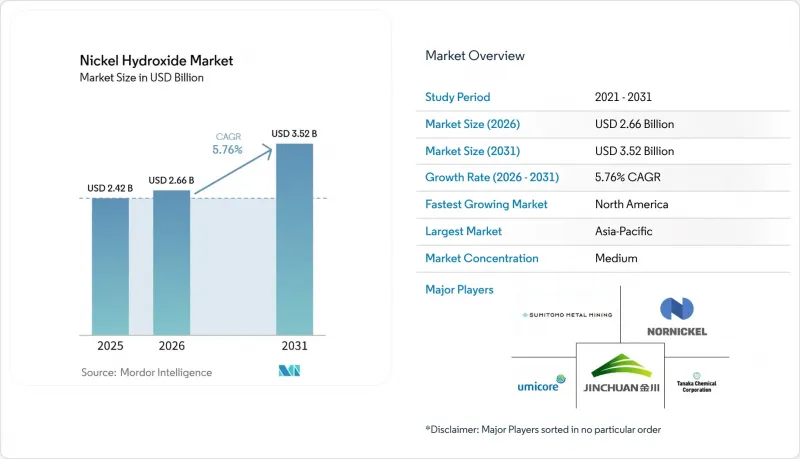
Mordor Intelligence에 의하면, 수산화 니켈 시장 규모는 2025년에 24억 2,000만 달러로 평가되었고 2026년 26억 6,000만 달러에서 2031년까지 35억 2,000만 달러에 이를 것으로 예측되며, 예측 기간(2026-2031년) CAGR은 5.76%를 나타낼 전망입니다.
본 보고서는 제품 유형(배터리용 수산화 니켈 등), 순도(배터리용 등급, 산업용 등급), 형태(분말 등), 용도(충전식 배터리 등), 최종 이용 산업(배터리 제조, 자동차 등), 지역(아시아태평양, 북미, 유럽, 남미, 중동 및 아프리카)별로 분류되어 있습니다. 시장 전망은 금액(달러) 기준으로 제시되어 있습니다.
세계 수산화 니켈 시장 동향 및 인사이트
전기차(EV)의 급속한 보급이 양극 전구체 수요를 가속화
세계 전기차용 배터리 도입량은 2025년에 1.2 TWh에 달할 것으로 예상되며, 이는 2024년 대비 30% 증가한 수치입니다. 이에 따라 배터리 재료 수요는 강력한 상승 추세를 유지할 전망입니다. 고에너지 밀도 배터리 플랫폼에서는 주행 거리 연장 및 성능 향상을 실현하기 위해 니켈을 풍부하게 함유한 양극재가 계속해서 채택되고 있어, 수산화 니켈 시장은 이러한 변화의 혜택을 받고 있습니다. 특히 프리미엄 전기차(EV) 부문은 여전히 중요하며, 장거리 주행을 목표로 하는 차량 프로그램에서는 중국 이외의 지역에서 저비용 대체재보다 니켈 함유 화학 조성이 계속해서 선호되고 있습니다. 이러한 추세에 따라 일관된 순도 및 입자 제어 요건을 충족하면서 양극 전구체 생산에 직접 전환 가능한 소재에 대한 수요가 유지되고 있습니다. 따라서 수산화 니켈 시장은 전기차 판매 대수뿐만 아니라 해당 차량에 채택되는 배터리 화학 조성의 구성과도 연동되어 있습니다. 고니켈 함량 셀 플랫폼의 상용화가 더욱 진행됨에 따라, 소재 수요는 더욱 집중화되고 있으며, 사양 주도형으로 증가하고 있습니다.
고순도 배터리 등급 사양으로의 구조적 전환이 공급 기준을 재정의
수산화 니켈 시장은 산업용 등급 소재에서 보다 엄격한 양극재 제조 기준을 충족할 수 있는 배터리 등급 공급으로 전환되고 있습니다. 2025년에는 순도 99% 이상의 배터리 등급이 매출의 64.9%를 차지하며, 이는 시장이 이미 첨단 배터리용도에 얼마나 의존하고 있는지를 보여줍니다. 이러한 변화는 배터리 재료 조달에 있어 품질 및 추적성에 대한 더 엄격한 기대를 포함하는 공식적인 공급망 요건에 의해 더욱 가속화되고 있습니다. 불순물 관리를 더 엄격하게 수행하고, 더 신뢰할 수 있는 공침법을 통한 제조 성능을 유지할 수 있는 생산자는 고객으로부터 장기적인 인정을 얻기 쉬운 입장에 있습니다. 또한, 인증 기준이 명목상의 설비 용량만큼 중요하게 여겨지게 되면서, 수산화 니켈 시장에 신규로 진입하는 것이 점점 더 어려워지고 있습니다. 이러한 요인들이 복합적으로 작용하여, 니켈의 전반적인 공급 상황이 비교적 여유로워 보일지라도 기존 공급업체들에 의한 가격 규율이 유지되고 있습니다.
높은 자본 요건이 배터리용 등급의 생산 능력 확대를 제약
수산화 니켈 시장은 배터리 등급의 공침법 생산 라인 건설 및 인증에 드는 높은 비용으로 인해 큰 장벽에 직면해 있습니다. 신규 시설에는 건설 자본뿐만 아니라 공정 검증, 폐기물 처리 시스템, 고객 승인도 필요하며, 이를 완료하는 데 수년이 소요될 수 있습니다. 이러한 과제는 중국에 비해 인건비 및 환경 규정 준수 비용이 높은 북미와 유럽에서 더욱 두드러집니다. 또한, 미국의 정책 논의에서도 국내 내 중요 광물 및 배터리 재료 생산은 수입품에 비해 여전히 비용 면에서 불리하다는 점이 지적되고 있습니다. 특히 리튬이나 흑연에 비해 지원이 부족한 가공 단계에서 이러한 경향이 두드러집니다. 그 결과, 수산화 니켈 시장에서는 채굴, 중간 가공, 전구체 제조 등 각 공정에 비용을 분산할 수 있는 대규모 통합 기업이 유리한 입장에 있습니다. 소규모 생산자도 시장 진입은 가능하지만, 가격과 사양 양면에서 일관성을 동시에 확보하는 데 어려움을 겪는 경우가 많은 것이 현실입니다.
부문 분석
2025년, 배터리용 수산화 니켈은 수산화 니켈 시장 점유율의 53.81%를 차지하며, 수요가 배터리 관련 용도로 크게 이동하고 있음을 반영하고 있습니다. 이 부문이 주도적인 위치를 차지하고 있는 이유는 양극 활물질 제조업체들이 니켈 함량이 높은 배터리 배합 및 더욱 엄격한 공정 허용 오차에 대응할 수 있는 전구체 공급을 점점 더 요구하고 있기 때문입니다. 산업용 수산화 니켈은 전기도금, 안료 및 일반 화학 합성 용도로 계속 사용되고 있어 수산화 니켈 산업 전체에서 그 역할을 유지하고 있습니다. 그러나 매출 구성이 고부가가치 배터리 사양으로 계속 이동함에 따라 성장 속도는 둔화되고 있습니다. 그 결과, 수산화 니켈 시장은 범용 화학 등급 제품이 아닌, 인증된 배터리용 소재를 공급할 수 있는 제조업체에 대한 의존도를 높이고 있습니다.
코발트 코팅 수산화 니켈은 2031년까지 연평균 성장률(CAGR) 6.62%를 나타낼 것으로 예측되며, 수산화 니켈 시장에서 가장 빠르게 성장하는 제품 하위 범주가 될 전망입니다. 고니켈 전극에서 사이클 안정성을 향상시키고 구조적 열화를 줄이기 위해 양극 제조업체들이 코발트 표면 처리를 채택함에 따라 수요가 증가하고 있습니다. 또한, 고밀도 수산화 니켈은 충전 밀도와 슬러리 성능이 극히 중요한 고체 배터리 전구체 개발 분야에서도 주목받고 있습니다. 구매자들이 화학적 특성뿐만 아니라 지속가능성과 공급망 규정 준수를 점점 더 중요하게 여기게 됨에 따라, 제품 차별화는 기술적 성능과 조달에 대한 신뢰성 모두에 의존하게 되었습니다. 이러한 추세로 인해 수산화 니켈 시장은 대체하기 어렵고 인증도 까다로운 고사양 제품에 지속적으로 집중하고 있습니다.
순도 99% 이상의 배터리 등급 수산화 니켈은 2025년에 매출의 64.93%를 차지하며, 2031년까지 연평균 성장률(CAGR) 6.31%로 성장할 것으로 전망됩니다. 이러한 실적은 순도가 니켈 하이드록사이드 시장에서 단순한 선택적 프리미엄 기능이 아닌 상업적 요건이 되었음을 보여줍니다. 배터리 공급망의 구매자들은 불순물에 대한 더 엄격한 관리, 더 안정적인 입자 특성, 그리고 로트 간 높은 신뢰성을 갖춘 균일성을 요구하고 있습니다. 순도 99% 미만의 산업용 등급 수산화 니켈은 전기도금, 세라믹, 안료 및 범용 화학제품 용도를 계속해서 뒷받침하고 있으며, 그 수요 기반은 유지되고 있습니다. 그러나 첨단 배터리 조달에서 중심적인 위치를 차지하지 못하고 있어 가격 결정력은 낮은 임베디드니다.
기준이 엄격해짐에 따라, 수산화 니켈 시장에서 효과적으로 경쟁할 수 있는 기업의 구도도 변화하고 있습니다. 고순도 소재를 안정적으로 공급할 수 있는 생산자는 고객의 인정을 받아 더 높은 이익률을 유지하기 쉬운 입장에 있습니다. 품질, 추적성, 공정 관리가 배터리 관련 공급망 전반에서 더욱 공식적인 주목을 받고 있는 만큼, 규제상의 압력도 이러한 격차를 더욱 심화시키고 있습니다. 신흥 배터리 플랫폼을 위한 초고순도 소재에 대한 소량 수요는 현재로서는 틈새 시장에 그칠지 모르지만, 제품 라인업에 중요한 프리미엄 부문을 추가하고 있습니다. 그 결과, 수산화 니켈 시장은 품질 중시 경향을 더욱 강화하고 있으며, 검증된 가공 능력을 갖춘 기존 공급업체들에게 힘을 실어주고 있습니다.
지역별 분석
2025년, 아시아태평양은 수산화 니켈 시장 점유율의 59.23%를 차지하며, 이 지역은 세계 생산 및 소비의 중심지로서의 입지를 공고히 했습니다. 중국은 양극 전구체의 가공, 배터리 제조, 그리고 대규모 최종 시장 수요를 긴밀하게 연계된 단일 공급망 내에 통합하고 있어 이 지위의 핵심으로 남아 있습니다. 일본은 고사양 배터리 원료를 뒷받침하는 정밀 니켈 정제 및 특수 소재 제조 능력을 통해 시장에 강점을 제공합니다. 한국 또한 업스트림 니켈 공급을 지속적으로 확보하고, 하류 양극재 생산 능력을 계속 확대하는 통합형 배터리 재료 그룹을 통해 중심적인 역할을 수행하고 있습니다. 따라서 아시아태평양의 수산화 니켈 시장은 다른 지역이 아직 구축 중인 규모, 공정의 심도, 그리고 공급망 연계라는 이점을 누리고 있습니다.
북미는 2031년까지 연평균 성장률(CAGR) 6.37%를 나타낼 것으로 예측되며, 수산화 니켈 시장 규모 측면에서 가장 빠르게 성장하는 지역이 될 것입니다. 이러한 성장은 ‘인플레이션 억제법(Inflation Reduction Act)’, 현지 조달 목표, 그리고 수입 배터리 재료에 대한 의존도를 낮추기 위한 광범위한 노력에 의해 주도되고 있습니다. 이 지역에서는 여전히 업스트림 부문의 기반 구축이 진행 중이므로, 국내 니켈 가공에 대한 지원이 전략적으로 중요해지고 있습니다. 또한, 각 OEM 업체들이 국내 조달 비율 및 공급망 적격성에 관한 규정을 충족하기 위해 노력함에 따라, 캐나다와 멕시코도 이 지역의 배터리 네트워크에 점점 더 통합되고 있습니다. 수산화 니켈 시장의 관점에서 볼 때, 이는 북미의 향후 수요 증가가 배터리 조립뿐만 아니라, 현지에서 적격한 전구체 및 원료 생산 능력을 구축할 수 있는지 여부에 달려 있음을 의미합니다.
유럽은 확립된 NMC 배터리 제조 거점과 엄격한 규제 요건을 갖추고 있어, 수산화 니켈 시장에서 여전히 중요한 수요 거점으로 남아 있습니다. 독일, 영국, 프랑스, 이탈리아는 자동차 제조업체와 연계된 배터리 투자 및 산업용 화학물질 수요를 통해 계속해서 지역 수요를 뒷받침하고 있습니다. EU 배터리 규정은 전기차 배터리 공급망 내 탄소 발자국 공개 및 실사 요건을 강화하고 있어 중요한 상업적 필터 역할을 하고 있습니다. 남미, 중동 및 아프리카는 현재 시장 규모는 여전히 작지만, 전기차 보급 촉진 정책, 정제 수요 및 새로운 배터리 재료 프로젝트가 향후 가공 산업의 성장 여지를 창출하고 있어 그 중요성이 높아지고 있습니다.
기타 혜택:
- 엑셀 형식 시장 예측(ME) 시트
- 3개월간의 애널리스트 지원
자주 묻는 질문
목차
제1장 서론
제2장 조사 방법
제3장 개요
제4장 시장 구도
제5장 시장 규모와 성장 예측
제6장 경쟁 구도
제7장 시장 기회와 향후 전망
JHS 26.09.01According to Mordor Intelligence, the nickel hydroxide market size was valued at USD 2.42 billion in 2025 and is estimated to grow from USD 2.66 billion in 2026 to reach USD 3.52 billion by 2031, at a CAGR of 5.76% during the forecast period (2026-2031).
This report is Segmented by Product Type (Battery-Grade Nickel Hydroxide, and More), Purity (Battery Grade, Industrial Grade), Form (Powder, and More), Application (Rechargeable Batteries, and More), End-Use Industry (Battery Manufacturing, Automotive, and More), and Geography (Asia-Pacific, North America, Europe, South America, Middle East and Africa). The Market Forecasts are Provided in Terms of Value (USD).
Global Nickel Hydroxide Market Trends and Insights
Rapid EV Adoption Intensifying Cathode Precursor Demand
Global EV battery deployment is expected to reach 1.2 TWh in 2025, a 30% increase from 2024, keeping battery materials demand on a strong upward trajectory. The nickel hydroxide market benefits from this shift, as higher-energy battery platforms continue to rely on nickel-rich cathode chemistries to deliver longer range and stronger performance. The premium EV segment remains especially important, as vehicle programs targeting longer driving ranges continue to favor nickel-bearing chemistries over lower-cost alternatives outside China. This trend sustains demand for materials that can move directly into cathode precursor production while meeting consistent purity and particle control requirements. Therefore, the nickel hydroxide market tracks not only EV unit sales but also the battery chemistry mix selected for those vehicles. As high-nickel cell platforms advance further into commercial use, material demand increases in a more concentrated and specification-driven manner.
Structural Shift Toward High-Purity Battery-Grade Specifications Redefining Supply Standards
The nickel hydroxide market is moving away from industrial-grade material and toward battery-grade supply that can meet stricter cathode manufacturing standards. Battery Grade with 99% and above purity held 64.9% of revenue in 2025, which shows how much the market already depends on advanced battery applications. This change is being reinforced by formal supply chain requirements, including tighter quality and traceability expectations across battery materials procurement . Producers that can maintain tighter impurity controls and more reliable co-precipitation performance are better placed to secure long-term customer approvals. The nickel hydroxide market is also becoming harder for new entrants to access because qualification standards now matter as much as nominal installed capacity. That combination supports pricing discipline for established suppliers, even when broader nickel supply appears more comfortable.
High Capital Requirements Constraining Battery-Grade Capacity Expansion
The nickel hydroxide market faces a significant barrier due to the high cost of building and qualifying battery-grade co-precipitation lines. New facilities require more than construction capital; they also need process validation, waste treatment systems, and customer approvals, which can take years to complete. This challenge is more pronounced in North America and Europe, where labor and environmental compliance costs are higher than in China. U.S. policy discussions have also highlighted that domestic critical mineral and battery material production still carries a cost disadvantage compared to imports, especially in processing stages that have received less support than lithium and graphite. As a result, the nickel hydroxide market favors larger, more integrated players that can spread costs across mining, intermediate processing, and precursor manufacturing. Smaller producers can still participate, but they often struggle to match price and specification consistency simultaneously.
Other drivers and restraints analyzed in the detailed report include:
- Growing Grid-Scale Energy Storage Deployment Broadening Demand Beyond EVs
- Government Localization Mandates Reshaping Supply Chain Geography
- LFP Chemistry Adoption Moderating But Not Eliminating Demand Growth
For complete list of drivers and restraints, kindly check the Table Of Contents.
Segment Analysis
Battery-grade nickel hydroxide accounted for 53.81% of the nickel hydroxide market share in 2025, reflecting the strong shift in demand toward battery-related applications. This segment leads as cathode active material producers increasingly require precursor inputs that support nickel-rich battery formulations and stricter process tolerances. Industrial-grade nickel hydroxide continues to serve electroplating, pigments, and general chemical synthesis applications, maintaining its role in the broader nickel hydroxide industry. However, it has a slower growth profile as the revenue mix continues to shift toward higher-value battery specifications. As a result, the nickel hydroxide market is becoming more dependent on producers that can supply qualified battery materials rather than generic chemical grades.
Cobalt-coated nickel hydroxide is projected to register a CAGR of 6.62% through 2031, making it the fastest-growing product sub-category in the nickel hydroxide market. Demand is increasing as cathode producers use cobalt surface treatment to improve cycle stability and reduce structural degradation in high-nickel electrodes. High-density nickel hydroxide is also gaining traction in solid-state battery precursor development, where packing density and slurry performance are critical. Product differentiation now depends on both technical performance and procurement confidence, as buyers increasingly assess sustainability and supply chain compliance alongside chemistry. This trend keeps the nickel hydroxide market focused on higher-specification products that are harder to replace and more difficult to qualify.
Battery Grade nickel hydroxide with 99% and above purity accounted for 64.93% of revenue in 2025 and is expected to grow at a 6.31% CAGR through 2031. This performance indicates that purity has become a commercial requirement in the nickel hydroxide market rather than an optional premium feature. Buyers in battery supply chains require tighter impurity control, more stable particle characteristics, and more reliable lot-to-lot consistency. Industrial Grade nickel hydroxide with below 99% purity continues to support electroplating, ceramics, pigments, and commodity chemical applications, keeping its demand base intact. However, it has lower pricing power because it does not occupy a central position in advanced battery procurement.
The shift toward tighter standards is also changing which companies can compete effectively in the nickel hydroxide market. Producers that consistently supply higher-purity material are better positioned to secure customer approvals and maintain stronger margins. Regulatory pressure further reinforces this divide, as quality, traceability, and process control are receiving greater formal attention across battery-related supply chains. Small volumes of ultra-high-purity material for emerging battery platforms may remain niche today, but they add an important premium layer to the product mix. As a result, the nickel hydroxide market is becoming more quality-driven, supporting established suppliers with proven processing capabilities.
Complete Report Scope:
- By Product Type
- Battery-Grade Nickel Hydroxide
- Industrial-Grade Nickel Hydroxide
- Cobalt-Coated Nickel Hydroxide
- High-Density Nickel Hydroxide
- Other Product Types
- By Purity
- Battery Grade (99% and Above)
- Industrial Grade (Below 99%)
- By Form
- Powder
- Granules
- Spherical
- Other Forms
- By Application
- Rechargeable Batteries
- Electroplating
- Catalysts
- Ceramics and Pigments
- Chemical Intermediates
- Other Applications
- By End-Use Industry
- Battery Manufacturing
- Automotive
- Electronics
- Chemical Industry
- Aerospace and Defense
- Other End-Use Industries
- By Geography
- Asia-Pacific
- China
- India
- Japan
- South Korea
- Rest of Asia Pacific
- North America
- United States
- Canada
- Mexico
- Europe
- Germany
- United Kingdom
- France
- Italy
- Russia
- Rest of Europe
- South America
- Brazil
- Argentina
- Rest of South America
- Middle East and Africa
- Saudi Arabia
- South Africa
- Rest of Middle East and Africa
- Asia-Pacific
Geography Analysis
Asia-Pacific held 59.23% of the nickel hydroxide market share in 2025, which kept the region firmly at the center of global production and consumption. China remains the core of this position because it combines cathode precursor processing, battery manufacturing, and large end-market demand within one tightly linked supply chain. Japan adds strength through precision nickel refining and specialty materials capability, which supports higher-specification battery inputs. South Korea also plays a central role through integrated battery materials groups that continue to secure upstream nickel supply and expand downstream cathode capacity. The nickel hydroxide market in Asia-Pacific therefore benefits from scale, process depth, and supply chain coordination that other regions are still building.
North America is projected to grow at a 6.37% CAGR through 2031, which makes it the fastest-growing regional part of the nickel hydroxide market size. This growth is being driven by the Inflation Reduction Act, localization targets, and a broad effort to reduce dependence on imported battery materials. The region is still building its upstream base, which is why support for domestic nickel processing has become strategically important. Canada and Mexico are also becoming more integrated into this regional battery network as OEMs work to meet domestic content and supply chain eligibility rules. For the nickel hydroxide market, this means future demand growth in North America will depend not only on battery assembly, but also on whether qualified precursor and feedstock capacity can be built locally.
Europe remains an important demand center in the nickel hydroxide market because it has an established NMC battery manufacturing base and strict regulatory expectations. Germany, the UK, France, and Italy continue to anchor regional demand through automaker-linked battery investment and industrial chemicals use. The EU Battery Regulation is a major commercial filter because it strengthens carbon footprint disclosure and due diligence requirements for EV battery supply chains . South America and the Middle East and Africa remain smaller in current size, but they are becoming more relevant as EV incentives, refining demand, and new battery materials projects create room for future processing growth.
- Sumitomo Metal Mining Co., Ltd.
- Jinchuan Group International Resources Co. Ltd.
- Umicore
- Tanaka Chemical Corporation
- Jilin Jien Nickel Industry Co., Ltd.
- Jiangmen Fangyuan New Materials Co., Ltd.
- Henan Kelong New Energy Co., Ltd.
- American Elements
- CNGR Advanced Material Co., Ltd.
- Guangxi Yinyi Science and Technology Co., Ltd.
- Anhui Yaland New Materials Co., Ltd.
- Zhejiang Taikai Battery Materials Co., Ltd.
- GFS Chemicals
- Johnson Matthey
- Nornickel Harjavalta Oy
- GEM Co., Ltd.
Additional Benefits:
- The market estimate (ME) sheet in Excel format
- 3 months of analyst support
TABLE OF CONTENTS
1 Introduction
- 1.1 Study Assumptions and Market Definition
- 1.2 Scope of the Study
2 Research Methodology
3 Executive Summary
4 Market Landscape
- 4.1 Market Overview
- 4.2 Market Drivers
- 4.2.1 Rapid adoption of electric vehicles and high-nickel lithium-ion batteries.
- 4.2.2 Shift to High-Purity Battery-Grade Nickel Hydroxide
- 4.2.3 Increasing demand for energy storage systems.
- 4.2.4 Growing use of nickel hydroxide in catalyst and specialty chemical applications.
- 4.2.5 Government support for localized battery material supply chains.
- 4.3 Market Restraints
- 4.3.1 High capital investment required for battery-grade nickel hydroxide production.
- 4.3.2 Shift toward alternative battery chemistries with lower nickel content
- 4.3.3 Nickel Feedstock Price Volatility
- 4.4 Value Chain Analysis
- 4.5 Porter's Five Forces Analysis
- 4.5.1 Threat of New Entrants
- 4.5.2 Bargaining Power of Suppliers
- 4.5.3 Bargaining Power of Buyers
- 4.5.4 Threat of Substitutes
- 4.5.5 Competitive Rivalry
5 Market Size and Growth Forecasts (Value)
- 5.1 By Product Type
- 5.1.1 Battery-Grade Nickel Hydroxide
- 5.1.2 Industrial-Grade Nickel Hydroxide
- 5.1.3 Cobalt-Coated Nickel Hydroxide
- 5.1.4 High-Density Nickel Hydroxide
- 5.1.5 Other Product Types
- 5.2 By Purity
- 5.2.1 Battery Grade (99% and Above)
- 5.2.2 Industrial Grade (Below 99%)
- 5.3 By Form
- 5.3.1 Powder
- 5.3.2 Granules
- 5.3.3 Spherical
- 5.3.4 Other Forms
- 5.4 By Application
- 5.4.1 Rechargeable Batteries
- 5.4.2 Electroplating
- 5.4.3 Catalysts
- 5.4.4 Ceramics and Pigments
- 5.4.5 Chemical Intermediates
- 5.4.6 Other Applications
- 5.5 By End-Use Industry
- 5.5.1 Battery Manufacturing
- 5.5.2 Automotive
- 5.5.3 Electronics
- 5.5.4 Chemical Industry
- 5.5.5 Aerospace and Defense
- 5.5.6 Other End-Use Industries
- 5.6 By Geography
- 5.6.1 Asia-Pacific
- 5.6.1.1 China
- 5.6.1.2 India
- 5.6.1.3 Japan
- 5.6.1.4 South Korea
- 5.6.1.5 Rest of Asia Pacific
- 5.6.2 North America
- 5.6.2.1 United States
- 5.6.2.2 Canada
- 5.6.2.3 Mexico
- 5.6.3 Europe
- 5.6.3.1 Germany
- 5.6.3.2 United Kingdom
- 5.6.3.3 France
- 5.6.3.4 Italy
- 5.6.3.5 Russia
- 5.6.3.6 Rest of Europe
- 5.6.4 South America
- 5.6.4.1 Brazil
- 5.6.4.2 Argentina
- 5.6.4.3 Rest of South America
- 5.6.5 Middle East and Africa
- 5.6.5.1 Saudi Arabia
- 5.6.5.2 South Africa
- 5.6.5.3 Rest of Middle East and Africa
- 5.6.1 Asia-Pacific
6 Competitive Landscape
- 6.1 Market Concentration
- 6.2 Strategic Moves
- 6.3 Market Share (%)/Ranking Analysis
- 6.4 Company Profiles (includes Global Overview, Market Overview, Core Segments, Financials as available, Strategic Information, Products and Services, and Recent Developments)
- 6.4.1 Sumitomo Metal Mining Co., Ltd.
- 6.4.2 Jinchuan Group International Resources Co. Ltd.
- 6.4.3 Umicore
- 6.4.4 Tanaka Chemical Corporation
- 6.4.5 Jilin Jien Nickel Industry Co., Ltd.
- 6.4.6 Jiangmen Fangyuan New Materials Co., Ltd.
- 6.4.7 Henan Kelong New Energy Co., Ltd.
- 6.4.8 American Elements
- 6.4.9 CNGR Advanced Material Co., Ltd.
- 6.4.10 Guangxi Yinyi Science and Technology Co., Ltd.
- 6.4.11 Anhui Yaland New Materials Co., Ltd.
- 6.4.12 Zhejiang Taikai Battery Materials Co., Ltd.
- 6.4.13 GFS Chemicals
- 6.4.14 Johnson Matthey
- 6.4.15 Nornickel Harjavalta Oy
- 6.4.16 GEM Co., Ltd.
7 Market Opportunities and Future Outlook
- 7.1 White-Space and Unmet-Need Assessment


