

|
시장보고서
상품코드
2117504
세라믹 : 시장 점유율 분석, 업계 동향 및 통계, 성장 예측(2026-2031년)Ceramics - Market Share Analysis, Industry Trends & Statistics, Growth Forecasts (2026 - 2031) |
||||||
 Mordor Intelligence
세라믹 시장 규모는 2025년에 2,376억 6,000만 달러로 평가되었습니다. 2026년 2,529억 3,000만 달러에서 2031년까지 3,448억 3,000만 달러에 이를 것으로 추정되고 예측 기간(2026-2031년) CAGR은 6.39%를 나타낼 전망입니다.
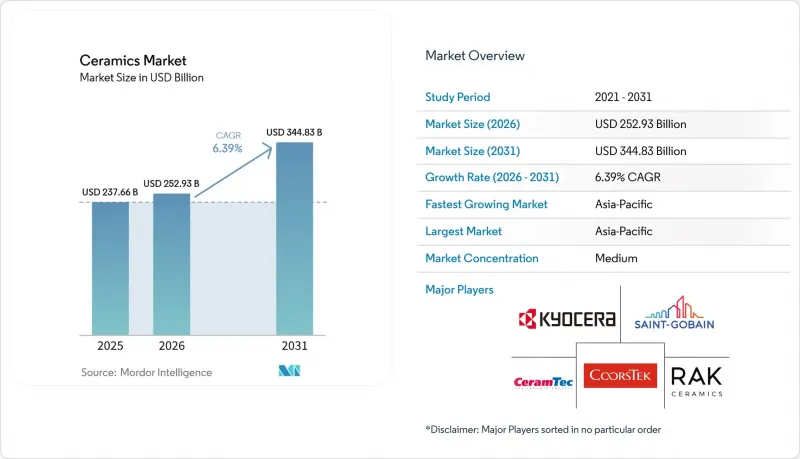
본 보고서는 유형(기존 및 첨단형), 용도(타일, 위생 도기 등), 최종 사용자 산업(건축 및 건설, 전기 및 전자 등), 지역(아시아태평양, 북미, 유럽, 남미, 중동 및 아프리카)별로 분류되어 있습니다. 시장 예측은 금액(달러) 기준으로 제시되어 있습니다.
세계의 세라믹 시장 동향 및 인사이트
전 세계 건설 활동에 따른 수요 증가
건설 분야에서 세라믹 시장은 주택 준공, 개보수 공사, 공공 인프라 정비와 밀접한 관련이 있으며, 주요 용도로는 타일, 위생 도기, 벽돌, 파이프 등이 포함됩니다. 이러한 경향은 도시 확장에 따라 기본적인 건축자재 및 인테리어 마감 제품의 안정적인 공급이 요구되는 고성장 경제국에서 특히 두드러집니다. 주택 건설 계획, 도시 확장, 상업 개발이 동시에 진행될 경우, 동일한 프로젝트 파이프라인이 여러 세라믹 제품 범주에 걸친 수요를 동시에 끌어올릴 수 있습니다. 데이터에 따르면, 인도에서는 고급 타일에 대한 수요가 증가하고 있으며, 이 지역의 세라믹 시장에서는 판매량이 증가할 뿐만 아니라 더 높은 부가가치를 지닌 제품 구성으로 전환되고 있음을 시사합니다. 이러한 변화는 저가형 제품이 가격 경쟁에 직면해 있는 상황에서도 매출 성장을 뒷받침하고 있으며, 새로운 용도가 전략적인 주목을 받고 있음에도 불구하고 세라믹 시장이 건설 산업의 펀더멘털에 계속 뿌리를 두고 있는 이유를 설명하는 한 가지 요인이 되고 있습니다.
반도체 및 AI 인프라에서의 첨단 세라믹 채택 확대
반도체 및 AI 인프라에 대한 투자도 세라믹 시장의 성장을 견인하고 있습니다. 이는 제조, 패키징 및 열 관리 시스템에 고순도 세라믹 부품이 필요하기 때문입니다. NGK 인슐레이터 주식회사는 2026년 4월, 반도체 제조 장비에 사용되는 세라믹의 생산 능력을 확대하기 위해 신규 공장에 700억 엔(약 4억 8,000만 달러)을 투자한다고 발표했습니다. 교세라는 2026년 4월, xPU 및 스위치용 특정 용도 집적 회로(ASIC)에 사용되는 첨단 AI 반도체 패키지를 위해 다층 세라믹 코어 기판을 도입했습니다. 이는 세라믹 시장이 데이터센터의 하드웨어 요구 사항에 깊이 침투하고 있음을 보여줍니다. 이러한 동향은 세라믹 시장이 더 이상 최종 제품에만 국한되지 않음을 보여주며, 반도체 생산을 뒷받침하는 자본 설비 및 기초 소재 분야에서도 그 중요성이 점점 더 커지고 있음을 시사합니다. 패키지 아키텍처에 대한 요구 사항이 까다로워짐에 따라 제품의 복잡성은 높아지고 있으며, 풍부한 공정 경험과 관리된 제조 조건을 갖춘 공급업체가 유리해집니다. 이로 인해 진입 장벽이 높아지며, 세라믹 시장은 기존의 건설 분야가 일반적으로 제공하는 것보다 더 강력한 기술 기반을 갖추게 될 것입니다.
세라믹 제조의 높은 에너지 소비
에너지 집약적인 소성 및 열처리 공정은 세라믹 시장에 있어 명백한 운영상의 제약 요인으로 작용하고 있습니다. 2025년 『International Journal of Applied Ceramic Technology』지에 게재된 조사에 따르면, 세라믹 타일 생산 시 생산량 1제곱미터당 32kWh의 에너지가 소비되며, 가마가 해당 부문 배출량의 80% 이상을 차지하고, 지구 온난화 계수(GWP)는 1제곱미터당 14.4kg CO2e에 달하는 것으로 밝혀졌습니다. 이러한 수치가 중요하게 여겨지는 이유는 세라믹 시장에 여전히 대규모의 전통적인 제조거점이 존재하며, 연료비 변동이 이익률을 압박하고 공장의 가동률을 저하시킬 가능성이 있기 때문입니다. 또한, 해당 조사에서는 전기식 가마, 수소 소성, 폐열 회수 등의 탈탄소화 방안이 기술적으로는 실현 가능하지만, 막대한 설비 투자가 필요하여 소규모 생산 업체의 경우 자금 조달에 어려움을 겪을 수 있다는 점도 지적되었습니다. 세라믹 시장은 연료 가격과 장기적으로 연료 의존도를 낮추기 위해 필요한 투자라는 두 가지 측면에서 비용 문제를 겪고 있습니다. 이러한 제약은 규제 강화로 인해 에너지 다소비형 공장의 현대화 비용이 증가하고 있는 유럽에서 특히 두드러집니다.
부문별 분석
2025년, 기존 세라믹는 매출의 62.15%를 차지하며, 매출 기준 세라믹 시장에서 가장 큰 카테고리로서의 위상을 유지했습니다. 이러한 점유율은 건설 용도에서 여전히 주요 세라믹 제품인 타일, 벽돌, 파이프, 위생 도자기, 도자기와 밀접한 관련이 있음을 반영합니다. 이러한 제품들은 대량으로 유통되며, 확립된 유통 시스템에 의존하고 있어 지속적인 교체 및 개보수 수요의 혜택을 받고 있습니다. 또한 물류 체계, 시공 업체의 익숙함, 사양 기준이 이미 충분히 확립되어 있어 기존 세라믹은 지역 시장 간 유통도 용이합니다. 이 때문에 가격 경쟁이 치열한 분야라 하더라도 기존 세라믹는 세라믹 시장에서 가장 큰 부문을 차지하고 있습니다. 따라서 주택, 인프라, 리모델링 활동의 동향은 계속해서 총매출액에 광범위한 영향을 미치고 있습니다.
하이테크 세라믹는 2031년까지 연평균 성장률(CAGR) 7.83%를 나타낼 것으로 예측됩니다. 이러한 성장은 전자기기, 산업용 기기, 의료용 임플란트, 에너지 시스템에서의 기능적 및 구조적 용도에 의해 뒷받침되고 있으며, 이러한 분야에서는 비용보다 순도, 치수 정밀도, 성능이 우선시됩니다. NGK가 2026년 4월에 실시한 반도체 장비용 세라믹 생산 능력 확대와 교세라의 AI 패키지 기판 제품 개발은 제조업체들이 보다 전문성이 높은 제품에 대한 투자를 추진하고 있음을 반영하고 있습니다. 무라타 제작소가 2026년 2월에 개설한 새로운 세라믹 커패시터 연구개발 센터와 2026년 4월에 준공한 신규 생산동 역시 마찬가지로 고부가가치 세라믹 시스템을 향한 움직임을 보여주고 있습니다. 따라서 세라믹 업계의 부가가치 창출은 기존 제품이 여전히 매출의 절대적 대부분을 차지하고 있음에도 불구하고, 첨단 소재로 점차 전환되고 있습니다. 이에 따라 세라믹 시장은 한편으로는 건설 수요에 이끌리고, 다른 한편으로는 기술적 성능 요건에 이끌리는 이중 구조를 띠고 있습니다.
지역별 분석
2025년, 아시아태평양은 전 세계 매출의 46.27%를 차지하며 세라믹 시장에서 가장 규모가 큰 지역이 되었습니다. 또한, 이 지역은 2031년까지 연평균 성장률(CAGR) 7.26%로 확대될 것으로 예측되어, 세라믹 시장에서 가장 빠르게 성장하는 지역 블록이 될 전망입니다. 아시아태평양은 세계 최대의 기존 세라믹 생산 거점을 보유하고 있을 뿐만 아니라, 일본과 한국에 첨단 세라믹 공급업체가 집중되어 있습니다. 중국은 여전히 타일 생산의 중심지인 반면, 일본과 한국은 고부가가치 전자기기용 및 정밀 세라믹 분야에서 더 큰 기여를 하고 있습니다. 이에 따라 아시아태평양은 규모, 비용 경쟁력, 기술력, 그리고 최종 시장의 깊이의 균형을 유지하고 있습니다.
북미와 유럽은 세라믹 시장 중에서도 보다 성숙한 지역으로, 그 성장은 신축 주택 건설에 대한 의존도가 낮으며, 리모델링 수요, 산업용도, 반도체 관련 소재 및 에너지 전환 관련 장비에 크게 좌우됩니다. 유럽에서는 개정된 ‘산업 배출 지침’에 따라 규정 준수 대응 및 가마 현대화가 세라믹 제조업체에게 더욱 두드러진 경쟁 요인으로 작용하고 있습니다. 이러한 정책 환경은 안정적인 생산을 유지하면서 설비 갱신 자금을 조달할 수 있는 대규모 사업자에게 유리하게 작용하고 있습니다. 북미는 꾸준한 리모델링 수요와 첨단 제조 용도 분야의 견고한 기반의 혜택을 받고 있습니다. 모호크 인더스트리즈(Mohawk Industries)는 2026년 1분기 순매출이 전년 동기 대비 8.0% 증가한 27억 달러를 기록했다고 보고했으며, 이는 해당 지역의 바닥재 수요가 견조함을 보여줍니다.
남미, 중동 및 아프리카의 총 매출액은 비교적 낮은 수준이지만, 성장 잠재력과 지역 다각화에서의 역할로 인해 세라믹 시장에 있어 여전히 중요한 지역입니다. 중동에서는 무역 경로의 혼란이 지속되는 가운데에서도 대규모 건설 프로젝트와 호텔·관광 분야의 개발이 세라믹 수요를 계속 뒷받침하고 있습니다. RAK 세라믹는 2026년 지역 정세가 수출 흐름에 영향을 미쳤다고 보고했으며, 중동 및 아프리카(MEA) 지역의 세라믹 시장이 프로젝트 수요와 물류 리스크 모두에 좌우되고 있음을 보여주고 있습니다. 남미는 여전히 주택 건설의 경기 순환 및 자금 조달 상황과 밀접한 관련이 있으나, 두 지역 모두에서 첨단 세라믹 수요는 여전히 주로 수입에 의존하고 있습니다.
기타 혜택 :
- 엑셀 형식 시장 전망(ME) 시트
- 3개월간의 애널리스트 지원
자주 묻는 질문
목차
제1장 서론
제2장 조사 방법
제3장 개요
제4장 시장 구도
제5장 시장 규모 및 성장 예측
제6장 경쟁 구도
제7장 시장 기회 및 향후 전망
KTH 26.09.02According to Mordor Intelligence, the ceramics market size was valued at USD 237.66 billion in 2025 and is estimated to grow from USD 252.93 billion in 2026 to reach USD 344.83 billion by 2031, at a CAGR of 6.39% during the forecast period (2026-2031).
This report is Segmented by Type (Traditional and Advanced), Application (Tiles, Sanitary Ware, and More), End-User Industry (Building & Construction, Electrical & Electronics, and More), and Geography (Asia-Pacific, North America, Europe, South America, and Middle-East and Africa). The Market Forecasts are Provided in Terms of Value (USD).
Global Ceramics Market Trends and Insights
Rising Demand from Global Construction Activity
In construction, the ceramics market is closely tied to housing completions, renovation work, and public infrastructure delivery, with key applications including tiles, sanitary ware, bricks, and pipes. This pattern is especially visible in high-growth economies where urban expansion requires a steady supply of basic building materials and interior finishing products. When housing programs, city expansion, and commercial development advance together, the same project pipeline can lift demand across several ceramic product categories simultaneously. Data indicates that premium tile formats have been gaining traction in India, suggesting that the ceramics market in these locations is not only selling more units but also a more valuable product mix. This shift supports revenue growth even when lower-end products face price competition, and helps explain why the ceramics market remains anchored in construction fundamentals, even as newer applications attract greater strategic attention.
Increasing Adoption of Advanced Ceramics in Semiconductor and AI Infrastructure
Semiconductor and AI infrastructure spending is also driving growth in the ceramics market, as high-purity ceramic parts are required for fabrication, packaging, and thermal management systems. NGK Insulators, Ltd. announced in April 2026 that it would invest JPY 70 billion (approximately USD 480 million) in a new facility to expand capacity for ceramics used in semiconductor manufacturing equipment. KYOCERA introduced a multilayer ceramic core substrate in April 2026 for advanced AI semiconductor packages used in xPUs and switch Application-Specific Integrated Circuits (ASICs), demonstrating how the ceramics market is moving deeper into data center hardware requirements. These developments indicate that the ceramics market is no longer tied solely to end products, as it is also becoming increasingly important for capital equipment and enabling materials that support semiconductor output. Product complexity is rising as package architecture becomes more demanding, which favors suppliers with extensive process experience and controlled manufacturing conditions. This raises entry barriers and gives the ceramics market a stronger technology layer than traditional construction categories typically offer.
High Energy Consumption in Ceramics Manufacturing
Energy-intensive firing and heat treatment processes present a clear operating constraint for the ceramics market. Research published in the International Journal of Applied Ceramic Technology in 2025 found that ceramic tile production consumed 32 kWh per square meter of output, with kilns responsible for more than 80% of sector emissions and a total global warming potential of 14.4 kg CO2e per square meter. These figures are significant because the ceramics market still has a large traditional manufacturing base where fuel cost fluctuations can pressure margins and reduce plant utilization. The research also notes that decarbonization options such as electrified kilns, hydrogen firing, and waste heat recovery are technically viable but require substantial capital investment that smaller producers may struggle to fund. The ceramics market faces a cost challenge from both fuel prices and the investment required to reduce fuel dependence over time. This restraint is particularly relevant in Europe, where regulatory tightening is increasing the cost of modernization for energy-intensive plants.
Other drivers and restraints analyzed in the detailed report include:
- Expansion of Ceramics in Renewable Energy and Electric Vehicles
- Growing Replacement Demand and Material Substitution
- Volatility in Raw Material Prices
For complete list of drivers and restraints, kindly check the Table Of Contents.
Segment Analysis
Traditional ceramics accounted for 62.15% of revenue in 2025, maintaining its position as the largest category in the ceramics market by revenue. This share reflects its strong ties to tiles, bricks, pipes, sanitary ware, and pottery, which remain the primary ceramic products used in construction applications. These products move in large volumes, rely on established distribution systems, and benefit from consistent replacement and renovation demand. Traditional ceramics are also easier to distribute across regional markets, as logistics, installer familiarity, and specification standards are already well established. This makes the traditional ceramics category the largest segment of the ceramics market, even where pricing is more competitive. Shifts in housing, infrastructure, and remodeling activity, therefore, continue to have a broad effect on total revenue.
Advanced ceramics are forecast to grow at a CAGR of 7.83% through 2031. Growth is supported by functional and structural applications in electronics, industrial equipment, medical implants, and energy systems, where purity, dimensional control, and performance are prioritized over cost. NGK's April 2026 capacity expansion for semiconductor equipment ceramics and KYOCERA's product development in AI package substrates reflect how producers are directing investment toward more specialized output. Murata's new Ceramic Capacitor R&D Center, opened in February 2026, and its new production building, completed in April 2026, point in the same direction toward higher-value ceramic systems. More value creation in the ceramics industry is therefore shifting toward advanced materials, even as traditional products continue to dominate absolute revenue. This gives the ceramics market a two-track structure, with one side driven by construction demand and the other by technical performance requirements.
Complete Report Scope:
- By Type
- Traditional
- Advanced
- By Application
- Tiles
- Sanitary Ware
- Bricks & Pipes
- Refractories
- Abrasives
- Electrical & Electronic Ceramics
- Pottery & Tableware
- Other Applications
- By End-User Industry
- Building & Construction
- Electrical & Electronics
- Industrial Manufacturing
- Healthcare & Medical
- Energy & Utilities
- Other End-Use Industries
- By Geography
- Asia-Pacific
- China
- India
- Japan
- South Korea
- Rest of Asia-Pacific
- North America
- United States
- Canada
- Mexico
- Europe
- Germany
- United Kingdom
- France
- Italy
- Russia
- Rest of Europe
- South America
- Brazil
- Argentina
- Rest of South America
- Middle-East and Africa
- Saudi Arabia
- South Africa
- Rest of Middle-East and Africa
- Asia-Pacific
Geography Analysis
Asia-Pacific accounted for 46.27% of global revenue in 2025, making it the largest region in the ceramics market. The region is also projected to expand at a 7.26% CAGR through 2031, making it the fastest-growing regional block in the ceramics market. Asia-Pacific combines the world's largest production base for traditional ceramics with a strong concentration of advanced ceramics suppliers in Japan and South Korea. China remains central to tile output, while Japan and South Korea contribute more strongly to higher-value electronics and precision ceramics. This gives Asia-Pacific a balance of scale, cost competitiveness, technical capability, and end-market depth.
North America and Europe represent more mature parts of the ceramics market, where growth is tied less to new housing construction and more to renovation demand, industrial applications, semiconductor-related materials, and energy transition equipment. In Europe, the revised Industrial Emissions Directive has made compliance and kiln modernization a more visible competitive factor for ceramic manufacturers. This policy environment favors larger operators that can fund upgrades while maintaining stable output. North America benefits from steady remodeling activity and a meaningful base of advanced manufacturing applications. Mohawk Industries reported Q1 2026 net sales of USD 2.7 billion, up 8.0% year over year, indicating resilient flooring demand in the region.
South America, the Middle East, and Africa generate lower total revenue but remain important to the ceramics market due to their growth potential and role in regional diversification. In the Middle East, large construction programs and hospitality development continue to support ceramic demand, even amid disruptions to trade routes. RAK Ceramics reported in 2026 that regional conditions affected export flows, illustrating how the ceramics market in the Middle East and Africa (MEA) is shaped by both project demand and logistics risk. South America remains more closely linked to residential construction cycles and financing conditions, while advanced ceramics demand in both regions is still served largely through imports.
- 3M
- AGC Ceramics Co., Ltd.
- CeramTec GmbH
- CoorsTek Inc.
- Du-Co Ceramics Company
- Imerys S.A.
- Kajaria Ceramics Limited
- KYOCERA Corporation
- LIXIL Corporation
- Materion Corporation
- McDanel Advanced Ceramic Technologies
- MOHAWK INDUSTRIES, INC.
- Morgan Advanced Materials plc
- Murata Manufacturing Co., Ltd.
- NGK Spark Plug Co., Ltd.
- RAK CERAMICS
- Rauschert GmbH
- Saint-Gobain
Additional Benefits:
- The market estimate (ME) sheet in Excel format
- 3 months of analyst support
TABLE OF CONTENTS
1 Introduction
- 1.1 Study Assumptions and Market Definition
- 1.2 Scope of the Study
2 Research Methodology
3 Executive Summary
4 Market Landscape
- 4.1 Market Overview
- 4.2 Market Drivers
- 4.2.1 Rising Demand for Ceramic Materials in Residential and Non-Residential Construction
- 4.2.2 Increasing Adoption of Advanced Ceramics in High-Performance Industrial Applications
- 4.2.3 Growing Replacement Demand for Wear-Resistant Ceramic Components Across Manufacturing Industries
- 4.2.4 Rising Demand for Modern Sanitary Ware Driven by Urbanization and Housing Development
- 4.2.5 Expansion of Ceramic Tile Manufacturing Capacity in Emerging Economies
- 4.3 Market Restraints
- 4.3.1 High Energy Consumption Associated with Ceramic Manufacturing Processes
- 4.3.2 Volatility in Raw Material Prices, Including Alumina, Zircon, and Kaolin
- 4.3.3 Stringent Environmental Regulations and Carbon Emission Compliance Requirements
- 4.4 Value Chain Analysis
- 4.5 Porter's Five Forces Analysis
- 4.5.1 Threat of New Entrants
- 4.5.2 Bargaining Power of Suppliers
- 4.5.3 Bargaining Power of Buyers
- 4.5.4 Threat of Substitutes
- 4.5.5 Competitive Rivalry
5 Market Size and Growth Forecasts (Value)
- 5.1 By Type
- 5.1.1 Traditional
- 5.1.2 Advanced
- 5.2 By Application
- 5.2.1 Tiles
- 5.2.2 Sanitary Ware
- 5.2.3 Bricks & Pipes
- 5.2.4 Refractories
- 5.2.5 Abrasives
- 5.2.6 Electrical & Electronic Ceramics
- 5.2.7 Pottery & Tableware
- 5.2.8 Other Applications
- 5.3 By End-User Industry
- 5.3.1 Building & Construction
- 5.3.2 Electrical & Electronics
- 5.3.3 Industrial Manufacturing
- 5.3.4 Healthcare & Medical
- 5.3.5 Energy & Utilities
- 5.3.6 Other End-Use Industries
- 5.4 By Geography
- 5.4.1 Asia-Pacific
- 5.4.1.1 China
- 5.4.1.2 India
- 5.4.1.3 Japan
- 5.4.1.4 South Korea
- 5.4.1.5 Rest of Asia-Pacific
- 5.4.2 North America
- 5.4.2.1 United States
- 5.4.2.2 Canada
- 5.4.2.3 Mexico
- 5.4.3 Europe
- 5.4.3.1 Germany
- 5.4.3.2 United Kingdom
- 5.4.3.3 France
- 5.4.3.4 Italy
- 5.4.3.5 Russia
- 5.4.3.6 Rest of Europe
- 5.4.4 South America
- 5.4.4.1 Brazil
- 5.4.4.2 Argentina
- 5.4.4.3 Rest of South America
- 5.4.5 Middle-East and Africa
- 5.4.5.1 Saudi Arabia
- 5.4.5.2 South Africa
- 5.4.5.3 Rest of Middle-East and Africa
- 5.4.1 Asia-Pacific
6 Competitive Landscape
- 6.1 Market Concentration
- 6.2 Strategic Moves
- 6.3 Market Share (%)/Ranking Analysis
- 6.4 Company Profiles (includes Global Overview, Market Overview, Core Segments, Financials as available, Strategic Information, Products and Services, and Recent Developments)
- 6.4.1 3M
- 6.4.2 AGC Ceramics Co., Ltd.
- 6.4.3 CeramTec GmbH
- 6.4.4 CoorsTek Inc.
- 6.4.5 Du-Co Ceramics Company
- 6.4.6 Imerys S.A.
- 6.4.7 Kajaria Ceramics Limited
- 6.4.8 KYOCERA Corporation
- 6.4.9 LIXIL Corporation
- 6.4.10 Materion Corporation
- 6.4.11 McDanel Advanced Ceramic Technologies
- 6.4.12 MOHAWK INDUSTRIES, INC.
- 6.4.13 Morgan Advanced Materials plc
- 6.4.14 Murata Manufacturing Co., Ltd.
- 6.4.15 NGK Spark Plug Co., Ltd.
- 6.4.16 RAK CERAMICS
- 6.4.17 Rauschert GmbH
- 6.4.18 Saint-Gobain
7 Market Opportunities and Future Outlook
- 7.1 White-Space and Unmet-Need Assessment


