
|
시장보고서
상품코드
2117509
번호가 부여된 미생물 표준물질 : 시장 점유율 분석, 업계 동향 및 통계, 성장 예측(2026-2031년)Enumerated Microbial Reference Materials - Market Share Analysis, Industry Trends & Statistics, Growth Forecasts (2026 - 2031) |
||||||
 Mordor Intelligence
번호가 부여된 미생물 표준물질 시장은 2025년에 1억 6,499만 달러로 평가되었습니다. 2026년에 1억 7,760만 달러에 달하고, 2031년까지 2억 6,301만 달러에 이를 것으로 예측되며, 2026년부터 2031년에 걸쳐 CAGR 8.17%로 성장할 전망입니다.
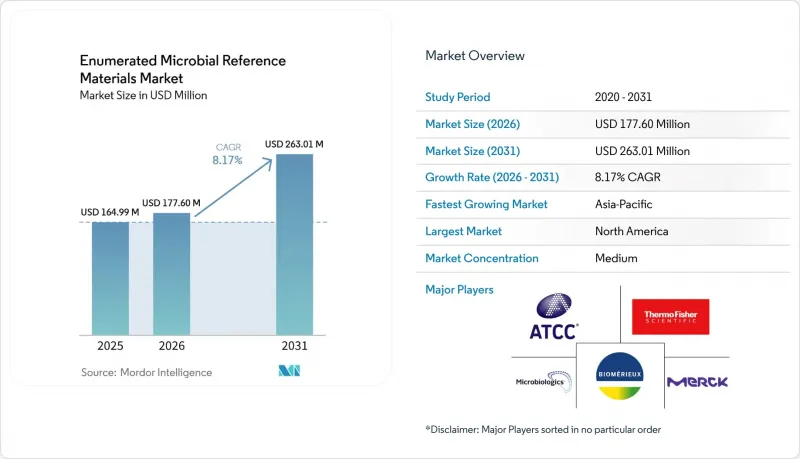
본 보고서는 제품 유형(세균 계수용 표준물질, 곰팡이 계수용 표준물질, 기타), 형태(동결건조, 냉동, 기타), 최종 사용자(제약·바이오기술 기업, 기타), 지역(북미, 유럽, 아시아태평양, 중동 및 아프리카, 남미)별로 분류되어 있습니다. 시장 전망은 금액(달러) 기준으로 제시되어 있습니다.
세계의 번호가 부여된 미생물 표준물질 시장 동향 및 인사이트
확대되는 바이오의약품 출시 및 방법 검증 워크플로우
번호가 부여된 미생물 표준물질 시장은 바이오의약품 제조 과정에서 미생물학적 검사의 빈도와 중요성이 높아짐에 따라 지지를 얻고 있습니다. 세포 치료, 유전자 치료, 항체-약물 복합체(ADC) 및 기타 고부가가치 제품은 많은 기존 제조 공정에 비해 더 엄격한 환경 모니터링, 더 강력한 공정 내 관리, 그리고 더 신속한 출하 승인 지원이 필요합니다. 또한, 유통 기한이 짧은 제품의 경우 장기간에 걸친 오염 시험을 수행할 시간이 제한적이기 때문에 출하 승인 워크플로우에서 검증된 신속한 분석법의 중요성이 더욱 커지고 있습니다. 이러한 변화가 있더라도 정량화된 챌린지 미생물의 필요성이 줄어들지는 않습니다. 왜냐하면 각 분석법의 적합성 확인은 여전히 정의된 양성 대조군과 재현 가능한 미생물 부하에 의존하고 있기 때문입니다. 따라서 동일한 시설에서도 기존의 약전 시험을 지속하면서 새로운 플랫폼의 검증 작업을 수행할 수 있으며, 이것이 정량 미생물 표준물질 시장에서 수요의 중복을 초래하고 있습니다. 또한, GMP 사이트나 바이오의약품 생산 라인이 추가될 때마다, 이들이 개별 조달 거점으로 기능하기 때문에 수요는 기존 고객에서의 점유율 확대뿐만 아니라 새로운 시험 거점 증가를 통해 확대되어 갑니다.
약전 및 ISO의 추적성 요건 강화
번호가 부여된 미생물 표준물질 시장은 미생물학 기준 전반에 걸친 규정 준수 재검토에 의해서도 뒷받침되고 있습니다. 미국 약전(USP)은 2025년에 신속 미생물학적 시험법에 관한 공식 개정 공지를 발표했으며, 이 변경을 통해 검사 기관은 보존 기간이 짧은 제품의 오염 검출에 대해 약전에 기반한 보다 명확한 지침을 얻을 수 있게 되었습니다. 찰스 리버(Charles River)사는 또한 USP가 ATP 생물발광법의 사용을 공식적으로 승인하고, 해당 워크플로우를 검증된 기준 미생물 조제물과 연계한 경위에 대해서도 설명하고 있습니다. 실질적인 영향으로는 정기적인 갱신 주기가 정착되고 있으며, 정량용 미생물 표준물질 시장은 반복되는 적합성 평가 작업, 더욱 엄격해진 추적성에 대한 기대, 그리고 수작업에 의한 대조를 최소화하면서도 사내 품질 관리 시스템 간에 공유 가능한 감사 대응 완료 인증서에 대한 수요 증가로 인해 혜택을 보고 있습니다.
높은 콜드체인 및 안정성 보증 비용
번호가 부여된 미생물 표준물질 시장은 보관 조건이 벗어나면 생존율이나 정량 정확도가 급격히 떨어질 가능성이 있기 때문에 기본적인 물류 위험에 지속적으로 노출되어 있습니다. 냉동 제품이나 액체 상태의 제품은 제조부터 납품에 이르기까지 지속적인 저온 관리가 필요한 경우가 많아, 이로 인해 전 세계 고객에게 운송의 복잡성이 가중됩니다. 이 문제는 수입 절차가 느린 지역이나 초저온 인프라의 신뢰성이 낮은 지역에서 더욱 두드러집니다. 그 결과, 제품의 형태, 운송의 신뢰성 및 목적지 인프라가 구매자의 검증 요건과 일치하지 않을 경우, 계수 가능한 미생물 표준 물질 시장은 일정한 성장 동력을 잃을 가능성이 있습니다.
부문별 분석
2025년, 정량된 세균 표준 물질은 번호가 부여된 미생물 표준물질 시장 점유율의 55.33%를 차지했으며, 이는 일상적인 약전 미생물학 프로그램에서 그 핵심적인 역할을 반영합니다. Bacillus subtilis, Staphylococcus aureus, Pseudomonas aeruginosa와 같은 종은 확립된 USP 관련 워크플로우에서 일상적인 시험법의 적합성 평가 및 품질 관리 업무에 여전히 깊이 뿌리내리고 있습니다. 이러한 유형의 미생물 정량 표준 물질 시장에서 차별화 요인은 미생물의 신규성보다는 오히려 형태, 정량 정확도 및 사용의 신속성에 기인합니다.
번호가 부여된 미생물 표준물질은 2026년부터 2031년까지 연평균 성장률(CAGR) 8.24%를 나타낼 것으로 예측되며, 번호가 부여된 미생물 표준물질 시장에서 가장 빠르게 확대될 제품 유형이 될 전망입니다. 이러한 성장은 신속한 시험법 검증, 환경 모니터링의 적합성 평가, 그리고 보다 광범위한 감시 환경에서 다종 미생물 챌린지가 널리 활용되고 있음을 반영합니다. 구매자들은 단일 미생물 제제만을 사용하여 각 단계를 검증하는 대신, 실제 시험 조건에 더 잘 부합하는 패널을 점점 더 많이 요구하고 있습니다. 또한, ISO 17034 준수 여부는 전체 제품 라인업에서 중요한 요소가 됩니다. 이는 규제 대상 구매자가 미생물 정량용 표준 물질 업계에서 승인된 공급업체 목록을 선별할 때, 확고한 입지를 갖춘 공급업체가 시장 점유율을 유지하는 데 도움이 되기 때문입니다.
지역별 분석
2025년, 북미는 번호가 부여된 미생물 표준물질 시장 점유율의 46.32%를 차지하며 지역별 1위를 유지했습니다. 이러한 위상은 FDA 규제를 받는 의약품 제조의 집중도와 2025년에 공식 발효된 USP(미국 약전) 공고 및 실험실 실무와의 밀접한 관련성에 기인합니다. 미생물학 관련 장이 개정되면, 이 지역의 검사실에서는 일반적으로 검증 파일 업데이트, 직원 재교육, 그리고 기준 물질이 여전히 승인된 절차에 부합하는지 확인이 필요합니다. 따라서 계수형 미생물 기준 물질 시장은 생산량 증가뿐만 아니라 이러한 정기적인 문서 작성 작업에서도 혜택을 받고 있습니다. 유럽은 대규모 바이오의약품 제조 거점과 의약품 품질 시스템에 대한 확고한 규정 준수 문화에 힘입어 계속해서 2위 지역 블록으로서의 지위를 유지했습니다.
유럽 수요는 확립된 생산 클러스터와 활발한 약전 거버넌스 모두에 의해 형성되고 있습니다. 2024년 6월 ANSM이 발표한 프랑스의 최신 GMP(우수 제조 관리 기준) 지침은 의약품 조제 및 관련 품질 활동에서 약전(Pharmacopoeia)이 정한 기준의 중요성을 재확인한 것이었습니다. 이 지역은 문서 관리의 철저함과 검증의 체계화 측면에서 항상 선구적인 움직임을 보이는 경우가 많기 때문에 이는 중요한 의미를 가지며, 추적성을 확보한 미생물 제제에 대한 안정적인 수요를 뒷받침하고 있습니다. 따라서 유럽의 계수 미생물 표준물질 시장은 로트 추적성, 인증된 공급업체, 그리고 여러 국가에 걸친 감사를 뒷받침하는 증거를 우선시하는 구매자층에 의해 계속해서 지지를 받고 있습니다.
아시아태평양은 2026년부터 2031년까지 연평균 성장률(CAGR) 10.21%를 나타낼 것으로 예측되며, 번호가 부여된 미생물 표준물질 시장에서 가장 두드러진 성장을 보일 지역 부문이 될 전망입니다. 이 지역의 성장세는 바이오의약품 생산 능력 확대, 품질 인프라 강화, 그리고 기초 생산에서 보다 고도화된 치료법 및 시험 워크플로우로의 광범위한 전환에 기인합니다. 그 결과, 아시아태평양의 번호가 부여된 미생물 표준물질 시장은 고도화 진전과 제조 규모 확대라는 두 가지 측면을 통해 성장하고 있습니다. 중동, 아프리카 및 남미는 절대적인 규모 면에서는 여전히 작지만, 모두 정량 미생물 표준물질 시장에 새로운 기회를 제공합니다. 걸프 국가들의 제조 투자 확대에 따라 GMP(우수 제조 기준)를 준수하는 미생물학적 관리의 필요성이 높아지고 있는 반면, 남아프리카는 계속해서 해당 지역의 시험 거점으로서의 역할을 수행하고 있습니다. 남미에서는 브라질과 아르헨티나가 계속해서 중요한 역할을 하고 있습니다. 이는 확립된 의약품 생산 체제로 인해 인증된 미생물학적 시료에 대한 지속적인 수요가 발생하고 있기 때문입니다. 또한, 유라시아 경제 연합(EAEU)이 2024년에 실시할 약전 개정에서 미생물학적 순도 요건이 국제 관행과 점진적으로 조화를 이룰 전망이며, 이로 인해 해당 지역 전체에 서비스를 제공하는 공급업체의 경우 향후 시장 진입이 용이해질 가능성이 있습니다.
기타 혜택 :
- 엑셀 형식 시장 예측(ME) 시트
- 3개월간의 애널리스트 지원
자주 묻는 질문
목차
제1장 서론
제2장 조사 방법
제3장 개요
제4장 시장 구도
제5장 시장 규모 및 성장 예측
제6장 경쟁 구도
제7장 시장 기회 및 향후 전망
KTH 26.09.02According to Mordor Intelligence, the enumerated microbial reference materials market is projected to be USD 164.99 million in 2025, USD 177.60 million in 2026, and reach USD 263.01 million by 2031, growing at a CAGR of 8.17% from 2026 to 2031.
This report is Segmented by Product Type (Bacterial Enumerated Reference Materials, Fungal Enumerated Reference Materials, and Others), Form (Lyophilized, Frozen, and Others), End-User (Pharmaceutical and Biotechnology Companies, and Others), and Geography (North America, Europe, Asia-Pacific, Middle East and Africa, South America). The Market Forecasts are Provided in Terms of Value (USD).
Global Enumerated Microbial Reference Materials Market Trends and Insights
Expanding Biopharmaceutical Release and Method-Validation Workflows
The enumerated microbial reference materials market is gaining support from the way biologics manufacturing raises the frequency and criticality of microbiology checks. Cell therapies, gene therapies, antibody-drug conjugates, and other high-value products require tighter environmental monitoring, stronger in-process control, and faster release support than many traditional operations. Short-life products also leave less time for extended contamination testing, which makes validated rapid methods more relevant in release workflows. That shift does not reduce the need for quantified challenge organisms, because each method qualification still depends on defined positive controls and repeatable organism loads. The same facility can therefore continue its legacy compendial testing while also validating new platforms, which creates overlapping points of consumption for the enumerated microbial reference materials market. Each added GMP site or added biologics line also acts as a separate procurement node, so demand expands through new testing locations rather than only through larger wallet share at existing accounts.
Tightening Pharmacopoeial and ISO Traceability Requirements
The enumerated microbial reference materials market is also being lifted by a broad compliance refresh across microbiology standards. USP posted the official revision notice for rapid microbiological methods in 2025, and that change gave laboratories a clearer compendial path for contamination detection in short-life products. Charles River also described how USP formalized the use of ATP-bioluminescence methods and linked those workflows to validated reference microorganism preparations. The practical effect is a steady renewal cycle in which the enumerated microbial reference materials market benefits from repeat qualification work, stronger traceability expectations, and growing demand for audit-ready certificates that can move across internal quality systems with less manual reconciliation.
High Cold-Chain and Stability Assurance Costs
The enumerated microbial reference materials market remains exposed to basic logistics risk because viability and quantitative accuracy can fall quickly when storage conditions drift. Frozen and liquid formats often need continuous low-temperature control from production through delivery, which raises shipping complexity for global customers. That issue becomes more visible in regions where import handling is slower or ultra-cold infrastructure is less dependable. As a result, the enumerated microbial reference materials market can lose some speed when product format, freight reliability, and destination infrastructure do not align with the buyer's validation needs.
Other drivers and restraints analyzed in the detailed report include:
- Rising Use of Rapid Microbial Methods in Routine QC
- Growth in Outsourced Microbiology Testing and Reference Lab Networks
- Fragmented Pharmacopoeial Acceptance, Limited Panel Availability, and Slow Qualification Cycles
For complete list of drivers and restraints, kindly check the Table Of Contents.
Segment Analysis
Bacterial enumerated materials held 55.33% of the enumerated microbial reference materials market share in 2025, which reflects their central role in routine compendial microbiology programs. Species such as Bacillus subtilis, Staphylococcus aureus, and Pseudomonas aeruginosa remain embedded in everyday method suitability and quality control work across established USP-linked workflows. In this part of the enumerated microbial reference materials market, differentiation comes more from format, enumeration accuracy, and speed of use than from organism novelty.
Mixed microbial enumerated materials are forecasted to grow at 8.24% CAGR from 2026 to 2031, making them the fastest-expanding product type in the enumerated microbial reference materials market. Their growth reflects wider use of multi-organism challenges in rapid method validation, environmental monitoring qualification, and broader surveillance settings. Buyers increasingly want panels that better match real testing conditions instead of validating each step with single-organism preparations only. ISO 17034 readiness also matters across the product mix, because it helps established suppliers defend share when regulated buyers narrow approved vendor lists in the enumerated microbial reference materials industry.
Complete Report Scope:
- By Product Type
- Bacterial Enumerated Reference Materials
- Fungal Enumerated Reference Materials
- Mixed Microbial Enumerated Reference Materials
- Other Microbial Enumerated Reference Materials
- By Form
- Lyophilized
- Frozen
- Liquid
- Other Forms
- By End-User
- Pharmaceutical and Biotechnology Companies
- Clinical and Diagnostic Laboratories
- Academic and Research Institutes
- Other End Users
- By Geography
- North America
- United States
- Canada
- Mexico
- Europe
- Germany
- United Kingdom
- France
- Italy
- Spain
- Rest of Europe
- Asia-Pacific
- China
- Japan
- India
- Australia
- South Korea
- Rest of Asia-Pacific
- Middle East and Africa
- GCC
- South Africa
- Rest of Middle East and Africa
- South America
- Brazil
- Argentina
- Rest of South America
- North America
Geography Analysis
North America held 46.32% of the enumerated microbial reference materials market share in 2025, which kept it in the leading regional position. That position rests on the density of FDA-regulated pharmaceutical production and the close link between laboratory practice and USP notices that became official in 2025. When microbiology chapters are revised, laboratories in this region usually have to update validation files, retrain staff, and confirm that reference materials still fit their approved procedures. The enumerated microbial reference materials market therefore benefits from recurrent documentation work, not only from rising production volume. Europe remained the second-largest regional block, supported by large biopharmaceutical manufacturing centers and a strong compliance culture in pharmaceutical quality systems.
European demand is shaped by both established production clusters and active pharmacopoeial governance. France's updated good manufacturing practice guidance published by ANSM in June 2024 reinforced the role of pharmacopoeial reference expectations in pharmaceutical compounding and related quality activities. That matters because the region often moves early on documentation discipline and validation formalization, which supports steady demand for traceable organism preparations. The enumerated microbial reference materials market in Europe therefore remains anchored by buyers that prioritize lot traceability, qualified suppliers, and evidence that can support inspections across several countries.
Asia-Pacific is forecasted to grow at 10.21% CAGR from 2026 to 2031, making it the fastest-growing regional segment in the enumerated microbial reference materials market. The region's momentum comes from expanding biologics capacity, stronger quality infrastructure, and a broader shift from basic production toward more demanding therapies and testing workflows. As a result, the enumerated microbial reference materials market in Asia-Pacific is expanding through both sophistication gains and wider manufacturing scale. The Middle East and Africa and South America remain smaller in absolute terms, but both add incremental opportunities for the enumerated microbial reference materials market. Gulf manufacturing investment is lifting the need for GMP-aligned microbiology controls, while South Africa continues to act as a regional testing anchor. In South America, Brazil and Argentina continue to matter because established pharmaceutical production creates recurring demand for qualified microbiology inputs. The Eurasian Economic Union's 2024 pharmacopoeial update on microbiological purity requirements also points to gradual convergence with broader international practice, which may ease market entry over time for suppliers serving that wider region.
- ATCC
- Beckton Dickinson
- bioMerieux
- Bio-Rad Laboratories
- Charles River
- Danaher
- Fera Science Limited
- Hardy Diagnostics
- HyServe GmbH and Co. KG
- LGC Group
- Liofilchem S.r.l.
- Merck
- Microbiologics, Inc.
- R-Biopharm
- Revvity, Inc.
- Sartorius
- Southern Group Laboratory Ltd.
- TCS Biosciences Ltd.
- Thermo Fisher Scientific
Additional Benefits:
- The market estimate (ME) sheet in Excel format
- 3 months of analyst support
TABLE OF CONTENTS
1 Introduction
- 1.1 Study Assumptions and Market Definition
- 1.2 Scope of the Study
2 Research Methodology
3 Executive Summary
4 Market Landscape
- 4.1 Market Overview
- 4.2 Market Drivers
- 4.2.1 Expanding Biopharmaceutical Release and Method-Validation Workflows
- 4.2.2 Tightening Pharmacopoeial and ISO Traceability Requirements
- 4.2.3 Rising Use of Rapid Microbial Methods in Routine QC
- 4.2.4 Growth in Outsourced Microbiology Testing and Reference Lab Networks
- 4.2.5 Regulatory Push for Digital Certificates of Analysis and Audit-Ready Lot Traceability
- 4.2.6 Regionalization of Qualified Reference Material Supply Chains
- 4.3 Market Restraints
- 4.3.1 High Cold-Chain and Stability Assurance Costs
- 4.3.2 Fragmented Pharmacopoeial and National Acceptance Requirements
- 4.3.3 Limited Availability of Truly Quantified Multi-Organism Reference Panels
- 4.3.4 Slow Customer Qualification Cycles for Regulated Manufacturing Sites
- 4.4 Supply/Value Chain Analysis
- 4.5 Regulatory Landscape
- 4.6 Technological Outlook
- 4.7 Porter's Five Forces Analysis
- 4.7.1 Threat of New Entrants
- 4.7.2 Bargaining Power of Suppliers
- 4.7.3 Bargaining Power of Buyers
- 4.7.4 Threat of Substitutes
- 4.7.5 Competitive Rivalry
5 Market Size & Growth Forecasts (Value, USD)
- 5.1 By Product Type
- 5.1.1 Bacterial Enumerated Reference Materials
- 5.1.2 Fungal Enumerated Reference Materials
- 5.1.3 Mixed Microbial Enumerated Reference Materials
- 5.1.4 Other Microbial Enumerated Reference Materials
- 5.2 By Form
- 5.2.1 Lyophilized
- 5.2.2 Frozen
- 5.2.3 Liquid
- 5.2.4 Other Forms
- 5.3 By End-User
- 5.3.1 Pharmaceutical and Biotechnology Companies
- 5.3.2 Clinical and Diagnostic Laboratories
- 5.3.3 Academic and Research Institutes
- 5.3.4 Other End Users
- 5.4 By Geography
- 5.4.1 North America
- 5.4.1.1 United States
- 5.4.1.2 Canada
- 5.4.1.3 Mexico
- 5.4.2 Europe
- 5.4.2.1 Germany
- 5.4.2.2 United Kingdom
- 5.4.2.3 France
- 5.4.2.4 Italy
- 5.4.2.5 Spain
- 5.4.2.6 Rest of Europe
- 5.4.3 Asia-Pacific
- 5.4.3.1 China
- 5.4.3.2 Japan
- 5.4.3.3 India
- 5.4.3.4 Australia
- 5.4.3.5 South Korea
- 5.4.3.6 Rest of Asia-Pacific
- 5.4.4 Middle East and Africa
- 5.4.4.1 GCC
- 5.4.4.2 South Africa
- 5.4.4.3 Rest of Middle East and Africa
- 5.4.5 South America
- 5.4.5.1 Brazil
- 5.4.5.2 Argentina
- 5.4.5.3 Rest of South America
- 5.4.1 North America
6 Competitive Landscape
- 6.1 Market Concentration
- 6.2 Market Share Analysis
- 6.3 Company Profiles (includes Global level Overview, Market level overview, Core Segments, Financials as available, Strategic Information, Market Rank/Share for key companies, Products & Services, Recent Developments)
- 6.3.1 ATCC
- 6.3.2 Becton, Dickinson and Company
- 6.3.3 bioMerieux SA
- 6.3.4 Bio-Rad Laboratories, Inc.
- 6.3.5 Charles River Laboratories International, Inc.
- 6.3.6 Danaher Corporation
- 6.3.7 Fera Science Limited
- 6.3.8 Hardy Diagnostics
- 6.3.9 HyServe GmbH and Co. KG
- 6.3.10 LGC Limited
- 6.3.11 Liofilchem S.r.l.
- 6.3.12 Merck KGaA
- 6.3.13 Microbiologics, Inc.
- 6.3.14 R-Biopharm AG
- 6.3.15 Revvity, Inc.
- 6.3.16 Sartorius AG
- 6.3.17 Southern Group Laboratory Ltd.
- 6.3.18 TCS Biosciences Ltd.
- 6.3.19 Thermo Fisher Scientific Inc.
7 Market Opportunities & Future Outlook
- 7.1 White-space & Unmet-need Assessment