|
시장보고서
상품코드
2117512
임상시험 디포 서비스 시장 : 점유율 분석, 업계 동향과 통계, 성장 예측(2026-2031년)Clinical Trial Depot Services - Market Share Analysis, Industry Trends & Statistics, Growth Forecasts (2026 - 2031) |
||||||
 Mordor Intelligence
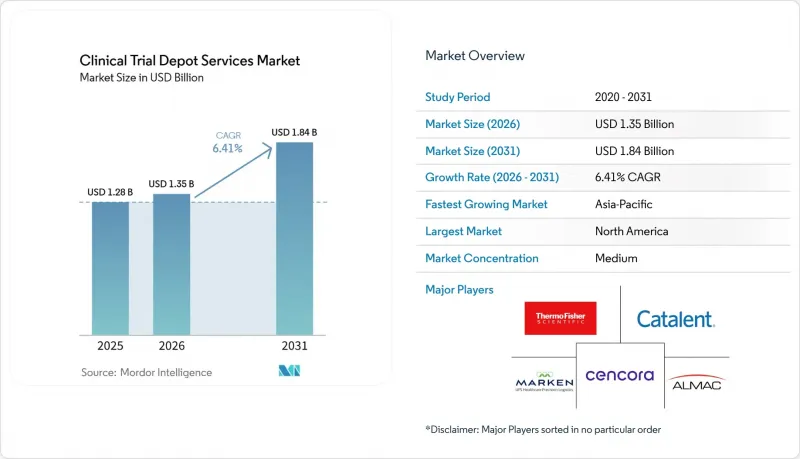
Mordor Intelligence에 의하면, 임상시험 디포 서비스 시장은 2025년에 12억 8,000만 달러, 2026년에 13억 5,000만 달러가 되고, 2031년까지 18억 4,000만 달러에 이를 것으로 예측되며, 2026년부터 2031년까지 CAGR 6.41%로 성장할 전망입니다.
본 보고서는 서비스 유형(디포 설치 및 적격성 평가, 기타), 임상 단계(BA/BE 및 1상, 기타), 치료 분야(종양학, 심혈관 질환, 기타), 최종 사용자(제약 회사, 기타), 지역(북미, 유럽, 아시아태평양, 중동 및 아프리카, 남미)별로 분류되어 있습니다. 시장 예측은 금액(미 달러) 기준으로 제시되어 있습니다.
전 세계 임상시험 디포 서비스 시장 동향 및 인사이트
분산형 및 환자 직접 배송형 임상시험 실시
임상시험 디포 서비스 시장에서는 스폰서가 지역 허브 보관소에만 의존하는 것이 아니라 피험자와 가까운 곳에 재고를 배치하는 추세로, 분산형 재고 모델로의 지속적인 전환이 관찰됩니다. RADIAL Trials&Home의 개념 증명 시험에서는 EU 6개국에서 68명의 피험자에게 직접 배송이 기록되었으며, 성공률은 94%에 달했습니다. 이는 택배 업체의 성과나 현지 규제가 여전히 실행상의 제약 요인으로 작용하고 있음을 보여주면서도, 중앙 물류 센터에서 피험자로의 배송이 실용적임을 입증하는 결과입니다. 임상시험 물류 센터 서비스 시장에서 이에 따라 서비스 모델은 기본적인 창고 보관에서 더 신속한 보충 주기, 참가자와의 연관성이 더 명확한 추적, 재택치료 및 온라인 약국 채널과의 더 긴밀한 연계로 변화하고 있습니다. 또한, 미국 내 후원사의 도입은 분산형 임상시험 및 피험자에게 시험용 의약품을 발송하는 조건을 직접 다룬 연방 정부의 지침에 힘입어 가속화되고 있습니다. 따라서 임상시험 디포 서비스 시장은 시험 실시 시설 수가 감소하더라도 혜택을 받게 될 것입니다. 이는 배송 물량이 줄어들고, 출하 빈도가 높아지며, 안전 재고가 추가됨에 따라 일반적으로 시험 1건당 디포의 활동량이 증가하기 때문입니다. 이러한 추세는 집중 보관의 효율성보다 치료의 연속성이 중시되는 임상시험에서 현지 디포의 역할을 더욱 강화하는 결과로 이어집니다.
생물학적 제제 및 ATMP의 콜드체인 요건 고도화
파이프라인에 세포 치료, 유전자 치료, 단일 클론 항체, mRNA 기반 임상시험용 의약품이 더욱 추가됨에 따라, 임상시험 디포 서비스 시장은 더 높은 부가가치를 지닌 취급 요건으로 전환되고 있습니다. 이러한 제품의 보관 온도 범위는 2°C에서 8°C, -80°C, 경우에 따라서는 극저온 조건에 이르기까지 다양합니다. 즉, 디포 운영 사업자에게는 초저온 보관 능력, 검증된 포장재, 그리고 지속적인 온도 이탈 모니터링이 필요합니다. 2025년 11월에 승인된 ICH 지침은 임상시험용 첨단 의료 제품에 대한 품질 및 임상적 기대치를 높이고 있으며, 이에 따라 해당 스폰서에게 서비스를 제공하는 보관 사업자에게는 더욱 엄격한 운영 요건이 요구될 것입니다. 임상시험 디포 서비스 시장에서 자가 유래 요법은 당일 또는 익일 운송이 요구되기 때문에 보관 시설의 재배치나 예기치 못한 사태에 대응할 시간이 거의 남지 않는 등 더욱 엄격한 운영 환경을 조성하고 있습니다. 따라서 치료의 실현 가능성과 치료 시기가 밀접하게 연관된 시장의 일부에서는 광범위한 네트워크 규모보다 제조 거점과 물류 거점의 근접성이 더 중요해집니다. 그 결과, 첨단 치료 업무를 처리할 수 있는 적격 사업자의 선택지는 좁아지고, 규제를 준수하는 전문적인 인프라에 대한 프리미엄은 더욱 높아지고 있습니다.
국경을 넘는 규제 차이와 통관 지연
임상시험 디포 서비스 시장은 다국간에 걸친 공급망에서 국가별 규제, 통관 실무, 수입업체의 의무에 차이가 있어 여전히 큰 걸림돌에 직면해 있습니다. 분산형 요소에 관한 유럽연합 집행위원회의 권고에 따라, 다른 EU 회원국의 보관소에서 환자에게 직접 배송하는 것은 스페인이나 폴란드의 국내 규정을 준수하지 않는 것으로 확인되었습니다. 이로 인해 단일 시장 내에서도 중복된 보관소 배치를 강요받고 있습니다. 유럽 이외의 지역, 특히 아시아태평양, 중동 및 아프리카, 남미에서는 GDP 전망, 관세 분류, 수입 라이선싱, 그리고 등록 수입자에 관한 규정이 국가마다 다르기 때문에 임상시험 디포 서비스 시장의 발전이 더뎌지고 있습니다. 이러한 차이는 속도 향상으로 이어지지 않은 채 비용을 증가시키며, 소규모 후원사의 경우 치료 중단이나 프로토콜 이탈로 이어질 수 있는 지연 위험에 노출될 가능성이 있습니다. 이러한 제약은 국경을 넘는 물류 경로가 활발함에도 불구하고 현지 규제 집행이 여전히 파편화되어 있는 지역에서 가장 두드러집니다. 보세 인프라와 탄탄한 현지 규정 준수 지원 체계를 갖춘 보관 사업자는 유리한 입장에 있지만, 이러한 역량을 구축하는 데 드는 비용 또한 시장 진입 장벽을 높이고 있습니다.
부문 분석
2025년에는 창고 설립 및 인증이 매출의 49.86%를 차지하며, 임상시험 디포 서비스 시장에서 가장 큰 서비스 라인이 되었습니다. 이러한 위상은 배포를 시작하기 전에 모든 프로그램에서 검증된 시설, 온도 매핑, 표준 운영 절차(SOP), 직원 자격 인증 및 감사 대응 체제가 필요함을 반영합니다. 이러한 활동은 각 신규 시험 및 각 신규 디포 거점마다 단순한 물리적 보관 용량뿐만 아니라 공식적인 준비가 필요하기 때문에 지속적인 수익 기반을 창출하고 있습니다. 따라서 임상시험 디포 서비스 업계는 여전히 대부분의 스폰서와의 관계에서 상업적 진입점으로서 고품질의 설비 구축에 의존하고 있습니다. 실제로 이는 기존 제공업체에 지속적인 우위를 가져다줍니다. 스폰서가 한 번 디포의 품질 시스템을 승인하면, 동일한 사업자가 인접한 연구에서 지속적인 업무를 수주할 가능성이 높아지기 때문입니다.
보관 및 재고 관리는 2031년까지 연평균 성장률(CAGR) 7.12%를 나타낼 것으로 예측되며, 이는 임상시험 디포 서비스 시장에서 가장 빠르게 성장하는 서비스 분야가 될 것입니다. 이러한 성장은 생물학적 제제 및 첨단 치료법에 대한 콜드체인 요건의 강화는 물론, 분산형 임상시험 모델에서 분산된 재고 거점의 활용 확대도 반영하고 있습니다. 스폰서가 여러 디포에 걸쳐 안전 재고를 보다 엄격하게 관리하기를 요구함에 따라, IRT 시스템과 연동된 실시간 재고 가시화의 중요성이 높아지고 있습니다. 따라서 임상시험 디포 서비스 시장의 이 분야는 정적인 창고 관리에서 신속한 대응, 문서화 정확도, 그리고 보다 동적인 재고 관리를 기반으로 한 운영 모델로 전환되고 있습니다.
2025년에는 2상이 매출의 45.74%를 차지하며, 임상시험 디포 서비스 시장에서 가장 큰 점유율을 기록했습니다. 이 부문은 대형 제약사 및 생명공학 기업의 전체 파이프라인에서 동시에 진행되는 개념 증명(PoC) 및 용량 설정 시험의 누적 규모로부터 혜택을 받고 있습니다. 스폰서는 종종 여러 중기 단계 자산을 일괄적으로 관리하며, 이들 전반에 걸쳐 유연한 보관, 라벨 부착 및 포장 지원을 필요로 하기 때문에 이러한 프로그램으로 인해 디포의 이용률은 안정적입니다. 임상시험 디포 서비스 시장에서 2상은 스폰서가 아직 개발의 초점을 소수의 주요 자산으로 좁히지 않았기 때문에 안정적인 수요를 뒷받침하고 있습니다.
3상은 2031년까지 연평균 성장률(CAGR) 7.84%를 나타낼 것으로 예측되며, 임상시험 디포 서비스 시장에서 가장 빠르게 성장하는 단계입니다. 이러한 계약은 일반적으로 건당 수익이 가장 높습니다. 이는 피험자 코호트의 규모가 더 크고, 유효 공급 기간이 길며, 유통 범위가 넓기 때문입니다. 또한, 제3상에서는 대조약 제공, 2차 포장 범위 확대, 그리고 다수의 임상시험 기관에 걸친 보다 긴밀한 조정이 필요합니다. 아울러, 임상시험 디포 서비스 업계에는 규모는 작지만 전략적으로 유용한 시판 후 틈새 시장이 존재합니다. 이는 임상용 의약품공급에서 이후의 상업적 유통으로의 전환을 지원할 수 있는 사업자는 승인 후에도 후원사와의 관계를 유지할 가능성이 있기 때문입니다.
지역별 분석
2025년, 북미는 매출의 41.83%를 차지하며 임상시험 디포 서비스 시장에서 가장 규모가 큰 지역 점유율을 확보했습니다. 이 지역은 2상 및 3상 종양학 임상시험이 가장 집중되어 있고, GMP 인증을 받은 보관소 네트워크가 밀집해 있으며, 국내 보관 및 유통 체계를 뒷받침하는 규제 환경과 같은 이점을 갖추고 있습니다. 미국은 후원사의 본사, CRO 거점, 그리고 광범위하게 분포된 임상 연구시설이 하나로 통합되어 있어 여전히 이 시스템의 핵심을 이루고 있습니다. 캐나다는 규모는 작지만, 바이오시밀러 파이프라인과 미국의 GMP 요건과의 긴밀한 부합을 통해 지역 내 활동을 뒷받침하고 있습니다.
유럽은 지역별 점유율 수치가 별도로 제시되고 있지만, 임상시험 디포 서비스 시장에서 여전히 구조적으로 가장 중요한 지역 중 하나입니다. EU의 임상시험 규정에 따라 CTIS(임상시험 정보 시스템)와 통합된 품질 관리 시스템의 중요성이 높아지고, 규정 준수를 효과적으로 확대할 수 없는 소규모 현지 사업자의 경쟁력이 저하됨에 따라, 이 지역은 현재 재편 단계에 있습니다. AFCRO의 ‘2026년 임상 연구 바로미터’에 따르면, 2025년 EU의 임상시험 활동은 둔화되고 있으며, 프랑스의 경우 2024년 2,402건에서 2025년 2,170건으로 감소했습니다. 시험 건수 기준으로 볼 때, 독일, 영국, 프랑스, 이탈리아, 스페인은 여전히 유럽의 주요 디포 시장이며, 스페인은 EU 내 기업 주도의 임상시험에서 계속해서 주도적인 위치를 유지하고 있습니다.
아시아태평양은 2031년까지 연평균 성장률(CAGR) 9.33%를 나타낼 것으로 예측되며, 임상시험 디포 서비스 시장에서 가장 빠르게 성장하는 지역이 될 전망입니다. 이 지역은 중국의 국내 생명공학 활동 확대, 한국 및 일본의 확립된 연구 생태계, 인도의 CRO 역량 향상, 그리고 호주의 승인된 보관소 네트워크 등의 혜택을 받고 있습니다. 알맥 그룹은 2025년 11월, 싱가포르의 콜드체인 및 2차 포장 역량을 확충하기 위해 수백만 파운드 규모의 투자를 발표했습니다. 이는 지역 공급 허브로서 싱가포르의 역할을 강화하는 것입니다. 남미는 임상시험 디포 서비스 시장에서 여전히 신흥 시장이지만, 중동 및 아프리카는 아직 초기 단계에 있으며, 의료 현대화 및 정부 주도의 임상 연구 활동을 중심으로 초기 성장세가 나타나고 있습니다.
기타 혜택:
- 엑셀 형식 시장 예측(ME) 시트
- 3개월간의 애널리스트 지원
자주 묻는 질문
목차
제1장 서론
제2장 조사 방법
제3장 개요
제4장 시장 구도
제5장 시장 규모와 성장 예측
제6장 경쟁 구도
제7장 시장 기회와 향후 전망
JHS 26.09.01According to Mordor Intelligence, the clinical trial depot services market is projected to be USD 1.28 billion in 2025, USD 1.35 billion in 2026, and reach USD 1.84 billion by 2031, growing at a CAGR of 6.41% from 2026 to 2031.
This report is Segmented by Service Type (Depot Setup and Qualification, and Others), Clinical Phase (BA/BE and Phase I, and Others), Therapeutic Area (Oncology, Cardiovascular Diseases, and Others), End-User (Pharmaceutical Companies, and Others), and Geography (North America, Europe, Asia-Pacific, Middle East and Africa, and South America). The Market Forecasts are Provided in Terms of Value (USD).
Global Clinical Trial Depot Services Market Trends and Insights
Decentralized and Direct-To-Patient Trial Execution
The clinical trial depot services market is seeing a durable shift toward distributed inventory models because sponsors are placing stock closer to participants instead of relying only on regional hub depots. The RADIAL Trials@Home proof-of-concept trial documented 68 direct-to-patient investigational product shipments across 6 EU countries with a 94% success rate, which supports the practical use of central-depot-to-patient delivery even while showing that courier performance and local rules still shape execution limits. For the clinical trial depot services market, this changes the service model from basic warehousing toward faster replenishment cycles, more visible participant-linked tracking, and closer coordination with home healthcare and e-pharmacy channels. U.S. sponsor adoption has also gained support from federal guidance that directly addresses decentralized clinical trials and conditions for shipping trial products to participants. The clinical trial depot services market therefore benefits even when site counts fall, because smaller delivery batches, more frequent shipments, and added safety stock usually raise depot activity per study. This pattern also strengthens the role of local depots in studies where treatment continuity matters more than centralized storage efficiency.
Biologics and ATMP Cold-Chain Intensity
The clinical trial depot services market is moving toward higher-value handling requirements as pipelines add more cell therapies, gene therapies, monoclonal antibodies, and mRNA-based investigational products. These products span storage ranges from 2°C to 8°C, to -80°C, and in some cases cryogenic conditions, which means depot operators need ultra-low temperature capacity, validated packaging, and continuous excursion monitoring. The ICH guideline endorsed in November 2025 raises the quality and clinical expectations for investigational advanced therapy medicinal products, which supports stricter operating requirements for depot providers serving those sponsors. In the clinical trial depot services market, autologous therapies create a tighter operating environment because same-day or next-day movement can leave little time for depot repositioning or contingency handling. That makes manufacturing-logistics proximity more important than broad network scale in parts of the market where therapy viability and treatment timing are closely linked. The result is a narrower set of qualified operators for advanced therapy work and a stronger premium for compliant, specialized infrastructure.
Cross-Border Regulatory Divergence and Customs Delays
The clinical trial depot services market still faces a major brake from uneven national rules, customs practice, and importer obligations across multi-country supply chains. The European Commission recommendation on decentralized elements confirmed that direct-to-patient delivery from a depot in another EU member state does not comply with national provisions in Spain and Poland, which forces redundant depot arrangements even inside the single market. Outside Europe, the clinical trial depot services market is slowed by country-level variation in GDP expectations, customs classification, import licensing, and importer-of-record rules, especially across Asia-Pacific, the Middle East, Africa, and South America. These differences add cost without improving speed, and they can expose smaller sponsors to delays that lead to treatment interruptions or protocol deviations. The constraint is strongest where cross-border lanes are active but local regulatory execution remains fragmented. Depot operators with bonded infrastructure and mature local compliance support are better placed, but the cost of that capability also raises market entry barriers.
Other drivers and restraints analyzed in the detailed report include:
- Global Phase II-III Trial Dispersion
- EU CTR Relabeling and QP-Release Pressure
- Comparator Shortages and Traceability Bottlenecks
For complete list of drivers and restraints, kindly check the Table Of Contents.
Segment Analysis
Depot setup and qualification held 49.86% of revenue in 2025, which made it the largest service line in the clinical trial depot services market. That position reflects the fact that every program needs validated facilities, temperature mapping, standard operating procedures, staff qualification, and audit readiness before distribution can begin. These activities create a recurring revenue base because each new study and each new depot site requires formal preparation rather than only physical storage capacity. The clinical trial depot services industry therefore still depends on quality setup as the commercial entry point for most sponsor relationships. In practice, that gives established providers a durable advantage because once a sponsor has approved a depot quality system, the same operator is more likely to secure follow-on work across adjacent studies.
Storage and inventory management is projected to grow at a 7.12% CAGR through 2031, which makes it the fastest-growing service line in the clinical trial depot services market. The expansion reflects stricter cold-chain requirements for biologics and advanced therapies, and it also reflects the wider use of distributed stock positions in decentralized trial models. Real-time inventory visibility linked to IRT systems is becoming more important because sponsors want tighter safety-stock control across multiple depots at once. This part of the clinical trial depot services market is therefore shifting from static warehousing toward an operating model built around responsiveness, documentation precision, and more dynamic inventory control.
Phase II represented 45.74% of revenue in 2025, which gave it the largest share in the clinical trial depot services market. The segment benefits from the cumulative volume of proof-of-concept and dose-finding studies that run at the same time across large pharma and biotech pipelines. These programs keep depot utilization stable because sponsors often manage several mid-stage assets together and need flexible storage, labeling, and packaging support across them. In the clinical trial depot services market, Phase II also supports consistent demand because sponsors have not yet narrowed their development focus to only a few pivotal assets.
Phase III is projected to grow at a 7.84% CAGR through 2031, and it is the faster-moving phase in the clinical trial depot services market. These contracts usually generate the highest revenue per study because patient cohorts are larger, active supply periods are longer, and distribution footprints are wider. Phase III also brings more need for comparator provision, broader secondary packaging scope, and tighter coordination across many investigator sites. The clinical trial depot services industry also has a smaller but strategically useful post-market niche because operators that can support movement from clinical supply into later commercial distribution may retain sponsor relationships beyond approval.
Complete Report Scope:
- By Service Type
- Depot Setup and Qualification
- Storage and Inventory Management
- Secondary Packaging and Labeling
- Site and Patient Distribution
- Returns, Reconciliation, and Destruction
- Import, Export, IOR, and QP Support
- By Clinical Phase
- BA/BE Studies
- Phase I
- Phase II
- Phase III
- Phase IV and Post-Marketing
- By Therapeutic Area
- Oncology
- Cardiovascular Diseases
- CNS and Mental Disorders
- Infectious Diseases
- Immunology
- Rare Diseases
- Metabolic and Endocrine Disorders
- Respiratory Diseases
- Hematology and Blood Disorders
- Other Therapeutic Areas
- By End-User
- Pharmaceutical Companies
- Biotechnology Companies
- Contract Research Organizations
- Medical Device Sponsors
- Academic, Government, and Nonprofit Sponsors
- By Geography
- North America
- United States
- Canada
- Mexico
- Europe
- Germany
- United Kingdom
- France
- Italy
- Spain
- Rest of Europe
- Asia-Pacific
- China
- Japan
- India
- Australia
- South Korea
- Rest of Asia-Pacific
- Middle East and Africa
- GCC
- South Africa
- Rest of Middle East and Africa
- South America
- Brazil
- Argentina
- Rest of South America
- North America
Geography Analysis
North America held 41.83% of revenue in 2025, which gave it the largest regional position in the clinical trial depot services market. The region benefits from the highest concentration of Phase II and Phase III oncology trials, a dense network of GMP-validated depots, and a regulatory environment that supports domestic storage and distribution depth. The United States remains the core of that system because it combines sponsor headquarters, CRO operating bases, and a broad spread of clinical research sites. Canada remains smaller, but it supports regional activity through its biosimilars pipeline and close alignment with U.S. GMP expectations.
Europe remains one of the most structurally important parts of the clinical trial depot services market even though a separate regional share figure. The region is moving through a consolidation phase because the EU Clinical Trials Regulation raises the value of CTIS-integrated quality systems and reduces the competitiveness of smaller local operators that cannot scale compliance effectively. The AFCROs 2026 Clinical Research Barometer showed weaker EU trial activity in 2025, including a decline in France from 2,402 trials in 2024 to 2,170 in 2025. Germany, the United Kingdom, France, Italy, and Spain remain the principal European depot markets by trial volume, and Spain retained a leading position in EU-based industry-sponsored trials.
Asia-Pacific is projected to grow at a 9.33% CAGR through 2031, which makes it the fastest-growing region in the clinical trial depot services market. The region benefits from China's expanding domestic biotech activity, South Korea and Japan's established research ecosystems, India's growing CRO capacity, and Australia's licensed depot network. Almac Group announced a multi-million-pound investment in Singapore in November 2025 to expand its local cold-chain and secondary packaging capability, which supports Singapore's role as a regional supply hub. South America remains an emerging market for the clinical trial depot services market, while the Middle East and Africa are still at an early stage with initial momentum centered on healthcare modernization and government-backed clinical research activity.
- Almac Group
- Ancillare
- Biocair
- Catalent
- Cryoport Systems
- DHL Health Logistics
- FedEx Corporation
- Inceptua
- KLIFO
- Marken (UPS Healthcare)
- MedPace
- Movianto
- Myonex
- Oximio
- Parexel International
- PCI Pharma Services
- Sharp
- Thermo Fisher Scientific / PPD Clinical Research
- WEP Clinical
- World Courier (Cencora)
Additional Benefits:
- The market estimate (ME) sheet in Excel format
- 3 months of analyst support
TABLE OF CONTENTS
1 Introduction
- 1.1 Study Assumptions and Market Definition
- 1.2 Scope of the Study
2 Research Methodology
3 Executive Summary
4 Market Landscape
- 4.1 Market Overview
- 4.2 Market Drivers
- 4.2.1 Decentralized and Direct-to-Patient Trial Execution
- 4.2.2 Biologics and ATMP Cold-Chain Intensity
- 4.2.3 Global Phase II-III Trial Dispersion
- 4.2.4 EU CTR Relabeling and QP-Release Pressure
- 4.2.5 Customs Valuation and IOR Complexity Favor Local Depots
- 4.2.6 Protocol Amendments Increase Depot Relabeling and Resupply Demand
- 4.3 Market Restraints
- 4.3.1 Cross-Border Regulatory Divergence and Customs Delays
- 4.3.2 Cold-Chain Capacity and Excursion Risk
- 4.3.3 Comparator Shortages and Traceability Bottlenecks
- 4.3.4 Investigational Site Storage and Staffing Limitations
- 4.4 Supply/Value Chain Analysis
- 4.5 Regulatory Landscape
- 4.6 Technological Outlook
- 4.7 Porter's Five Forces Analysis
- 4.7.1 Threat of New Entrants
- 4.7.2 Bargaining Power of Suppliers
- 4.7.3 Bargaining Power of Buyers
- 4.7.4 Threat of Substitutes
- 4.7.5 Competitive Rivalry
5 Market Size & Growth Forecasts (Value, USD)
- 5.1 By Service Type
- 5.1.1 Depot Setup and Qualification
- 5.1.2 Storage and Inventory Management
- 5.1.3 Secondary Packaging and Labeling
- 5.1.4 Site and Patient Distribution
- 5.1.5 Returns, Reconciliation, and Destruction
- 5.1.6 Import, Export, IOR, and QP Support
- 5.2 By Clinical Phase
- 5.2.1 BA/BE Studies
- 5.2.2 Phase I
- 5.2.3 Phase II
- 5.2.4 Phase III
- 5.2.5 Phase IV and Post-Marketing
- 5.3 By Therapeutic Area
- 5.3.1 Oncology
- 5.3.2 Cardiovascular Diseases
- 5.3.3 CNS and Mental Disorders
- 5.3.4 Infectious Diseases
- 5.3.5 Immunology
- 5.3.6 Rare Diseases
- 5.3.7 Metabolic and Endocrine Disorders
- 5.3.8 Respiratory Diseases
- 5.3.9 Hematology and Blood Disorders
- 5.3.10 Other Therapeutic Areas
- 5.4 By End-User
- 5.4.1 Pharmaceutical Companies
- 5.4.2 Biotechnology Companies
- 5.4.3 Contract Research Organizations
- 5.4.4 Medical Device Sponsors
- 5.4.5 Academic, Government, and Nonprofit Sponsors
- 5.5 By Geography
- 5.5.1 North America
- 5.5.1.1 United States
- 5.5.1.2 Canada
- 5.5.1.3 Mexico
- 5.5.2 Europe
- 5.5.2.1 Germany
- 5.5.2.2 United Kingdom
- 5.5.2.3 France
- 5.5.2.4 Italy
- 5.5.2.5 Spain
- 5.5.2.6 Rest of Europe
- 5.5.3 Asia-Pacific
- 5.5.3.1 China
- 5.5.3.2 Japan
- 5.5.3.3 India
- 5.5.3.4 Australia
- 5.5.3.5 South Korea
- 5.5.3.6 Rest of Asia-Pacific
- 5.5.4 Middle East and Africa
- 5.5.4.1 GCC
- 5.5.4.2 South Africa
- 5.5.4.3 Rest of Middle East and Africa
- 5.5.5 South America
- 5.5.5.1 Brazil
- 5.5.5.2 Argentina
- 5.5.5.3 Rest of South America
- 5.5.1 North America
6 Competitive Landscape
- 6.1 Market Concentration
- 6.2 Market Share Analysis
- 6.3 Company Profiles (includes Global level Overview, Market level overview, Core Segments, Financials as available, Strategic Information, Market Rank/Share for key companies, Products & Services, Recent Developments)
- 6.3.1 Almac Group
- 6.3.2 Ancillare
- 6.3.3 Biocair
- 6.3.4 Catalent
- 6.3.5 Cryoport Systems
- 6.3.6 DHL Health Logistics
- 6.3.7 FedEx Corporation
- 6.3.8 Inceptua
- 6.3.9 KLIFO
- 6.3.10 Marken (UPS Healthcare)
- 6.3.11 Medpace
- 6.3.12 Movianto
- 6.3.13 Myonex
- 6.3.14 Oximio
- 6.3.15 Parexel International
- 6.3.16 PCI Pharma Services
- 6.3.17 Sharp
- 6.3.18 Thermo Fisher Scientific / PPD Clinical Research
- 6.3.19 WEP Clinical
- 6.3.20 World Courier (Cencora)
7 Market Opportunities & Future Outlook
- 7.1 White-space & Unmet-need Assessment