

|
시장보고서
상품코드
2117538
로우코드 모바일 앱 개발 플랫폼 시장 : 점유율 분석, 업계 동향과 통계, 성장 예측(2026-2031년)Low-Code Mobile App Development Platform - Market Share Analysis, Industry Trends & Statistics, Growth Forecasts (2026 - 2031) |
||||||
 Mordor Intelligence
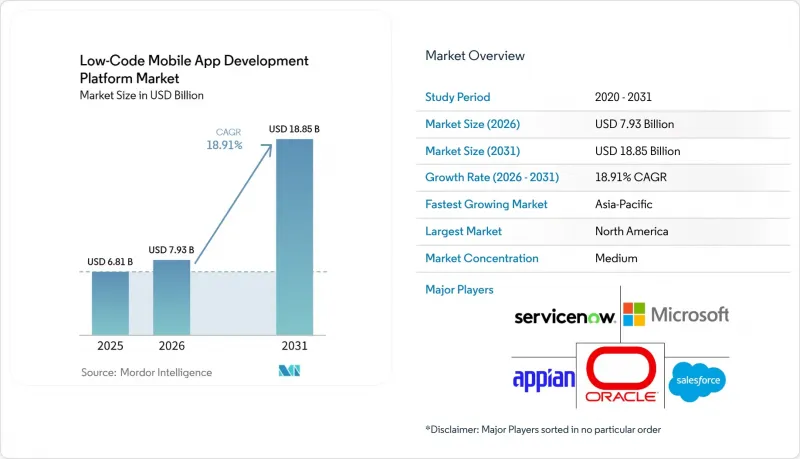
Mordor Intelligence에 의하면, 로우코드 모바일 앱 개발 플랫폼 시장 규모는 2025년 68억 1,000만 달러에서 2026년에는 79억 3,000만 달러로 확대되어 2031년까지 188억 5,000만 달러에 이를 것으로 예상되고 있어 2026년부터 2031년까지 CAGR 18.91%로 성장할 전망입니다.
본 보고서는 솔루션(소프트웨어 및 서비스), 도입 형태(클라우드 기반, 하이브리드 등), 애플리케이션 유형(소비자용 모바일 애플리케이션 등), 기업 규모(대기업 및 중소기업), 최종 사용자 산업(IT 및 통신, 에너지·유틸리티 등), 그리고 지역별로 분류되어 있습니다. 시장 전망은 금액(미 달러) 기준으로 제시되어 있습니다.
세계 로우코드 모바일 앱 개발 플랫폼 시장 동향 및 인사이트
모바일 우선 사내 워크플로우로의 급속한 전환
로우코드 모바일 앱 개발 플랫폼 시장에서는 모바일 기기 상에서 사내 워크플로우 개선을 목표로 하는 기업들의 강력한 수요가 나타나고 있습니다. 이러한 변화는 데스크톱에 대한 의존으로 인해 업무 실행이 지연되는 현장 서비스, 승인 업무, 인사 업무, 물류 및 일상적인 업무 프로세스에서 특히 두드러집니다. 비즈니스 팀이 애플리케이션 요구 사항에 대해 더 큰 역할을 맡게 됨에 따라, 로우코드 플랫폼은 기존 모바일 개발 팀이 해소하는 데 어려움을 겪기 쉬운 백로그를 줄이는 데 기여하고 있습니다. 마이크로소프트는 라보뱅크를 사례로 들었습니다. 이 회사는 2,500개 이상의 Power Apps 및 Power Automate 솔루션을 활용하여 38개국에 걸쳐 있는 4만 명의 직원을 지원할 뿐만 아니라, 3주가 걸리던 조직 개편 프로세스를 3분으로 단축했습니다. 로우코드 모바일 앱 개발 플랫폼 시장에서 이러한 성과는 조직이 플랫폼의 활용 범위를 단일 업무 워크플로우에서 다른 수많은 워크플로우로 확대하는 데 박차를 가하고 있습니다.
AI를 활용한 앱 생성 및 테스트
로우코드 모바일 앱 개발 플랫폼 시장은 모바일 애플리케이션의 설계, 구축, 테스트, 개선에 필요한 시간을 단축하는 AI 기능에 의해 재편되고 있습니다. 초기에는 시각적인 드래그 앤 드롭 개발로 시작되었으나, 이제는 소프트웨어 라이프사이클 전반에 걸친 프롬프트 기반 생성 및 가이드형 자동화로 전환되고 있습니다. OutSystems는 2025년 2월 ‘Mentor’를 정식 출시하며, 이를 단일 요구사항 문서에서 애플리케이션을 생성하고 더 광범위한 라이프사이클 자동화를 지원할 수 있는 ‘디지털 워커’로 포지셔닝하고 있습니다. 이러한 변화로 인해, 즉시 사용 가능한 모바일 앱의 골격을 신속하게 필요로 하고 긴 개발 주기를 기다릴 수 없는 조직에게 플랫폼 도입이 더욱 매력적으로 다가오고 있습니다. 로우코드 모바일 앱 개발 플랫폼 시장에서 AI는 더 이상 부가 기능이 아니라, 핵심적인 제품 정의의 일부가 되어가고 있습니다.
보안, 개인정보 보호 및 데이터 소재지 관련 제약
로우코드 모바일 앱 개발 플랫폼 시장에서는 모바일 애플리케이션이 기밀 데이터를 다루거나 엄격한 지역 규제의 적용을 받는 산업 분야에서 여전히 장벽이 존재합니다. 이러한 환경에 있는 조달 팀은 활용을 확대하기 전에 호스팅 모델, 데이터 분리, 접근 제어 및 지역별 도입 옵션에 대해 명확한 답변을 요구하는 경우가 많습니다. 이러한 요구 사항은 의사 결정을 지연시킬 수 있으며, 더 광범위한 인프라 네트워크와 유연한 도입 모델을 갖춘 벤더에게 유리하게 작용할 가능성이 있습니다. OutSystems는 2026년 6월 플랫폼 발표에서 런타임 분리 및 자체 호스팅 기능을 강조했습니다. 이는 기업 구매자들이 주권 및 관리상의 요구 사항을 충족해 줄 것을 벤더에게 얼마나 강력하게 요구하고 있는지를 보여줍니다. 로우코드 모바일 앱 개발 플랫폼 시장에서 이러한 제약은 수요를 저해하기보다는 거버넌스 및 호스팅에 대한 우려가 해소될 때까지 본격적인 확장을 지연시키는 측면이 더 강하다고 할 수 있습니다.
부문 분석
2025년 로우코드 모바일 앱 개발 플랫폼 시장에서 소프트웨어가 71.24%를 차지하고 있으며, 이는 라이선싱 및 플랫폼 구독이 여전히 주요 비즈니스 모델임을 보여줍니다. 여전히 많은 조직에서는 먼저 플랫폼을 구매한 후, 구현 작업을 사내에서 수행할지, 파트너를 통해 수행할지, 아니면 벤더에 위탁할지 결정하고 있습니다. 플랫폼은 모든 도입의 기반이 되기 때문에 이러한 패턴으로 인해 소프트웨어 매출은 지출 구성의 중심에 계속 자리 잡고 있습니다. 로우코드 모바일 앱 개발 플랫폼 시장에서 이는 또한 강력한 핵심 기능과 광범위한 개발자 생태계를 갖춘 벤더가 여전히 우위를 점하고 있음을 의미합니다.
서비스 부문은 2031년까지 연평균 성장률(CAGR) 21.82%를 나타낼 것으로 예측되며, 이는 엔터프라이즈 도입의 복잡성이 증가하고 있음을 반영합니다. 고객이 AI 기능, 레거시 시스템과의 통합, 거버넌스 관리, 다중 환경 운영 등을 추가함에 따라 전문적인 지원은 필수적인 요소가 되고 있습니다. Appian은 2026년 4월 제품 업데이트를 통해 AI를 활용한 사양 주도형 개발과 더욱 광범위한 파트너 및 통합 기능을 결합하여, 엔터프라이즈 고객에게 신속하게 서비스를 제공하는 데 있어 서비스가 수행하는 역할을 강화했습니다. 따라서 로우코드 모바일 앱 개발 플랫폼 업계는 도입 초기 단계에 비해 자문, 구현 및 관리형 지원의 중요성이 더욱 커지는 보다 종합적인 라이프사이클 모델로 전환되고 있습니다.
2025년 로우코드 모바일 앱 개발 플랫폼 시장에서 클라우드 기반 도입은 68.41%를 차지하고 있으며, 구매자들이 여전히 유연한 용량과 벤더 관리에 의한 업데이트를 선호하고 있음을 여실히 보여주고 있습니다. 많은 조직에게 클라우드는 개발을 시작하고, 업데이트를 배포하며, 새로운 모바일 워크플로를 팀 전체로 확대하기 위한 가장 빠른 수단으로 남아 있습니다. 또한 이 모델은 복잡한 환경을 자체적으로 유지 관리하기를 원하지 않는 고객의 인프라 관리 부담을 덜어줍니다. 로우코드 모바일 앱 개발 플랫폼 시장에서 편의성과 속도가 여전히 광범위한 구매자에게 중요하기 때문에 클라우드는 우위를 유지하고 있습니다.
하이브리드 배포는 2031년까지 연평균 성장률(CAGR) 20.43%로 확대될 것으로 예측되며, 이는 규제 대상이나 데이터 기밀성이 높은 이용 사례에서 통제의 중요성이 점점 더 커지고 있음을 뒷받침합니다. 금융 서비스, 의료, 정부 기관의 사용자들은 클라우드 기반 개발 및 오케스트레이션 계층을 활용하면서도, 일부 데이터나 런타임 요소를 사내 시스템에 가까운 곳에 보관하기를 원하는 경우가 많습니다. OutSystems는 2026년 플랫폼 발표에서 자체 호스팅과 런타임의 분리를 강조했는데, 이는 바로 이러한 기업의 요구 패턴에 부합하는 것입니다. On-Premise 배포는 여전히 특수한 환경을 지원하지만, 로우코드 모바일 앱 개발 플랫폼 시장의 실질적인 변화 대부분은 완전히 로컬 모델로의 회귀가 아니라 하이브리드 모델로 향하고 있습니다.
지역별 분석
2025년, 북미는 로우코드 모바일 앱 개발 플랫폼 시장의 34.62%를 차지했습니다. 이 지역은 기업의 막대한 기술 투자, 성숙한 클라우드 생태계, 그리고 AI를 활용한 애플리케이션 제공에 대한 강력한 추진력 등의 혜택을 누리고 있습니다. 미국의 대기업들은 사내용 및 고객용 모바일 이용 사례 모두에서 체계적인 로우코드 프로그램을 가장 먼저 도입한 기업 중 하나입니다. 마이크로소프트는 2025년 4월 기준으로 Power Platform의 월간 활성 사용자 수가 5,600만 명에 달했다고 보고했으며, 이는 이미 달성된 기업 도입 규모를 여실히 보여줍니다. 캐나다와 멕시코의 점유율은 작지만, 두 나라 모두 금융 서비스, 제조업 및 국경을 초월한 기업 활동에서 중요한 역할을 계속하고 있습니다.
아시아태평양은 2031년까지 연평균 성장률(CAGR) 23.48%를 나타낼 것으로 예측되며, 로우코드 모바일 앱 개발 플랫폼 시장에서 가장 두드러진 성장을 보일 것으로 전망됩니다. 이 지역의 성장은 개발자 부족, 디지털 전환(DX) 프로그램, 그리고 중소기업(SME)의 도입이 더 큰 역할을 하고 있기 때문에 북미와는 다른 요인에 기인합니다. 인도, 중국, 일본, 한국, 동남아시아의 구매자들은 대규모 전문 개발 팀을 구축하지 않고도 앱을 더 신속하게 제공할 수 있는 방법을 모색하고 있습니다. 따라서 이 지역의 도입 패턴에서는 AI를 활용한 개발과 재사용 가능한 템플릿이 특히 가치 있는 요소로 부상하고 있습니다. 또한 로우코드 모바일 앱 개발 플랫폼 시장은 아시아태평양 일부 국가에서 활동하는 국내 통합 업체들의 활동으로부터도 혜택을 받고 있으며, 이들 기업은 플랫폼을 기반으로 고객 참여 및 업무 운영 도구를 구축하고 있습니다.
2025년, 유럽은 로우코드 모바일 앱 개발 플랫폼 시장에서 큰 점유율을 차지했으며, 독일, 영국, 프랑스가 도입을 주도했습니다. 이 지역 수요는 기업의 현대화 요구에 의해 형성되고 있지만, 개인정보 보호 및 데이터 관리 요건이 조달 결정의 핵심 요소로 남아 있기 때문에 성장 속도는 종종 신중한 양상을 띠고 있습니다. 따라서 해당 지역의 구매자가 도입 대안을 평가할 때 하이브리드형 및 관리형 호스팅 모델이 중요해집니다. 남미, 중동 및 아프리카는 여전히 소규모 시장이지만, 금융 서비스, 공공 부문의 디지털화, 제조업 및 기업의 모바일 현대화를 통해 수요를 지속적으로 견인하고 있습니다. 로우코드 모바일 앱 개발 플랫폼 시장에서 이 지역들은 현재 시장 규모보다는 플랫폼 비용의 하락과 도입 모델의 유연화에 따라, 다음 도입 물결에서 중요한 역할을 할 것으로 예측됩니다.
기타 혜택:
- 엑셀 형식 시장 예측(ME) 시트
- 3개월간의 애널리스트 지원
자주 묻는 질문
목차
제1장 서론
제2장 조사 방법
제3장 개요
제4장 시장 구도
제5장 시장 규모와 성장 예측
제6장 경쟁 구도
제7장 시장 기회와 향후 전망
JHS 26.09.01According to Mordor Intelligence, the low-code mobile app development platform market size is expected to increase from USD 6.81 billion in 2025 to USD 7.93 billion in 2026 and reach USD 18.85 billion by 2031, growing at a CAGR of 18.91% over 2026-2031.
This report is Segmented by Solution (Software, and Services), Deployment (Cloud-Based, Hybrid, and More), Application Type (Consumer Mobile Applications, and More), Enterprise Size (Large Enterprises, and Small and Medium Enterprises), End-User Industry (IT and Telecommunication, Energy and Utilities, and More), and Geography. The Market Forecasts are Provided in Terms of Value (USD).
Global Low-Code Mobile App Development Platform Market Trends and Insights
Rapid Enterprise Shift to Mobile-First Internal Workflows
The low-code mobile app development platform market is seeing strong demand from enterprises seeking to improve internal workflows on mobile devices. This shift is especially visible in field service, approvals, HR tasks, logistics, and day-to-day operating processes, where desktop dependence slows execution. As business teams take a larger role in application requests, low-code platforms help reduce the backlog that traditional mobile development teams often struggle to clear. Microsoft highlighted Rabobank as an example of a company that used more than 2,500 Power Apps and Power Automate solutions to support 40,000 employees across 38 countries and reduce a three-week reorganization process to 3 minutes. In the low-code mobile app development platform market, results like that encourage organizations to expand platform use from a single operational workflow to many others.
AI-Assisted App Generation And Testing
The low-code mobile app development platform market is being reshaped by AI features that reduce the time needed to design, build, test, and refine mobile applications. What started as visual drag-and-drop development is moving toward prompt-based generation and guided automation across the software lifecycle. OutSystems made Mentor generally available in February 2025, positioning it as a digital worker that can support application generation and broader lifecycle automation from a single requirements document. That shift makes platform procurement more attractive for organizations that need usable mobile scaffolds quickly and cannot wait for long development cycles. In the low-code mobile app development platform market, AI is no longer an add-on feature because it is becoming part of the core product definition.
Security, Privacy, And Data Residency Constraints
The low-code mobile app development platform market still faces friction in industries where mobile applications handle sensitive data or operate under strict regional controls. Procurement teams in those environments often want clear answers on hosting models, data separation, access controls, and regional deployment options before they scale usage. Those requirements can slow decision-making and can favor vendors with broader infrastructure reach or more flexible deployment models. OutSystems emphasized runtime isolation and self-hosting capabilities in its June 2026 platform announcement, which shows how strongly enterprise buyers are pushing vendors to address sovereignty and control needs. In the low-code mobile app development platform market, this restraint is less about blocking demand and more about delaying broader rollouts until governance and hosting concerns are resolved.
Other drivers and restraints analyzed in the detailed report include:
- Demand for Cross-Platform Delivery with Lower Maintenance Burden
- Legacy Modernization Through Visual Development
- Vendor Lock-In and Proprietary Runtime Dependency
For complete list of drivers and restraints, kindly check the Table Of Contents.
Segment Analysis
Software accounted for 71.24% of the low-code mobile app development platform market in 2025, indicating that licensing and platform subscriptions remained the main commercial model. Most organizations still buy the platform first and then decide whether implementation work will be handled internally, through partners, or through the vendor. This pattern keeps software revenue at the center of the spending mix because the platform is the foundation for every deployment. In the low-code mobile app development platform market, that also means vendors with strong core functionality and a broad developer ecosystem still hold an advantage.
Services are projected to grow at a 21.82% CAGR through 2031, which reflects the rising complexity of enterprise deployments. As customers add AI functionality, legacy integration, governance controls, and multi-environment operations, professional support becomes harder to avoid. Appian's April 2026 product update paired AI-assisted spec-driven development with broader partner and integration capabilities, reinforcing the role of services in speeding delivery for enterprise customers. The low-code mobile app development platform industry is therefore moving toward a fuller lifecycle model where advisory, implementation, and managed support matter more than they did in earlier adoption stages.
Cloud-based deployment accounted for 68.41% of the low-code mobile app development platform market in 2025, underscoring that buyers still prefer elastic capacity and vendor-managed updates. For many organizations, cloud remains the fastest way to start development, roll out updates, and scale new mobile workflows across teams. This model also lowers infrastructure management demands for customers who do not want to maintain complex environments on their own. In the low-code mobile app development platform market, cloud keeps its lead because convenience and speed still matter to a wide range of buyers.
Hybrid deployment is projected to expand at a 20.43% CAGR through 2031, underscoring the growing importance of control in regulated and data-sensitive use cases. Financial services, healthcare, and government users often want some data and runtime elements kept closer to internal systems while still using cloud-based development and orchestration layers. OutSystems highlighted self-hosting and runtime isolation in its 2026 platform announcement, directly aligning with that enterprise demand pattern. On-premises deployment still serves specialized environments, but much of the practical shift in the low-code mobile app development platform market is now moving toward hybrid rather than back to fully local models.
Complete Report Scope:
- By Solution
- Software
- Services
- By Deployment
- Cloud-Based
- Hybrid
- On-Premises
- By Application Type
- Enterprise Workforce Applications
- Customer-Facing Mobile Applications
- Field Service and Operational Applications
- Consumer Mobile Applications
- By Enterprise Size
- Large Enterprises
- Small and Medium Enterprises
- By End-user Industry
- IT and Telecommunication
- BFSI
- Healthcare and Life Sciences
- Retail and E-Commerce
- Industrial Manufacturing
- Education and Research Institutions
- Media and Entertainment
- Government and Administration
- Energy and Utilities
- Other End-user Industries
- By Geography
- North America
- United States
- Canada
- Mexico
- South America
- Brazil
- Argentina
- Rest of South America
- Europe
- Germany
- United Kingdom
- France
- Russia
- Spain
- Rest of Europe
- Asia-Pacific
- China
- Japan
- India
- South Korea
- Southeast Asia
- Rest of Asia-Pacific
- Middle East and Africa
- Middle East
- Saudi Arabia
- United Arab Emirates
- Rest of Middle East
- Africa
- South Africa
- Nigeria
- Rest of Africa
- Middle East
- North America
Geography Analysis
North America accounted for 34.62% of the low-code mobile app development platform market in 2025. The region benefits from deep enterprise technology spending, mature cloud ecosystems, and a strong push toward AI-enabled application delivery. Large organizations in the United States have been among the earliest adopters of structured low-code programs for both internal and customer-facing mobile use cases. Microsoft reported 56 million monthly active users on Power Platform in April 2025, underscoring the scale of enterprise adoption already achieved. Canada and Mexico contribute smaller shares, but both remain relevant in financial services, manufacturing, and cross-border enterprise operations.
Asia-Pacific is projected to grow at a 23.48% CAGR through 2031, making it the fastest-growing region in the low-code mobile app development platform market. Growth in this region comes from a different mix than in North America because developer shortages, digital transformation programs, and SME adoption all play a stronger role. Buyers across India, China, Japan, South Korea, and Southeast Asia are looking for faster app delivery without building very large specialist development teams. That makes AI-assisted development and reusable templates especially valuable in regional adoption patterns. The low-code mobile app development platform market is also benefiting from domestic integrator activity in several Asia-Pacific countries, where firms are building customer engagement and operational tools on top of these platforms.
Europe held a significant share of the low-code mobile app development platform market in 2025, with Germany, the United Kingdom, and France leading adoption. The region's demand is shaped by enterprise modernization needs, but growth often moves more carefully because privacy and data control requirements remain central to procurement decisions. Hybrid and controlled hosting models are therefore important when buyers evaluate deployment choices in the region. South America, the Middle East, and Africa remain smaller markets, yet they continue to drive demand through financial services, public-sector digitization, manufacturing, and enterprise mobile modernization. In the low-code mobile app development platform market, these regions matter less for current scale than for the next wave of adoption as platform costs fall and deployment models become more flexible.
- Microsoft Corporation
- Salesforce, Inc.
- Oracle Corporation
- ServiceNow, Inc.
- Appian Corporation
- Mendix Technology B.V.
- OutSystems, S.A.
- Zoho Corporation Pvt. Ltd.
- Pegasystems Inc.
- Betty Blocks B.V.
- Quickbase, Inc.
- Nintex Software, Inc.
- Bizagi Limited
- FlutterFlow
- Caspio, Inc.
- Creatio, Inc.
- WaveMake
- SAP SE
- Google LLC
- Amazon Web Services, Inc.
- FlutterFlow, Inc.
- TrackVia, Inc.
Additional Benefits:
- The market estimate (ME) sheet in Excel format
- 3 months of analyst support
TABLE OF CONTENTS
1 INTRODUCTION
- 1.1 Study Assumptions and Market Definition
- 1.2 Scope of the Study
2 RESEARCH METHODOLOGY
3 EXECUTIVE SUMMARY
4 MARKET LANDSCAPE
- 4.1 Market Overview
- 4.2 Market Drivers
- 4.2.1 Rapid Enterprise Shift to Mobile-First Internal Workflows
- 4.2.2 AI-Assisted App Generation and Testing
- 4.2.3 Demand for Cross-Platform Delivery With Lower Maintenance Burden
- 4.2.4 Legacy Modernization Through Visual Development
- 4.2.5 Cloud-Native Integration With ERP, CRM, and Data Platforms
- 4.2.6 Mobile Governance Needs in Regulated Industries
- 4.3 Market Restraints
- 4.3.1 Security, Privacy, and Data Residency Constraints
- 4.3.2 Vendor Lock-In and Proprietary Runtime Dependency
- 4.3.3 Integration Complexity With Legacy Systems
- 4.3.4 Citizen Developer Sprawl and Governance Risk
- 4.4 Impact of Macroeconomic Factors on the Market
- 4.5 Industry Value-Chain Analysis
- 4.6 Technology Outlook
- 4.7 Regulatory Landscape
- 4.8 Porter's Five Forces Analysis
- 4.8.1 Threat of New Entrants
- 4.8.2 Bargaining Power of Suppliers
- 4.8.3 Bargaining Power of Buyers
- 4.8.4 Threat of Substitutes
- 4.8.5 Intensity of Competitive Rivalry
5 MARKET SIZE AND GROWTH FORECASTS (VALUE)
- 5.1 By Solution
- 5.1.1 Software
- 5.1.2 Services
- 5.2 By Deployment
- 5.2.1 Cloud-Based
- 5.2.2 Hybrid
- 5.2.3 On-Premises
- 5.3 By Application Type
- 5.3.1 Enterprise Workforce Applications
- 5.3.2 Customer-Facing Mobile Applications
- 5.3.3 Field Service and Operational Applications
- 5.3.4 Consumer Mobile Applications
- 5.4 By Enterprise Size
- 5.4.1 Large Enterprises
- 5.4.2 Small and Medium Enterprises
- 5.5 By End-user Industry
- 5.5.1 IT and Telecommunication
- 5.5.2 BFSI
- 5.5.3 Healthcare and Life Sciences
- 5.5.4 Retail and E-Commerce
- 5.5.5 Industrial Manufacturing
- 5.5.6 Education and Research Institutions
- 5.5.7 Media and Entertainment
- 5.5.8 Government and Administration
- 5.5.9 Energy and Utilities
- 5.5.10 Other End-user Industries
- 5.6 By Geography
- 5.6.1 North America
- 5.6.1.1 United States
- 5.6.1.2 Canada
- 5.6.1.3 Mexico
- 5.6.2 South America
- 5.6.2.1 Brazil
- 5.6.2.2 Argentina
- 5.6.2.3 Rest of South America
- 5.6.3 Europe
- 5.6.3.1 Germany
- 5.6.3.2 United Kingdom
- 5.6.3.3 France
- 5.6.3.4 Russia
- 5.6.3.5 Spain
- 5.6.3.6 Rest of Europe
- 5.6.4 Asia-Pacific
- 5.6.4.1 China
- 5.6.4.2 Japan
- 5.6.4.3 India
- 5.6.4.4 South Korea
- 5.6.4.5 Southeast Asia
- 5.6.4.6 Rest of Asia-Pacific
- 5.6.5 Middle East and Africa
- 5.6.5.1 Middle East
- 5.6.5.1.1 Saudi Arabia
- 5.6.5.1.2 United Arab Emirates
- 5.6.5.1.3 Rest of Middle East
- 5.6.5.2 Africa
- 5.6.5.2.1 South Africa
- 5.6.5.2.2 Nigeria
- 5.6.5.2.3 Rest of Africa
- 5.6.5.1 Middle East
- 5.6.1 North America
6 COMPETITIVE LANDSCAPE
- 6.1 Market Concentration
- 6.2 Strategic Moves
- 6.3 Market Share Analysis
- 6.4 Company Profiles (includes Global Level Overview, Market Level Overview, Core Segments, Financials as available, Strategic Information, Market Rank/Share, Products and Services, Recent Developments)
- 6.4.1 Microsoft Corporation
- 6.4.2 Salesforce, Inc.
- 6.4.3 Oracle Corporation
- 6.4.4 ServiceNow, Inc.
- 6.4.5 Appian Corporation
- 6.4.6 Mendix Technology B.V.
- 6.4.7 OutSystems, S.A.
- 6.4.8 Zoho Corporation Pvt. Ltd.
- 6.4.9 Pegasystems Inc.
- 6.4.10 Betty Blocks B.V.
- 6.4.11 Quickbase, Inc.
- 6.4.12 Nintex Software, Inc.
- 6.4.13 Bizagi Limited
- 6.4.14 FlutterFlow
- 6.4.15 Caspio, Inc.
- 6.4.16 Creatio, Inc.
- 6.4.17 WaveMake
- 6.4.18 SAP SE
- 6.4.19 Google LLC
- 6.4.20 Amazon Web Services, Inc.
- 6.4.21 FlutterFlow, Inc.
- 6.4.22 TrackVia, Inc.
7 MARKET OPPORTUNITIES AND FUTURE OUTLOOK
- 7.1 White-Space and Unmet-Need Assessment


