
|
시장보고서
상품코드
2117553
아시아태평양의 농업용 로봇 시장 : 점유율 분석, 업계 동향과 통계, 성장 예측(2026-2031년)Asia-Pacific Agricultural Robots - Market Share Analysis, Industry Trends & Statistics, Growth Forecasts (2026 - 2031) |
||||||
 Mordor Intelligence
Mordor Intelligence에 의하면, 아시아태평양의 농업용 로봇 시장은 2025년에 23억 5,000만 달러 규모가 되어, 2026년 27억 9,000만 달러에서 2031년까지 54억 9,000만 달러로 성장할 것으로 예측 기간 중 CAGR은 14.47%에 이를 전망입니다.
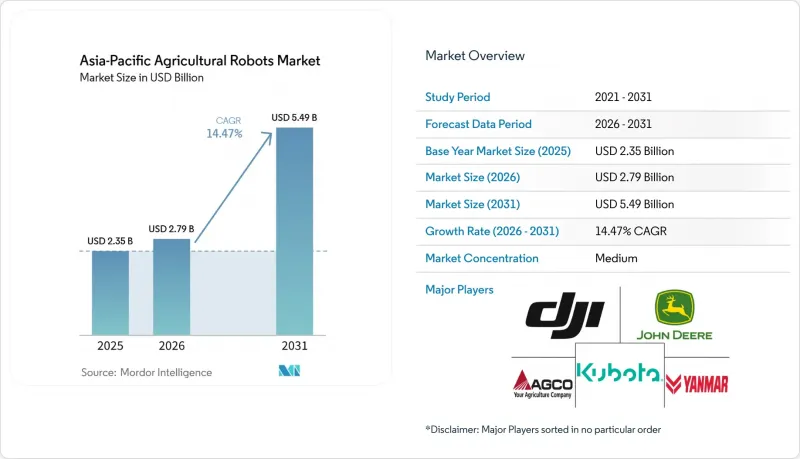
본 보고서는 제품 유형별(무인 트랙터, 무인 항공기 등), 구성 요소별(하드웨어, 소프트웨어, 서비스), 용도별(작물 재배, 가축 관리, 낙농 관리 등), 지역별(중국, 일본, 인도, 호주, 한국, 인도네시아 등)로 분류되어 있습니다. 시장 전망은 금액(미 달러) 기준으로 제시되어 있습니다.
아시아태평양 농업용 로봇 시장 동향 및 인사이트
동아시아 및 오세아니아 지역의 농업 인력 부족 심화
생산자들이 노동 집약적인 농업 작업의 자동화를 점점 더 추진함에 따라, 노동력 부족이 아시아태평양의 농업용 로봇 시장의 주요 촉진요인으로 부상하고 있습니다. 일본 농림수산성(MAFF)에 따르면, 2024년 기준 일본의 주요 농업 종사자 수는 111만 명이며, 평균 연령은 69.2세, 70세 이상이 60.9%를 차지하고 있어 노동력 구조의 불균형이 심화되고 있음이 드러나고 있습니다. 이러한 노동력의 고령화로 인해 생산성을 유지하고, 업무 효율을 높이며, 지역 전체에서 적기에 농작업을 수행하기 위해 자율주행 트랙터, 수확용 로봇, 드론 및 기타 정밀 농업 기술에 대한 투자가 가속화되고 있습니다.
스마트 농업 및 자동화에 대한 정부의 지원책
정부의 지원으로 투자 장벽이 낮아지고 스마트 농업 생태계가 강화됨에 따라, 아시아태평양 전체에서 농업용 로봇 도입이 가속화되고 있습니다. 한국 농림축산식품부(MAFRA)에 따르면, 2025년 정부는 ‘스마트농업 육성 및 지원에 관한 법률’에 따라 기술 개발, 인재 양성, 산업 성장 및 스마트농업 솔루션 보급을 촉진하기 위해 2개의 스마트농업 지원센터를 지정했습니다. 이러한 정책 이니셔티브는 자율형 농업 기계, 로봇 공학, 디지털 농업 기술에 대한 투자를 촉진하여 지역 전체의 신속한 상용화와 장기적인 시장 성장을 지원하고 있습니다.
높은 초기 투자 비용과 개조 작업의 복잡성
높은 초기 설비 투자 비용과 개조의 복잡성은 아시아태평양의 농업용 로봇 시장, 특히 소규모 농가가 주류를 이루는 농업 시스템에서 여전히 큰 제약 요인으로 작용하고 있습니다. NITI Aayog의 ‘Frontier Tech Hub’ 보고서(2025년)에 따르면, 인도 농가의 86% 이상이 평균 0.74헥타르에 불과한 소규모 농지를 경작하고 있습니다. 이처럼 소규모이고 세분화된 농장에서는 고가의 자율형 농업 기계에 투자할 자금력이 부족한 경우가 많습니다. 게다가 로봇 기술을 기존 트랙터나 장비에 통합하려면 추가적인 개조, 설치 및 유지보수 비용이 필요합니다. 이러한 비용적 장벽이 아시아태평양의 개발도상국 시장에서 농업용 로봇의 대규모 보급을 여전히 가로막고 있습니다.
부문 분석
2025년 아시아태평양의 농업용 로봇 시장에서 무인 항공기(UAV) 및 드론은 36.0%라는 가장 큰 점유율을 차지했습니다. 이러한 압도적인 위상은 작물 살포, 농지 모니터링, 정밀 매핑 등 광활한 농지에서 활발하게 도입되고 있음을 반영하며, 공중에서 신속하게 조사함으로써 업무 효율이 향상되고 있습니다. 드론은 아시아태평양의 많은 국가에서 볼 수 있는 세분화된 농지와 다양한 작물 재배 체계에 특히 적합하며, 생산자는 더 적은 인력으로 농장 작업을 최적화할 수 있습니다. 이러한 범용성, 비교적 쉬운 도입, 그리고 확대되는 서비스 기반 운영 모델 덕분에 이 지역에서 가장 널리 채택되고 있는 농업용 로봇 플랫폼으로서의 입지를 더욱 공고히 하고 있습니다.
수확·채취 로봇은 2026년부터 2031년까지 연평균 성장률(CAGR) 18.9%라는 가장 높은 성장률을 보일 것으로 예측됩니다. 과일, 채소, 과수원, 온실 재배 분야의 노동력 부족이 심화됨에 따라 생산자들은 속도,일관성, 정밀성이 요구되는 수확 작업의 자동화를 추진하고 있습니다. 로봇 비전, 인공지능, 그리고 엔드 이펙터 기술의 발전으로 인해 민감한 작물에 대한 상업적 적용 범위가 확대되고, 수확 정밀도가 향상되며, 작물 손상이 줄어들고 있습니다. 각 제조업체가 여러 작물 품종에 대응 가능한 유연한 수확 시스템 개발을 지속하는 가운데, 수확 로봇은 아시아태평양의 농업용 로봇 시장에서 가장 빠르게 성장하는 제품 카테고리 중 하나가 될 것으로 예측됩니다.
기타 혜택:
- 엑셀 형식 시장 예측(ME) 시트
- 3개월간의 애널리스트 지원
자주 묻는 질문
목차
제1장 서론
제2장 조사 방법
제3장 개요
제4장 시장 구도
제5장 시장 규모와 성장 예측
제6장 경쟁 구도
제7장 시장 기회와 향후 전망
JHS 26.09.01According to Mordor Intelligence, the Asia-Pacific agricultural robots market was valued at USD 2.35 billion in 2025 and is projected to grow from USD 2.79 billion in 2026 to USD 5.49 billion by 2031, registering a CAGR of 14.47% over the forecast period.
This report is Segmented by Product Type (Driverless Tractors, Unmanned Aerial Vehicles, and More), by Component (Hardware, Software, and Services), by Application (Crop Farming, Livestock Management, Dairy Management, and More), and by Geography (China, Japan, India, Australia, South Korea, Indonesia, and More). The Market Forecasts are Provided in Terms of Value (USD).
Asia-Pacific Agricultural Robots Market Trends and Insights
Accelerating Agricultural Labor Shortages in East Asia and Oceania
Labor shortages are emerging as a primary driver of the Asia-Pacific agricultural robots market, as producers increasingly automate labor-intensive farm operations. According to Japan's Ministry of Agriculture, Forestry and Fisheries (MAFF), the country had 1.11 million core agricultural workers in 2024, with an average age of 69.2 years and 60.9% aged 70 years or older, highlighting a growing workforce imbalance. This aging labor force is accelerating investments in autonomous tractors, robotic harvesters, drones, and other precision farming technologies to maintain productivity, improve operational efficiency, and ensure timely field operations across the region.
Government Incentives for Smart Farming and Automation
Government support is accelerating the adoption of agricultural robots across the Asia-Pacific region by reducing investment barriers and strengthening the smart farming ecosystem. According to the Ministry of Agriculture, Food and Rural Affairs (MAFRA) of South Korea, in 2025, the government designated two Smart Farming Support Centers to promote technology development, workforce training, industry growth, and wider adoption of smart farming solutions under the Act on Fostering and Supporting Smart Farming. These policy initiatives encourage investments in autonomous agricultural machinery, robotics, and digital farming technologies, supporting faster commercialization and long-term market growth across the region.
High Upfront Capital Cost and Retrofit Complexity
High upfront capital costs and retrofit complexity remain significant restraints on the Asia-Pacific agricultural robots market, particularly in smallholder-dominated farming systems. According to NITI Aayog's Frontier Tech Hub report (2025), more than 86% of India's farmers cultivate an average landholding of just 0.74 hectares. Such small and fragmented farms often lack the financial capacity to invest in expensive autonomous machinery. Additionally, integrating robotic technologies with existing tractors and equipment requires additional retrofit, installation, and maintenance expenditures. These cost barriers continue to limit large-scale adoption of agricultural robots across developing markets in the Asia-Pacific region.
Other drivers and restraints analyzed in the detailed report include:
- Declining Economics of Sensors, Vision Systems, and Edge AI Hardware
- Autonomous Robotics Adoption in Controlled-Environment Agriculture
- Safety, Liability, and Cybersecurity Concerns for Autonomous Farm Machines
For complete list of drivers and restraints, kindly check the Table Of Contents.
Segment Analysis
Unmanned aerial vehicles and drones accounted for the largest share of 36.0% in the Asia-Pacific agricultural robots market in 2025. Their dominant position reflects strong adoption across broad-acre farming for crop spraying, field monitoring, and precision mapping, where rapid aerial coverage improves operational efficiency. Drones are particularly suited to fragmented farmland and diverse cropping systems common across several Asia-Pacific countries, enabling growers to optimize field operations with lower labor requirements. Their versatility, relatively simple deployment, and expanding service-based operating models continue to strengthen their position as the most widely adopted agricultural robotic platform in the region.
Harvesting and picking robots are forecast to grow at the fastest CAGR of 18.9% from 2026 to 2031. Rising labor shortages in fruit, vegetable, orchard, and greenhouse production are encouraging growers to automate harvesting activities that require speed, consistency, and precision. Improvements in robotic vision, artificial intelligence, and end-effector technologies are expanding commercial applications for delicate crops, improving picking accuracy and reducing crop damage. As manufacturers continue developing flexible harvesting systems capable of handling multiple crop varieties, harvesting robots are projected to become one of the fastest-growing product categories in the Asia-Pacific agricultural robots market.
Complete Report Scope:
- By Product Type
- Driverless Tractors
- Unmanned Aerial Vehicles and Drones
- Milking Robots
- Harvesting and Picking Robots
- Weeding Robots
- Other Product Types
- By Application
- Crop Farming
- Livestock Management
- Dairy Management
- Aquaculture
- Greenhouse Farming
- By Component
- Hardware
- Software
- Services
- By Geography
- China
- Japan
- India
- Australia
- South Korea
- Indonesia
- Thailand
- Rest of Asia-Pacific
List of Companies Covered in this Report:
- Deere and Company
- SZ DJI Technology Co., Ltd.
- Kubota Corporation
- Yanmar Holdings Co., Ltd.
- AGCO Corporation
- CNH Industrial N.V.
- FJ Dynamics International Limited
- Daedong Corporation
- Trimble Inc.
- Autonomous Solutions, Inc.
- AgXeed B.V.
- Naio Technologies SAS
- Ecorobotix SA
- Carbon Robotics, Inc.
- Harvest Automation, Inc.
Additional Benefits:
- The market estimate (ME) sheet in Excel format
- 3 months of analyst support
TABLE OF CONTENTS
1 Introduction
- 1.1 Study Assumptions and Market Definition
- 1.2 Scope of the Study
2 Research Methodology
3 Executive Summary
4 Market Landscape
- 4.1 Market Overview
- 4.2 Market Drivers
- 4.2.1 Accelerating agricultural labor shortages in East Asia and Oceania
- 4.2.2 Rising need for precision crop intervention in high-value farms
- 4.2.3 Government incentives for smart farming and automation
- 4.2.4 Declining economics of sensors, vision systems, and edge AI hardware
- 4.2.5 Expansion of robotics-as-a-service for small and mid-sized farms
- 4.2.6 Autonomous robotics adoption in controlled-environment agriculture
- 4.3 Market Restraints
- 4.3.1 High upfront capital cost and retrofit complexity
- 4.3.2 Fragmented farm digitization and interoperability gaps
- 4.3.3 Rural connectivity limits for cloud-connected autonomy
- 4.3.4 Safety, liability, and cybersecurity concerns for autonomous farm machines
- 4.4 Regulatory Landscape
- 4.5 Technological Outlook
- 4.6 Value and Supply-Chain Analysis
- 4.7 Porter's Five Forces Analysis
- 4.7.1 Threat of New Entrants
- 4.7.2 Bargaining Power of Suppliers
- 4.7.3 Bargaining Power of Buyers
- 4.7.4 Threat of Substitutes
- 4.7.5 Intensity of Competitive Rivalry
5 Market Size and Growth Forecasts (Value)
- 5.1 By Product Type
- 5.1.1 Driverless Tractors
- 5.1.2 Unmanned Aerial Vehicles and Drones
- 5.1.3 Milking Robots
- 5.1.4 Harvesting and Picking Robots
- 5.1.5 Weeding Robots
- 5.1.6 Other Product Types
- 5.2 By Application
- 5.2.1 Crop Farming
- 5.2.2 Livestock Management
- 5.2.3 Dairy Management
- 5.2.4 Aquaculture
- 5.2.5 Greenhouse Farming
- 5.3 By Component
- 5.3.1 Hardware
- 5.3.2 Software
- 5.3.3 Services
- 5.4 By Geography
- 5.4.1 China
- 5.4.2 Japan
- 5.4.3 India
- 5.4.4 Australia
- 5.4.5 South Korea
- 5.4.6 Indonesia
- 5.4.7 Thailand
- 5.4.8 Rest of Asia-Pacific
6 Competitive Landscape
- 6.1 Strategic Moves
- 6.2 Market Share Analysis
- 6.3 Company Profiles (Includes Global Level Overview, Market Level Overview, Core Segments, Financials as Available, Strategic Information, Market Rank/Share for Key Companies, Products and Services, and Recent Developments)
- 6.3.1 Deere and Company
- 6.3.2 SZ DJI Technology Co., Ltd.
- 6.3.3 Kubota Corporation
- 6.3.4 Yanmar Holdings Co., Ltd.
- 6.3.5 AGCO Corporation
- 6.3.6 CNH Industrial N.V.
- 6.3.7 FJ Dynamics International Limited
- 6.3.8 Daedong Corporation
- 6.3.9 Trimble Inc.
- 6.3.10 Autonomous Solutions, Inc.
- 6.3.11 AgXeed B.V.
- 6.3.12 Naio Technologies SAS
- 6.3.13 Ecorobotix SA
- 6.3.14 Carbon Robotics, Inc.
- 6.3.15 Harvest Automation, Inc.