

|
시장보고서
상품코드
2117555
NVDIMM 및 영구 메모리 모듈 : 시장 점유율 분석, 업계 동향 및 통계, 성장 예측(2026-2031년)NVDIMM and Persistent Memory Module - Market Share Analysis, Industry Trends & Statistics, Growth Forecasts (2026 - 2031) |
||||||
 Mordor Intelligence
Mordor Intelligence에 의하면, NVDIMM 및 영구 메모리 모듈 시장 규모는 2025년 8억 3,000만 달러로 평가되었습니다. 2026년 8억 9,000만 달러에서 2031년에는 13억 달러로 확대되며 2026년부터 2031년까지 연평균 성장률(CAGR)은 7.92%를 나타낼 전망입니다.
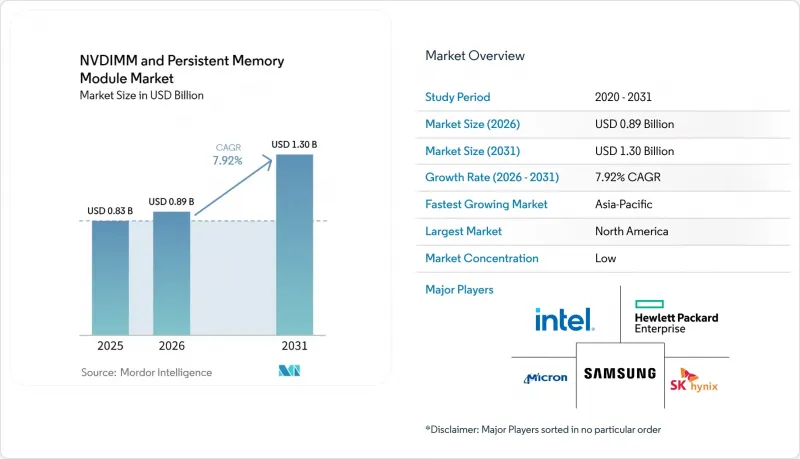
본 보고서는 제품 유형(NVDIMM-N, NVDIMM-F, NVDIMM-P 등),최종 사용자(엔터프라이즈 IT, 통신 및 엣지 인프라 등), 용도(데이터베이스 고속화, 실시간 분석 등), 기술(DRAM+NAND 하이브리드, NAND 플래시 기반 등), 지역(북미, 아시아태평양 등)별로 분류되어 있습니다. 시장 예측은 금액(달러) 기준으로 제시되어 있습니다.
세계의 NVDIMM 및 영구 메모리 모듈 시장 동향 및 인사이트
지속적 메모리가 필요한 AI 및 고성능 컴퓨팅 워크로드
대규모 언어 모델(LLM) 추론 클러스터에서는 스토리지 재로딩을 반복하지 않고도 컨텍스트 재설정을 견딜 수 있도록 피처 스토어, KV 캐시 및 임베디드 벡터가 필요합니다. 이로 인해 활성 메모리 실적 내에서의 영속성의 중요성이 더욱 높아지고 있습니다. 휘발성 DRAM만으로는 정전이나 계획된 중단 시에도 작동 상태를 유지할 수 없기 때문에 이러한 요구 사항이 NVDIMM 및 영구 메모리 모듈 시장의 전략적 가치를 높이고 있습니다. 마이크로소프트는 2026 회계연도 3분기 10-Q 보고서에서 2026 회계연도 자본 지출액 중 250억 달러가 DRAM 및 HBM 가격 급등과 관련이 있다고 밝혔으며, 이는 메모리의 경제성이 단순한 인프라 운영상의 문제가 아니라 이사회 차원의 문제가 되었음을 보여줍니다. 또한, 통신 및 금융 서비스 환경의 AI 추론 클러스터에서는 정전 후 세션의 연속성 및 저지연 재시작에 대한 요구가 점점 더 높아지고 있어, NVDIMM 및 영구 메모리 모듈 시장도 그 혜택을 보고 있습니다. 이로 인해 NVDIMM 및 퍼시스턴트 메모리 모듈 시장의 잠재적 적용 범위는 기존의 고성능 컴퓨팅 시설에 그치지 않고, 보다 광범위한 기업 환경으로 확대되고 있습니다. 또한, 램버스(Lambus)는 2026년 7월 DDR5 서버 칩셋 출시를 에이전트형 AI 및 HPC 서버 인프라의 핵심으로 자리매김했습니다. 이는 퍼시스턴트 메모리 지원이 현재 주류를 이루는 AI 서버 설계 주기 내에서 검토되고 있다는 견해를 뒷받침하는 것입니다.
하이퍼스케일 및 엔터프라이즈 데이터센터의 교체 주기 확대
많은 구매자가 2026년에 DDR5 지원 플랫폼으로 전환함에 따라, NVDIMM 및 퍼시스턴트 메모리 모듈 시장은 서버 교체 활동에 힘입어 성장하고 있습니다. 이 시점이 중요한 이유는 DDR4만 있는 환경에서는 도입을 정당화하기 어려웠던 업그레이드도, 기업이 이미 핵심 서버 보드와 메모리 컨트롤러를 교체하고 있는 상황에서는 보다 현실적인 선택지가 되기 때문입니다. 마이크론은 SEC에 제출한 2026 회계연도 3분기 실적 발표에서 2026 회계연도의 설비 투자액이 2025 회계연도의 138억 달러에서 270억 달러에 달했으며, 해당 지출은 첨단 DRAM 및 HBM 생산 능력에 중점을 둔 것이라고 밝혔습니다. 이러한 환경 속에서 NVDIMM 및 비휘발성 메모리 모듈 시장은 두드러진 존재감을 보이고 있습니다. 이는 전용 비휘발성 계층을 통해 범용 DRAM에 모든 내결함성 요건을 부과하지 않고도 고부가가치 워크로드를 보호할 수 있기 때문입니다. SK하이닉스는 2025년 12월, 자사의 256GB DDR5 RDIMM에 대해 인텔 데이터센터 인증을 획득했습니다. 이를 통해 벤더들이 OEM 설계 채택을 목표로 할 때 의존하는 검증된 DDR5 생태계가 확대되었습니다. NVDIMM 및 퍼시스턴트 메모리 모듈 시장은 이러한 혜택을 누리고 있습니다. 새로 인증된 DDR5 플랫폼이 하나씩 늘어날 때마다, 서버 교체 주기 동안 퍼시스턴트 메모리 모듈을 도입할 수 있는 더욱 신뢰할 수 있는 경로가 마련되기 때문입니다.
모듈 및 플랫폼 통합 비용의 높음
NVDIMM 및 영구 메모리 모듈 시장은 여전히 큰 가격 장벽에 직면해 있습니다. 이는 이러한 모듈이 표준 DRAM보다 부품 명세서(BOM)의 복잡성이 높기 때문입니다. 이 아키텍처에는 DRAM, NAND, 에너지 저장 부품, 그리고 백업 및 복구 작업을 위한 컨트롤러 로직이 필요하며, 이로 인해 인증 작업이 완료되기도 전에 이미 비용 기반이 상승하게 됩니다. 따라서 소켓당 예산이 제한적이고 투자 회수 기간이 일반적인 IT 지출 주기에 맞추어져야 하는 중견 기업 시장 환경에서는 NVDIMM 및 영구 메모리 모듈 시장 규모 확대가 어려워집니다. 또한, 설계가 양산 수익을 창출하기까지 펌웨어, BIOS, 운영 체제 지원 및 서버 보드와의 호환성에 대해 12-24개월에 걸쳐 개별적으로 검증해야 하므로, 인증 프로세스가 또 다른 장벽이 됩니다. 또한, SNIA의 NVM 프로그래밍 모델에서는 용도 팀이 기존의 버퍼가 있는 스토리지 방식이 아닌 직접 액세스 경로를 사용해야 하므로 소프트웨어 적응 작업도 증가합니다. 컴포넌트의 비용 효율성이 더욱 향상되고 플랫폼 스택의 인증이 용이해질 때까지는 NVDIMM 및 영구 메모리 모듈 시장은 비용 중심의 도입보다는 부가가치가 높은 도입 환경에서 더 매력적인 시장으로 남아 있을 것입니다.
부문별 분석
2025년, NVDIMM-N은 NVDIMM 및 영구 메모리 모듈 시장 점유율의 58.71%를 차지했으며, 주요 서버 라인 전반에 걸쳐 이미 광범위한 OEM 검증을 거친 덕분에 계속해서 주요 제품 유형으로서의 지위를 유지했습니다. NVDIMM 및 영구 메모리 모듈 시장은 가동 중에는 DRAM과 같은 성능을 발휘하고, 전원 손실 시에만 NAND를 통해 영구성을 확보하는 특성을 겸비하고 있기 때문에 여전히 이 형식에 크게 의존하고 있습니다. 이러한 설계 덕분에 활성 워크로드 중 NAND에 가해지는 직접적인 마모가 완화되어, 안정적인 인증 실적을 중시하는 엔터프라이즈 환경에서 기존 도입 기반을 지속적으로 활용할 수 있게 됩니다. 또한, NVDIMM 및 영구 메모리 모듈 시장에서는 새로운 포맷의 조기 도입보다, 이미 알려진 펌웨어 동작 및 검증된 상호 운용성을 중시하는 고객들 사이에서도 NVDIMM-N이 선호되고 있습니다. Unigen과 Kingston은 모두 출처 자료에 명시된 확립된 규정 준수 및 검증 프레임워크 내에서 사업을 전개하고 있으므로, 이 분야에서 중요한 공급업체로 자리매김하고 있습니다.
NVDIMM-P는 2031년까지 연평균 성장률(CAGR)이 9.11%로 가장 빠르게 성장하는 제품 유형이며, 새로운 DDR5 플랫폼 및 바이트 단위로 주소 지정 가능한 영속성과의 정합성이 보다 직접적이라는 점에서 그 위상이 중요합니다. NVDIMM 및 영구 메모리 모듈 시장에서는 구매자들이 외부 메모리 확장 장치가 일반적으로 제공할 수 있는 것보다 낮은 레이턴시로 영구성을 요구하고 있기 때문에 NVDIMM-P에 대한 수요가 확대될 여지가 커지고 있습니다. CXL 컨소시엄은 2025년, NVDIMM-N 개념에서 CXL 퍼시스턴트 메모리로의 전환에 대해, 고속 휘발성 미디어와 비휘발성 백업을 결합하는 논리가 유지되므로 즉각적인 교체 주기가 아닌 공존 단계가 지원될 것이라고 밝혔습니다. JEDEC 또한 퍼시스턴트 메모리 프로토콜에 관한 표준화 방향을 정했습니다. 이는 차세대 서버에서 OEM 인증의 핵심 요소로 계속 자리 잡고 있습니다. 따라서 NVDIMM 및 퍼시스턴트 메모리 모듈 시장은 현재 규모를 유지하기 위해 계속해서 NVDIMM-N에 의존하는 한편, 다음 플랫폼 주기에서 더 많은 시장 점유율을 확보하기 위한 제품 전략으로 NVDIMM-P를 활용해 나갈 것입니다.
2025년에는 엔터프라이즈 IT가 최종 사용자 매출의 43.88%를 차지했으며, 이는 데이터베이스 상태, 트랜잭션 로그, 체크포인트 파일을 보호하는 데 있어 퍼시스턴트 메모리가 수년 동안 수행해 온 역할을 반영한 것입니다. NVDIMM 및 지속성 메모리 모듈 시장은 이 구매자층에 깊이 뿌리내리고 있습니다. 그 이유는 도입 사례가 벤더 고유의 펌웨어, 배터리, 컨트롤러 로직을 갖춘 엄격하게 관리되는 서버 스택 내에 배치되는 경우가 많기 때문입니다. 따라서 설계가 프로덕션용 서버 플랫폼에서 인증받으면 기존 공급업체는 확고한 입지를 다질 수 있습니다. 또한 NVDIMM 및 퍼시스턴트 메모리 모듈 시장은 하이퍼스케일러와 클라우드 제공업체에게도 전략적으로 중요한 위치를 계속 차지하고 있습니다. 다만, 이러한 구매자들은 기업보다 더 적극적으로 기존 모듈과 병행하여 CXL 기반 대체 제품을 평가하는 경향이 있습니다. 정부 기관 및 연구 기관은 데이터 무결성이나 재시작 시의 동작이 공식적인 운영 요건과 직결되는 특수한 HPC 환경에서 계속해서 수요를 뒷받침하고 있습니다.
통신 및 엣지 인프라는 2031년까지 연평균 성장률(CAGR)이 9.25%로 최종 사용자 부문 중 가장 빠르게 성장하고 있으며, NVDIMM 및 영구 메모리 모듈 시장에 있어 가장 확실한 새로운 성장 분야로 부상하고 있습니다. NVDIMM 및 영구 메모리 모듈 시장은 5G 독립형 네트워크, Open RAN, 멀티 액세스 엣지 컴퓨팅(MAEC)의 혜택을 받고 있으며, 이들은 지연 시간에 민감한 처리를 중앙 시설에서 멀리 떨어뜨리는 역할을 하고 있습니다. SK하이닉스는 2026년, AI 서버 환경을 위한 SOCAMM2 192GB 모듈의 양산을 시작했습니다. 이는 첨단 메모리 기술의 혁신이 분산형 및 엣지 지향적 배포 모델로 다가서고 있음을 보여줍니다. 이러한 환경에서는 원격 노드가 재시작 시 긴 지연이나 모델 상태 재구성을 반복하는 것을 허용할 수 없기 때문에 구매자는 정전 시 보호 기능을 중요하게 여깁니다. 따라서 NVDIMM 및 영구 메모리 모듈 시장은 엣지에서의 데이터 양 증가뿐만 아니라, 분산형 통신 인프라에서 메모리 상태 손실에 따른 운영상의 페널티 증가로도 혜택을 받고 있습니다.
지역별 분석
2025년, 북미는 NVDIMM 및 영구 메모리 모듈 시장 점유율의 45.43%를 차지했습니다. 이는 해당 지역의 하이퍼스케일 용량 집중, 대기업의 인메모리 워크로드, 그리고 활발한 서버 OEM 인증 프로그램을 반영한 것입니다. 이 지역에서 NVDIMM 및 영구 메모리 모듈 시장이 특히 견조한 이유는 해당 지역의 구매자들이 새로운 서버 아키텍처와 메모리 집약적인 AI 인프라를 조기에 채택하는 경향이 있기 때문입니다. 마이크로소프트의 2026 회계연도 3분기(Q3) 10-Q 보고서에 따르면, 2026년 자본 지출 중 250억 달러가 DRAM 및 HBM 가격 급등에 기인한 것으로 나타났으며,이는 북미의 주요 통신 사업자들이 AI 용량을 확보하기 위해 메모리 비용 부담을 얼마나 강력하게 감당하고 있는지를 보여줍니다. 또한 마이크론(Micron)도 2026 회계연도 3분기 보고서에서 2026 회계연도 설비 투자액이 270억 달러에 달할 것이라고 밝혔으며, 이는 첨단 메모리 공급 확대 및 플랫폼 검증에서 북미가 차지하는 역할을 뒷받침하고 있습니다. 플랫폼 검증, 부품 접근성, 그리고 내결함성 메모리에 대한 수요가 모두 이 지역에 유례없이 집중되어 있기 때문에 NVDIMM 및 영구 메모리 모듈 시장은 이러한 환경의 혜택을 받고 있습니다.
유럽은 지역별 시장 규모에서 2위를 차지했으며, 북미와는 다른 수요 패턴을 보였습니다. 유럽의 NVDIMM 및 퍼시스트 메모리 모듈 시장은 금융 서비스, 의료, 제조업 등 규제 대상 기업 부문에 의해 더 강하게 형성되고 있으며, 이러한 분야에서는 AI 성능과 마찬가지로 내결함성 및 재시작 시의 일관성이 중시되고 있습니다. HPE가 2026년 5월 SAP HANA 워크로드를 위해 ‘Compute Scale-up Server 3250’을 출시한 것은 이러한 지역적 추세와 부합합니다. 이는 최대 규모의 인메모리 데이터베이스 환경 대부분이 하이퍼스케일 실험이라기보다는 여전히 기업의 비즈니스 연속성 요구 사항과 밀접하게 연결되어 있기 때문입니다. 또한, NVDIMM 및 영구 메모리 모듈 시장은 유럽의 도입 패턴과도 일치합니다. 이는 소프트웨어 도입 경로가 신속한 파일럿 배포의 확대라기보다는 표준 규격 중심의 인프라 계획이나 장기적인 인증 주기에 의해 규정되는 경우가 많기 때문입니다.
아시아태평양은 2031년까지 연평균 성장률(CAGR)이 8.96%로 가장 빠르게 성장하고 있으며, NVDIMM 및 영구 메모리 모듈 시장 규모 측면에서 가장 뚜렷한 지역적 성장 동력이 되고 있습니다. 이 지역에서 NVDIMM 및 영구 메모리 모듈 시장이 확대되고 있는 것은 한국, 일본, 대만의 반도체 제조 강점에 더해, 중국, 인도, 동남아시아 전역에서의 광범위한 5G 구축과 산업 자동화 수요가 맞물려 시너지 효과를 낳고 있기 때문입니다. SK하이닉스는 2026년에 SOCAMM2 192GB의 양산을 시작했다고 발표했는데, 이는 해당 지역이 AI 인프라와 관련된 차세대 메모리 모듈공급 거점일 뿐만 아니라 실증의 장으로서의 역할도 담당하고 있음을 뒷받침합니다. 또한, 분산형 통신 및 산업용 노드에서는 운영 현장에 가까운 곳에서 메모리의 내결함성이 요구되기 때문에 NVDIMM 및 영구 메모리 모듈 시장은 지역 성장의 에지 측면에서도 혜택을 받고 있습니다. 세계 기타 지역에서는 도입이 다소 늦어지고 있지만, 걸프 국가들의 국가 주도의 AI 데이터센터 구축과 브라질, 남아프리카공화국 등의 국가에서 클라우드 인프라가 단계적으로 확대됨에 따라, 예측 기간 동안 더 많은 기회가 창출될 것으로 전망됩니다.
기타 혜택 :
- 엑셀 형식 시장 예측(ME) 시트
- 3개월간의 애널리스트 지원
자주 묻는 질문
목차
제1장 서론
제2장 조사 방법
제3장 개요
제4장 시장 구도
제5장 시장 규모 및 성장 예측
제6장 경쟁 구도
제7장 시장 기회 및 향후 전망
KTH 26.09.02According to Mordor Intelligence, the NVDIMM and persistent memory module market size is projected to expand from USD 0.83 billion in 2025 and USD 0.89 billion in 2026 to USD 1.3 billion by 2031, registering a CAGR of 7.92% between 2026 to 2031.
This report is Segmented by Product Type (NVDIMM-N, NVDIMM-F, NVDIMM-P, and More), End User (Enterprise IT, Telecom and Edge Infrastructure, and More), Application (Database Acceleration, Real-Time Analytics, and More), Technology (DRAM+NAND Hybrid, NAND Flash-Based, and More), and Geography (North America, Asia Pacific, and More). The Market Forecasts are Provided in Terms of Value (USD).
Global NVDIMM and Persistent Memory Module Market Trends and Insights
AI and High-Performance Computing Workloads Requiring Persistent Memory
Large language model inference clusters need feature stores, KV caches, and embedding vectors to survive context resets without repeated storage reloads, which makes persistence more relevant inside active memory footprints. That requirement is lifting the strategic value of the NVDIMM and persistent memory module market because volatile DRAM alone cannot preserve the working state across outages or planned interruptions. Microsoft stated in its Q3 FY2026 10-Q that USD 25 billion of its 2026 capital expenditure was linked to DRAM and HBM price inflation, showing that memory economics had become a board-level issue rather than only an infrastructure operations concern. The NVDIMM and persistent memory module market also benefits, as AI inference clusters in telecom and financial services environments increasingly require session continuity and low-latency restart behavior after power events. That expands the addressable market for the NVDIMM and persistent memory module markets beyond traditional high-performance computing facilities into broader enterprise deployments. Rambus also framed its July 2026 DDR5 server chipset launch around agentic AI and HPC server infrastructure, which supports the view that persistent memory readiness is now being considered within mainstream AI server design cycles.
Growth in Hyperscale and Enterprise Data Center Refresh Cycles
The NVDIMM and persistent memory module market is gaining support from server refresh activity, as many buyers are moving to DDR5-capable platforms in 2026. That timing matters because upgrades that were harder to justify on DDR4-only environments become more practical when enterprises are already changing core server boards and memory controllers. Micron said in its fiscal Q3 2026 earnings release filed with the SEC that fiscal 2026 capital expenditures would reach USD 27 billion, up from USD 13.8 billion in fiscal 2025, with spending centered on advanced DRAM and HBM capacity. In that environment, the NVDIMM and persistent memory module market stands out because specialized persistence layers can protect high-value workloads without imposing every resilience requirement on commodity DRAM. SK hynix completed Intel Data Center Certification for its 256GB DDR5 RDIMM in December 2025, which broadened the validated DDR5 ecosystem that module vendors depend on when pursuing OEM design wins. The NVDIMM and persistent memory module market benefits from this, as each new qualified DDR5 platform creates a more credible insertion path for persistent memory modules during active server refresh cycles.
High Module and Platform Integration Cost
The NVDIMM and persistent memory module market still faces a meaningful pricing barrier because these modules carry more bill-of-materials complexity than standard DRAM. The architecture requires DRAM, NAND, an energy storage component, and controller logic for backup and restore behavior, which lifts the cost base before qualification work is even complete. That makes the NVDIMM and persistent memory module market harder to scale in mid-market environments where per-socket budgets stay tight and payback periods must fit normal IT spending cycles. Qualification adds another layer because firmware, BIOS, operating system support, and server board compatibility often need separate validation over 12-24 months before a design reaches production revenue. The SNIA NVM programming model also increases software adaptation work because application teams need to use direct access pathways rather than conventional buffered storage methods. Until component economics improve further and platform stacks become easier to certify, the NVDIMM and persistent memory module market will remain more attractive in higher-value deployments than in cost-sensitive rollouts.
Other drivers and restraints analyzed in the detailed report include:
- Shift Toward In-Memory Databases and Real-Time Analytics Architecture
- DDR5 Platform Transitions Supporting New Persistent Memory Designs
- Slow Software Ecosystem Optimization and Qualification Cycles
For complete list of drivers and restraints, kindly check the Table Of Contents.
Segment Analysis
NVDIMM-N held 58.71% of the NVDIMM and persistent memory module market share in 2025, which kept it as the leading product type because it already had broad OEM validation across major server lines. The NVDIMM and persistent memory module market still leans heavily on this format because it combines DRAM-like performance during operation with NAND-backed persistence only at power loss. That design reduces direct NAND wear during active workloads and keeps the installed base relevant in enterprise environments that prioritize stable qualification history. The NVDIMM and persistent memory module market also favors NVDIMM-N in accounts where buyers value known firmware behavior and proven interoperability over early adoption of newer formats. Unigen and Kingston remained important suppliers in this area because both companies operate inside the established compliance and validation framework described in the source material.
NVDIMM-P is the fastest-growing product type with a 9.11% CAGR through 2031, and that positioning matters because it aligns more directly with newer DDR5 platforms and byte-addressable persistence. The NVDIMM and persistent memory module market is opening more space for NVDIMM-P because buyers want persistence at lower latency than external memory expansion devices can usually provide. The CXL Consortium stated in 2025 that the move from NVDIMM-N concepts into CXL persistent memory preserves the logic of fast volatile media paired with non-volatile backup, which supports a coexistence phase instead of an immediate replacement cycle. JEDEC also set the standards direction for persistent memory protocol work, which remains central to OEM qualification on new server generations. The NVDIMM and persistent memory module market should therefore continue to rely on NVDIMM-N for current scale while using NVDIMM-P as the product path that captures more of the next platform cycle.
Enterprise IT accounted for 43.88% of end-user revenue in 2025, which reflected the long-standing role of persistent memory in protecting database state, transaction logs, and checkpoint files. The NVDIMM and persistent memory module market has deep roots in this buyer group because deployments often sit inside tightly managed server stacks with vendor-specific firmware and battery or controller logic. That creates durable positions for incumbent suppliers once a design is qualified on a production server platform. The NVDIMM and persistent memory module market also remains strategically important for hyperscalers and cloud providers, even though these buyers are more willing than enterprises to evaluate CXL-based alternatives alongside traditional modules. Government and research organizations continue to support demand in specialized HPC environments where data integrity and restart behavior are tied to formal operating requirements.
Telecom and edge infrastructure is the fastest-growing end-user segment, with a 9.25% CAGR through 2031, making it the clearest new expansion lane for the NVDIMM and persistent memory module market. The NVDIMM and persistent memory module market is benefiting from 5G standalone networks, Open RAN, and multi-access edge computing, which push more latency-sensitive processing away from central facilities. SK hynix began mass production of its SOCAMM2 192GB module in 2026 for AI server environments, showing that advanced memory innovation is moving closer to distributed and edge-oriented deployment models. In these environments, buyers value power-fail protection because remote nodes cannot absorb long restart delays or repeated model-state reconstruction. The NVDIMM and persistent memory module market therefore gains not only from higher data volumes at the edge, but also from the higher operational penalty attached to lost memory state in distributed telecom infrastructure.
Complete Report Scope:
- By Product Type
- NVDIMM-N
- NVDIMM-F
- NVDIMM-P
- Persistent Memory DIMMs (PMem)
- By End User
- Enterprise IT
- Cloud Service Providers / Hyperscalers
- Telecom and Edge Infrastructure
- Government and Research Organizations
- By Application
- Database Acceleration
- Real-Time Analytics
- Disaster Recovery and Data Persistence
- Edge Computing Systems
- By Technology
- DRAM + NAND Hybrid
- NAND Flash-Based
- Byte-Addressable Persistent Memory (3D XPoint)
- Emerging SCM Technologies (MRAM, ReRAM, PCM)
- By Geography
- North America
- Europe
- Asia Pacific
- China
- Japan
- South Korea
- Taiwan
- Rest of Asia Pacific
- Rest of the World
Geography Analysis
North America held 45.43% of the NVDIMM and persistent memory module market share in 2025, which reflected the region's heavy concentration of hyperscale capacity, large enterprise in-memory workloads, and active server OEM qualification programs. The NVDIMM and persistent memory module market is particularly strong in the region because buyers there tend to adopt new server architectures and memory-intensive AI infrastructure earlier. Microsoft's Q3 FY2026 10-Q showed that USD 25 billion of its 2026 capital expenditure was attributed to DRAM and HBM price inflation, which shows how strongly large North American operators are absorbing memory cost pressure to secure AI capacity. Micron also said in its fiscal Q3 2026 filing that capital expenditures would reach USD 27 billion in fiscal 2026, reinforcing the role of North America in advanced memory supply expansion and platform validation. The NVDIMM and persistent memory module market benefits from that environment because platform validation, component access, and demand for resilient memory all remain unusually concentrated in the region.
Europe ranked as the second-largest regional market and showed a different demand pattern from North America. The NVDIMM and persistent memory module market in Europe is shaped more by regulated enterprise sectors such as financial services, healthcare, and manufacturing, where resilience and restart integrity matter as much as AI performance. HPE's May 2026 launch of the Compute Scale-up Server 3250 for SAP HANA workloads fits this regional pattern because many of the largest in-memory database environments remain tied to enterprise continuity requirements rather than hyperscale experimentation. The NVDIMM and persistent memory module market also aligns with European deployment patterns because the software path is often governed by standards-led infrastructure planning and long qualification cycles rather than rapid pilot scaling.
Asia Pacific is the fastest-growing region at an 8.96% CAGR through 2031, and this makes it the clearest geographic growth engine in the NVDIMM and persistent memory module market size. The NVDIMM and persistent memory module market is expanding in the region because semiconductor manufacturing strength in South Korea, Japan, and Taiwan is being matched by broader 5G rollout and industrial automation demand across China, India, and Southeast Asia. SK hynix said it had begun mass production of SOCAMM2 192GB in 2026, which supports the region's role as both a supply center and a proving ground for next-generation memory modules tied to AI infrastructure. The NVDIMM and persistent memory module market is also gaining from the edge side of regional growth because distributed telecom and industrial nodes need memory resilience closer to operations. The Rest of the World remained earlier in adoption, but sovereign AI data center activity in Gulf markets and gradual cloud infrastructure expansion in countries such as Brazil and South Africa are expected to create incremental opportunities over the forecast period.
- Micron Technology, Inc.
- SK hynix Inc.
- Intel Corporation
- Samsung Electronics Co., Ltd.
- SMART Global Holdings, Inc.
- Netlist, Inc.
- Viking Technology, Inc.
- AgigA Tech, Inc.
- Kingston Technology Company, Inc.
- Hewlett Packard Enterprise Company
- Dell Technologies Inc.
- Fujitsu Limited
- Huawei Technologies Co., Ltd.
- Super Micro Computer, Inc.
- Everspin Technologies, Inc.
- Rambus Inc.
- Unigen Corporation
Additional Benefits:
- The market estimate (ME) sheet in Excel format
- 3 months of analyst support
TABLE OF CONTENTS
1 INTRODUCTION
- 1.1 Study Assumptions and Market Definition
- 1.2 Scope of the Study
2 RESEARCH METHODOLOGY
3 EXECUTIVE SUMMARY
4 MARKET LANDSCAPE
- 4.1 Market Overview
- 4.2 Market Drivers
- 4.2.1 AI and High-Performance Computing Workloads Requiring Persistent Low-Latency Memory
- 4.2.2 Growth in Hyperscale and Enterprise Data Center Refresh Cycles
- 4.2.3 Shift Toward In-Memory Databases and Real-Time Analytics Architectures
- 4.2.4 DDR5 Platform Transitions Supporting New Persistent Memory Designs
- 4.2.5 Edge Computing and Industrial Resilience Requirements
- 4.2.6 Server Downtime Avoidance and Power-Loss Protection Priorities
- 4.3 Market Restraints
- 4.3.1 High Module and Platform Integration Cost
- 4.3.2 Slow Software Ecosystem Optimization and Qualification Cycles
- 4.3.3 Competition From CXL-Based Memory Expansion Architectures
- 4.3.4 Limited Design Wins Outside High-Value Enterprise Use Cases
- 4.4 Industry Value Chain Analysis
- 4.5 Regulatory Landscape
- 4.6 Technological Outlook
- 4.7 Impact of Macroeconomic Factors on the Market
- 4.8 Porter's Five Forces Analysis
- 4.8.1 Bargaining Power of Suppliers
- 4.8.2 Bargaining Power of Buyers
- 4.8.3 Threat of New Entrants
- 4.8.4 Threat of Substitutes
- 4.8.5 Intensity of Competitive Rivalry
5 MARKET SIZE AND GROWTH FORECASTS (VALUE)
- 5.1 By Product Type
- 5.1.1 NVDIMM-N
- 5.1.2 NVDIMM-F
- 5.1.3 NVDIMM-P
- 5.1.4 Persistent Memory DIMMs (PMem)
- 5.2 By End User
- 5.2.1 Enterprise IT
- 5.2.2 Cloud Service Providers / Hyperscalers
- 5.2.3 Telecom and Edge Infrastructure
- 5.2.4 Government and Research Organizations
- 5.3 By Application
- 5.3.1 Database Acceleration
- 5.3.2 Real-Time Analytics
- 5.3.3 Disaster Recovery and Data Persistence
- 5.3.4 Edge Computing Systems
- 5.4 By Technology
- 5.4.1 DRAM + NAND Hybrid
- 5.4.2 NAND Flash-Based
- 5.4.3 Byte-Addressable Persistent Memory (3D XPoint)
- 5.4.4 Emerging SCM Technologies (MRAM, ReRAM, PCM)
- 5.5 By Geography
- 5.5.1 North America
- 5.5.2 Europe
- 5.5.3 Asia Pacific
- 5.5.3.1 China
- 5.5.3.2 Japan
- 5.5.3.3 South Korea
- 5.5.3.4 Taiwan
- 5.5.3.5 Rest of Asia Pacific
- 5.5.4 Rest of the World
6 COMPETITIVE LANDSCAPE
- 6.1 Market Concentration
- 6.2 Strategic Moves
- 6.3 Market Share Analysis
- 6.4 Company Profiles (includes Global Level Overview, Market Level Overview, Core Segments, Financials as available, Strategic Information, Market Rank/Share, Products and Services, Recent Developments)
- 6.4.1 Micron Technology, Inc.
- 6.4.2 SK hynix Inc.
- 6.4.3 Intel Corporation
- 6.4.4 Samsung Electronics Co., Ltd.
- 6.4.5 SMART Global Holdings, Inc.
- 6.4.6 Netlist, Inc.
- 6.4.7 Viking Technology, Inc.
- 6.4.8 AgigA Tech, Inc.
- 6.4.9 Kingston Technology Company, Inc.
- 6.4.10 Hewlett Packard Enterprise Company
- 6.4.11 Dell Technologies Inc.
- 6.4.12 Fujitsu Limited
- 6.4.13 Huawei Technologies Co., Ltd.
- 6.4.14 Super Micro Computer, Inc.
- 6.4.15 Everspin Technologies, Inc.
- 6.4.16 Rambus Inc.
- 6.4.17 Unigen Corporation
7 MARKET OPPORTUNITIES AND FUTURE OUTLOOK
- 7.1 White-space and Unmet-Need Assessment


