
|
시장보고서
상품코드
2124821
차세대 비휘발성 메모리 : 시장 점유율 분석, 업계 동향과 통계, 성장 예측(2026-2031년)Emerging Non-Volatile Memory - Market Share Analysis, Industry Trends & Statistics, Growth Forecasts (2026 - 2031) |
||||||
 Mordor Intelligence
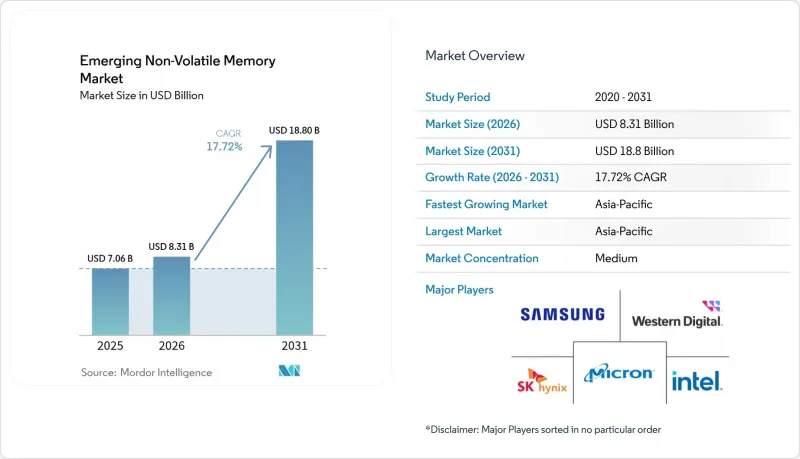
Mordor Intelligence에 의하면, 차세대 비휘발성 메모리 시장 규모는 2025년에 70억 6,000만 달러로 평가되었고, 2026년 83억 1,000만 달러에서 2031년까지 188억 달러에 이를 것으로 예측되며, 예측 기간(2026-2031년) CAGR은 17.72%를 기록할 전망입니다.
본 보고서는 메모리 기술(MRAM, ReRAM 등), 유형(독립형 및 임베디드형), 최종 사용자(소비자 가전, 산업용, 기업 및 데이터센터, 자동차 및 운송 등), 용도(캐시 메모리 및 엔터프라이즈 스토리지, 휴대전화 및 웨어러블 기기 등), 지역별로 분류되어 있습니다. 시장 전망은 금액(달러) 기준으로 제시되어 있습니다.
전 세계 차세대 비휘발성 메모리 시장 동향 및 인사이트
AI 데이터센터에서 저지연·고대역폭 스토리지에 대한 수요 급증
대규모 언어 모델을 운영하는 하이퍼스케일 사업자들은 ‘메모리의 벽’에 직면해 있습니다. 이는 DRAM과 NAND 간에 데이터를 전송하는 데 소비되는 에너지가 연산에 소비되는 에너지를 초과하는 현상입니다. 차세대 비휘발성 메모리는 100나노초 미만의 액세스 시간과 바이트 단위의 주소 지정 기능을 제공하며, 전원을 껐다 켰습니다 해도 훈련 데이터 세트를 그대로 유지할 수 있어 고비용의 DRAM 계층에 대한 의존도를 줄여줍니다. 삼성이 2024년에 발표한 1기가비트 스핀 전송 토크(STT) MRAM 프로토타입은 10나노초의 쓰기 속도를 입증하며, NAND에 비해 지연 시간 측면에서 우위를 확인했습니다. 2022년 인텔 옵테인의 생산 중단은 MRAM 및 ReRAM 계층으로의 전환을 더욱 가속화했습니다. 트랜스포머 모델의 매개변수 수가 1조 개를 넘어서는 가운데, 빈번한 체크포인트 생성을 위해서는 퍼시스턴트 메모리가 필수적이며, 추천 시스템이나 이상 감지 파이프라인에서의 채택이 확대되고 있습니다.
IoT 및 웨어러블 기기용 고효율 메모리로의 전환
배터리 구동에 제약이 있는 디바이스에서는 높은 쓰기 전류나 ‘쓰기 전 삭제’에 따른 오버헤드를 해소하기 위해, 시리얼 NOR 플래시 대신 강유전체 RAM(FRAM)이나 MRAM이 채택되고 있습니다. ST마이크로일렉트로닉스는 2024년, 초저전력 마이크로컨트롤러에서 임베디드형 FRAM을 통해 시스템 전력 소비를 40% 절감할 수 있었습니다고 밝혔습니다. 상시 가동형 음성 어시스턴트나 연속 건강 모니터링 기기에는 순간적인 기동과 대기 시 누설 전류 제로가 요구되는데, 이는 FRAM의 대기 전류가 서브 마이크로암페어 수준이라는 특징과 부합합니다. 에너지 효율 표시를 의무화하는 유럽연합(EU)의 에코디자인 규정 또한 FRAM 채택을 뒷받침하고 있습니다.
20nm 미만 노드에서 발생하는 높은 제조 비용과 수율 문제
차세대 비휘발성 메모리 스택에는 특수한 마스크 층과 원자층 증착(ALD) 공정이 통합되어 있어, 이로 인해 웨이퍼 비용은 표준 CMOS에 비해 20%-30% 증가합니다. 대당 1억 5,000만 달러가 넘는 극자외선(EUV) 노광 장비는 극소수의 팹에 생산 능력이 집중되어 있어 공급 탄력성이 제한적입니다. 초기 시범 생산 단계에서는 성숙한 NAND 공정에 비해 결함 밀도가 2-3배 높은 것으로 보고되었으며, 이로 인해 소비자용 디바이스에서의 비용 평준화 실현이 지연되고, 단기적인 단위 성장세가 둔화되고 있습니다.
부문 분석
자기저항형 RAM(MRAM)은 인스턴트 온 기능이 필요한 자동차용 마이크로컨트롤러 및 산업용 컨트롤러에서의 인증을 배경으로 2025년 매출의 36.74%를 차지했습니다. 저항형 RAM(RRAM)은 2단자 셀 구조로 인해 기존의 고-k 게이트 제조 장비를 활용할 수 있기 때문에 2031년까지 연평균 20.12%의 성장률을 보일 것으로 예측됩니다. ReRAM의 비용 동향은 자기 증착 장비가 필요 없이 플래시 메모리의 드롭인 대체품을 찾는 팹리스 설계자들에게 매력적입니다. 상변화 메모리는 결정론적 쓰기 및 내방사선성을 중시하는 자동차용 블랙박스나 항공우주용 레코더에서 여전히 틈새 시장용 선택지로 남아 있습니다. 강유전체 RAM은 무제한의 내구 횟수가 밀도 제한을 상쇄하는 초저전력 마이크로컨트롤러 및 RFID 태그 분야에서 여전히 중요한 역할을 하고 있습니다. 3D XPoint와 같은 크로스포인트 아키텍처는 재부팅 후에도 모델 가중치를 유지해야 하는 엣지 AI 가속기를 위해 그 위상이 재평가되고 있습니다. 삼성의 1기가비트 프로토타입은 스핀 전이 방식의 설계가 스핀 궤도 토크 방식과의 지연 시간 차이를 좁히고 있음을 입증하여, MRAM의 우위를 더욱 공고히 하고 있습니다.
ReRAM은 탄탈륨 산화물, 하프늄 산화물, 티타늄 산화물 등의 재료를 유연하게 전환할 수 있기 때문에 파운드리 각사는 노드별 고유한 요구 사항에 적응할 수 있습니다. Weebit Nano가 2024년에 SkyWater와 제휴하여 내방사선성 우주용 130nm ReRAM 인증을 추진하고 있는 것은 특수 노드에 대한 적합성을 보여줍니다. 10^14 사이클을 넘는 내구성을 자랑하는 강유전체 RAM은 수십 년에 걸친 수명 동안 몇 초마다 센서 데이터를 기록하는 스마트 미터의 도입에 있어 여전히 중요한 역할을 하고 있습니다. 삼성의 Z-NAND와 같은 하이브리드 설계는 MRAM 버퍼와 고밀도 NAND를 결합하여 쓰기 부하가 높은 워크로드에서 내구성을 향상시키고 있습니다.
독립형 모듈은 2025년 출하 대수의 63.12%를 차지하며, 현장에서 교체가 가능한 패키지를 중시하는 엔터프라이즈용 스토리지 어레이 및 산업용 컨트롤러에 채택되고 있습니다. 임베디드 비휘발성 메모리는 지연 시간 단축과 전력 소비 감소를 목적으로 시스템 온 칩(SoC) 설계자들이 외부 직렬 플래시를 배제하는 추세에 힘입어 2031년까지 연평균 18.67%의 성장이 예상됩니다. TSMC의 22nm eMRAM 및 GlobalFoundries의 12nm eMRAM 플랫폼을 통해 펌웨어, 보정 데이터, 신경망 가중치를 온다이에 저장할 수 있게 됩니다. 소비자 가전제품에 상시 작동형 센싱이 채택됨에 따라, 임베디드 용도를 위한 차세대 비휘발성 메모리 시장 규모는 급속히 확대될 것으로 예측됩니다.
스토리지 영역 네트워크(SAN)나 산업용 PLC 등 용량과 유지보수성이 극히 중요한 분야에서는 여전히 독립형 모듈이 선호되고 있습니다. Everspin사의 256메가비트 MRAM 모듈은 정전 보호 기능과 무제한 수명을 갖춘, 높은 비용을 상쇄할 만한 캐시 계층을 대상으로 합니다. 파운드리 업체는 전체 공정 범위에서 열 안정성을 검증해야 하기 때문에 임베디드용 제품의 인증 주기는 길어지지만, 기판 면적과 조립 비용의 절감이 전환의 추세를 뒷받침하고 있습니다.
지역별 분석
아시아태평양은 2025년 매출의 40.35%를 차지할 것으로 보이며, 2031년까지 연평균 19.82%의 성장률이 예상됩니다. 이 지역은 한국의 삼성과 SK하이닉스의 파일럿 라인, 대만의 TSMC의 22nm eMRAM, 그리고 저항성 RAM 생산의 현지화를 목표로 하는 중국 정부 주도의 프로그램의 혜택을 받고 있습니다. 밀접하게 연계된 소비자 가전 및 자동차 공급망은 시제품 단계에서 양산 단계로의 확장을 이끄는 선순환을 촉진하고 있습니다. 차세대 비휘발성 메모리 시장은 고온 및 고내구성의 저장 장치가 필요한 배터리식 전기차(BEV)의 아시아태평양 내 채택이 확대됨에 따라 더욱 탄력을 받고 있습니다.
북미에서는 항공우주 및 방위 분야를 위한 내방사선 메모리 개발이 진행되고 있으며, 세계파운드리(GlobalFoundries)의 12nm eMRAM은 자동차 및 산업용 마이크로컨트롤러에 채택되고 있습니다. 미국의 ‘CHIPS and Science Act’는 국내 팹에 자금을 배분함으로써 방위 관련 기업공급 안정성을 높이고 있습니다. 유럽에서는 430억 유로 규모의 ‘CHIPS 법’을 활용하여 반도체 생산 능력 확대를 도모하고 있으며, 인피니온과 ST마이크로일렉트로닉스는 자동차 전동화를 위한 임베디드형 MRAM 실증 실험을 진행하고 있습니다. 유럽의 차세대 비휘발성 메모리 시장 점유율은 MRAM에 유리한 엄격한 기능 안전 기준 덕분에 확대되고 있습니다.
남미, 중동 및 아프리카에서는 도입이 여전히 초기 단계에 있으며, 스마트 그리드 계측, 석유 및 가스 원격 계측, 모바일 결제에 중점을 두고 있습니다. 사우디아라비아의 NEOM 프로젝트에서는 에너지 관리를 위한 MRAM 기반 데이터 로거의 실증 실험이 진행되고 있는 반면, 아프리카에서의 도입은 저전력 및 고내구성의 메모리가 필요한 Off-grid형 태양광 컨트롤러에 중점을 두고 있습니다.
기타 혜택:
- 엑셀 형식 시장 예측(ME) 시트
- 3개월간의 애널리스트 지원
자주 묻는 질문
목차
제1장 서론
제2장 조사 방법
제3장 주요 요약
제4장 시장 구도
제5장 시장 규모와 성장 예측
제6장 경쟁 구도
제7장 시장 기회와 향후 전망
LSH 26.09.14According to Mordor Intelligence, the emerging non-volatile memory market size was valued at USD 7.06 billion in 2025 and estimated to grow from USD 8.31 billion in 2026 to reach USD 18.8 billion by 2031, at a CAGR of 17.72% during the forecast period (2026-2031).
This report is Segmented by Memory Technology (MRAM, Reram, and More), Type (Stand-Alone and Embedded), End-User (Consumer Electronics, Industrial, Enterprise and Data Center, Automotive and Transportation, and More), Application (Cache Memory and Enterprise Storage, Mobile Phones and Wearables, and More), and Geography. The Market Forecasts are Provided in Terms of Value (USD).
Global Emerging Non-Volatile Memory Market Trends and Insights
Exploding Demand for Low-Latency, High-Bandwidth Storage in AI Data Centers
Hyperscale operators running large language models are hitting the memory wall, where the energy used to shuttle data between DRAM and NAND exceeds the energy used for computation. Emerging non-volatile memory supplies sub-100-nanosecond access and byte-addressability, allowing training datasets to persist in place through power cycles and cutting reliance on costly DRAM tiers. Samsung's 1-gigabit spin-transfer-torque MRAM prototype demonstrated 10-nanosecond writes in 2024, validating the latency advantage over NAND. The discontinuation of Intel Optane in 2022 intensified the push toward MRAM and ReRAM tiers. As transformer models scale past one trillion parameters, persistent memory becomes essential for frequent checkpointing, boosting adoption across recommender systems and fraud-detection pipelines.
Shift Toward Energy-Efficient Memory for IoT and Wearable Devices
Battery-constrained devices are replacing serial NOR flash with ferroelectric RAM and MRAM to remove high write currents and erase-before-write overhead. STMicroelectronics disclosed in 2024 that embedded FRAM lowered system energy by 40% in ultra-low-power microcontrollers. Always-on voice assistants and continuous health monitors need instant wake-up and zero standby leakage, benefits that align with FRAM's sub-microampere standby current. European Union Ecodesign rules, which mandate energy-efficiency labeling, are reinforcing adoption.
High Fabrication Cost and Yield Challenges at Sub-20 nm Nodes
Emerging non-volatile memory stacks incorporate specialized mask layers and atomic-layer deposition steps, which increase wafer cost by 20%-30% over baseline CMOS. Extreme-ultraviolet scanners, which exceed USD 150 million each, concentrate capacity at a handful of fabs, limiting supply elasticity. Early pilot runs report defect densities two to three times higher than mature NAND processes, postponing cost parity in consumer devices and tempering near-term unit growth.
Other drivers and restraints analyzed in the detailed report include:
- Automotive Electrification and ADAS Requiring High-Temperature, High-Endurance NVM
- Foundry Qualification of Embedded MRAM Below 28 nm Enables Flash Replacement
- Lack of Unified Standards for Controller Interfaces and Software Stacks
For complete list of drivers and restraints, kindly check the Table Of Contents.
Segment Analysis
Magnetoresistive RAM accounted for 36.74% of 2025 revenue, supported by qualification in automotive microcontrollers and industrial controllers that demand instant-on capability. Resistive RAM is forecast to grow at a 20.12% annual rate to 2031, as its two-terminal cell structure leverages existing high-k gate tooling. ReRAM's cost trajectory appeals to fabless designers seeking drop-in flash replacements without the need for magnetic-deposition equipment. Phase-change memory remains a niche option in automotive black boxes and aerospace recorders, which value deterministic writes and radiation tolerance. Ferroelectric RAM retains a role in ultra-low-power microcontrollers and RFID tags, where unlimited endurance offsets density limitations. Cross-point architectures such as 3D XPoint are being repositioned for edge-AI accelerators that must preserve model weights across reboots. Samsung's 1-gigabit prototype verifies that spin-transfer designs are narrowing the latency gap with spin-orbit-torque variants, reinforcing MRAM's dominance.
ReRAM's flexibility in switching materials, such as tantalum oxide, hafnium oxide, and titanium oxide, allows foundries to adapt to node-specific requirements. Weebit Nano's 2024 partnership with SkyWater to qualify 130-nm ReRAM for radiation-hardened space applications shows suitability for specialty nodes. Ferroelectric RAM's endurance, exceeding 10^14 cycles, keeps it relevant in smart-meter deployments, where it logs sensor data every few seconds over multi-decade lifetimes. Hybrid designs such as Samsung's Z-NAND combine MRAM buffers with high-density NAND to extend endurance in write-intensive workloads.
Stand-alone modules contributed 63.12% of 2025 shipments, serving enterprise storage arrays and industrial controllers that value field-replaceable packages. Embedded non-volatile memory is projected to grow at a 18.67% annual rate through 2031, driven by system-on-chip designers eliminating external serial flash to reduce latency and lower power budgets. TSMC's 22-nm eMRAM and GlobalFoundries' 12-nm eMRAM platforms allow firmware, calibration data, and neural-network weights to reside on-die. The emerging non-volatile memory market size for embedded applications is projected to expand rapidly as consumer electronics adopt always-on sensing.
Stand-alone modules remain the preferred choice where capacity and serviceability are crucial, such as in storage-area networks and industrial PLCs. Everspin's 256-megabit MRAM module targets cache tiers where power-fail protection and unlimited endurance outweigh cost premiums. Qualification cycles for embedded variants are longer because foundries must validate thermal stability across the entire process window; however, the savings in board area and assembly cost reinforce the migration trajectory.
Complete Report Scope:
- By Memory Technology
- Magnetoresistive RAM (MRAM)
- Resistive RAM (ReRAM)
- Phase-Change Memory (PCM)
- Ferroelectric RAM (FRAM)
- 3D XPoint / Other Emerging
- By Type
- Stand-Alone
- Embedded
- By End-user Industry
- Consumer Electronics
- Industrial
- Enterprise and Data Center
- Automotive and Transportation
- Healthcare and Medical Devices
- Aerospace and Defense
- Other End-user Industries
- By Application
- Cache Memory and Enterprise Storage
- Mobile Phones and Wearables
- Industrial and Automotive Control
- Mass Storage
- Embedded MCU and Smart Cards
- Other Applications
- By Geography
- North America
- United States
- Canada
- Mexico
- South America
- Brazil
- Argentina
- Rest of South America
- Europe
- Germany
- United Kingdom
- France
- Italy
- Spain
- Russia
- Rest of Europe
- Asia Pacific
- China
- Japan
- India
- South Korea
- Australia
- Rest of Asia Pacific
- Middle East and Africa
- Middle East
- Saudi Arabia
- United Arab Emirates
- Turkey
- Rest of Middle East
- Africa
- South Africa
- Nigeria
- Egypt
- Rest of Africa
- Middle East
- North America
Geography Analysis
The Asia Pacific region held 40.35% of 2025 revenue and is projected to grow at an annual rate of 19.82% through 2031. The region benefits from Samsung and SK Hynix pilot lines in South Korea, TSMC's 22-nm eMRAM in Taiwan, and state-backed Chinese programs to localize resistive RAM production. Dense consumer-electronics and automotive supply chains reinforce a virtuous cycle of prototype and volume ramp. The emerging non-volatile memory market is further bolstered by the Asia-Pacific's growing adoption of battery-electric vehicles, which require high-temperature, high-endurance storage.
North America pursues radiation-hardened memory for aerospace and defense, with GlobalFoundries' 12-nm eMRAM serving automotive and industrial microcontrollers. The U.S. CHIPS and Science Act allocates funds to domestic fabs, thereby enhancing supply security for defense contractors. Europe leverages the EUR 43 billion Chips Act to expand semiconductor capacity; Infineon and STMicroelectronics are piloting embedded MRAM for automotive electrification. The emerging non-volatile memory market share in Europe rises due to stringent functional-safety standards that favor MRAM.
South America, the Middle East, and Africa remain at early adoption stages, focusing on smart grid metering, oil and gas telemetry, and mobile payments. Saudi Arabia's NEOM project is piloting MRAM-based data loggers for energy management, while African deployments focus on off-grid solar controllers that require low-power, high-endurance memory.
- Samsung Electronics Co. Ltd.
- SK Hynix Inc.
- Micron Technology Inc.
- Intel Corporation
- Western Digital Corporation
- Kioxia Holdings Corporation
- Everspin Technologies Inc.
- Crossbar Inc.
- Weebit Nano Ltd.
- Nantero Inc.
- Fujitsu Ltd.
- Texas Instruments Incorporated
- Infineon Technologies AG
- STMicroelectronics N.V.
- Renesas Electronics Corporation
- TSMC (Taiwan Semiconductor Manufacturing Company Limited)
- GlobalFoundries Inc.
- United Microelectronics Corporation
- Avalanche Technology Inc.
- Adesto Technologies Corporation
- Toshiba Electronic Devices and Storage Corporation
- Winbond Electronics Corporation
- NXP Semiconductors N.V.
Additional Benefits:
- The market estimate (ME) sheet in Excel format
- 3 months of analyst support
TABLE OF CONTENTS
1 INTRODUCTION
- 1.1 Study Assumptions and Market Definition
- 1.2 Scope of the Study
2 RESEARCH METHODOLOGY
3 EXECUTIVE SUMMARY
4 MARKET LANDSCAPE
- 4.1 Market Overview
- 4.2 Market Drivers
- 4.2.1 Exploding demand for low-latency, high-bandwidth storage in AI data centers
- 4.2.2 Shift toward energy-efficient memory for IoT and wearable devices
- 4.2.3 Automotive electrification and ADAS requiring high-temperature, high-endurance NVM
- 4.2.4 Foundry qualification of embedded MRAM and ReRAM below 28 nm enables flash replacement
- 4.2.5 Market pull for in-memory compute to cut data-movement energy in edge AI chips
- 4.2.6 Government semiconductor-sovereignty incentives expanding domestic emerging NVM fabs
- 4.3 Market Restraints
- 4.3.1 High fabrication cost and yield challenges at sub-20 nm nodes
- 4.3.2 Lack of unified standards for controller interfaces and software stacks
- 4.3.3 Device-level endurance variability limiting high-write workloads
- 4.3.4 Supply-chain dependence on critical magnetic and rare-earth materials
- 4.4 Industry Value Chain Analysis
- 4.5 Impact of Macroeconomic Factors
- 4.6 Regulatory Landscape
- 4.7 Technological Outlook
- 4.8 Porter's Five Forces Analysis
- 4.8.1 Bargaining Power of Suppliers
- 4.8.2 Bargaining Power of Buyers
- 4.8.3 Threat of New Entrants
- 4.8.4 Threat of Substitutes
- 4.8.5 Intensity of Competitive Rivalry
5 MARKET SIZE AND GROWTH FORECASTS (VALUES)
- 5.1 By Memory Technology
- 5.1.1 Magnetoresistive RAM (MRAM)
- 5.1.2 Resistive RAM (ReRAM)
- 5.1.3 Phase-Change Memory (PCM)
- 5.1.4 Ferroelectric RAM (FRAM)
- 5.1.5 3D XPoint / Other Emerging
- 5.2 By Type
- 5.2.1 Stand-Alone
- 5.2.2 Embedded
- 5.3 By End-user Industry
- 5.3.1 Consumer Electronics
- 5.3.2 Industrial
- 5.3.3 Enterprise and Data Center
- 5.3.4 Automotive and Transportation
- 5.3.5 Healthcare and Medical Devices
- 5.3.6 Aerospace and Defense
- 5.3.7 Other End-user Industries
- 5.4 By Application
- 5.4.1 Cache Memory and Enterprise Storage
- 5.4.2 Mobile Phones and Wearables
- 5.4.3 Industrial and Automotive Control
- 5.4.4 Mass Storage
- 5.4.5 Embedded MCU and Smart Cards
- 5.4.6 Other Applications
- 5.5 By Geography
- 5.5.1 North America
- 5.5.1.1 United States
- 5.5.1.2 Canada
- 5.5.1.3 Mexico
- 5.5.2 South America
- 5.5.2.1 Brazil
- 5.5.2.2 Argentina
- 5.5.2.3 Rest of South America
- 5.5.3 Europe
- 5.5.3.1 Germany
- 5.5.3.2 United Kingdom
- 5.5.3.3 France
- 5.5.3.4 Italy
- 5.5.3.5 Spain
- 5.5.3.6 Russia
- 5.5.3.7 Rest of Europe
- 5.5.4 Asia Pacific
- 5.5.4.1 China
- 5.5.4.2 Japan
- 5.5.4.3 India
- 5.5.4.4 South Korea
- 5.5.4.5 Australia
- 5.5.4.6 Rest of Asia Pacific
- 5.5.5 Middle East and Africa
- 5.5.5.1 Middle East
- 5.5.5.1.1 Saudi Arabia
- 5.5.5.1.2 United Arab Emirates
- 5.5.5.1.3 Turkey
- 5.5.5.1.4 Rest of Middle East
- 5.5.5.2 Africa
- 5.5.5.2.1 South Africa
- 5.5.5.2.2 Nigeria
- 5.5.5.2.3 Egypt
- 5.5.5.2.4 Rest of Africa
- 5.5.5.1 Middle East
- 5.5.1 North America
6 COMPETITIVE LANDSCAPE
- 6.1 Market Concentration
- 6.2 Strategic Moves
- 6.3 Market Share Analysis
- 6.4 Company Profiles (includes Global level Overview, Market level overview, Core Segments, Financials as available, Strategic Information, Market Rank/Share for key companies, Products and Services, and Recent Developments)
- 6.4.1 Samsung Electronics Co. Ltd.
- 6.4.2 SK Hynix Inc.
- 6.4.3 Micron Technology Inc.
- 6.4.4 Intel Corporation
- 6.4.5 Western Digital Corporation
- 6.4.6 Kioxia Holdings Corporation
- 6.4.7 Everspin Technologies Inc.
- 6.4.8 Crossbar Inc.
- 6.4.9 Weebit Nano Ltd.
- 6.4.10 Nantero Inc.
- 6.4.11 Fujitsu Ltd.
- 6.4.12 Texas Instruments Incorporated
- 6.4.13 Infineon Technologies AG
- 6.4.14 STMicroelectronics N.V.
- 6.4.15 Renesas Electronics Corporation
- 6.4.16 TSMC (Taiwan Semiconductor Manufacturing Company Limited)
- 6.4.17 GlobalFoundries Inc.
- 6.4.18 United Microelectronics Corporation
- 6.4.19 Avalanche Technology Inc.
- 6.4.20 Adesto Technologies Corporation
- 6.4.21 Toshiba Electronic Devices and Storage Corporation
- 6.4.22 Winbond Electronics Corporation
- 6.4.23 NXP Semiconductors N.V.
7 MARKET OPPORTUNITIES AND FUTURE OUTLOOK
- 7.1 White-Space and Unmet-Need assessment