

|
시장보고서
상품코드
2117600
고객의 목소리(VoC) 소프트웨어 : 시장 점유율 분석, 업계 동향 및 통계, 성장 예측(2026-2031년)Voice Of Customer Software - Market Share Analysis, Industry Trends & Statistics, Growth Forecasts (2026 - 2031) |
||||||
 Mordor Intelligence
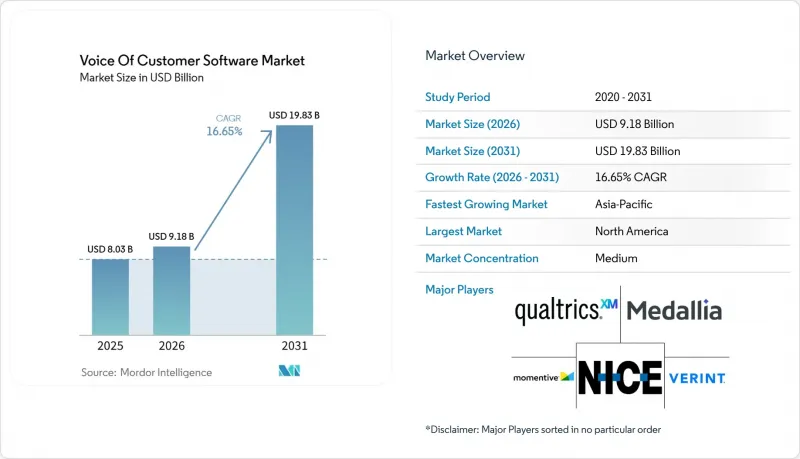
Mordor Intelligence에 의하면, 고객의 목소리(VoC) 소프트웨어 시장 규모는 2025년 80억 3,000만 달러로 평가되었습니다. 2026년 91억 8,000만 달러에서 2031년까지 198억 3,000만 달러로 확대되어 2026-2031년까지 연평균 성장률(CAGR)은 16.65%를 나타낼 것으로 예측됩니다.
본 보고서는 구성 요소(소프트웨어 및 서비스), 배포 방식(클라우드, On-Premise, 하이브리드), 용도(고객 여정 최적화, 폐쇄 루프 피드백 관리, 기타),데이터 출처(조사 및 설문조사, 기타), 최종 사용자(IT 및 통신, 은행, 금융서비스 및 보험(BFSI), 기타), 지역별로 분류되어 있습니다. 시장 예측은 금액(달러) 기준으로 제시되어 있습니다.
세계의 고객의 목소리(VoC) 소프트웨어 시장 동향 및 인사이트
기업 내 ‘조사를 통한 스냅샷’에서 ‘지속적인 청취’로의 전환
고객의 목소리 소프트웨어 시장은 분기별 NPS 프로그램에서 지속적이고 다중 채널을 통한 청취로 전환되면서 형성되고 있습니다. 이러한 프로그램은 고객과의 상호작용이 이루어질 때 행동 신호, 대화, 제품에 대한 피드백을 포착합니다. 기업들은 예정된 설문조사를 기다리지 않고, 각 상호작용을 유용한 정보로 활용하고 있습니다. 지속적인 프로그램은 고객 여정 전반에 걸쳐 작동하며, 고객 이탈 예측 및 서비스 복구 워크플로를 지원할 수 있습니다. 2026년 3월, Qualtrics는 자사의 AI 경험 에이전트가 TruGreen에서 초기 도입 단계에서 서비스 제공 후 고객의 우려 사항 중 51%를 해결하고, 도입 첫 주에 발생한 에스컬레이션을 30% 이상 줄였다고 보고했습니다. 이러한 지속적인 청취 프로그램을 구축한 벤더는 그 역할을 단순한 설문조사 수집에서 더 광범위한 운영 플랫폼으로 확대할 수 있습니다.
대규모 비정형 피드백에 대한 AI 네이티브 분석
현재 고객 피드백은 전화, 채팅 기록, 앱 리뷰, 소셜 미디어 댓글, 디지털 행동 데이터 등을 통해 수집되고 있습니다. 이러한 데이터의 양이 방대하기 때문에 수동 코딩이나 규칙 기반의 분류를 지속적으로 유지하기는 어렵습니다. AI 도구를 활용함으로써 조직은 텍스트나 음성 데이터에서 주제와 감정을 더 신속하게 파악할 수 있게 됩니다. 퀄트릭스(Qualtrics)는 2026년 3월, 자동 텍스트 분석을 통해 도입 기간을 수개월에서 수시간으로 단축하고, 분석 비용을 4-5분의 1로 절감했다고 발표했습니다. 분석 비용의 감소로 인해 대규모 대기업뿐만 아니라 더 많은 조직이 고급 피드백 도구를 활용하기 쉬워졌습니다. 그 결과, 고객의 목소리(VoC) 소프트웨어 시장에서는 고객의 신호를 실질적인 행동으로 연결하는 도구가 더 높이 평가받고 있습니다.
낮은 응답률과 고객 설문조사에 대한 피로감
설문 피로는 응답자가 전체 고객 기반을 반영하지 못할 가능성이 있어, 고객 피드백 프로그램의 대표성을 훼손할 우려가 있습니다. 미국 고객 만족도 지수(ACSI)는 2026년 4월, 참여율 저하로 인해 만족도가 극단적인 수치로 치우쳐 중간 평가를 내리는 고객이 이탈할 우려가 있다고 지적했습니다. 이로 인해 NPS 프로그램이나 해지 예측 모델이 의사 결정에 활용하는 데이터의 신뢰성이 떨어집니다. 또한 응답률 저하는 조직이 앱 내 행동, 음성 상호작용, 웹사이트 활동에서 수동적인 신호를 수집하도록 유도하는 요인이 되고 있습니다. 개인정보 보호 규제로 인해 아웃바운드 연락 기회가 제한되고, 명확한 동의 획득 절차가 요구되는 경우가 있습니다. 따라서 고객 의견(VoC) 소프트웨어 시장은 설문조사 기법을 지원하는 동시에, 직접적인 응답에만 의존하지 않는 신뢰할 수 있는 대안 수단을 제공해야 합니다.
부문별 분석
2025년, 고객 의견 소프트웨어 시장에서 소프트웨어가 72.41%의 점유율을 차지했습니다. 이는 설문조사 관리, 분석, 워크플로우 도구를 단일 운영 환경에 통합하는 플랫폼에 대한 기업 수요를 반영합니다. 소프트웨어 구성 요소는 데이터 수집 계층, 분석 인터페이스, 여러 팀이 동일한 피드백 기록을 기반으로 작업할 수 있도록 하는 제어 기능을 제공하기 때문에 여전히 주요 구매 대상입니다. 조직에서는 개별 도구로 인해 고객 문제에 대한 정의에 일관성이 떨어지는 경우, 서로 연동되지 않는 설문조사, 텍스트 분석, 피드백 관리 용도를 대체하려는 움직임이 확산되고 있습니다. 통합 플랫폼을 통해 제품 팀,서비스 책임자, 마케팅 팀은 반복적으로 나타나는 주제에 대해 공통된 관점을 얻을 수 있는 한편, 각 팀은 여전히 그 정보를 자체적인 목적을 위해 활용할 수 있습니다. 이러한 추세로 인해 전문 도구의 필요성이 사라지는 것은 아니지만, 구매자가 공급업체 수 축소, 공통된 데이터 관리, 고객 정보 중복 감소를 요구할 경우 광범위한 기능을 갖춘 플랫폼이 우위를 점하게 됩니다. 또한, 공급업체가 AI 기반 텍스트 분석, 안내형 실행 계획 수립, CRM 및 컨택 센터 시스템과의 통합 기능을 추가함에 따라 소프트웨어의 역할도 변화하고 있습니다. 이러한 기능을 통해 사용자는 신호를 담당자, 워크플로우 또는 후속 조치와 연결할 수 있으므로, 피드백이 수집된 후 플랫폼의 유용성이 높아집니다. 대기업은 설문조사 도구, 보고서 작성 도구, 업무 시스템 간에 정보를 주고받는 데 필요한 노력을 줄일 수 있기 때문에 이 접근 방식을 선호하는 경향이 있습니다. 또한 플랫폼 퍼스트 모델은 단일 설문조사에 그치지 않고 여러 고객 여정에 걸쳐 시스템이 활용되므로 지속적인 소프트웨어 지출을 촉진합니다. 따라서 구매자가 개별 기능 도입 방식에 있어 유연성을 요구하는 반면, 고객 의견 소프트웨어 산업은 여전히 통합된 소프트웨어 환경을 중심으로 삼고 있습니다.
서비스 시장은 2031년까지 연평균 성장률(CAGR) 19.82%로 확대될 것으로 예상되며, 이는 소프트웨어 부문의 성장률을 상회하는 속도입니다. 그 이유는 고급 플랫폼에는 단순한 설치 작업 이상의 지원이 필요하기 때문입니다. 조직은 서로 다른 고객 식별자나 데이터 규칙을 채택하고 있을 수 있는 CRM, 컨택 센터, 마케팅, 내부 데이터 시스템과 피드백 용도를 연동하기 위한 지원이 필요합니다. 또한 데이터 모델 정의, 권한 할당, 워크플로 설정, 비즈니스 사용자의 요구에 맞춘 보고서 조정에 대한 지원도 필요합니다. 이러한 요구 사항은 레거시 조사 및 경험 시스템에서 마이그레이션할 때 특히 중요합니다. 이때 과거 기록이나 기존 프로세스를 반드시 새로운 플랫폼으로 직접 이전할 수 있는 것은 아니기 때문입니다. 서비스 부문의 성장이 더 빠른 이유는 피드백 데이터를 단순히 대시보드에서 이용할 수 있게 하는 것뿐만 아니라, 기업 전체에서 활용할 수 있도록 하는 데 필요한 실무 작업을 반영하고 있기 때문입니다. Sprinklr는 고객 피드백, 소셜 미디어 관리, 컨택 센터 AI를 아우르는 플랫폼을 통해 2026 회계연도 매출이 전년 대비 8% 증가한 8억 5,700만 달러에 달했다고 보고했습니다. 이처럼 광범위한 영역을 아우르는 플랫폼의 경우, 기본적인 소프트웨어 구독 이상의 설정이 필요할 수 있습니다. 프로페셔널 서비스와 매니지드 애널리틱스는 새로운 채널, 고객 그룹, 규제 요건이 등장함에 따라 조직이 워크플로우를 조정하는 데 도움이 됩니다. AI를 통한 자동화로 인해 수동 설정 작업은 점차 줄어들 수 있겠지만, 시스템을 연동하거나 데이터 활용 규칙을 수립해야 할 필요성이 사라지는 것은 아닙니다. 기업들이 AI를 활용한 폐쇄형 루프 프로그램을 도입하고 있음에도 여전히 대규모 레거시 기술 환경을 운영하고 있기 때문에 당분간은 서비스가 계속 중요할 것입니다.
2025년에는 고객 의견 수렴 소프트웨어 시장의 68.19%를 클라우드 도입이 차지했으며, 이는 SaaS 구매로의 지속적인 전환과 여러 거점에 있는 팀이 피드백 도구를 이용할 수 있도록 해야 할 필요성을 반영합니다. 클라우드 플랫폼은 기존 On-Premise 시스템에 필요한 인프라 투자 없이 도입할 수 있으므로, 조직은 소규모 사내 기술 팀으로도 피드백 프로그램을 시작할 수 있게 됩니다. 또한 캠페인 기간이나 계절적 성수기, 서비스 장애 시 고객과의 상호작용량이 증가하더라도 정기적인 제품 업데이트와 유연한 용량을 제공할 수 있습니다. 분산된 제품, 마케팅, 서비스 팀이 별도의 로컬 시스템을 유지 관리하지 않고도 동일한 고객 주제를 확인해야 할 경우, 공유 액세스가 유용합니다. 미리 준비된 커넥터와 설정 도구는 일상적인 통합에 필요한 작업을 줄여줌으로써 클라우드 도입을 더욱 촉진합니다. 클라우드를 통한 제공은 장기적인 인프라 프로젝트를 진행하지 않고도 디지털 채널 전반에 걸쳐 피드백 수집을 확대하고자 하는 상업 부문의 구매 담당자에게 특히 유용합니다. 소매, 전자상거래, 호스피탈리티 산업의 기업들은 이를 활용하여 다양한 수요 패턴과 대량의 고객 문의에 대응할 수 있습니다. 또한 이 모델은 엔터프라이즈급 기능이 필요하지만 복잡한 플랫폼을 관리할 대규모 사내 팀을 보유하지 않은 중견 기업에도 적합합니다. 이러한 이점 덕분에 기밀 데이터나 현지 규제 요건으로 인해 완전한 클라우드 기반 접근 방식이 제한되는 경우에도, 많은 구매자에게 클라우드는 주요 제공 모델이 되고 있습니다. 그 결과, 고객의 목소리(VoC) 소프트웨어 시장은 구매자가 데이터 유형이나 운영 상황에 따라 서로 다른 배포 모델을 선택하는 한편, 여전히 견고한 클라우드 기반을 유지하고 있습니다.
규제 대상 조직이 기밀 정보를 엄격하게 관리하면서 클라우드 분석을 활용하려는 움직임에 따라, 하이브리드 배포는 2031년까지 연평균 성장률(CAGR) 18.43%로 확대될 것으로 예측됩니다. 의료 기관, 금융 기관, 정부 기관 등은 환자와의 상호작용 기록, 재무 데이터, 또는 취급이 제한된 업무 데이터를 관리된 환경에 저장하기도 합니다. 보안 및 거버넌스 요건을 충족하는 데이터에 대해서는 클라우드 기반의 보고서 작성 및 분석을 활용할 수 있습니다. 이러한 접근 방식을 통해 조직은 모든 고객 기록을 단일 외부 환경으로 이전하지 않고도 최신 분석 기능의 유연성을 활용할 수 있게 됩니다. 이러한 수요는 단순히 기술적 선호에 기인한 것이 아니라, 데이터 저장 및 처리 방식이 데이터 거주 규정, 계약상 의무, 내부 위험 정책에 의해 결정되는 경우가 있기 때문입니다. On-Premise 배포는 국가 안보, 운영 기술(OT) 또는 지역 데이터 상주 요건에 구속되는 정부 기관 및 산업 조직에게 여전히 중요한 선택지입니다. 하이브리드 모델은 특정 기능을 On-Premise에 남기면서 다른 기능에서는 클라우드 리소스를 활용함으로써 이러한 요구를 충족시킵니다. Qualtrics는 FedRAMP High 인증과 ISO 42001 인증을 획득하여 규제 대상 조달 환경에서의 입지를 입증하고 있습니다. 이러한 인증은 구매자가 공급자가 공식적인 정보 보안 및 AI 거버넌스 요건을 충족할 수 있다는 증거를 필요로 할 때 중요합니다. 클라우드의 편의성과 관리된 데이터 처리를 결합함으로써, 고객 의견 수집 소프트웨어 시장 전반에서 클라우드, 하이브리드, On-Premise 각 옵션이 계속해서 중요한 선택지로 자리 잡고 있습니다.
지역별 분석
2025년, 북미는 고객 피드백 소프트웨어 시장의 34.62%를 차지했습니다. 이 지역은 기업용 SaaS 도입이 성숙 단계에 이르렀고, 고객 경험 문화가 충분히 정착되어 있으며, 주요 플랫폼 제공업체가 존재한다는 점에서 혜택을 보고 있습니다. 금융 서비스, 기술, 소매 산업 분야의 미국 기업들은 고객 이탈 방지, 서비스 복구, 워크플로 자동화에 중점을 두고 업무 계획의 일환으로 피드백 시스템을 점점 더 많이 활용하고 있습니다. 캐나다에서는 이중 언어 피드백 요건과 금융 서비스 및 기술 분야의 SaaS 도입이 수요를 뒷받침하고 있습니다. 한편, 멕시코에서는 디지털 상거래의 성장에 따라 소매 및 호텔·관광 기업들이 체계적인 프로그램을 구축하고 있어 시장이 발전하고 있습니다. 유럽은 두 번째로 큰 지역 블록으로, 독일, 영국, 프랑스가 주도하고 있습니다. 이들 국가에서는 GDPR(EU 개인정보보호규정)(일반 데이터 보호 규정)에 따라 동의 관리, 데이터 흐름 문서화, 처리 관리가 플랫폼 선정의 핵심 요소가 되고 있습니다.
아시아태평양은 2031년까지 연평균 성장률(CAGR) 20.71%로 확대될 것으로 예측되며, 이는 지역별 기준으로 가장 높은 성장률입니다. 모바일 우선의 고객 행동, 소매 및 의료 부문의 확대, 디지털 경제 촉진 정책이 이 지역 내 고객 피드백 시스템 도입을 뒷받침하고 있습니다. 제네시스(Genesis)의 보고서에 따르면, 아시아태평양의 고객 경험 조직 중 44%가 에이전트형 AI를 탑재한 가상 에이전트를 도입하고 있으며, 이는 세계 평균인 41%를 상회하는 수치입니다. 중국의 모바일 소매 및 디지털 결제 활동에서는 방대한 데이터 세트가 생성되고 있으며, 국경을 초월한 데이터 규제 하에서 언어별 분석이 필요합니다. 인도의 2023년 디지털 개인 데이터 보호법은 동의를 중시하는 데이터 수집과 거버넌스의 필요성을 강조하고 있는 반면, 한국, 인도네시아, 베트남, 필리핀에서는 디지털 커머스 분야에서 앱 내 및 대화형 피드백이 확대되고 있습니다.
남미는 신흥 지역으로, 브라질에서는 전자상거래의 확대, 금융 포용 프로그램, 중견 기업을 위한 디지털화가 이를 뒷받침하고 있습니다. 중동 및 아프리카는 아직 초기 단계에 있지만, 사우디아라비아와 아랍에미리트에서는 행정 서비스,소매, 호텔·관광, 금융, 물류 등 각 분야에서 고객 경험에 대한 투자를 확대되고 있습니다. 남아프리카공화국과 나이지리아에서는 디지털 인프라가 정비되고, 더 많은 조직이 공식적인 고객 피드백 프로그램을 구축함에 따라 장기적인 가능성이 기대되고 있습니다. 이 지역의 많은 구매 담당자들은 클라우드 기반 설문조사 도구 도입으로 시작해, 이후 더 광범위한 분석 및 옴니채널을 통한 고객 의견 수집으로 전환하고 있으며, 이는 더 성숙한 지역에서 이전에 관찰되었던 진전을 반영하고 있습니다.
기타 혜택
- 엑셀 형식 시장 예측(ME) 시트
- 3개월간의 애널리스트 지원
자주 묻는 질문
목차
제1장 서론
제2장 조사 방법
제3장 개요
제4장 시장 구도
제5장 시장 규모 및 성장 예측
제6장 경쟁 구도
제7장 시장 기회 및 향후 전망
KTH 26.09.02According to Mordor Intelligence, the voice of customer software market size is projected to expand from USD 8.03 billion in 2025 and USD 9.18 billion in 2026 to USD 19.83 billion by 2031, registering a CAGR of 16.65% between 2026 and 2031.
This report is Segmented by Component (Software, and Services), Deployment Mode (Cloud, On-Premise, and Hybrid), Application (Customer Journey Optimization, Closed-Loop Feedback Management, and More), Data Source (Surveys and Questionnaires, and More), End User (IT and Telecommunication, BFSI, and More), and Geography. The Market Forecasts are Provided in Terms of Value (USD).
Global Voice Of Customer Software Market Trends and Insights
Enterprise Shift From Survey Snapshots to Continuous Listening
The voice of customer software market is being shaped by a shift away from quarterly NPS programs toward continuous, multichannel listening. These programs capture behavioral signals, conversations, and product feedback as customer interactions take place. Enterprises are treating each interaction as usable input rather than waiting for a scheduled survey event. Continuous programs can support churn prediction and service recovery workflows that operate throughout the customer journey. In March 2026, Qualtrics reported that its AI Experience Agents resolved 51% of post-service customer concerns for TruGreen in an initial deployment and reduced escalations by more than 30% during the first week. Vendors that establish these ongoing listening programs can extend their role from survey collection to a broader operational platform.
AI-Native Analysis of Unstructured Feedback at Scale
Customer feedback now arrives through calls, chat logs, app reviews, social comments, and digital behavior data. The volume of this material makes manual coding and rule-based categorization difficult to sustain. AI tools help organizations identify topics and sentiment from text and voice data more quickly. Qualtrics stated in March 2026 that Automated Text Analytics reduced deployment time from months to hours and reduced analytical costs by 4 to 5 times. Lower analysis costs make advanced feedback tools more accessible to organizations beyond the largest enterprises. The voice of customer software market, therefore, places greater value on tools that connect a customer signal with a practical action.
Low Response Rates and Customer Survey Fatigue
Survey fatigue can undermine the representativeness of customer feedback programs, as respondents may not reflect the full customer base. The American Customer Satisfaction Index stated in April 2026 that lower participation can create bias toward satisfaction extremes, while customers in the middle disengage. This weakens the data that NPS programs and churn models use for decisions. Lower response levels also encourage organizations to collect passive signals from in-app behavior, voice interactions, and website activity. Privacy rules can narrow the window for outbound contact and require clear consent practices. The voice of customer software market must therefore support survey methods while offering reliable alternatives that do not rely only on direct responses
Other drivers and restraints analyzed in the detailed report include:
- Omnichannel Customer Experience and Closed-Loop Action Requirements
- Cloud Deployment Expanding Access for Midmarket Buyers
- Integration Complexity Across Legacy Experience Systems
For complete list of drivers and restraints, kindly check the Table Of Contents.
Segment Analysis
Software held 72.41% of the voice of customer software market in 2025, reflecting enterprise demand for platforms that bring survey management, analytics, and workflow tools into a single operating environment. The software component remains the primary purchase because it provides the data-collection layer, the analytics interface, and controls that enable multiple teams to work from the same feedback record. Organizations are replacing disconnected survey, text analytics, and feedback management applications when separate tools create inconsistent definitions of a customer issue. A consolidated platform can give product teams, service leaders, and marketing teams a shared view of recurring themes, while each team can still use the information for its own purposes. This preference does not remove the need for specialist tools, but it gives broad platforms an advantage when buyers want fewer vendors, common data controls, and less duplication of customer information. The role of software is also changing as providers add AI-based text analysis, guided action planning, and integrations with CRM and contact center systems. These functions make the platform more useful after feedback has been collected because users can connect a signal to an owner, a workflow, or a follow-up action. Large enterprises often favor this approach because it reduces the effort required to move information between a survey tool, a reporting tool, and an operational system. The platform-first model also supports recurring software spending, as the system is used across multiple customer journeys rather than just a single research exercise. The voice of the customer software industry, therefore, continues to center on integrated software environments even as buyers seek flexibility in how individual capabilities are deployed.
Services are projected to expand at a 19.82% CAGR through 2031, faster than the software component, because sophisticated platforms require more than routine installation. Organizations need support to connect feedback applications with CRM, contact center, marketing, and internal data systems that may use different customer identifiers and data rules. They also need assistance defining data models, assigning permissions, setting up workflows, and adapting reports to business users' needs. These requirements are especially important during migration from legacy survey and experience systems, where historical records and existing processes cannot always be moved directly into a new platform. The faster growth of services reflects the practical work needed to make feedback data usable across the enterprise rather than simply available in a dashboard. Sprinklr reported fiscal 2026 revenue of USD 857 million, up 8% year over year, from a platform spanning customer feedback, social media management, and contact center AI. A platform with this scope can require configuration beyond a basic software subscription. Professional services and managed analytics can help organizations adjust workflows as new channels, customer groups, and regulatory requirements emerge. AI automation may gradually reduce manual configuration, but it does not eliminate the need to connect systems or establish rules for data use. Services remain important in the near term because enterprises are introducing AI-powered closed-loop programs while still operating substantial legacy technology estates.
Cloud deployment accounted for 68.19% of the voice of customer software market in 2025, reflecting the continuing shift toward SaaS purchasing and the need to make feedback tools available to teams in multiple locations. Cloud platforms can be deployed without the infrastructure investment required by traditional on-premises systems, helping organizations launch feedback programs with smaller internal technology teams. They can also provide regular product updates and flexible capacity when customer interaction volumes rise during a campaign, a seasonal period, or a service disruption. Shared access is valuable for distributed product, marketing, and service teams that need to review the same customer themes without maintaining separate local systems. Pre-built connectors and configuration tools further support cloud adoption by reducing the work required for routine integrations. Cloud delivery is particularly useful for commercial buyers who want to extend feedback collection across digital channels without a long infrastructure project. Retail, e-commerce, and hospitality firms can use it to respond to varied demand patterns and high volumes of customer interaction. The model also supports midmarket organizations that need enterprise functions but may not have large internal teams to administer a complex platform. These advantages make the cloud the main delivery model for many buyers, even when sensitive data or local requirements limit a fully cloud-based approach. The voice of customer software market consequently retains a strong cloud foundation while buyers choose different deployment models for different data types and operating conditions.
Hybrid deployment is projected to expand at an 18.43% CAGR through 2031 as regulated organizations seek cloud analytics while retaining close control over sensitive information. Healthcare providers, financial institutions, and government organizations may store patient interaction records, financial data, or restricted operational data in controlled environments. They can then use cloud-based reporting and analysis for data that meets their security and governance requirements. This approach lets organizations obtain the flexibility of modern analytics without moving every customer record into a single external environment. The demand is not only about technology preference, since residency rules, contractual obligations, and internal risk policies may determine how the data can be stored and processed. On-premise deployment remains relevant for sovereign entities and industrial organizations with requirements tied to national security, operational technology, or local data residency. Hybrid models address this need by allowing selected functions to remain on-premise while other functions use cloud capacity. Qualtrics reported FedRAMP High authorization and ISO 42001 certification, which supports its position in regulated procurement settings. Such credentials can matter when buyers need evidence that a provider can meet formal information security and AI governance requirements. This combination of cloud convenience and controlled data handling keeps cloud, hybrid, and on-premises options relevant across the voice of customer software market.
Complete Report Scope:
- By Component
- Software
- Services
- By Deployment Mode
- Cloud
- On-Premise
- Hybrid
- By Application
- Customer Journey Optimization
- Closed-Loop Feedback Management
- Product and Service Development
- Brand and Reputation Management
- Customer Retention and Churn Management
- Campaign Performance and Experience Measurement
- By Data Source
- Surveys and Questionnaires
- Customer Service Conversations
- Digital Behavior and Web Analytics
- In-App Behavior and Feedback
- Social Media, Ratings and Reviews
- Store and In-Person Interactions
- Email and Messaging
- By End User
- IT and Telecommunication
- BFSI
- Healthcare and Life Sciences
- Retail and E-Commerce
- Industrial Manufacturing
- Education and Research Institutions
- Media and Entertainment
- Government and Administration
- Travel and Hospitality
- Other End Users
- By Geography
- North America
- United States
- Canada
- Mexico
- South America
- Brazil
- Argentina
- Rest of South America
- Europe
- Germany
- United Kingdom
- France
- Russia
- Spain
- Rest of Europe
- Asia-Pacific
- China
- Japan
- India
- South Korea
- Southeast Asia
- Rest of Asia-Pacific
- Middle East and Africa
- Middle East
- Saudi Arabia
- United Arab Emirates
- Rest of Middle East
- Africa
- South Africa
- Nigeria
- Rest of Africa
- Middle East
- North America
Geography Analysis
North America held 34.62% of the voice of customer software market in 2025. The region benefits from mature enterprise SaaS adoption, a well-developed customer experience culture, and the presence of major platform providers. U.S. firms in financial services, technology, and retail increasingly use feedback systems as part of operational planning, focusing on churn reduction, service recovery, and workflow automation. Canada supports demand through bilingual feedback requirements and SaaS adoption across financial services and technology, while Mexico is developing as retail and hospitality firms build structured programs with digital commerce growth. Europe is the second-largest regional block, led by Germany, the United Kingdom, and France, where GDPR makes consent management, documented data flows, and processing controls central to platform selection.
Asia-Pacific is projected to expand at a 20.71% CAGR through 2031, the highest regional rate. Mobile-first customer behavior, expanding retail and healthcare sectors, and digital economy programs support the region's adoption of customer feedback systems. Genesys reported that 44% of Asia-Pacific customer experience organizations use agentic AI-powered virtual agents, compared with a global average of 41%. China's mobile retail and digital payment activities generate large datasets that require language-specific analysis under cross-border data restrictions. India's Digital Personal Data Protection Act of 2023 underscores the need for consent-aware collection and governance, while South Korea, Indonesia, Vietnam, and the Philippines are expanding in-app and conversational feedback in digital commerce.
South America is an emerging region, with Brazil supported by e-commerce expansion, financial inclusion programs, and midmarket digitalization. The Middle East and Africa are at an earlier stage, although Saudi Arabia and the United Arab Emirates are increasing investment in customer experience across government services, retail, hospitality, finance, and logistics. South Africa and Nigeria offer longer-term potential as digital infrastructure develops and more organizations create formal customer feedback programs. Many buyers in the region start with cloud survey tools before moving toward broader analytics and omnichannel listening, reflecting the progression seen earlier in more mature regions.
- Qualtrics International Inc.
- Medallia, Inc.
- InMoment, Inc.
- NICE Ltd.
- Verint Systems Inc.
- Momentive Global Inc.
- QuestionPro Inc.
- Sogolytics, Inc.
- Alida Inc.
- Forsta AS
- Sprinklr, Inc.
- Alchemer LLC
- Typeform S.L.
- SurveySparrow Inc.
- Survicate Sp. z o.o.
- Zonka Technologies Private Limited
- Feedier SAS
- Qualaroo Inc.
- UserVoice, Inc.
- Wonderflow B.V.
- Enterpret, Inc.
- Chattermill Ltd.
- SANDSIV AG
- Birdeye, Inc.
- Service Management Group, Inc.
Additional Benefits:
- The market estimate (ME) sheet in Excel format
- 3 months of analyst support
TABLE OF CONTENTS
1 INTRODUCTION
- 1.1 Study Assumptions and Market Definition
- 1.2 Scope of the Study
2 RESEARCH METHODOLOGY
3 EXECUTIVE SUMMARY
4 MARKET LANDSCAPE
- 4.1 Market Overview
- 4.2 Market Drivers
- 4.2.1 Enterprise Shift From Survey Snapshots to Continuous Listening
- 4.2.2 AI-Native Analysis of Unstructured Feedback at Scale
- 4.2.3 Omnichannel Customer Experience and Closed-Loop Action Requirements
- 4.2.4 Cloud Deployment Expanding Access for Midmarket Buyers
- 4.2.5 Privacy, Consent, and Auditability Requirements
- 4.2.6 Product-Led Feedback Loops Compressing Innovation Cycles
- 4.3 Market Restraints
- 4.3.1 Low Response Rates and Customer Survey Fatigue
- 4.3.2 Integration Complexity Across Legacy Experience Systems
- 4.3.3 Privacy-Safe Handling of Voice, Text, and Behavioral Data
- 4.3.4 Bundle Competition and Commoditization of Basic Feedback Features
- 4.4 Impact of Macroeconomic Factors on the Market
- 4.5 Industry Value-Chain Analysis
- 4.6 Technology Outlook
- 4.7 Regulatory Landscape
- 4.8 Porter's Five Forces Analysis
- 4.8.1 Threat of New Entrants
- 4.8.2 Bargaining Power of Suppliers
- 4.8.3 Bargaining Power of Buyers
- 4.8.4 Threat of Substitutes
- 4.8.5 Intensity of Competitive Rivalry
5 MARKET SIZE AND GROWTH FORECASTS (VALUE)
- 5.1 By Component
- 5.1.1 Software
- 5.1.2 Services
- 5.2 By Deployment Mode
- 5.2.1 Cloud
- 5.2.2 On-Premise
- 5.2.3 Hybrid
- 5.3 By Application
- 5.3.1 Customer Journey Optimization
- 5.3.2 Closed-Loop Feedback Management
- 5.3.3 Product and Service Development
- 5.3.4 Brand and Reputation Management
- 5.3.5 Customer Retention and Churn Management
- 5.3.6 Campaign Performance and Experience Measurement
- 5.4 By Data Source
- 5.4.1 Surveys and Questionnaires
- 5.4.2 Customer Service Conversations
- 5.4.3 Digital Behavior and Web Analytics
- 5.4.4 In-App Behavior and Feedback
- 5.4.5 Social Media, Ratings and Reviews
- 5.4.6 Store and In-Person Interactions
- 5.4.7 Email and Messaging
- 5.5 By End User
- 5.5.1 IT and Telecommunication
- 5.5.2 BFSI
- 5.5.3 Healthcare and Life Sciences
- 5.5.4 Retail and E-Commerce
- 5.5.5 Industrial Manufacturing
- 5.5.6 Education and Research Institutions
- 5.5.7 Media and Entertainment
- 5.5.8 Government and Administration
- 5.5.9 Travel and Hospitality
- 5.5.10 Other End Users
- 5.6 By Geography
- 5.6.1 North America
- 5.6.1.1 United States
- 5.6.1.2 Canada
- 5.6.1.3 Mexico
- 5.6.2 South America
- 5.6.2.1 Brazil
- 5.6.2.2 Argentina
- 5.6.2.3 Rest of South America
- 5.6.3 Europe
- 5.6.3.1 Germany
- 5.6.3.2 United Kingdom
- 5.6.3.3 France
- 5.6.3.4 Russia
- 5.6.3.5 Spain
- 5.6.3.6 Rest of Europe
- 5.6.4 Asia-Pacific
- 5.6.4.1 China
- 5.6.4.2 Japan
- 5.6.4.3 India
- 5.6.4.4 South Korea
- 5.6.4.5 Southeast Asia
- 5.6.4.6 Rest of Asia-Pacific
- 5.6.5 Middle East and Africa
- 5.6.5.1 Middle East
- 5.6.5.1.1 Saudi Arabia
- 5.6.5.1.2 United Arab Emirates
- 5.6.5.1.3 Rest of Middle East
- 5.6.5.2 Africa
- 5.6.5.2.1 South Africa
- 5.6.5.2.2 Nigeria
- 5.6.5.2.3 Rest of Africa
- 5.6.5.1 Middle East
- 5.6.1 North America
6 COMPETITIVE LANDSCAPE
- 6.1 Market Concentration
- 6.2 Strategic Moves
- 6.3 Market Share Analysis
- 6.4 Company Profiles (includes Global Level Overview, Market Level Overview, Core Segments, Financials as available, Strategic Information, Market Rank/Share, Products and Services, Recent Developments)
- 6.4.1 Qualtrics International Inc.
- 6.4.2 Medallia, Inc.
- 6.4.3 InMoment, Inc.
- 6.4.4 NICE Ltd.
- 6.4.5 Verint Systems Inc.
- 6.4.6 Momentive Global Inc.
- 6.4.7 QuestionPro Inc.
- 6.4.8 Sogolytics, Inc.
- 6.4.9 Alida Inc.
- 6.4.10 Forsta AS
- 6.4.11 Sprinklr, Inc.
- 6.4.12 Alchemer LLC
- 6.4.13 Typeform S.L.
- 6.4.14 SurveySparrow Inc.
- 6.4.15 Survicate Sp. z o.o.
- 6.4.16 Zonka Technologies Private Limited
- 6.4.17 Feedier SAS
- 6.4.18 Qualaroo Inc.
- 6.4.19 UserVoice, Inc.
- 6.4.20 Wonderflow B.V.
- 6.4.21 Enterpret, Inc.
- 6.4.22 Chattermill Ltd.
- 6.4.23 SANDSIV AG
- 6.4.24 Birdeye, Inc.
- 6.4.25 Service Management Group, Inc.
7 MARKET OPPORTUNITIES AND FUTURE OUTLOOK
- 7.1 White-Space and Unmet-Need Assessment


