

|
시장보고서
상품코드
2118210
마케팅 성과 관리(MPM) 소프트웨어 시장 : 시장 점유율 분석, 업계 동향 및 통계, 성장 예측(2026-2031년)Marketing Performance Management (MPM) Software - Market Share Analysis, Industry Trends & Statistics, Growth Forecasts (2026 - 2031) |
||||||
 Mordor Intelligence
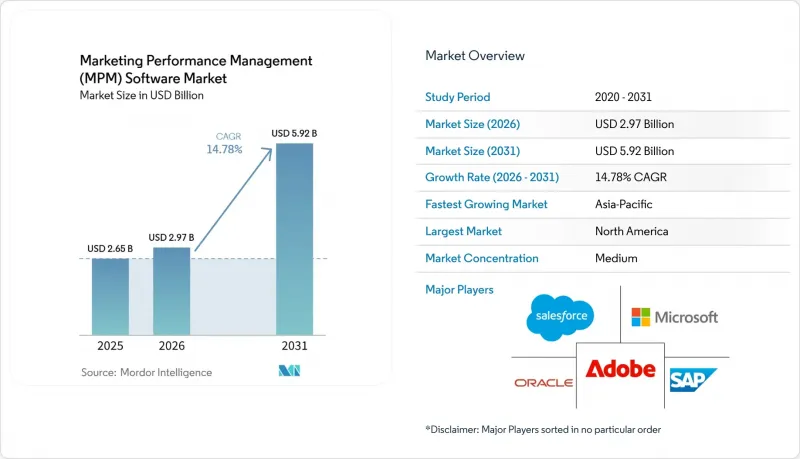
Mordor Intelligence에 의하면, 마케팅 성과 관리(MPM) 소프트웨어 시장 규모는 2025년 26억 5,000만 달러로 평가되었고, 2026년 29억 7,000만 달러에서 2031년까지 59억 2,000만 달러로 확대될 것으로 예측되며, 2026-2031년 연평균 복합 성장률(CAGR)은 14.78%를 나타낼 전망입니다.
본 보고서는 기능별(마케팅 분석·보고서, 예산 계획·예측 등), 배포 유형별(클라우드 기반, 온프레미스형, 하이브리드형), 기업 규모별(대기업, 중소기업), 최종 사용자 산업별(소매 및 전자상거래 등), 지역별로 분류되어 있습니다. 시장 전망은 금액(달러) 기준으로 제시되어 있습니다.
세계의 마케팅 성과 관리(MPM) 소프트웨어 시장 동향 및 인사이트
클로즈드 루프형 마케팅 ROI에 대한 설명 책임에 대한 요구 증가
여전히 라스트 클릭 어트리뷰션이나 사일로화된 대시보드를 사용하고 있는 마케팅 팀은 재무 부서로부터 “캠페인이 수익에 어떻게 기여하고 있는가”라는 질문을 받았을 때, 지출의 정당성을 설명하는 데 어려움을 겪고 있습니다. 마케팅 성과 관리(MPM) 소프트웨어 시장에서 이러한 격차로 인해 측정은 단순한 보고서 작성의 문제에서 예산 거버넌스의 문제로 변화하고 있습니다. 광고주가 각각 고유한 어트리뷰션 로직을 가진 더 많은 채널과 리테일 미디어 네트워크로 활동을 분산함에 따라 이 문제는 더욱 심각해지고 있습니다. 따라서 구매 담당자들은 계획, 지출, 성과를 하나의 운영 뷰에서 연결해 주는 플랫폼을 선호하며, 월간 검토에서는 다음에 예산을 어디에 재할당해야 할지에 초점을 맞출 수 있습니다. 이러한 요구에 따라 마케팅 성과 관리(MPM) 소프트웨어 시장은 대시보드의 표시량 그 자체가 아니라 투자 대비 효과(ROI)의 입증과 밀접하게 연결되어 있습니다.
개인정보 보호를 고려한 측정 및 어트리뷰션 워크플로우의 확대
개인정보 보호형 측정으로의 전환은 마케팅 성과 관리(MPM) 소프트웨어 시장의 설계 및 구매 방식에 변화를 가져오고 있습니다. W3C는 2025년 6월 ‘개인정보 보호형 어트리뷰션’ 사양을 공개하여, 사이트 간에 개별 사용자의 신원을 노출하지 않는 브라우저 수준의 전환 측정 모델을 생태계에 제공했습니다. 동시에 IAB는 2026년에 커머스 미디어 지출이 12.1% 증가할 것으로 예측하고 있으며, 이에 따라 더욱 엄격해진 개인정보 보호 규제 하에서 네트워크 전반에 걸친 일관된 측정의 필요성이 높아지고 있습니다. 퍼스트 파티 데이터, 해시화된 ID 및 서버 측 전환 워크플로우를 기반으로 시스템을 재구축한 기업은 규제가 강화되는 상황에서도 안정적인 신호 품질을 유지하기 쉬운 입장에 있습니다. 동의 기반 데이터 흐름과 집계된 데이터 흐름을 조화시킬 수 있는 벤더는 마케팅 성과 관리(MPM) 소프트웨어 시장에서 더 많은 수요를 확보할 가능성이 높습니다.
CRM, ERP, 데이터 웨어하우스와의 고도화된 통합 작업
마케팅 성과 관리(MPM) 소프트웨어 시장에서 도입의 가장 큰 장벽은 여전히 높은 통합 작업 부담입니다. 구매 기업은 단일 성과 보기를 신뢰할 수 있게 되기 전에 캠페인 시스템, CRM 데이터, ERP 레코드 및 데이터 웨어하우스 테이블을 연동해야 하는 경우가 많습니다. Uptempo사는 2025년 플랫폼 업데이트에서 Salesforce, Adobe, Oracle ERP와의 연동을 핵심으로 삼았습니다. 이는 기업 도입 과정에서 이러한 기반 작업이 얼마나 중요한지를 보여줍니다. 필드 정의, 트랜잭션의 세분화 수준, 거버넌스 규칙이 일관되지 않을 경우, 본격적인 가동까지의 일정이 지연되고 조기 ROI를 입증하기 어려워집니다. 그 결과, 보다 정밀한 측정에 대한 필요성이 분명함에도 불구하고, 일부 잠재 고객은 계획보다 더 오랜 기간 동안 파일럿 단계에 머물게 됩니다.
부문 분석
2025년, 마케팅 분석 및 보고 기능은 마케팅 성과 관리(MPM) 소프트웨어 시장 점유율의 66.12%를 차지했습니다. 이러한 우위는 대시보드, 어트리뷰션, 그리고 캠페인 전반에 걸친 표준화된 KPI 추적의 기반이 되고 있습니다. 많은 구매자들은 최적화 자동화나 예산 거버넌스를 공식적으로 구축하기 전에 여전히 안정적인 보고 기반을 필요로 합니다. 이것이 바로 마케팅 성과 관리(MPM) 소프트웨어 시장의 많은 확장 주기에서 분석 기능이 여전히 첫 번째 구매 대상이 되는 이유입니다.
성과 측정 및 최적화는 2031년까지 연평균 성장률(CAGR) 16.71%를 나타낼 것으로 예측되며, 이는 지출의 추세가 어디로 이동하고 있는지를 보여줍니다. 마케팅 성과 관리(MPM) 소프트웨어 시장의 다음 단계에서는 데이터 수집보다 해당 데이터를 바탕으로 더 신속하게 행동하는 것이 중요해질 것입니다. 세일즈포스가 2026년 6월에 출시한 ‘Agentforce Marketing’은 캠페인 생성 및 최적화를 AI 기반 워크플로우에 통합함으로써 이러한 변화를 명확히 보여주었습니다. 결과만 보고하는 벤더는 구매자가 실시간으로 예산 결정을 내릴 수 있는 시스템을 요구하게 됨에 따라 가격을 유지하기 어려워질 가능성이 있습니다. 현재 수요의 균형은 여전히 분석 도구에 치우쳐 있지만, 성장은 분명히 성과 신호를 행동으로 전환하는 도구 쪽으로 이동하고 있습니다.
2025년, 마케팅 성과 관리(MPM) 소프트웨어 시장 규모 중 클라우드 기반 도입이 70.29%의 점유율을 차지했습니다. 이러한 우위는 구독 모델, 신속한 업데이트, 분산된 팀 전체에 걸친 도입의 용이성을 반영합니다. 또한, 클라우드 기반 제공 방식은 AI 기능이나 커넥터 변경 사항을 기존 시스템 전체에 지연을 최소화하며 배포하고자 하는 벤더에게도 적합합니다. 따라서 마케팅 성과 관리 소프트웨어 시장의 대부분에서 클라우드는 여전히 기본 진입점으로 자리 잡고 있습니다.
하이브리드 도입은 데이터의 완전한 외부화를 수반하지 않으면서 클라우드의 확장성을 추구하는 구매자에 의해 주도되어, 2031년까지 연평균 성장률(CAGR) 17.05%로 확대될 것으로 예측됩니다. 이러한 추세는 의료, BFSI(은행 및 금융 및 보험), 정부 관련 업무 등 규제가 엄격한 환경에서 가장 두드러지며, 이러한 분야에서는 데이터 보유 및 관리에 관한 규정이 아키텍처 선택을 좌우하고 있습니다. W3C의 개인정보 보호형 어트리뷰션(attribution) 이니셔티브는 기존 추적 기법에 대한 의존도를 낮추는 개인정보 보호를 고려한 측정 모델로의 광범위한 전환을 뒷받침하고 있습니다. 내부 통제가 여전히 우선시되는 상황에서는 온프레미스형 시스템도 중요하지만, 현재는 보다 선택적인 도입 사례의 일부에 그치고 있습니다. 거버넌스 요건이 더욱 엄격한 부문에서 마케팅 성과 관리(MPM) 소프트웨어 시장이 확대됨에 따라, 신뢰성 높은 하이브리드형 옵션을 제공하는 벤더는 더 유리한 입장에 있습니다.
지역별 분석
2025년, 북미는 마케팅 성과 관리(MPM) 소프트웨어 시장의 37.23% 점유율을 차지했습니다. 이 지역이 선두를 차지한 이유는 대규모 기업 고객, 성숙한 디지털 광고 시스템, 그리고 탄탄한 소프트웨어 벤더 기반이 결합되어 있기 때문입니다. 현재 북미의 많은 도입 사례에서는 채널별 보고서 작성뿐만 아니라 퍼스트파티 데이터, 재무 검토 주기, 크로스채널 책임성(accountability)에 중점을 두고 있습니다. 또한 브라우저 수준의 어트리뷰션 기준이 지속적으로 발전함에 따라, 개인정보 보호를 고려한 측정도 이 지역의 주요 주제로 대두되고 있습니다. 이어 유럽에서는 독일, 영국, 프랑스 수요가 견조하며, 이들 국가에서는 대형 소비재, 통신, 금융 서비스 기업들이 시장 전반에 걸친 보다 엄격한 거버넌스를 필요로 하고 있습니다.
아시아태평양은 2031년까지 연평균 성장률(CAGR) 16.37%를 나타낼 것으로 예측되며, 마케팅 성과 관리(MPM) 소프트웨어 시장에서 가장 빠르게 확장되는 지역이 될 전망입니다. 이 지역의 성장은 디지털 광고 활동의 활성화, 기업 소프트웨어의 보급 확대, 그리고 마케팅 성과에 대한 설명 책임을 요구하는 압력 증가에 힘입고 있습니다. 중국과 인도는 중요한 성장 동력이 되고 있습니다. 이는 대규모 디지털 상거래 생태계가 존재하기 때문에 북미에서 이전에 보였던 것과 동일한 어트리뷰션 및 예산 거버넌스 문제가 발생하고 있기 때문입니다. 또한, 이 지역에서는 AI 및 분석 워크플로우를 팀 규모 확대에 대응할 수 있을 만큼 단순하게 유지하면서 현지화된 도입 요구를 지원할 수 있는 벤더에게 성장의 여지가 있습니다.
남미는 여전히 규모는 작지만, 디지털 커머스와 마케팅 분석의 성숙도가 계속 높아짐에 따라 브라질과 아르헨티나를 필두로 기회가 확대되고 있습니다. 중동도 중요성이 커지고 있으며, 특히 사우디아라비아와 UAE에서는 국가 차원의 디지털화 프로그램을 통해 엔터프라이즈 기술 투자에 대한 설명 책임 강화가 촉진되고 있습니다. 튀르키예는 이 지역에서 특히 주목할 만한 존재입니다. 디지털 커머스 보급률이 높고, 현지 마케팅 기술(MarTech) 역량이 독자적인 도입 경로를 뒷받침하고 있기 때문입니다. 아프리카는 마케팅 성과 관리(MPM) 소프트웨어 시장에서 아직 초기 단계에 있으며, 남아프리카공화국과 나이지리아가 지역 진출의 주요 출발점이 되고 있습니다.
기타 혜택 :
- 엑셀 형식 시장 예측(ME) 시트
- 3개월간의 애널리스트 지원
자주 묻는 질문
목차
제1장 서론
제2장 조사 방법
제3장 주요 요약
제4장 시장 구도
제5장 시장 규모 및 성장 예측
제6장 경쟁 구도
제7장 시장 기회 및 향후 전망
AJY 26.09.03According to Mordor Intelligence, the marketing performance management (MPM) software market size is projected to expand from USD 2.65 billion in 2025 and USD 2.97 billion in 2026 to USD 5.92 billion by 2031, registering a CAGR of 14.78% between 2026 and 2031.
This report is Segmented by Functionality (Marketing Analytics and Reporting, Budget Planning and Forecasting, and More), Deployment Type (Cloud-Based, On-Premises, and Hybrid), Organization Size (Large Enterprises, and Small and Medium Enterprises), End User Industry (Retail and E-Commerce, and More), and Geography. The Market Forecasts are Provided in Terms of Value (USD).
Global Marketing Performance Management (MPM) Software Market Trends and Insights
Rising Need for Closed-Loop Marketing ROI Accountability
Marketing teams still using last-click attribution and siloed dashboards struggle to defend spend when finance asks how campaigns connect to revenue. In the Marketing Performance Management (MPM) Software Market, this gap turns measurement from a reporting issue into a budget governance issue. The problem is sharper as advertisers spread activity across more channels and more retail media networks, each with its own attribution logic. Buyers therefore favor platforms that connect plans, spend, and outcomes in one operating view, so monthly reviews can focus on what to reallocate next. This need keeps the Marketing Performance Management (MPM) Software Market tied closely to proof of return rather than to dashboard volume alone.
Expansion of Privacy-Safe Measurement and Attribution Workflows
The shift to privacy-safe measurement is changing how the Marketing Performance Management (MPM) Software Market is designed and bought. The W3C published its Privacy-Preserving Attribution specification in June 2025, providing the ecosystem with a browser-level model for conversion measurement that does not expose individual user identities across sites. At the same time, the IAB said commerce media spend is expected to grow 12.1% in 2026, which raises the need for consistent cross-network measurement under tougher privacy rules. Enterprises that rebuild around first-party data, hashed identity, and server-side conversion workflows are better positioned to maintain stable signal quality as policies tighten. Vendors that can harmonize consent-managed and aggregated data flows are likely to capture more demand in the Marketing Performance Management (MPM) Software Market.
High Integration Effort With CRM, ERP, and Data Warehouses
High integration effort remains the largest brake on adoption in the Marketing Performance Management (MPM) Software Market. Buyers often need to connect campaign systems, CRM data, ERP records, and warehouse tables before they can trust a single performance view. Uptempo positioned its 2025 platform update around integrations with Salesforce, Adobe, and Oracle ERP, which shows how central this plumbing work is to enterprise deployments. When field definitions, transaction granularity, and governance rules do not align, go-live timelines stretch, and early ROI becomes harder to prove. This keeps some prospective customers in pilot mode longer than planned, even when demand for better measurement is clear.
Other drivers and restraints analyzed in the detailed report include:
- Convergence of Marketing, Finance, and Operations Planning
- AI-Enabled Forecasting for Budget Reallocation and Scenario Planning
- Data Quality Gaps that Undermine Attribution Confidence
For complete list of drivers and restraints, kindly check the Table Of Contents.
Segment Analysis
Marketing analytics and reporting held 66.12% of the Marketing Performance Management (MPM) Software Market share in 2025. That lead serves as the base layer for dashboards, attribution, and standardized KPI tracking across campaigns. Most buyers still need a stable reporting spine before they can automate optimization or formalize budget governance. This is why analytics remains the first purchase in many expansion cycles across the Marketing Performance Management Software Market.
Performance measurement and optimization are projected to grow at a 16.71% CAGR through 2031, which shows where spending momentum is shifting. The next phase of the Marketing Performance Management (MPM) Software Market is less about collecting data and more about acting on it faster. Salesforce's June 2026 rollout of Agentforce Marketing pointed to this change by embedding campaign creation and optimization into AI-driven workflows. Vendors that report only results may find it harder to protect pricing as buyers seek systems that guide budget decisions in real time. The balance of demand still favors analytics today, but growth is clearly moving toward tools that turn performance signals into action.
Cloud-based deployment captured 70.29% share of the Marketing Performance Management (MPM) Software Market size in 2025. Its lead reflects the subscription model, faster updates, and easier rollout across distributed teams. Cloud delivery also suits vendors that want to release AI features and connector changes across the installed base with less delay. That keeps Cloud as the default entry point for much of the Marketing Performance Management Software Market.
Hybrid deployment is projected to expand at a 17.05% CAGR through 2031, led by buyers that want cloud scale without full data externalization. This pattern is strongest in regulated settings, such as healthcare, BFSI, and government-linked operations, where retention and control rules shape architectural choices. The W3C privacy-preserving attribution work has reinforced the broader shift toward privacy-safe measurement models that reduce dependence on older tracking methods. On-premises systems still matter where internal control remains the priority, but they are now part of a more selective procurement case. Vendors with credible hybrid options are better placed as the Marketing Performance Management (MPM) Software Market expands across sectors with stricter governance needs.
Complete Report Scope:
- By Functionality
- Marketing Analytics and Reporting
- Budget Planning and Forecasting
- Performance Measurement and Optimization
- Marketing Resource and Workflow Management
- By Deployment Type
- Cloud-Based
- On-Premises
- Hybrid
- By Organization Size
- Large Enterprises
- Small and Medium Enterprises
- By End User Industry
- Retail and E-Commerce
- Healthcare and Life Sciences
- Banking, Financial Services, and Insurance (BFSI)
- IT and Telecommunication
- Consumer Goods
- Travel and Hospitality
- Media and Entertainment
- Industrial Manufacturing
- Other End User Industries
- By Geography
- North America
- United States
- Canada
- Mexico
- South America
- Brazil
- Argentina
- Rest of South America
- Europe
- Germany
- United Kingdom
- France
- Italy
- Spain
- Russia
- Rest of Europe
- Asia-Pacific
- China
- Japan
- India
- South Korea
- Australia and New Zealand
- Rest of Asia-Pacific
- Middle East
- Saudi Arabia
- United Arab Emirates
- Turkey
- Rest of Middle East
- Africa
- South Africa
- Nigeria
- North America
Geography Analysis
North America held 37.23% of the Marketing Performance Management (MPM) Software Market share in 2025. The region leads because it combines large enterprise buyers, mature digital advertising systems, and a deep base of software vendors. Many North American deployments now center on first-party data, finance review cycles, and cross-channel accountability rather than on channel-specific reporting alone. Privacy-safe measurement is also a major theme in the region as browser-level attribution standards continue to evolve. Europe followed with strong demand from Germany, the UK, and France, where large consumer, telecom, and financial services organizations need tighter governance across markets.
Asia-Pacific is projected to grow at a 16.37% CAGR through 2031, making it the fastest-expanding region in the Marketing Performance Management (MPM) Software Market. Growth in the region is supported by rising digital advertising activity, broader enterprise software adoption, and stronger pressure to show accountable marketing outcomes. China and India are important growth engines because large digital commerce ecosystems create the same attribution and budget governance issues seen earlier in North America. The region also offers room for vendors that can support localized deployment needs while keeping AI and analytics workflows simple enough for scaling teams.
South America remains a smaller but improving opportunity, led by Brazil and Argentina as digital commerce and marketing analytics maturity continue to build. The Middle East is gaining relevance, especially in Saudi Arabia and the UAE, where national digitalization programs are encouraging stronger accountability for enterprise technology spending. Turkey stands apart in this geography because its high digital commerce penetration and local martech capabilities support a distinct adoption path. Africa is still early in the Marketing Performance Management (MPM) Software Market, with South Africa and Nigeria acting as the main starting points for regional deployments.
- Adobe Inc.
- Analytic Partners, Inc.
- Aprimo LLC
- Google LLC
- HCL Technologies Limited
- HubSpot, Inc.
- IBM Corporation
- Ipsos MMA, LLC
- Microsoft Corporation
- Oracle Corporation
- Salesforce, Inc.
- SAP SE
- SAS Institute Inc.
- Sprinklr Inc.
- Uptempo, Inc.
- Workday, Inc.
- Zoho Corporation Pvt. Ltd.
- BrandMaker GmbH
- Demandbase, Inc.
- Huble Group
Additional Benefits:
- The market estimate (ME) sheet in Excel format
- 3 months of analyst support
TABLE OF CONTENTS
1 INTRODUCTION
- 1.1 Study Assumptions and Market Definition
- 1.2 Scope of the Study
2 RESEARCH METHODOLOGY
3 EXECUTIVE SUMMARY
4 MARKET LANDSCAPE
- 4.1 Market Overview
- 4.2 Market Drivers
- 4.2.1 Rising Need for Closed-Loop Marketing ROI Accountability
- 4.2.2 Expansion of Privacy-Safe Measurement and Attribution Workflows
- 4.2.3 Convergence of Marketing, Finance, and Operations Planning
- 4.2.4 AI-Enabled Forecasting for Budget Reallocation and Scenario Planning
- 4.2.5 Rising Demand for Enterprise-Wide Marketing Governance
- 4.2.6 Growth of Multi-Channel and Retail Media Measurement Complexity
- 4.3 Market Restraints
- 4.3.1 High Integration Effort With CRM, ERP, and Data Warehouses
- 4.3.2 Data Quality Gaps that Undermine Attribution Confidence
- 4.3.3 Long Change-Management Cycles in Legacy Marketing Organizations
- 4.3.4 Budget Scrutiny from CFOs During Slowdown Cycles
- 4.4 Industry Value Chain Analysis
- 4.5 Impact of Macroeconomic Factors on the Market
- 4.6 Technology Outlook
- 4.7 Regulatory Landscape
- 4.8 Porter's Five Forces Analysis
- 4.8.1 Threat of New Entrants
- 4.8.2 Bargaining Power of Suppliers
- 4.8.3 Bargaining Power of Buyers
- 4.8.4 Threat of Substitutes
- 4.8.5 Competitive Rivalry
5 MARKET SIZE AND GROWTH FORECASTS (VALUE)
- 5.1 By Functionality
- 5.1.1 Marketing Analytics and Reporting
- 5.1.2 Budget Planning and Forecasting
- 5.1.3 Performance Measurement and Optimization
- 5.1.4 Marketing Resource and Workflow Management
- 5.2 By Deployment Type
- 5.2.1 Cloud-Based
- 5.2.2 On-Premises
- 5.2.3 Hybrid
- 5.3 By Organization Size
- 5.3.1 Large Enterprises
- 5.3.2 Small and Medium Enterprises
- 5.4 By End User Industry
- 5.4.1 Retail and E-Commerce
- 5.4.2 Healthcare and Life Sciences
- 5.4.3 Banking, Financial Services, and Insurance (BFSI)
- 5.4.4 IT and Telecommunication
- 5.4.5 Consumer Goods
- 5.4.6 Travel and Hospitality
- 5.4.7 Media and Entertainment
- 5.4.8 Industrial Manufacturing
- 5.4.9 Other End User Industries
- 5.5 By Geography
- 5.5.1 North America
- 5.5.1.1 United States
- 5.5.1.2 Canada
- 5.5.1.3 Mexico
- 5.5.2 South America
- 5.5.2.1 Brazil
- 5.5.2.2 Argentina
- 5.5.2.3 Rest of South America
- 5.5.3 Europe
- 5.5.3.1 Germany
- 5.5.3.2 United Kingdom
- 5.5.3.3 France
- 5.5.3.4 Italy
- 5.5.3.5 Spain
- 5.5.3.6 Russia
- 5.5.3.7 Rest of Europe
- 5.5.4 Asia-Pacific
- 5.5.4.1 China
- 5.5.4.2 Japan
- 5.5.4.3 India
- 5.5.4.4 South Korea
- 5.5.4.5 Australia and New Zealand
- 5.5.4.6 Rest of Asia-Pacific
- 5.5.5 Middle East
- 5.5.5.1 Saudi Arabia
- 5.5.5.2 United Arab Emirates
- 5.5.5.3 Turkey
- 5.5.5.4 Rest of Middle East
- 5.5.6 Africa
- 5.5.6.1 South Africa
- 5.5.6.2 Nigeria
- 5.5.1 North America
6 COMPETITIVE LANDSCAPE
- 6.1 Market Concentration
- 6.2 Strategic Moves
- 6.3 Market Share Analysis
- 6.4 Company Profiles (includes Global Level Overview, Market Level Overview, Core Segments, Financials as available, Strategic Information, Market Rank/Share, Products and Services, Recent Developments)
- 6.4.1 Adobe Inc.
- 6.4.2 Analytic Partners, Inc.
- 6.4.3 Aprimo LLC
- 6.4.4 Google LLC
- 6.4.5 HCL Technologies Limited
- 6.4.6 HubSpot, Inc.
- 6.4.7 IBM Corporation
- 6.4.8 Ipsos MMA, LLC
- 6.4.9 Microsoft Corporation
- 6.4.10 Oracle Corporation
- 6.4.11 Salesforce, Inc.
- 6.4.12 SAP SE
- 6.4.13 SAS Institute Inc.
- 6.4.14 Sprinklr Inc.
- 6.4.15 Uptempo, Inc.
- 6.4.16 Workday, Inc.
- 6.4.17 Zoho Corporation Pvt. Ltd.
- 6.4.18 BrandMaker GmbH
- 6.4.19 Demandbase, Inc.
- 6.4.20 Huble Group
7 MARKET OPPORTUNITIES AND FUTURE OUTLOOK
- 7.1 White-Space and Unmet-Need Assessment


