
|
시장보고서
상품코드
2117626
마그네슘 보충제 시장 : 점유율 분석, 업계 동향과 통계, 성장 예측(2026-2031년)Magnesium Supplements - Market Share Analysis, Industry Trends & Statistics, Growth Forecasts (2026 - 2031) |
||||||
 Mordor Intelligence
마그네슘 보충제 시장에서 분말 유형이 가장 급성장 하는 형태가 될 것으로 예측되고 있어 2026년부터 2031년까지 CAGR 8.61%로 성장할 전망입니다.
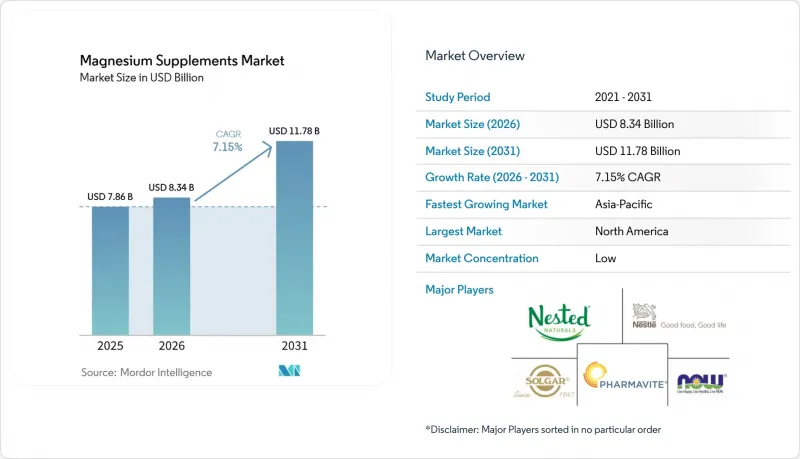
Mordor Intelligence에 따르면, 마그네슘 보충제 시장은 2025년 78억 6,000만 달러에서 2026년에는 83억 4,000만 달러로 확대될 것이며, 2026년부터 2031년까지 연평균 성장률(CAGR) 7.15%의 연평균 성장률(CAGR)을 기록하며 2031년에는 117억 8,000만 미달러에 달할 것으로 예측됩니다. 본 보고서는 제품 유형(산화마그네슘, 구연산마그네슘, 글리신산염 등), 제형(정제, 캡슐, 구미, 분말, 액제),용도(뼈·근육, 수면 지원, 심혈관, 기타), 최종 사용자(Z세대, 밀레니얼 세대, X세대, 베이비부머, 알파 세대), 지역(북미, 유럽, 아시아태평양, 남미, 중동 및 아프리카)별로 분류되어 있습니다. 시장 예측은 금액(달러) 기준으로 제시되어 있습니다.
전 세계 마그네슘 보충제 시장 동향 및 인사이트
마그네슘 결핍증 유병률 증가
마그네슘 결핍 유병률 증가는 마그네슘 보충제 수요를 견인하고 있습니다. 이는 소비자들이 식사를 통한 섭취 부족을 보충하고 필수적인 생리 기능을 지원하고자 하기 때문입니다. 2025년 미국 국립의학도서관(National Library of Medicine)에 게재된 리뷰에 따르면, 약 24억 명, 즉 전 세계 인구의 약 31%가 권장 마그네슘 섭취량을 충족하지 못하고 있는 것으로 나타났습니다. 이러한 광범위한 영양 결핍으로 인해, 특히 소비자들이 예방적 건강 관리와 웰니스에 더욱 적극적으로 나서면서 근육 및 신경 기능, 에너지 대사, 뼈 건강, 전해질 균형에서 마그네슘이 수행하는 역할에 대한 인식이 높아지고 있습니다. 그 결과, 소비자들은 식단을 통해 부족한 양을 보충하고 적절한 마그네슘 수치를 유지하기 위해 보충제를 점점 더 많이 이용하고 있으며, 이것이 전 세계 마그네슘 보충제 시장의 성장을 뒷받침하고 있습니다.
수면 및 스트레스 관리 솔루션에 대한 수요 증가
수면 및 스트레스 관리 솔루션에 대한 수요 증가가 마그네슘 보충제 시장의 성장을 뒷받침하고 있습니다. 이는 소비자들이 수면장애, 스트레스, 휴식과 관련된 문제를 해결하기 위해 천연 유래 제품을 점점 더 많이 찾고 있기 때문입니다. 업무로 인한 압박감 증가, 라이프스타일 변화, 그리고 수면의 중요성에 대한 인식 제고가 소비자로 하여금 휴식과 전반적인 건강을 지원하는 영양 보충제를 찾도록 유도하고 있습니다. 마그네슘은 수면 및 스트레스 관리 제품에 점점 더 많이 함유되고 있으며, 특히 글리신산 마그네슘, 마그네슘 구연산염, 그리고 이완을 돕는 데 목적을 둔 기타 형태가 함유된 제품들이 주목받고 있습니다. 예방적 건강 관리와 비의약적 해결책에 대한 선호도가 높아짐에 따라 마그네슘 보충제에 대한 소비자의 관심이 확대되고 있으며, 이는 시장 성장을 뒷받침하고 있습니다.
마그네슘의 다양한 형태에 대한 소비자의 인식 부족
마그네슘의 각 형태별 차이에 대한 소비자의 인식이 제한적이어서 제품 선택 시 혼란을 초래하고, 이는 마그네슘 보충제 시장의 성장을 저해하고 있습니다. 마그네슘 보충제에는 구연산 마그네슘, 글리신산 마그네슘, 산화 마그네슘, 말산 마그네슘, 염화 마그네슘 등 다양한 형태가 있으며, 이들은 흡수 특성, 용도, 소비자에게 주는 인상이 다릅니다. 그러나 많은 소비자는 이러한 차이에 대해 충분한 지식을 가지고 있지 않아, 주로 가격, 섭취량 또는 브랜드 인지도에 근거하여 제품을 선택하고 있을 가능성이 있습니다. 이러한 이해 부족은 구매 의욕을 저하시켜 고품질 제품에 대한 신뢰를 떨어뜨리고, 제조업체가 제품의 차별화 요소를 전달하기 어렵게 하며, 결국 시장 성장을 제한하는 결과로 이어집니다.
부문 분석
산화 마그네슘은 2025년 전 세계 마그네슘 보충제 시장에서 가장 큰 점유율인 25.62%를 차지했습니다. 이러한 선도적 지위는 영양 보충제 분야에서 오랜 사용 실적과 소비자들 사이에서 널리 알려져 있다는 점에 기반을 두고 있습니다. 산화 마그네슘은 정제나 캡슐 등 다양한 형태로 구할 수 있으며, 약국, 슈퍼마켓, 건강식품점, 온라인 채널을 통해 쉽게 구입할 수 있습니다. 또한 제조 비용이 비교적 저렴하기 때문에 대중을 대상으로 하거나 가성비를 중시하는 보충제 제품에의 채택도 촉진되고 있습니다. 이 성분은 일반적인 마그네슘 보충이나 뼈·근육 건강 유지를 목적으로 사용되는 것이 일반적입니다. 시장 내 확고한 입지와 폭넓은 접근성 덕분에 예측 기간 동안에도 큰 시장 점유율을 유지할 것으로 전망됩니다.
글리신산 마그네슘은 2026년부터 2031년까지 연평균 성장률(CAGR) 8.56%를 기록하며 가장 빠르게 성장하는 제품 유형이 될 것으로 예측됩니다. 이러한 성장은 흡수율이 높고 신체에 부담이 적은 마그네슘 제제에 대한 소비자의 관심이 높아짐에 따라 주도되고 있습니다. 이 성분은 수면 지원, 이완, 근육 회복 및 전반적인 건강 증진을 목적으로 하는 보충제를 찾는 소비자들 사이에서 특히 인기를 끌고 있습니다. 또한, 이 성분의 프리미엄 포지셔닝은 더 높은 품질과 특정 목적에 특화된 영양 보충제로의 광범위한 전환 추세와도 부합합니다. 다양한 마그네슘 형태에 대한 인식이 높아짐에 따라, 소비자들은 기존의 산화 마그네슘 제품에서 다른 형태로 전환하는 경향을 보이고 있습니다.
마그네슘 보충제 시장에서는 캡슐이 가장 큰 점유율을 차지하고 있으며, 2025년에는 시장 규모의 34.62%를 차지할 것으로 전망됩니다. 이러한 주도적인 위상은 편의성, 휴대성, 섭취 용이성에 의해 뒷받침되고 있습니다. 또한 캡슐 형태라면 글리신산 마그네슘, 구연산 마그네슘, 산화 마그네슘 등 다양한 마그네슘 제제에서 제조업체가 정확한 용량을 설정할 수 있습니다. 이 형태의 제품은 약국, 건강식품점, 슈퍼마켓 및 전자상거래 플랫폼을 통해 널리 유통되고 있습니다. 간편한 일상적인 보충제 섭취를 선호하는 소비자 경향이 높아지고 있는 점도 캡슐형 제품 수요를 더욱 부추기고 있습니다. 그 결과, 예측 기간 동안 캡슐이 주요 형태로 자리매김할 것으로 예측됩니다.
이러한 성장은 유연한 투여량과 편리한 보충제 형태에 대한 수요 증가에 힘입은 것입니다. 마그네슘 분말은 물이나 기타 음료에 쉽게 섞을 수 있어, 정제나 캡슐의 대안을 찾는 소비자들에게 인기가 있습니다. 또한, 수분 보충, 회복, 매일의 영양제 섭취를 중시하는 스포츠 영양 및 웰니스 관련 소비자층 사이에서도 이 형태가 주목받고 있습니다.
지역별 분석
북미는 전 세계 마그네슘 보충제 시장에서 가장 큰 점유율을 차지하고 있으며, 2025년에는 시장 가치의 36.11%를 차지했습니다. 이 지역은 영양 보충제, 예방 의학, 스포츠 영양에 대한 소비자 인식이 높다는 이점을 누리고 있습니다. 근육 건강, 수면, 심혈관 건강, 인지 기능 건강을 지원하는 제품에 대한 꾸준한 수요가 시장 성장을 지속적으로 견인하고 있습니다. 정평이 나 있는 보충제 제조업체의 존재, 광범위한 소매 네트워크, 약국 및 전자상거래 플랫폼의 존재가 제품의 접근성을 더욱 높이고 있습니다. 또한, 이 지역의 소비자들은 프리미엄급이며 전문적이고 특정 건강 상태에 초점을 맞춘 마그네슘 제제에 대해서도 강한 관심을 보이고 있습니다.
아시아태평양은 2026년부터 2031년까지 연평균 성장률(CAGR) 9.23%로 확대되어 가장 빠르게 성장하는 지역 시장이 될 것으로 예측됩니다. 이러한 성장은 건강에 대한 인식 제고, 가처분 소득 증가, 그리고 중국, 일본, 인도, 호주 등 주요 시장에서 영양 보충제의 보급 확대에 힘입고 있습니다. 스포츠 영양, 수면 지원, 활동적인 라이프스타일, 예방 의학에 대한 관심 증가가 마그네슘 함유 제품 수요를 끌어올리고 있습니다. 또한, 전자상거래 및 현대적인 소매업의 확장으로 국내외 영양제 브랜드에 대한 접근성도 개선되고 있습니다.
유럽은 높은 건강 의식, 정착된 건강기능식품 소비, 그리고 프리미엄 제품 및 클린 라벨 제품에 대한 수요에 힘입어 중요한 지역 시장으로 자리매김하고 있습니다. 남미는 웰니스 의식의 고조와 소매 및 전자상거래를 통한 유통망 확장으로 인해 혜택을 볼 것으로 예측됩니다. 중동 및 아프리카 시장은 예방 의료, 피트니스, 영양 보조제에 대한 관심 증가에 힘입고 있지만, 시장 침투율은 여전히 비교적 낮은 수준에 머물러 있습니다.
기타 혜택:
- 엑셀 형식 시장 예측(ME) 시트
- 3개월간의 애널리스트 지원
자주 묻는 질문
목차
제1장 서론
제2장 조사 방법
제3장 개요
제4장 시장 구도
제5장 시장 규모와 성장 예측
제6장 경쟁 구도
제7장 시장 기회와 향후 전망
JHS 26.09.01Powder is projected to be the fastest-growing form in the magnesium supplements market, expanding at a CAGR of 8.61% from 2026 to 2031.
According to Mordor Intelligence, the magnesium supplements is expected to grow from USD 7.86 billion in 2025 to USD 8.34 billion in 2026 and is forecast to reach USD 11.78 billion by 2031 at 7.15% CAGR over 2026-2031. This report is Segmented by Product Type (Oxide, Citrate, Glycinate, and More), Form (Tablets, Capsules, Gummies, Powder, Liquid), Application (Bone and Muscle, Sleep Support, Cardiovascular, and More), End User (Gen Z, Millennials, Gen X, Boomers, Gen Alpha), Geography (North America, Europe, Asia-Pacific, South America, Middle East and Africa). The Market Forecasts are Provided in Terms of Value (USD).
Global Magnesium Supplements Market Trends and Insights
Rising Prevalence of Magnesium Deficiency
The rising prevalence of magnesium inadequacy is driving demand for magnesium supplements, as consumers seek to address insufficient dietary intake and support essential physiological functions. According to a 2025 review published in the National Library of Medicine, approximately 2.4 billion people, or around 31% of the global population, do not meet recommended magnesium intake levels . This widespread nutritional gap is raising awareness of magnesium's role in muscle and nerve function, energy metabolism, bone health, and electrolyte balance, particularly as consumers become more proactive about preventive health and wellness. As a result, consumers are increasingly using supplements to bridge dietary gaps and maintain adequate magnesium levels, thereby supporting the growth of the global magnesium supplements market.
Increasing Demand for Sleep and Stress-Management Solutions
Increasing demand for sleep and stress-management solutions is supporting the growth of the magnesium supplements market as consumers increasingly seek natural products to address sleep disturbances, stress, and relaxation-related concerns. Rising work-related pressures, changing lifestyles, and growing awareness of the importance of sleep are encouraging consumers to explore nutritional supplements that support relaxation and overall well-being. Magnesium is increasingly incorporated into sleep and stress-management products, particularly formulations featuring magnesium glycinate, magnesium citrate, and other forms positioned for relaxation support. The growing preference for preventive wellness and non-pharmaceutical solutions is therefore expanding consumer interest in magnesium supplements and supporting market growth.
Limited Consumer Awareness of Different Magnesium Forms
Limited consumer awareness of the differences between magnesium forms is restraining the growth of the magnesium supplements market by creating confusion during product selection. Magnesium supplements are available in various forms, including magnesium citrate, glycinate, oxide, malate, and chloride, which differ in absorption characteristics, applications, and consumer positioning. However, many consumers have limited knowledge of these differences and may select products based primarily on price, dosage, or brand recognition. This lack of understanding can discourage purchases, reduce confidence in premium formulations, and make it more difficult for manufacturers to communicate product differentiation, thereby limiting market growth.
Other drivers and restraints analyzed in the detailed report include:
- Rising Sports Nutrition and Fitness Participation
- Growing Aging Population Supporting Growth
- Side Effects Associated with Excessive Consumption
For complete list of drivers and restraints, kindly check the Table Of Contents.
Segment Analysis
Magnesium oxide held the largest share of the global magnesium supplements market, accounting for 25.62% in 2025. Its leading position is supported by its long-standing use in dietary supplements and broad consumer familiarity. Magnesium oxide is widely available across tablets and capsules, making it accessible through pharmacies, supermarkets, health stores, and online channels. Its relatively low production cost also supports its presence in mass-market and value-oriented supplement products. The ingredient is commonly positioned for general magnesium supplementation and bone and muscle health. Its established market presence and broad availability are expected to help it retain a significant share during the forecast period.
Magnesium glycinate is projected to be the fastest-growing product type, recording a CAGR of 8.56% from 2026 to 2031. Growth is being driven by increasing consumer interest in highly absorbable and well-tolerated magnesium formulations. The ingredient is particularly gaining traction among consumers seeking supplements for sleep support, relaxation, muscle recovery, and general wellness. Its premium positioning also aligns with the broader shift toward higher-quality and targeted nutritional supplements. Growing awareness of different magnesium forms is encouraging consumers to move beyond traditional magnesium oxide products.
Capsules accounted for the largest share of the magnesium supplements market, representing 34.62% of the market size in 2025. Their leading position is supported by convenience, portability, and ease of consumption. Capsules also enable manufacturers to offer precise dosages across various magnesium formulations, including glycinate, citrate, and oxide. The format is widely distributed through pharmacies, health stores, supermarkets, and e-commerce platforms. Growing consumer preference for convenient daily supplementation further supports demand for capsule-based products. As a result, capsules are expected to remain the dominant form throughout the forecast period.
Growth is being supported by increasing demand for flexible dosing and convenient supplementation formats. Magnesium powders can be easily mixed with water or other beverages, appealing to consumers seeking alternatives to tablets and capsules. The format is also gaining traction among sports nutrition and wellness consumers focused on hydration, recovery, and daily supplementation.
Complete Report Scope:
- By Product Type
- Magnesium Oxide
- Magnesium Citrate
- Magnesium Glycinate
- Magnesium L-Threonate
- Magnesium Taurate
- Other Product Types
- By Form
- Tablets
- Capsules
- Gummies
- Powder
- Liquid
- By Application
- Bone and Muscle
- Sleep Support
- Cardiovascular Health
- Brain and Cognitive Health
- Other Applications
- By End User
- Gen Alpha
- Gen Z
- Millennials
- Gen X
- Boomers
- By Geography
- North America
- United States
- Canada
- Mexico
- Rest of North America
- Europe
- Germany
- United Kingdom
- Italy
- Spain
- France
- Belgium
- Poland
- Rest of Europe
- Asia-Pacific
- China
- India
- Japan
- Australia
- South Korea
- Thailand
- Indonesia
- Vietnam
- Rest of Asia-Pacific
- South America
- Brazil
- Argentina
- Chile
- Peru
- Rest of South America
- Middle East and Africa
- South Africa
- Saudi Arabia
- United Arab Emirates
- Qatar
- Egypt
- Morocco
- Rest of Middle East and Africa
- North America
Geography Analysis
North America held the largest share of the global magnesium supplements market, accounting for 36.11% of market value in 2025. The region benefits from high consumer awareness of dietary supplements, preventive healthcare, and sports nutrition. Strong demand for products supporting muscle health, sleep, cardiovascular wellness, and cognitive health continues to support market growth. The presence of established supplement manufacturers, extensive retail networks, pharmacies, and e-commerce platforms further strengthens product accessibility. Consumers in the region also show strong interest in premium, specialized, and condition-focused magnesium formulations.
Asia-Pacific is projected to be the fastest-growing regional market, expanding at a CAGR of 9.23% from 2026 to 2031. Growth is supported by rising health awareness, increasing disposable incomes, and the expanding adoption of dietary supplements across major markets such as China, Japan, India, and Australia. Growing interest in sports nutrition, sleep support, active lifestyles, and preventive healthcare is increasing demand for magnesium-based products. The expansion of e-commerce and modern retail is also improving access to international and domestic supplement brands.
Europe represents a significant regional market, supported by strong health awareness, established supplement consumption, and demand for premium and clean-label products. South America is expected to benefit from rising wellness awareness and expanding retail and e-commerce distribution. The Middle East and Africa market is supported by growing interest in preventive health, fitness, and nutritional supplementation, although market penetration remains comparatively lower.
- Pharmavite LLC
- Nestle S.A.
- NOW Foods
- Nested Naturals, Inc.
- Solaray (Nutraceutical International Corporation)
- Doctor's Best, Inc.
- Solgar, Inc.
- Pure Encapsulations, LLC
- Life Extension Foundation
- Thorne HealthTech, Inc.
- Natural Vitality (The Clorox Company)
- Jigsaw Health, LLC
- BioEmblem, LLC
- Balchem Corporation (Albion Minerals)
- Jungbunzlauer Suisse AG
- Fortitech, Inc.
- Magceutics, Inc.
- Swanson Health Products, Inc.
- Jarrow Formulas, Inc.
- Sundown Naturals (The Bountiful Company)
Additional Benefits:
- The market estimate (ME) sheet in Excel format
- 3 months of analyst support
TABLE OF CONTENTS
1 INTRODUCTION
- 1.1 Study Assumptions and Market Definition
- 1.2 Scope of the Study
2 RESEARCH METHODOLOGY
3 EXECUTIVE SUMMARY
4 MARKET LANDSCAPE
- 4.1 Market Overview
- 4.2 Market Drivers
- 4.2.1 Rising Prevalence of Magnesium Deficiency
- 4.2.2 Growing Focus on Preventive Healthcare
- 4.2.3 Increasing Demand for Sleep and Stress-Management Solutions
- 4.2.4 Rising Sports Nutrition and Fitness Participation
- 4.2.5 Growing Aging Population Supporing Growth
- 4.2.6 Product Innovation and Formulation Diversification
- 4.3 Market Restraints
- 4.3.1 Limited Consumer Awareness of Different Magnesium Forms
- 4.3.2 Side Effects Associated with Excessive Consumption
- 4.3.3 Competition from Magnesium-Rich Foods
- 4.3.4 Regulatory Variations Across Countries
- 4.4 Supply Chain Analysis
- 4.5 Regulatory Outlook
- 4.6 Porter's Five Forces
- 4.6.1 Threat of New Entrants
- 4.6.2 Bargaining Power of Buyers/Consumers
- 4.6.3 Bargaining Power of Suppliers
- 4.6.4 Threat of Substitute Products
- 4.6.5 Intensity of Competitive Rivalry
5 MARKET SIZE and GROWTH FORECASTS (VALUE)
- 5.1 By Product Type
- 5.1.1 Magnesium Oxide
- 5.1.2 Magnesium Citrate
- 5.1.3 Magnesium Glycinate
- 5.1.4 Magnesium L-Threonate
- 5.1.5 Magnesium Taurate
- 5.1.6 Other Product Types
- 5.2 By Form
- 5.2.1 Tablets
- 5.2.2 Capsules
- 5.2.3 Gummies
- 5.2.4 Powder
- 5.2.5 Liquid
- 5.3 By Application
- 5.3.1 Bone and Muscle
- 5.3.2 Sleep Support
- 5.3.3 Cardiovascular Health
- 5.3.4 Brain and Cognitive Health
- 5.3.5 Other Applications
- 5.4 By End User
- 5.4.1 Gen Alpha
- 5.4.2 Gen Z
- 5.4.3 Millennials
- 5.4.4 Gen X
- 5.4.5 Boomers
- 5.5 By Geography
- 5.5.1 North America
- 5.5.1.1 United States
- 5.5.1.2 Canada
- 5.5.1.3 Mexico
- 5.5.1.4 Rest of North America
- 5.5.2 Europe
- 5.5.2.1 Germany
- 5.5.2.2 United Kingdom
- 5.5.2.3 Italy
- 5.5.2.4 Spain
- 5.5.2.5 France
- 5.5.2.6 Belgium
- 5.5.2.7 Poland
- 5.5.2.8 Rest of Europe
- 5.5.3 Asia-Pacific
- 5.5.3.1 China
- 5.5.3.2 India
- 5.5.3.3 Japan
- 5.5.3.4 Australia
- 5.5.3.5 South Korea
- 5.5.3.6 Thailand
- 5.5.3.7 Indonesia
- 5.5.3.8 Vietnam
- 5.5.3.9 Rest of Asia-Pacific
- 5.5.4 South America
- 5.5.4.1 Brazil
- 5.5.4.2 Argentina
- 5.5.4.3 Chile
- 5.5.4.4 Peru
- 5.5.4.5 Rest of South America
- 5.5.5 Middle East and Africa
- 5.5.5.1 South Africa
- 5.5.5.2 Saudi Arabia
- 5.5.5.3 United Arab Emirates
- 5.5.5.4 Qatar
- 5.5.5.5 Egypt
- 5.5.5.6 Morocco
- 5.5.5.7 Rest of Middle East and Africa
- 5.5.1 North America
6 COMPETITIVE LANDSCAPE
- 6.1 Market Concentration
- 6.2 Strategic Moves
- 6.3 Market Ranking Analysis
- 6.4 Company Profiles (includes Global-level Overview, Market-level Overview, Core Segments, Financials (if available), Strategic Information, Market Rank/Share, Products and Services, Recent Developments)
- 6.4.1 Pharmavite LLC
- 6.4.2 Nestle S.A.
- 6.4.3 NOW Foods
- 6.4.4 Nested Naturals, Inc.
- 6.4.5 Solaray (Nutraceutical International Corporation)
- 6.4.6 Doctor's Best, Inc.
- 6.4.7 Solgar, Inc.
- 6.4.8 Pure Encapsulations, LLC
- 6.4.9 Life Extension Foundation
- 6.4.10 Thorne HealthTech, Inc.
- 6.4.11 Natural Vitality (The Clorox Company)
- 6.4.12 Jigsaw Health, LLC
- 6.4.13 BioEmblem, LLC
- 6.4.14 Balchem Corporation (Albion Minerals)
- 6.4.15 Jungbunzlauer Suisse AG
- 6.4.16 Fortitech, Inc.
- 6.4.17 Magceutics, Inc.
- 6.4.18 Swanson Health Products, Inc.
- 6.4.19 Jarrow Formulas, Inc.
- 6.4.20 Sundown Naturals (The Bountiful Company)