|
시장보고서
상품코드
2117628
QaaS(Quantum-as-a-Service) 소프트웨어 플랫폼 : 시장 점유율 분석, 업계 동향 및 통계, 성장 예측(2026-2031년)Quantum-as-a-Service (QaaS) Software Platform - Market Share Analysis, Industry Trends & Statistics, Growth Forecasts (2026 - 2031) |
||||||
 Mordor Intelligence
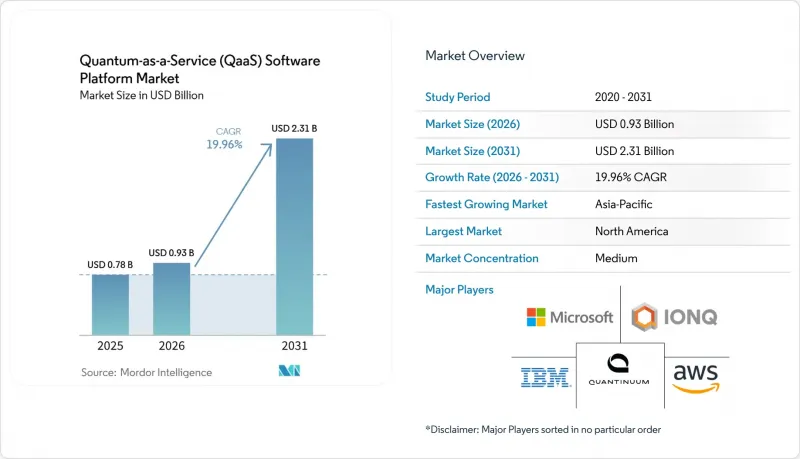
Mordor Intelligence에 의하면, QaaS(Quantum-as-a-Service) 소프트웨어 플랫폼 시장 규모는 2025년 7억 8,000만 달러로 평가되었습니다. 2026년 9억 3,000만 달러에서 2031년까지 23억 1,000만 달러로 확대되며 2026-2031년까지 CAGR은 19.96%를 나타낼 전망입니다.
본 보고서는 서비스 유형(양자 컴퓨팅 클라우드 액세스, Quantum-Simulation-as-a-Service, 기타), 배포 모드(퍼블릭 클라우드 QaaS, 프라이빗 전용 양자 액세스, 하이브리드 양자·고전 워크플로우), 최종 사용자 산업(은행 및 금융 서비스·보험(BFSI),제약·생명과학, 기타), 지역별로 분류되어 있습니다. 시장 전망은 금액(달러) 기준으로 제시되어 있습니다.
세계의 QaaS(Quantum-as-a-Service) 소프트웨어 플랫폼 시장 동향 및 인사이트
하드웨어를 소유하지 않고 양자 액세스를 이용하고자 하는 기업 수요 증가
QaaS(Quantum-as-a-Service) 소프트웨어 플랫폼 시장은 초기 단계의 워크로드에서 고가의 양자 시스템을 자체적으로 소유 및 유지 관리하기를 원하는 기업이 거의 없다는 단순한 경제적 변화의 혜택을 받고 있습니다. 구매 기업들은 극저온 시스템의 유지보수, 교정 또는 전문 인력의 인건비를 부담하지 않고도 포트폴리오 최적화, 분자 시뮬레이션, 보안 이용 사례를 검증하기 위해 QaaS(Quantum-as-a-Service) 소프트웨어 플랫폼을 점점 더 많이 활용하고 있습니다. ‘2026년 세계 양자 산업의 현황’ 조사에 따르면, 기업의 89%가 이미 양자 기술을 실제로 활용하고 있지만, 대규모 도입에 이른 곳은 고작 3%에 불과하여, 시험 단계에서 실제 운영 환경으로 전환하기 위한 긴 여정이 남아 있습니다. 동 조사에서는 주권 요건과 로컬 제어에 대한 기대도 지적되고 있으며, 이는 기업들이 단순히 접근 권한을 원할 뿐만 아니라 제어 가능하고 감사 가능한 접근 모델을 원하고 있음을 의미합니다. 그 결과, QaaS(Quantum-as-a-Service) 소프트웨어 플랫폼 시장은 단일 제공 모델에 국한되지 않고, 퍼블릭, 프라이빗, 하이브리드 등 다양한 형태로 확대되고 있습니다.
클라우드 네이티브 양자 개발 생태계의 확대
QaaS(Quantum-as-a-Service) 소프트웨어 플랫폼 시장도 확대되고 있습니다. 이는 개발자가 기업의 워크플로우 내에 이미 존재하는 클라우드 환경을 통해 양자 리소스에 접근할 수 있기 때문입니다. 이를 통해 학습 장벽이 낮아지고, 팀은 기존 도구,데이터 파이프라인, 익숙한 액세스 제어와 병행하여 양자 루틴을 테스트할 수 있게 됩니다. 2026년 5월, Scaleway와 QbitSoft는 유럽 최초의 클라우드 네이티브 양자 도입 프로그램을 시작하여, 기업이 단일 주권 클라우드 인터페이스를 통해 여러 하드웨어 모드에 접근할 수 있도록 했습니다. 이러한 구조는 QaaS(Quantum-as-a-Service) 소프트웨어 플랫폼 시장에서 중요합니다. 하드웨어 계층 위에 위치한 소프트웨어 제공업체가 기업의 워크플로우 설계에 있어 장기적인 통제 지점이 될 수 있기 때문입니다. 클라우드를 통해 이용 가능한 백엔드가 늘어남에 따라, QaaS(Quantum-as-a-Service) 소프트웨어 플랫폼 시장에서는 단순한 하드웨어 성능만을 내세우는 벤더보다 개발자의 도입 과정을 간소화하는 벤더가 더 높이 평가받을 것으로 보입니다.
NISQ 하드웨어의 한계와 낮은 생산 신뢰성
QaaS(Quantum-as-a-Service) 소프트웨어 플랫폼 시장은 여전히 잡음이 많은 중규모 양자 하드웨어의 근본적인 한계에 직면해 있습니다. 현재 시스템에는 유한한 코히어런스 시간, 제한된 연결성, 상용적으로 유용한 회로의 깊이와 일관성을 저해하는 오류율 등의 문제가 있습니다. 2026년 『New Journal of Physics』지에 게재된 연구에 따르면, NISQ 시대의 양자 머신러닝 시스템은 여전히 표현력, 학습 가능성, 노이즈 내성 사이에서 상충 관계에 직면해 있으며, 이것이 많은 하이브리드 워크플로의 원활한 확장을 방해하고 있습니다. 『The State of the Global Quantum Industry 2026』 보고서에서는 실제 운영으로의 확장에 있어 가장 큰 장벽으로 하드웨어의 성숙도를 능가하는 알고리즘 설계를 꼽고 있으며,이는 QaaS(Quantum-as-a-Service) 소프트웨어 플랫폼 시장이 공학적 한계와 응용 측면의 한계 모두에 의해 발목이 잡혀 있음을 보여줍니다. 처리량이 향상되고 있는 기업들이 더 대규모의 워크로드를 일상적으로 활용하기 위해서는 QaaS(Quantum-as-a-Service) 소프트웨어 플랫폼 시장에서 여전히 더 신뢰할 수 있는 운영 환경이 필요합니다.
부문별 분석
2025년, 양자 컴퓨팅 클라우드 액세스는 QaaS(Quantum-as-a-Service) 소프트웨어 플랫폼 시장 점유율의 38.29%를 차지하며, 이 분야에 진출하는 기업들에게 주요한 상업적 진입점이 되었습니다. 이 부문이 주도적인 위치를 차지하는 이유는 구매자들이 일반적으로 보다 전문적인 시뮬레이션, 최적화 또는 보안 계약으로 전환하기 전에 구독 기반의 하드웨어 액세스로 시작하기 때문입니다. 이러한 추세로 인해, 특히 이용 사례나 사내 팀의 적합성을 아직 검토 중인 기업의 경우, QaaS(Quantum-as-a-Service) 소프트웨어 플랫폼 시장은 ‘접근 우선’ 구매 행동에 기반한 상태를 유지하고 있습니다. 또한 초기 접근 결정이 이후 툴체인 및 워크플로우 선택에 막대한 영향을 미치는 경우가 많기 때문에 플랫폼 사업자들은 QaaS(Quantum-as-a-Service) 소프트웨어 플랫폼 시장에서 확고한 입지를 구축하고 있습니다.
양자 머신러닝 서비스 분야의 QaaS(Quantum-as-a-Service) 소프트웨어 플랫폼 시장 규모는 2031년까지 연평균 성장률(CAGR) 21.63%로 확대될 것으로 예측되며, 이는 가장 빠르게 성장하는 서비스 카테고리가 될 것입니다. 이러한 성장은 단순한 학술적 실험에 그치지 않고, 실제 운영을 위한 머신러닝 워크플로우에 대한 관심이 높아지고 있음을 반영합니다. 또한, QaaS(Quantum-as-a-Service) 소프트웨어 플랫폼 시장에서는 소재, 물류, 금융 모델링 분야에서 시뮬레이션 및 최적화 서비스에 대한 수요가 증가하고 있습니다. 이러한 분야에서 구매자들은 기존 기준에 비해 측정 가능한 개선을 요구하고 있습니다. 양자암호 및 보안 서비스의 중요성도 커지고 있습니다. 이는 일부 규제 대상 기업들이 통제된 환경 내에서 내결함성, 위험 노출 정도, 향후 보안 대응 요건을 검증하기 위해 QaaS(Quantum-as-a-Service) 소프트웨어 플랫폼 시장을 활용하고 있기 때문입니다.
지역별 분석
2025년, 북미는 전 세계 매출의 37.19%를 차지하며 QaaS(Quantum-as-a-Service) 소프트웨어 플랫폼 시장에서 가장 규모가 큰 지역 점유율을 기록했습니다. 미국은 직접적인 정책 조정을 통해 그 우위를 강화하고 있습니다. 이는 백악관이 2026년 6월, 상용화를 가속화하고 국가 양자 전략을 갱신하기 위해 대통령령 제14413호를 발령했기 때문입니다. 또한, 미국 에너지부는 내결함성 시스템 개발 및 국가 차원의 컴퓨팅 인프라와 연계된 ‘Quantum Genesis’ 이니셔티브를 통해 QaaS(Quantum-as-a-Service) 소프트웨어 플랫폼 시장을 추진하고 있습니다. 2026년 5월, 미국 상무부는 9개 양자 관련 기업에 대해 CHIPS법에 근거한 20억 1,300만 달러의 인센티브를 발표했습니다. 이를 통해 해당 지역의 상용화 파이프라인에 제조 및 엔지니어링 지원이 추가될 것입니다. 유럽은 QaaS(Quantum-as-a-Service) 소프트웨어 플랫폼 시장에서 여전히 중요한 위치를 차지하고 있습니다. 이는 킬리만자로의 멀티모달 QaaS 데이터센터 출범이나 Scaleway와 QbitSoft의 클라우드 네이티브 도입 프로그램이 보여주듯이, 주권 클라우드의 위상, 국내 공급업체, 규제 대상 부문에서 수요가 현지 도입을 뒷받침하고 있기 때문입니다.
아시아태평양은 2026년부터 2031년까지 연평균 성장률(CAGR) 26.11%를 나타낼 것으로 예측되며, QaaS(Quantum-as-a-Service) 소프트웨어 플랫폼 시장에서 가장 두드러진 성장을 보일 것으로 전망됩니다. 이 지역은 공공 자금, 연구 기관, 기업의 파일럿 사업 활동이 강력하게 연계된 혜택을 받고 있으며, 이를 통해 지역 생태계가 실험실 중심 단계에서 상용 액세스 모델로 전환되고 있습니다. 이러한 구조는 단순히 클라우드 액세스를 도입하는 데 그치지 않고, 국내 역량 구축을 통해 QaaS(Quantum-as-a-Service) 소프트웨어 플랫폼 시장을 뒷받침하고 있습니다. 중국, 일본, 인도, 한국은 국가 프로그램, 지역 파트너십, 컴퓨팅, 통신, 상용 제품 개발 분야의 초기 구매자들과의 협력을 통해 이러한 전환을 주도하고 있습니다.
남미, 중동 및 아프리카는 QaaS(Quantum-as-a-Service) 소프트웨어 플랫폼 시장에서 여전히 초기 단계에 있지만, 이 지역의 구매자들은 하드웨어를 장기간 소유하는 단계를 거치지 않고 직접 관리형 서비스 형태로 전환할 수 있기 때문에 전략적으로 중요한 위치를 차지하고 있습니다. 2025년, 아람코(Aramco)와 파스쿠알(Pascual)은 아람코의 다란(Dharan) 데이터센터에서 사우디아라비아 최초이자 중동 최초의 상용 QaaS(Quantum-as-a-Service) 플랫폼을 출시했습니다. 이러한 움직임은 중동의 QaaS(Quantum-as-a-Service) 소프트웨어 플랫폼 시장이 에너지, 소재, 산업 최적화 등 기관용 이용 사례를 중심으로 형성되고 있음을 보여줍니다. 남미에서는 여전히 인지도 제고 및 시범 사업 단계에 머물러 있지만, 금융 서비스 기반이 탄탄하고 디지털 전환이 광범위하게 추진되고 있는 만큼, 브라질은 QaaS(Quantum-as-a-Service) 소프트웨어 플랫폼 시장에서 가장 큰 잠재력을 지니고 있습니다.
기타 혜택
- 엑셀 형식 시장 예측(ME) 시트
- 3개월간의 애널리스트 지원
자주 묻는 질문
목차
제1장 서론
제2장 조사 방법
제3장 개요
제4장 시장 구도
제5장 시장 규모 및 성장 예측
제6장 경쟁 구도
제7장 시장 기회 및 향후 전망
KTH 26.09.02According to Mordor Intelligence, the quantum-as-a-service (QaaS) software platform market size is projected to expand from USD 0.78 billion in 2025 and USD 0.93 billion in 2026 to USD 2.31 billion by 2031, registering a CAGR of 19.96% between 2026-2031.
This report is Segmented by Service Type (Quantum Computing Cloud Access, Quantum Simulation-As-A-Service, and More), Deployment Mode (Public Cloud QaaS, Private Dedicated Quantum Access, and Hybrid Quantum-Classical Workflow), End User Industry (BFSI, Pharmaceutical and Life Sciences, and More), and Geography. The Market Forecasts are Provided in Terms of Value (USD).
Global Quantum-as-a-Service (QaaS) Software Platform Market Trends and Insights
Rising Enterprise Demand for Quantum Access Without Hardware Ownership
The quantum-as-a-service (QaaS) software platform market is benefiting from a simple economic shift, as few enterprises want to own and maintain expensive quantum systems for early-stage workloads. Buyers are increasingly using the quantum-as-a-service (QaaS) software platform market to test portfolio optimization, molecular simulation, and security use cases without incurring cryogenic maintenance, calibration, or specialist staffing costs. The State of the Global Quantum Industry 2026 found that 89% of enterprises were already hands-on with quantum technologies, but only 3% had reached scaled deployment, leaving a significant conversion path from trial activity to production use. The same study also pointed to sovereignty requirements and local control expectations, meaning enterprises are not only asking for access; they are asking for controlled, auditable access models. That is why the quantum-as-a-service market is expanding across public, private, and hybrid formats rather than through a single delivery model.
Expansion of Cloud-Native Quantum Development Ecosystems
The quantum-as-a-service (QaaS) software platform market is also moving forward because developers can reach quantum resources through cloud environments that already sit inside enterprise workflows. This lowers the learning barrier and lets teams test quantum routines alongside classical tools, data pipelines, and familiar access controls. In May 2026, Scaleway and QbitSoft launched Europe's first cloud-native quantum adoption program, giving enterprises access to multiple hardware modalities through one sovereign cloud interface. That kind of structure matters in the quantum-as-a-service (QaaS) software platform market because software providers that sit above the hardware layer can become the long-term control point for enterprise workflow design. As more backends become available through cloud access, the quantum-as-a-service (QaaS) software platform market is likely to reward vendors that simplify developer adoption rather than vendors that only promote raw hardware characteristics.
NISQ Hardware Limitations and Low Production Reliability
The quantum-as-a-service (QaaS) software platform market still faces the basic limits of noisy intermediate-scale quantum hardware. Current systems have finite coherence times, limited connectivity, and error rates that reduce the depth and consistency of commercially useful circuits. Research published in the New Journal of Physics in 2026 showed that NISQ-era quantum machine learning systems still face a tradeoff among expressivity, trainability, and noise resilience, which keeps many hybrid workflows from scaling cleanly. The State of the Global Quantum Industry 2026 also reported that algorithm design has overtaken hardware maturity as the leading barrier to production deployment, which shows that the quantum-as-a-service (QaaS) software platform market is being held back by both engineering and application limits. Even as throughput improves, the quantum-as-a-service (QaaS) software platform market still needs more reliable production conditions before enterprises shift larger workloads into routine use.
Other drivers and restraints analyzed in the detailed report include:
- Government-Funded Quantum Programs Accelerating Commercial Pilot Activity
- Growing Need for Hybrid Quantum-Classical Workflow Orchestration
- Shortage of Quantum Software Engineers and Algorithm Specialists
For complete list of drivers and restraints, kindly check the Table Of Contents.
Segment Analysis
Quantum Computing Cloud Access held 38.29% of the quantum-as-a-service (QaaS) software platform market share in 2025, which made it the main commercial doorway for enterprises entering this space. The segment leads because buyers usually start with subscription-based access to hardware before moving toward more specialized simulation, optimization, or security contracts. This pattern keeps the quantum-as-a-service (QaaS) software platform market grounded in access-first purchasing behavior, especially among enterprises that are still qualifying use cases and internal teams. It also gives platform operators a strong position in the quantum-as-a-service (QaaS) software platform market because early access decisions often shape later toolchain and workflow choices.
The quantum-as-a-service (QaaS) software platform market size for Quantum Machine Learning Services is projected to expand at a 21.63% CAGR through 2031, which makes it the fastest-growing service category. That growth reflects rising interest in production-oriented machine learning workflows rather than only academic experiments. The quantum-as-a-service (QaaS) software platform market is also seeing a stronger pull for simulation and optimization services in materials, logistics, and financial modeling, where buyers want measurable improvements over classical baselines. Quantum cryptography and security services are gaining weight as well, because some regulated enterprises are using the quantum-as-a-service (QaaS) software platform market to test resilience, risk exposure, and future security-readiness requirements within controlled environments.
Complete Report Scope:
- By Service Type
- Quantum Computing Cloud Access
- Quantum Simulation as a Service
- Quantum Optimization APIs
- Quantum Machine Learning Services
- Quantum Cryptography and Security Services
- By Deployment Mode
- Public Cloud QaaS
- Private Dedicated Quantum Access
- Hybrid Quantum-Classical Workflow
- By End User Industry
- Banking, Financial Services, and Insurance (BFSI)
- Pharmaceutical and Life Sciences
- Aerospace and Defense
- Materials and Chemistry
- Logistics and Supply Chain
- Other End User Industries
- By Geography
- North America
- United States
- Canada
- Mexico
- South America
- Brazil
- Argentina
- Rest of South America
- Europe
- Germany
- United Kingdom
- France
- Russia
- Rest of Europe
- Asia-Pacific
- China
- Japan
- India
- South Korea
- Australia
- Rest of Asia-Pacific
- Middle East and Africa
- Middle East
- Turkey
- Israel
- Saudi Arabia
- United Arab Emirates
- Rest of Middle East
- Africa
- South Africa
- Rest of Africa
- Middle East
- North America
Geography Analysis
North America held 37.19% of global revenue in 2025, which gave it the largest regional position in the quantum-as-a-service (QaaS) software platform market share. The United States is strengthening that lead through direct policy coordination, because the White House issued Executive Order 14413 in June 2026 to accelerate commercialization and update the national quantum strategy. The US Department of Energy is also pushing the quantum-as-a-service (QaaS) software platform market through the Quantum Genesis initiative, which is tied to fault-tolerant system development and national-scale computing infrastructure. In May 2026, the US Department of Commerce announced USD 2.013 billion in CHIPS Act incentives for 9 quantum companies, which adds fabrication and engineering support to the region's commercial pipeline. Europe remains a meaningful part of the quantum-as-a-service (QaaS) software platform market because sovereign cloud positioning, domestic providers, and regulated-sector demand are supporting local adoption, as shown by Qilimanjaro's multimodal QaaS data center launch and the Scaleway and QbitSoft cloud-native adoption program.
Asia-Pacific is projected to grow at a 26.11% CAGR from 2026 to 2031, which makes it the fastest-growing regional part of the quantum-as-a-service (QaaS) software platform market size. The region is benefiting from strong alignment among public funding, research institutions, and enterprise pilot activity, which is helping local ecosystems move from laboratory focus to commercial access models. This structure is supporting the quantum-as-a-service (QaaS) software platform market through domestic capability building rather than only through imported cloud access. China, Japan, India, and South Korea are shaping that shift through national programs, local partnerships, and early buyer engagement across computing, communications, and commercial product development.
South America, the Middle East, and Africa remain earlier-stage parts of the quantum-as-a-service (QaaS) software platform market, but they are strategically important because buyers there can move directly into managed-service formats without a long hardware ownership phase. In 2025, Aramco and Pasqal launched Saudi Arabia's first quantum computer and the Middle East's first commercial quantum computing as a service platform at Aramco's Dhahran data center. That move shows that the quantum-as-a-service (QaaS) software platform market in the Middle East is forming around institutional use cases in energy, materials, and industrial optimization. South America remains closer to awareness and pilot activity, with Brazil showing the strongest potential in the quantum-as-a-service (QaaS) software platform market because of its financial services depth and broader digital transformation push.
- IBM Corporation
- Microsoft Corporation
- Amazon Web Services, Inc.
- IonQ, Inc.
- Quantinuum Ltd.
- QC Ware Corporation
- Zapata Computing Holdings Inc.
- Classiq Technologies Ltd.
- Riverlane Ltd.
- Q-CTRL Pty Ltd.
- Xanadu Quantum Technologies Inc.
- Pasqal SAS
- QuEra Computing Inc.
- Aliro Technologies, Inc.
- Horizon Quantum Computing Pte. Ltd.
- Terra Quantum AG
- Quantastica Ltd.
- QunaSys Inc.
- Strangeworks, Inc.
- D-Wave Systems Inc.
- Rigetti Computing, Inc.
- Fujitsu Limited
- Atos SE
- Alibaba Cloud Computing Ltd.
- Huawei Technologies Co., Ltd.
- Origin Quantum Computing Technology Co., Ltd.
Additional Benefits:
- The market estimate (ME) sheet in Excel format
- 3 months of analyst support
TABLE OF CONTENTS
1 INTRODUCTION
- 1.1 Study Assumptions and Market Definition
- 1.2 Scope of the Study
2 RESEARCH METHODOLOGY
3 EXECUTIVE SUMMARY
4 MARKET LANDSCAPE
- 4.1 Market Overview
- 4.2 Market Drivers
- 4.2.1 Rising Enterprise Demand for Quantum Access Without Hardware Ownership
- 4.2.2 Expansion of Cloud-Native Quantum Development Ecosystems
- 4.2.3 Government-Funded Quantum Programs Accelerating Commercial Pilot Activity
- 4.2.4 Growing Need for Hybrid Quantum-Classical Workflow Orchestration
- 4.2.5 Increased Demand for Quantum Simulation and Optimization APIs in Regulated Industries
- 4.2.6 Emerging PQC Readiness and Quantum Risk Testing Use Cases
- 4.3 Market Restraints
- 4.3.1 NISQ Hardware Limitations and Low Production Reliability
- 4.3.2 Shortage of Quantum Software Engineers and Algorithm Specialists
- 4.3.3 Interoperability Fragmentation Across SDKs and Cloud Platforms
- 4.3.4 Data Sovereignty, Security, and Export Control Constraints
- 4.4 Impact of Macroeconomic Factors on the Market
- 4.5 Industry Value-Chain Analysis
- 4.6 Regulatory Landscape
- 4.7 Technological Outlook
- 4.8 Porter's Five Forces Analysis
- 4.8.1 Threat of New Entrants
- 4.8.2 Bargaining Power of Suppliers
- 4.8.3 Bargaining Power of Buyers
- 4.8.4 Threat of Substitutes
- 4.8.5 Intensity of Competitive Rivalry
5 MARKET SIZE AND GROWTH FORECASTS (VALUE)
- 5.1 By Service Type
- 5.1.1 Quantum Computing Cloud Access
- 5.1.2 Quantum Simulation as a Service
- 5.1.3 Quantum Optimization APIs
- 5.1.4 Quantum Machine Learning Services
- 5.1.5 Quantum Cryptography and Security Services
- 5.2 By Deployment Mode
- 5.2.1 Public Cloud QaaS
- 5.2.2 Private Dedicated Quantum Access
- 5.2.3 Hybrid Quantum-Classical Workflow
- 5.3 By End User Industry
- 5.3.1 Banking, Financial Services, and Insurance (BFSI)
- 5.3.2 Pharmaceutical and Life Sciences
- 5.3.3 Aerospace and Defense
- 5.3.4 Materials and Chemistry
- 5.3.5 Logistics and Supply Chain
- 5.3.6 Other End User Industries
- 5.4 By Geography
- 5.4.1 North America
- 5.4.1.1 United States
- 5.4.1.2 Canada
- 5.4.1.3 Mexico
- 5.4.2 South America
- 5.4.2.1 Brazil
- 5.4.2.2 Argentina
- 5.4.2.3 Rest of South America
- 5.4.3 Europe
- 5.4.3.1 Germany
- 5.4.3.2 United Kingdom
- 5.4.3.3 France
- 5.4.3.4 Russia
- 5.4.3.5 Rest of Europe
- 5.4.4 Asia-Pacific
- 5.4.4.1 China
- 5.4.4.2 Japan
- 5.4.4.3 India
- 5.4.4.4 South Korea
- 5.4.4.5 Australia
- 5.4.4.6 Rest of Asia-Pacific
- 5.4.5 Middle East and Africa
- 5.4.5.1 Middle East
- 5.4.5.1.1 Turkey
- 5.4.5.1.2 Israel
- 5.4.5.1.3 Saudi Arabia
- 5.4.5.1.4 United Arab Emirates
- 5.4.5.1.5 Rest of Middle East
- 5.4.5.2 Africa
- 5.4.5.2.1 South Africa
- 5.4.5.2.2 Rest of Africa
- 5.4.5.1 Middle East
- 5.4.1 North America
6 COMPETITIVE LANDSCAPE
- 6.1 Market Concentration
- 6.2 Strategic Moves
- 6.3 Market Share Analysis
- 6.4 Company Profiles (includes Global Level Overview, Market Level Overview, Core Segments, Financials as available, Strategic Information, Market Rank/Share, Products and Services, Recent Developments)
- 6.4.1 IBM Corporation
- 6.4.2 Microsoft Corporation
- 6.4.3 Amazon Web Services, Inc.
- 6.4.4 IonQ, Inc.
- 6.4.5 Quantinuum Ltd.
- 6.4.6 QC Ware Corporation
- 6.4.7 Zapata Computing Holdings Inc.
- 6.4.8 Classiq Technologies Ltd.
- 6.4.9 Riverlane Ltd.
- 6.4.10 Q-CTRL Pty Ltd.
- 6.4.11 Xanadu Quantum Technologies Inc.
- 6.4.12 Pasqal SAS
- 6.4.13 QuEra Computing Inc.
- 6.4.14 Aliro Technologies, Inc.
- 6.4.15 Horizon Quantum Computing Pte. Ltd.
- 6.4.16 Terra Quantum AG
- 6.4.17 Quantastica Ltd.
- 6.4.18 QunaSys Inc.
- 6.4.19 Strangeworks, Inc.
- 6.4.20 D-Wave Systems Inc.
- 6.4.21 Rigetti Computing, Inc.
- 6.4.22 Fujitsu Limited
- 6.4.23 Atos SE
- 6.4.24 Alibaba Cloud Computing Ltd.
- 6.4.25 Huawei Technologies Co., Ltd.
- 6.4.26 Origin Quantum Computing Technology Co., Ltd.
7 MARKET OPPORTUNITIES AND FUTURE OUTLOOK
- 7.1 White Space and Unmet-Need Assessment