

|
시장보고서
상품코드
2099533
GPU 클라우드 시장 : 점유율 분석, 업계 동향 및 통계, 성장 예측(2026-2031년)GPU Cloud - Market Share Analysis, Industry Trends & Statistics, Growth Forecasts (2026 - 2031) |
||||||
 Mordor Intelligence
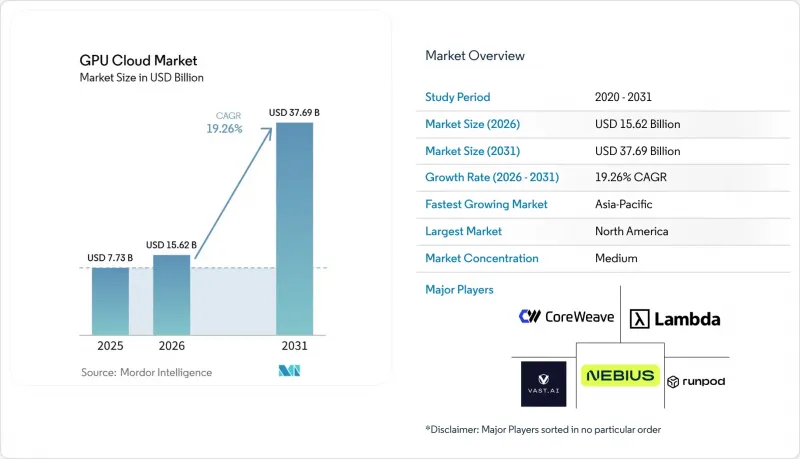
Mordor Intelligence에 의하면, GPU 클라우드 시장 규모는 2025년 77억 3,000만 달러에서 2026년에는 156억 2,000만 달러로 확대되어 2031년까지 376억 9,000만 달러에 이를 것으로 예상되고 있어 2026년부터 2031년까지 CAGR 19.26%로 성장할 전망입니다.
본 보고서는 서비스 모델(IaaS, PaaS), GPU 워크로드 유형(AI 훈련, 대규모 HPC GPU 인스턴스 등), 호스팅 모델(호스트형 프라이빗 GPU 클라우드 등), 조직 규모(중소기업 등), 용도(AI 훈련 및 파인 튜닝 등), 최종 사용자(IT, 통신, 소프트웨어 및 인터넷 플랫폼 등), 지역별로 분류되어 있습니다. 시장 전망은 금액(달러) 기준으로 제시되어 있습니다.
세계 GPU 클라우드 시장 동향 및 인사이트
증가하는 생성형 AI 및 LLM 훈련 수요
생성형 AI 및 대규모 언어 모델(LLM)의 개발은 계속해서 GPU 클라우드 시장 수요를 견인하는 핵심 요인으로 작용하고 있습니다. 새로운 모델이 세대를 거듭할수록 더 대규모의 훈련 클러스터, 더 고밀도의 네트워크, 그리고 배포당 메모리 용량의 증대가 필요해짐에 따라, 제공업체들은 더 조기에, 그리고 더 장기적인 계약을 통해 용량을 확보해야 하는 압박을 받고 있습니다. 이러한 상황으로 인해 이미 대규모 GPU 리소스를 보유하고 긴밀하게 통합된 훈련 환경을 제공할 수 있는 사업자의 우위가 높아지고 있습니다. 또한, 초대형 모델 구축에는 제한된 수의 제공업체만이 대규모로 구축할 수 있는 특수한 인프라가 필요하기 때문에 GPU 클라우드 시장은 훈련 스택의 업스트림 부문에서 더욱 집중화되고 있습니다. CoreWeave의 공시 문서 및 사업 공개 자료를 통해, 대규모 GPU 플릿에 대한 접근성과 대규모 데이터센터 확보가 이 시장에서 훈련에 특화된 제공업체에게 결정적인 경쟁 우위가 되고 있음이 드러났습니다. 또한, CoreWeave가 2025년 3월에 발표한 IPO 소식은 투자자들이 대규모 AI 컴퓨팅 용량을 일시적인 구축 주기가 아닌 지속적인 성장 분야로 인식하고 있음을 더욱 뒷받침하는 것이었습니다.
에이전트형 AI 추론 워크로드의 성장
GPU 클라우드 시장은 에이전트형 AI 추론 워크로드의 급속한 증가에 의해서도 견인되고 있습니다. 프로덕션 환경의 에이전트는 단순히 프롬프트에 응답하는 것뿐만 아니라, 단일 작업에 대해 여러 사이클에 걸쳐 행동 계획 수립, 컨텍스트 파악, 도구 실행, 출력 평가를 수행합니다. 이러한 패턴으로 인해 추론 클러스터는 더 오랜 기간 가동되며, GPU 클라우드 시장에서 저지연 서빙 능력의 가치가 높아집니다. NVIDIA 경영진은 2025년에 에이전트형 추론에는 초기 생성형 AI 시스템보다 훨씬 더 많은 연산 능력이 필요할 수 있다고 밝혔으며, 이는 향후 서빙 수요가 더욱 증가할 것이라는 전망을 뒷받침합니다. CoreWeave가 2026년 5월에 통합된 에이전트형 AI 플랫폼을 출시한 것은 제공업체가 강화 학습, 프로덕션 환경에서의 추론, 가시성, 지속적인 개선을 하나의 관리된 워크플로우로 통합하고 있음을 보여줍니다. 이러한 운영 모델이 보편화됨에 따라 GPU 클라우드 시장은 순수한 훈련 중심의 이용 곡선에서 보다 지속적인 추론 수요로 전환되고 있습니다.
HBM 및 첨단 패키징공급 제약
고대역폭 메모리(HBM)는 여전히 GPU 클라우드 시장에 있어 가장 두드러진 물리적 병목 현상으로 남아 있습니다. 이는 최신 AI 가속기가 대규모 성능을 발휘하기 위해 HBM에 의존하고 있기 때문입니다. 메모리 공급이 부족해지면, 데이터센터 공간이나 구매자의 관심이 여전히 높더라도 클라우드 제공업체는 수요와 같은 속도로 도입 가능한 용량을 확대할 수 없게 됩니다. 이러한 압박은 칩 수요를 실용적인 시스템으로 전환하는 과정을 지연시키는 첨단 패키징 제약으로 인해 더욱 가중되고 있습니다. 2026년 AMD의 리더십에 관한 보고서에서는 HBM 수요 증가율이 공급 증가율을 상회하고 있는 반면, 주요 공급업체들은 이미 2026년 HBM3E 생산 물량을 모두 매진했다고 지적하고 있습니다. 따라서 GPU 클라우드 시장에서는 공급 접근성이 일반적인 조달 요소라기보다는 경쟁상의 장벽으로 기능하고 있기 때문에 장기적인 할당 관계를 구축한 제공업체가 유리한 입장에 있습니다. 이러한 제약은 신규 진출기업이 GPU 클라우드 시장의 가장 가치 높은 분야에서 기존 사업자에게 얼마나 신속하게 도전할 수 있는지를 제한하는 요인이 되고 있습니다.
부문 분석
2025년, GPU 클라우드 시장의 78.66%를 ‘Infrastructure as a Service(IaaS)’가 차지했으며, 이는 연산, 네트워크, 메모리 정책을 직접 제어하고자 하는 구매자에게 있어 지배적인 서비스 계층이 되었습니다. 이러한 상황은 GPU 클라우드 시장이 아직 초기 성숙 단계에 있음을 반영하며, 많은 주요 고객들은 여전히 환경을 직접 구축하고 조정하는 것을 선호했습니다. 프레임워크, 클러스터 설계, 확장 규칙에 걸친 유연성을 필요로 하는 훈련을 많이 수행하는 사용자에게는 GPU에 대한 직접 접근이 여전히 매력적이었습니다. 서비스 구성을 살펴보아도 구매자의 기대가 변화하기 시작했음에도 불구하고, 지출의 대부분은 여전히 인프라 계층에 가장 가까운 부분에 집중되어 있는 것으로 나타났습니다.
PaaS(Platform as a Service)는 2031년까지 연평균 성장률(CAGR) 19.32%를 나타낼 것으로 예측되며, 이는 원시 용량과 관리형 AI 환경 간의 격차가 꾸준히 좁혀지고 있음을 보여줍니다. 기업들이 단일 운영 계층 내에서 오케스트레이션, 가시성, 강화 학습 워크플로우 및 모델 서빙을 점점 더 필요로 함에 따라, GPU 클라우드 시장은 이러한 방향으로 움직이고 있습니다. CoreWeave가 2026년 5월에 통합된 에이전트형 AI 기능을 출시한 것은 제공업체들이 단순한 컴퓨팅 제공에 그치지 않고 훈련 및 추론 운영을 폐쇄형 개선 루프에 통합하고 있음을 보여줍니다. 이는 고객이 더 빠른 도입과 엔지니어링 오버헤드 감소를 요구하는 가운데, GPU 클라우드 시장이 IaaS를 대체하는 것이 아니라 그 위에 추가적인 부가가치를 제공하고 있음을 의미합니다. 장기적으로는 견고한 인프라와 실용적인 플랫폼 도구를 결합한 제공업체가, 단순히 GPU 접근성만으로 경쟁하는 제공업체보다 더 확고한 입지를 다지게 될 것입니다.
2025년 워크로드 분류별 GPU 클라우드 시장에서 ‘AI 훈련 및 대규모 HPC GPU 인스턴스’는 62.34%의 점유율을 차지했습니다. 이러한 선두 위상은 최첨단 모델 개발, 대기업의 파인 튜닝 프로그램, 그리고 여전히 대규모 훈련 클러스터를 필요로 하는 연구 계산 프로젝트에 지출이 집중되고 있음을 반영합니다. GPU 클라우드 시장의 초기 단계에서는 훈련 수요가 공급업체의 데이터센터 규모, 상호 연결 설계, 그리고 용량 계획 모델 구축 방식을 결정지었습니다. 이러한 워크로드는 정의된 프로젝트 기간 동안 여전히 고밀도이자 고부가가치의 연산 자원을 소비하기 때문에 중심적인 위치를 차지하고 있습니다. 또한 고객은 까다로운 모델 개발 작업을 얼마나 적절하게 지원할 수 있는지에 따라 플랫폼의 강점을 판단하는 경우가 많기 때문에 훈련은 계속해서 제공업체 평판의 기반이 되고 있습니다.
AI 추론 및 범용 가속 컴퓨팅용 GPU 인스턴스는 2031년까지 연평균 성장률(CAGR) 19.41%를 나타낼 것으로 예측되며, 이는 GPU 클라우드 시장이 향후 시간과 용량을 어디에 더 많이 할당할지에 있어 명확한 변화를 보여줍니다. 모델이 프로덕션 환경으로 전환되면, 더 엄격한 지연 시간 요구 사항과 더 긴 사용 주기를 수반하는 지속적인 서빙 수요가 발생합니다. 이로 인해 GPU 클라우드 시장의 경제성이 변화합니다. 왜냐하면 추론은 단일 훈련 실행보다 모델의 운영 기간 전체에 걸쳐 더 많은 총 연산 시간을 축적할 가능성이 있기 때문입니다. 2025년 ECRTS에서 발표된 NVIDIA GPU의 하드웨어 연산 파티셔닝에 관한 연구에서는 다양한 워크로드 프로파일 전반에 걸쳐 활용도를 높일 수 있는 보다 효율적인 스케줄링 기법이 제시되었습니다. 프로덕션 환경에서 AI가 확대됨에 따라, GPU 클라우드 시장 제공업체들은 훈련의 신뢰성과 견고한 추론 아키텍처, 그리고 엄격한 스케줄링 간의 균형을 맞추어야 할 필요가 생깁니다.
지역별 분석
2025년, 북미는 GPU 클라우드 시장의 72.76%를 차지하며 현재 세계 수요의 중심지로서 확고한 입지를 다졌습니다. 이 지역은 최첨단 AI 연구소, 주요 하이퍼스케일러, 풍부한 민간 자본, 그리고 AI를 도입하는 기업의 광범위한 기반이 집중되어 있다는 이점을 가지고 있습니다. GPU 클라우드 시장에서 이는 공급업체, 구매자, 기술 인력이 서로 인접해 있어 인프라 구축부터 상용화까지의 과정을 단축하는 선순환을 만들어내고 있습니다. 캐나다와 멕시코 역시 데이터센터 확장, 국경을 초월한 서비스 제공, 그리고 미국 수요 패턴에 대한 근접성을 통해 이 지역의 위상을 뒷받침하고 있습니다.
유럽은 GPU 클라우드 시장에서 2위의 점유율을 차지하고 있으며, 그 성장 경로는 단순한 규모 확대라기보다는 주권 요건에 의해 형성되고 있습니다. 이 지역 수요는 데이터 거주 요건과 관련된 규정 준수 기대, 규제 대상인 AI의 활용, 그리고 인프라에 대한 보다 강력한 현지 관리의 필요성에 의해 주도되고 있습니다. 이는 충분한 용량과 함께 해당 지역 내 신뢰 및 인증 지위를 겸비한 공급자에게 유리하게 작용합니다. 도이치 텔레콤의 뮌헨 AI 팩토리 계획은 유럽의 기존 사업자들이 산업용 및 규제 대상 이용 사례를 지원하기 위해 국내에 대규모 GPU 인프라를 구축하고 있음을 보여줍니다. 또한 네비우스(Nebius)도 2026년 6월, 영국 내 NVIDIA 기반 신규 인프라 구축에 약 17억 파운드(약 21억 6,000만 달러)를 투자하겠다고 발표했습니다. 이러한 움직임은 유럽의 GPU 클라우드 시장이 단순한 규모가 아니라 현지 용량의 중요성을 중심으로 구축되고 있음을 보여줍니다.
아시아태평양은 2031년까지 연평균 성장률(CAGR) 19.68%를 나타낼 것으로 예측되며, GPU 클라우드 시장에서 가장 성장세가 두드러지는 지역 부문입니다. 이러한 성장은 국내 AI 프로그램의 확대, 기업의 도입 증가, 그리고 국가 및 지역의 데이터 요구 사항을 충족할 수 있는 현지 인프라에 대한 수요에 힘입고 있습니다. 2026년 4월 마이크로소프트가 일본에 대해 발표한 100억 달러 규모의 투자는 AI 인프라, 사이버 보안, 인재 양성을 위해 현재 유입되고 있는 지역 투자의 규모를 여실히 보여주었습니다. 남미, 중동 및 아프리카는 GPU 클라우드 시장에서 여전히 초기 단계에 있지만, 현지 호스팅 수요와 국가 차원의 컴퓨팅 전략이 인프라에 대한 관심을 끌기 시작하면서 선정된 성장 지역으로 발전하고 있습니다.
기타 혜택:
- 엑셀 형식 시장 예측(ME) 시트
- 3개월간의 애널리스트 지원
자주 묻는 질문
목차
제1장 서론
제2장 조사 방법
제3장 주요 요약
제4장 시장 구도
제5장 시장 규모와 성장 예측
제6장 경쟁 구도
제7장 시장 기회와 향후 전망
JHS 26.08.05According to Mordor Intelligence, the GPU cloud market size is expected to increase from USD 7.73 billion in 2025 to USD 15.62 billion in 2026 and reach USD 37.69 billion by 2031, growing at a CAGR of 19.26% over 2026-2031.
This report is Segmented by Service Model (IaaS, and PaaS), GPU Workload Class (AI Training and Large-Scale HPC GPU Instances, and More), Hosting Model (Hosted Private GPU Cloud, and More), Organization Size (SMEs, and More), Application (AI Training and Fine-Tuning, and More), End-User (IT, Telecom, Software and Internet Platforms, and More), and Geography. The Market Forecasts are Provided in Terms of Value (USD).
Global GPU Cloud Market Trends and Insights
Rising Generative AI And LLM Training Demand
Generative AI and large language model development remain the central demand engine for the GPU cloud market. Each new model generation requires larger training clusters, denser networking, and more memory per deployment, which pushes providers to secure capacity earlier and on longer terms. This has increased the advantage of operators that already control large GPU estates and can deliver tightly integrated training environments. The GPU cloud market is also becoming more concentrated at the top of the training stack because very large model builds need specialized infrastructure that only a limited number of providers can assemble at scale. CoreWeave's public filings and operating disclosures showed how access to large GPU fleets and large data center commitments became a defining competitive asset for training-focused providers in this market. CoreWeave's March 2025 IPO announcement further showed that investors viewed large-scale AI compute capacity as a durable growth category rather than a short-lived build cycle.
Growth In Agentic AI Inference Workloads
The GPU cloud market is also being pushed forward by a rapid increase in agentic AI inference workloads. Production agents do more than answer prompts because they plan actions, retrieve context, invoke tools, and evaluate outputs across multiple cycles for a single task. That pattern keeps inference clusters active for longer periods and raises the value of low-latency serving capacity inside the GPU cloud market. NVIDIA leadership stated in 2025 that agentic inference can require far more compute than early generative AI systems, which supports the expectation of heavier serving demand over time. CoreWeave's May 2026 launch of a unified agentic AI platform showed how providers are linking reinforcement learning, production inference, observability, and continuous improvement into one managed workflow. As this operating model spreads, the GPU cloud market is shifting toward more persistent inference demand and away from a purely training-led utilization curve.
HBM And Advanced Packaging Supply Constraints
High-bandwidth memory remains the clearest physical bottleneck for the GPU cloud market because modern AI accelerators depend on it for performance at scale. When memory supply tightens, cloud providers cannot expand deployable capacity at the same pace as demand, even if data center space and buyer interest remain strong. This pressure is amplified by advanced packaging constraints, which slow the conversion of chip demand into usable systems. Reporting tied to AMD leadership in 2026 noted that HBM demand growth was outpacing supply growth, while major suppliers had already sold through their 2026 HBM3E output. The GPU cloud market, therefore, rewards providers with long-term allocation relationships because supply access is functioning as a competitive moat rather than a normal procurement input. This constraint also limits how quickly new entrants can challenge established operators in the highest-value parts of the GPU cloud market.
Other drivers and restraints analyzed in the detailed report include:
- Enterprise Shift Toward Elastic Pay-Per-Use GPU Capacity
- Sovereign AI And Data Residency Requirements
- GPU Spot Price Volatility And Capacity Hoarding
For complete list of drivers and restraints, kindly check the Table Of Contents.
Segment Analysis
Infrastructure as a Service accounted for 78.66% of the GPU cloud market in 2025, which made it the dominant service layer for buyers that wanted direct control over compute, networking, and memory policies. That position reflected the early maturity of the GPU cloud market, where many large customers still preferred to assemble and tune environments themselves. Raw GPU access remained attractive for training-heavy users who needed flexibility across frameworks, cluster designs, and scaling rules. The service mix also showed that most spending still sat closest to the infrastructure layer, even as buyer expectations were beginning to change.
Platform as a Service is projected to grow at a 19.32% CAGR through 2031, which points to a steady narrowing between raw capacity and managed AI environments. The GPU cloud market is moving in this direction because enterprises increasingly need orchestration, observability, reinforcement learning workflows, and model serving within one operating layer. CoreWeave's May 2026 rollout of unified agentic AI capabilities illustrated how providers are folding training and inference operations into a closed improvement loop rather than offering compute alone. This means the GPU cloud market is not replacing IaaS, but it is adding more value above it as customers push for faster deployment and lower engineering overhead. Over time, providers that combine strong infrastructure with usable platform tooling should hold a more durable position than providers that compete on GPU access alone.
AI Training and Large-Scale HPC GPU Instances held a 62.34% share of the GPU cloud market by workload class in 2025. That lead reflected the heavy concentration of spending around frontier model development, large enterprise fine-tuning programs, and research computing projects that still required large training clusters. In the earlier phase of the GPU cloud market, training demand shaped how providers built data center footprints, interconnect designs, and capacity planning models. Those workloads remain central because they still consume dense, high-value compute over defined project windows. Training also continues to anchor provider reputation because customers often judge platform strength by how well it supports demanding model development tasks.
AI Inference and General Accelerated Compute GPU Instances are projected to grow at a 19.41% CAGR through 2031, which marks a clear change in where the GPU cloud market will spend more time and capacity. Once models move into production, they create continuous serving demand with tighter latency requirements and longer utilization cycles. That changes the economics of the GPU cloud market because inference can accumulate more total compute-hours over a model's operating life than a single training run. Research presented at ECRTS in 2025 on hardware compute partitioning for NVIDIA GPUs pointed to more efficient scheduling approaches that can improve utilization across varied workload profiles. As production AI expands, providers in the GPU cloud market will need to balance training credibility with strong inference architecture and scheduling discipline.
Complete Report Scope:
- By Service Model
- Infrastructure as a Service
- Platform as a Service
- By GPU Workload Class
- AI Training and Large-Scale HPC GPU Instances
- AI Inference and General Accelerated Compute GPU Instances
- Graphics, Visualization, Rendering, and VDI GPU Instances
- Cost-Optimized and Legacy GPU Instances
- By Hosting Model
- Shared Multi-Tenant Public GPU Cloud
- Dedicated Single-Tenant GPU Cloud
- Hosted Private GPU Cloud
- Sovereign and Regulated GPU Cloud
- By Organization Size
- Large Enterprises
- Small and Medium Enterprises
- Research Institutions, Academia, and Public-Sector Organizations
- By Application
- AI Training and Fine-Tuning
- AI Inference and Model Serving
- High-Performance Computing and Scientific Simulation
- Rendering, Animation, VFX, and Virtual Production
- Cloud Gaming
- Others (Visualization, Virtual Workstations, and Digital Twins)
- By End-User Industry
- IT, Telecom, Software, and Internet Platforms
- Media, Entertainment, Gaming, and Advertising
- BFSI
- Automotive, Mobility, and Autonomous Systems
- Healthcare, Life Sciences, and Pharmaceuticals
- Manufacturing, Semiconductor, and Industrial
- Other End-User Industries (Retail and E-Commerce, Energy and Utilities)
- By Geography
- North America
- United States
- Canada
- Mexico
- Europe
- Germany
- United Kingdom
- France
- Italy
- Rest of Europe
- Asia-Pacific
- China
- Japan
- South Korea
- India
- Southeast Asia
- Rest of Asia-Pacific
- South America
- Middle East and Africa
- North America
Geography Analysis
North America held 72.76% of the GPU cloud market in 2025, which made it the clear center of current global demand. The region benefits from the concentration of frontier AI labs, major hyperscalers, deep private capital pools, and a large base of enterprise AI adopters. In the GPU cloud market, this creates a reinforcing cycle where providers, buyers, and technical talent remain close to one another and shorten the path from infrastructure buildout to commercial use. Canada and Mexico also support the regional position through data center expansion, cross-border provisioning, and adjacency to the United States demand patterns.
Europe held the second-largest share of the GPU cloud market, and its growth path is being shaped less by raw scale and more by sovereignty requirements. Demand in the region is being pulled by compliance expectations tied to data residency, regulated AI use, and the need for stronger local control over infrastructure. This favors providers that can combine meaningful capacity with regional trust and certification positioning. Deutsche Telekom's Munich AI factory plan showed how European incumbents are building large domestic GPU estates to support industrial and regulated use cases. Nebius also announced in June 2026 that it would invest approximately GBP 1.7 billion, approximately USD 2.16 billion, in new NVIDIA-powered infrastructure deployments in the United Kingdom. These moves show that the GPU cloud market in Europe is being built around local capacity relevance rather than volume alone.
Asia-Pacific is projected to grow at a 19.68% CAGR through 2031, which makes it the fastest-growing regional segment in the GPU cloud market. Growth is being supported by expanding domestic AI programs, rising enterprise adoption, and the need for local infrastructure that can support national and regional data requirements. Microsoft's USD 10 billion commitment in Japan in April 2026 underscored the scale of regional investment now flowing into AI infrastructure, cybersecurity, and talent capacity. South America and the Middle East and Africa remain earlier-stage parts of the GPU cloud market, but they are developing as selective growth zones where local hosting demand and sovereign compute ambitions are starting to attract more infrastructure attention.
- CoreWeave, Inc.
- Lambda, Inc.
- RunPod, Inc.
- Vast.ai, Inc.
- Nebius Group N.V.
- Crusoe Energy Systems LLC
- FluidStack Limited
- Voltage Park, Inc.
- WhiteFiber LLC
- Denvr Dataworks Corp.
- Genesis Cloud GmbH
- Scaleway S.A.S.
- OVH SAS
- The Constant Company, LLC
- Northern Data AG
- DigitalOcean, LLC
- Cirrascale Cloud Services, Inc.
- TensorWave, Inc.
- NexGen Cloud Limited
- Jarvislabs.ai Private Limited
Additional Benefits:
- The market estimate (ME) sheet in Excel format
- 3 months of analyst support
TABLE OF CONTENTS
1 INTRODUCTION
- 1.1 Study Assumptions and Market Definition
- 1.2 Scope of the Study
2 RESEARCH METHODOLOGY
3 EXECUTIVE SUMMARY
4 MARKET LANDSCAPE
- 4.1 Market Overview
- 4.2 Impact of Macroeconomic Factors on the Market
- 4.3 Market Drivers
- 4.3.1 Rising Generative AI and LLM Training Demand
- 4.3.2 Growth in Agentic AI Inference Workloads
- 4.3.3 Expansion of GPU-Heavy Cloud Gaming and Real-Time Rendering
- 4.3.4 Enterprise Shift Toward Elastic Pay-Per-Use GPU Capacity
- 4.3.5 Sovereign AI and Data Residency Requirements
- 4.3.6 Fractional GPU Scheduling and Composable GPU Fabrics
- 4.4 Market Restraints
- 4.4.1 HBM and Advanced Packaging Supply Constraints
- 4.4.2 GPU Spot Price Volatility and Capacity Hoarding
- 4.4.3 Energy and Cooling Intensity of Dense GPU Racks
- 4.4.4 Customer Lock-In Around Specialized AI Toolchains
- 4.5 Industry Value Chain Analysis
- 4.6 Regulatory Landscape
- 4.7 Technological Outlook
- 4.8 Porter's Five Forces Analysis
- 4.8.1 Threat of New Entrants
- 4.8.2 Bargaining Power of Suppliers
- 4.8.3 Bargaining Power of Buyers
- 4.8.4 Threat of Substitutes
- 4.8.5 Competitive Rivalry
5 MARKET SIZE AND GROWTH FORECASTS (VALUE)
- 5.1 By Service Model
- 5.1.1 Infrastructure as a Service
- 5.1.2 Platform as a Service
- 5.2 By GPU Workload Class
- 5.2.1 AI Training and Large-Scale HPC GPU Instances
- 5.2.2 AI Inference and General Accelerated Compute GPU Instances
- 5.2.3 Graphics, Visualization, Rendering, and VDI GPU Instances
- 5.2.4 Cost-Optimized and Legacy GPU Instances
- 5.3 By Hosting Model
- 5.3.1 Shared Multi-Tenant Public GPU Cloud
- 5.3.2 Dedicated Single-Tenant GPU Cloud
- 5.3.3 Hosted Private GPU Cloud
- 5.3.4 Sovereign and Regulated GPU Cloud
- 5.4 By Organization Size
- 5.4.1 Large Enterprises
- 5.4.2 Small and Medium Enterprises
- 5.4.3 Research Institutions, Academia, and Public-Sector Organizations
- 5.5 By Application
- 5.5.1 AI Training and Fine-Tuning
- 5.5.2 AI Inference and Model Serving
- 5.5.3 High-Performance Computing and Scientific Simulation
- 5.5.4 Rendering, Animation, VFX, and Virtual Production
- 5.5.5 Cloud Gaming
- 5.5.6 Others (Visualization, Virtual Workstations, and Digital Twins)
- 5.6 By End-User Industry
- 5.6.1 IT, Telecom, Software, and Internet Platforms
- 5.6.2 Media, Entertainment, Gaming, and Advertising
- 5.6.3 BFSI
- 5.6.4 Automotive, Mobility, and Autonomous Systems
- 5.6.5 Healthcare, Life Sciences, and Pharmaceuticals
- 5.6.6 Manufacturing, Semiconductor, and Industrial
- 5.6.7 Other End-User Industries (Retail and E-Commerce, Energy and Utilities)
- 5.7 By Geography
- 5.7.1 North America
- 5.7.1.1 United States
- 5.7.1.2 Canada
- 5.7.1.3 Mexico
- 5.7.2 Europe
- 5.7.2.1 Germany
- 5.7.2.2 United Kingdom
- 5.7.2.3 France
- 5.7.2.4 Italy
- 5.7.2.5 Rest of Europe
- 5.7.3 Asia-Pacific
- 5.7.3.1 China
- 5.7.3.2 Japan
- 5.7.3.3 South Korea
- 5.7.3.4 India
- 5.7.3.5 Southeast Asia
- 5.7.3.6 Rest of Asia-Pacific
- 5.7.4 South America
- 5.7.5 Middle East and Africa
- 5.7.1 North America
6 COMPETITIVE LANDSCAPE
- 6.1 Market Concentration
- 6.2 Strategic Moves
- 6.3 Market Positioning Analysis
- 6.4 Company Profiles (includes Global Level Overview, Market Level Overview, Core Segments, Financials as available, Strategic Information, Market Rank/Share, Products and Services, Recent Developments)
- 6.4.1 CoreWeave, Inc.
- 6.4.2 Lambda, Inc.
- 6.4.3 RunPod, Inc.
- 6.4.4 Vast.ai, Inc.
- 6.4.5 Nebius Group N.V.
- 6.4.6 Crusoe Energy Systems LLC
- 6.4.7 FluidStack Limited
- 6.4.8 Voltage Park, Inc.
- 6.4.9 WhiteFiber LLC
- 6.4.10 Denvr Dataworks Corp.
- 6.4.11 Genesis Cloud GmbH
- 6.4.12 Scaleway S.A.S.
- 6.4.13 OVH SAS
- 6.4.14 The Constant Company, LLC
- 6.4.15 Northern Data AG
- 6.4.16 DigitalOcean, LLC
- 6.4.17 Cirrascale Cloud Services, Inc.
- 6.4.18 TensorWave, Inc.
- 6.4.19 NexGen Cloud Limited
- 6.4.20 Jarvislabs.ai Private Limited
7 MARKET OPPORTUNITIES AND FUTURE OUTLOOK
- 7.1 White-space and Unmet-Need Assessment


