
|
시장보고서
상품코드
2117990
미국의 저발연 무할로겐(LSZH) 케이블 시장 : 시장 점유율 분석, 업계 동향 및 통계, 성장 예측(2026-2031년)United States Low Smoke Zero Halogen (LSZH) Cables - Market Share Analysis, Industry Trends & Statistics, Growth Forecasts (2026 - 2031) |
||||||
 Mordor Intelligence
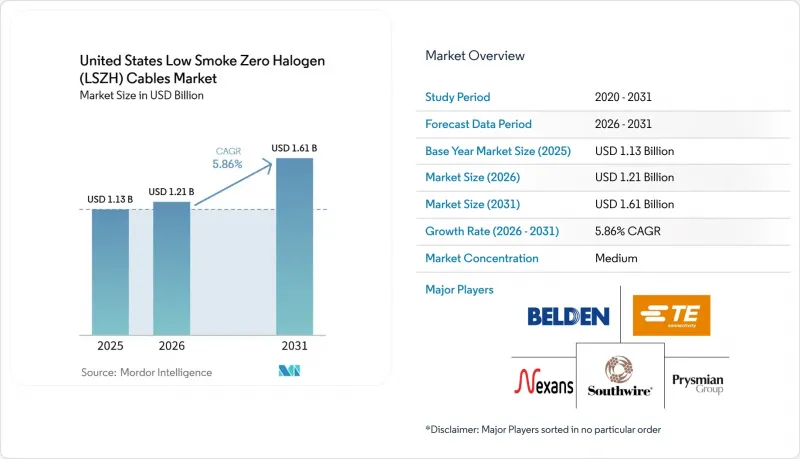
Mordor Intelligence에 의하면, 미국의 저발연 무할로겐(LSZH) 케이블 시장 규모는 2025년에 11억 3,000만 달러로 평가되었고, 2026년 12억 1,000만 달러로 추정되며, 2031년까지 16억 1,000만 달러에 이를 것으로 예측됩니다.
예측 기간(2026-2031년) 연평균 성장률(CAGR)은 5.86%를 나타낼 전망입니다.
본 보고서는 케이블 유형별(LSZH 전력 케이블, LSZH 제어·계장용 케이블, LSZH 데이터 통신 케이블, LSZH 광섬유 케이블, 기타), 정격 전압별(1kV 미만, 1-35kV, 기타), 절연 재료별(PVC(폴리염화비닐), XLPE(가교 폴리에틸렌), PE(폴리에틸렌), 기타), 최종 사용자별(상업용 건물, 데이터센터, 재생에너지, 교통 인프라, 기타)로 분류되어 있습니다. 예측치는 금액(달러)으로 표시되어 있습니다.
미국의 저발연 무할로겐(LSZH) 케이블 시장 동향 및 인사이트
화재 방지 기준 및 건축 기준 준수 요건의 강화
방화 규제는 미국 내 저발연 무할로겐(LSZH) 케이블 시장에서 여전히 가장 강력한 수요 동인으로 작용하고 있습니다. 이는 케이블 선택 기준이 구매자의 선호에서 설계 요건으로 전환되고 있기 때문입니다. NFPA 70, NFPA 130, NFPA 502는 화재 시 연기 방출 및 회로 무결성이 중요한 밀폐된 건물, 교통 시스템, 터널 및 기타 중요 시설에서 케이블 선정 기준을 규정하고 있습니다. 특히 NFPA 130은 교통 기관이 지하역, 여객용 터널, 철도 차량에서 이를 채택하고 있기 때문에 매우 중요하며, 그로 인해 LSZH 사양이 광범위한 프로젝트 범위에 적용되고 있습니다. 2025년 6월에 발행된 ANSI/UL 2196 제3판에는 개정된 양자간 시험 기준이 추가됨에 따라, 기존 제품 라인은 내화 용도로 계속 사용하기 전에 재인증을 받아야 합니다. 2025년 IEEE 가이드에서는 이러한 표준 요구 사항이 견인 전력, 신호 및 통신 시스템을 위한 실용적인 케이블 선정 지침으로 전환되어, 조달 팀이 규정 준수 설계에서 벗어날 여지가 줄어들었습니다. 이러한 추세는 미국의 저발연 무할로겐(LSZH) 케이블 시장에서 수요가 조기에 확정된 후, 수년에 걸친 인프라 프로그램을 통해 지속되고 있음을 보여줍니다.
하이퍼스케일 데이터센터에 대한 투자 확대
미국의 저발연 무할로겐(LSZH) 케이블 시장에서는 AI 주도형 데이터센터 투자로 인해 케이블 수요가 증가하는 동시에 더 높은 열 성능이 요구됨에 따라 수요 상한선이 높아지고 있습니다. Meta는 2026년 7월, 루이지애나주 리치랜드 패리시에 위치한 캠퍼스를 AI 연산 능력 5GW, 면적 약 1,000만 제곱피트 규모로 확장한다고 발표했으며, 이 프로젝트에 500억 달러 이상을 투자할 것이라고 밝혔습니다. 이 규모의 프로젝트에서는 배전, 구조화 케이블 배선, 네트워크실, 연기 제어가 필요한 기타 밀폐된 운영 구역에서 필요한 LSZH 케이블의 양이 증가합니다. 프리즈미안(Prismian)이 2025년 7월 중공 코어 광섬유의 대규모 양산에 착수한 것은 각 공급업체들이 더 빠르고 고밀도이며 저지연 데이터센터 네트워크에 맞추어 제품 로드맵을 조정하고 있음을 보여줍니다. 2025년 7월, 높은 성장이 예상되는 GPU 환경을 위해 출시된 AFL의 모듈형 광섬유 플랫폼 ‘DENALI’는 데이터센터의 케이블 사양이 기존의 표준 엔터프라이즈 설계의 틀을 넘어 변화하고 있음을 보여줍니다. 그 결과, 미국의 LSZH 케이블 시장은 시설 수 증가뿐만 아니라 시설당 케이블 사용량 증가로도 혜택을 보고 있습니다.
무할로겐 화합물의 가격 변동
업스트림 공급망은 여전히 집중되어 있어 헤지하기 어렵기 때문에 투입 비용의 변동은 미국 저발연 무할로겐(LSZH) 케이블 시장에서 여전히 가장 시급한 과제로 남아 있습니다. 클라리언트(Clariant)는 Fastmarkets의 데이터를 인용하여, 중국의 수출 규제와 후난성의 생산 중단을 배경으로 1980년대 초 이후 가장 급격한 가격 급등을 겪은 삼산화안티몬이 2025년 초에 톤당 5만 1,500달러에 달할 가능성이 있다고 지적했습니다. 안티몬은 브롬계 시스템과 더 직접적인 관련이 있지만, 가격 상승 압력은 난연제 공급망 전체로 파급되어 LSZH 피복 배합의 수익성에 영향을 미치고 있습니다. 원자재비는 HFFR 컴파운드 제조 비용의 60-80%를 차지하기 때문에 단기적인 가격 변동은 곧바로 완제품 케이블 가격에 반영되어 제조업체의 이익률을 압박하게 됩니다. 또한 클라리언트(Clariant)는 2025년 안티몬 가격이 정점에 달했을 때, 자사의 ‘Exolit OP’ 플랫폼이 기존 브롬·안티몬계 시스템에 비해 10-15%의 비용 절감을 실현할 수 있을 것이라고 밝혔습니다. 이는 배합 전략이 얼마나 경쟁상의 지렛대 역할을 하고 있는지를 여실히 보여줍니다. 컴파운드 조달 능력, 배합 관리 능력, 또는 수직 통합의 폭이 넓은 공급업체일수록 미국 LSZH 케이블 시장에서 입지를 지키는 데 유리한 위치에 있습니다.
부문 분석
저발연 무할로겐(LSZH) 데이터 통신 케이블은 케이블 유형 중 가장 큰 점유율을 유지할 것으로 예상되며, 2025년에는 미국 저발연 무할로겐(LSZH) 케이블 시장의 21.34%를 차지했습니다. 이러한 주도적인 지위는 코로케이션 데이터센터, 하이퍼스케일 캠퍼스, 기업 거점, 통신국에 구조화된 케이블 배선이 고도로 집중되어 있음을 반영합니다. 이러한 시설은 고밀도 케이블 네트워크에 의존하고 있으며, 저발연 무할로겐 성능을 선택 사양이 아닌 기본 요건으로 취급하는 것이 일반적입니다. 전력 케이블과 제어·계장용 케이블은 산업 플랜트, 유틸리티, 에너지 인프라를 뒷받침하고 있으며, 이러한 분야에서는 보험사나 EPC 계약업체들이 법규에서 의무화한 제한적인 범위를 넘어 LSZH 설계를 확대 적용하고 있습니다. 또한, 건축용 전선 및 특수 LSZH 케이블도 더 엄격한 내화 기준 준수가 요구되는 상업시설의 개보수, 교통 시스템, 터널, 회로 무결성 확보 용도에서 중요한 역할을 하고 있습니다.
광섬유 케이블은 케이블 유형 중 가장 빠른 성장세를 기록할 것으로 예상되며, 2026-2031년 연평균 성장률(CAGR) 6.45%를 나타낼 것으로 전망됩니다. 이러한 변화는 AI에 의한 상호 연결 밀도의 향상 및 데이터 집약형 용도에서 구리선에서 광섬유로의 전환과 관련이 있으며, 미국 LSZH 케이블 시장의 제품 구성을 재편하고 있습니다. 프리즘(Prismian)사가 2025년 7월에 중공 코어 광섬유에 투자한 것은 각 공급업체들이 규격에 부합하는 피복 시스템도 요구되는 밀폐 시설에서 더 높은 대역폭 요구 사항에 대비하고 있음을 보여줍니다. GPU를 많이 사용하는 환경과 10Gb/s에서 800Gb/s의 속도 범위를 위해 설계된 AFL의 DENALI 플랫폼 역시 성능에 대한 기대치의 이러한 변화를 반영하고 있습니다. 라이저 용도의 경우, UL 1666 및 UL 1685 준수가 여전히 중요합니다. 그 결과, 인증 취득 준비 상황은 처리량 및 지연 시간과 마찬가지로 구매 결정에 계속해서 큰 영향을 미치고 있습니다.
2025년에는 1kV 미만 부문이 미국 LSZH 케이블 시장의 32.45%를 차지한 것으로 평가되었습니다. 이 부문의 주도적 위상은 상업용 건물 배선, 데이터센터의 구조화 배선, 제어 회로 용도에서의 현재 수요 구성과 일치하며, 이러한 분야에서는 저전압 LSZH 제품이 이미 일반적인 사양으로 자리 잡고 있습니다. 미국 저발연 무할로겐(LSZH) 케이블 시장에서 이 부문은 정기적인 케이블 교체, 서비스 업그레이드, 임차인 리모델링 공사의 혜택을 받고 있습니다. 이는 초기 설계 단계에서 선정된 케이블이 일반적으로 건물의 수명 주기 동안 그대로 계속 사용되기 때문입니다. 36-65kV 및 65kV 이상의 부문은 주로 특수한 유틸리티 및 재생에너지의 계통 연계 용도를 대상으로 하기 때문에 시장 규모는 여전히 작은 임베디드니다. 이러한 고전압 범주에서는 더 복잡한 XLPE 절연 시스템, 무할로겐 외피, 더 긴 인증 주기가 필요하기 때문에 단기적인 판매량 증가에는 한계가 있습니다.
1-35kV 대역은 2031년까지 연평균 성장률(CAGR)이 5.92%로 예측되어, 가장 빠르게 성장하는 전압 부문이 될 것으로 전망됩니다. 이러한 성장은 유틸리티 규모의 배터리 연결 및 대규모 재생에너지 시설 내의 중전압 배전 요건과 밀접한 관련이 있습니다. 미국 에너지 정보국(EIA) 보고서에 따르면, 2026년에는 24GW의 배터리 저장 설비가 계획되어 있으며, 그 대부분이 텍사스주, 캘리포니아주, 애리조나주에 집중되어 있어 중전압 케이블 수요 전망은 견조합니다. 이러한 추세는 미국 저발연 무할로겐(LSZH) 케이블 산업의 구매층 확대로도 이어지고 있습니다. 이는 독립 발전 사업자(IPP)와 에너지 저장 시스템 개발업체들이 많은 기존 전력 회사의 조달 주기보다 더 신속하게 움직이고 있기 때문입니다. 이러한 프로젝트에서는 밀폐형 변전소, 인버터실, 제어동이 필수적이며, 중전압 시스템에서 LSZH 설계를 채택하는 것이 더욱 정당화되고 있습니다.
기타 혜택
- 엑셀 형식 시장 예측(ME) 시트
- 3개월간의 애널리스트 지원
목차
제1장 서론
제2장 조사 방법
제3장 주요 요약
제4장 시장 구도
제5장 시장 규모 및 성장 예측
제6장 경쟁 구도
제7장 시장 기회 및 향후 전망
AJYAccording to Mordor Intelligence, the United States low smoke zero halogen (LSZH) cables market size was valued at USD 1.13 billion in 2025 and estimated to grow from USD 1.21 billion in 2026 to reach USD 1.61 billion by 2031, at a CAGR of 5.86% during the forecast period (2026-2031).
This report is Segmented by Cable Type (Power, Control and Instrumentation, Data and Communication, Fiber Optic, Building Wires, and More), Voltage Rating (Less Than 1 KV, 1-35 KV, and More), Insulation Material (PVC, XLPE, PE, and More), and End User (Commercial Buildings, Data Centers, Renewable Energy, Transportation Infrastructure, and More). Forecasts in Value (USD).
United States Low Smoke Zero Halogen (LSZH) Cables Market Trends and Insights
Increasing Stringent Fire Safety and Building Code Compliance Drive Adoption
Fire safety rules remain the strongest demand trigger in the United States Low Smoke Zero Halogen (LSZH) cables market, as they shift cable choice from buyer preference to a design requirement. NFPA 70, NFPA 130, and NFPA 502 shape cable selection across enclosed buildings, transit systems, tunnels, and other critical sites where smoke release and circuit integrity matter during a fire. NFPA 130 is especially important because transit authorities use it across underground stations, passenger tunnels, and rail vehicles, thereby extending LSZH specifications across broad project scopes. The June 2025 third edition of ANSI/UL 2196 added revised binational testing criteria, so existing product lines now face requalification before they can continue serving fire-resistive applications. The 2025 IEEE guide translated these code requirements into practical cable-selection guidance for traction power, signaling, and communication systems, leaving procurement teams less room to deviate from compliant designs. This pattern indicates that the USA Low Smoke Zero Halogen cables market is seeing demand that is fixed early and then carried through multi-year infrastructure programs.
Growing Investments in Hyperscale Data Centers Fuel Demand for Low-Smoke Cabling
The United States Low Smoke Zero Halogen (LSZH) cables market is seeing a higher demand ceiling as AI-led data center investment is increasing cable volume and simultaneously driving higher thermal performance needs. Meta stated in July 2026 that it was expanding its Richland Parish, Louisiana campus to 5 GW of AI compute capacity and nearly 10 million square feet, with more than USD 50 billion committed to the project. Projects of that scale increase the amount of LSZH cabling required in power distribution, structured cabling, network rooms, and other enclosed operating areas where smoke control is required. Prysmian's July 2025 move to industrialize hollow-core optical fiber at scale shows that suppliers are aligning product road maps with faster, denser, and lower-latency data center networks. AFL's DENALI modular optical fiber platform, launched in July 2025 for high-growth GPU environments, shows how data center cable specifications are shifting beyond standard enterprise designs. As a result, the United States LSZH cables market is benefiting not only from more facilities, but also from a higher cable intensity per facility.
Halogen-Free Compound Price Volatility Challenges Manufacturer Margins
Input cost volatility remains the most immediate challenge in the United States Low Smoke Zero Halogen (LSZH) cables market, as the upstream supply chain remains concentrated and difficult to hedge. Clariant cited Fastmarkets data indicating that antimony trioxide could reach USD 51,500 per ton in early 2025, following the sharpest rally since the early 1980s, driven by Chinese export controls and production suspensions in Hunan province. Although antimony is more directly linked to brominated systems, price pressure spreads across the broader flame-retardant supply chain and affects the economics of LSZH jacket formulations. Raw materials can account for 60-80% of HFFR compound production costs, which means short-term price swings quickly affect finished cable pricing and compress manufacturer margins. Clariant also stated that its Exolit OP platform could deliver a 10-15% lower cost than conventional bromine-antimony systems when antimony prices peak in 2025. This highlights how formulation strategy is becoming a competitive lever. Suppliers with stronger compound sourcing, better formulation control, or broader vertical integration are better positioned to protect their position in the United States LSZH cables market.
Other drivers and restraints analyzed in the detailed report include:
- Rising Adoption in Transportation and Critical Infrastructure Expands the LSZH Install Base
- Expansion of Renewable Energy and Battery Storage Projects Accelerates LSZH Cable Demand
- Premium Pricing Creates Adoption Friction in Cost-Sensitive Applications
For complete list of drivers and restraints, kindly check the Table Of Contents.
Segment Analysis
Low Smoke Zero Halogen data and communication cables are expected to hold the largest share by cable type, accounting for 21.34% of the United States Low Smoke Zero Halogen (LSZH) cables market in 2025. This leadership reflects the high concentration of structured cabling across co-location data centers, hyperscale campuses, enterprise sites, and telecommunications central offices. These facilities rely on dense cable networks and often treat low-smoke, halogen-free performance as a baseline requirement rather than an optional specification. Power cables and control and instrumentation cables support industrial plants, utilities, and energy infrastructure, where insurers and EPC contractors are expanding the use of LSZH designs beyond limited code-mandated areas. Building wires and specialty LSZH cables also play important roles in commercial retrofits, transit systems, tunnels, and circuit-integrity applications that require compliance with more demanding fire-resistive standards.
Fiber-optic cables are projected to record the fastest growth among cable types, with a CAGR of 6.45% from 2026 to 2031. This shift is linked to AI-driven interconnect density and the transition from copper to fiber in data-intensive applications, reshaping the product mix in the US LSZH cables market. Prysmian's July 2025 investment in hollow-core optical fiber indicates that suppliers are preparing for higher bandwidth requirements in enclosed facilities that also require compliant jacketing systems. AFL's DENALI platform, designed for GPU-heavy environments and speeds ranging from 10 Gb/s to 800 Gb/s, reflects the same shift in performance expectations. Compliance with UL 1666 and UL 1685 remains important in riser applications. As a result, certification readiness continues to influence purchasing decisions as strongly as throughput and latency.
The segment below 1 kV is expected to account for 32.45% of the United States LSZH cable market in 2025. Its leadership aligns with the current demand mix across commercial building wire, data center structured cabling, and control circuit applications, where low-voltage LSZH products are already a common specification. This segment of the United States Low Smoke Zero Halogen (LSZH) cables market industry benefits from recurring replacement, service upgrades, and tenant improvement work, as cable choices made during the initial design phase typically remain in place throughout the building cycle. The 36-65 kV and above 65 kV segments remain narrower because they primarily serve specialized utility and renewable interconnection applications. These higher-voltage categories also require more complex XLPE insulation systems, halogen-free outer jackets, and longer qualification cycles, which limit their near-term volume base.
The 1-35 kV band is projected to be the fastest-growing voltage segment, registering a CAGR of 5.92% through 2031. This growth is closely tied to utility-scale battery storage interconnections and medium-voltage distribution requirements within large renewable energy sites. The U.S. Energy Information Administration reported that 24 GW of battery storage is planned for 2026, with most of it concentrated in Texas, California, and Arizona, creating a strong pipeline for medium-voltage cables. This trend is also broadening the buyer base in the United States Low Smoke Zero Halogen cables industry, as independent power producers and storage developers are moving faster than many traditional utility procurement cycles. Their projects depend on enclosed substations, inverter rooms, and control buildings, strengthening the case for LSZH designs in medium-voltage systems.
Complete Report Scope:
- By Cable Type
- LSZH Power Cables
- LSZH Control and Instrumentation Cables
- LSZH Data and Communication Cables
- LSZH Fiber Optic Cables
- LSZH Building Wires
- Specialty LSZH Cables
- By Voltage Rating
- Less Than 1 kV
- 1 - 35 kV
- 36 - 65 kV
- above 65KV
- By Insulation Material
- PVC (Polyvinyl Chloride)
- XLPE (Cross-linked Polyethylene)
- PE (Polyethylene)
- Other Insulation Materials
- By End User
- Commercial Buildings
- Industrial Manufacturing
- Data Centers
- Energy and Utilities
- Transportation Infrastructure
- Telecommunications
- Renewable Energy
- Others End User Industries
List of Companies Covered in this Report:
- Prysmian Group
- Nexans
- Southwire Company LLC
- Belden Inc.
- CommScope Holding Company Inc.
- Encore Wire Corporation
- Atkore Inc.
- TE Connectivity Ltd.
- Alpha Wire (LAPP)
- Superior Essex Inc.
- Leviton Manufacturing Co., Inc.
- HELUKABEL USA
- SAB North America
- Eland Cables
- RSCC Wire & Cable LLC
- Cerrowire (Marmon)
- Carlisle Interconnect Technologies
Additional Benefits:
- The market estimate (ME) sheet in Excel format
- 3 months of analyst support
TABLE OF CONTENTS
1 INTRODUCTION
- 1.1 Study Assumptions and Market Definition
- 1.2 Scope of the Study
2 RESEARCH METHODOLOGY
3 EXECUTIVE SUMMARY
4 MARKET LANDSCAPE
- 4.1 Market Overview
- 4.2 Market Drivers
- 4.2.1 Increasing Stringent Fire Safety and Building Code Compliance
- 4.2.2 Growing Investments in Hyperscale Data Centers
- 4.2.3 Rising Adoption in Transportation and Critical Infrastructure
- 4.2.4 Expansion of Renewable Energy and Battery Storage Projects
- 4.2.5 Increasing Demand for Environmentally Sustainable Cable Materials
- 4.2.6 Growing Industrial Automation and Smart Manufacturing Deployments
- 4.3 Market Restraints
- 4.3.1 Premium Pricing Compared to PVC-Based Cables
- 4.3.2 Volatility in Halogen-Free Compound Prices
- 4.3.3 Limited Awareness in Cost-Sensitive End-User Segments
- 4.3.4 Complex Qualification and Certification Requirements
- 4.4 Industry Value Chain Analysis
- 4.5 Porter's Five Forces Analysis
- 4.5.1 Threat of New Entrants
- 4.5.2 Bargaining Power of Suppliers
- 4.5.3 Bargaining Power of Buyers
- 4.5.4 Threat of Substitutes
- 4.5.5 Rivalry Among Existing Competitors
5 MARKET SIZE AND GROWTH FORECASTS (VALUE)
- 5.1 By Cable Type
- 5.1.1 LSZH Power Cables
- 5.1.2 LSZH Control and Instrumentation Cables
- 5.1.3 LSZH Data and Communication Cables
- 5.1.4 LSZH Fiber Optic Cables
- 5.1.5 LSZH Building Wires
- 5.1.6 Specialty LSZH Cables
- 5.2 By Voltage Rating
- 5.2.1 Less Than 1 kV
- 5.2.2 1 - 35 kV
- 5.2.3 36 - 65 kV
- 5.2.4 above 65KV
- 5.3 By Insulation Material
- 5.3.1 PVC (Polyvinyl Chloride)
- 5.3.2 XLPE (Cross-linked Polyethylene)
- 5.3.3 PE (Polyethylene)
- 5.3.4 Other Insulation Materials
- 5.4 By End User
- 5.4.1 Commercial Buildings
- 5.4.2 Industrial Manufacturing
- 5.4.3 Data Centers
- 5.4.4 Energy and Utilities
- 5.4.5 Transportation Infrastructure
- 5.4.6 Telecommunications
- 5.4.7 Renewable Energy
- 5.4.8 Others End User Industries
6 COMPETITIVE LANDSCAPE
- 6.1 Market Concentration
- 6.2 Strategic Moves
- 6.3 Market Share Analysis
- 6.4 Company Profiles (includes Global Level Overview, Market Level Overview, Core Segments, Financials as available, Strategic Information, Market Rank/Share, Products and Services, Recent Developments)
- 6.4.1 Prysmian Group
- 6.4.2 Nexans
- 6.4.3 Southwire Company LLC
- 6.4.4 Belden Inc.
- 6.4.5 CommScope Holding Company Inc.
- 6.4.6 Encore Wire Corporation
- 6.4.7 Atkore Inc.
- 6.4.8 TE Connectivity Ltd.
- 6.4.9 Alpha Wire (LAPP)
- 6.4.10 Superior Essex Inc.
- 6.4.11 Leviton Manufacturing Co., Inc.
- 6.4.12 HELUKABEL USA
- 6.4.13 SAB North America
- 6.4.14 Eland Cables
- 6.4.15 RSCC Wire & Cable LLC
- 6.4.16 Cerrowire (Marmon)
- 6.4.17 Carlisle Interconnect Technologies
7 MARKET OPPORTUNITIES AND FUTURE OUTLOOK
- 7.1 White-Space and Unmet-Need Assessment