

|
시장보고서
상품코드
2119655
북미의 전선 및 케이블 : 시장 점유율 분석, 업계 동향과 통계, 성장 예측(2026-2031년)North America Wire And Cable - Market Share Analysis, Industry Trends & Statistics, Growth Forecasts (2026 - 2031) |
||||||
 Mordor Intelligence
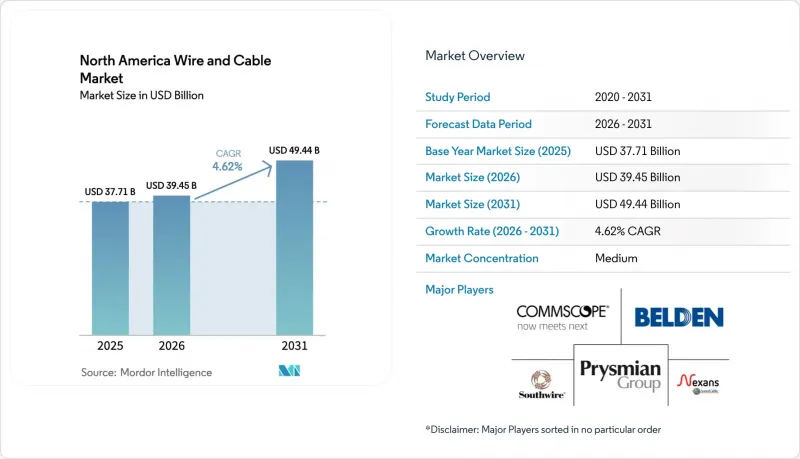
Mordor Intelligence에 따르면 북미의 전선 및 케이블 시장 규모는 2025년 377억 1,000만 달러에서 2026년에는 394억 5,000만 달러로 확대되고, 2026년부터 2031년까지 CAGR 4.62%를 기록하며 2031년까지 494억 4,000만 달러에 달할 것으로 예측됩니다.
본 보고서는 케이블 유형(저압 전력 케이블, 중압 전력 케이블 등), 정격 전압(1kV 미만, 1-35kV 등), 설치 방식(가공, 지하 등), 도체 재료(구리, 알루미늄 등), 최종사용자 산업(건설, 산업 제조 등), 및 국가별로 분류되어 있습니다. 시장 전망은 금액(달러) 기준으로 제시되어 있습니다.
북미 전선 및 케이블 시장의 동향 및 인사이트
인프라 현대화를 위한 투자
송전망 업그레이드를 위한 연방 정부의 650억 달러 전용 예산에 힘입어, 노후화된 도체를 첨단 알루미늄 복합재 및 내열 설계 제품으로 교체하는 속도가 가속화되고 있습니다. 또한, 25억 달러 규모의 복원력 보조금으로 인해 전력 사업자들의 선호도가 지하 매설 경로 및 내화 절연재로 이동하고 있습니다. 국내 조달 조항에 따라 지역 제조업체는 지속적인 수주 전망이 보장되며, 공장은 더 높은 설비 가동률로 운영될 수 있게 되었습니다. 또한, 지방 자치 단체의 공익 사업체와 농촌 협동조합도 설계, 건설, 유지보수 서비스를 패키지화한 성과 기반 계약 체계를 활용하여 프로젝트 리드타임을 2년 예산 주기 내로 단축하고 있습니다.
스마트 그리드 및 송전망 강화 도입
배전선 전체에 광섬유식 온도 감지 스트랜드를 시범 도입하고 있는 공익사업자는 실시간 허용 전류 데이터를 확보함으로써 비용이 많이 드는 도체 교체를 미루고 산불 위험을 줄이고 있습니다. 미네소타주의 도입 사례는 이러한 개념 증명을 뒷받침하고 있습니다. PG&E의 연간 60억 달러 지출 등, 병행하여 진행되고 있는 송전망 강화 예산에 따라 수요는 극한 기상 조건을 견딜 수 있는 절연 수목용 전선 및 피복 도체 시스템으로 향하고 있습니다. 사이버 보안에 관한 규제 요건으로 인해, 전력 전송과 병행하여 안전한 데이터 통신 채널을 지원하는 하이브리드 전력·광섬유 케이블의 사양이 더욱 강화되고 있습니다.
지하 및 해저 매설의 높은 비용
지하 배전 공사 비용은 가공 공사의 4.5배에 달할 수 있으며, 해저 매설의 시행 기간은 선박의 가용 여부와 계절적 기상 조건에 좌우됩니다. 전문 계약업체의 차량 수가 제한적이기 때문에 일당이 치솟고 프로젝트 공사 기간이 장기화되고 있어, 전력 회사는 내결함성의 이점과 자본 예산 간의 균형을 맞추어야 하는 상황에 직면해 있습니다. 현재 비용 최적화의 핵심은 경로 설계 소프트웨어와 공동 굴착 프로그램입니다. 이를 통해 전기, 통신, 가스 배관을 한 번의 굴착 작업으로 통합하여 피트당 비용을 절감하고 있습니다.
부문 분석
저압 전력 도체는 견조한 주택 및 상업 건축을 배경으로 2025년에 매출의 39.40%를 차지했습니다. 한편, 광섬유 제품은 통신 사업자의 5G 구축과 클라우드 제공업체의 AI 클러스터에 힘입어 2031년까지 연평균 성장률(CAGR) 6.12%를 기록하고 있습니다. 북미 전선 및 케이블 시장에서 광섬유 부문의 시장 규모는 2031년까지 32억 8,000만 달러 증가할 것으로 예측됩니다. 또한, 신호·제어용 케이블도 생산 라인 전체에 센서를 통합하는 공장 자동화 개조 공사의 혜택을 받고 있습니다.
감아 올릴 수 있는 리본을 채택한 복합 광섬유 설계 덕분에, 콤팩트한 설치 면적에 2,000가닥의 케이블을 수납할 수 있어 통신 사업자의 덕트 임대 비용을 절감할 수 있습니다. 데이터센터에서는 저연기·무할로겐 재킷이 규격 승인을 얻고 있는 반면, 굽힘에 강한 싱글 모드 코어는 좁은 트레이 내의 슬랙 관리를 개선하고 있습니다. 전력 분야에서는 중압 차폐 케이블이 배전망 업그레이드의 주력으로 자리 잡고 있는 반면, 고압 XLPE 및 HVDC 압출 시스템은 300km에 달하는 해상 풍력발전 송전선에 활용되고 있습니다. 전력 회사가 데이터 네트워크와 에너지 네트워크를 통합함에 따라, 하이브리드 전력·광섬유 케이블은 북미 전선 및 케이블 시장에서 시너지 효과를 강화하고 있습니다.
2025년에는 1kV 미만 구간이 주거용 피더 및 건물 내 배선을 중심으로 출하량의 42.30%를 차지했습니다. 그러나 36-69kV 구간이 6.03%라는 가장 높은 연평균 성장률(CAGR)을 보였으며, 이는 피더 및 백본의 강화와 재생에너지와의 연계를 반영한 것입니다. 이 구간은 교외 변전소에서 비용과 용량의 균형이 가장 뛰어난 경우가 많아, 계획 중인 자본 예산에서 특히 큰 주목을 받고 있는 이유입니다.
전력 회사는 69-220 kV의 업그레이드에서 더 넓은 부지를 확보하지 않고도 허용 전류를 두 배로 늘리기 위해 첨단 알루미늄 복합재 및 고온 저처짐형 제품을 지정하고 있습니다. 이러한 사양으로 인해 1마일당 도체 매출이 증가하여 북미 전선 및 케이블 시장의 수익성이 강화되고 있습니다. 더 높은 연속 작동 온도를 규정하는 IEEE C57 규격의 개정도 이러한 제품의 채택을 더욱 정당화합니다. 동시에, 상업용 부동산의 건축 기준 개정 주기에 따라 PoE 조명 및 재실 분석을 지원하는 스마트 빌딩용 저전압(LV) 케이블 수요가 증가하고 있어, 저전압 분야의 수익 기반이 확대되고 있습니다.
기타 혜택:
- 엑셀 형식의 시장 예측(ME) 시트
- 3개월간의 애널리스트 지원
자주 묻는 질문
목차
제1장 소개
제2장 조사 방법
제3장 주요 요약
제4장 시장 구도
제5장 시장 규모와 성장 예측
제6장 경쟁 구도
제7장 시장 기회와 향후 전망
KSM 26.09.03According to Mordor Intelligence, the North America wire and cable market size is expected to grow from USD 37.71 billion in 2025 to USD 39.45 billion in 2026 and is forecast to reach USD 49.44 billion by 2031 at 4.62% CAGR over 2026-2031.
This report is Segmented by Cable Type (Low-Voltage Energy Cable, Medium-Voltage Power Cable, and More), Voltage Rating (< 1 KV, 1-35 KV, and More), Installation Type (Overhead, Underground, and More), Conductor Material (Copper, Aluminium, and More), End-User Industry (Construction, Industrial Manufacturing, and More), and Country. The Market Forecasts are Provided in Terms of Value (USD).
North America Wire And Cable Market Trends and Insights
Infrastructure-modernization spending
A dedicated USD 65 billion federal allocation for grid upgrades is accelerating the replacement of aging conductors with advanced aluminum-composite and high-temperature designs, while USD 2.5 billion in resilience grants has shifted utility preferences toward underground routes and fire-resistant insulation. Domestic-content clauses guarantee local manufacturers sustained order visibility, enabling plants to run at higher asset-utilization rates. Municipal utilities and rural co-operatives are also tapping performance-contracting frameworks that bundle design, build, and maintenance services, compressing project lead times to within two-year budget cycles.
Smart-grid and grid-hardening roll-outs
Utilities piloting fiber-optic temperature-sensing strands across distribution lines obtain real-time ampacity data, deferring costly reconductoring and reducing wildfire risk; Minnesota's deployment illustrates the proof of concept. Parallel grid-hardening budgets, such as PG&E's USD 6 billion annual outlay, are steering demand toward insulated tree-wire and covered conductor systems able to withstand extreme weather. Regulatory cybersecurity mandates further elevate specifications for hybrid power-fiber cables that support secure data channels alongside energy transfer.
High underground and submarine installation cost
Underground distribution work can cost 4.5 times more than overhead construction, while submarine installation windows hinge on vessel availability and seasonal weather. Limited specialty-contractor fleets inflate day-rates and prolong project timelines, forcing utilities to balance resilience benefits against capital budgets. Cost-optimization now centers on route-engineering software and joint-trench programs that consolidate electrical, telecom, and gas conduits within a single excavation to dilute per-foot expenses.
Other drivers and restraints analyzed in the detailed report include:
- Utility-scale renewable cabling demand
- Edge-data-center and hyperscale fiber wave
- Copper and aluminum price volatility
For complete list of drivers and restraints, kindly check the Table Of Contents.
Segment Analysis
Low-voltage energy conductors sustained 39.40% revenue in 2025 on the back of resilient residential and commercial construction. Conversely, fiber-optic variants are registering a 6.12% CAGR to 2031, propelled by telco 5G roll-outs and cloud-provider AI clusters. The North America wire and cable market size for fiber segments is projected to add USD 3.28 billion by 2031. Signal-and-control lines also benefit from factory-automation retrofits that embed sensors across production lines.
Composite fiber designs with rollable ribbons enable 2,000-strand vaults in compact footprints, trimming duct-leasing costs for carriers. Low-smoke zero-halogen jackets are gaining code acceptance in data centers, while bend-insensitive single-mode cores improve slack management in tight trays. In power, medium-voltage shielded cables remain the workhorse for distribution upgrades, whereas high-voltage XLPE and HVDC extruded systems service 300 km offshore wind export runs. As utilities converge data and energy networks, hybrid power-fiber cables reinforce synergies within the North America wire and cable market.
The sub-1 kV bracket accounted for 42.30% shipments in 2025, anchored in residential feeders and building wiring. Yet, the 36-69 kV span exhibits the fastest 6.03% CAGR, mirroring feeder-backbone enhancements and renewable interconnections. This tier often delivers the best cost-capacity trade-off for suburban substations, explaining its outsized traction in planned capital budgets.
Utilities are specifying advanced aluminum-composite and high-temperature low-sag variants within 69-220 kV upgrades to double ampacity without wider rights-of-way. Such specifications lift conductor-per-mile revenues, reinforcing the North America wire and cable market's profitability. IEEE C57 revisions covering higher continuous-operating temperatures further legitimize adoption. Simultaneously, code cycles in commercial real estate push smart-building LV cabling to support PoE lighting and occupancy analytics, expanding the low-voltage revenue base.
Complete Report Scope:
- By Cable Type
- Low-Voltage Energy Cable
- Medium-Voltage Power Cable
- High / Extra-High-Voltage Cable
- Fiber-Optic Cable
- Signal and Control Cable
- Co-axial and Data Cable
- Specialty Wire (Magnet, Stranded, etc.)
- By Voltage Rating
- < 1 kV
- 1 - 35 kV
- 36 - 69 kV
- 69 - 220 kV
- By Installation Type
- Overhead
- Underground
- Submarine
- Indoor/Building
- Aerial Micro-duct
- By Conductor Material
- Copper
- Aluminium
- Copper-Clad Aluminium
- Composite/High-Strength Core
- By End-user Industry
- Construction (Residential and Commercial)
- Power Transmission and Distribution Utilities
- Telecommunications and Data Centres
- Industrial Manufacturing
- Automotive and Transportation (EV/Rail)
- Renewable Energy (Solar, Wind)
- Oil, Gas and Mining
- Military and Defence
- Other End-user Industries
- By Country
- United States
- Canada
- Mexico
List of Companies Covered in this Report:
- Prysmian Group USA, Inc.
- Nexans AmerCable Incorporated
- Southwire Company, LLC
- CommScope Holding Company, Inc.
- Belden Inc.
- Corning Incorporated
- TE Connectivity Corporation
- Amphenol Corporation
- LS Cable and System U.S.A., Inc.
- Furukawa Electric Co., Ltd. (OFS Fitel, LLC)
- Leoni Cable Inc.
- Sumitomo Electric Wiring Systems, Inc.
- Encore Wire Corporation
- American Wire Group, LLC
- TPC Wire and Cable Corp.
- General Cable Technologies Corporation
- Superior Essex Inc.
- AFL Telecommunications LLC
- NKT North America Inc.
- KEI Industries North America, Inc.
- Hengtong Cable Americas Inc.
- Tratos USA Inc.
Additional Benefits:
- The market estimate (ME) sheet in Excel format
- 3 months of analyst support
TABLE OF CONTENTS
1 INTRODUCTION
- 1.1 Study Assumptions and Market Definition
- 1.2 Scope of the Study
2 RESEARCH METHODOLOGY
3 EXECUTIVE SUMMARY
4 MARKET LANDSCAPE
- 4.1 Market Overview
- 4.2 Market Drivers
- 4.2.1 Rising investments in infrastructure modernisation
- 4.2.2 Accelerated smart-grid and grid-hardening roll-outs
- 4.2.3 Utility-scale renewable energy cabling demand surge
- 4.2.4 Edge-data-centre and hyperscale fibre build-out wave
- 4.2.5 "Buy-America" sourcing clauses in Bipartisan Infrastructure Law
- 4.2.6 HVDC underground links for offshore-wind clusters
- 4.3 Market Restraints
- 4.3.1 High installation costs for underground and submarine cables
- 4.3.2 Copper and aluminium price volatility
- 4.3.3 Skilled-labour bottlenecks for fibre/HV installations
- 4.3.4 Lengthy permitting and ROW approvals for new corridors
- 4.4 Industry Value Chain Analysis
- 4.5 Regulatory Landscape
- 4.6 Technological Outlook
- 4.7 Porter's Five Forces Analysis
- 4.7.1 Bargaining Power of Suppliers
- 4.7.2 Bargaining Power of Buyers
- 4.7.3 Threat of New Entrants
- 4.7.4 Threat of Substitutes
- 4.7.5 Intensity of Competitive Rivalry
- 4.8 Impact of Key Macroeconomic Trends on Market
5 MARKET SIZE AND GROWTH FORECASTS (VALUES)
- 5.1 By Cable Type
- 5.1.1 Low-Voltage Energy Cable
- 5.1.2 Medium-Voltage Power Cable
- 5.1.3 High / Extra-High-Voltage Cable
- 5.1.4 Fiber-Optic Cable
- 5.1.5 Signal and Control Cable
- 5.1.6 Co-axial and Data Cable
- 5.1.7 Specialty Wire (Magnet, Stranded, etc.)
- 5.2 By Voltage Rating
- 5.2.1 < 1 kV
- 5.2.2 1 - 35 kV
- 5.2.3 36 - 69 kV
- 5.2.4 69 - 220 kV
- 5.3 By Installation Type
- 5.3.1 Overhead
- 5.3.2 Underground
- 5.3.3 Submarine
- 5.3.4 Indoor/Building
- 5.3.5 Aerial Micro-duct
- 5.4 By Conductor Material
- 5.4.1 Copper
- 5.4.2 Aluminium
- 5.4.3 Copper-Clad Aluminium
- 5.4.4 Composite/High-Strength Core
- 5.5 By End-user Industry
- 5.5.1 Construction (Residential and Commercial)
- 5.5.2 Power Transmission and Distribution Utilities
- 5.5.3 Telecommunications and Data Centres
- 5.5.4 Industrial Manufacturing
- 5.5.5 Automotive and Transportation (EV/Rail)
- 5.5.6 Renewable Energy (Solar, Wind)
- 5.5.7 Oil, Gas and Mining
- 5.5.8 Military and Defence
- 5.5.9 Other End-user Industries
- 5.6 By Country
- 5.6.1 United States
- 5.6.2 Canada
- 5.6.3 Mexico
6 COMPETITIVE LANDSCAPE
- 6.1 Market Concentration
- 6.2 Strategic Moves
- 6.3 Market Share Analysis
- 6.4 Company Profiles (includes Global level Overview, Market level overview, Core Segments, Financials as available, Strategic Information, Market Rank/Share for key companies, Products and Services, and Recent Developments)
- 6.4.1 Prysmian Group USA, Inc.
- 6.4.2 Nexans AmerCable Incorporated
- 6.4.3 Southwire Company, LLC
- 6.4.4 CommScope Holding Company, Inc.
- 6.4.5 Belden Inc.
- 6.4.6 Corning Incorporated
- 6.4.7 TE Connectivity Corporation
- 6.4.8 Amphenol Corporation
- 6.4.9 LS Cable and System U.S.A., Inc.
- 6.4.10 Furukawa Electric Co., Ltd. (OFS Fitel, LLC)
- 6.4.11 Leoni Cable Inc.
- 6.4.12 Sumitomo Electric Wiring Systems, Inc.
- 6.4.13 Encore Wire Corporation
- 6.4.14 American Wire Group, LLC
- 6.4.15 TPC Wire and Cable Corp.
- 6.4.16 General Cable Technologies Corporation
- 6.4.17 Superior Essex Inc.
- 6.4.18 AFL Telecommunications LLC
- 6.4.19 NKT North America Inc.
- 6.4.20 KEI Industries North America, Inc.
- 6.4.21 Hengtong Cable Americas Inc.
- 6.4.22 Tratos USA Inc.
7 MARKET OPPORTUNITIES AND FUTURE OUTLOOK
- 7.1 White-space and Unmet-need Assessment


