

|
시장보고서
상품코드
2118049
중국의 고정 무선 액세스 시장 : 점유율 분석, 업계 동향과 통계, 성장 예측(2026-2031년)China Fixed Wireless Access - Market Share Analysis, Industry Trends & Statistics, Growth Forecasts (2026 - 2031) |
||||||
 Mordor Intelligence
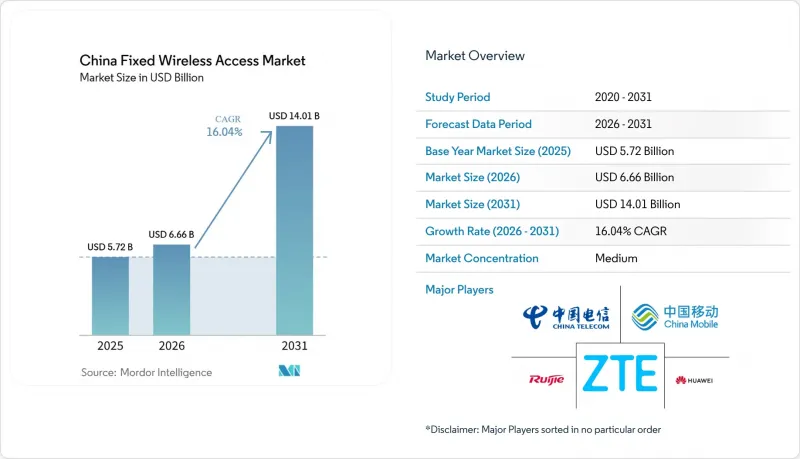
Mordor Intelligence에 의하면, 중국의 고정 무선 액세스 시장 규모는 2025년 57억 2,000만 달러, 2026년 66억 6,000만 달러에서 2031년까지 140억 1,000만 달러로 확대된다고 예측되고 있어 2026년부터 2031년까지 CAGR 16.04%를 기록하는 전망입니다.
본 보고서는 유형별(하드웨어 및 서비스), 용도별(주거, 상업, 산업, 정부·공공 안전),주파수 대역별(6GHz 미만, 밀리파(24GHz 이상), 면허 불필요/공유 CBRS), 도입 형태별(실내용 CPE, 실외용 CPE, 자가 설치형 창문 장착 CPE)로 분류되어 있습니다. 시장 예측은 금액(미 달러)으로 표시되어 있습니다.
중국 고정 무선 액세스 시장 동향 및 인사이트
5G 및 5G-Advanced의 확산으로 기가비트급 FWA 커버리지 확대
중국의 3대 주요 통신 사업자는 2025년 중반까지 이미 300개 이상의 도시에서 5G-Advanced 서비스를 확대했으며, 30개 이상의 성급 지역에서 관련 서비스 요금제가 도입되어 1,000만 명 이상의 사용자가 가입하고 있습니다. 이러한 확산은 중국의 고정 무선 액세스 시장에 중요한 의미를 지닙니다. 왜냐하면 기가비트급 무선 성능 덕분에, 그동안 광섬유를 당연한 선택지로 여겨왔던 가정과 기업에게 이 서비스의 신뢰성이 높아지기 때문입니다. 이 성능 기준이 충족되면 통신 사업자는 FWA를 가격뿐만 아니라 서비스 수준 및 신뢰성 측면에서도 포지셔닝할 수 있게 됩니다. 또한, 이러한 전환 과정은 특히 새로운 플랫폼이 보다 광범위한 생산 주기로 전환됨에 따라, 더 높은 사양의 고객 단말 장비에 대한 교체 수요 증가를 뒷받침하게 될 것입니다. 더 나아가 통신 사업자에게는 광대역 확장을 지역 디지털 인프라 프로젝트와 연계할 여지가 생겨, 이를 통해 공유 네트워크에 대한 투자의 수익성이 향상됩니다. 그 결과, 교외의 가정이나 기업 거점에서 프리미엄 FWA 요금제의 상업적 타당성이 더욱 공고해집니다.
군 단위 광대역 경제성 측면에서는 풀 파이버 구축보다 무선 기반의 라스트 마일이 유리
2025년 말 기준, 중국 농촌 지역의 광대역 이용자는 2억 400만 명에 달했으며, 차이나모바일(China Mobile)은 자사의 ‘1진당 2기가비트’ 이니셔티브가 예정보다 빨리 모든 향 및 진 수준의 행정 단위에 도달했다고 발표했습니다. 이러한 커버리지 확대로 인해 고개나 하천 유역, 산재한 마을 등으로 인해 도랑 파기 공사가 비용이 많이 들고 시간이 오래 걸리는 지역에서 중국 고정 무선 액세스 시장의 경제성이 변화했습니다. 기존 5G 기지국이 라스트 마일(last mile) 광대역 수요를 충족할 수 있다면, 통신 사업자는 토목 공사의 대부분을 피하고 가입자의 서비스 개통을 신속하게 진행할 수 있습니다. 신화통신도 ‘제15차 5개년 계획’의 과제에서 농촌 및 국경 지역의 통신 품질 향상이 계속해서 중시되고 있다고 보도했으며, 이는 실외용 CPE 및 접속 기기에 대한 지속적인 수요를 뒷받침하고 있습니다. 실제로, 이로 인해 이미 통신 타워가 구축되어 있고 사용자 밀도가 너무 낮아 새로운 광섬유 설치의 경제성이 맞지 않는 군에서 FWA의 매력이 유지되고 있습니다. 또한, 투자 회수 기간이 짧은 추가 접속 비용에 의존하는 마을에서는 자본 배분이 무선 네트워크 확장으로 이동하게 될 것입니다.
FTTR과 광섬유 가격 하락이 인구 밀집 도시 지역의 FWA 전환을 억제
중국 도시 지역의 광대역 인프라는 여전히 광섬유가 포화 상태이며, 2025년 말 기준 FTTR 사용자 수는 5,939만 명에 달했습니다. 이러한 보급 기반의 존재로 인해, 중국의 고정 무선 액세스 시장이 기존 도시 지역 가입자를 어느 정도까지 전환할 수 있는지에 한계가 있습니다. 일선 도시에서는 이미 FTTR 번들 요금제가 제공되고 있어 타사로의 전환 유인이 낮기 때문입니다. 밀집된 공동주택 지역에서는 전문적인 광섬유 설치 서비스와 통신 사업자의 성숙한 번들 요금제 덕분에 가정의 주요 접속 수단을 무선으로 전환해야 할 시급성은 계속해서 낮아지고 있습니다. 광섬유 비용 상승은 프로젝트 수준에서는 어느 정도 완화 요인이 되었습니다. 2025년 중반부터 2026년 초에 걸쳐 G.652D 단일 모드 광섬유 가격은 1킬로미터당 20위안(입력값에서는 이미 2.76달러로 표시됨)에서 50위안 이상(입력값에서는 이미 6.90달러로 표시됨)으로 상승했습니다. 그러나 이는 주로 신규 그린필드 건설에 영향을 미치는 것으로, 이미 광섬유에 연결된 가입자의 입지를 약화시키지는 않습니다. 그 결과, 도시 지역의 FWA는 기존 광섬유 회선에서 대규모로 전환되는 것보다는 일시적인 설치, 새로운 복합 시설 및 기업의 백업 시나리오에서 여전히 가장 강력한 수요를 유지하고 있습니다.
부문 분석
2025년에는 하드웨어가 시장의 60.76%를 차지했습니다. 이는 통신 사업자들이 5G 기반의 라스트 마일 커버리지를 확대함에 따라 CPE 및 액세스 유닛에 대한 수요가 견조했음을 반영합니다. 가정, 기업, 정부 기관의 각 도입에서 서비스 수익화를 심화하기 위해서는 기기 측의 업그레이드가 필요했기 때문에 하드웨어 계층은 계속해서 중국 고정 무선 액세스 시장의 주요 수익원으로 남아 있었습니다. CPE 출하량에는 실내용 서브 6GHz 기기, 실외용 고이득 유닛, 창문 장착형이 포함되었으며, 한편 액세스 유닛은 통신 사업자의 전체 네트워크에서 고밀도화와 라스트 마일 백홀을 지원했습니다. ZTE는 2026년 3월, Wi-Fi 8을 탑재하고 피크 처리량이 각각 10 Gbps 및 12.5Gbps에 달하는 최초의 5G-Advanced 기기로 평가받는 ‘G6 Ultra’와 ‘G6 Max’를 출시하며, 이 성능 기준을 한층 더 높였습니다. 이러한 출시가 중요한 이유는 통신 사업자의 차기 조달에서 기대되는 사양 수준을 높이기 위함입니다. 또한, 하드웨어 시장 전반에서 경쟁이 격화되는 가운데, 프리미엄 부문에서의 가격 결정력 강화에 기여하고 있습니다.
서비스 시장은 2031년까지 연평균 성장률(CAGR) 16.86%를 나타낼 것으로 예측되며, 중국 고정 무선 액세스 업계에서 가장 빠르게 성장하는 분야가 될 전망입니다. 이러한 성장은 시장이 단순한 장비 주기에서 관리형 성능 및 지원을 중심으로 한 보다 지속 가능한 서비스 모델로 전환되고 있음을 보여줍니다. 통신 사업자가 관리하는 서비스 플랜에서는 기업 및 공공 부문 사용자를 대상으로 원격 펌웨어 제어, 서비스 품질(QoS) 조정, 그리고 서비스 수준에 기반한 업링크 보장이 점점 더 결합되고 있습니다. 차이나 유니콤(China Unicom)과 ZTE는 2026년 6월 ‘UniMAX 1.0+’를 출시하고, 5G-Advanced의 확정적인 연결성을 관리형 엔터프라이즈 서비스로 포지셔닝함으로써 이러한 방향성을 한층 더 추진했습니다. 벤더 간 하드웨어 비교가 쉬워짐에 따라, 차별화를 꾀하는 데 있어 서비스 계층화가 더욱 중요해지고 있습니다. 이를 통해 통신 사업자의 수익 전망이 더욱 안정화되고, 시간이 지남에 따라 단말기가 단순한 상품으로 전락할 위험이 완화됩니다.
2025년 중국의 고정 무선 액세스 시장에서 주거용 연결은 64.22%를 차지하고 있으며, 이는 이 부문에서 주거용 수요가 여전히 가장 큰 도입 기반임을 보여줍니다. 이러한 우위는 주로 무선 액세스가 여전히 보조적인 역할이 아닌 주요한 역할을 수행하고 있는 농촌 및 준도시 지역 가구에서 비롯된 것이었습니다. 차이나모바일(China Mobile)이 마을 단위로 5G 및 기가비트 광대역 커버리지 확대라는 이정표를 달성함으로써, 시장이 현재의 성장 단계에 접어들기 전에 이 주거용 시장의 확장에 필요한 무선 네트워크 기반을 구축했습니다. 또한, 가정용 부문은 설치의 번거로움을 줄이고 신속한 이용 개시를 선호하는 사용자들 사이에서 보급을 촉진한 ‘플러그 앤 플레이’ 방식의 단말기 형태로부터도 혜택을 받았습니다. 이로 인해 도시 지역에서 광섬유와의 경쟁이 여전히 치열한 상황에서도 중국의 고정 무선 액세스 시장은 소비자 수준에서 판매량 주도형으로 변화했습니다.
정부 및 공공 안전 분야는 2031년까지 연평균 성장률(CAGR) 16.98%를 나타낼 것으로 예측되며, 가장 빠르게 성장하는 응용 분야가 될 전망입니다. 긴급 대응, 국경 감시, 교통 모니터링, 유틸리티 감시에는 모두 이동 중이거나 시간적 제약이 있는 상황에서 유선 방식보다 신속하게 구축할 수 있는 견고한 접속이 요구됩니다. 2026년 6월, 5개 부처가 산업용 5G 프라이빗 네트워크 확대 프레임워크에 공공 안전 및 중요 인프라 연결을 공식적으로 포함시켰습니다. 이러한 정책적 지원에 힘입어, 사업 연속성과 가동 시간을 확보하기 위해 구축된 실외용 CPE, 이중화된 무선 경로 및 관리형 연결 패키지의 조달이 촉진될 전망입니다. 상업용 사용자도 여전히 중요한 존재이며, 특히 소매, 접객업, 그리고 주요 광섬유 회선 외에도 백업 회선을 원하는 중소기업 캠퍼스에서 그 중요성이 높습니다. 산업용 사용자의 점유율은 여전히 적지만, 결정론적 무선 링크의 가치가 높아지고 있는 스마트 제조 및 자동화된 물류 환경에서 그 역할은 확대되고 있습니다.
기타 혜택:
- 엑셀 형식 시장 예측(ME) 시트
- 3개월간의 애널리스트 지원
자주 묻는 질문
목차
제1장 서론
제2장 조사 방법
제3장 개요
제4장 시장 구도
제5장 시장 규모와 성장 예측
제6장 경쟁 구도
제7장 시장 기회와 향후 전망
JHS 26.09.01According to Mordor Intelligence, the China fixed wireless access market size is projected to expand from USD 5.72 billion in 2025 and USD 6.66 billion in 2026 to USD 14.01 billion by 2031, registering a CAGR of 16.04% from 2026 to 2031.
This report is Segmented by Type (Hardware and Services), Application (Residential, Commercial, Industrial, and Government and Public Safety), Frequency Band (Sub-6 GHz, Mmwave (Above 24 GHz), and Unlicensed/Shared CBRS), and Deployment Mode (Indoor CPE, Outdoor CPE, and Self-Install Window-Mount CPE). The Market Forecasts are Provided in Value (USD).
China Fixed Wireless Access Market Trends and Insights
5G and 5G-Advanced Rollout Expanding Gigabit-Class FWA Coverage
China's 3 major telecom operators had already extended 5G-Advanced services across more than 300 cities by mid-2025, and more than 30 provincial-level regions had introduced related service plans with over 10 million users enrolled. That rollout matters for the China fixed wireless access market because gigabit-class wireless performance makes the service more credible for homes and businesses that previously defaulted to fiber. Once that performance threshold is met, operators can position FWA on service tier and reliability rather than only on price. The migration path also supports stronger refresh demand for higher-specification customer premises equipment, especially as newer platforms move into broader production cycles. It also gives operators room to align broadband expansion with local digital infrastructure projects, which improves the return profile of shared network investments. The result is a stronger commercial case for premium FWA plans in both semi-urban households and enterprise locations.
County-Level Broadband Economics Favor Wireless Last Mile Over Full Fiber Buildout
Rural broadband users in China reached 204 million by the end of 2025, and China Mobile stated that its dual-gigabit-per-township initiative had already reached all township-level administrative units ahead of schedule. That coverage base changed the economics of the China fixed wireless access market in areas where mountain passes, river valleys, and scattered settlements make trenching expensive and slow. When existing 5G base stations can serve last-mile broadband demand, operators avoid most civil works and speed up subscriber activation. Xinhua also reported that the 15th Five-Year Plan agenda continued to emphasize signal upgrades in rural and border regions, which supports ongoing demand for outdoor CPE and access equipment. In practice, this keeps FWA attractive in counties where tower assets are already in place, and user density is too low to justify fresh fiber buildouts. It also shifts capital allocation toward wireless expansion in townships where payback periods depend on low incremental connection costs.
FTTR and Fiber Price Compression Reducing FWA Conversion in Dense Urban Areas
China's urban broadband base remained heavily fiber-saturated, and FTTR users reached 59.39 million by the end of 2025. That installed base limits how far the China fixed wireless access market can convert existing urban subscribers, because bundled FTTR packages already come with low switching appeal in tier-1 cities. In dense apartment clusters, professional fiber installation and mature operator bundles continue to reduce the urgency to shift core household access to wireless. Fiber cost inflation did provide some relief at the project level, with G.652D single-mode fiber rising from CNY 20 (already shown as USD 2.76 in the input) to above CNY 50 (already shown as USD 6.90 in the input) per fiber-kilometer between mid-2025 and early 2026. Even so, that mainly affects new greenfield builds and does not weaken the position of already connected fiber subscribers. As a result, urban FWA remains strongest in temporary setups, new complexes, and enterprise backup scenarios rather than mass migration from established fiber lines.
Other drivers and restraints analyzed in the detailed report include:
- AI-Driven Uplink Demand Increasing the Value of Deterministic Home and Enterprise Broadband
- Enterprise Backup Connectivity Demand From Retail, Logistics, and Branch Networks
- Mid-Band Spectrum Coordination and Planning Constraints in High-Density Cities
For complete list of drivers and restraints, kindly check the Table Of Contents.
Segment Analysis
Hardware accounted for 60.76% of the market in 2025, reflecting strong demand for CPE and access units as operators expanded 5G-based last-mile coverage. The hardware layer remained the main revenue anchor for the China fixed wireless access market, as residential, enterprise, and government deployments all required device-side upgrades before service monetization could deepen. CPE shipments covered indoor sub-6 GHz devices, outdoor high-gain units, and window-mount formats, while access units supported densification and last-mile backhaul across operator networks. ZTE strengthened that performance benchmark in March 2026 when it launched the G6 Ultra and G6 Max, described as the first 5G-Advanced devices with Wi-Fi 8 and peak throughputs of 10 Gbps and 12.5 Gbps. Those launches matter because they raise the expected specification level for the next phase of operator procurement. They also support stronger pricing power at the premium end, even as broader hardware competition intensifies.
Services are projected to grow at a 16.86% CAGR through 2031, making them the faster-moving part of the China fixed wireless access industry. That growth shows that the market is shifting from a pure equipment cycle to a more recurring service model built around managed performance and support. Operator-managed offers increasingly combine remote firmware control, quality-of-service tuning, and service-level-backed uplink commitments for enterprise and public-sector users. China Unicom and ZTE moved further in that direction in June 2026 with the UniMAX 1.0+ launch, which positioned 5G-Advanced deterministic connectivity as a managed enterprise service. As hardware becomes easier to compare across vendors, service layering becomes more important for differentiation. That supports more stable revenue visibility for operators and reduces the risk of simple device commoditization over time.
Residential connections accounted for 64.22% of the China fixed wireless access market in 2025, indicating that household demand remained the largest installed base for the category. This lead came mainly from rural and semi-urban households, where wireless access still played a primary role rather than a backup one. China Mobile's township-level 5G and gigabit broadband coverage milestone established the radio footprint needed for this residential-scale-up before the market entered its current growth phase. The residential segment also benefited from plug-and-play device formats that lowered installation friction and improved adoption among users who preferred quick activation. That made the China fixed wireless access market more volume-driven at the consumer level, even while urban fiber competition remained strong.
Government and public safety are projected to grow at a 16.98% CAGR through 2031, making them the fastest-growing application area. Emergency response, border surveillance, transport monitoring, and utility oversight all require resilient access that can be deployed faster than wired alternatives in mobile or time-sensitive scenarios. In June 2026, 5 ministries formally included public safety and critical infrastructure connectivity within the industrial 5G private network expansion framework. That policy support should strengthen procurement for outdoor CPE, redundant radio paths, and managed connectivity packages built for continuity and uptime. Commercial users also remain important, especially for retail, hospitality, and small-business campuses that want backup links alongside primary fiber. Industrial users still account for a smaller share, yet their role is rising in smart manufacturing and automated logistics environments, where deterministic wireless links are increasingly valuable.
Complete Report Scope:
- By Type
- Hardware
- Consumer Premise Equipment (CPE)
- Access Units (Femto and Picocells)
- Services
- Hardware
- By Application
- Residential
- Commercial
- Industrial
- Government and Public Safety
- By Frequency Band
- Sub-6 GHz
- mmWave (Above 24 GHz)
- Unlicensed/Shared CBRS
- By Deployment Mode
- Indoor CPE
- Outdoor CPE
- Self-Install Window-Mount CPE
List of Companies Covered in this Report:
- Huawei Technologies Co., Ltd.
- ZTE Corporation
- China Mobile Limited
- China Telecom Corporation Limited
- China United Network Communications Group Co., Ltd.
- Ruijie Networks Co., Ltd.
- Shenzhen Gongjin Electronics Co., Ltd.
- Qualcomm Technologies, Inc.
- FiberHome Telecommunication Technologies Co., Ltd.
- Datang Mobile Communications Equipment Co., Ltd.
- H3C Technologies Co., Limited
- TD Tech Ltd.
- Arcadyan Technology Corporation
- Sercomm Corporation
- Quectel Wireless Solutions Co., Ltd.
- Fibocom Wireless Inc.
- Meig Smart Technology Co., Ltd.
- Tongyu Communication Inc.
- Shenzhen Skyworth Digital Technology Co., Ltd.
- Askey Computer Corp.
Additional Benefits:
- The market estimate (ME) sheet in Excel format
- 3 months of analyst support
TABLE OF CONTENTS
1 INTRODUCTION
- 1.1 Study Assumptions and Market Definition
- 1.2 Scope of the Study
2 RESEARCH METHODOLOGY
3 EXECUTIVE SUMMARY
4 MARKET LANDSCAPE
- 4.1 Market Overview
- 4.2 Market Drivers
- 4.2.1 5G and 5G-Advanced Rollout Expanding Gigabit-Class FWA Coverage
- 4.2.2 County-Level Broadband Economics Favor Wireless Last Mile Over Full Fiber Buildout
- 4.2.3 Enterprise Backup Connectivity Demand from Retail, Logistics, and Branch Networks
- 4.2.4 AI-Driven Uplink Demand Increasing the Value of Deterministic Home and Enterprise Broadband
- 4.2.5 Domestic CPE, Chipset, and RAN Localization Shortening Deployment Cycles and Lowering Unit Cost
- 4.2.6 Flexible Pricing and Bundling by Operators Improving FWA Adoption
- 4.3 Market Restraints
- 4.3.1 FTTR and Fiber Price Compression Reducing FWA Conversion in Dense Urban Areas
- 4.3.2 Mid-Band Spectrum Coordination and Planning Constraints in High-Density Cities
- 4.3.3 Power, Thermal, and Installation Constraints for Outdoor and High-Gain CPE in Large-Scale Rollouts
- 4.3.4 Rain Fade and Obstruction Losses in Higher Frequency Deployments
- 4.4 Industry Value-Chain Analysis
- 4.5 Regulatory Landscape
- 4.6 Technological Outlook
- 4.6.1 Key Enablers for FWA Adoption
- 4.6.2 Vendor Initiatives and Partnerships
- 4.6.3 Business Considerations and Prerequisites
- 4.6.4 FWA vs FTTH / FTTdp Comparison
- 4.6.5 Rural, Semi-Urban and Urban Use-Case Models
- 4.7 Impact of Macroeconomic Factors on the Market
- 4.8 Porter's Five Forces Analysis
- 4.8.1 Bargaining Power of Suppliers
- 4.8.2 Bargaining Power of Buyers
- 4.8.3 Threat of New Entrants
- 4.8.4 Threat of Substitutes
- 4.8.5 Competitive Rivalry
5 MARKET SIZE AND GROWTH FORECASTS (VALUE)
- 5.1 By Type
- 5.1.1 Hardware
- 5.1.1.1 Consumer Premise Equipment (CPE)
- 5.1.1.2 Access Units (Femto and Picocells)
- 5.1.2 Services
- 5.1.1 Hardware
- 5.2 By Application
- 5.2.1 Residential
- 5.2.2 Commercial
- 5.2.3 Industrial
- 5.2.4 Government and Public Safety
- 5.3 By Frequency Band
- 5.3.1 Sub-6 GHz
- 5.3.2 mmWave (Above 24 GHz)
- 5.3.3 Unlicensed/Shared CBRS
- 5.4 By Deployment Mode
- 5.4.1 Indoor CPE
- 5.4.2 Outdoor CPE
- 5.4.3 Self-Install Window-Mount CPE
6 COMPETITIVE LANDSCAPE
- 6.1 Market Concentration
- 6.2 Strategic Moves
- 6.3 Market Share Analysis
- 6.4 Company Profiles (includes Global Level Overview, Market Level Overview, Core Segments, Financials as Available, Strategic Information, Market Rank/Share for Key Companies, Products and Services, and Recent Developments)
- 6.4.1 Huawei Technologies Co., Ltd.
- 6.4.2 ZTE Corporation
- 6.4.3 China Mobile Limited
- 6.4.4 China Telecom Corporation Limited
- 6.4.5 China United Network Communications Group Co., Ltd.
- 6.4.6 Ruijie Networks Co., Ltd.
- 6.4.7 Shenzhen Gongjin Electronics Co., Ltd.
- 6.4.8 Qualcomm Technologies, Inc.
- 6.4.9 FiberHome Telecommunication Technologies Co., Ltd.
- 6.4.10 Datang Mobile Communications Equipment Co., Ltd.
- 6.4.11 H3C Technologies Co., Limited
- 6.4.12 TD Tech Ltd.
- 6.4.13 Arcadyan Technology Corporation
- 6.4.14 Sercomm Corporation
- 6.4.15 Quectel Wireless Solutions Co., Ltd.
- 6.4.16 Fibocom Wireless Inc.
- 6.4.17 Meig Smart Technology Co., Ltd.
- 6.4.18 Tongyu Communication Inc.
- 6.4.19 Shenzhen Skyworth Digital Technology Co., Ltd.
- 6.4.20 Askey Computer Corp.
7 MARKET OPPORTUNITIES AND FUTURE OUTLOOK
- 7.1 White-Space and Unmet-Need Assessment


