
|
시장보고서
상품코드
2118059
AR 컨텐츠 스트리밍 시장 : 점유율 분석, 업계 동향과 통계, 성장 예측(2026-2031년)AR Content Streaming - Market Share Analysis, Industry Trends & Statistics, Growth Forecasts (2026 - 2031) |
||||||
 Mordor Intelligence
Mordor Intelligence에 의하면, AR 컨텐츠 스트리밍 시장 규모는 2025년 46억 4,000만 달러에서 2026년에는 54억 3,000만 달러로 확대되어 2026년부터 2031년까지 CAGR 18.84%로 성장을 지속하여, 2031년에는 128억 6,000만 달러에 이를 것으로 예측됩니다.
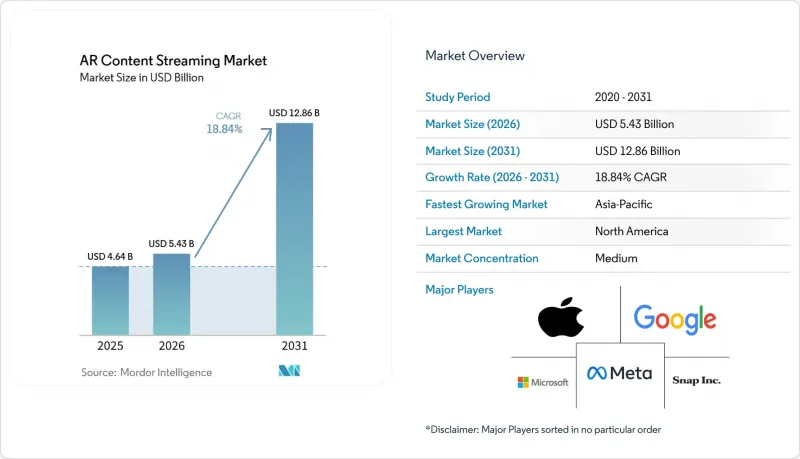
본 보고서는 용도별(AR 모바일 게임, 소셜 AR 필터 및 스폰서 렌즈, 소매·커머스용 AR, 엔터프라이즈용 AR 컨텐츠 및 원격 지원 스트리밍) 및 지역별(북미, 남미, 유럽, 아시아태평양, 중동 및 아프리카)로 분류되어 있습니다. 시장 예측은 금액(달러) 기준으로 제시되어 있습니다.
세계 AR 컨텐츠 스트리밍 시장 동향 및 인사이트
커머스 및 브랜드 미디어에서 몰입형 제품 스토리에 대한 수요 증가
커머스는 AR 컨텐츠 스트리밍 시장의 직접적인 수요 원천으로 부상하고 있습니다. 이는 제품 시각화가 매출과 반품 관리라는 두 가지 목표를 모두 지원할 수 있기 때문이며, 투자의 근거가 브랜드 실험에서 구매 결정 전 제품 이해를 심화시키는 실용적인 수단으로 변화하고 있기 때문입니다. Snap의 조사에 따르면, AR을 활용한 소매업은 쇼핑객에게 사이즈, 착용감, 공간적 맥락을 보다 명확하게 제시함으로써 반품을 대폭 줄일 수 있는 것으로 밝혀졌습니다. 이 점은 중요하며, 해당 조사에서는 온라인 반품률이 오프라인 매장 반품률을 상회한다고 보고되었습니다. WebXR 디바이스 API는 2026년 6월 9일 ‘후보 권고안 초안(Candidate Recommendation Draft)’ 단계에 도달했으며, 브라우저 기반 AR을 지원함으로써 용도 다운로드의 필요성을 줄였습니다. 2026년 5월, OTB 그룹과 Google Cloud는 디젤, 메종 마르지엘라, 마르니를 대상으로 가상 피팅 기능을 도입하여, 고객 상담사에게 대규모 의류 시각화를 실현했습니다. 또한, 공간적 상호작용을 통해 상품 회전, 크기 조정, 망설임 등의 동작을 포착할 수 있으므로, 기존의 클릭만으로는 얻을 수 없었던 보다 상세한 신호를 추천 시스템에 제공할 수 있습니다.
저지연 AR 재생을 위한 5G 및 엣지 전송 확대
5G mm파 네트워크는 다중 사용자 AR 스트리밍을 지원하지만, 대역폭이 좁은 네트워크에서는 필요한 품질을 유지하기 어려울 수 있습니다. 2026년 3월, KDDI는 일본에서 라이브 이벤트 실증 실험을 실시하여, 5G mm파와 Mawari의 분산형 3D 전송 플랫폼을 통해 스마트 글래스 사용자에게 실물 크기의 가상 공연자를 스트리밍으로 전송했습니다. 조사에 따르면, 고도화된 네트워크 슬라이싱 환경에서는 엣지 클라우드의 가상화를 통해 모바일 AR의 지연을 ‘모션 투 포톤(Motion-to-Photon)’ 임계치 이하로 낮출 수 있는 것으로 밝혀졌습니다. 한국과 GCC(걸프협력회의) 국가들에서 통신 사업자가 기업을 대상으로 전용 네트워크 용량을 패키지화함으로써, AR 컨텐츠 스트리밍 시장이 혜택을 볼 가능성이 있습니다. 이를 통해 네트워크 품질, 신뢰성 높은 사용자 경험, 그리고 프리미엄 전송 서비스의 가치 간의 연관성이 더욱 명확해집니다. 이러한 구조를 통해 연결성은 단순한 기본 공공 서비스가 아닌, 상업적 전송 모델의 일부가 됩니다. 또한, 한국의 5G 커버리지 확대도 수요에만 의존하는 전개보다 신속한 인프라 구축을 뒷받침하고 있습니다.
분산된 기기 생태계와 크로스 플랫폼 호환성의 격차
플랫폼의 파편화는 증강현실(AR) 컨텐츠 스트리밍 시장 전체에서 사용자에게 서비스를 제공하는 비용을 상승시키고 있습니다. ARKit과 ARCore의 구현 방식이 다르면 자산 최적화 과정도 개별적으로 필요하며, 제공된 조사에 따르면 렌더링의 차이로 인해 초기 프로젝트 견적에 30%-40%의 추가 비용이 발생할 가능성이 있습니다. WebXR은 브라우저 기반의 경로를 제공하지만, 2026년 시점에서도 iPhone이나 iPad의 네이티브 지원은 이용할 수 없기 때문에 Apple의 AR Quick Look을 통한 대체 수단을 별도로 마련해야 합니다. Android XR, visionOS, Meta의 헤드셋용 OS, 그리고 기존 모바일 프레임워크 각각에 인증 및 하드웨어 최적화 요건이 추가됩니다. 또한, 기업의 구매 담당자는 RealWear, Vuzix, Lenovo ThinkReality, Magic Leap에서 제작한 안경형 디바이스에 대한 테스트도 수행해야 합니다. 대규모 플랫폼 기업은 이러한 기술적 요건을 더 쉽게 흡수할 수 있으므로, 소규모 전문 공급업체에 대한 우위를 더욱 공고히 할 가능성이 있습니다.
부문 분석
2025년, AR 모바일 게임은 AR 컨텐츠 스트리밍 시장 점유율의 32.91%를 차지하며, 게임이 가장 큰 용도 부문이 되었습니다. 이러한 위상은 인앱 결제 모델, 확립된 프랜차이즈, 그리고 게임 출시 후에도 지출을 지속시킬 수 있는 위치 기반 메커니즘을 반영합니다. 『포켓몬 GO』는 2026년 7월까지 누적 수익이 91억 달러를 넘어, 확립된 위치 기반 AR 타이틀이 가진 수익 잠재력을 보여주었습니다. 나이안틱의 ‘보상형 AR 광고’ 역시 게임 내 브랜드 경험과 오프라인 매장 방문을 연결함으로써, 인앱 결제에 광고주의 자금을 더하고 있습니다. 소셜 AR 필터 및 스폰서 렌즈는 2031년까지 연평균 성장률(CAGR) 19.55%를 나타낼 것으로 예측되며, 이는 용도 분야 중 가장 높은 성장률입니다.
소매 및 상거래 분야의 AR은 브라우저 기반 시각화 도구와 가상 피팅 도구의 지원을 받아 소규모 시범 단계에서 광범위한 도입 단계로 전환되고 있습니다. WebXR 표준화라는 이정표는 브라우저 네이티브 경험에서의 참여도를 제한하던 다운로드 장벽을 낮춰줄 것입니다. 조사에 따르면, Shopify 상품 페이지의 3D 컨텐츠는 평균 94%의 전환율 향상을 가져왔으며, AR을 도입한 소매업에서는 반품률이 최대 40% 감소한 것으로 보고되었습니다. OTB Group의 Google Cloud 활용 도입 사례에서는 여러 명품 브랜드에서 가상 착용이 검증되었으며, 패션 그룹이 실현 가능한 운영 규모가 제시되었습니다. 기업용 AR 컨텐츠 및 원격 지원 스트리밍은 기술 관리, 작업 지시, 현장 지원 조달을 통해 확대되고 있으며, 한편 AI를 활용한 2D에서 3D로의 변환 도구는 소규모 도입 시 초기 비용을 절감할 수 있습니다.
지역별 분석
2025년, 북미는 AR 컨텐츠 스트리밍 시장 점유율의 44.16%를 차지하며, 해당 지역이 시장에서 중심적인 역할을 하고 있음이 부각되었습니다. Apple, Meta, Google, Snap, Microsoft, NVIDIA가 해당 지역에서 사업을 전개하고 있으며, 막대한 소프트웨어 예산을 보유한 기업 고객도 존재합니다. 이 지역의 게임 수익, 소셜 렌즈 광고 인벤토리, 클라우드 렌더링 투자의 대부분은 미국이 차지하고 있습니다. 캐나다에서는 혼합현실(MR) 개발 활동 외에도 제조업 및 의료 분야의 기업 내 활용이 진행되고 있습니다. 브라우저 기반 소매 도구, 원격 지원, 소셜 광고 측정, 프리미엄 클라우드 렌더링이 결합되어 해당 지역 수요를 뒷받침하고 있습니다.
아시아태평양은 2026년부터 2031년까지 연평균 성장률(CAGR) 19.41%를 나타낼 것으로 예측되며, 이는 지역별로는 가장 높은 성장률입니다. 이 지역의 AR 컨텐츠 스트리밍 시장은 한국, 중국, 일본의 첨단 모바일 네트워크 투자와 더불어 소비자용 및 기업용 제품을 아우르는 스마트글라스 개발에 힘입어 성장하고 있습니다. 이는 웨이브가이드 디스플레이 기기의 보급이 시작됨에 따라 연초 전 세계 스마트글라스 출하량이 견조한 증가세를 보였음을 보여줍니다. KDDI가 2026년에 개최한 행사에서는 기기 측의 GPU 처리가 필요 없이 공공장소에서 스마트글래스로 3D 컨텐츠를 전송하는 실증 실험이 진행되었습니다. 중국의 근안 디스플레이 관련 안전 기준은 국내 인증 절차를 신속하게 진행할 가능성이 있는 반면, 인도와 동남아시아에서는 5G 보급 범위 확대와 AI를 활용한 컨텐츠 제작 도구의 개선에 따라 혜택을 볼 것으로 기대됩니다.
2025년, 유럽은 매출액 기준 3위의 기여도를 보였으며, 수요는 제조, 의료, 원격 유지보수 분야에 집중되었습니다. 독일에서는 Holo-Light사의 AR 가이드가 포함된 조립 및 유지보수 용도를 비롯한 산업용 워크플로우가 지원되고 있는 반면, 영국과 프랑스는 여전히 활발한 소비자 시장을 형성하고 있습니다. EU의 AI 법은 특정 상황에서 직장에서의 감정 인식을 제한하고 있으며, 방관자의 얼굴을 기록하는 공간 인식 장치는 GDPR(EU 개인정보보호규정)의 데이터 보호 요건 적용 대상이 됩니다. 남미, 중동 및 아프리카는 단일한 지역적 경향이라기보다는 각각 다른 기회 수준을 보이고 있습니다. 사우디아라비아의 ‘Snap Souq’ 캠페인은 상거래 관련 AR에 대한 관심을 보여주고 있는 반면, ‘사우디 비전 2030’과 UAE의 스마트 시티 투자는 공공 및 기업용 이용 사례를 뒷받침하고 있습니다. 브라질에서는 의료 교육 및 소매업 시각화 분야의 AR 애플리케이션이 개발되고 있으며, Orange와 Synamedia는 향후 전송 수요에 대응하기 위해 아프리카 내 스트리밍 용량 확충에 주력하고 있습니다.
기타 혜택:
- 엑셀 형식 시장 예측(ME) 시트
- 3개월간의 애널리스트 지원
자주 묻는 질문
목차
제1장 서론
제2장 조사 방법
제3장 개요
제4장 시장 구도
제5장 시장 규모와 성장 예측
제6장 경쟁 구도
제7장 시장 기회와 향후 전망
JHS 26.09.01According to Mordor Intelligence, the AR content streaming market size is expected to grow from USD 4.64 billion in 2025 to USD 5.43 billion in 2026 and is forecast to reach USD 12.86 billion by 2031 at 18.84% CAGR over 2026-2031.
This report is Segmented by Application (AR Mobile Games, Social AR Filters and Sponsored Lenses, Retail and Commerce AR, and Enterprise AR Content and Remote-Assist Streaming) and Geography (North America, South America, Europe, Asia-Pacific, Middle East, and Africa). The Market Forecasts are Provided in Terms of Value (USD).
Global AR Content Streaming Market Trends and Insights
Rising Demand for Immersive Product Narratives in Commerce and Brand Media
Commerce is becoming a direct source of demand for the AR content streaming market because product visualization can support both sales and return-management goals, changing the case for investment from brand experimentation to a practical way to improve product understanding before checkout. Snap research found that AR-enabled retail can significantly reduce returns when it provides shoppers with a clearer view of size, fit, and spatial context. This matters because the research reported that online returns were higher than those in physical retail. The WebXR Device API reached Candidate Recommendation Draft status on June 9, 2026, supporting browser-based AR and reducing the need for an application download. In May 2026, OTB Group and Google Cloud introduced virtual try-on capabilities for Diesel, Maison Margiela, and Marni, bringing garment visualization to client advisors at scale. Spatial interactions can also provide recommendation systems with more detailed signals than a conventional click, as they capture product rotation, scale adjustments, and hesitation.
Expansion of 5G and Edge Delivery for Low-Latency AR Playback
5G millimeter-wave networks support multi-user AR streaming, where lower-bandwidth networks can struggle to maintain the required quality. In March 2026, KDDI demonstrated a live event in Japan that streamed a full-scale virtual performer to smart-glass users through 5G millimeter-wave and Mawari's distributed 3D delivery platform. Research found that edge-cloud virtualization can reduce mobile AR latency below the motion-to-photon threshold under advanced network-slicing conditions. The AR content streaming market can benefit when telecom providers package dedicated network capacity for enterprise use in South Korea and the GCC, providing a clearer link between network quality, a reliable user experience, and the value of premium delivery services. These arrangements make connectivity part of the commercial delivery model rather than a basic utility. South Korean 5G coverage milestones also support faster infrastructure deployment than demand alone would produce.
Fragmented Device Ecosystems and Cross-Platform Compatibility Gaps
Platform fragmentation raises the cost of serving users across the augmented reality (AR) content streaming market. Different ARKit and ARCore implementations require separate asset-optimization processes, and the supplied research indicated that rendering differences can add 30%-40% to initial project estimates. WebXR provides a browser-based route, but native iPhone and iPad support remains unavailable in 2026, which requires separate Apple AR Quick Look fallback work. Android XR, visionOS, Meta's headset operating system, and established mobile frameworks each add certification and hardware-optimization requirements. Enterprise buyers also must test glasses from RealWear, Vuzix, Lenovo ThinkReality, and Magic Leap. Larger platform companies can more easily absorb these engineering requirements, which may increase their advantage over smaller specialist providers.
Other drivers and restraints analyzed in the detailed report include:
- Creator-Led AR Content Monetization Across Social and Retail Channels
- Enterprise Use of AR Streaming for Remote Guidance and Training
- High Content Production Cost for Real-Time 3D and Spatial Assets
For complete list of drivers and restraints, kindly check the Table Of Contents.
Segment Analysis
AR Mobile Games held 32.91% of the AR content streaming market share in 2025, making gaming the largest application segment. Its position reflects in-app purchase models, established franchises, and location-based mechanics that can sustain spending after a game's launch. Pokemon GO had exceeded USD 9.1 billion in cumulative lifetime revenue by July 2026, which showed the revenue potential of a well-established location-based AR title. Niantic's Rewarded AR Ads also connect in-game branded experiences with physical store visits, adding advertiser funding to in-app purchasing. Social AR Filters and Sponsored Lenses are projected to grow at 19.55% CAGR through 2031, the fastest rate among applications.
Retail and Commerce AR is moving from small pilots to widespread adoption, supported by browser-based visualization and virtual try-on tools. The WebXR standardization milestone reduces a download barrier that had limited engagement for browser-native experiences. The research reported an average 94% conversion lift from 3D content on Shopify product pages and return reductions of up to 40% in AR-enabled retail. OTB Group's deployment with Google Cloud demonstrated virtual try-on across several luxury brands and showed the operational scale available to fashion groups. Enterprise AR Content and Remote-Assist Streaming are expanding through skills management, work instruction, and field support procurement, while AI-supported 2D-to-3D tools can reduce entry costs for smaller deployments.
Complete Report Scope:
- By Application
- AR Mobile Games
- Social AR Filters and Sponsored Lenses
- Retail and Commerce AR
- Enterprise AR Content and Remote-Assist Streaming
- By Geography
- North America
- United States
- Canada
- Mexico
- South America
- Brazil
- Argentina
- Rest of South America
- Europe
- Germany
- United Kingdom
- France
- Italy
- Spain
- Russia
- Rest of Europe
- Asia-Pacific
- China
- Japan
- India
- South Korea
- Australia
- Rest of Asia-Pacific
- Middle East
- Saudi Arabia
- United Arab Emirates
- Turkey
- Rest of Middle East
- Africa
- South Africa
- Egypt
- Rest of Africa
- North America
Geography Analysis
North America held 44.16% of the AR content streaming market share in 2025, underscoring the region's central role in the market. Apple, Meta, Google, Snap, Microsoft, and NVIDIA operate in the region alongside enterprise buyers with substantial software budgets. The United States accounts for much of the region's gaming revenue, social-lens advertising inventory, and cloud-rendering investment. Canada adds mixed-reality development activity and enterprise use in manufacturing and health care. Browser retail tools, remote assistance, social advertising measurement, and premium cloud rendering together support regional demand.
Asia-Pacific is projected to grow at a 19.41% CAGR from 2026 to 2031, the fastest geographic rate. The AR content streaming market in the region is supported by advanced mobile network investment in South Korea, China, and Japan, as well as smart-glass development across consumer and enterprise products, indicating strong global smart-glass delivery growth during the early part of the year, as waveguide display devices gained traction. KDDI's 2026 event demonstrated public-venue delivery of 3D content to smart glasses without device-side GPU processing. China's near-eye display safety standards can speed domestic certification, while India and Southeast Asia can benefit as 5G coverage and AI content-production tools improve.
Europe was the third-largest revenue contributor in 2025, with demand centered on manufacturing, health care, and remote maintenance. Germany supports industrial workflows, including Holo-Light's AR-guided assembly and maintenance applications, while the United Kingdom and France remain active consumer markets. The EU AI Act restricts workplace emotion recognition in specified circumstances, while spatial devices that record bystanders' faces are subject to GDPR data protection requirements. South America, the Middle East, and Africa represent distinct opportunity tiers rather than a single regional pattern. Saudi Arabia's Snap Souq campaign showed interest in commerce-related AR, while Saudi Vision 2030 and UAE smart-city investment support public and enterprise use cases. Brazil is developing AR applications in health care training and retail visualization, and Orange and Synamedia are building African streaming capacity to support future delivery needs.
- Apple Inc.
- Meta Platforms Inc.
- Google LLC
- Microsoft Corporation
- Snap Inc.
- Qualcomm Technologies Inc.
- Sony Group Corporation
- Samsung Electronics Co. Ltd.
- Unity Technologies
- Niantic Inc.
- PTC Inc.
- Magic Leap Inc.
- Vuzix Corporation
- Lenovo Group Ltd.
- Xiaomi Corporation
- HTC Corporation
- EON Reality
- Blippar Ltd.
- Zappar Ltd.
- RealWear Inc.
- Alibaba Group Holding Ltd.
- Tencent Holdings Ltd.
- NVIDIA Corporation
- Epic Games Inc.
Additional Benefits:
- The market estimate (ME) sheet in Excel format
- 3 months of analyst support
TABLE OF CONTENTS
1 INTRODUCTION
- 1.1 Study Assumptions and Market Definition
- 1.2 Scope of the Study
2 RESEARCH METHODOLOGY
3 EXECUTIVE SUMMARY
4 MARKET LANDSCAPE
- 4.1 Market Overview
- 4.2 Market Drivers
- 4.2.1 Rising Demand for Immersive Product Narratives in Commerce and Brand Media
- 4.2.2 Expansion of 5G and Edge Delivery for Low-Latency AR Playback
- 4.2.3 Creator-Led AR Content Monetization Across Social and Retail Channels
- 4.2.4 Enterprise Use of AR Streaming for Remote Guidance and Training
- 4.2.5 AI-Assisted Personalization of Context-Aware AR Experiences
- 4.2.6 Adoption of Cloud-Native Rendering and Content Orchestration
- 4.3 Market Restraints
- 4.3.1 Fragmented Device Ecosystems and Cross-Platform Compatibility Gaps
- 4.3.2 High Content Production Cost for Real-Time 3D and Spatial Assets
- 4.3.3 Privacy, Biometric, and Location Data Compliance Complexity
- 4.3.4 Battery, Thermal, and Network Constraints on Always-On AR Streaming
- 4.4 Industry Value Chain Analysis
- 4.5 Impact of Macroeconomic Factors on the Market
- 4.6 Regulatory Landscape
- 4.7 Technological Outlook
- 4.8 Porter's Five Forces Analysis
- 4.8.1 Threat of New Entrants
- 4.8.2 Bargaining Power of Suppliers
- 4.8.3 Bargaining Power of Buyers
- 4.8.4 Threat of Substitutes
- 4.8.5 Intensity of Competitive Rivalry
5 MARKET SIZE AND GROWTH FORECASTS (VALUE)
- 5.1 By Application
- 5.1.1 AR Mobile Games
- 5.1.2 Social AR Filters and Sponsored Lenses
- 5.1.3 Retail and Commerce AR
- 5.1.4 Enterprise AR Content and Remote-Assist Streaming
- 5.2 By Geography
- 5.2.1 North America
- 5.2.1.1 United States
- 5.2.1.2 Canada
- 5.2.1.3 Mexico
- 5.2.2 South America
- 5.2.2.1 Brazil
- 5.2.2.2 Argentina
- 5.2.2.3 Rest of South America
- 5.2.3 Europe
- 5.2.3.1 Germany
- 5.2.3.2 United Kingdom
- 5.2.3.3 France
- 5.2.3.4 Italy
- 5.2.3.5 Spain
- 5.2.3.6 Russia
- 5.2.3.7 Rest of Europe
- 5.2.4 Asia-Pacific
- 5.2.4.1 China
- 5.2.4.2 Japan
- 5.2.4.3 India
- 5.2.4.4 South Korea
- 5.2.4.5 Australia
- 5.2.4.6 Rest of Asia-Pacific
- 5.2.5 Middle East
- 5.2.5.1 Saudi Arabia
- 5.2.5.2 United Arab Emirates
- 5.2.5.3 Turkey
- 5.2.5.4 Rest of Middle East
- 5.2.6 Africa
- 5.2.6.1 South Africa
- 5.2.6.2 Egypt
- 5.2.6.3 Rest of Africa
- 5.2.1 North America
6 COMPETITIVE LANDSCAPE
- 6.1 Market Concentration
- 6.2 Strategic Moves
- 6.3 Market Share Analysis
- 6.4 Company Profiles (includes Global Level Overview, Market Level Overview, Core Segments, Financials as available, Strategic Information, Market Rank/Share, Products and Services, Recent Developments)
- 6.4.1 Apple Inc.
- 6.4.2 Meta Platforms Inc.
- 6.4.3 Google LLC
- 6.4.4 Microsoft Corporation
- 6.4.5 Snap Inc.
- 6.4.6 Qualcomm Technologies Inc.
- 6.4.7 Sony Group Corporation
- 6.4.8 Samsung Electronics Co. Ltd.
- 6.4.9 Unity Technologies
- 6.4.10 Niantic Inc.
- 6.4.11 PTC Inc.
- 6.4.12 Magic Leap Inc.
- 6.4.13 Vuzix Corporation
- 6.4.14 Lenovo Group Ltd.
- 6.4.15 Xiaomi Corporation
- 6.4.16 HTC Corporation
- 6.4.17 EON Reality
- 6.4.18 Blippar Ltd.
- 6.4.19 Zappar Ltd.
- 6.4.20 RealWear Inc.
- 6.4.21 Alibaba Group Holding Ltd.
- 6.4.22 Tencent Holdings Ltd.
- 6.4.23 NVIDIA Corporation
- 6.4.24 Epic Games Inc.
7 MARKET OPPORTUNITIES AND FUTURE OUTLOOK
- 7.1 White-space and Unmet-Need Assessment