
|
시장보고서
상품코드
2118095
법원 기술 소프트웨어 시장 : 시장 점유율 분석, 업계 동향 및 통계, 성장 예측(2026-2031년)Court Technology Software - Market Share Analysis, Industry Trends & Statistics, Growth Forecasts (2026 - 2031) |
||||||
 Mordor Intelligence
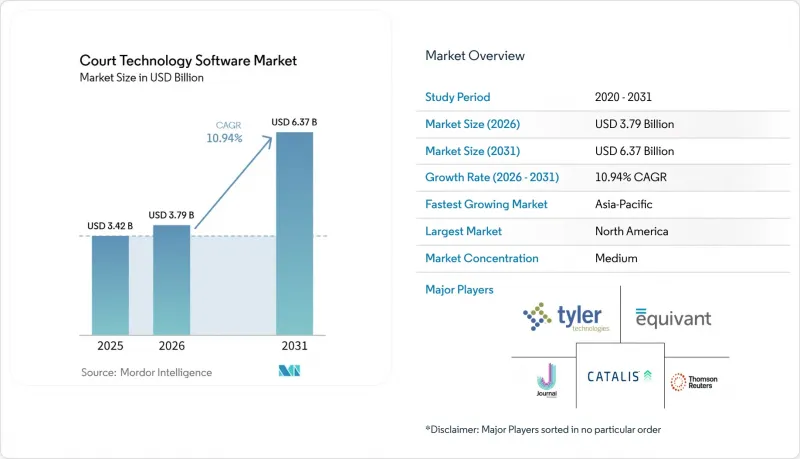
Mordor Intelligence에 의하면, 법원 기술 소프트웨어 시장 규모는 2025년에 34억 2,000만 달러로 평가되었고, 2026년 37억 9,000만 달러에서 2031년까지 63억 7,000만 달러에 이를 것으로 예측되며, 2026-2031년 예측 기간 CAGR은 10.94%를 나타낼 전망입니다.
본 보고서는 솔루션별(사건 관리, 전자 신청 및 사건 접수, 디지털 증거 및 문서 관리, 법정 기록 및 온라인 심리, 기타), 배포 방식별(클라우드 SaaS, 온프레미스, 하이브리드), 법원 유형별(민사 법원, 형사 법원, 가정법원 및 소년법원, 기타), 지역별로 분류되어 있습니다. 시장 예측은 금액(달러) 기준으로 제시되어 있습니다.
세계의 법원 기술 소프트웨어 시장 동향 및 인사이트
정부 주도의 전자 신청 및 법원 디지털화 의무화
정부의 의무화는 법원이 전자 신청 및 디지털 사건 관리 시스템을 도입하는 주요 이유가 되고 있습니다. 독일의 전자 사건 파일 관련 규정은 2026년 1월 1일부터 시행되어, 연방 법원과 검찰청에 디지털 사건 파일 사용이 의무화되었습니다. 또한, 더 많은 시간이 필요한 관할 구역에 대해서는 2027년 1월까지의 이행 기간이 마련되어 있습니다. 프랑스 역시 2,420만 유로(2,660만 달러 상당)의 혁신 자금 지원을 받아 형사 절차 디지털화 프로그램을 지속하고 있습니다. 이러한 요건으로 인해 법원 기술 소프트웨어 시장에는 공식적인 도입 프로그램에 뒷받침된 명확한 수요가 발생합니다. 지방 당국의 승인은 여전히 중요하지만, 정책 결정에서 조달 절차에 이르는 기간을 단축하는 것이 가능합니다. 디지털화 목표가 공공 자금, 직원 교육, 법원이 현실적으로 준수할 수 있는 명확한 도입 일정과 결합될 경우, 법원 기술 소프트웨어 시장은 그 혜택을 누리게 될 것입니다.
만성화된 법원의 미처리 사건과 사건의 복잡화
법원의 미처리 사건 누적으로 인해, 사건 제출, 일정 관리, 추적, 문서 처리를 지원하는 시스템의 필요성이 높아지고 있습니다. 인도 대법원은 2026년 5월, ‘One Case One Data’ 이니셔티브를 출범시켜 타르카 법원의 사법 데이터를 단일 전국 플랫폼으로 통합했습니다. 중국의 스마트 법원 개혁에서는 자동 속기 및 AI를 활용한 워크플로 도구가 도입되었으며, 한 조사에 따르면 평균 심리 기간이 30% 단축된 것으로 보고되었습니다. 이러한 사례들은 법원 기술 소프트웨어 시장이 사건 처리 흐름에서 측정 가능한 개선에 의존하고 있는 이유를 보여줍니다. 민사, 형사, 행정, 항소 절차 모두에서 유사한 압박이 가해지고 있지만, 각 절차의 요건은 서로 다릅니다. 플랫폼이 사용자에게 절차를 복잡하게 만들지 않으면서도 일상적인 사법 업무의 질과 속도를 향상시킬 수 있음을 입증할 수 있다면, 법원 기술 소프트웨어 시장은 이러한 수요로부터 혜택을 볼 수 있습니다.
사이버 보안, 개인정보 보호, 증거의 무결성에 관한 위험
사법 플랫폼은 극히 기밀성이 높은 사건 정보를 보유하고 있기 때문에 사이버 보안은 법원 현대화의 직접적인 제약 요인이 되고 있습니다. 미국 연방 사법 기관은 2025년 8월, 자사의 사건 관리 시스템이 고도로 정교하고 집요한 사이버 공격에 노출되었음을 확인하고, 이에 따라 사이버 보안 대책을 강화했습니다. 이 사건 이후, 일부 법원에서는 기밀성이 높은 자료에 대해 일시적으로 종이 매체를 통한 접수를 할 수밖에 없었으며, 이는 보안상의 사태가 일반적인 디지털 프로세스를 얼마나 혼란스럽게 하는지 여실히 드러냈습니다. 그 후, 사법 기관은 보다 광범위한 다단계 인증 도입과 IT 현대화 대응을 추진했습니다. 법원과 계약을 맺고자 하는 공급업체는 접근 제어, 감사 기록, 데이터 보호, 시스템 내결함성에 관해 더욱 엄격한 기대치를 충족해야 합니다. 이러한 요구 사항은 특히 규정 준수 테스트나 전문적인 도입 작업을 위한 자원이 부족한 법원 기술 소프트웨어 시장의 소규모 공급업체에게 개발 및 도입 비용을 증가시킬 가능성이 있습니다.
부문 분석
2025년 기준, 재판 사건 관리 소프트웨어는 법원 기술 소프트웨어 시장 규모의 29.32%를 차지했습니다. 이 소프트웨어는 사건 접수, 사건 등록, 일정 관리, 문서 관리, 사건 처리의 운영 기반으로서 기능하고 있습니다. 이러한 중요한 위치 덕분에 법원에서는 기존의 핵심 플랫폼에 전자 신청, 증거 관리, 기록, 분석 도구를 추가하는 경우가 많습니다. 따라서 법원 기술 소프트웨어 시장에서는 법원 직원이 별도의 시스템 사이를 오가야 하는 번거로움 없이 모듈을 연동할 수 있는 공급업체가 높이 평가됩니다. 전자 신청 및 사건 접수 기능은 새로운 사건을 법원의 워크플로우에 통합하기 위해 여전히 중요한 관련 부문입니다. 또한 디지털 증거 및 문서 관리의 경우에도, 시스템이 파일을 심리, 기한, 사건 기록에 직접 연결할 수 있다면 부가가치를 창출합니다.
전국 규모의 법원 현대화 프로그램은 단일 제품 카테고리가 아닌 솔루션 포트폴리오 전반에 걸친 수요를 뒷받침할 수 있습니다. 원격 심리가 계획적인 법원 운영의 일부가 됨에 따라, 온라인 심리는 2026-2031년 연평균 성장률(CAGR) 14.92%를 나타낼 것으로 예측됩니다. 영국 행정사법위원회는 원격 심리를 위한 장기적인 디지털 인프라 구축과 사건 선별, 요약, 속기 분야에서 AI 활용을 권장했습니다. 2026년 4월, 로스앤젤레스 카운티 고등법원, 스탠퍼드 대학교 로스쿨, ODR.com은 차세대 온라인 사건 해결 시스템을 개발하기 위한 제휴를 시작했습니다.
지역별 분석
2025년, 북미는 법원 기술 소프트웨어 시장의 39.81%를 차지했습니다. 미국 상원 법안 S.4667에서는 접근성, 모바일 대응, 사이버 보안에 관한 규정을 담은 전자 사건 관리 시스템의 현대화가 제안되었습니다. 캐나다의 ‘디지털 전략 2025-2027’에서도 핵심적인 사건 관리 및 디지털 서비스의 현대화가 법원 행정 서비스의 우선 과제로 자리매김했습니다. 남미 시장은 여전히 소규모이지만, 브라질, 콜롬비아, 칠레에서는 초기 단계의 전자 신청 시범 사업을 거쳐 통합 플랫폼으로의 전환이 진행되고 있습니다.
유럽의 법원 기술 소프트웨어 시장은 자금력이 풍부한 서유럽의 프로젝트와 중동유럽의 기존 법원 인프라가 혼재되어 있습니다. 독일의 ‘E-Akte’ 규정에서는 민사, 형사, 노동, 가정법원 절차 전반에 걸쳐 디지털 파일 사용이 의무화되어 있지만, 일부 관할 구역에서는 2027년 1월까지의 전환 기간이 설정되어 있습니다. 프랑스의 디지털 사법 프로그램에는 형사 절차의 디지털화를 위해 2,420만 유로(2,660만 달러)가 배정되었습니다. 또한 프랑스에서는 각 법원에 ‘Portalis’를 도입하고, 형사 법원의 디지털 인증 프로그램을 추진했습니다. 영국 행정사법평의회는 개혁이 이루어지지 않은 심판소에 대해서는 상용 시스템(COTS)의 채택을 권장하는 한편, 장기적으로 이용 가능한 원격 심리 인프라에 대한 투자를 제안했습니다.
아시아태평양은 2026-2031년 법원 기술 소프트웨어 시장에서 15.47%라는 지역 내 가장 높은 연평균 성장률(CAGR)을 나타낼 전망입니다. 인도의 법원 현대화 프로그램은 2027년까지 고등법원의 전반적인 서비스 혁신을 지원하고 있습니다. ‘One Case One Data’ 이니셔티브와 ‘Su Sahay’ 디지털 서비스는 사법 데이터의 연계와 사용자 접근성 개선에 중점을 두고 있음을 보여줍니다. 중국, 일본, 한국, 동남아시아의 각 관할 구역도 해당 지역 내 광범위한 법원 디지털화 활동의 일익을 담당하고 있습니다. 중동 및 아프리카의 수익 기반은 가장 작지만, 이 지역 법원들도 미처리 사건 해소를 위해 디지털 서비스 개발을 추진하고 있습니다.
기타 혜택
- 엑셀 형식 시장 예측(ME) 시트
- 3개월간의 애널리스트 지원
자주 묻는 질문
목차
제1장 서론
제2장 조사 방법
제3장 주요 요약
제4장 시장 구도
제5장 시장 규모 및 성장 예측
제6장 경쟁 구도
제7장 시장 기회 및 향후 전망
AJY 26.09.03According to Mordor Intelligence, the court technology software market size was valued at USD 3.42 billion in 2025 and estimated to grow from USD 3.79 billion in 2026 to reach USD 6.37 billion by 2031, at a CAGR of 10.94% during the forecast period 2026-2031.
This report is Segmented by Solution (Court Case Management, Electronic Filing and Case Intake, Digital Evidence and Document Management, Court Recording and Virtual Hearings, and More), Deployment (Cloud-Based, On-Premises, and Hybrid), Court Type (Civil Courts, Criminal Courts, Family and Juvenile Courts, and More), and Geography. The Market Forecasts are Provided in Terms of Value (USD).
Global Court Technology Software Market Trends and Insights
Government-Led E-Filing and Court Digitization Mandates
Government mandates are a major reason courts adopt electronic filing and digital case management systems. Germany's electronic case file rules took effect on January 1, 2026, requiring federal courts and public prosecutors to use digital case files, with a transition option until January 2027 for jurisdictions that needed more time. France also continued its penal procedure digitization program, supported by EUR 24.2 million in transformation funding, equal to USD 26.6 million. Such requirements give the Court a technology software market defined demand around formal implementation programs. They can shorten the period between a policy decision and a procurement process, although local approvals still matter. The Court technology software market benefits when digitization targets are paired with public funding, staff training, and a clear implementation schedule that courts can realistically follow.
Persistent Court Backlogs and Caseload Complexity
Court backlogs increase the need for systems that support filing, scheduling, case tracking, and document handling. India's Supreme Court launched the One Case One Data initiative in May 2026 to consolidate judicial data from taluka courts into a single national platform. China's smart court reform used automated transcription and AI-assisted workflow tools, and a study reported a 30% reduction in average trial duration. These examples show why the Court technology software market depends on measurable improvements in case flow. The same pressure affects civil, criminal, administrative, and appellate proceedings, although each has different procedural requirements. The Court technology software market can benefit from this demand when platforms demonstrate that they improve the quality and speed of routine judicial work without making procedures more difficult for users.
Cybersecurity, Privacy, and Evidentiary Integrity Exposure
Cybersecurity has become a direct limit on court modernization because judicial platforms hold highly sensitive case information. The U.S. federal judiciary confirmed in August 2025 that its case management system had faced sophisticated and persistent cyberattacks, leading to strengthened cybersecurity measures. Some courts temporarily used paper intake for sensitive material after the incident, which showed how a security event can disrupt normal digital processes. The judiciary then moved toward broader multi-factor authentication and an IT modernization response. Vendors seeking court contracts need to meet stronger expectations for access controls, audit records, data protection, and system resilience. These requirements can raise development and implementation costs, particularly for smaller providers in the Court technology software market that have fewer resources for compliance testing and specialist implementation work.
Other drivers and restraints analyzed in the detailed report include:
- Cloud Migration and Remote Court Service Delivery
- Rising Volume and Evidentiary Complexity of Digital Records
- Lengthy Public-Sector Procurement and Implementation Cycles
For complete list of drivers and restraints, kindly check the Table Of Contents.
Segment Analysis
Court case management software accounted for 29.32% of the Court technology software market size in 2025. It serves as the operational foundation for intake, docketing, scheduling, document management, and case disposition. Its position means that courts often add electronic filing, evidence management, recording, and analytics tools to an existing core platform. The Court technology software industry, therefore, rewards suppliers that can connect modules without forcing court staff to move between separate systems. Electronic filing and case intake remain important adjacent areas because they bring new cases into the court workflow. Digital evidence and document management also add value when the system can link files directly to hearings, deadlines, and case records.
Large national court modernization programs can support demand across the solution portfolio instead of a single product category. Virtual hearings are projected to grow at a 14.92% CAGR from 2026 to 2031 as remote proceedings become part of planned court operations. The Administrative Justice Council in the United Kingdom recommended long-term digital infrastructure for remote hearings and the use of AI in case triage, summarization, and transcription. In April 2026, the Superior Court of Los Angeles County, Stanford Law School, and ODR.com began a partnership to develop a next-generation online case resolution system.
Complete Report Scope:
- By Solution
- Court Case Management
- Electronic Filing and Case Intake
- Digital Evidence and Document Management
- Court Recording and Virtual Hearings
- Online Dispute Resolution (ODR)
- Public Access and Citizen Services Portals
- Court Intelligence and Analytics
- By Deployment
- Cloud SaaS
- On-Premises
- Hybrid
- By Court Type
- Civil Courts
- Criminal Courts
- Family and Juvenile Courts
- Administrative and Regulatory Courts
- Probate and Estate Courts
- Traffic and Municipal Courts
- Appellate Courts
- By Geography
- North America
- United States
- Canada
- Mexico
- South America
- Brazil
- Argentina
- Colombia
- Chile
- Rest of South America
- Europe
- United Kingdom
- Germany
- France
- Italy
- Spain
- Russia
- Nordic
- Rest of Europe
- Asia-Pacific
- China
- India
- Japan
- South Korea
- Australia
- Southeast Asia
- Rest of Asia-Pacific
- Middle East and Africa
- Middle East
- Saudi Arabia
- United Arab Emirates
- Israel
- Turkey
- Qatar
- Rest of Middle East
- Africa
- South Africa
- Nigeria
- Egypt
- Rest of Africa
- Middle East
- North America
Geography Analysis
North America accounted for 39.81% of the Court technology software market in 2025. U.S. Senate bill S.4667 proposed modernizing electronic case management systems with accessibility, mobile design, and cybersecurity provisions. Canada's Digital Strategy 2025-2027 also identified modernization of core case management and digital services as a priority for the Courts Administration Service. South America remains smaller, but Brazil, Colombia, and Chile are moving beyond early e-filing pilots toward integrated platforms.
The Court technology software market in Europe combines well-funded Western European projects with older court infrastructure in Central and Eastern Europe. Germany's E-Akte rules require digital files across civil, criminal, labor, and family proceedings, although some jurisdictions have a transition period until January 2027. France's digital justice program included EUR 24.2 million (USD 26.6 million) for digitizing the penal procedure. France also advanced the deployment of Portalis and digital penal court certification programs across tribunals. The United Kingdom's Administrative Justice Council recommended commercial off-the-shelf systems for unreformed tribunals and investment in durable remote-hearing infrastructure.
Asia-Pacific is projected to record the fastest regional CAGR of 15.47% in the Court technology software market between 2026 and 2031. India's court modernization program supports changes across high-court services through 2027. The One Case One Data initiative and the Su Sahay digital service show a focus on linking judicial data and improving user access. China, Japan, South Korea, and Southeast Asian jurisdictions also form part of the region's wider court digitization activity. The Middle East and Africa have the smallest revenue base, yet their courts are also developing digital services to address case backlogs.
- Tyler Technologies, Inc.
- Thomson Reuters Corporation
- Journal Technologies, Inc.
- Equivant, Inc.
- Catalis, Inc.
- Hyland Software, Inc.
- ImageSoft, Inc.
- i3 Verticals, Inc.
- Justice Systems, Inc.
- Pioneer Technology Group, Inc.
- Matrix Pointe Software, LLC
- Cott Systems, Inc.
- For The Record, Inc.
- BIS Digital, Inc.
- Synergy International Systems, Inc.
- Relational Semantics, Inc.
- Civitek Solutions, LLC
- Neumo, Inc.
- Judicial Systems, Inc.
- Microsoft Corporation
- Modria
- CourtView Justice Solutions
Additional Benefits:
- The market estimate (ME) sheet in Excel format
- 3 months of analyst support
TABLE OF CONTENTS
1 INTRODUCTION
- 1.1 Study Assumptions and Market Definition
- 1.2 Scope of the Study
2 RESEARCH METHODOLOGY
3 EXECUTIVE SUMMARY
4 MARKET LANDSCAPE
- 4.1 Market Overview
- 4.2 Market Drivers
- 4.2.1 Government-Led e-Filing and Court Digitization Mandates
- 4.2.2 Persistent Court Backlogs and Caseload Complexity
- 4.2.3 Cloud Migration and Remote Court Service Delivery
- 4.2.4 Rising Volume and Evidentiary Complexity of Digital Records
- 4.2.5 Self-Represented Litigant Demand for Guided Digital Access
- 4.2.6 Interoperability Requirements Across Justice Agencies
- 4.3 Market Restraints
- 4.3.1 Lengthy Public-Sector Procurement and Implementation Cycles
- 4.3.2 Cybersecurity, Privacy, and Evidentiary Integrity Exposure
- 4.3.3 Legacy-System Lock-In and Jurisdiction-Specific Customization
- 4.3.4 Algorithmic Accountability and Judicial Acceptance Constraints
- 4.4 Industry Value-Chain Analysis
- 4.4.1 Court Technology Strategy and Procurement
- 4.4.2 Software Development and Platform Engineering
- 4.4.3 Systems Integration and Data Migration
- 4.4.4 Implementation, Training, and Change Management
- 4.4.5 Managed Services, Support, and Upgrades
- 4.4.6 Court Users, Justice Partners, and Public Access Channels
- 4.5 Regulatory Landscape
- 4.5.1 Electronic Filing and Digital Service Rules
- 4.5.2 Data Protection, Privacy, and Data Residency Requirements
- 4.5.3 Digital Signature and Electronic Record Admissibility Rules
- 4.5.4 Accessibility and Language-Access Requirements
- 4.5.5 Government Cloud Security and Procurement Certifications
- 4.6 Technological Outlook
- 4.6.1 Cloud-Native and Hybrid Court Platforms
- 4.6.2 Artificial Intelligence and Machine Learning
- 4.6.3 Natural Language Processing and Automated Transcription
- 4.6.4 Digital Evidence Management and Multimedia Indexing
- 4.6.5 Application Programming Interfaces and Data Exchange Standards
- 4.6.6 Blockchain-Based Evidence Integrity and Audit Trails
- 4.6.7 Online Dispute Resolution and Virtual Hearing Infrastructure
- 4.7 Impact of Macroeconomic Factors on the Market
- 4.8 Porter's Five Forces Analysis
- 4.8.1 Bargaining Power of Buyers
- 4.8.2 Bargaining Power of Suppliers
- 4.8.3 Threat of New Entrants
- 4.8.4 Threat of Substitutes
- 4.8.5 Intensity of Competitive Rivalry
5 MARKET SIZE AND GROWTH FORECASTS (VALUE)
- 5.1 By Solution
- 5.1.1 Court Case Management
- 5.1.2 Electronic Filing and Case Intake
- 5.1.3 Digital Evidence and Document Management
- 5.1.4 Court Recording and Virtual Hearings
- 5.1.5 Online Dispute Resolution (ODR)
- 5.1.6 Public Access and Citizen Services Portals
- 5.1.7 Court Intelligence and Analytics
- 5.2 By Deployment
- 5.2.1 Cloud SaaS
- 5.2.2 On-Premises
- 5.2.3 Hybrid
- 5.3 By Court Type
- 5.3.1 Civil Courts
- 5.3.2 Criminal Courts
- 5.3.3 Family and Juvenile Courts
- 5.3.4 Administrative and Regulatory Courts
- 5.3.5 Probate and Estate Courts
- 5.3.6 Traffic and Municipal Courts
- 5.3.7 Appellate Courts
- 5.4 By Geography
- 5.4.1 North America
- 5.4.1.1 United States
- 5.4.1.2 Canada
- 5.4.1.3 Mexico
- 5.4.2 South America
- 5.4.2.1 Brazil
- 5.4.2.2 Argentina
- 5.4.2.3 Colombia
- 5.4.2.4 Chile
- 5.4.2.5 Rest of South America
- 5.4.3 Europe
- 5.4.3.1 United Kingdom
- 5.4.3.2 Germany
- 5.4.3.3 France
- 5.4.3.4 Italy
- 5.4.3.5 Spain
- 5.4.3.6 Russia
- 5.4.3.7 Nordic
- 5.4.3.8 Rest of Europe
- 5.4.4 Asia-Pacific
- 5.4.4.1 China
- 5.4.4.2 India
- 5.4.4.3 Japan
- 5.4.4.4 South Korea
- 5.4.4.5 Australia
- 5.4.4.6 Southeast Asia
- 5.4.4.7 Rest of Asia-Pacific
- 5.4.5 Middle East and Africa
- 5.4.5.1 Middle East
- 5.4.5.1.1 Saudi Arabia
- 5.4.5.1.2 United Arab Emirates
- 5.4.5.1.3 Israel
- 5.4.5.1.4 Turkey
- 5.4.5.1.5 Qatar
- 5.4.5.1.6 Rest of Middle East
- 5.4.5.2 Africa
- 5.4.5.2.1 South Africa
- 5.4.5.2.2 Nigeria
- 5.4.5.2.3 Egypt
- 5.4.5.2.4 Rest of Africa
- 5.4.5.1 Middle East
- 5.4.1 North America
6 COMPETITIVE LANDSCAPE
- 6.1 Market Concentration
- 6.2 Strategic Moves (Product Launches and Platform Modernization, Cloud Migration Partnerships, Artificial Intelligence and Automation Investments, Government Contract Wins and Renewals, etc.)
- 6.3 Market Share Analysis
- 6.4 Company Profiles (includes Global Level Overview, Market Level Overview, Core Segments, Financials as available, Strategic Information, Market Rank/Share, Products and Services, Recent Developments)
- 6.4.1 Tyler Technologies, Inc.
- 6.4.2 Thomson Reuters Corporation
- 6.4.3 Journal Technologies, Inc.
- 6.4.4 Equivant, Inc.
- 6.4.5 Catalis, Inc.
- 6.4.6 Hyland Software, Inc.
- 6.4.7 ImageSoft, Inc.
- 6.4.8 i3 Verticals, Inc.
- 6.4.9 Justice Systems, Inc.
- 6.4.10 Pioneer Technology Group, Inc.
- 6.4.11 Matrix Pointe Software, LLC
- 6.4.12 Cott Systems, Inc.
- 6.4.13 For The Record, Inc.
- 6.4.14 BIS Digital, Inc.
- 6.4.15 Synergy International Systems, Inc.
- 6.4.16 Relational Semantics, Inc.
- 6.4.17 Civitek Solutions, LLC
- 6.4.18 Neumo, Inc.
- 6.4.19 Judicial Systems, Inc.
- 6.4.20 Microsoft Corporation
- 6.4.21 Modria
- 6.4.22 CourtView Justice Solutions
7 MARKET OPPORTUNITIES AND FUTURE OUTLOOK
- 7.1 White-Space and Unmet-Need Assessment
- 7.2 Future Technology Adoption Roadmap
- 7.3 Investment and Funding Outlook