
|
시장보고서
상품코드
2118206
법률 문서 자동화 소프트웨어 시장 : 시장 점유율 분석, 업계 동향 및 통계, 성장 예측(2025-2031년)Legal Document Automation Software - Market Share Analysis, Industry Trends & Statistics, Growth Forecasts (2025 - 2031) |
||||||
 Mordor Intelligence
Mordor Intelligence에 의하면, 법률 문서 자동화 소프트웨어 시장 규모는 2025년 26억 1,000만 달러로 평가되었고, 2026년에는 29억 8,000만 달러로 추정되고, 2031년까지 64억 9,000만 달러에 이를 것으로 예상되며, 2026-2031년 CAGR 16.82%로 성장할 전망입니다.
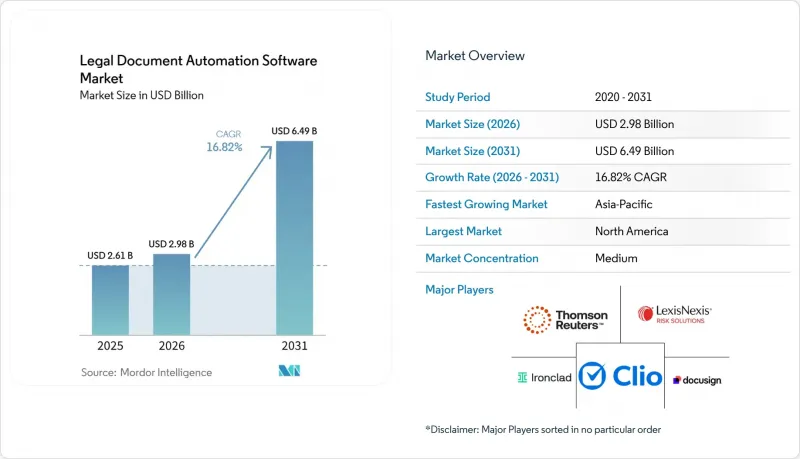
본 보고서는 도입 형태별(클라우드 기반, 온프레미스형, 하이브리드형), 용도별(법률 문서 자동화·작성, CLM, 법률 지식 관리, E-디스커버리), 조직 규모별(대기업, 중소기업), 최종 사용자별(법률 사무소, 기업 법무 부서, 정부·공공 부문 등), 지역별로 분류되어 있습니다. 시장 전망은 금액(달러)으로 표시되어 있습니다.
세계의 법률 문서 자동화 소프트웨어 시장 동향 및 인사이트
AI를 활용한 초안 작성 및 검토 워크플로우 도입 확대
2025년과 2026년에 걸쳐, 법률 문서 자동화 시장의 대부분에서 AI를 활용한 초안 작성은 시범 단계에서 일상적인 법무 업무로 전환되었습니다. NetDocuments의 보고서에 따르면, 로펌의 법률 AI 도입률은 2024년 37%에서 2025년 80%로 상승했으며, 이는 로펌들이 더 이상 이러한 도구를 제한적인 실험으로 취급하지 않고 있음을 보여줍니다. 이러한 변화는 구매자가 소프트웨어를 평가하는 방식에도 영향을 미치고 있습니다. 사내 법무 팀은 현재 더 신속한 초안 작성, 더 강력한 검토 지원, 그리고 조사와 문서 작성 간의 더 긴밀한 연계를 기대하고 있기 때문입니다. 톰슨 로이터는 2025년 ‘CoCounsel Legal’을 보다 광범위한 법무 업무 공간으로 지속적으로 발전시켰는데, 이는 주요 벤더들이 고립된 단일 기능 도구가 아닌 통합된 AI 환경으로 전환하고 있음을 반영한 것입니다. 법무 문서 자동화 소프트웨어 시장이 확대됨에 따라, 변호사의 업무 시간은 초안 작성에서 판단, 협상 및 예외 사항 검토로 이동하고 있습니다. 이에 따라 동일한 워크플로우 내에서 속도와 법적 타당성을 모두 지원할 수 있는 플랫폼에 대한 수요는 계속해서 증가하고 있습니다.
법무 업무에서 계약 처리 기간 단축에 대한 수요 증가
계약 주기 시간은 법무 문서 자동화 소프트웨어 시장의 구매자에게 여전히 가장 두드러진 과제 중 하나입니다. 구매자들은 업무를 서로 연동되지 않은 여러 도구에 분산시키지 않고, 사건 접수, 라우팅, 검토, 협상 지원, 서명 후 후속 조치를 일원화하여 관리할 수 있는 단일 시스템을 점점 더 요구하고 있습니다. 아이언클래드(Ironclad)는 2026년, 자사의 ‘Jurist Redlining Agent with Playbooks’가 플레이북을 기반으로 한 1차 수정안을 5분 이내에 작성할 수 있다고 발표했습니다. 이 벤치마크는 법무 팀이 변호사의 업무량을 측정하는 방식을 변화시킬 것입니다. 왜냐하면 초안 작성이 더 이상 프로세스에서 가장 시간이 많이 소요되는 단계가 아니기 때문입니다. 또한 아이언클래드사는 계약서 검토의 주요 환경으로 Microsoft Word를 꼽으며, 이것이 독립적인 초안 작성 환경보다 내장형 워크플로가 더 매력적인 이유를 설명하고 있습니다. 법무 문서 자동화 소프트웨어 시장에서는 변호사가 이미 사용하고 있는 도구와 원활하게 통합할 수 있는 공급업체가 지지를 얻고 있습니다. 이는 업무에 미치는 혼란을 최소화하면서 처리 시간을 단축할 수 있기 때문입니다.
기밀성 및 특권 정보 유출에 대한 우려
기밀 유지 위험은 여전히 법무 문서 자동화 소프트웨어 시장의 가장 큰 걸림돌로 남아 있습니다. 법무 팀은 특권 정보가 관리된 환경 밖으로 유출될 위험을 감수할 수 없기 때문입니다. 로이터 프랙티컬 로(Reuters Practical Law)는 2025년, 생성형 AI의 활용이 기밀성, 데이터 소유권 및 영업 비밀 보호와 관련하여 중요한 문제를 제기하고 있다고 지적했습니다. 이러한 우려는 도구가 사용자의 입력 데이터를 보유하거나, 재사용 및 보유에 관한 명확한 계약상 제한이 없는 경우 더욱 심각해집니다. 따라서 구매자들은 데이터 비보관 설계, 강력한 암호화, 그리고 감사된 관리 체계를 프리미엄 옵션이 아닌 기본 요건으로 간주하고 있습니다. 이로 인해 성숙한 거버넌스 프로그램을 갖춘 대형 벤더가 유리한 입장에 서게 되며, 거버넌스가 미흡한 도구를 평가 단계에 있는 로펌에서의 도입은 지연되고 있습니다. 법무 문서 자동화 소프트웨어 시장은 계속 성장하고 있지만, 도입 초기 단계에서 기밀 정보에 대한 우려를 완전히 해소하지 못할 경우 조달에 더 오랜 시간이 소요될 것입니다.
부문 분석
2025년, 클라우드 기반 도입은 법률 문서 자동화 소프트웨어 시장 점유율의 69.84%를 차지했으며, 로펌 및 기업의 법무 팀에서 확립된 제공 모델이 되었습니다. 클라우드 플랫폼은 모델의 신속한 업데이트, 손쉬운 협업, 원격지에서의 문서 접근을 지원하며, 이러한 기능은 서버 기반 환경에서는 동등한 비용으로 구현하기 어렵습니다. 또한, 사내에서 복잡한 법무 시스템을 유지 관리하고 싶지 않은 기업의 경우, 사내 인프라 부담을 경감시켜 줍니다. 온프레미스형 도입은 데이터 소재지 요건이나 사내 정책으로 인해 제3자 호스팅이 제한되는 국방, 금융 서비스, 정부 기관 환경에서 여전히 중요한 역할을 하고 있습니다. 기밀성이 높은 이용 사례에서 규정 준수 인증을 받은 환경이 널리 수용됨에 따라, 법무 문서 자동화 소프트웨어 시장에서는 클라우드 기반 제공이 계속해서 주류를 이루고 있습니다.
하이브리드형 도입은 2026-2031년 연평균 성장률(CAGR) 19.74%로 확대될 것으로 예측되며, 법률 문서 자동화 소프트웨어 시장에서 가장 빠르게 성장하는 하위 부문이 될 전망입니다. 이 모델을 통해 조직은 기밀성이 높은 저장소를 온프레미스에 유지하면서, AI 추론 및 워크플로우 오케스트레이션에는 클라우드 도구를 활용할 수 있습니다. 이러한 균형은 최신 AI 기능을 희생하지 않으면서도 더 강력한 제어를 원하는 대기업 및 공공 부문 구매자에게 적합합니다. 또한 하이브리드 모델을 통해 전체 문서 자산을 이전하기 전에 워크플로우 계층을 현대화할 수 있으므로 단계적인 전환도 가능합니다. 그 결과, 소규모 구매자층에서는 클라우드가 계속해서 주류를 이루는 반면, 대규모이며 규제가 엄격한 조직에서는 하이브리드 모델이 입지를 다지는 시장 구조가 형성되고 있습니다.
2025년, 계약 수명주기 관리(CLM)는 법무 문서 자동화 소프트웨어 시장의 34.27%를 차지했으며, 거래 상대방의 위험, 의무 및 계약 갱신을 일원화하여 관리할 필요성을 부각시켰습니다. CLM 플랫폼은 계약서, 플레이북, 승인 이력을 관리하는 ‘기록 관리 시스템’의 역할을 하므로 고객을 장기적으로 유지하는 경향이 있습니다. 워크플로우, 거래 상대방, 체결된 문서가 플랫폼에 통합되면 이러한 기록 관리 기능으로 인해 플랫폼 전환 비용이 높아집니다. 또한, 법무 팀은 조사, 보존, 기록 관리 도구를 문서 작성 워크플로우와 연동하기를 원하기 때문에 법무 지식 관리 및 e-디스커버리도 여전히 중요합니다. 따라서 법무 문서 자동화 소프트웨어 시장은 단순히 템플릿을 자동화하는 것을 넘어, 계약의 전체 라이프사이클을 관리하는 플랫폼으로 전환되고 있습니다.
법무 문서 자동화 및 작성 시장은 2026-2031년 연평균 성장률(CAGR) 20.18%를 나타낼 것으로 예측되며, 법무 문서 자동화 소프트웨어 시장에서 가장 두드러진 성장을 보일 용도 분야가 될 전망입니다. Ironclad에 따르면, 계약서 검토의 약 70%는 여전히 Microsoft Word에서 이루어지고 있으며, 이것이 내장형 작성 도구가 주목을 받고 있는 이유를 설명해 줍니다. 레드라인 기능, 조항 생성, 협상 지원을 변호사가 익숙한 환경에 통합하는 벤더는 워크플로우 측면에서 발생하는 저항을 최소화할 수 있습니다. 변호사들은 일반적으로 워크플로우를 전면적으로 대체하는 것보다 익숙한 도구 내에서 프로세스를 개선하는 것을 선호하기 때문에 이러한 설계상의 선택은 중요합니다. 이러한 변화로 인해 용도 분야는 고립된 초안 작성 지원이 아닌, 초안 작성, 검토, 협상을 아우르는 보다 광범위한 협업으로 전환되고 있습니다.
지역별 분석
2025년, 북미는 법률 문서 자동화 소프트웨어 시장의 41.18%를 차지하며 지역 내 주도적 위치를 유지했습니다. 미국은 높은 기술 투자, 대규모 기업의 법무 부서, 그리고 밀집된 벤더 생태계를 통해 그 선두 위치를 공고히 하고 있습니다. 톰슨 로이터에 따르면, 2025년 미국 로펌의 기술 투자는 9.7% 증가했으며, 지식 관리에 대한 투자는 10.5% 증가했습니다. 이는 예산이 현재 워크플로우 자동화를 얼마나 강력하게 지원하고 있는지를 보여줍니다. 또한 캐나다도 이 지역의 기반을 강화하고 있습니다. 클리오(Clio)가 vLex를 10억 달러에 인수하고, 2025년 11월에는 시리즈 G 자금 조달을 통해 5억 달러를 유치함으로써 북미 내 플랫폼의 전개 범위가 확대되었기 때문입니다. 멕시코 및 남미 시장은 여전히 도입 초기 단계에 있지만, 다국적 기업의 법무 및 컴플라이언스 수요가 증가함에 따라 더욱 표준화된 문서 워크플로우에 대한 수요는 계속 확대되고 있습니다.
유럽은 독일, 영국, 프랑스를 필두로, 법무 문서 자동화 소프트웨어 시장에서 여전히 2위의 규모를 자랑하는 지역입니다. 이 지역 수요는 계약 및 문서 워크플로우 전반에 걸쳐 더 강력한 감사 가능성을 요구하는 규제 산업 및 대기업에 의해 뒷받침되고 있습니다. EU AI법 및 GDPR(EU 개인정보보호규정)은 투명성이 높은 거버넌스,유연한 도입, 그리고 정당성을 입증할 수 있는 문서 관리 기능을 갖춘 플랫폼을 지속적으로 뒷받침하고 있습니다. 스페인 국가검찰청이 2026년 2월에 TEMIS를 도입한 것은 남유럽의 정부 법무 기관들도 문서 인텔리전스를 실제 운영에 적용하기 시작하고 있음을 보여줍니다.
아시아태평양은 2026-2031년 연평균 성장률(CAGR) 21.47%로 확대될 것으로 예측되며, 법률 문서 자동화 소프트웨어 시장에서 가장 빠르게 성장하는 지역이 될 전망입니다. 이 지역의 성장은 법원의 현대화, 기업의 디지털화, 그리고 법률 워크플로우에서 AI 도구의 채택 확대와 밀접하게 관련되어 있습니다. 인도와 중국은 두 시장 모두 대규모 법적 절차의 현대화를 추진하고 있어, 이러한 성장의 중심적인 역할을 계속하고 있습니다. 일본과 한국은 여전히 도입에 신중한 태도를 보이고 있지만, 기존의 온프레미스형 시스템 노후화에 따라 ‘클라우드 우선’ 조달 정책이 수요를 끌어올릴 것으로 예측됩니다. 중동 및 아프리카도 여전히 초기 단계에 있지만, 사우디아라비아, 아랍에미리트, 남아프리카공화국의 법무 디지털화 프로그램이 향후 도입을 위한 명확한 로드맵을 구축해 나가고 있습니다.
기타 혜택 :
- 엑셀 형식 시장 예측(ME) 시트
- 3개월간의 애널리스트 지원
자주 묻는 질문
목차
제1장 서론
제2장 조사 방법
제3장 개요
제4장 시장 구도
제5장 시장 규모 및 성장 예측
제6장 경쟁 구도
제7장 시장 기회 및 향후 전망
AJY 26.09.01According to Mordor Intelligence, the legal document automation software market size is expected to increase from USD 2.61 billion in 2025 to USD 2.98 billion in 2026 and reach USD 6.49 billion by 2031, growing at a CAGR of 16.82% over 2026-2031.
This report is Segmented by Deployment Mode (Cloud-Based, On-Premise, and Hybrid), Application (Legal Document Automation and Drafting, CLM, Legal Knowledge Management, and E-Discovery), Organization Size (Large Enterprises, and SMEs), End User (Law Firms, Corporate Legal Departments, Government and Public Sector, and More), and Geography. The Market Forecasts are in Value (USD).
Global Legal Document Automation Software Market Trends and Insights
Rising Adoption Of AI-Assisted Drafting And Review Workflows
AI-assisted drafting moved from pilot activity into daily legal work across much of the legal document automation software market in 2025 and 2026. NetDocuments reported that legal AI adoption in law firms rose from 37% in 2024 to 80% in 2025, which showed that firms were no longer treating these tools as limited experiments. That change is influencing how buyers evaluate software, as in-house teams now expect faster first drafts, stronger review support, and tighter integration between research and document creation. Thomson Reuters continued building CoCounsel Legal into a broader legal workspace in 2025, which reflected how major vendors were moving toward integrated AI environments rather than isolated point tools. As the legal document automation software market expands, attorney time is shifting away from first-draft production and toward judgment, negotiation, and exception review. This keeps demand high for platforms that can support both speed and legal defensibility inside the same workflow.
Expanding Need For Faster Contract Turnaround In Legal Operations
Contract cycle time remains one of the clearest pain points for buyers in the legal document automation software market. Buyers increasingly want a single system that manages intake, routing, review, negotiation support, and post-signature follow-up without pushing work across multiple disconnected tools. Ironclad said in 2026 that its Jurist Redlining Agent with Playbooks could deliver a playbook-grounded first-pass redline in under 5 minutes. That benchmark changes how legal teams measure attorney effort because the first draft no longer needs to be the slowest stage in the process. Ironclad also pointed to Microsoft Word as the primary setting for contract review, which explains why embedded workflows have become more attractive than separate drafting environments. In the legal document automation software market, vendors that integrate seamlessly with the tools attorneys already use are gaining favor because they reduce disruption while still improving turnaround time.
Concerns Around Confidentiality And Privileged Data Exposure
Confidentiality risk remains the strongest brake on the legal document automation software market because legal teams cannot risk privileged material leaving controlled environments. Reuters Practical Law noted in 2025 that the use of generative AI raises important questions around confidentiality, data ownership, and trade secret protection. That concern becomes sharper when a tool retains user inputs or lacks clear contractual limits on reuse and retention. Buyers, therefore, treat zero-retention design, strong encryption, and audited controls as baseline requirements rather than premium options. This favors larger vendors with mature governance programs and slows adoption among firms that are still evaluating lightly governed tools. The legal document automation software market continues to grow, but procurement takes longer when buyers cannot fully resolve privilege concerns at the start of a deployment.
Other drivers and restraints analyzed in the detailed report include:
- Cloud Migration Of Law Firm And In-House Document Systems
- Growing Demand For Audit-Ready, Version-Controlled Legal Workflows
- Integration Complexity With Legacy DMS And CLM Environments
For complete list of drivers and restraints, kindly check the Table Of Contents.
Segment Analysis
Cloud-based deployment accounted for 69.84% of the legal document automation software market share in 2025, making it the established delivery model across law firms and corporate legal teams. Cloud platforms support quicker model updates, easier collaboration, and remote document access, which are difficult to match at a similar cost in server-based environments. They also reduce internal infrastructure burden for firms that do not want to maintain complex legal systems in-house. On-premise deployments still matter in defense, financial services, and government settings where data residency or internal policy limits third-party hosting. The legal document automation software market continues to favor cloud delivery as compliance-certified environments become more accepted across sensitive use cases.
Hybrid deployment is projected to expand at a 19.74% CAGR from 2026 to 2031, making it the fastest-growing subsegment in the legal document automation software market. This model lets organizations keep sensitive repositories on-premise while using cloud tools for AI inference and workflow orchestration. That balance suits large firms and public-sector buyers that want stronger control without giving up newer AI capabilities. Hybrid also supports phased migration because firms can modernize workflow layers before moving entire document estates. The result is a market structure where cloud remains dominant for smaller buyers while hybrid gains ground with larger and more regulated organizations.
Contract lifecycle management accounted for 34.27% of the legal document automation software market in 2025, underscoring the need to centralize counterparty risk, obligations, and renewals. CLM platforms tend to keep clients for long periods because they become the system of record for agreements, playbooks, and approval history. That record-keeping role increases switching costs once workflows, counterparties, and executed documents are embedded in the platform. Legal knowledge management and e-discovery also remain important because legal teams want research, preservation, and records tools to connect with drafting workflows. The legal document automation software market is therefore moving toward platforms that manage agreements across their full life cycle rather than only automating templates.
Legal document automation and drafting is projected to grow at a 20.18% CAGR from 2026 to 2031, making it the fastest-growing application in the legal document automation software market. Ironclad said around 70% of contract review still occurs in Microsoft Word, which explains why embedded drafting tools are attracting attention. Vendors that bring redlining, clause generation, and negotiation support into attorney-native environments face less workflow resistance. Those design choices matter because lawyers usually prefer process improvement within familiar tools rather than a full workflow replacement. This shift is moving the application segment toward broader orchestration across drafting, review, and negotiation rather than isolated drafting assistance.
Complete Report Scope:
- By Deployment Mode
- Cloud-Based
- On-Premise
- Hybrid
- By Application
- Legal Document Automation and Drafting
- Contract Lifecycle Management
- Legal Knowledge and Research Management
- Litigation Support and E-Discovery
- By Organization Size
- Large Enterprises
- Small And Medium Enterprises
- By End User
- Law Firms
- Corporate Legal Departments
- Government And Public Sector
- Other End Users
- By Geography
- North America
- United States
- Canada
- Mexico
- South America
- Brazil
- Argentina
- Rest Of South America
- Europe
- Germany
- United Kingdom
- France
- Italy
- Spain
- Russia
- Rest Of Europe
- Asia-Pacific
- China
- Japan
- India
- South Korea
- Australia
- Rest Of Asia-Pacific
- Middle East
- Turkey
- Saudi Arabia
- United Arab Emirates
- Rest Of Middle East
- Africa
- South Africa
- Egypt
- Rest Of Africa
- North America
Geography Analysis
North America held 41.18% of the legal document automation software market in 2025, maintaining its leading regional position. The United States supports that lead through high technology spending, large corporate legal departments, and a dense vendor ecosystem. Thomson Reuters said technology spending at US law firms grew 9.7% in 2025, and knowledge management spending rose 10.5%, which showed how strongly budgets now support workflow automation. Canada also strengthens the region because Clio completed its USD 1 billion acquisition of vLex and raised USD 500 million in Series G funding in November 2025, giving North America a larger platform footprint. Mexico and South American markets remained earlier-stage adopters, although multinational legal and compliance needs continue to widen demand for more standardized document workflows.
Europe remained the second-largest region in the legal document automation software market, led by Germany, the United Kingdom, and France. Regional demand is supported by regulated industries and large firms that need stronger auditability across contract and document workflows. The EU AI Act and GDPR continue to favor platforms with transparent governance, flexible deployment, and defensible document controls. Spain's General State Attorney's Office deployed TEMIS in February 2026, which showed that government legal bodies in Southern Europe were also moving document intelligence into operational use.
Asia-Pacific is projected to expand at a 21.47% CAGR from 2026 to 2031, making it the fastest-growing region in the legal document automation software market. Growth in the region is tied to court modernization, enterprise digitization, and the growing adoption of AI tools in legal workflows. India and China remain central to this expansion because both markets are pushing legal process modernization at scale. Japan and South Korea remain more conservative adopters, but cloud-first procurement is expected to lift demand as legacy on-premise systems age. The Middle East and Africa also remained early stage, but legal digitalization programs in Saudi Arabia, the United Arab Emirates, and South Africa are creating a clearer path for future adoption.
- Thomson Reuters Corporation
- LexisNexis Risk Solutions Group Ltd.
- Ironclad Inc.
- DocuSign Inc.
- Clion Inc.
- iManage LLC
- NetDocuments Software Inc.
- Litera
- ContractPod Technologies Ltd.
- Luminance Technologies Ltd.
- LinkSquares Inc.
- Juro Ltd.
- Everlaw Inc.
- CS Disco, Inc.
- LegalSifter, Inc.
- LawGeex Ltd.
- Spellbook Legal Technologies Inc.
- Avvoka Ltd.
- DraftWise, Inc.
- Robin AI Ltd.
- Evisort, Inc.
- Conga Corporation
- HotDocs Ltd.
- Bigle Legal, S.L.
Additional Benefits:
- The market estimate (ME) sheet in Excel format
- 3 months of analyst support
TABLE OF CONTENTS
1 INTRODUCTION
- 1.1 Study Assumptions and Market Definition
- 1.2 Scope of the Study
2 RESEARCH METHODOLOGY
3 EXECUTIVE SUMMARY
4 MARKET LANDSCAPE
- 4.1 Market Overview
- 4.2 Market Drivers
- 4.2.1 Rising Adoption Of AI-Assisted Drafting And Review Workflows
- 4.2.2 Expanding Need For Faster Contract Turnaround In Legal Operations
- 4.2.3 Cloud Migration Of Law Firm And In-House Document Systems
- 4.2.4 Growing Demand For Audit-Ready, Version-Controlled Legal Workflows
- 4.2.5 Higher Budget Allocation For Legal Technology Modernization
- 4.2.6 Increasing Regulatory Pressure For Traceable Document Governance
- 4.3 Market Restraints
- 4.3.1 Concerns Around Confidentiality And Privileged Data Exposure
- 4.3.2 Integration Complexity With Legacy DMS And CLM Environments
- 4.3.3 Inconsistent Legal Output Quality In Edge-Case Drafting Use Cases
- 4.3.4 Change Resistance From Attorney-Heavy Workflows
- 4.4 Impact Of Macroeconomic Factors On The Market
- 4.5 Industry Value Chain Analysis
- 4.6 Regulatory Landscape
- 4.7 Technological Outlook
- 4.8 Porter's Five Forces, Analysis
- 4.8.1 Threat Of New Entrants
- 4.8.2 Bargaining Power Of Suppliers
- 4.8.3 Bargaining Power Of Buyers
- 4.8.4 Threat Of Substitutes
- 4.8.5 Industry Rivalry
5 MARKET SIZE AND GROWTH FORECASTS (VALUE)
- 5.1 By Deployment Mode
- 5.1.1 Cloud-Based
- 5.1.2 On-Premise
- 5.1.3 Hybrid
- 5.2 By Application
- 5.2.1 Legal Document Automation and Drafting
- 5.2.2 Contract Lifecycle Management
- 5.2.3 Legal Knowledge and Research Management
- 5.2.4 Litigation Support and E-Discovery
- 5.3 By Organization Size
- 5.3.1 Large Enterprises
- 5.3.2 Small And Medium Enterprises
- 5.4 By End User
- 5.4.1 Law Firms
- 5.4.2 Corporate Legal Departments
- 5.4.3 Government And Public Sector
- 5.4.4 Other End Users
- 5.5 By Geography
- 5.5.1 North America
- 5.5.1.1 United States
- 5.5.1.2 Canada
- 5.5.1.3 Mexico
- 5.5.2 South America
- 5.5.2.1 Brazil
- 5.5.2.2 Argentina
- 5.5.2.3 Rest Of South America
- 5.5.3 Europe
- 5.5.3.1 Germany
- 5.5.3.2 United Kingdom
- 5.5.3.3 France
- 5.5.3.4 Italy
- 5.5.3.5 Spain
- 5.5.3.6 Russia
- 5.5.3.7 Rest Of Europe
- 5.5.4 Asia-Pacific
- 5.5.4.1 China
- 5.5.4.2 Japan
- 5.5.4.3 India
- 5.5.4.4 South Korea
- 5.5.4.5 Australia
- 5.5.4.6 Rest Of Asia-Pacific
- 5.5.5 Middle East
- 5.5.5.1 Turkey
- 5.5.5.2 Saudi Arabia
- 5.5.5.3 United Arab Emirates
- 5.5.5.4 Rest Of Middle East
- 5.5.6 Africa
- 5.5.6.1 South Africa
- 5.5.6.2 Egypt
- 5.5.6.3 Rest Of Africa
- 5.5.1 North America
6 COMPETITIVE LANDSCAPE
- 6.1 Market Concentration
- 6.2 Strategic Moves
- 6.3 Market Share Analysis
- 6.4 Company Profiles (includes Global Level Overview, Market Level Overview, Core Segments, Financials as available, Strategic Information, Market Rank/Share, Products and Services, Recent Developments)
- 6.4.1 Thomson Reuters Corporation
- 6.4.2 LexisNexis Risk Solutions Group Ltd.
- 6.4.3 Ironclad Inc.
- 6.4.4 DocuSign Inc.
- 6.4.5 Clion Inc.
- 6.4.6 iManage LLC
- 6.4.7 NetDocuments Software Inc.
- 6.4.8 Litera
- 6.4.9 ContractPod Technologies Ltd.
- 6.4.10 Luminance Technologies Ltd.
- 6.4.11 LinkSquares Inc.
- 6.4.12 Juro Ltd.
- 6.4.13 Everlaw Inc.
- 6.4.14 CS Disco, Inc.
- 6.4.15 LegalSifter, Inc.
- 6.4.16 LawGeex Ltd.
- 6.4.17 Spellbook Legal Technologies Inc.
- 6.4.18 Avvoka Ltd.
- 6.4.19 DraftWise, Inc.
- 6.4.20 Robin AI Ltd.
- 6.4.21 Evisort, Inc.
- 6.4.22 Conga Corporation
- 6.4.23 HotDocs Ltd.
- 6.4.24 Bigle Legal, S.L.
7 MARKET OPPORTUNITIES AND FUTURE OUTLOOK
- 7.1 White-Space And Unmet-Need Assessment