

|
시장보고서
상품코드
2118098
클라우드 OTT 시장 : 점유율 분석, 업계 동향과 통계, 성장 예측(2026-2031년)Cloud OTT - Market Share Analysis, Industry Trends & Statistics, Growth Forecasts (2026 - 2031) |
||||||
 Mordor Intelligence
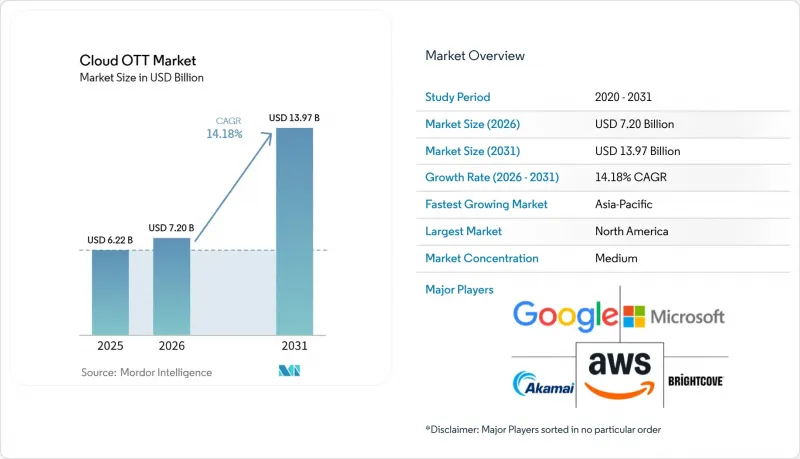
Mordor Intelligence에 의하면, 클라우드 OTT 시장 규모는 2025년 62억 2,000만 달러, 2026년 71억 달러에서 2031년까지 139억 7,000만 달러로 확대되어 2026년부터 2031년까지 사이에 CAGR 14.18%를 나타낼 것으로 예측됩니다.
본 보고서는 최종 사용자별(방송사 및 유료 TV 사업자, 통신 사업자 및 인터넷 서비스 제공업체 등), 산업별(미디어 및 엔터테인먼트, e-러닝·교육 등), 도입 형태별(퍼블릭 클라우드, 프라이빗 클라우드, 하이브리드 클라우드), 그리고 지역별(북미, 남미, 유럽,아시아태평양, 중동 및 아프리카)로 분류되어 있습니다. 시장 예측은 금액(달러) 기준으로 제시되어 있습니다.
세계 클라우드 OTT 시장 동향 및 인사이트
고속 광대역, 광섬유 및 5G의 확대
세계 5G 가입자 수는 2026년 1분기에 31억 건을 넘어, 2031년 말까지 64억 건에 달할 것으로 예측됩니다. 에릭슨(Ericsson)의 보고서에 따르면, 2025년 말 기준 전 세계 모바일 데이터 트래픽의 48%를 5G가 차지하고 있으며, 이 비율은 2031년까지 85%를 나타낼 것으로 전망됩니다. 이러한 광범위한 고대역폭 인프라는 고해상도 라이브 동영상 및 온디맨드 동영상의 전송 품질을 향상시켜 클라우드 OTT 시장을 뒷받침하고 있습니다. 또한 에릭슨의 조사에 따르면, 2025년에는 55개 통신 사업자 중 43개사에서 다운링크 트래픽 증가율을 상회하는 업링크 트래픽 증가세가 관찰되었으며, 이는 컨텐츠 전송 및 수집 워크플로우를 촉진하고 있습니다. 2026년 중반까지 5G 기반 고정 무선 접속은 전 세계 고정 무선 접속 제공업체의 71%를 차지하며, 인구 밀집 도시권 외 지역의 사용자에게도 광대역과 동등한 접속을 제공했습니다. 따라서 각국의 주파수 대역 및 광대역 프로그램을 통해 플랫폼 측에서 라스트 마일 네트워크를 구축할 필요 없이 클라우드 기반 동영상 서비스를 이용할 수 있는 사용자층을 확대할 수 있습니다.
클라우드 네이티브 OTT 워크플로우 도입
방송국과 미디어 사업자들은 기존의 플레이아웃 장비를 소프트웨어 기반의 클라우드 워크플로우로 대체하고 있습니다. 많은 전환 프로그램에서 자본 조달의 가능 여부보다 변경 관리가 더 중요한 제약 요인으로 작용하고 있습니다. 퍼블릭 클라우드 시스템은 현재 마이크로서비스, 컨테이너 및 API 기반 오케스트레이션을 활용하여 라이브 채널 운영을 지원할 수 있게 되었습니다. Amagi사는 자사의 CLOUDPORT 플랫폼이 2025-26 회계연도에 250개 이상의 기능을 도입하고, 단일 테넌트 내에서 200개의 기업에 대한 멀티 AZ 중복성을 갖추며, 100개 이상의 동시 피드를 지원했다고 밝혔습니다. 또한 이 회사는 2025년 후반에 출시된 모니터링 제품군을 통해 발생할 수 있었던 운영 장애의 80% 이상을 사전에 방지했다고 보고했습니다. 이러한 변화로 인해 클라우드 OTT 시장에서는 긴 하드웨어 조달 주기에 의존하지 않고, 설정만으로도 새로운 채널이나 서비스를 지원할 수 있게 되었습니다.
컨텐츠 권리, 제작 및 클라우드 전송에 따른 비용 압박
클라우드 워크플로우의 효율화는 프리미엄 컨텐츠의 권리나 라이브 스트리밍 요건으로 인해 발생하는 비용 압박을 해소해 주지는 않습니다. 스포츠 스트리밍 서비스는 권리료, 멀티 CDN 이그레스, 그리고 멀티 포맷 인코딩에 드는 복합적인 비용에 직면해 있습니다. 이러한 비용은 플랫폼이 종량제 클라우드 인프라에서 기대하는 운영상의 이점을 제한할 가능성이 있습니다. 현지화에는 더빙, 자막 삽입, 그리고 지역별 권리 확보와 같은 추가 비용이 발생합니다. 유럽 및 캐나다의 접근성 관련 의무로 인해, 이러한 요건들은 선택적 부가 기능으로 취급되지 않고 제품 예산에 반영되어야 합니다. 클라우드 OTT 시장 계획에 현지화 기능을 포함하지 않은 플랫폼은 나중에 규정 준수를 위한 지출을 감수해야 할 수 있으며, 이는 이익률 목표에 영향을 미칠 수 있습니다.
부문 분석
2025년, 방송사 및 유료 TV 사업자는 최종 사용자 수익의 25.29%를 차지하며 가장 큰 최종 사용자 그룹이 되었습니다. 이 사업자들의 지출은 기존의 선형 TV 시스템에서 클라우드 기반의 플레이아웃, 트랜스코딩, 배포로의 전환을 반영하고 있습니다. 이 사업자들은 전송 체인을 CDN 기반 배포로 대체하고, 선형 워크플로우에 서버 측 광고를 도입하고 있습니다. 또한 유료 TV와 스트리밍의 백오피스 시스템을 연동하고 있습니다. 통신 사업자 및 인터넷 서비스 제공업체는 클라우드 OTT 시장에서 또 다른 중요한 고객층을 형성하고 있습니다. 이 사업자들은 광대역 번들 서비스에 동영상 서비스를 통합함으로써 고객의 해지율을 낮추고, 사용자 1인당 평균 수익(ARPU)을 향상시키고 있습니다. 이러한 접근 방식을 통해 클라우드 OTT 시장의 사업자는 반드시 추가 권리를 구매하지 않더라도 컨텐츠의 부가가치를 높일 수 있습니다. 또한, 광대역 서비스의 품질과 동영상 서비스의 지속 이용률을 더욱 밀접하게 연계하는 결과로 이어집니다.
기업 및 기관 조직은 2026년부터 2031년까지 최종 사용자 기준 14.91%라는 가장 높은 연평균 성장률(CAGR)을 보일 것으로 예측됩니다. 사내 커뮤니케이션, 하이브리드 이벤트, 고객 대상 동영상 경험은 기업의 동영상 시스템으로 전환되고 있습니다. 순수한 OTT 사업자나 D2C(Direct-to-Consumer) 제공업체는 간소화된 인프라 모델로 운영되고 있기 때문에 계속해서 주요 클라우드 사용자로 자리 잡고 있습니다. 컨텐츠 소유자, 스튜디오, 디지털 미디어 플레이어은 클라우드 기반 미디어 자산 관리 및 권리 정보를 고려한 배포 도구를 도입하고 있습니다. Kaltura는 2026년판 ‘Gartner Market Guide for Video Platform Services’에서 대표적인 벤더로 선정되었습니다. 이 회사는 ISO/IEC 42001 인증을 획득했다고 밝혔으며, 이를 통해 AI 관리에 대한 기대가 기업의 조달 프로세스에 반영되고 있습니다. 따라서 클라우드 OTT 업계는 유사한 핵심 인프라를 통해 소비자 대상 동영상 스트리밍과 기관용 동영상 요구 사항 모두를 충족하고 있습니다. 또한 기업 수요가 증가함에 따라 보안, 규정 준수 및 컨텐츠 거버넌스의 중요성도 커지고 있습니다.
지역별 분석
2025년, 북미는 전 세계 매출의 45.50%를 차지하며 여전히 가장 규모가 큰 지역 기여 원천이었습니다. 이 지역에는 스트리밍 네이티브 서비스, 스포츠 저작권 보유자, 클라우드 인프라 제공업체가 집중되어 있습니다. 이러한 요인들로 인해 클라우드 OTT 시장에서 비디오 플랫폼이 클라우드 기반 시스템으로 전환할 때의 도입 장벽이 낮아지고 있습니다. 또한, 미국에는 FAST 광고 환경이 잘 갖춰져 있습니다. 2026년 4월부터 6월까지 북미와 캐나다는 전 세계 FAST 광고 노출의 74%를 차지했습니다. 이러한 집중 현상은 클라우드 OTT 시장에서 광고, 메타데이터, 전송 기능에 대한 수요를 뒷받침하고 있습니다.
유럽은 독일, 영국, 프랑스가 주도하는 2위 지역 시장입니다. 이들 국가의 공영 방송사와 유료 TV 사업자들은 동영상 워크플로우를 점점 더 클라우드 환경으로 전환하고 있습니다. EU 데이터법은 2025년 9월에 전면 시행되어, 클라우드 서비스 제공업체에 대해 데이터 마이그레이션성 및 전환 요건이 도입되었습니다. 이러한 요건은 데이터 주권 보장을 필요로 하는 사업자의 벤더 선정에 영향을 미치고 있습니다. 또한 프랑스, 독일, 북유럽 국가들도 주권형 클라우드 체계를 구축하고 있습니다. 러시아는 여전히 서유럽 클라우드 제공업체와의 협력이 부족한 상황입니다. 이러한 상황은 일부 정부 및 공공 부문의 도입 과정에서 유럽 공급업체를 유리하게 만들 가능성이 있습니다.
아시아태평양은 2026년부터 2031년까지 연평균 성장률(CAGR) 15.01%를 나타낼 것으로 예측되며, 이는 지역별로는 가장 높은 성장률입니다. 인도, 한국, 일본의 높은 5G 보급률은 모바일 우선의 동영상 시청을 촉진하고 있습니다. 이러한 시장에서는 기존 유료 TV 시스템에 대한 의존도가 낮은 동영상 시청 습관이 정착되어 있습니다. 일본은 사용자 1인당 평균 수익(ARPU) 향상 및 스포츠 컨텐츠를 중심으로 한 서비스 차별화를 통해 시장 성장에 기여할 것으로 전망됩니다. 인도는 사용자 수 증가와 광고 지원형 서비스의 보급 확대를 통해 시장 성장에 기여할 것으로 전망됩니다. 남미에서는 2026년 4월부터 6월까지 FAST 시청 시간이 190% 증가하여, 저비용 광고 지원형 동영상에 대한 강한 관심이 나타나고 있습니다. 사우디아라비아와 아랍에미리트에서는 모든 트래픽을 해외를 경유하여 라우팅하는 대신, 지역 내 미디어 확장을 촉진하는 데이터 보호 규정이 마련되어 있습니다. 아프리카는 여전히 인프라 구축의 초기 단계에 있지만, 모바일 광대역의 확대와 단말기 가격 하락이 향후 시청자 수 증가를 뒷받침할 것으로 전망됩니다.
기타 혜택:
- 엑셀 형식 시장 예측(ME) 시트
- 3개월간의 애널리스트 지원
자주 묻는 질문
목차
제1장 서론
제2장 조사 방법
제3장 개요
제4장 시장 구도
제5장 시장 규모와 성장 예측
제6장 경쟁 구도
제7장 시장 기회와 향후 전망
JHS 26.09.01According to Mordor Intelligence, the cloud OTT market size is projected to expand from USD 6.22 billion in 2025 and USD 7.10 billion in 2026 to USD 13.97 billion by 2031, registering a CAGR of 14.18% between 2026 and 2031.
This report is Segmented by End User (Broadcasters and Pay-TV Operators, Telecom Operators and Internet Service Providers, and More), Vertical (Media and Entertainment, E-Learning and Education, and More), Deployment (Public Cloud, Private Cloud, and Hybrid Cloud), and Geography (North America, South America, Europe, Asia-Pacific, Middle East, and Africa). The Market Forecasts are Provided in Terms of Value (USD).
Global Cloud OTT Market Trends and Insights
High-Speed Broadband, Fiber, and 5G Expansion
Global 5G subscriptions exceeded 3.1 billion in the first quarter of 2026 and are forecast to reach 6.4 billion by the end of 2031. Ericsson reported that 5G carried 48% of global mobile data traffic by the end of 2025, with this share expected to reach 85% by 2031. This wider high-bandwidth base supports the Cloud OTT market because it improves the delivery of high-resolution live and on-demand video. Ericsson also found that 43 of 55 operators had faster uplink than downlink traffic growth in 2025, which supports contribution and content-ingest workflows. Fixed wireless access based on 5G accounted for 71% of global fixed wireless access providers by mid-2026, extending broadband-like access to audiences outside dense urban areas. National spectrum and broadband programs can therefore expand the audience available to cloud-based video services without requiring platforms to build last-mile networks.
Cloud-Native OTT Workflow Adoption
Broadcasters and media operators are replacing legacy playout equipment with software-based cloud workflows. Change management has become a more important constraint than capital availability for many migration programs. Public cloud systems can now support live channel operations using microservices, containers, and API-based orchestration. Amagi stated that its CLOUDPORT platform introduced more than 250 features in FY 2025-26 and supported more than 100 concurrent feeds with 200-player multi-AZ redundancy in one tenant. The company also reported that its monitoring suite had prevented more than 80% of potential operational disruptions since its late-2025 launch. This shift allows the Cloud OTT market to support new channels and services through configuration rather than long hardware procurement cycles.
Content Rights, Production, and Cloud Delivery Cost Pressure
Cloud workflow efficiencies do not remove the cost pressure created by premium content rights and live delivery requirements. Sports services face combined expenses for rights, multi-CDN egress, and multi-format encoding. These costs can limit the operating benefits that platforms expect from consumption-based cloud infrastructure. Localization adds another expense through dubbing, captioning, and territory-specific rights clearance. Accessibility obligations in Europe and Canada can place these requirements in product budgets rather than treating them as optional additions. Platforms that do not include localization capabilities in their Cloud OTT market planning may face later compliance spending that affects margin objectives.
Other drivers and restraints analyzed in the detailed report include:
- Live Sports, FAST, and Event Streaming Migration
- AI-Enabled Personalization, Localization, and Ad Yield Optimization
- Piracy, Credential Abuse, and Content Protection Losses
For complete list of drivers and restraints, kindly check the Table Of Contents.
Segment Analysis
Broadcasters and Pay-TV Operators held 25.29% of end-user revenue in 2025, making them the largest end-user group. Their spending reflects the movement of legacy linear television systems to cloud-based playout, transcoding, and distribution. These operators are replacing transmission chains with CDN-based delivery and are adding server-side advertising to linear workflows. They are also connecting pay-TV and streaming back-office systems. Telecom Operators and Internet Service Providers form another important customer group for the Cloud OTT market. They use video services with broadband bundles to reduce customer churn and increase average revenue per user. This approach lets Cloud OTT market operators add content value without necessarily purchasing more rights. It also links the quality of broadband services more closely to video-service retention.
Enterprises and Institutional Organizations are projected to record the highest end-user CAGR at 14.91% from 2026 to 2031. Internal communications, hybrid events, and customer video experiences are moving onto enterprise video systems. Pure-play OTT and direct-to-consumer providers remain major cloud users because they operate with lean infrastructure models. Content owners, studios, and digital media companies are adopting cloud media asset management and rights-aware delivery tools. Kaltura was recognized as a Representative Vendor in the 2026 Gartner Market Guide for Video Platform Services. The company stated that it held ISO/IEC 42001 certification, which brings AI management expectations into enterprise procurement. The Cloud OTT industry is therefore serving both consumer video distribution and institutional video requirements through similar core infrastructure. Enterprise demand also increases the importance of security, compliance, and content governance.
Complete Report Scope:
- By End User
- Broadcasters and Pay-TV Operators
- Telecom Operators and Internet Service Providers
- Pure-play OTT and Direct-to-Consumer Providers
- Content Owners, Studios, and Digital Media Companies
- Enterprises and Institutional Organizations
- By Vertical
- Media and Entertainment
- E-Learning and Education
- BFSI
- Retail and E-commerce
- IT and Telecommunication
- Healthcare and Life Sciences
- Government and Public Sector
- Other Verticals
- By Deployment Type
- Public Cloud
- Private Cloud
- Hybrid Cloud
- By Geography
- North America
- United States
- Canada
- Mexico
- South America
- Brazil
- Argentina
- Rest of South America
- Europe
- Germany
- United Kingdom
- France
- Russia
- Italy
- Rest of Europe
- Asia-Pacific
- China
- India
- Japan
- South Korea
- Australia
- Rest of Asia-Pacific
- Middle East
- Saudi Arabia
- United Arab Emirates
- Turkey
- Rest of Middle East
- Africa
- South Africa
- Nigeria
- Egypt
- Rest of Africa
- North America
Geography Analysis
North America held 45.50% of global revenue in 2025 and remained the largest regional contributor. The region has a high concentration of streaming-native services, sports rights holders, and cloud infrastructure providers. These factors reduce adoption barriers for video platforms moving to cloud-based systems in the Cloud OTT market. The United States also has a developed FAST advertising environment. North America and Canada produced 74% of global FAST advertising impressions during April through June 2026. This concentration supports demand for advertising, metadata, and delivery functions in the Cloud OTT market.
Europe is the second-largest regional market, led by Germany, the United Kingdom, and France. Public broadcasters and pay-TV operators in these countries are moving more video workflows into cloud environments. The EU Data Act entered full application in September 2025 and introduced portability and switching requirements for cloud service providers. These requirements influence vendor selection for operators that need data sovereignty assurances. France, Germany, and Nordic countries are also developing sovereign cloud frameworks. Russia remains less connected to Western cloud providers. These conditions can support European vendors in some government and public-sector deployments.
Asia-Pacific is forecast to grow at a 15.01% CAGR from 2026 to 2031, the fastest regional rate. Higher 5G density in India, South Korea, and Japan supports mobile-first video consumption. These markets have developed video habits that are less dependent on traditional pay-TV systems. Japan is expected to contribute through average revenue per user improvements and sports-led service differentiation. India is expected to contribute through user growth and greater adoption of advertising-supported services. South America recorded 190% growth in FAST viewing hours during April through June 2026, indicating strong interest in lower-cost ad-supported video. Saudi Arabia and the United Arab Emirates have data-protection rules that encourage regional media deployment rather than routing all traffic through overseas locations. Africa remains at an earlier infrastructure stage, with mobile broadband expansion and lower device costs supporting future audience growth.
- Amazon Web Services, Inc.
- Google LLC
- Microsoft Corporation
- Akamai Technologies, Inc.
- Brightcove Inc.
- Kaltura, Inc.
- Amagi Corporation
- Harmonic Inc.
- Synamedia Limited
- MediaKind
- Comcast Technology Solutions
- Roku, Inc.
- Cloudflare, Inc.
- IBM Corporation
- Tencent Cloud
- Endeavor Streaming
- Deltatre S.p.A.
- Accedo Group
- Muvi LLC
- Vimeo, Inc.
- JW Player
Additional Benefits:
- The market estimate (ME) sheet in Excel format
- 3 months of analyst support
TABLE OF CONTENTS
1 INTRODUCTION
- 1.1 Study Assumptions and Market Definition
- 1.2 Scope of the Study
2 RESEARCH METHODOLOGY
3 EXECUTIVE SUMMARY
4 MARKET LANDSCAPE
- 4.1 Market Overview
- 4.2 Market Drivers
- 4.2.1 High-Speed Broadband, Fiber, and 5G Expansion
- 4.2.2 Cloud-Native OTT Workflow Adoption
- 4.2.3 Live Sports, FAST, and Event Streaming Migration
- 4.2.4 AI-Enabled Personalization, Localization, and Ad Yield Optimization
- 4.2.5 Telco, CTV, and Pay-TV Cloud Transformation
- 4.2.6 Regionalized Cloud Media Zones for Sovereign and Low-Latency Delivery
- 4.3 Market Restraints
- 4.3.1 Content Rights, Production, and Cloud Delivery Cost Pressure
- 4.3.2 Piracy, Credential Abuse, and Content Protection Losses
- 4.3.3 Data Sovereignty, Privacy, and Cross-Border Compliance Complexity
- 4.3.4 Egress Economics, Peak-Capacity Volatility, and Vendor Lock-In
- 4.4 Value-Chain Analysis
- 4.4.1 Content Owners and Rights Holders
- 4.4.2 Production, Ingest, and Contribution
- 4.4.3 Encoding, Transcoding, and Packaging
- 4.4.4 Media Asset Management and Cloud Storage
- 4.4.5 Content Management, Metadata, and Discovery
- 4.4.6 CDN, Edge Delivery, and Network Optimization
- 4.4.7 DRM, Identity, and Access Control
- 4.4.8 Monetization, Ad Decisioning, and Payments
- 4.4.9 Applications, Devices, and Audience Analytics
- 4.5 Regulatory Landscape
- 4.5.1 Privacy, Data Localization, and Consumer Protection
- 4.5.2 Copyright, Licensing, and Retransmission Rules
- 4.5.3 Advertising Disclosure and Addressable Advertising
- 4.5.4 Accessibility, Captioning, and Local-Language Requirements
- 4.5.5 Platform Liability and Online Safety
- 4.6 Technological Outlook
- 4.6.1 Cloud-Native Microservices and Containerized Media Workflows
- 4.6.2 AI-Assisted Media Operations and Agentic Workflows
- 4.6.3 Low-Latency Streaming, Edge Compute, and 5G Network APIs
- 4.6.4 AV1, VVC, HDR, and Encoding-Efficiency Roadmaps
- 4.6.5 Multi-CDN, Peer-Assisted Delivery, and Traffic Steering
- 4.6.6 Server-Side Ad Insertion and Contextual Monetization
- 4.7 Porter's Five Forces Analysis
- 4.7.1 Threat of New Entrants
- 4.7.2 Bargaining Power of Suppliers
- 4.7.3 Bargaining Power of Buyers
- 4.7.4 Threat of Substitutes
- 4.7.5 Competitive Rivalry
5 MARKET SIZE AND GROWTH FORECASTS (VALUE)
- 5.1 By End User
- 5.1.1 Broadcasters and Pay-TV Operators
- 5.1.2 Telecom Operators and Internet Service Providers
- 5.1.3 Pure-play OTT and Direct-to-Consumer Providers
- 5.1.4 Content Owners, Studios, and Digital Media Companies
- 5.1.5 Enterprises and Institutional Organizations
- 5.2 By Vertical
- 5.2.1 Media and Entertainment
- 5.2.2 E-Learning and Education
- 5.2.3 BFSI
- 5.2.4 Retail and E-commerce
- 5.2.5 IT and Telecommunication
- 5.2.6 Healthcare and Life Sciences
- 5.2.7 Government and Public Sector
- 5.2.8 Other Verticals
- 5.3 By Deployment Type
- 5.3.1 Public Cloud
- 5.3.2 Private Cloud
- 5.3.3 Hybrid Cloud
- 5.4 By Geography
- 5.4.1 North America
- 5.4.1.1 United States
- 5.4.1.2 Canada
- 5.4.1.3 Mexico
- 5.4.2 South America
- 5.4.2.1 Brazil
- 5.4.2.2 Argentina
- 5.4.2.3 Rest of South America
- 5.4.3 Europe
- 5.4.3.1 Germany
- 5.4.3.2 United Kingdom
- 5.4.3.3 France
- 5.4.3.4 Russia
- 5.4.3.5 Italy
- 5.4.3.6 Rest of Europe
- 5.4.4 Asia-Pacific
- 5.4.4.1 China
- 5.4.4.2 India
- 5.4.4.3 Japan
- 5.4.4.4 South Korea
- 5.4.4.5 Australia
- 5.4.4.6 Rest of Asia-Pacific
- 5.4.5 Middle East
- 5.4.5.1 Saudi Arabia
- 5.4.5.2 United Arab Emirates
- 5.4.5.3 Turkey
- 5.4.5.4 Rest of Middle East
- 5.4.6 Africa
- 5.4.6.1 South Africa
- 5.4.6.2 Nigeria
- 5.4.6.3 Egypt
- 5.4.6.4 Rest of Africa
- 5.4.1 North America
6 COMPETITIVE LANDSCAPE
- 6.1 Market Concentration
- 6.2 Strategic Moves
- 6.3 Market Share Analysis
- 6.4 Company Profiles (includes Global Level Overview, Market Level Overview, Core Segments, Financials as available, Strategic Information, Market Rank/Share, Products and Services, Recent Developments)
- 6.4.1 Amazon Web Services, Inc.
- 6.4.2 Google LLC
- 6.4.3 Microsoft Corporation
- 6.4.4 Akamai Technologies, Inc.
- 6.4.5 Brightcove Inc.
- 6.4.6 Kaltura, Inc.
- 6.4.7 Amagi Corporation
- 6.4.8 Harmonic Inc.
- 6.4.9 Synamedia Limited
- 6.4.10 MediaKind
- 6.4.11 Comcast Technology Solutions
- 6.4.12 Roku, Inc.
- 6.4.13 Cloudflare, Inc.
- 6.4.14 IBM Corporation
- 6.4.15 Tencent Cloud
- 6.4.16 Endeavor Streaming
- 6.4.17 Deltatre S.p.A.
- 6.4.18 Accedo Group
- 6.4.19 Muvi LLC
- 6.4.20 Vimeo, Inc.
- 6.4.21 JW Player
7 MARKET OPPORTUNITIES AND FUTURE OUTLOOK
- 7.1 White-Space and Unmet-Need Assessment


