

|
시장보고서
상품코드
2118101
AI 운영체제 시장 : 점유율 분석, 업계 동향과 통계, 성장 예측(2026-2031년)AI Operating System - Market Share Analysis, Industry Trends & Statistics, Growth Forecasts (2026 - 2031) |
||||||
 Mordor Intelligence
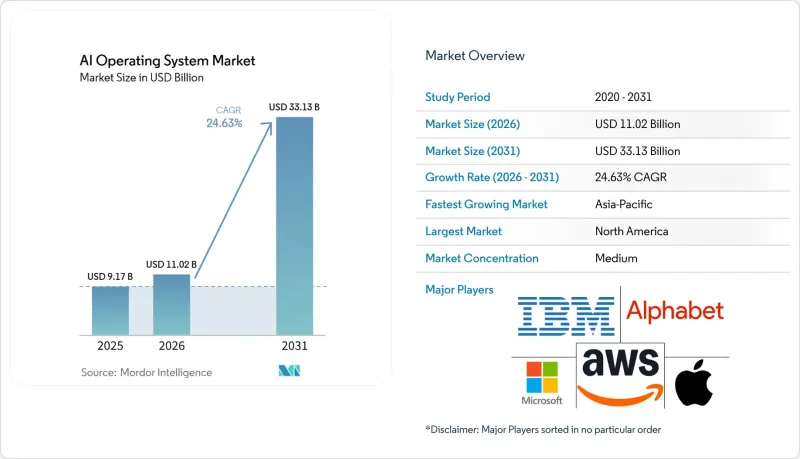
Mordor Intelligence에 의하면, AI 운영체제 시장 규모는 2025년 91억 7,000만 달러, 2026년 110억 2,000만 달러에서 2031년까지 331억 3,000만 달러로 확대된다고 예측되고 있어 2026년부터 2031년까지 연평균 성장률(CAGR)은 24.63%를 나타낼 전망입니다.
본 보고서는 모델 통합 방식(온디바이스 AI 운영체제, 클라우드 네이티브 AI 운영체제, 하이브리드 AI 운영체제), 플랫폼(모바일, 데스크톱 및 노트북, 임베디드 및 엣지, 기타),최종 사용자(IT 및 통신, 은행, 금융서비스 및 보험(BFSI), 자동차 및 운송, 헬스케어 및 생명과학, 기타), 그리고 지역별로 분류되어 있습니다. 시장 전망은 금액(미 달러) 기준으로 제시되어 있습니다.
세계 AI 운영체제 시장 동향 및 인사이트
거버넌스가 적용된 AI 오케스트레이션에 대한 기업 수요
AI 운영체제 시장은 각 모델의 작동을 승인, 기록 및 검토하는 시스템에 대한 수요로 인해 혜택을 받고 있습니다. AI 도구가 고객 데이터, 업무 기록 또는 규제 대상 워크플로우와 연동될 경우, 조직에는 이러한 기능이 필요합니다. 마이크로소프트는 2026년 6월, 20개의 Azure 리전에서 샌드박스화된 컴퓨팅, ID 기능, 거버넌스 도구 및 가시성을 갖춘 ‘Azure AI Foundry Agent Service’의 일반 제공을 시작했습니다. 이번 출시는 기업 구매자들이 거버넌스 기능을 나중에 추가하는 것이 아니라, 프로덕션 환경 단계부터 바로 활용할 수 있기를 기대하고 있음을 보여줍니다. 또한, EU AI 법에서는 투명성, 위험 관리 및 문서화 요건이 도입되어 조직이 거버넌스 기능이 통합된 플랫폼을 선택하도록 장려하고 있습니다. 따라서 금융, 의료, 행정 분야의 대규모 조직은 AI 도구의 표준화를 추진하는 경향이 있는 반면, 중소기업은 계속해서 경량 자동화 제품을 사용할 가능성이 있습니다.
AI 가속기 및 NPU 탑재 기기의 보급
전용 프로세서공급 확대에 따라 AI 운영체제 시장의 기술 기반은 점차 넓어지고 있습니다. 가속기의 고속화로 인해 추론, 메모리, 에이전트 워크로드를 대규모로 실행하는 것이 더욱 현실화되고 있습니다. NVIDIA는 2026 회계연도 데이터센터 매출이 전년 대비 68% 증가한 1,937억 달러에 달했다고 보고했으며, ‘Blackwell Ultra’는 ‘Hopper’와 비교해 에이전트 워크로드 비용을 최대 35분의 1로 줄일 수 있다고 밝혔습니다. 또한 이 회사는 에이전트형 워크로드를 위해 설계된 플랫폼인 ‘Vera Rubin’을 발표하며, 추론 토큰당 비용이 Blackwell보다 최대 10배 낮다는 점을 밝혔습니다. 이러한 장점 덕분에 더 대규모 도입이 가능해지겠지만, 가장 큰 혜택을 가장 먼저 누리게 될 주체는 대형 클라우드 제공업체나 자금력이 풍부한 기업이 될 가능성이 높습니다. 또한 모바일 기기, PC, 자동차, 산업용 기기에 도입된 AI 지원 하드웨어의 보급 기반은 소프트웨어 제공업체에게 로컬 인텔리전스를 위한 추가적인 도입 옵션을 제공합니다.
높은 연산, 메모리 및 에너지 비용
연산, 메모리, 전력 수요는 여전히 AI 운영체제 시장에서 큰 제약 요인으로 작용하고 있습니다. 프로덕션 환경의 에이전트 워크로드는 영구 메모리, 다단계 추론, 여러 에이전트의 협업 등을 수반할 가능성이 있어 단순한 추론 요청보다 더 많은 리소스를 필요로 합니다. 이러한 부담은 대형 클라우드 고객이 누리는 대량 구매 할인을 받을 수 없는 중견 기업에게는 큰 과제가 될 수 있습니다. 에너지 수요 증가는 데이터센터 계획에도 영향을 미치며, 전력망에 제약이 있는 지역에서는 용량 확충이 지연될 가능성이 있습니다. NVIDIA가 보고한 추론 토큰당 비용 개선은 운영 비용 절감으로 가는 길을 제시하고 있습니다. 그러나 시장 가격으로 용량을 구매할 수밖에 없는 조직의 경우, 이러한 개선이 재정적 장벽을 즉시 해소해 주지는 않습니다.
부문 분석
2025년 AI 운영체제 시장 규모에서 하이브리드 플랫폼은 42.31%의 점유율을 차지했습니다. 이를 통해 조직은 기밀성이 높은 요청을 로컬에서 처리하는 동시에, 부하가 더 높은 작업에 대해서는 클라우드 모델에 대한 접근을 유지할 수 있게 됩니다. 이러한 균형은 데이터 상주성 관리가 필요한 금융 서비스, 의료, 정부 기관 및 기타 구매자에게 중요합니다. Microsoft Foundry는 샌드박스화된 컴퓨팅 환경과 Azure 모델 엔드포인트에 대한 연결을 갖춘 호스팅형 에이전트를 제공하며, 클라우드 공급자가 이러한 설계를 어떻게 지원하는지 보여줍니다. 이 접근 방식을 통해 더 강력한 모델 기능과 기밀 정보의 엄격한 취급 사이에서 선택을 강요받을 필요성을 줄일 수 있습니다. 또한 기술 팀에게는 위험, 지연 시간, 데이터 저장 위치 및 로컬 컴퓨팅 리소스의 가용성을 기반으로 워크로드를 할당할 수 있는 실용적인 방법을 제공합니다. 이러한 유연성 덕분에 서로 다른 사업 부서가 각기 고유한 데이터 처리 규칙에 따라 운영되더라도 사내 승인 절차를 간소화할 수 있습니다.
온디바이스 플랫폼은 2026년부터 2031년까지 연평균 성장률(CAGR) 27.84%를 나타낼 것으로 예측됩니다. 애플은 2026년 6월, iOS 27, macOS 27, iPadOS 27, watchOS 27, visionOS 27을 통해 차세대 Apple Intelligence 및 Siri AI를 미리 공개했습니다. 로컬 처리는 개인정보를 보호할 뿐만 아니라, 인터넷 연결이 불안정한 환경에서도 응답 시간을 개선할 수 있습니다. 매우 대규모의 컨텍스트 윈도우나 신속한 모델 변경이 필요한 작업의 경우, 클라우드 네이티브 플랫폼이 여전히 필수적입니다. 이 세 가지 접근 방식에서 고객들은 모델 버전 관리, 성능 모니터링, 롤백 기능 및 감사 기록을 더욱 중요하게 여기고 있습니다. 이러한 기능들은 별도의 관리 도구로 남아 있는 것이 아니라, 플랫폼의 기능으로 통합되고 있습니다. 구매자는 공통된 제어 구조를 활용하여 모델 버전을 비교하고, 변경 내용을 확인하며, 모델이 부적절한 결과를 생성했을 때 적절히 대응할 수 있습니다. 이는 팀이 여러 모델을 사용하고 용도 전반에 걸쳐 일관된 기록을 유지해야 하는 경우에 중요합니다.
지역별 분석
2025년에는 북미가 총 매출의 36.42%를 차지했습니다. 미국에는 클라우드 제공업체, 모델 개발자, 엔터프라이즈 플랫폼 기업이 집중되어 있습니다. NIST의 AI 위험 관리 프레임워크는 거버넌스와 위험 관리를 평가하기 위한 널리 인정받는 기준을 구매자에게 제공합니다. 이로 인해 초기 단계부터 리스크 관리와 문서화를 내재화한 제공업체가 유리한 입지를 점할 가능성이 있습니다. 캐나다는 토론토, 몬트리올, 밴쿠버의 각 클러스터를 통해 연구 및 기술 활동을 강화하고 있습니다. 멕시코에서는 임베디드 자동화의 실용화가 진행됨에 따라 제조 및 물류 분야에서의 활용이 증가하고 있습니다.
아시아태평양은 2031년까지 연평균 성장률(CAGR) 28.73%를 나타낼 것으로 예측됩니다. 중국은 공공 정책과 국내 기술 생태계를 통해 AI 응용을 확대하고 있는 반면, 일본과 한국은 자동차, 로봇 공학, 소비자 가전, 반도체 분야에서 강점을 발휘하고 있습니다. 인도 및 동남아시아에서는 모바일 우선 수요, 디지털 인프라 구축, 기업 내 클라우드 이용 확대가 나타나고 있습니다. 산업용 제어 시스템, 차량 시스템, 기업 소프트웨어에서도 현지 AI 기능이 채택되고 있기 때문에 이 지역의 비즈니스 기회는 소비자용 기기에만 국한되지 않습니다. AI 운영체제 시장의 지역별 수요는 다양하며, 각국은 서로 다른 기기 유형, 국내 공급업체, 도입 모델을 중시하고 있습니다.
유럽은 규모 면에서 3위를 차지하는 지역으로, 독일, 영국, 프랑스가 산업, 금융, 공공 부문에서의 도입을 주도하고 있습니다. EU AI법은 고위험 사용에 대한 규정 준수 조치를 의무화하는 한편, 감사, 투명성, 위험 관리 기능을 갖춘 플랫폼에 대한 수요를 촉진하고 있습니다. 남미는 도입이 아직 초기 단계에 있으며, 금융 서비스 및 디지털 정부 분야에 활동이 집중되어 있습니다. 인프라 제약과 인력 부족으로 인해 해당 지역에서의 보다 광범위한 도입이 지연될 가능성이 있습니다. 중동 및 아프리카에서는 사우디아라비아와 아랍에미리트(UAE)가 활발한 투자 거점으로 부상하고 있습니다. NVIDIA는 DRIVE Hyperion이 레벨 4 대응 로보택시 배포를 지원하며, 중동에서 HUMAIN사와 공동으로 도입을 추진하고 있다고 발표했습니다.
기타 혜택:
- 엑셀 형식 시장 예측(ME) 시트
- 3개월간의 애널리스트 지원
자주 묻는 질문
목차
제1장 서론
제2장 조사 방법
제3장 개요
제4장 시장 구도
제5장 시장 규모와 성장 예측
제6장 경쟁 구도
제7장 시장 기회와 향후 전망
JHS 26.09.01According to Mordor Intelligence, the AI operating system market size is projected to expand from USD 9.17 billion in 2025 and USD 11.02 billion in 2026 to USD 33.13 billion by 2031, registering a CAGR of 24.63% between 2026 and 2031.
This report is Segmented by Model Integration Approach (On-Device AI Operating System, Cloud-Native AI Operating System, and Hybrid AI Operating System), Platform (Mobile, Desktop and Laptop, Embedded and Edge, and More), End User (IT and Telecommunication, BFSI, Automotive and Transportation, Healthcare and Life Sciences, and More), and Geography. The Market Forecasts are Provided in Terms of Value (USD).
Global AI Operating System Market Trends and Insights
Enterprise Demand for Governed AI Orchestration
The AI Operating System Market is benefiting from demand for systems that authorize, record, and review each model action. Organizations need these capabilities when AI tools interact with customer data, business records, or regulated workflows. Microsoft made Azure AI Foundry Agent Service generally available in June 2026 with sandboxed compute, identity features, governance tools, and observability across 20 Azure regions. This release shows that enterprise buyers now expect controls to be available at the production stage rather than added later. The EU AI Act also introduces transparency, risk management, and documentation requirements that encourage organizations to select platforms with built-in governance. Large organizations in finance, healthcare, and public administration are therefore more likely to standardize their AI tools, while smaller firms may continue to use lighter automation products.
Proliferation of AI Accelerators and NPU-Enabled Devices
The growing supply of specialized processors is widening the technical base for the AI Operating System Market. Faster accelerators make it more practical to run reasoning, memory, and agent workloads at scale. NVIDIA reported fiscal 2026 data center revenue of USD 193.7 billion, up 68% year over year, and stated that Blackwell Ultra can lower the cost of agentic workloads by up to 35 times compared with Hopper. The company also presented Vera Rubin as a platform designed for agentic workloads, with a cost per inference token up to 10 times lower than Blackwell's. These gains can support larger deployments, although the strongest benefits are likely to reach major cloud providers and well-funded enterprises first. The installed base of AI-capable hardware in mobile devices, PCs, vehicles, and industrial equipment also provides software providers with more deployment options for local intelligence.
High Compute, Memory, and Energy Costs
Compute, memory, and power needs remain a major constraint on the AI Operating System Market. Production agent workloads require more resources than simple inference requests because they may involve persistent memory, multi-step reasoning, and multiple coordinated agents. This burden can be difficult for mid-sized organizations that lack the volume discounts available to large cloud customers. Higher energy demand also affects data center planning and can delay capacity additions in regions with constrained grids. NVIDIA's reported improvement in cost per inference token points to a path toward lower operating costs. However, these gains do not immediately remove the financial barrier for organizations that must buy capacity at market rates.
Other drivers and restraints analyzed in the detailed report include:
- Expansion of On-Device and Edge AI Processing
- Growth of Autonomous Agents and Goal-Oriented Interfaces
- Data Privacy, Security, and Regulatory Compliance Burden
For complete list of drivers and restraints, kindly check the Table Of Contents.
Segment Analysis
Hybrid platforms accounted for 42.31% share of the AI operating system market size in 2025. They allow organizations to process sensitive requests locally while maintaining access to cloud models for more demanding tasks. This balance matters to financial services, healthcare, government, and other buyers that need data residency controls. Microsoft Foundry provides hosted agents with sandboxed compute and connections to Azure model endpoints, demonstrating how a cloud provider supports this design. The approach can reduce the need to choose between stronger model capability and tighter handling of sensitive information. It also gives technology teams a practical way to assign workloads by risk, latency, data location, and the availability of local compute resources. This flexibility can simplify internal approval processes when different business units operate under distinct data-handling rules.
On-device platforms are projected to grow at a CAGR of 27.84% from 2026 to 2031. Apple previewed next-generation Apple Intelligence and Siri AI across iOS 27, macOS 27, iPadOS 27, watchOS 27, and visionOS 27 in June 2026. Local processing supports privacy and can improve response times where an internet connection is unreliable. Cloud-native platforms remain necessary for tasks that require very large context windows or rapid model changes. Across the three approaches, customers are placing more value on model version control, performance monitoring, rollback options, and audit records. These functions are moving into platform offerings rather than remaining as separate management tools. Buyers can use a common control structure to compare model versions, review changes, and respond when a model produces unsuitable results. This is important when teams use several models and must maintain consistent records across their applications.
Complete Report Scope:
- By Model Integration Approach
- On-Device AI Operating System
- Cloud-Native AI Operating System
- Hybrid AI Operating System
- By Platform
- Mobile
- Desktop and Laptop
- Embedded and Edge
- Other Platforms
- By End User
- IT and Telecommunication
- BFSI
- Automotive and Transportation
- Healthcare and Life Sciences
- Retail and E-Commerce
- Industrial Manufacturing
- Education and Research Institutions
- Government and Administration
- Energy and Utilities
- Other End Users
- By Geography
- North America
- United States
- Canada
- Mexico
- South America
- Brazil
- Argentina
- Rest of South America
- Europe
- Germany
- United Kingdom
- France
- Russia
- Spain
- Rest of Europe
- Asia-Pacific
- China
- Japan
- India
- South Korea
- Southeast Asia
- Rest of Asia-Pacific
- Middle East and Africa
- Middle East
- Saudi Arabia
- United Arab Emirates
- Rest of Middle East
- Africa
- South Africa
- Nigeria
- Rest of Africa
- Middle East
- North America
Geography Analysis
North America accounted for 36.42% of total revenue in 2025. The United States has a high concentration of cloud providers, model developers, and enterprise platform companies. The NIST AI Risk Management Framework provides buyers with a recognized framework for evaluating governance and risk controls. This can favor providers that include risk management and documentation from the start. Canada adds to its research and technology activities through its clusters in Toronto, Montreal, and Vancouver. Mexico is seeing increased use in manufacturing and logistics as embedded automation becomes more practical.
Asia-Pacific is projected to grow at a CAGR of 28.73% through 2031. China is expanding AI applications through public policy and domestic technology ecosystems, while Japan and South Korea bring automotive, robotics, consumer electronics, and semiconductor capabilities. India and Southeast Asia offer mobile-first demand, growing digital infrastructure, and expanding enterprise cloud use. The regional opportunity extends beyond consumer devices because industrial control, vehicle systems, and enterprise software are also adopting local AI capabilities. The AI Operating System Market has varied regional demand, with each country emphasizing different device types, domestic suppliers, and deployment models.
Europe is the third-largest region, with Germany, the United Kingdom, and France leading adoption in industrial, financial, and public-sector applications. The EU AI Act creates compliance work for high-risk uses and supports demand for platforms with audit, transparency, and risk management features. South America is at an earlier stage, with activity concentrated in financial services and digital government. Infrastructure constraints and a limited talent pool can slow broader adoption there. Saudi Arabia and the UAE are active investment centers within the Middle East and Africa. NVIDIA stated that DRIVE Hyperion supports level 4-ready robotaxi deployments and is being pursued with HUMAIN in the Middle East.
- Microsoft Corporation
- Alphabet Inc.
- Amazon Web Services, Inc.
- International Business Machines Corporation
- NVIDIA Corporation
- Apple Inc.
- Oracle Corporation
- Salesforce, Inc.
- ServiceNow, Inc.
- SAP SE
- OpenAI, L.L.C.
- Anthropic PBC
- Databricks, Inc.
- Snowflake Inc.
- Palantir Technologies Inc.
- C3.ai, Inc.
- UiPath, Inc.
- DataRobot, Inc.
- Hugging Face, Inc.
- Mistral AI SAS
- Cohere Inc.
- SambaNova Systems, Inc.
- Cerebras Systems, Inc.
- H2O.ai, Inc.
Additional Benefits:
- The market estimate (ME) sheet in Excel format
- 3 months of analyst support
TABLE OF CONTENTS
1 INTRODUCTION
- 1.1 Study Assumptions and Market Definition
- 1.2 Scope of the Study
2 RESEARCH METHODOLOGY
3 EXECUTIVE SUMMARY
4 MARKET LANDSCAPE
- 4.1 Market Overview
- 4.2 Market Drivers
- 4.2.1 Enterprise Demand for Governed AI Orchestration
- 4.2.2 Proliferation of AI Accelerators and NPU-Enabled Devices
- 4.2.3 Expansion of On-Device and Edge AI Processing
- 4.2.4 Growth of Autonomous Agents and Goal-Oriented Interfaces
- 4.2.5 Increasing Requirements for Model Lifecycle Management and Auditability
- 4.2.6 Agent-Ready Operating Layers for Legacy System Modernization
- 4.3 Market Restraints
- 4.3.1 High Compute, Memory, and Energy Costs
- 4.3.2 Data Privacy, Security, and Regulatory Compliance Burden
- 4.3.3 Hardware Fragmentation and Interoperability Gaps
- 4.3.4 Integration Complexity Across Legacy Enterprise Systems
- 4.4 Impact of Macroeconomic Factors on the Market
- 4.5 Industry Value-Chain Analysis
- 4.6 Technology Outlook
- 4.7 Regulatory Landscape
- 4.8 Porter's Five Forces Analysis
- 4.8.1 Threat of New Entrants
- 4.8.2 Bargaining Power of Suppliers
- 4.8.3 Bargaining Power of Buyers
- 4.8.4 Threat of Substitutes
- 4.8.5 Intensity of Competitive Rivalry
5 MARKET SIZE AND GROWTH FORECASTS (VALUE)
- 5.1 By Model Integration Approach
- 5.1.1 On-Device AI Operating System
- 5.1.2 Cloud-Native AI Operating System
- 5.1.3 Hybrid AI Operating System
- 5.2 By Platform
- 5.2.1 Mobile
- 5.2.2 Desktop and Laptop
- 5.2.3 Embedded and Edge
- 5.2.4 Other Platforms
- 5.3 By End User
- 5.3.1 IT and Telecommunication
- 5.3.2 BFSI
- 5.3.3 Automotive and Transportation
- 5.3.4 Healthcare and Life Sciences
- 5.3.5 Retail and E-Commerce
- 5.3.6 Industrial Manufacturing
- 5.3.7 Education and Research Institutions
- 5.3.8 Government and Administration
- 5.3.9 Energy and Utilities
- 5.3.10 Other End Users
- 5.4 By Geography
- 5.4.1 North America
- 5.4.1.1 United States
- 5.4.1.2 Canada
- 5.4.1.3 Mexico
- 5.4.2 South America
- 5.4.2.1 Brazil
- 5.4.2.2 Argentina
- 5.4.2.3 Rest of South America
- 5.4.3 Europe
- 5.4.3.1 Germany
- 5.4.3.2 United Kingdom
- 5.4.3.3 France
- 5.4.3.4 Russia
- 5.4.3.5 Spain
- 5.4.3.6 Rest of Europe
- 5.4.4 Asia-Pacific
- 5.4.4.1 China
- 5.4.4.2 Japan
- 5.4.4.3 India
- 5.4.4.4 South Korea
- 5.4.4.5 Southeast Asia
- 5.4.4.6 Rest of Asia-Pacific
- 5.4.5 Middle East and Africa
- 5.4.5.1 Middle East
- 5.4.5.1.1 Saudi Arabia
- 5.4.5.1.2 United Arab Emirates
- 5.4.5.1.3 Rest of Middle East
- 5.4.5.2 Africa
- 5.4.5.2.1 South Africa
- 5.4.5.2.2 Nigeria
- 5.4.5.2.3 Rest of Africa
- 5.4.5.1 Middle East
- 5.4.1 North America
6 COMPETITIVE LANDSCAPE
- 6.1 Market Concentration
- 6.2 Strategic Moves
- 6.3 Market Share Analysis
- 6.4 Company Profiles (includes Global Level Overview, Market Level Overview, Core Segments, Financials as available, Strategic Information, Market Rank/Share, Products and Services, Recent Developments)
- 6.4.1 Microsoft Corporation
- 6.4.2 Alphabet Inc.
- 6.4.3 Amazon Web Services, Inc.
- 6.4.4 International Business Machines Corporation
- 6.4.5 NVIDIA Corporation
- 6.4.6 Apple Inc.
- 6.4.7 Oracle Corporation
- 6.4.8 Salesforce, Inc.
- 6.4.9 ServiceNow, Inc.
- 6.4.10 SAP SE
- 6.4.11 OpenAI, L.L.C.
- 6.4.12 Anthropic PBC
- 6.4.13 Databricks, Inc.
- 6.4.14 Snowflake Inc.
- 6.4.15 Palantir Technologies Inc.
- 6.4.16 C3.ai, Inc.
- 6.4.17 UiPath, Inc.
- 6.4.18 DataRobot, Inc.
- 6.4.19 Hugging Face, Inc.
- 6.4.20 Mistral AI SAS
- 6.4.21 Cohere Inc.
- 6.4.22 SambaNova Systems, Inc.
- 6.4.23 Cerebras Systems, Inc.
- 6.4.24 H2O.ai, Inc.
7 MARKET OPPORTUNITIES AND FUTURE OUTLOOK
- 7.1 White-Space and Unmet-Need Assessment


