

|
시장보고서
상품코드
2118112
우울증 스크리닝 시장 : 시장 점유율 분석, 업계 동향 및 통계, 성장 예측(2026-2031년)Depression Screening - Market Share Analysis, Industry Trends & Statistics, Growth Forecasts (2026 - 2031) |
||||||
 Mordor Intelligence
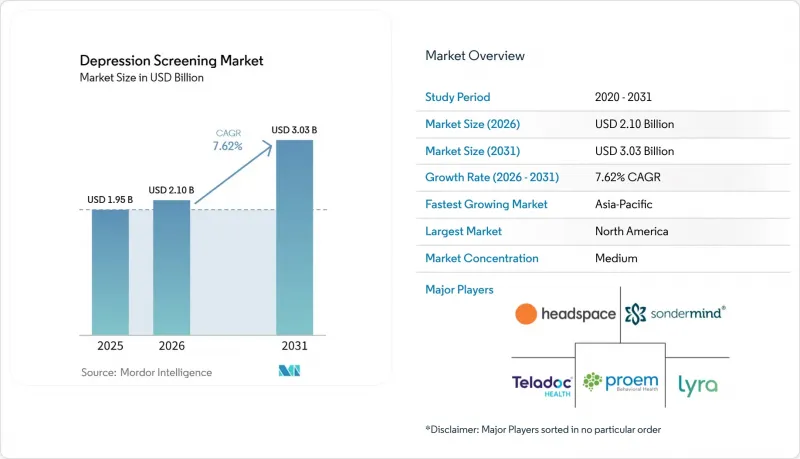
Mordor Intelligence에 의하면, 우울증 스크리닝 시장 규모는 2025년 19억 5,000만 달러로 평가되었고, 2026년에는 21억 달러로 추정되고, 2031년까지 30억 3,000만 달러에 이를 것으로 예상되며, 2026-2031년 CAGR 7.62%로 성장할 전망입니다.
본 보고서는 플랫폼 및 기술별(모바일 헬스 애플리케이션, 웹 기반 스크리닝 플랫폼, 기타), 용도별(임상 스크리닝 및 진단 지원, 기타), 진료 환경별(병원 및 클리닉, 1차 진료 클리닉, 기타), 연령대별(소아, 청소년, 성인), 지역별(북미, 유럽, 기타)로 분류되어 있습니다. 시장 전망은 금액(달러) 기준으로 제시되어 있습니다.
세계의 우울증 스크리닝 시장 동향 및 인사이트
보편적인 스크리닝 의무화가 임상 분야의 기본적인 수요를 재정의하고 있습니다.
임상 권고 사항에 따라 우울증 스크리닝는 선택적 서비스가 아닌 일상적인 요건이 되어가고 있습니다. 미국 예방의료서비스작업반(USPSTF)은 2023년, 임산부 및 산후 여성을 포함한 성인을 대상으로 한 스크리닝에 대해 B등급 권고를 내렸습니다. 이 태스크포스는 12세에서 18세 청소년에 대한 스크리닝도 권고했습니다. 이러한 권고 사항에 따라 해당 요건의 범위 내에서 서비스가 제공될 경우, 의료보험개혁법(Affordable Care Act)에 근거하여 환자의 본인 부담금 없이 보험 적용이 지원됩니다. 이로 인해 청구 대상이 되는 환자층이 확대되어, 1차 진료, 원격 의료, 전문 의료 각 현장에서의 활용이 촉진됩니다. 검증된 도구가 단순한 선택적 추가 서비스가 아닌 일반적인 임상 진료의 일부가 됨에 따라, 우울증 스크리닝 시장은 혜택을 보고 있습니다.
CMS는 2027 회계연도 측정 연도부터 적용되는 메디케어 어드밴티지(Medicare Advantage)의 별점 평가를 위한 ‘우울증 스크리닝 및 후속 조치’ 지표를 최종 확정했습니다. 이 지표를 통해 기록된 스크리닝 및 후속 조치가 건강보험 플랜의 품질 프로그램에서 더욱 중요한 요소가 될 것입니다. 따라서 건강보험 플랜은 시행 및 보고를 지원할 수 있는 도구를 도입할 이유가 생깁니다. 의뢰나 치료 후속 조치가 기록상 확인되지 않는 경우, 설문조사만으로는 운영상의 요구를 완전히 충족시킬 수 없습니다. 지불 기관이 자사의 품질 관리 프로세스에 부합하는 검증된 디지털 시스템을 요구하게 될 것이므로, 우울증 스크리닝 시장은 이러한 변화로부터 혜택을 볼 수 있습니다. 또한, 의료 제공업체는 스크리닝 건수를 늘리기 전에 의뢰 체계를 정비해야 하므로, 이로 인해 단기적인 구매는 지연될 수 있지만, 반면 통합형 플랫폼에 대한 장기적인 수요는 촉진될 것입니다.
EHR에 통합된 스크리닝가 워크플로우 전환율을 가속화합니다.
표준화된 스크리닝를 전자의무기록(EHR)에 통합함으로써, 1차 의료 및 예방 의료 현장에서의 활용이 용이해집니다. PORTAL-Depression 프로젝트는 EHR과 통합된 전산화 적응형 우울증 평가가 1차 의료 현장에서 어떻게 도입될 수 있는지를 보여주었습니다. 이러한 접근 방식을 통해 스크리닝 실시부터 임상 워크플로우에 결과 기록까지의 간극이 좁혀집니다. 또한 양성 결과가 나온 후의 의뢰 및 치료 기록을 위한 명확한 절차를 의료 제공업체에게 제공합니다. 청소년을 대상으로 한 디지털 스크리닝에 관한 조사에서는 1차 진료 의료 제공업체들이 EHR과의 통합에 있어 발생하는 격차를 도입의 주요 장벽으로 지적하고 있는 것으로 밝혀졌습니다. 따라서 우울증 스크리닝 시장에서는 양방향 데이터 교환과 폐쇄 루프형 후속 조치를 지원하는 벤더가 우위를 점하고 있습니다.
EHR과의 연동이 중요한 이유는 스크리닝의 가치가 점수 기록 후의 대응을 통해 측정되기 때문입니다. 결과를 전원 조정에 연계하는 시스템은 치료 시작 과정의 가시성을 높일 수 있습니다. 이를 통해 스크리닝 결과에 따라 후속 조치가 필요한 경우, 의료 제공업체의 설명 책임이 더 쉽게 이행될 수 있습니다. 또한, 직원이 서로 다른 도구 간에 정보를 주고받는 번거로움도 줄어듭니다. 우울증 스크리닝 시장은 이러한 워크플로우상의 우위를 활용하여, 단순한 설문지 제공에 그치지 않고 치료 제공의 가치 그 자체로 경쟁할 수 있습니다. 앱 전용 도구는 일부 환자용 또는 고용주용 프로그램에서는 여전히 유용하지만, 문서화된 연계가 요구되는 임상 현장에는 그다지 적합하지 않습니다.
보상 격차가 진단 후 후속 조치 단계에 리스크를 집중시킵니다.
스크리닝 과정에서 진단 및 후속 조치 능력이 입증되지 않으면 보험 급여가 제한됩니다. 실제 문제는 의료 제공업체가 스크리닝를 실시할 수 있는지 여부에만 국한되지 않습니다. 양성 결과가 나온 후 적절한 다음 단계를 문서화할 수 있는지가 관건입니다. 새로운 메디케어 어드밴티지 지표는 이러한 요구를 반영하고 있지만, 시행에는 시간이 걸립니다. 일부 의료 제공업체는 스크리닝 실시 건수를 늘리기 전에 의뢰 체계를 구축할 수도 있습니다. 의료 제공업체가 후속 관리를 확실하게 제공하고 기록하지 못할 경우, 우울증 스크리닝 시장은 단기적으로 플랫폼 수익 성장세가 둔화될 전망입니다.
의뢰 조정 및 치료 개시 기록을 포함하는 선별 도구는 보험사에게 더 설득력이 있습니다. 이는 이러한 도구가 이상 소견이 확인된 후의 임상 과정을 뒷받침하기 때문입니다. 일회성 설문지도 여전히 유용하지만, 의료 제공과 분리되어 있는 경우 보험 급여 측면에서 입지가 약해집니다. 특히 아시아태평양 및 중동 및 아프리카의 일부 지역에서는 편견이나 환자의 낮은 참여도가 응답률과 후속 관리율을 더욱 떨어뜨릴 가능성이 있습니다. 또한, 의료 서비스가 부족한 상황에서는 위양성 결과가 의뢰 시스템에 부담을 줄 수도 있습니다. 이러한 장벽이 존재하기 때문에 스크리닝부터 치료 연계에 이르는 전체 과정을 관리할 수 있는 검증되고 임상적으로 입증된 도구가 유리합니다.
부문 분석
2025년, 이 부문에서 우울증 스크리닝 시장 점유율의 44.31%를 원격의료 및 가상 진료 플랫폼이 차지했습니다. 이러한 우위는 원격의료의 보급과 PHQ-9, GAD-7, EPDS와 같은 도구가 가상 진료 워크플로우에 통합되어 있음을 반영합니다. 이러한 플랫폼은 기존 상호작용에 스크리닝를 통합하여 별도의 워크플로우를 마련하지 않고도 결과를 임상의나 진료팀에 직접 전송할 수 있습니다. Teladoc Health는 2025년 연례 보고서에서 6,000만 명 이상의 회원이 건강 보험 플랜이나 고용주와의 계약을 통해 자사의 정신 건강 서비스를 이용할 수 있다고 밝혔습니다. 이러한 규모는 예방적 가상 진료의 일환으로 정기적인 스크리닝를 촉진하고 있습니다.
웹 기반 스크리닝 플랫폼은 기관 프로그램이나 고용주가 제공하는 웰니스 프로그램에서 여전히 중요한 역할을 하고 있습니다. 웨어러블 기기나 지속적 모니터링 기기는 임상적 보험 급여가 제한적인 초기 단계의 선택지이지만, 바이오마커에 대한 증거가 축적됨에 따라 더 중요한 역할을 하게 될 가능성이 있습니다. AI 기반 스크리닝 도구는 2031년까지 연평균 성장률(CAGR) 10.38%를 나타낼 것으로 예측되며, 이는 해당 부문에서 가장 빠른 성장 속도입니다. Ellipsis Health는 2025년 7월, 음성 바이오마커 기술을 기반으로 구축된 AI 케어 매니저 ‘Sage’와 함께 4,500만 달러의 자금 조달을 발표했습니다. SonderMind는 2025년 10월에 AI 제품군을 출시했으나, FDA의 ‘의료기기로서의 소프트웨어(SaMD)’에 대한 승인 절차가 어떤 AI 도구가 보험 환급 대상이 될 수 있는지에 점점 더 큰 영향을 미칠 것으로 보입니다.
2025년 기준, 정신 건강 관리는 전체 용도 부문의 43.44%를 차지했습니다. 이러한 위상은 지속적인 증상 추적, 결과 측정, 디지털 자가 관리 도구의 광범위한 활용을 반영합니다. 고용주가 제공하는 직원 지원 프로그램 및 건강 보험 혜택은 일반적으로 지속적인 모니터링을 지원합니다. 이러한 프로그램들은 급성기 스크리닝만 제공하는 경우보다 더 광범위한 도입 기반을 갖추고 있습니다. 임상 스크리닝 및 진단 지원은 우울증 스크리닝 시장에서 의료 현장에서 사용되는 핵심 설문지와 AI를 활용한 워크플로를 제공합니다.
‘치료 분류 및 의뢰’ 부문은 2031년까지 연평균 성장률(CAGR) 11.52%를 나타낼 것으로 예측됩니다. 이러한 성장 속도는 확인된 우려 사항을 문서화된 치료 경로와 연계해야 할 필요성을 반영합니다. 2025년에 실시된 확장 가능한 e-정신건강 개입에 관한 연구에서는 우울 증상 완화가 확인되었으며, 아임상 상태에서 임상적 주요 우울 장애로의 진행을 예방할 수 있는 구조화된 치료 경로가 지지되었습니다. ‘인구 및 역학적 스크리닝’는 일본과 독일의 시범 사업을 포함하여 정부 및 기관 프로그램에서 활용이 확대되고 있습니다. 그 밖의 용도로는 직장 내 웰니스 스크리닝 및 학교 내 정신건강 평가가 포함됩니다. 이러한 부문에서는 스크리닝를 일회성 평가로 취급하기보다는 의뢰 완료와 연계함으로써 그 가치를 높일 수 있습니다.
지역별 분석
2025년, 북미는 우울증 스크리닝 시장 점유율의 38.61%를 차지했습니다. 이 지역에서는 USPSTF(미국 예방 서비스 태스크포스) 권고 사항의 일상적인 활용, 고용주가 제공하는 정신 건강 복리후생, 첨단 디지털 정신 건강 인프라가 결합되어 있습니다. CMS(미국 의료보험센터)는 2027 회계연도 평가 연도를 앞두고 메디케어 어드밴티지의 별점 평가에 ‘우울증 스크리닝 및 후속 조치’를 추가할 예정입니다. 이를 통해 건강보험 플랜은 검증된 스크리닝 서비스 조달 및 공급업체와의 관계 구축에 투자할 동기를 얻게 됩니다. 지역별 매출의 대부분은 미국이 차지하고 있지만, 캐나다와 멕시코에서는 주 정부 의료 제도나 고용주가 제공하는 웰니스 프로그램을 통해 시장이 확대되고 있습니다.
유럽에는 국민건강보험 시스템과의 통합 채널과 디지털 헬스 용도에 대한 환급 메커니즘이 있으며, GDPR(EU 개인정보보호규정)에 따라 AI에 대해 보다 신중한 접근 방식을 취하고 있습니다. 독일의 DiGA 프레임워크는 근거 기반의 디지털 헬스 용도이 법정 건강보험을 통해 처방 및 환급될 수 있는 길을 열어주고 있습니다. ‘프랑스 2030’은 얼굴, 목소리, 수면, 활동 데이터를 활용해 기분 장애를 지속적으로 모니터링하는 다중 모드 플랫폼 ‘EmoCare’의 임상 검증을 지원했습니다. 영국은 NHS(국민보건서비스)와 연계한 디지털 정신건강 조달 노력을 통해 여전히 성장 시장으로 자리 잡고 있습니다. 한편, 유럽 매출에서 가장 큰 비중을 차지하는 국가는 독일, 영국, 프랑스이며, 이탈리아와 스페인에서도 국가 디지털 헬스 계획에서 정신건강이 우선순위로 다뤄짐에 따라 시장이 확대되고 있습니다.
아시아태평양은 2031년까지 연평균 성장률(CAGR) 10.65%를 나타낼 것으로 예측되며, 이는 우울증 스크리닝 시장에서 지역별 가장 빠른 성장 속도입니다. 중국, 일본, 인도, 호주, 한국에서는 디지털 헬스 인프라 구축과 정신 건강에 대한 투자가 확대되고 있습니다. 특히 인도와 동남아시아의 정신과 의사 및 심리 상담사 부족으로 인해, 디지털 도구는 전문의의 진료를 단순히 보완하는 차원을 넘어 초기 접근 지점으로 활용되고 있습니다. 한국은 병원 시스템 내 임상 활용을 목표로 하는 음성 및 다중 모드 바이오마커 기업들의 혁신 거점으로 자리매김하고 있습니다. 중동 및 아프리카와 남미는 여전히 비교적 소규모의 지역 시장이지만, GCC(걸프협력회의) 국가들의 의료 혁신 프로그램과 브라질 및 아르헨티나에서 고용주 주도의 도구가 높아지는 관심을 뒷받침하고 있습니다.
기타 혜택
- 엑셀 형식 시장 예측(ME) 시트
- 3개월간의 애널리스트 지원
자주 묻는 질문
목차
제1장 서론
제2장 조사 방법
제3장 주요 요약
제4장 시장 구도
제5장 시장 규모 및 성장 예측
제6장 경쟁 구도
제7장 시장 기회 및 향후 전망
AJY 26.09.03According to Mordor Intelligence, the depression screening market size is expected to increase from USD 1.95 billion in 2025 to USD 2.10 billion in 2026 and reach USD 3.03 billion by 2031, growing at a CAGR of 7.62% over 2026-2031.
This report is Segmented by Platform and Technology (Mobile Health Applications, Web-Based Screening Platforms, and More), Application (Clinical Screening and Diagnosis Support and More), Care Setting (Hospitals and Clinics, Primary Care Practices, and More), Age Group (Children, Adolescents, Adults), and Geography (North America, Europe, and More). Market Forecasts are Provided in Terms of Value (USD).
Global Depression Screening Market Trends and Insights
Universal Screening Mandates Redefining Baseline Clinical Demand
Clinical recommendations are making depression screening a routine requirement rather than a discretionary service. The U.S. Preventive Services Task Force gave a Grade B recommendation for screening adults, including pregnant and postpartum people, in 2023. The task force also recommended screening adolescents aged 12 to 18. These recommendations support coverage without patient cost sharing under the Affordable Care Act when the service is delivered within the applicable requirements. This expands the billable population and supports use across primary care, telehealth, and specialty settings. The depression screening market benefits because validated tools become part of normal clinical delivery rather than an optional add-on.
CMS has finalized a Depression Screening and Follow-Up measure for Medicare Advantage Star Ratings beginning with the 2027 measurement year. The measure makes documented screening and follow-up more relevant to health plan quality programs. Health plans therefore have a reason to purchase tools that can support implementation and reporting. A questionnaire alone does not meet the full operational need when referral and care follow-up are not visible in the record. The depression screening market can gain from this change as payers look for validated digital systems that fit their quality processes. Providers also need referral capacity before increasing screening volume, which can delay some near-term purchases while supporting longer-term demand for integrated platforms.
EHR-Embedded Screening Accelerates Workflow Conversion Rates
Embedding standardized screening in electronic health records can make it easier to use within primary and preventive care. The PORTAL-Depression project showed how an EHR-integrated, computerized adaptive depression assessment could be implemented in primary care. This approach reduces the separation between completing a screen and recording its result in the clinical workflow. It also gives providers a clearer path to document referrals and treatment after a positive result. Research on adolescent digital screening found that primary care providers identified EHR integration gaps as a key adoption barrier. The depression screening market thus gives an advantage to vendors that support bidirectional data exchange and closed-loop follow-up.
EHR integration matters because the value of screening is measured by what happens after the score is recorded. Systems that link a result with referral coordination can improve the visibility of treatment initiation. This supports provider accountability where screening measures require follow-up. It also reduces the need for staff to move information between separate tools. The Depression screening industry can use this workflow position to compete on care delivery value rather than questionnaire delivery alone. App-only tools remain useful for some patient and employer programs, but they are less suited to clinical settings that require documented coordination.
Reimbursement Gaps Concentrate Risk at the Diagnostic Follow-Up Stage
Reimbursement is limited when a screening episode does not show diagnostic and follow-up capacity. The practical issue is not only whether a provider can administer a screen. It is whether the provider can document a suitable next step after a positive result. The new Medicare Advantage measure addresses this need, but implementation will take time. Some providers may build referral infrastructure before increasing screening volume. The depression screening market faces slower near-term platform revenue when providers cannot confidently deliver or record follow-up care.
Screening tools that include referral coordination and treatment initiation records have a stronger case with payers. This is because they support the clinical process that follows identification. One-time questionnaires can still be useful, but they face a weaker reimbursement position when they are disconnected from care delivery. Stigma and low patient engagement can further reduce completion and follow-up, particularly in some Asia-Pacific and Middle East and Africa settings. False positives can also strain referral systems when services are scarce. These barriers favor validated, clinically supported tools that can manage the full process from screening through treatment connection.
Other drivers and restraints analyzed in the detailed report include:
- Telehealth as the Default Screening Infrastructure for Scale
- AI Biomarker Analysis and Access for Underserved Populations
- Sensitive-Data Governance and Model Bias Constrain AI Adoption
For complete list of drivers and restraints, kindly check the Table Of Contents.
Segment Analysis
Telehealth and Virtual Care Platforms held 44.31% of the depression screening market share within this segmentation in 2025. Their lead reflects telehealth adoption and the placement of PHQ-9, GAD-7, and EPDS tools into virtual care workflows. These platforms can place screening within an existing interaction and direct results to a clinician or care team without a separate workflow. Teladoc Health disclosed that more than 60 million members had access to its mental health services through health-plan and employer contracts in its 2025 annual report. This scale supports routine screening as a component of preventive virtual care.
Web-based screening platforms remain relevant for institutional programs and employer wellness delivery. Wearable and continuous-monitoring devices are earlier-stage options with limited clinical reimbursement, although they may become more relevant as biomarker evidence develops. AI-Based Screening Tools are forecast to grow at a 10.38% CAGR through 2031, which is the fastest pace in this segmentation. Ellipsis Health announced USD 45 million in funding in July 2025 alongside Sage, an AI care manager built on vocal biomarker technology. SonderMind launched an AI Suite in October 2025, while FDA software-as-a-medical-device pathways will increasingly influence which AI tools can compete for reimbursement.
Psychological Health Management accounted for 43.44% of the application segmentation in 2025. Its position reflects the broad use of ongoing symptom tracking, outcome measurement, and digital self-management tools. Employer-sponsored employee assistance programs and health-plan benefits commonly support continuous monitoring. These programs have a larger installed base than acute screening alone. Clinical Screening and Diagnosis Support provides the core questionnaire and AI-supported workflows used in care settings in the depression screening market.
Treatment Triage and Referral is forecast to grow at an 11.52% CAGR through 2031. The pace reflects the need to connect an identified concern with a documented care pathway. A 2025 study of a scalable e-mental-health intervention found reductions in depressive symptoms and supported structured care pathways that can prevent progression from subclinical to clinical major depressive disorder. Population and Epidemiological Screening is gaining use in government and institutional programs, including pilots in Japan and Germany. Other Applications include workplace wellness screening and school-based mental health assessment, where value rises when screening is linked to referral completion rather than treated as a one-time assessment.
Complete Report Scope:
- By Platform and Technology
- Mobile Health Applications
- Web-Based Screening Platforms
- Telehealth and Virtual Care Platforms
- AI-Based Screening Tools
- Wearable and Continuous Monitoring Devices
- Others
- By Application
- Clinical Screening and Diagnosis Support
- Psychological Health Management
- Treatment Triage and Referral
- Population and Epidemiological Screening
- Other Applications
- By Care Setting
- Hospitals and Clinics
- Primary Care Practices
- Specialty Mental Health Providers
- Homecare Settings
- Other Care Settings
- By Age Group
- Children
- Adolescents
- Adults
- By Geography
- North America
- United States
- Canada
- Mexico
- Europe
- Germany
- United Kingdom
- France
- Italy
- Spain
- Rest of Europe
- Asia-Pacific
- China
- Japan
- India
- Australia
- South Korea
- Rest of Asia-Pacific
- Middle East and Africa
- GCC
- South Africa
- Rest of Middle East and Africa
- South America
- Brazil
- Argentina
- Rest of South America
- North America
Geography Analysis
North America held 38.61% of the depression screening market share in 2025. The region combines routine use of USPSTF recommendations, employer-sponsored mental health benefits, and advanced digital mental health infrastructure. CMS is adding Depression Screening and Follow-Up to Medicare Advantage Star Ratings for the 2027 measurement year. This gives health plans a reason to invest in validated screening procurement and vendor relationships. The United States accounts for most regional revenue, while Canada and Mexico are growing through provincial systems and employer wellness programs.
Europe has national health-system integration paths, reimbursement mechanisms for digital health applications, and a more cautious approach to AI under GDPR. Germany's DiGA framework provides a route for evidence-based digital health applications to be prescribed and reimbursed through statutory health insurance. France 2030 supported clinical validation of EmoCare, a multimodal platform using facial, voice, sleep, and activity data for continuous mood-disorder monitoring. The United Kingdom remains a growth market because of NHS-aligned digital mental health procurement, while Germany, the United Kingdom, and France account for the largest share of European revenue and Italy and Spain are expanding as national digital health plans prioritize mental health.
Asia-Pacific is forecast to grow at a 10.65% CAGR through 2031, the fastest regional pace in the depression screening market. China, Japan, India, Australia, and South Korea are expanding digital health infrastructure and mental health investment. Shortages of psychiatrists and psychologists, especially in India and Southeast Asia, support digital tools as initial access points rather than only additions to specialist care. South Korea is becoming an innovation center for voice and multimodal biomarker companies seeking clinical use in hospital systems. The Middle East and Africa and South America remain smaller regional opportunities, while GCC health transformation programs and employer-based tools in Brazil and Argentina support growing interest.
- Adaptive Testing Technologies
- Aiberry
- Apple
- Canary Speech, Inc.
- Clarigent Health
- Ellipsis Health, Inc.
- FuturesThrive
- Headspace
- Kintsugi Mindful Wellness, Inc.
- Koa Health
- Koninklijke Philips
- Limbic
- Lyra Health, Inc.
- Moodfit
- Proem Behavioral Health
- Quartet Health, Inc.
- Sonde Health
- SonderMind Inc.
- Teladoc Health
- Thymia Limited
- Woebot Health
- Wysa Ltd
Additional Benefits:
- The market estimate (ME) sheet in Excel format
- 3 months of analyst support
TABLE OF CONTENTS
1 Introduction
- 1.1 Study Assumptions and Market Definition
- 1.2 Scope of the Study
2 Research Methodology
3 Executive Summary
4 Market Landscape
- 4.1 Market Overview
- 4.2 Market Drivers
- 4.2.1 Universal Depression Screening Recommendations in Adults and Adolescents
- 4.2.2 Integration of Screening Into Primary Care and Preventive Care Workflows
- 4.2.3 Expansion of Digital, Telehealth and Mobile Screening Channels
- 4.2.4 AI-Enabled Analysis of Voice, Text, Facial and Behavioral Biomarkers
- 4.2.5 Workflow-Ready Screening With Closed-Loop Referral and Follow-Up
- 4.2.6 Screening Demand From Underserved and Low-Specialist-Capacity Populations
- 4.3 Market Restraints
- 4.3.1 Limited Reimbursement Without Documented Diagnostic and Follow-Up Capacity
- 4.3.2 Privacy, Consent and Sensitive-Data Governance Requirements
- 4.3.3 False Positives, Stigma and Low Patient Engagement
- 4.3.4 Cultural and Linguistic Bias in AI and Digitized Screening Models
- 4.4 Value Chain Analysis
- 4.5 Technological Outlook
- 4.6 Porter's Five Forces Analysis
- 4.6.1 Bargaining Power of Suppliers
- 4.6.2 Bargaining Power of Buyers
- 4.6.3 Threat of New Entrants
- 4.6.4 Threat of Substitutes
- 4.6.5 Competitive Rivalry
5 Market Size & Growth Forecasts (Value, USD)
- 5.1 By Platform and Technology
- 5.1.1 Mobile Health Applications
- 5.1.2 Web-Based Screening Platforms
- 5.1.3 Telehealth and Virtual Care Platforms
- 5.1.4 AI-Based Screening Tools
- 5.1.5 Wearable and Continuous Monitoring Devices
- 5.1.6 Others
- 5.2 By Application
- 5.2.1 Clinical Screening and Diagnosis Support
- 5.2.2 Psychological Health Management
- 5.2.3 Treatment Triage and Referral
- 5.2.4 Population and Epidemiological Screening
- 5.2.5 Other Applications
- 5.3 By Care Setting
- 5.3.1 Hospitals and Clinics
- 5.3.2 Primary Care Practices
- 5.3.3 Specialty Mental Health Providers
- 5.3.4 Homecare Settings
- 5.3.5 Other Care Settings
- 5.4 By Age Group
- 5.4.1 Children
- 5.4.2 Adolescents
- 5.4.3 Adults
- 5.5 By Geography
- 5.5.1 North America
- 5.5.1.1 United States
- 5.5.1.2 Canada
- 5.5.1.3 Mexico
- 5.5.2 Europe
- 5.5.2.1 Germany
- 5.5.2.2 United Kingdom
- 5.5.2.3 France
- 5.5.2.4 Italy
- 5.5.2.5 Spain
- 5.5.2.6 Rest of Europe
- 5.5.3 Asia-Pacific
- 5.5.3.1 China
- 5.5.3.2 Japan
- 5.5.3.3 India
- 5.5.3.4 Australia
- 5.5.3.5 South Korea
- 5.5.3.6 Rest of Asia-Pacific
- 5.5.4 Middle East and Africa
- 5.5.4.1 GCC
- 5.5.4.2 South Africa
- 5.5.4.3 Rest of Middle East and Africa
- 5.5.5 South America
- 5.5.5.1 Brazil
- 5.5.5.2 Argentina
- 5.5.5.3 Rest of South America
- 5.5.1 North America
6 Competitive Landscape
- 6.1 Market Concentration
- 6.2 Market Share Analysis
- 6.3 Company Profiles (includes Global Level Overview, Market Level Overview, Core Segments, Financials as available, Strategic Information, Market Rank/Share, Products and Services, Recent Developments)
- 6.3.1 Adaptive Testing Technologies
- 6.3.2 Aiberry
- 6.3.3 Apple Inc.
- 6.3.4 Canary Speech, Inc.
- 6.3.5 Clarigent Health
- 6.3.6 Ellipsis Health, Inc.
- 6.3.7 FuturesThrive
- 6.3.8 Headspace Inc.
- 6.3.9 Kintsugi Mindful Wellness, Inc.
- 6.3.10 Koa Health
- 6.3.11 Koninklijke Philips N.V.
- 6.3.12 Limbic
- 6.3.13 Lyra Health, Inc.
- 6.3.14 Moodfit
- 6.3.15 Proem Behavioral Health
- 6.3.16 Quartet Health, Inc.
- 6.3.17 Sonde Health, Inc.
- 6.3.18 SonderMind Inc.
- 6.3.19 Teladoc Health, Inc.
- 6.3.20 Thymia Limited
- 6.3.21 Woebot Health
- 6.3.22 Wysa Ltd
7 Market Opportunities and Future Outlook
- 7.1 White-Space and Unmet-Need Assessment


