|
시장보고서
상품코드
2118130
HVAC 단열재 시장 : 시장 점유율 분석, 업계 동향 및 통계, 성장 예측(2026-2031년)HVAC Insulation - Market Share Analysis, Industry Trends & Statistics, Growth Forecasts (2026 - 2031) |
||||||
 Mordor Intelligence
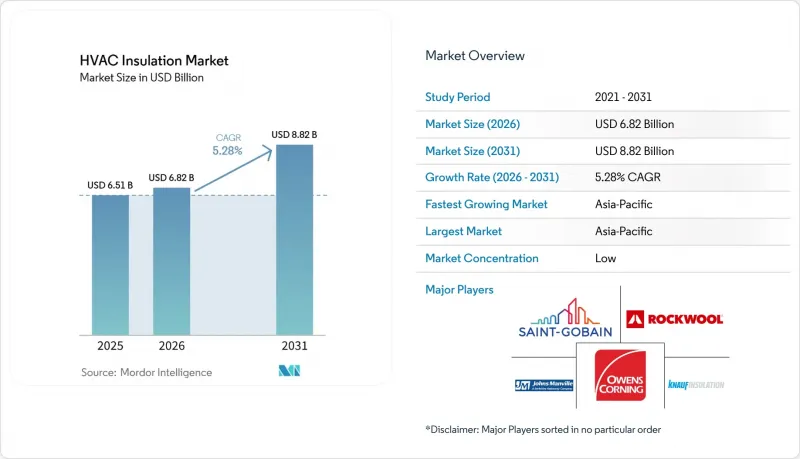
Mordor Intelligence에 의하면, HVAC 단열재 시장 규모는 2025년 65억 1,000만 달러로 평가되었고, 2026년 68억 2,000만 달러에서 2031년까지 88억 2,000만 달러로 확대될 것으로 예측되며, 2026-2031년 CAGR 5.28%를 나타낼 전망입니다.
본 보고서는 제품 유형별(덕트 단열재, 배관 단열재 등), 소재 유형별(유리솜, 석면솜 등), 용도별(덕트 단열, 배관 단열 등), 최종 사용자 산업별(주택, 상업시설 등), 지역별(아시아태평양, 북미, 유럽, 남미, 중동 및 아프리카)로 분류되어 있습니다. 시장 예측은 금액(달러) 기준으로 제시되어 있습니다.
세계의 HVAC 단열재 시장 동향 및 인사이트
엄격한 건축물 에너지 효율 규제의 도입이 진행되고 있습니다.
건축 기준은 단순한 지침에서 강제력이 있는 에너지 성능 요건으로 전환되고 있으며, 이것이 HVAC 단열재 시장 수요를 뒷받침하고 있습니다. ‘건축물 에너지 성능에 관한 지침(개정판)’에 따르면, 유럽연합(EU) 회원국은 에너지 성능이 가장 낮은 비주거용 건축물 중 2030년까지 16%, 2033년까지 26%를 개보수해야 할 의무가 있습니다. 이를 보완하는 위임규정 2025/1511은 2026년 1월 1일부터 적용되며, 회원국들에게 난방, 환기, 공조를 포함한 건축 기술 시스템에 대해 비용 최적화된 성능 수준을 산정할 것을 의무화하고 있습니다. 또한, 제13조에서는 2026년 5월 29일부터 비주거용 건축물의 실내 환경 품질 모니터링이 의무화되어, HVAC 어셈블리 전반에 걸친 열 관리에 대한 기대가 높아지고 있습니다. 캘리포니아주의 ‘2025년 건축물 에너지 효율 기준’은 2026년 1월 1일 이후의 신규 건축 허가 신청에 적용되며, 신축 주택의 히트 펌프 및 환기에 관한 요건을 확대되고 있습니다. 충분한 자금이 확보된 검사 프로그램의 경우, 이러한 규정이 더 높은 단열 사양으로 반영될 가능성이 높지만, 시행 체계가 취약한 지역에서는 그 도입이 더 완만해질 수 있습니다.
노후된 건물의 HVAC 개보수 및 리모델링 프로젝트에 대한 수요 증가
기존 건축물은 2050년까지도 개보수의 주요 대상으로 남아 있을 것으로 예상되며, 성숙한 시장에서 HVAC 단열재에 대한 수요를 지속적으로 창출할 것으로 전망됩니다. 2025년에 발표된 동료 심사 연구에 따르면, 건물이나 기후 유형에 관계없이 기후 친화적인 개보수에서 단열과 HVAC 시스템의 성능이 주요 구성 요소임이 밝혀졌습니다. 유럽연합(EU)의 ‘리노베이션 패스포트(Renovation Passport)’ 체계는 단계적인 대규모 개보수를 지원하며, 주요 구조 공사에 앞서 HVAC 및 건축 설비의 업그레이드를 수행할 수 있도록 하고 있습니다. 북미에서는 상업시설 리노베이션 프로젝트에서 덕트 단열 공사와 보다 광범위한 기계 설비 교체를 병행하는 사례가 증가하고 있습니다. 리노베이션 프로젝트에서는 기본적인 단열 기준을 충족할 뿐만 아니라, 더 우수한 방음 성능과 방습 성능이 요구되는 경우가 많아지고 있습니다. 이에 따라 사양은 엘라스토머 폼이나 폴리이소시아누레이트(PIR) 패널 시스템으로 전환되고 있으며, 소유주는 초기 자재비 외에도 기대되는 운영 성능과 리모델링 위험도 고려하여 판단하고 있습니다.
원자재 가격 및 제조 비용의 변동
HVAC 단열재 제조업체는 유리솜의 경우 실리카와 소다회, 석면솜의 경우 현무암과 슬래그, 폴리이소시아누레이트(PIR) 및 폴리우레탄(PUR) 폼의 경우 화학 원료, 엘라스토머 제품의 경우 천연 또는 합성 고무를 원료로 사용하고 있습니다. 이처럼 광범위한 원료 기반을 가지고 있기 때문에 제조업체는 여러 상품 공급망에 걸친 동시적인 공급 차질 위험에 노출되어 있습니다. 오웬스 코닝(Owens Corning)의 보고서에 따르면, 2026년 2분기에는 에너지 관련 원자재 비용 상승을 배경으로, 지정학적 혼란으로 인해 원자재 비용이 6,000만 달러 증가했습니다. PIR의 주요 원료인 메틸렌디페닐디이소시아네이트(MDI)는 여전히 전 세계적으로 공급이 집중된 상황이며, 사양 요건에 따른 수요가 증가하고 있다는 점을 감안할 때 우려 사항이 되고 있습니다. 유리섬유와 미네랄 울의 제조를 통합하고 있는 제조업체는 발포재에 특화된 공급업체에 비해 원자재 비용이 비교적 안정적일 가능성이 있습니다. 비용 변동이 심하기 때문에 조달 주기가 긴 대규모 상업용 HVAC 프로젝트의 경우, 가격 책정 및 예산 수립이 어려워지고 있습니다.
부문 분석
2025년에는 덕트 단열재가 36.82%의 점유율을 차지했으나, 사전 단열 덕트 패널은 2031년까지 연평균 성장률(CAGR) 6.34%로 확대될 것으로 예측됩니다. 덕트 단열재는 상업, 산업, 주거용 공기 분배 시스템의 기반 역할을 계속하고 있으며, 유리솜 덕트 보드와 엘라스토머 덕트 랩은 신축 및 리모델링 용도로 계속해서 사용되고 있습니다. 배관 단열재는 중요한 부문입니다. 이는 냉수, 냉매, 온수의 배관망이 대형 빌딩 및 산업 시설 전체에 걸쳐 있으며, 배관이 길어질수록 단열이 불충분할 경우 에너지 손실과 결로로 인한 손실이 증가하기 때문입니다. HVAC 단열재 시장은 설치 기반의 대부분에서 여전히 덕트 및 배관 시스템에 의존하고 있습니다. 사전 단열 덕트 패널의 성장이 특히 빠른 이유는 특히 천장이 높은 상업 공간에서 시공업체들이 ‘원터치 시공’과 공장에서 정의된 열 성능을 중시하기 때문입니다.
킹스팬의 ‘KoolDuct’ 시스템은 미국에서 언더라이터스 래버러토리스(UL) 181 클래스 1 공기 덕트 인증을 획득한 최초의 경질 페놀 폼 프리인슐레이티드 덕트 제품이 되었습니다. 이 인증을 통해 성능과 안전성 입증이 요구되는 상업시설 및 공공시설의 사양에 따른 사용이 뒷받침되고 있습니다. 방음 단열 보드는 고급 사무실 및 호텔·리조트 프로젝트에서 중요한 역할을 담당하기 시작했으며, 이러한 프로젝트에서는 기계 설비 사양에 있어 단열 성능뿐만 아니라 소음 제어에 대한 고려가 점점 더 중요시되고 있습니다. 유연성이 있는 단열재는 경질 시스템으로는 설치가 어려운 불규칙한 덕트 경로나 기존 배관에 대응할 수 있기 때문에 개보수 공사에서 여전히 유용합니다. 고온용 블랭킷, 특수 랩, 기계실용 단열재 등의 다른 제품들은 보다 구체적인 요건이 요구되는 데이터센터나 제약 시스템에 활용되고 있습니다. 이러한 제품군 전반에 걸쳐, 프로젝트 소유자가 설치 후의 신뢰성 높은 성능을 우선시할 경우, 시장 점유율이 기본 소재에서 고성능 시스템으로 이동하고 있습니다. 이러한 경향은 향후 접근, 습기로 인한 보수, 혹은 건물 운영에 지장을 주는 데 드는 비용이 기본 소재를 통한 비용 절감 효과를 상회하는 경우에 특히 두드러집니다. 따라서 제품 공급업체는 문서화된 시스템 성능, 설치 지침, 그리고 복잡한 상업 프로젝트의 요구 사항을 충족하는 능력을 무기로 경쟁할 수 있습니다. 또한, HVAC 단열재 시장에서는 개보수 공사에 필요한 유연성을 해치지 않으면서 현장 작업을 줄여주는 솔루션도 시장을 견인하고 있습니다.
2025년에는 유리솜이 31.78%의 점유율을 차지했으나, PIR 폼은 2031년까지 연평균 성장률(CAGR) 6.46%를 나타낼 것으로 예측됩니다. 유리솜은 불연성, 광범위한 온도 성능, 그리고 덕트 보드, 배관 단열, 장비 래핑 용도에서의 높은 비용 효율성으로 인해 그 입지를 유지하고 있습니다. PIR 폼은 독립 기포 구조와 사전 단열 덕트 패널 제조와의 호환성이라는 장점을 가지고 있습니다. Armacell사의 기술 정보에 따르면, 이 회사의 관련 단열 제품 사용 온도 범위는 -183°C에서 +148°C로 알려져 있으며, 그 고성능 발포재는 내습성이나 제한된 공간이 중요한 용도에 적합합니다. PIR 폼의 HVAC 단열재 시장 규모는 단위 두께당 열저항 향상을 요구하는 수요에 힘입어 성장하고 있습니다. 반면, 예산, 내화 성능 및 확립된 시공 관행이 자재 선정의 결정 요인이 되는 분야에서는 유리솜이 여전히 중심적인 위치를 차지하고 있습니다.
Knauf Insulation사의 ‘Performance+Air Duct Board’는 페놀, 포름알데히드, 아크릴계 물질을 포함하지 않는 바이오 결합제를 사용하며, 실내 공기질 배출량과 관련하여 GREENGUARD Gold 인증을 획득했습니다. 이는 유리솜 제조업체들이 점점 더 엄격해지는 실내 환경 기준에 어떻게 대응하고 있는지를 보여줍니다. 스톤울은 불연성이 필수 요건인 상업 및 산업 프로젝트에서 주목을 받고 있습니다. ROCKWOOL사는 2025년에 ‘Rockpanel’의 유로클래스 A2 등급 상향을 발표하며, 화재 위험이 높은 건축 용도에서 해당 제품군의 적용 범위를 확대했습니다. 엘라스토머 폼은 내습성이 뛰어나고 시공 시 섬유를 방출하지 않기 때문에 습도가 높은 기후에서 냉매 배관 및 공조기(AHU) 용도로 자리 잡고 있습니다. 폴리우레탄(PUR) 폼은 표준 배관 단열재로 사용되는 반면, 페놀 폼은 공간 제약이 있는 리모델링 공사에서 얇은 사전 단열 덕트 패널로 적합합니다. 폴리에틸렌 폼은 사양 기준이 비교적 완화된, 비용 중심의 주택 및 소규모 상업시설 공사에서 여전히 중요한 역할을 하고 있습니다. 덕트, 배관, 설비의 용도에 따라 열 노출, 습기 노출, 사용 가능한 설치 깊이, 방화 요건이 다르기 때문에 재료 선정은 여전히 용도별로 다릅니다. 여러 유형의 재료를 제공하는 공급업체는 시공업체가 여러 시스템을 조달할 필요를 없애고, 단일 프로젝트 내에서 이러한 상충 관계를 해결할 수 있게 해줍니다. 건물 소유주가 규제 준수, 시공 용이성, 장기적인 단열 성능 간의 균형을 모색하고 있는 HVAC 단열재 시장에서 이러한 폭넓은 제품 포트폴리오를 제공할 수 있는 능력은 중요합니다.
지역별 분석
아시아태평양은 2025년에 매출의 39.61%를 차지한 것으로 평가되었으며, 2031년까지 연평균 성장률(CAGR) 6.13%로 성장할 것으로 전망됩니다. HVAC 단열재 시장의 지역별 수요는 중국의 대규모 상업 프로젝트, 인도 및 동남아시아의 도시 개발, 그리고 더욱 엄격해진 에너지 효율 규제에 힘입어 증가하고 있습니다. ROCKWOOL은 2025년 인도, 말레이시아, 일본을 아시아태평양에서 가장 빠르게 성장하는 시장으로 지목했습니다. 이 회사의 중국 내 단열재 사업은 같은 해 두 자릿수 마이너스 성장을 기록했는데, 이는 중국 상업용 부동산 시장의 압박을 반영한 것입니다. 인도에서는 상업, 의료, 정보기술(IT) 인프라가 확대되는 가운데, ‘에너지 절약 및 지속 가능한 건축 기준법’을 통해 단열 성능에 대한 기대가 높아지고 있습니다. 킹스팬은 하오웨이 싱가포르 인수를 비롯해 태국, 인도, 싱가포르에 대한 투자를 통해 해당 지역에서의 사업 확장을 추진하고 있습니다. 남아시아 및 동남아시아는 새로운 생산 능력 확대와 성능 중심의 제품 사양 측면에서 여전히 중요한 지역으로 남아 있습니다. 이 지역의 프로젝트는 표준 주거용 시스템부터 복잡한 상업시설 및 데이터센터 설치에 이르기까지 다양하며, 공급업체는 광범위한 가격 및 성능 요건을 충족해야 합니다. 현지 공급 체계를 강화함으로써 납기 단축이 가능할 뿐만 아니라, 제조업체는 시공업체에 제품 선정 및 설치 단계에서 지원을 제공할 수 있게 됩니다. 따라서 이 지역의 HVAC 단열재 시장은 막대한 판매량 잠재력과 고부가가치 소재에 대한 수요 증가라는 두 가지 측면을 모두 갖추고 있습니다.
북미는 미국의 상업시설 개보수, 데이터센터 건설, 노후화된 HVAC 시스템 교체에 힘입어 지역별 시장 중 2위 규모를 자랑합니다. ROCKWOOL사는 2025년 미국에서 두 자릿수의 견실한 매출 성장을 기록했으며, 적어도 2028년까지는 북미 수요가 지역 생산 능력을 초과할 것으로 예상하고 있습니다. 이로 인해 유럽으로부터의 추가 수입이 필요할 가능성이 있습니다. 오웬스 코닝(Owens Corning)의 단열재 부문은 2026년 1분기에 8억 6,700만 달러의 순매출을 기록했습니다. 이 회사는 브랜드 건축자재에 대한 투자에 주력하고 있어, 2026년 2분기 기업 수익을 26억 달러에서 27억 달러로 보고했습니다. 캐나다의 주택 건설 활동 둔화는 넷 제로 목표와 관련된 상업시설의 개보수로 일부 상쇄되고 있지만, 멕시코에서는 제조업 및 도시 주택 부문의 기반이 미비한 상황입니다. 개보수 공사, 데이터센터 개발, 그리고 성능 기준의 강화는 신축 주택 건설에만 의존하지 않는 수요 원천이 되고 있습니다. 북미에서 생산 체계와 기술 지원을 갖춘 공급업체는 문서화된 규정 준수 및 안정적인 공급이 요구되는 프로젝트에서 유리한 입지를 점하고 있으며, 이로 인해 해당 지역은 HVAC용 단열재의 주요 수요 거점으로서의 역할을 강화하고 있습니다.
ROCKWOOL은 2025년 독일과 프랑스에서 매출 감소를 기록한 반면, 루마니아, 폴란드, 헝가리에서는 성장을 보였습니다. 이는 산업 활동과 건물 개보수가 여전히 활발한 저비용 동유럽 국가들로의 단기적인 전환을 시사합니다. 규제 환경은 유럽 전역의 HVAC 단열재 시장에 대한 장기적인 수요를 지속적으로 뒷받침하고 있습니다. 남미는 상장된 지역 부문 중규모가 가장 작은 지역이지만, 브라질의 상업 건축 및 산업용 냉동 설비 분야에서는 잠재적 수요가 예상됩니다. 또한 아르헨티나와 브라질은 원자재 가격 및 환율 리스크에 직면해 있어, 이는 세계 제조업체 공급 계획을 복잡하게 만들고 있습니다. 이러한 지역별 차이로 인해 사업 확장을 목표로 하는 공급업체에게는 현지 생산, 유통 및 제품 선정이 중요해집니다. 유럽 프로젝트에서는 리모델링, 방화 성능, 규제 준수가 더욱 중시되는 경향이 있는 반면, 남미 프로젝트에서는 투입 비용 및 환율 리스크 관리도 필요합니다. 일률적인 제품 및 공급 방식으로는 이러한 서로 다른 조건에 대응하기 어려울 것입니다. 그 결과, HVAC 단열재 시장에서는 현지 건축 상황에 맞추어 재료 구성, 판매 지원, 생산 능력 계획을 조정할 수 있는 공급업체가 유리해집니다.
기타 혜택 :
- 엑셀 형식 시장 예측(ME) 시트
- 3개월간의 애널리스트 지원
자주 묻는 질문
목차
제1장 서론
제2장 조사 방법
제3장 개요
제4장 시장 구도
제5장 시장 규모 및 성장 예측
제6장 경쟁 구도
제7장 시장 기회 및 향후 전망
AJY 26.09.01According to Mordor Intelligence, the HVAC insulation market size is projected to expand from USD 6.51 billion in 2025 and USD 6.82 billion in 2026 to USD 8.82 billion by 2031, and is expected to register a CAGR of 5.28% between 2026 and 2031.
This report is Segmented by Product Type (Duct Insulation, Pipe Insulation, and More), Material Type (Glass Wool, Stone Wool, and More), Application (Duct Insulation, Pipe Insulation, and More), End-User Industry (Residential, Commercial, and More), and Geography (Asia-Pacific, North America, Europe, South America, and Middle-East and Africa). The Market Forecasts are Provided in Terms of Value (USD).
Global HVAC Insulation Market Trends and Insights
Increasing Adoption of Stringent Building Energy Efficiency Regulations
Building codes are shifting from guidance to enforceable energy performance requirements, supporting demand in the HVAC insulation market. The recast Energy Performance of Buildings Directive requires European Union member states to renovate the 16% worst-performing non-residential buildings by 2030 and 26% by 2033. Its supporting Delegated Regulation 2025/1511 applies from January 1, 2026, and requires member states to calculate cost-optimal performance levels for technical building systems, including heating, ventilation, and air conditioning. Article 13 also requires indoor environmental quality monitoring in non-residential buildings from May 29, 2026, raising expectations for thermal management across HVAC assemblies. California's 2025 Building Energy Efficiency Standards apply to new permit applications from January 1, 2026, and expand heat pump and ventilation requirements in new residential construction. Well-funded inspection programs are more likely to convert these rules into higher insulation specifications, while areas with weaker enforcement may adopt them more slowly.
Growing Demand for HVAC Retrofit and Renovation Projects in Aging Buildings
Existing buildings are expected to remain the primary base for renovation through 2050, creating a sustained source of HVAC insulation demand in mature markets. A 2025 peer-reviewed study identified thermal insulation and HVAC system performance as primary components of climate-sensitive renovation across building and climate types. The European Union's Renovation Passport framework supports phased deep renovation, allowing HVAC and building services upgrades to be addressed before major structural work. In North America, commercial renovation projects increasingly combine duct insulation work with broader mechanical system replacements. Retrofit projects often require better acoustic and moisture performance than basic thermal compliance. This shifts specifications toward elastomeric foam and polyisocyanurate (PIR) panel systems, where owners weigh expected operating performance and remediation exposure alongside initial material cost.
Volatility in Raw Material Prices and Manufacturing Costs
HVAC insulation producers rely on silica and soda ash for glass wool, basalt and slag for stone wool, chemical inputs for polyisocyanurate (PIR) and polyurethane (PUR) foam, and natural or synthetic rubber for elastomeric products. This broad input base exposes manufacturers to simultaneous supply disruptions across multiple commodity chains. Owens Corning reported that geopolitical disruption added USD 60 million to input costs in the second quarter of 2026, driven by higher energy-linked feedstock costs. Methylene diphenyl diisocyanate (MDI), a key PIR input, remains exposed to a concentrated global supply, which is a concern given its growing specification demand. Producers with integrated glass fiber or mineral wool operations may have steadier input costs than foam-focused suppliers. Volatile costs make pricing and budgeting difficult for large commercial HVAC projects with long procurement cycles.
Other drivers and restraints analyzed in the detailed report include:
- Rising Demand for High-Performance Moisture-Resistant Insulation in Humid Climates
- Increasing Electrification of Heating, Ventilation, and Air Conditioning Systems
- Performance Dependence on Proper Installation and Workmanship
For complete list of drivers and restraints, kindly check the Table Of Contents.
Segment Analysis
Duct insulation held a 36.82% share in 2025, while pre-insulated duct panels are forecast to expand at a 6.34% CAGR through 2031. Duct insulation remains the foundation for commercial, industrial, and residential air distribution systems, with glass wool duct boards and elastomeric duct wrap continuing to serve both new construction and retrofit applications. Pipe insulation is a key segment, as chilled water, refrigerant, and hot water networks extend across large buildings and industrial facilities, where long pipe runs increase energy and condensation losses when insulation is inadequate. The HVAC insulation market continues to rely on duct and pipe systems for the majority of its installed base. Pre-insulated duct panels are growing faster because contractors value single-fix installation and factory-defined thermal performance, particularly in high-ceiling commercial spaces.
Kingspan's KoolDuct system became the first rigid phenolic foam pre-insulated ductwork product with an Underwriters Laboratories (UL) 181 Class 1 Air Duct listing in the United States. That listing supports its use in commercial and institutional specifications where performance and safety evidence are required. Acoustic insulation boards are developing a focused role in premium offices and hospitality projects, where mechanical specifications increasingly address noise control alongside thermal performance. Flexible insulation remains useful in retrofits because it can accommodate irregular duct routes and existing pipework where rigid systems are difficult to install. Other products, including high-temperature blankets, specialty wraps, and mechanical-room insulation, serve data center and pharmaceutical systems with more specific requirements. Across these product groups, higher-performance systems are gaining share from basic materials where project owners prioritize reliable installed performance. This preference is strongest where the cost of later access, moisture repair, or disruption to building operations exceeds the savings from a basic material. Product suppliers can therefore compete on documented system performance, installation guidance, and the ability to meet the requirements of complex commercial projects. The HVAC insulation market is also benefiting from solutions that reduce fieldwork without sacrificing the flexibility needed for retrofit installations.
Glass wool held a 31.78% share in 2025, while PIR foam is forecast to grow at a 6.46% CAGR through 2031. Glass wool maintains its position through non-combustibility, broad temperature performance, and cost efficiency in duct board, pipe insulation, and equipment wrap applications. PIR foam benefits from a closed-cell structure and compatibility with pre-insulated duct panel fabrication. Armacell's technical information specifies a service temperature range of -183°C to +148°C for its relevant insulation products, making its high-performance foam materials suitable for applications where moisture resistance and limited space are important. The HVAC insulation market size for PIR foam is supported by demand for greater thermal resistance per unit thickness. Glass wool remains central where budgets, fire performance, and established installation practices govern material selection.
Knauf Insulation's Performance+ Air Duct Board uses a bio-based binder without phenol, formaldehyde, or acrylics and holds GREENGUARD Gold certification for indoor air quality emissions. This demonstrates how glass wool suppliers are responding to more demanding indoor environment standards. Stone wool is gaining traction in commercial and industrial projects where non-combustibility is a mandatory requirement. ROCKWOOL reported a Euroclass A2 classification upgrade for Rockpanel in 2025, extending the material family's relevance in fire-sensitive building applications. Elastomeric foam is established in refrigerant pipe and air handling unit (AHU) applications in humid climates because it resists moisture and does not release fibers during installation. Polyurethane (PUR) foam supports standard pipe insulation, while phenolic foam is well-suited to thin pre-insulated duct panels in space-constrained retrofits. Polyethylene foam remains relevant in cost-sensitive residential and light commercial work where specification thresholds are lower. Material selection remains application-specific because heat exposure, moisture exposure, available installation depth, and fire requirements differ across duct, pipe, and equipment uses. Suppliers that offer multiple material types can address these trade-offs within a single project rather than requiring contractors to source multiple systems. This broad portfolio capability is important in the HVAC insulation market as building owners seek a balance between compliance, ease of installation, and long-term thermal performance.
Complete Report Scope:
- By Product Type
- Duct Insulation
- Pipe Insulation
- Acoustic Insulation Boards
- Pre-Insulated Duct Panels
- Flexible Insulation
- Other Products
- By Material Type
- Glass Wool
- Stone Wool
- Elastomeric Foam
- Polyurethane (PUR) Foam
- Polyisocyanurate (PIR) Foam
- Phenolic Foam
- Polyethylene Foam
- Other Materials
- By Application
- Duct Insulation
- Pipe Insulation
- Equipment Insulation
- Air Handling Unit (AHU) Insulation
- By End-user Industry
- Residential
- Commercial
- Industrial
- Transportation
- By Geography
- Asia-Pacific
- China
- India
- Japan
- South Korea
- Rest of Asia-Pacific
- North America
- United States
- Canada
- Mexico
- Europe
- Germany
- United Kingdom
- France
- Italy
- Russia
- Rest of Europe
- South America
- Brazil
- Argentina
- Rest of South America
- Middle-East and Africa
- Saudi Arabia
- South Africa
- Rest of Middle-East and Africa
- Asia-Pacific
Geography Analysis
Asia-Pacific accounted for 39.61% of revenue in 2025 and is forecast to grow at a 6.13% CAGR through 2031. Regional demand in the HVAC insulation market is supported by large commercial projects in China, urban development in India and Southeast Asia, and stricter energy efficiency regulations. ROCKWOOL identified India, Malaysia, and Japan as its strongest Asia-Pacific growth markets in 2025. Its China insulation business declined at a double-digit rate during the same year, reflecting pressure in the Chinese commercial real estate market. India is raising thermal performance expectations through its Energy Conservation and Sustainable Building Code as commercial, healthcare, and information technology infrastructure expand. Kingspan is expanding its regional presence through investments in Thailand, India, and Singapore, including the acquisition of Hao Wei Singapore. South and Southeast Asia remain important areas for new manufacturing capacity and performance-oriented product specifications. Regional projects range from standard residential systems to complex commercial and data center installations, requiring suppliers to address a wide range of price and performance requirements. Greater local availability can shorten delivery times and allow manufacturers to support contractors during product selection and installation. The HVAC insulation market in this region therefore offers both broad volume potential and a growing demand for higher-value materials.
North America is the second-largest regional market, driven by commercial renovation, data center construction, and upgrades to aging HVAC systems in the United States. ROCKWOOL reported strong double-digit U.S. revenue growth in 2025 and expects North American demand to exceed regional production capacity through at least 2028, which may require supplemental imports from Europe. Owens Corning's insulation segment generated USD 867 million in net sales in the first quarter of 2026. The company reported enterprise revenue of USD 2.6 billion to USD 2.7 billion in the second quarter of 2026 as it focuses investment on branded building products. Canada's slower housing activity is partly offset by commercial retrofits tied to net-zero goals, while Mexico presents an underdeveloped base in manufacturing and urban housing. Renovation activity, data center development, and tighter performance standards provide demand sources that do not depend solely on new residential construction. Suppliers with North American production and technical support are positioned where projects require documented compliance and dependable supply, reinforcing the region's role as a major center of demand for HVAC insulation.
ROCKWOOL recorded revenue declines in Germany and France in 2025, while Romania, Poland, and Hungary grew, pointing to a near-term shift toward lower-cost Eastern European economies where industrial activity and building upgrades remain active. The regulatory environment continues to support longer-term demand in the HVAC insulation market across Europe. South America is the smallest listed geographic segment, with potential in Brazil's commercial construction and industrial refrigeration base. Argentina and Brazil also face commodity price and currency risks that complicate supply planning for global manufacturers. These regional differences make localized production, distribution, and product selection important for suppliers seeking to expand. European projects may place greater weight on renovation, fire performance, and regulatory compliance, while South American projects must also manage input cost and currency exposure. A uniform product and supply approach is unlikely to address these distinct conditions. The HVAC insulation market consequently favors suppliers that can adapt their material mix, sales support, and capacity planning to local building conditions.
- AFICO
- American Flexible Products
- Armacell
- Climatech
- Glassrock Insulation Co. S.A.E.
- Johns Manville
- Kingspan Holdings (IRL) Limited
- Knauf Insulation
- L'ISOLANTE K-FLEX S.p.A.
- Owens Corning
- Panasonic Corporation
- ROCKWOOL A/S
- Saint-Gobain
- Thermafiber
- Thermaflex
- Ursa Insulation S.A.
Additional Benefits:
- The market estimate (ME) sheet in Excel format
- 3 months of analyst support
TABLE OF CONTENTS
1 Introduction
- 1.1 Study Assumptions and Market Definition
- 1.2 Scope of the Study
2 Research Methodology
3 Executive Summary
4 Market Landscape
- 4.1 Market Overview
- 4.2 Market Drivers
- 4.2.1 Increasing Adoption of Stringent Building Energy Efficiency Regulations
- 4.2.2 Growing Demand for HVAC Retrofit and Renovation Projects in Aging Buildings
- 4.2.3 Rising Demand for High-Performance Moisture-Resistant Insulation in Humid Climates
- 4.2.4 Increasing Electrification of Heating, Ventilation, and Air Conditioning (HVAC) Systems
- 4.2.5 Growing Preference for Non-Combustible and Fire-Resistant Insulation Materials
- 4.3 Market Restraints
- 4.3.1 Volatility in Raw Material Prices and Manufacturing Costs
- 4.3.2 Performance Dependence on Proper Installation and Workmanship
- 4.3.3 Stringent Fire Safety, Smoke Emission, and Building Code Compliance Requirements
- 4.4 Value Chain Analysis
- 4.5 Porter's Five Forces Analysis
- 4.5.1 Threat of New Entrants
- 4.5.2 Bargaining Power of Suppliers
- 4.5.3 Bargaining Power of Buyers
- 4.5.4 Threat of Substitutes
- 4.5.5 Competitive Rivalry
5 Market Size and Growth Forecasts (Value)
- 5.1 By Product Type
- 5.1.1 Duct Insulation
- 5.1.2 Pipe Insulation
- 5.1.3 Acoustic Insulation Boards
- 5.1.4 Pre-Insulated Duct Panels
- 5.1.5 Flexible Insulation
- 5.1.6 Other Products
- 5.2 By Material Type
- 5.2.1 Glass Wool
- 5.2.2 Stone Wool
- 5.2.3 Elastomeric Foam
- 5.2.4 Polyurethane (PUR) Foam
- 5.2.5 Polyisocyanurate (PIR) Foam
- 5.2.6 Phenolic Foam
- 5.2.7 Polyethylene Foam
- 5.2.8 Other Materials
- 5.3 By Application
- 5.3.1 Duct Insulation
- 5.3.2 Pipe Insulation
- 5.3.3 Equipment Insulation
- 5.3.4 Air Handling Unit (AHU) Insulation
- 5.4 By End-user Industry
- 5.4.1 Residential
- 5.4.2 Commercial
- 5.4.3 Industrial
- 5.4.4 Transportation
- 5.5 By Geography
- 5.5.1 Asia-Pacific
- 5.5.1.1 China
- 5.5.1.2 India
- 5.5.1.3 Japan
- 5.5.1.4 South Korea
- 5.5.1.5 Rest of Asia-Pacific
- 5.5.2 North America
- 5.5.2.1 United States
- 5.5.2.2 Canada
- 5.5.2.3 Mexico
- 5.5.3 Europe
- 5.5.3.1 Germany
- 5.5.3.2 United Kingdom
- 5.5.3.3 France
- 5.5.3.4 Italy
- 5.5.3.5 Russia
- 5.5.3.6 Rest of Europe
- 5.5.4 South America
- 5.5.4.1 Brazil
- 5.5.4.2 Argentina
- 5.5.4.3 Rest of South America
- 5.5.5 Middle-East and Africa
- 5.5.5.1 Saudi Arabia
- 5.5.5.2 South Africa
- 5.5.5.3 Rest of Middle-East and Africa
- 5.5.1 Asia-Pacific
6 Competitive Landscape
- 6.1 Market Concentration
- 6.2 Strategic Moves
- 6.3 Market Share (%)/Ranking Analysis
- 6.4 Company Profiles (includes Global Overview, Market Overview, Core Segments, Financials as available, Strategic Information, Products and Services, and Recent Developments)
- 6.4.1 AFICO
- 6.4.2 American Flexible Products
- 6.4.3 Armacell
- 6.4.4 Climatech
- 6.4.5 Glassrock Insulation Co. S.A.E.
- 6.4.6 Johns Manville
- 6.4.7 Kingspan Holdings (IRL) Limited
- 6.4.8 Knauf Insulation
- 6.4.9 L'ISOLANTE K-FLEX S.p.A.
- 6.4.10 Owens Corning
- 6.4.11 Panasonic Corporation
- 6.4.12 ROCKWOOL A/S
- 6.4.13 Saint-Gobain
- 6.4.14 Thermafiber
- 6.4.15 Thermaflex
- 6.4.16 Ursa Insulation S.A.
7 Market Opportunities and Future Outlook
- 7.1 White-Space and Unmet-Need Assessment