

|
시장보고서
상품코드
2118142
AI 트레이닝 데이터 리니지 소프트웨어 시장 : 시장 점유율 분석, 업계 동향 및 통계, 성장 예측(2026-2031년)AI Training Data Lineage Software - Market Share Analysis, Industry Trends & Statistics, Growth Forecasts (2026 - 2031) |
||||||
 Mordor Intelligence
Mordor Intelligence에 의하면, AI 트레이닝 데이터 리니지 소프트웨어 시장 규모는 2025년 28억 6,000만 달러로 평가되었고, 2026년 34억 8,000만 달러에서 2031년까지 108억 4,000만 달러로 확대될 것응로 예측되며, 2026-2031년 CAGR 25.51%를 기록할 전망입니다.

본 보고서는 구성 요소별(소프트웨어 및 서비스), 배포 모델별(클라우드, 하이브리드, 온프레미스), 기업 규모별(대기업, 기타), 용도별(모델 개발 및 실험 재현성, 기타), 데이터 모달리티별(텍스트 및 코드, 기타), 최종 사용자별(에너지·유틸리티, 기타), 지역별로 분류되어 있습니다. 시장 예측은 금액(달러) 기준으로 제시되어 있습니다.
세계의 AI 트레이닝 데이터 리니지 소프트웨어 시장 동향 및 인사이트
추적 가능한 AI 훈련 데이터에 대한 규제 요구 증가
EU AI법에 따라 훈련 데이터의 출처에 관한 요건은 권장 관행에서 고위험 시스템에 대한 규정 준수 의무로 전환되었습니다. 제10조에서는 훈련, 검증, 테스트용 데이터 세트에 대해 데이터의 출처, 수집 방법, 처리, 라벨링, 편향성 검증을 포괄하는 거버넌스 조치를 요구하고 있습니다. 또한, EUR-LEX 제53조는 범용 AI 제공업체에게 EU AI 사무국의 템플릿에 기반한 훈련 컨텐츠 문서화를 의무화하고 있습니다. 이러한 요건으로 인해 구매자는 감사 시 기록을 서둘러 정리하기보다는 개발 단계에서 데이터 출처 정보를 확실하게 기록하도록 권장받고 있습니다. 이와 유사한 요구 사항은 유럽 이외의 지역으로도 확산되고 있으며, 미국의 주법 및 산업별 의무로 인해 훈련 데이터의 투명성에 대한 관심이 높아지고 있습니다. 따라서 컴플라이언스 팀이나 기술 팀이 데이터 처리에 관한 단일하고 실용적인 기록을 필요로 할 경우, AI 트레이닝 데이터 리니지 소프트웨어 시장은 그 혜택을 누리게 될 것입니다.
다중 모달 및 에이전트형 AI 파이프라인의 성장
로봇, 자율주행차, 산업 자동화 분야에서는 기존의 표 형식 데이터보다 더 복잡한 센서 데이터가 생성됩니다. 이러한 워크플로에서는 동영상, LiDAR, 텔레메트리 및 기타 입력 데이터가 결합되는데, 이들은 각각의 변환 처리 및 라벨과 항상 연동된 상태로 유지되어야 합니다. Encord의 보고서에 따르면, 이 회사의 멀티모달 플랫폼상의 데이터 양은 1년 만에 1페타바이트에서 5페타바이트로 증가했으며, AI 관련 고객으로부터의 매출은 10배로 증가했습니다. 에이전트형 시스템도 유사한 과제를 안겨줍니다. 자율 에이전트는 각 단계에서 인간의 개입 없이 데이터를 읽고, 쓰고, 변경할 수 있기 때문입니다. LakeFS는 2026년 6월, 격리된 데이터 브랜치, 제어된 병합, 에이전트의 ID와 실행 세부 정보를 데이터 조작에 연결하는 레코드를 갖춘 ‘Agentic AI’ 솔루션을 발표했습니다. 이에 따라 데이터셋 수준뿐만 아니라 각 에이전트의 실행 수준에서도 작업을 기록하는 도구에 대한 수요가 높아지고 있습니다.
분산된 툴체인 전반에 걸친 높은 통합 복잡성
AI 훈련 환경에는 데이터 레이크, 오케스트레이션 도구, 피처 스토어, 실험 추적 소프트웨어, 모델 레지스트리 등이 포함되는 경우가 많습니다. 이러한 시스템을 단일 추적 가능한 기록으로 통합하려면, 특히 기업이 구식이나 특수한 용도를 사용하는 경우, 맞춤화가 필요할 수 있습니다. 2025년 ISG 조사에 따르면, 기업의 38%는 데이터 관리 통합에 드는 비용이 얻을 수 있는 이점을 상회할 것이라고 생각했습니다. 또한, 같은 조사에서 43%의 기업이 조직 전체에 걸쳐 일관된 데이터 구조를 구축하고 있는 것으로 나타났습니다. 벤더가 구형 제품군의 제공을 중단하거나 플랫폼과 고객 시스템 간의 연결 방식을 변경할 경우, 기존 도입 환경에서는 추가 작업이 필요할 수 있습니다. Collibra는 자사의 레거시 CLI 리니지 하베스터에 대한 지원이 2026년 7월 31일에 종료된다고 발표했으며, 자체 호스팅형 고객은 Edge 기반 아키텍처로 마이그레이션해야 합니다.
부문 분석
2025년 기준, AI 트레이닝 데이터 리니지 소프트웨어 시장 내 소프트웨어 점유율은 74.18%를 차지했으며, 현 단계에서 AI 트레이닝 데이터 리니지 소프트웨어 시장은 주로 플랫폼 주도형으로 구성되어 있습니다. 구매자들은 리니지, 메타데이터 관리, 감사 기록, 규정 준수 기능을 기존 AI 개발 환경에 통합할 수 있는 플랫폼을 선호합니다. 이 범주에는 프로비넌스 도구, 카탈로그 제품, 파이프라인 모니터링 시스템, 거버넌스 용도이 포함됩니다. 조직은 라이프사이클 전반에 걸친 추적성을 필요로 할 때, 서로 다른 시스템 간의 연결 수를 최소화하는 것을 점점 더 선호하고 있습니다. 이러한 추세는 기술적 메타데이터와 정책 정보를 연결할 수 있는 플랫폼을 뒷받침하고 있습니다. 또한, 별도의 용도 간에 기록을 이동시키지 않고도 원시 데이터에서 전처리, 라벨링, 테스트, 승인, 후속 검토에 이르는 전체 채널을 유지해야 할 필요성도 반영하고 있습니다.
서비스 시장은 2026-2031년 연평균 성장률(CAGR) 28.41%를 나타낼 것으로 예측됩니다. 기업 환경에는 맞춤형 SQL, 독자적인 데이터 처리 프로세스, 다양한 액세스 규칙이 존재하기 때문에 도입 작업은 여전히 필요합니다. 서비스 제공업체는 연결 설정, 기존 레코드 매핑, 비즈니스 팀과 기술 팀을 아우르는 운영 도입을 지원합니다. Collibra의 OpenLineage가 AWS Glue 및 Apache Airflow를 지원함으로써 개방형 통합을 가능하게 하여 커넥터 관련 작업을 경감시켰습니다. 구매자가 여러 클라우드 및 레거시 시스템을 포괄해야 하는 경우, 맞춤형 도입 작업은 계속해서 중요할 것으로 보입니다.
2025년 AI 트레이닝 데이터 리니지 소프트웨어 시장 점유율 중 클라우드 배포가 71.24%를 차지했으며, AI 트레이닝 데이터 리니지 소프트웨어 시장과 호스팅형 훈련 환경 간의 강한 연관성이 부각되었습니다. 클라우드 기반 훈련 파이프라인은 메타데이터 이벤트를 생성하며, 호스팅형 플랫폼은 이를 지연을 최소화하여 수집할 수 있습니다. 이 모델은 업데이트 작업을 간소화하고, 분산된 팀을 보유한 조직의 중앙 집중식 관리를 지원합니다. Collibra와 Atlan은 기업 내 활용이 확대됨에 따라 리니지 수집을 클라우드 연결형 엣지 아키텍처로 전환하고 있습니다. 클라우드 배포는 이미 훈련 및 데이터 저장을 위해 하이퍼스케일러 서비스를 이용하고 있는 AI 팀에 특히 적합합니다. 이를 통해 분산된 팀이 파이프라인의 활동 상황을 공유하고 파악할 수 있을 뿐만 아니라, 각 고객이 개별적인 로컬 설치를 유지할 필요 없이 플랫폼 업데이트를 적용할 수 있게 됩니다.
하이브리드 배포는 2026-2031년 연평균 성장률(CAGR) 27.69%로 확대될 것으로 예측됩니다. 은행, 국방, 의료 기관에서는 클라우드 시스템과 에어갭 환경 또는 로컬 환경을 아우르는 기록이 필요한 경우가 많습니다. Collibra는 이러한 환경에서 엔드투엔드 가시성이 필요한 고객을 위해 2026년에 자체 호스팅형 배포용 ‘Data Lineage’를 출시했습니다. 또한, 훈련 데이터의 클라우드 처리가 국내 규제로 인해 제한되는 경우, 온프레미스 배포의 중요성은 여전히 높습니다. 이러한 환경 전반에 걸쳐 일관된 기록을 유지할 수 있는 벤더라면 거버넌스 업무의 중복을 줄일 수 있습니다.
지역별 분석
2025년, 북미는 AI 트레이닝 데이터 리니지 소프트웨어 시장의 34.62% 점유율을 차지했습니다. 이 지역에는 AI 전문 기업, 클라우드 제공업체, 확립된 거버넌스 프로그램을 갖춘 기업 고객이 집중되어 있습니다. 미국은 의료, 금융 서비스, 공공 부문 프로그램 및 주요 기술 기업을 통해 수요의 상당 부분을 주도하고 있습니다. 2025년 지침 초안에 따라 AI 탑재 의료기기의 수명 주기에 대한 문서화 필요성이 높아졌을 뿐만 아니라, 주 차원의 요건에서도 책임 있는 사용과 문서화가 강조되고 있습니다. 캐나다와 멕시코는 비교적 소규모 기반에서 발전하고 있으며, 금융 서비스 및 공공 부문에서의 활용이 수요에 기여하고 있습니다.
아시아태평양은 2026-2031년 연평균 성장률(CAGR) 29.74%로 확대될 것으로 예측됩니다. 중국, 인도, 일본, 한국, 동남아시아 국가에서는 데이터 보호 규제와 더불어 AI 훈련 활동이 확대되고 있습니다. 일본의 자동차 및 로봇 산업에서는 센서 융합 데이터를 기록하고 라벨링 작업을 수행할 수 있는 도구에 대한 수요가 발생하고 있습니다. 또한, Encord는 데이터 큐레이션 기능을 갖춘 물리적 AI의 이용 사례로 도요타가 개발한 ‘Woven’을 꼽고 있습니다. 중국과 한국도 대규모 국내 AI 개발 프로그램을 보유하고 있으며, 해당 지역의 법적 규제 차이로 인해 동의, 위치 정보, 안전성, 설명 책임에 관한 유연한 관리 체계의 가치가 높아지고 있습니다.
유럽은 EU AI법이 고위험 AI 시스템에 대해 상세한 데이터 거버넌스를 의무화하고 있어 중요한 위치를 차지하고 있습니다. 프랑스, 독일, 영국은 중요한 국내 시장이며, 독일의 산업 부문은 자동화와 관련된 수요를 뒷받침하고 있습니다. 남미는 매출 규모 면에서는 여전히 작지만, 브라질의 LGPD(개인정보보호법)가 데이터 처리에 관한 문서화의 법적 근거를 제공합니다. 한편, 중동 및 아프리카는 신흥 시장으로, 사우디아라비아와 아랍에미리트가 AI 및 데이터 인프라에 대한 투자를 추진하고 있습니다. 남아프리카와 나이지리아에서는 금융 서비스용 용도에 대한 초기 수요가 나타나고 있습니다. AI 트레이닝 데이터 리니지 소프트웨어 시장은 현지 데이터 규제와 AI 투자가 모두 성숙해 가는 지역에서 더 광범위한 비즈니스 기회를 제공합니다.
기타 혜택
- 엑셀 형식 시장 예측(ME) 시트
- 3개월간의 애널리스트 지원
자주 묻는 질문
목차
제1장 서론
제2장 조사 방법
제3장 주요 요약
제4장 시장 구도
제5장 시장 규모 및 성장 예측
제6장 경쟁 구도
제7장 시장 기회 및 향후 전망
AJY 26.09.03According to Mordor Intelligence, the AI training data lineage software market size is projected to expand from USD 2.86 billion in 2025, USD 3.48 billion in 2026 to USD 10.84 billion by 2031, registering a CAGR of 25.51% between 2026 and 2031.
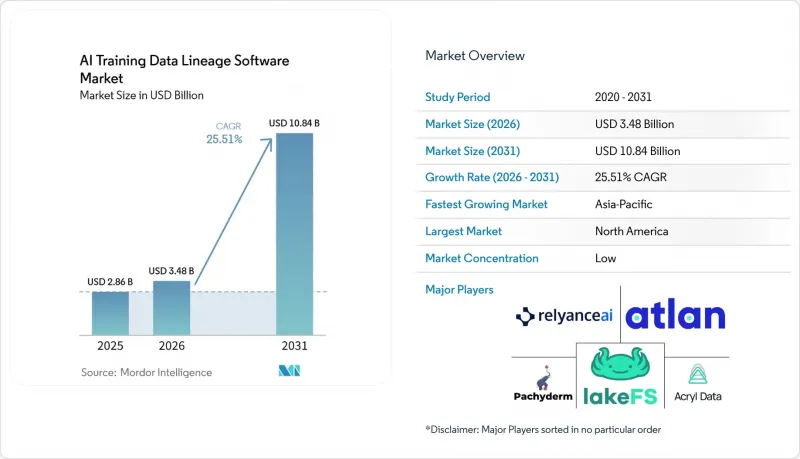
This report is Segmented by Component (Software, and Services), Deployment Model (Cloud, Hybrid, and On-Premises), Enterprise Size (Large Enterprises, and More), Application (Model Development and Experiment Reproducibility, and More), Data Modality (Text and Code, and More), End User (Energy and Utilities, and More), and Geography. The Market Forecasts are Provided in Terms of Value (USD).
Global AI Training Data Lineage Software Market Trends and Insights
Rising Regulatory Demand for Traceable AI Training Data
The EU AI Act has shifted the provenance of training data from a recommended practice to a compliance obligation for high-risk systems. Article 10 requires governance measures covering data origin, collection methods, processing, labeling, and bias examination for training, validation, and testing datasets. EUR-LEX Article 53 also requires general-purpose AI providers to prepare training content documentation under an EU AI Office template. These requirements encourage buyers to capture provenance during development instead of trying to assemble records during an audit. The same need extends beyond Europe, as U.S. state rules and sector-specific obligations increase attention to transparency in training data. The AI Training Data Lineage Software Market therefore benefits when compliance and technical teams need a single, usable record of data handling.
Growth of Multimodal and Agentic AI Pipelines
Robotics, autonomous vehicles, and industrial automation generate sensor data that is more complex than conventional tabular data. These workflows combine video, LiDAR, telemetry, and other inputs that must remain connected to their transformations and labels. Encord reported that data volumes on its multimodal platform increased from 1 petabyte to 5 petabytes over 1 year, with physical AI customer revenue increasing 10-fold. Agentic systems pose a related challenge because autonomous agents can read, write, and modify data without human intervention at each step. LakeFS introduced its Agentic AI offering in June 2026 with isolated data branches, controlled merges, and records that link agent identity and execution details to data actions. This raises demand for tools that record work at the level of each agent run as well as at the dataset level.
High Integration Complexity Across Fragmented Toolchains
AI training environments often include data lakes, orchestration tools, feature stores, experiment tracking software, and model registries. Connecting these systems into a single, traceable record can require custom work, especially when firms use older or specialized applications. The 2025 ISG study reported that 38% of enterprises believed the cost of harmonizing data management outweighed the likely benefit. The study also found that 43% had created a consistent data structure across their organizations. Existing deployments can require additional work when vendors retire older collectors or change how a platform connects to customer systems. Collibra stated that its legacy CLI lineage harvester would reach end of life on July 31, 2026, requiring self-hosted customers to move to its Edge-based architecture.
Other drivers and restraints analyzed in the detailed report include:
- Expansion of Cloud and Hybrid AI Infrastructure
- Data Quality as a Model Performance Differentiator
- Privacy, Sovereignty, and Consent Constraints
For complete list of drivers and restraints, kindly check the Table Of Contents.
Segment Analysis
Software held 74.18% of the AI Training Data Lineage Software Market share in 2025, making the AI Training Data Lineage Software Market primarily platform-led at this stage. Buyers favor platforms that bring lineage, metadata management, audit records, and compliance functions into existing AI development environments. The category includes provenance tools, catalog products, pipeline monitoring systems, and governance applications. Organizations increasingly prefer fewer connections between separate systems when they need traceability across the full lifecycle. This preference supports platforms that can connect technical metadata with policy information. It also reflects the need to preserve the path from raw material through preparation, labeling, testing, approval, and later review without moving records between separate applications.
Services are projected to grow at a 28.41% CAGR from 2026 to 2031. Implementation work remains necessary because enterprise environments contain custom SQL, proprietary data processes, and varied access rules. Service providers help configure connections, map existing records, and support operational adoption across business and technical teams. Collibra's OpenLineage support for AWS Glue and Apache Airflow reduced connector work by enabling open integration. Even so, tailored implementation work is likely to remain important where buyers need coverage across multiple clouds and older systems.
Cloud deployment accounted for 71.24% of the AI Training Data Lineage Software Market share in 2025, underscoring the strong link between the AI Training Data Lineage Software Market and hosted training environments. Cloud-based training pipelines create metadata events that a hosted platform can capture with limited delay. This model can simplify updates and support centralized administration for organizations with distributed teams. Collibra and Atlan have moved lineage collection toward cloud-connected edge architectures as enterprise use has expanded. Cloud deployment is especially suited to AI groups that already use hyperscaler services for training and data storage. It gives distributed teams a shared view of pipeline activity, while platform updates can be applied without each customer having to maintain a separate local installation.
Hybrid deployment is projected to expand at a 27.69% CAGR from 2026 to 2031. Banking, defense, and healthcare organizations often need records across cloud systems and air-gapped or local environments. Collibra released Data Lineage for self-hosted deployments in 2026 for customers who need end-to-end visibility in such settings. Local deployment also remains relevant where national rules limit cloud processing of training data. Vendors that maintain consistent records across these locations can reduce the need for duplicate governance work.
Complete Report Scope:
- By Component
- Software
- Data Lineage and Provenance Software
- Metadata and Catalog Management Software
- Data Transformation and Pipeline Observability Software
- Governance, Audit and Compliance Software
- Services
- Software
- By Deployment Model
- Cloud
- Hybrid
- On-Premises
- By Enterprise Size
- Large Enterprises
- Small and Medium-Sized Enterprises
- By Application
- Model Development and Experiment Reproducibility
- Dataset Versioning and Release Management
- Data Governance and Metadata Management
- Regulatory Compliance and AI Audit
- Data Quality and Data Drift Analysis
- By Data Modality
- Text and Code
- Image and Video
- Audio and Speech
- Multimodal and Sensor-Rich Data
- Structured and Tabular Data
- By End User
- IT and Telecommunication
- BFSI
- Automotive and Transportation
- Healthcare and Life Sciences
- Retail and E-Commerce
- Industrial Manufacturing
- Education and Research Institutions
- Government and Administration
- Energy and Utilities
- Other End Users
- By Geography
- North America
- United States
- Canada
- Mexico
- South America
- Brazil
- Argentina
- Rest of South America
- Europe
- Germany
- United Kingdom
- France
- Russia
- Spain
- Rest of Europe
- Asia-Pacific
- China
- Japan
- India
- South Korea
- Southeast Asia
- Rest of Asia-Pacific
- Middle East and Africa
- Middle East
- Saudi Arabia
- United Arab Emirates
- Rest of Middle East
- Africa
- South Africa
- Nigeria
- Rest of Africa
- Middle East
- North America
Geography Analysis
North America held 34.62% of the AI Training Data Lineage Software Market share in 2025. The region has a large concentration of AI-focused businesses, cloud providers, and enterprise buyers with established governance programs. The United States drives much of the demand through healthcare, financial services, public-sector programs, and large technology firms. The 2025 draft guidance increased the need for lifecycle documentation for AI-enabled medical devices, while state-level requirements also emphasize responsible use and documentation. Canada and Mexico are developing from a smaller base, with financial services and public-sector uses contributing to demand.
Asia-Pacific is projected to expand at a 29.74% CAGR from 2026 to 2031. China, India, Japan, South Korea, and Southeast Asian countries are expanding AI training activity alongside data-protection rules. Japan's automotive and robotics sectors create demand for tools that can record sensor-fusion data and perform labeling work, and Encord identified Woven by Toyota as a physical AI user with data curation capabilities. China and South Korea also have large domestic AI development programs, and the region's differing legal requirements increase the value of flexible controls for consent, location, safety, and accountability.
Europe holds a significant position because the EU AI Act requires detailed data governance for high-risk AI systems. France, Germany, and the United Kingdom are important national markets, while Germany's industrial sector supports demand related to automation. South America remains smaller in revenue, although Brazil's LGPD provides a related basis for data-processing documentation, while the Middle East and Africa are emerging, with Saudi Arabia and the UAE investing in AI and data infrastructure. South Africa and Nigeria show early demand for financial services applications. The AI Training Data Lineage Software Market offers broader regional opportunities where local data rules and AI investment mature together.
- Acryl Data, Inc.
- Alation, Inc.
- Ataccama Corporation
- Atlan Pte. Ltd.
- Bigeye, Inc.
- Collibra NV
- Data.World, Inc.
- Dataloop Ltd.
- Encord, Inc.
- Informatica Inc.
- lakeFS Ltd.
- Monte Carlo Data, Inc.
- Octopai Ltd.
- Pachyderm, Inc.
- Relyance AI, Inc.
- Secoda, Inc.
- Sifflet, Inc.
- Snorkel AI, Inc.
- Solidatus Limited
- SuperAnnotate AI, Inc.
- V7 Labs Limited
- WhyLabs, Inc.
Additional Benefits:
- The market estimate (ME) sheet in Excel format
- 3 months of analyst support
TABLE OF CONTENTS
1 INTRODUCTION
- 1.1 Study Assumptions and Market Definition
- 1.2 Scope of the Study
2 RESEARCH METHODOLOGY
3 EXECUTIVE SUMMARY
4 MARKET LANDSCAPE
- 4.1 Market Overview
- 4.2 Market Drivers
- 4.2.1 Rising Regulatory Demand for Traceable AI Training Data
- 4.2.2 Growth of Multimodal and Agentic AI Pipelines
- 4.2.3 Expansion of Cloud and Hybrid AI Infrastructure
- 4.2.4 Data Quality as a Model-Performance Differentiator
- 4.2.5 Synthetic and Simulation Data Provenance
- 4.2.6 Lineage-Aware Data Contracts for Agentic AI
- 4.3 Market Restraints
- 4.3.1 High Integration Complexity Across Fragmented Toolchains
- 4.3.2 Privacy, Sovereignty, and Consent Constraints
- 4.3.3 Shortage of Data Governance and MLOps Skills
- 4.3.4 Provenance Gaps in Synthetic and Web-Sourced Data
- 4.4 Impact of Macroeconomic Factors on the Market
- 4.5 Industry Value-Chain Analysis
- 4.6 Technology Outlook
- 4.7 Regulatory Landscape
- 4.8 Porter's Five Forces Analysis
- 4.8.1 Threat of New Entrants
- 4.8.2 Bargaining Power of Suppliers
- 4.8.3 Bargaining Power of Buyers
- 4.8.4 Threat of Substitutes
- 4.8.5 Intensity of Competitive Rivalry
5 MARKET SIZE AND GROWTH FORECASTS (VALUE)
- 5.1 By Component
- 5.1.1 Software
- 5.1.1.1 Data Lineage and Provenance Software
- 5.1.1.2 Metadata and Catalog Management Software
- 5.1.1.3 Data Transformation and Pipeline Observability Software
- 5.1.1.4 Governance, Audit and Compliance Software
- 5.1.2 Services
- 5.1.1 Software
- 5.2 By Deployment Model
- 5.2.1 Cloud
- 5.2.2 Hybrid
- 5.2.3 On-Premises
- 5.3 By Enterprise Size
- 5.3.1 Large Enterprises
- 5.3.2 Small and Medium-Sized Enterprises
- 5.4 By Application
- 5.4.1 Model Development and Experiment Reproducibility
- 5.4.2 Dataset Versioning and Release Management
- 5.4.3 Data Governance and Metadata Management
- 5.4.4 Regulatory Compliance and AI Audit
- 5.4.5 Data Quality and Data Drift Analysis
- 5.5 By Data Modality
- 5.5.1 Text and Code
- 5.5.2 Image and Video
- 5.5.3 Audio and Speech
- 5.5.4 Multimodal and Sensor-Rich Data
- 5.5.5 Structured and Tabular Data
- 5.6 By End User
- 5.6.1 IT and Telecommunication
- 5.6.2 BFSI
- 5.6.3 Automotive and Transportation
- 5.6.4 Healthcare and Life Sciences
- 5.6.5 Retail and E-Commerce
- 5.6.6 Industrial Manufacturing
- 5.6.7 Education and Research Institutions
- 5.6.8 Government and Administration
- 5.6.9 Energy and Utilities
- 5.6.10 Other End Users
- 5.7 By Geography
- 5.7.1 North America
- 5.7.1.1 United States
- 5.7.1.2 Canada
- 5.7.1.3 Mexico
- 5.7.2 South America
- 5.7.2.1 Brazil
- 5.7.2.2 Argentina
- 5.7.2.3 Rest of South America
- 5.7.3 Europe
- 5.7.3.1 Germany
- 5.7.3.2 United Kingdom
- 5.7.3.3 France
- 5.7.3.4 Russia
- 5.7.3.5 Spain
- 5.7.3.6 Rest of Europe
- 5.7.4 Asia-Pacific
- 5.7.4.1 China
- 5.7.4.2 Japan
- 5.7.4.3 India
- 5.7.4.4 South Korea
- 5.7.4.5 Southeast Asia
- 5.7.4.6 Rest of Asia-Pacific
- 5.7.5 Middle East and Africa
- 5.7.5.1 Middle East
- 5.7.5.1.1 Saudi Arabia
- 5.7.5.1.2 United Arab Emirates
- 5.7.5.1.3 Rest of Middle East
- 5.7.5.2 Africa
- 5.7.5.2.1 South Africa
- 5.7.5.2.2 Nigeria
- 5.7.5.2.3 Rest of Africa
- 5.7.5.1 Middle East
- 5.7.1 North America
6 COMPETITIVE LANDSCAPE
- 6.1 Market Concentration
- 6.2 Strategic Moves
- 6.3 Market Share Analysis
- 6.4 Company Profiles (includes Global Level Overview, Market Level Overview, Core Segments, Financials as available, Strategic Information, Market Rank/Share, Products and Services, Recent Developments)
- 6.4.1 Acryl Data, Inc.
- 6.4.2 Alation, Inc.
- 6.4.3 Ataccama Corporation
- 6.4.4 Atlan Pte. Ltd.
- 6.4.5 Bigeye, Inc.
- 6.4.6 Collibra NV
- 6.4.7 Data.World, Inc.
- 6.4.8 Dataloop Ltd.
- 6.4.9 Encord, Inc.
- 6.4.10 Informatica Inc.
- 6.4.11 lakeFS Ltd.
- 6.4.12 Monte Carlo Data, Inc.
- 6.4.13 Octopai Ltd.
- 6.4.14 Pachyderm, Inc.
- 6.4.15 Relyance AI, Inc.
- 6.4.16 Secoda, Inc.
- 6.4.17 Sifflet, Inc.
- 6.4.18 Snorkel AI, Inc.
- 6.4.19 Solidatus Limited
- 6.4.20 SuperAnnotate AI, Inc.
- 6.4.21 V7 Labs Limited
- 6.4.22 WhyLabs, Inc.
7 MARKET OPPORTUNITIES AND FUTURE OUTLOOK
- 7.1 White-Space and Unmet-Need Assessment


