

|
시장보고서
상품코드
2118147
스트리밍 수익 관리 시장 : 시장 점유율 분석, 업계 동향 및 통계, 성장 예측(2026-2031년)Streaming Revenue Management - Market Share Analysis, Industry Trends & Statistics, Growth Forecasts (2026 - 2031) |
||||||
 Mordor Intelligence
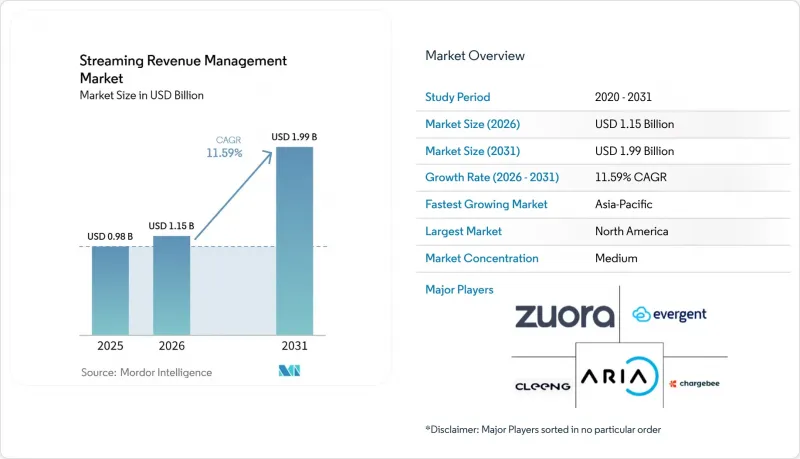
Mordor Intelligence에 의하면, 스트리밍 수익 관리 시장 규모는 2025년에 9억 8,000만 달러로 평가되었고, 2026년 11억 5,000만 달러에서 2031년까지 19억 9,000만 달러에 이를 것으로 예측되며, 2026-2031년 예측 기간 CAGR은 11.59%를 나타낼 전망입니다.
본 보고서는 구성 요소별(소프트웨어, 서비스(구축 및 통합 서비스 등)), 수익 모델별(정기 구독형 과금(SVOD), 기타), 최종 사용자별(미디어 및 엔터테인먼트, BFSI, 소매 및 전자상거래, IT 및 통신, 기타), 배포 방식별(클라우드, 온프레미스, 기타), 지역별로 분류되어 있습니다. 시장 예측은 금액(달러) 기준으로 제시되어 있습니다.
세계의 스트리밍 수익 관리 시장 동향 및 인사이트
광고 지원형 및 하이브리드형 스트리밍 수익화의 확대
광고 지원형 시청은 스트리밍 과금 시스템이 처리해야 하는 거래 방식을 변화시키고 있습니다. Amagi의 보고서에 따르면, 2026년 4월부터 6월까지 전 세계 FAST 시청 시간은 전년 동기 대비 55% 증가했습니다. 플랫폼은 광고 게재 부족분을 계약상 의무와 대조하여, 여러 광고 게재 시스템에 걸쳐 보상 크레딧을 발행해야 합니다. SVOD 및 AVOD 각 요금제를 운영하는 서비스는 서로 다른 거래 상대방과 서로 다른 일정에 따라 정산이 이루어지는 가입자 기록, 컨텐츠 권리, 광고 인벤토리를 관리해야 합니다. 따라서 정기 구독 수익과 광고 수익을 연계한 원장이 필요합니다. 공급업체가 이러한 결제 채널을 단일 보고 및 권리 배분 프로세스로 통합할 수 있다면, 스트리밍 수익 관리 시장은 큰 혜택을 볼 것입니다.
스트리밍 번들의 성장과 파트너 주도형 배포
스트리밍 번들의 등장으로 가입자 확보에 있어 파트너 주도형 배포의 중요성이 커지고 있습니다. 통신사, 광대역 제공업체, 기기 플랫폼, 애그리게이터는 가입자가 스트리밍 서비스를 구매하는 과정에 점점 더 깊이 관여하고 있습니다. 수익 관리 시스템은 컨텐츠 소유자, 플랫폼 운영자, 통신 파트너, 기기 마켓플레이스, 서비스 및 가입자 사이에 위치할 수 있는 기타 이해관계자들 간에 결제를 적절하게 배분해야 합니다. 각 참여자는 컨텐츠 소유자가 구독 수익 분배금을 받기 전에 수수료를 공제할 수 있기 때문에 재무 팀이 정확하게 설명, 검증 및 보고해야 하는 결제 순서가 발생합니다. 또한, 중개업체가 고객과의 청구 관계를 관리하는 경우, 플랫폼 측은 결제 불이행에 대한 직접적인 가시성을 일부 상실하게 됩니다. 스트리밍 수익 관리 시장에서는 확고한 파트너와의 협력이나 자동화된 수익 분배 대조 기능을 제공하는 공급업체에게 비즈니스 기회가 있습니다.
결제 부정, 차지백, 의도파관 않은 해지
결제 실패는 고객이 해지할 의도가 없었더라도 구독을 종료하게 할 가능성이 있으며, 그 결과 수익 손실과 서비스를 이탈하려는 의도적인 결정을 구별하기 어려워집니다. Recurly는 결제 실패로 인해 2025년에는 구독 기반 기업들이 1,290억 달러 이상의 손실을 입을 가능성이 있다고 밝혔습니다. 결제 제공업체는 다양한 결제 처리 업체의 거부 코드를 해석하는 동시에, 정당한 결제 문제가 발생했을 때 추가적인 부정 알림이나 중복 청구, 혹은 고객 경험 저하를 초래하는 재시도 활동을 피해야 합니다. 차지백은 비용 증가로 이어집니다. 결제 네트워크는 가맹점의 클레임 발생률을 모니터링하고 있으며, 그 비율이 높아지면 제한을 가할 가능성이 있기 때문입니다. 재시도 로직을 개선하면 회수율 향상으로 이어지지만, 이는 결제 게이트웨이와 가입자 시스템에서 제공하는 적시 데이터에 의존합니다. 사업자가 결제 데이터를 확실하게 통합하지 못할 경우, 이러한 제약으로 인해 스트리밍 수익 관리 시장에서의 도입이 지연될 수 있습니다.
부문 분석
2025년, 소프트웨어는 스트리밍 수익 관리 시장의 85.90% 점유율을 차지했습니다. 스트리밍 사업자들은 사내에서 완전한 과금 스택을 구축하지 않고도 가입자 관리, 결제 처리, 이용 권한 관리, 수금, 보고서 작성, 수익 인식을 지원할 수 있기 때문에 구성 가능한 소프트웨어를 선호합니다. 이러한 기능을 한 번 도입하면 고객 기록, 결제 라우팅, 프로모션 규칙, 재무 프로세스, 사내 운영 절차가 플랫폼에 의존하게 되므로 해당 플랫폼을 교체하기는 어렵습니다. 기업 내 변경 시에는 신구 시스템을 장기간에 걸쳐 병행 운영해야 할 수도 있습니다.
이 서비스 시장은 2031년까지 연평균 성장률(CAGR) 12.05%를 나타낼 것으로 예측됩니다. 사업자가 수익 모델을 추가하거나, 새로운 상품을 출시하거나, 유통 파트너와 협력하거나, 결제 및 규정 준수 요건이 다른 새로운 국가로 사업을 확장함에 따라 도입, 통합, 관리형 서비스, 자문 업무가 필요해집니다. 결제 경로의 온보딩, 광고 수익 데이터 파이프라인, 파트너와의 연계, 과거 계정 데이터의 마이그레이션, 권한 할당 설정에는 많은 경우 표준 소프트웨어 설정을 넘어서는 작업이 필요합니다. 중규모 플랫폼도 과금 업무를 지속적으로 유지하기 위한 인력이 부족한 경우 매니지드 서비스를 이용하고 있습니다. Evergent는 2026년 4월 ‘Agentic Revenue Orchestration Platform’을 발표하며, 가입자 라이프사이클 워크플로우를 위한 AI 에이전트를 추가했습니다.
2025년 기준, 정기 구독형 과금(SVOD)은 스트리밍 수익 관리 시장의 45.50%를 차지했습니다. 이 점유율은 초기 스트리밍 서비스에서 채택되었던 정기 구독 도구의 도입 실적을 반영한 것으로, 이러한 도구는 직접적인 정기 과금과 표준 접근 권한을 전제로 설계되었습니다. 이 모델은 예측 가능한 정기 수익과 가입자와의 직접적인 관계 구축에 있어 여전히 중요한 역할을 하고 있습니다. 또한, 접근 권한 관리 및 갱신 처리의 기반도 제공합니다.
AVOD 및 FAST를 포함한 광고 지원형 과금은 2031년까지 연평균 성장률(CAGR) 12.22%를 나타낼 것으로 예측됩니다. 이러한 성장을 위해서는 플랫폼이 구독 거래와 병행하여 노출 수, 전송 의무, 대행사 수수료, 광고주의 약정, 캠페인 조정, 크레딧을 대조해야 합니다. 하이브리드형 서비스는 수익원을 하나로 한정하지 않고, SVOD, AVOD, TVOD 프로세스를 동시에 활용하고 있습니다. TVOD와 페이퍼뷰는 스포츠 생중계나 프리미엄 영화 개봉에 있어 여전히 중요한 역할을 하고 있습니다. 스트리밍 수익 관리 시장에서는 이러한 거래를 단일 보고 기간과 단일 재무 기록으로 통합할 수 있는 시스템이 요구되고 있습니다.
지역별 분석
2025년, 북미는 스트리밍 수익 관리 시장의 35.40%를 차지했습니다. 이 지역에는 성숙한 프리미엄 스트리밍 서비스, 광고 기술 제공업체, 결제 처리 업체, 기기 생태계, 파트너와의 배포 관계가 확립되어 있어, 이러한 요소들이 구독 및 광고 결제에 복잡성을 더하고 있습니다. 사업자들은 구독, 광고, 거래, 도매 계약, 프로모션 가격, 기기 및 채널 배포 계약을 동시에 관리하는 경우가 많습니다. 이로 인해 여러 수익원을 대조하고 투명한 고객 해지 절차를 지원하는 시스템에 대한 필요성이 높아지고 있습니다.
아시아태평양은 2031년까지 연평균 성장률(CAGR) 12.06%를 나타낼 것으로 예측됩니다. 인도, 일본, 인도네시아, 중국은 각각 서로 다른 결제 관행, 현지 플랫폼, 데이터 규제를 가지고 있습니다. 카드 사용이 그다지 일반적이지 않은 지역에서는 수익 확보를 위해 현지 결제 수단을 활용하는 것이 필수적입니다. 서비스 제공업체는 시장 전반에 걸쳐 신뢰할 수 있는 그룹 보고 체계를 유지하면서, 현지 결제 방식, 언어, 통화, 고객 서비스 프로세스, 가입자 관리 요건에도 대응해야 합니다. 한 국가에서 효과적인 과금 구조가 다른 국가의 현지 결제, 보고, 데이터 처리 요구 사항을 충족하지 못할 가능성이 있으므로, 이러한 상황으로 인해 스트리밍 수익 관리 시장에서는 지역별 도입 역량이 중요해집니다.
2025년, 유럽은 지역별 기준으로 세 번째로 큰 수익원이 되었으며, 영국과 독일이 스트리밍 가입자 수익의 대부분을 차지했습니다. 이 지역에는 디지털 부가가치세, 전자 청구서, 개인 데이터 취급, 국경 간 거래 보고와 관련하여 엄격한 규제가 있으며, 이는 과금 및 재무 워크플로우 구성에 영향을 미칠 수 있습니다. 표준 SEPA 송금 서비스를 제공하는 결제 사업자는 2025년 10월 이후 동일한 가격으로 ‘SEPA 인스턴트’를 제공해야 할 의무가 있으며, 이로 인해 신속한 결제 확인에 대한 기대가 높아졌습니다. 남미에서는 현지 플랫폼 활동과 Pix를 활용한 구독 결제가 확대됨에 따라 그 중요성이 커지고 있습니다. 중동은 디지털 인프라 투자의 혜택을 받고 있는 반면, 아프리카에서는 카드 사용이 제한된 지역에서 모바일 머니 서비스가 구독 결제를 뒷받침하고 있어 장기적인 기회가 기대되고 있습니다.
기타 혜택
- 엑셀 형식 시장 예측(ME) 시트
- 3개월간의 애널리스트 지원
자주 묻는 질문
목차
제1장 서론
제2장 조사 방법
제3장 주요 요약
제4장 시장 구도
제5장 시장 규모 및 성장 예측
제6장 경쟁 구도
제7장 시장 기회 및 향후 전망
AJY 26.09.03According to Mordor Intelligence, the streaming revenue management market size was valued at USD 0.98 billion in 2025 and is estimated to grow from USD 1.15 billion in 2026 to reach USD 1.99 billion by 2031, at a CAGR of 11.59% during the forecast period 2026-2031.
This report is Segmented by Component (Software, Services [Implementation and Integration Services, and More]), Revenue Model (Recurring Subscription Billing (SVOD), and More), End User (Media and Entertainment, BFSI, Retail and E-Commerce, IT and Telecommunication, and More), Deployment Mode (Cloud, On-Premises, and More), and Geography. The Market Forecasts are Provided in Terms of Value (USD).
Global Streaming Revenue Management Market Trends and Insights
Expansion of Ad-Supported and Hybrid Streaming Monetization
Advertising-supported viewing is changing the transactions that streaming billing systems must handle. Amagi reported 55% year-over-year growth in global FAST viewing hours in the April-June 2026 period. Platforms must reconcile ad-delivery shortfalls against commitments and issue make-good credits across several ad-serving systems. A service operating SVOD and AVOD tiers must manage subscriber records, content rights, and advertising inventory that settle with different counterparties and on different schedules. It therefore needs linked ledgers for recurring subscription revenue and advertising revenue. The Streaming revenue management market benefits when vendors can bring these settlement paths into one reporting and rights-distribution process.
Growth of Streaming Bundles and Partner-Led Distribution
Streaming bundles have made partner distribution more important to subscriber acquisition. Telecommunications operators, broadband providers, device platforms, and aggregators are increasingly involved in how subscribers purchase streaming services. Revenue systems still need to allocate payments among content owners, platform operators, telecommunications partners, device marketplaces, and other participants that may sit between the service and its subscriber. Each participant can apply a fee before the content owner receives its share of subscription revenue, creating a payment sequence that finance teams need to explain, validate, and report accurately. Platforms also lose some direct visibility into payment failures when an intermediary controls the customer billing relationship. The Streaming revenue management market has an opportunity for suppliers that offer established partner connections and automated revenue-share reconciliation.
Payment Fraud, Chargebacks, and Involuntary Churn
Payment failures can end a subscription even when the customer did not intend to cancel, which makes lost revenue harder to distinguish from an intentional decision to leave a service. Recurly stated that failed payments could cost subscription companies more than USD 129 billion in 2025.Billing providers must interpret different processor decline codes while avoiding retry activity that creates further fraud alerts, duplicate charges, or a poor customer experience when a legitimate payment problem occurs. Chargebacks add cost because payment networks monitor merchant dispute levels and can impose restrictions when ratios rise. Better retry logic can improve recovery, but it depends on timely data from payment gateways and subscriber systems. This constraint can slow adoption in the Streaming revenue management market when operators cannot integrate their payment data reliably.
Other drivers and restraints analyzed in the detailed report include:
- Increasing Demand for Global Payment Conversion and Local Payment Rails
- Rights-Aware Revenue Allocation Across Territories and Content Windows
- Legacy Integration and Fragmented Revenue Data
For complete list of drivers and restraints, kindly check the Table Of Contents.
Segment Analysis
Software held 85.90% of the Streaming revenue management market share in 2025. Streaming operators favor configurable software because it can support subscriber management, payment processing, entitlement control, collections, reporting, and revenue recognition without building a full billing stack internally. Once deployed across these functions, a platform is difficult to replace because customer records, payment routing, promotional rules, financial processes, and internal operating procedures depend on it. Enterprise changes can require parallel operation of old and new systems for extended periods.
Services are projected to grow at a 12.05% CAGR through 2031. Implementation, integration, managed services, and advisory work become necessary as operators add revenue models, launch new offers, connect distribution partners, and expand into new countries with different payment and compliance requirements. Payment rail onboarding, advertising-revenue data pipelines, partner connections, migration of historic account data, and rights-allocation configurations often require work beyond standard software settings. Mid-sized platforms also use managed services when they lack teams to maintain billing operations continuously. Evergent introduced its Agentic Revenue Orchestration Platform in April 2026, adding AI agents for subscriber lifecycle workflows.
Recurring subscription billing, or SVOD, accounted for 45.50% of the Streaming revenue management market share in 2025. Its position reflects the installed base of subscription tools used by early streaming services, which were designed around direct recurring charges and standard access entitlements. The model remains important for predictable recurring revenue and direct subscriber relationships. It also provides the foundation for entitlement management and renewal processing.
Advertising-supported billing, including AVOD and FAST, is projected to grow at a 12.22% CAGR through 2031. Its growth requires platforms to reconcile impressions, delivery obligations, agency fees, advertiser commitments, campaign adjustments, and credits alongside subscription transactions. Hybrid offerings use SVOD, AVOD, and TVOD processes at the same time, rather than selecting one route to revenue. TVOD and pay-per-view remain relevant for live sports and premium film releases. The Streaming revenue management industry needs systems that can consolidate these transactions into one reporting period and one financial record.
Complete Report Scope:
- By Component
- Software
- Services
- Implementation and Integration Services
- Managed Services
- Consulting and Advisory Services
- By Revenue Model
- Recurring Subscription Billing (SVOD)
- Transactional Billing (TVOD/PPV)
- Advertising-Supported Billing (AVOD/FAST)
- Hybrid Monetization Billing
- By End User
- Media and Entertainment
- E-Learning and Education
- BFSI
- Retail and E-commerce
- IT and Telecommunication
- Healthcare and Life Sciences
- Government and Public Sector
- Other End Users
- By Deployment Mode
- Cloud
- On-Premises
- Hybrid Cloud
- By Geography
- North America
- United States
- Canada
- Mexico
- South America
- Brazil
- Argentina
- Rest of South America
- Europe
- United Kingdom
- Germany
- France
- Italy
- Spain
- Russia
- Rest of Europe
- Asia-Pacific
- China
- India
- Japan
- South Korea
- Australia
- Southeast Asia
- Rest of Asia-Pacific
- Middle East
- United Arab Emirates
- Saudi Arabia
- Turkey
- Israel
- Rest of Middle East
- Africa
- South Africa
- Nigeria
- Egypt
- Rest of Africa
- North America
Geography Analysis
North America held 35.40% of the Streaming revenue management market share in 2025. The region has a mature set of premium streaming services, advertising technology providers, payment processors, device ecosystems, and partner distribution relationships that add layers to subscription and advertising settlement. Operators often manage subscriptions, advertising, transactions, wholesale arrangements, promotional pricing, and device or channel distribution agreements at the same time. This increases the need for systems that reconcile multiple revenue streams and support transparent customer cancellation processes.
Asia-Pacific is projected to grow at a 12.06% CAGR through 2031. India, Japan, Indonesia, and China each have different payment habits, local platforms, and data rules. Revenue recovery depends on using local payment methods where card use is less common. Providers must also support local settlement, language, currency, customer-service processes, and subscriber-management requirements while maintaining reliable group reporting across markets. These conditions make regional implementation capability important for the Streaming revenue management market, because a billing design that works in one country may not serve local payment, reporting, and data-handling needs in another.
Europe was the third-largest regional contributor in 2025, with the United Kingdom and Germany holding large pools of streaming subscriber revenue. The region has demanding rules for digital value-added tax, electronic invoicing, personal data handling, and cross-border transaction reporting, which can affect the configuration of billing and finance workflows. Payment providers offering standard SEPA transfers were required from October 2025 to offer SEPA Instant at the same price, which increased expectations for rapid payment confirmation. South America is gaining importance as local platform activity and Pix-based subscription payments expand. The Middle East benefits from investment in digital infrastructure, while Africa has a longer-term opportunity as mobile money services support subscription payments where card access is limited.
- Zuora, Inc.
- Evergent, Inc.
- Cleeng B.V.
- Aria Systems, Inc.
- Chargebee, Inc.
- Recurly, Inc.
- Stripe, Inc.
- Salesforce, Inc.
- Oracle Corporation
- SAP SE
- Vindicia, Inc.
- BillingPlatform, Inc.
- Gotransverse, LLC
- Brightcove Inc.
- Kaltura, Inc.
- JW Player
- Amagi Media Labs Pvt. Ltd.
- Rightsline, Inc.
- Synamedia Limited
- Harmonic Inc.
Additional Benefits:
- The market estimate (ME) sheet in Excel format
- 3 months of analyst support
TABLE OF CONTENTS
1 INTRODUCTION
- 1.1 Study Assumptions and Market Definition
- 1.2 Scope of the Study
2 RESEARCH METHODOLOGY
3 EXECUTIVE SUMMARY
4 MARKET LANDSCAPE
- 4.1 Market Overview
- 4.2 Market Drivers
- 4.2.1 Expansion of Ad-Supported and Hybrid Streaming Monetization
- 4.2.2 Growth of Streaming Bundles and Partner-Led Distribution
- 4.2.3 Increasing Demand for Global Payment Conversion and Local Payment Rails
- 4.2.4 Rights-Aware Revenue Allocation Across Territories and Content Windows
- 4.2.5 Live-Event Revenue Volatility and Burst Reconciliation Requirements
- 4.2.6 Privacy-Safe First-Party Measurement Under Signal Loss
- 4.3 Market Restraints
- 4.3.1 Payment Fraud, Chargebacks, and Involuntary Churn
- 4.3.2 Legacy Integration and Fragmented Revenue Data
- 4.3.3 Multi-Party Content-Rights Waterfall Disputes
- 4.3.4 Real-Time Ad-Quality and Make-Good Reconciliation Burden
- 4.4 Industry Value-Chain Analysis
- 4.4.1 Content Owner and Broadcaster Requirements
- 4.4.2 OTT Platform and Video Service Layer
- 4.4.3 Billing Platform and Subscriber Management Layer
- 4.4.4 Payment Gateway, Wallet, and Carrier Billing Layer
- 4.4.5 Tax, Identity, Fraud, and Revenue Recognition Partners
- 4.4.6 Systems Integrators and Managed Service Providers
- 4.5 Regulatory Landscape
- 4.5.1 Auto-Renewal Consent and Click-to-Cancel Requirements
- 4.5.2 Digital Services Tax and Indirect Tax Compliance
- 4.5.3 Payment Data Security and Privacy Requirements
- 4.5.4 E-Invoicing and Revenue Recognition Requirements
- 4.6 Technological Outlook
- 4.6.1 Cloud-Native and API-First Billing Architecture
- 4.6.2 AI-Based Churn Prediction and Payment Retry Optimization
- 4.6.3 Payment Orchestration and Network Tokenization
- 4.6.4 Real-Time Entitlement and Access Control Synchronization
- 4.6.5 Data Fabric, Event Streaming, and Revenue Analytics
- 4.7 Porter's Five Forces Analysis
- 4.7.1 Bargaining Power of Suppliers Analysis
- 4.7.2 Bargaining Power of Buyers Analysis
- 4.7.3 Threat of New Entrants Analysis
- 4.7.4 Threat of Substitutes Analysis
- 4.7.5 Intensity of Competitive Rivalry Analysis
- 4.8 Impact of Macroeconomic Factors on the Market
5 MARKET SIZE AND GROWTH FORECASTS (VALUE)
- 5.1 By Component
- 5.1.1 Software
- 5.1.2 Services
- 5.1.2.1 Implementation and Integration Services
- 5.1.2.2 Managed Services
- 5.1.2.3 Consulting and Advisory Services
- 5.2 By Revenue Model
- 5.2.1 Recurring Subscription Billing (SVOD)
- 5.2.2 Transactional Billing (TVOD/PPV)
- 5.2.3 Advertising-Supported Billing (AVOD/FAST)
- 5.2.4 Hybrid Monetization Billing
- 5.3 By End User
- 5.3.1 Media and Entertainment
- 5.3.2 E-Learning and Education
- 5.3.3 BFSI
- 5.3.4 Retail and E-commerce
- 5.3.5 IT and Telecommunication
- 5.3.6 Healthcare and Life Sciences
- 5.3.7 Government and Public Sector
- 5.3.8 Other End Users
- 5.4 By Deployment Mode
- 5.4.1 Cloud
- 5.4.2 On-Premises
- 5.4.3 Hybrid Cloud
- 5.5 By Geography
- 5.5.1 North America
- 5.5.1.1 United States
- 5.5.1.2 Canada
- 5.5.1.3 Mexico
- 5.5.2 South America
- 5.5.2.1 Brazil
- 5.5.2.2 Argentina
- 5.5.2.3 Rest of South America
- 5.5.3 Europe
- 5.5.3.1 United Kingdom
- 5.5.3.2 Germany
- 5.5.3.3 France
- 5.5.3.4 Italy
- 5.5.3.5 Spain
- 5.5.3.6 Russia
- 5.5.3.7 Rest of Europe
- 5.5.4 Asia-Pacific
- 5.5.4.1 China
- 5.5.4.2 India
- 5.5.4.3 Japan
- 5.5.4.4 South Korea
- 5.5.4.5 Australia
- 5.5.4.6 Southeast Asia
- 5.5.4.7 Rest of Asia-Pacific
- 5.5.5 Middle East
- 5.5.5.1 United Arab Emirates
- 5.5.5.2 Saudi Arabia
- 5.5.5.3 Turkey
- 5.5.5.4 Israel
- 5.5.5.5 Rest of Middle East
- 5.5.6 Africa
- 5.5.6.1 South Africa
- 5.5.6.2 Nigeria
- 5.5.6.3 Egypt
- 5.5.6.4 Rest of Africa
- 5.5.1 North America
6 COMPETITIVE LANDSCAPE
- 6.1 Market Concentration
- 6.2 Strategic Moves
- 6.3 Market Share Analysis
- 6.4 Company Profiles (includes Global Level Overview, Market Level Overview, Core Segments, Financials as available, Strategic Information, Market Rank/Share, Products and Services, Recent Developments)
- 6.4.1 Zuora, Inc.
- 6.4.2 Evergent, Inc.
- 6.4.3 Cleeng B.V.
- 6.4.4 Aria Systems, Inc.
- 6.4.5 Chargebee, Inc.
- 6.4.6 Recurly, Inc.
- 6.4.7 Stripe, Inc.
- 6.4.8 Salesforce, Inc.
- 6.4.9 Oracle Corporation
- 6.4.10 SAP SE
- 6.4.11 Vindicia, Inc.
- 6.4.12 BillingPlatform, Inc.
- 6.4.13 Gotransverse, LLC
- 6.4.14 Brightcove Inc.
- 6.4.15 Kaltura, Inc.
- 6.4.16 JW Player
- 6.4.17 Amagi Media Labs Pvt. Ltd.
- 6.4.18 Rightsline, Inc.
- 6.4.19 Synamedia Limited
- 6.4.20 Harmonic Inc.
7 MARKET OPPORTUNITIES AND FUTURE OUTLOOK
- 7.1 White-Space and Unmet-Need Assessment


