
|
시장보고서
상품코드
2118168
소버린 키 관리 시스템 소프트웨어 시장 : 시장 점유율 분석, 업계 동향 및 통계, 성장 예측(2026-2031년)Sovereign Key Management Systems Software - Market Share Analysis, Industry Trends & Statistics, Growth Forecasts (2026 - 2031) |
||||||
 Mordor Intelligence
Mordor Intelligence에 의하면, 소버린 키 관리 시스템 소프트웨어 시장 규모는 2025년 89억 2,000만 달러로 평가되었고, 2026년 103억 6,000만 달러에서 2031년까지 268억 4,000만 달러로 확대될 것으로 예측되며, 2026-2031년 연평균 복합 성장률(CAGR)은 20.97%를 나타낼 전망입니다.
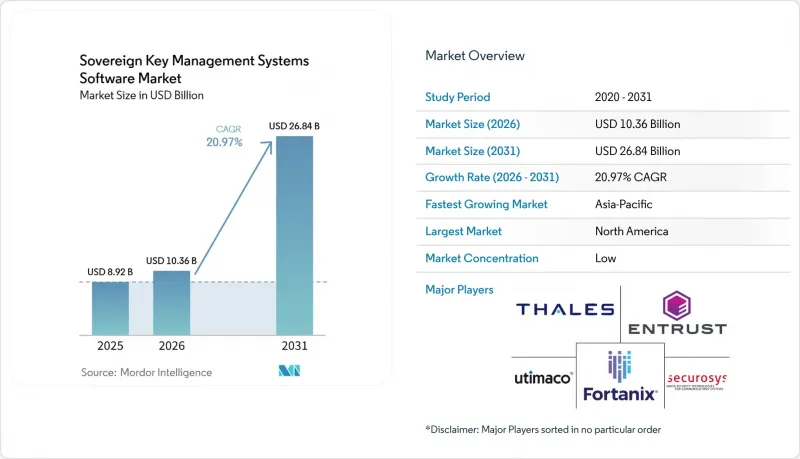
본 보고서는 구성 요소별(소프트웨어 및 서비스), 배포 모델별(클라우드, 하이브리드, 온프레미스), 기업 규모별(대기업 및 중소기업), 최종 사용자별(IT 및 통신, 은행, 금융서비스 및 보험(BFSI), 자동차 및 운송, 헬스케어 및 생명과학, 기타) 및 지역별로 분류되어 있습니다. 시장 전망은 금액(달러) 기준으로 제시되어 있습니다.
세계의 소버린 키 관리 시스템 소프트웨어 시장 동향 및 인사이트
데이터 주권 및 암호화에 관한 규제 요건
프랑스는 2026년 4월, 주권형 클라우드 호스팅 및 키 관리 의무를 국가가 관리하는 기관 및 그 하도급 업체까지 확대했습니다. 이 정령에서는 암호화 키가 EU 역외의 클라우드 제공업체 관리 하에 놓이지 않도록 요구하고 있습니다. 또한, 프랑스의 국가 사이버 보안 전략에서는 데이터 수명 주기 전반에 걸쳐 암호화 기술의 국내 관리를 유지하기 위한 투자도 약속하고 있습니다. ANSSI는 2026년 3월에 암호화 규정 버전 3.00을 발표하여, NIS2의 규제 대상이 되는 프랑스 사업체에 기술적 준수 기준을 제시했습니다. 이러한 조치로 인해 소버린 키 관리 시스템 소프트웨어 시장에서 공공 부문 및 중요 인프라 관련 계약을 목표로 하는 벤더들에게 주권 관리 능력은 실질적인 요건이 되었습니다. 프랑스의 SecNumCloud 프레임워크와 독일의 C5 및 C3A 요건 또한 ‘Hold Your Own Key(키 자체 관리)’를 실천하지 않거나 외부 키 관리 능력을 갖추지 못한 공급업체에게 시장 진입 장벽이 되고 있습니다. 이는 공급업체가 조달 프로세스에 참여하기 전에 자격 증명, 법적 관할권, 운영 통제, 그리고 클라우드 공급업체와 고객의 키 환경 간의 분리 여부에 대해 모두 심사를 받을 가능성이 있기 때문입니다.
데이터 유출로 인한 비용 증가와 경영진 차원의 영향
IBM 보고서에 따르면, 2025년 미국의 데이터 침해 평균 비용은 1,022만 달러에 달한 반면, 세계 평균은 444만 달러였습니다. 해당 보고서에서는 세계 평균이 낮은 이유로 AI 도구를 활용한 신속한 차단 조치를 꼽고 있습니다. 인터넷 기반 AI 도구의 무단 사용으로 인해 데이터 침해의 전 세계 평균 비용은 67만 달러 증가했습니다. 침해 감지 및 차단에 소요되는 평균 일수는 241일로 단축되었으나, AI 관련 침해를 보고한 조직의 97%에서는 적절한 AI 접근 제어가 부재했습니다. 이러한 조사 결과는 소버린 키 관리 시스템 소프트웨어 시장에서 접근 거버넌스와 키 관리가 감지와 마찬가지로 이사회 차원의 우선순위임을 보여줍니다. 규제 집행이 엄격한 관할 구역에서는 비용이 높아지므로, 특히 이사회는 개별 보안 조치에 드는 비용과 사고 발생 시의 잠재적 비용,통지 의무, 고객에 미치는 영향, 법적 위험, 그리고 장기화되는 복구 작업 비용을 비교 검토해야 하는 경우, 키 거버넌스에 대한 투자는 단순한 규정 준수 비용으로 취급하는 것보다 정당화하기 더 쉬워집니다.
키 관리 생태계 간의 상호 운용성 한계
‘소버린 키 관리 시스템 소프트웨어 시장’의 기업 팀은 여러 클라우드 제공업체나 온프레미스형 하드웨어를 이용할 때, 호환되지 않는 용도 인터페이스, 키 형식, 감사 로그에 직면하는 경우가 많습니다. ‘키 관리 상호 운용성 프로토콜(KMIP)’은 표준 기반의 대안을 제공하지만, 그 채택 현황은 구형 및 신형 플랫폼 간에 여전히 편차가 있습니다. 여러 독자적인 시스템을 보유한 조직의 경우, 맞춤형 통합 계층이 필요할 수 있으며, 이로 인해 운영 비용과 감사 위험이 증가할 가능성이 있습니다. 이와 같은 분산화로 인해 각 환경에서 개별적인 키 로테이션 및 마이그레이션 작업이 필요하게 되어, 양자 이후 알고리즘으로의 전환이 복잡해지고 있습니다. 또한, 보호된 데이터를 이동할 때 새로운 키를 사용하여 재암호화가 필요할 수 있으므로, 키 보관 계층에서 락인 현상이 발생할 가능성도 있습니다. 이러한 제약으로 인해 소버린 키 관리 시스템 소프트웨어 시장의 광범위한 도입이 지연될 우려가 있습니다. 특히, 대규모의 분산된 데이터 자산을 보유한 조직의 경우, 사업 부문별로 서로 다른 공급자를 이용하거나, 서로 다른 용도를 지원하거나, 서로 다른 감사 기록을 보관하고 있는 경우가 있어, 키 소유권이나 암호화 정책 변경을 조정할 단일 책임 팀이 존재하지 않기 때문에 이러한 경향이 두드러집니다.
부문 분석
2025년, 소프트웨어는 소버린 키 관리 시스템 소프트웨어 시장에서 72.41%의 점유율을 차지했습니다. 이러한 위상은 CI/CD 파이프라인, 쿠버네티스(Kubernetes) 환경 및 서버리스 워크로드 전반에 걸쳐 암호화 정책을 코드로 표현해야 할 필요성을 반영합니다. 엔터프라이즈 키 관리 소프트웨어, 클라우드 키 관리 및 KMaaS, 하드웨어 보안 모듈(HSM) 관리 소프트웨어, 시크릿 및 인증서 수명 주기 관리 소프트웨어, 그리고 암호화 포지션 관리 소프트웨어가 주요 제품 카테고리를 구성합니다. 암호 포지션 관리는 조직이 혼합 환경 전반에 걸쳐 키 자산을 식별하는 데 도움이 됩니다. 이러한 가시성은 포스트 양자 환경으로의 전환 계획을 수립하는 데 실질적인 출발점이 됩니다. 2026년 3월, Fortanix는 Qrypt 및 Quantum Dice와의 파트너십을 통해 Data Security Manager에 다중 소스 양자 엔트로피 기능을 추가했습니다. 이러한 전개는 양자 내성이 엔트로피 계층 및 키 라이프사이클까지 확장되고 있음을 보여줍니다. 엔트로피 소스, 생성된 키, 저장된 키, 로테이션 규칙, 감사 증거 등 모든 요소가 도입 환경이 규제 대상 고객이 정한 보증 요건을 충족하는지 여부에 영향을 미칠 수 있기 때문입니다.
서비스 시장은 2026-2031년 연평균 성장률(CAGR) 22.84%로 확대될 것으로 예측됩니다. ‘주권형 키 관리 시스템 소프트웨어’ 서비스 시장 규모는 전문 암호화 기술자 부족을 호재로 삼고 있습니다. 키 로테이션 일정, 감사 로그 검증, 포스트 양자 평가에는 외부 지원이 필요한 사례가 늘고 있습니다. ‘클라우드 퍼스트’ 시대에 키 관리 모범 사례를 확립한 조직은 현재 ‘자체 키 보유(Hold Your Own Key)’ 도입과 관련하여 더욱 엄격한 요건에 직면하고 있습니다. 자문, 통합 및 관리형 운영을 통해 사내에서 이러한 기능을 유지하는 부담을 줄일 수 있습니다. 또한 서비스 제공업체는 규제 당국 및 감사인을 위한 통제 조치의 문서화 과정에서 고객을 지원할 수도 있습니다. 이를 통해 특히 감사 증거, 키 소유권 기록, 직무 분리 및 문서화된 로테이션 절차를 여러 관할 구역이나 사업 부문에 걸쳐 유지해야 하는 경우 등, 기존 하드웨어나 소프트웨어를 교체하지 않고도 지원이 필요한 조직에게 성장 기회가 생깁니다.
2025년 매출 중 클라우드 배포가 68.19%를 차지했습니다. 클라우드 네이티브 솔루션은 관리형 및 고객 관리형 키 옵션을 통해 제공업체의 인프라와 쉽게 통합됩니다. 그 규모와 도입 용이성 덕분에 기업의 전체 워크로드에 걸쳐 널리 채택되고 있습니다. 그러나 클라우드 전용 설계는 키 자산을 제공업체의 접근 범위 밖에서 보관해야 한다는 요건과 상충될 수 있습니다. 정부, 국방, 금융 기관에서는 물리적 및 법적 관리가 필수적인 경우, 여전히 온프레미스 하드웨어 보안 모듈(HSM)이 사용되고 있습니다. 따라서 클라우드 도입은 중요하지만, 규제 대상인 모든 워크로드에 대해 충분하다고 할 수는 없습니다. ‘소버린 키 관리 시스템 소프트웨어 시장’에서는 클라우드 운영과 보다 엄격한 보관 요건을 조화시키는 모델이 계속해서 요구되고 있습니다. 특히, 컴플라이언스 팀이 누가 키 사용을 승인할 수 있는지, 루트 키가 어디에 보관되어 있는지, 그리고 인프라 제공업체가 일상적인 서비스 운영 중에 이에 접근할 수 있는지 여부를 입증해야 하는 경우, 그 필요성은 더욱 커집니다.
하이브리드 배포는 2026-2031년 연평균 성장률(CAGR) 21.63%로 확대될 것으로 예측됩니다. 이 방식에서는 라이프사이클 관리 업무에 클라우드 기반 애플리케이션 인터페이스를 활용하면서도 루트 키를 온프레미스 하드웨어 보안 모듈에 보관합니다. 이러한 설계를 통해 클라우드 규모의 운영을 희생하지 않으면서도 데이터 보관 요건을 충족할 수 있습니다. Utimaco가 인용한 LSEG의 데이터에 따르면, 2025년에도 금융 서비스 기업의 44%가 기밀 데이터의 보관처로 프라이빗 클라우드를 여전히 우선시하고 있었습니다. 따라서 하이브리드 활용 형태는 신뢰할 수 있는 로컬 인프라와 더 광범위한 클라우드 연결성을 필요로 하는 기관에 적합합니다. Fortanix는 하이브리드 키 관리를 통합된 가시성과 일관된 정책 적용이 필요한 엔터프라이즈 표준이라고 설명합니다. 이 모델은 주권 요구 사항과 운영상의 편의성 사이에 존재하는 현실적인 격차를 해소하며, 팀이 법적으로 관리되는 신뢰의 근원을 유지하면서 용도 수준 암호화, 키 로테이션, 액세스 승인 및 보고서를 위해 클라우드 인터페이스를 활용할 수 있도록 합니다.
지역별 분석
2025년, 북미는 소버린 키 관리 시스템 소프트웨어 시장 점유율의 34.62%를 차지했습니다. 미국의 연방 요구 사항, 클라우드 제공업체의 집중, 그리고 대규모 BFSI 부문이 이 지역 수요를 뒷받침했습니다. 2026년 6월 행정관리예산국(OMB)의 각서에서는 연방 기관에 120일 이내에 포스트 양자암호화로의 전환 계획을 제출할 것을 요구하고 있으며, 이에 따라기존 키와 포스트 양자 키를 통합 관리하고, 키 이력을 저장하며, 인증서 변경을 조정하고, 워크로드 간 정책 분리를 유지하며, 연방 팀이 기관, 용도, 데이터 분류 및 공유 서비스 환경 전반에 걸친 진행 상황을 평가할 수 있도록 문서화된 근거를 제공하는 플랫폼에 대한 단기적인 수요가 발생하고 있습니다. 북미에서는 캐나다와 멕시코가 미국을 보완하는 한편, 브라질, 아르헨티나 및 기타 남미 국가들은 더 초기 단계에 있으며, 디지털 뱅킹, 현지화 규정, 새로운 클라우드 인프라가 수요를 주도하고 있습니다.
유럽은 데이터 주권과 관련하여 가장 규범적인 지역 프레임워크를 갖추고 있으며, GDPR(EU 개인정보보호규정) 제44조, NIS2, SecNumCloud, 그리고 독일의 C5 및 C3A 요건이 공공 부문 공급업체에 대한 기술적 요건을 형성하고 있습니다. 2026년 5월, 탈레스(Thales)와 구글 클라우드(Google Cloud)는 C5 및 새로 제정되고 있는 C3A 요건을 충족하도록 설계된 독일용 주권 클라우드 서비스를 발표했습니다. 독일의 금융 기관들은 국내 NIS2 시행에 따라 2026년 4월의 등록 마감 기한을 맞이했습니다. 한편, 프랑스는 같은 달 제2026-272호 정령을 공포하고, 규제 명확화에 따라 조달을 가속화했습니다. 영국, 스페인, 러시아 및 기타 유럽 국가들은 독일과 프랑스에 이어 두 번째 그룹을 형성하고 있으며, 영국 수요는 암호화 관련 지침과 브렉시트 이후의 데이터 적정성 관련 고려 사항에 의해 형성되고 있습니다.
아시아태평양은 2026-2031년 연평균 성장률(CAGR) 22.91%를 나타낼 것으로 예측됩니다. 일본의 소버린 클라우드 프로그램, 인도의 ‘디지털 개인 데이터 보호법’ 시행, 그리고 한국과 싱가포르의 공식적인 포스트 양자암호화 지침이 이러한 전망을 뒷받침하고 있습니다. KDDI는 2025년 7월, Google Cloud용 ‘암호 키 관리 서비스’를 시작하여 일본 내 조직을 대상으로 Google Cloud 인프라와 별도로 일본 국내에서 키를 보관하도록 했습니다. NTT 데이터는 2026년 4월 일본 국내에서 양자 내성 서비스의 시범 운영을 시작하여, 2026년 10월 상용화를 예정하고 있습니다. 중국, 일본, 인도, 한국, 동남아시아 및 기타 아시아태평양에서는 현지화 요건의 정비에 따라 잠재적인 수요가 예상됩니다. 한편, 중동 및 아프리카에는 사우디아라비아, 아랍에미리트, 기타 중동 국가, 남아프리카공화국, 나이지리아 및 기타 아프리카 국가들이 포함됩니다.
기타 혜택 :
- 엑셀 형식 시장 예측(ME) 시트
- 3개월간의 애널리스트 지원
자주 묻는 질문
목차
제1장 서론
제2장 조사 방법
제3장 주요 요약
제4장 시장 구도
제5장 시장 규모 및 성장 예측
제6장 경쟁 구도
제7장 시장 기회 및 향후 전망
AJY 26.09.03According to Mordor Intelligence, the sovereign key management systems software market size is projected to expand from USD 8.92 billion in 2025 and USD 10.36 billion in 2026 to USD 26.84 billion by 2031, registering a CAGR of 20.97% between 2026 and 2031.
This report is Segmented by Component (Software, and Services), Deployment Model (Cloud, Hybrid, and On-Premises), Enterprise Size (Large Enterprises, and Small and Medium-Sized Enterprises), End User (IT and Telecommunication, BFSI, Automotive and Transportation, Healthcare and Life Sciences, and More), and Geography. The Market Forecasts are Provided in Terms of Value (USD).
Global Sovereign Key Management Systems Software Market Trends and Insights
Regulatory Mandates for Data Sovereignty and Encryption
France extended sovereign cloud hosting and key management obligations in April 2026 to state-administered groupings and their subcontractors. The decree requires encryption keys to remain outside the control of non-EU cloud providers. France's national cybersecurity strategy also committed investment to retain domestic control of cryptographic technologies across the data lifecycle. ANSSI issued version 3.00 of its cryptographic rules in March 2026, giving NIS2-regulated French entities a technical compliance baseline. These measures make sovereignty capabilities a practical requirement for vendors seeking public-sector and critical-infrastructure contracts in the Sovereign Key Management Systems Software Market. France's SecNumCloud framework and Germany's C5 and C3A requirements also create market-access barriers for providers without Hold Your Own Key or external key management capabilities, because qualification evidence, legal jurisdiction, operational controls, and the separation between a cloud provider and a customer key environment can all be examined before a supplier enters a procurement process.
Rising Cost and Board-Level Impact of Data Breaches
IBM reported that the average cost of a data breach in the United States reached USD 10.22 million in 2025, while the global average was USD 4.44 million. The report linked the lower global average to faster containment supported by AI tools. Unapproved use of internet-based AI tools added USD 670,000 to the global average cost of a breach. The mean time to identify and contain a breach fell to 241 days, yet 97% of organizations reporting AI-related breaches lacked proper AI access controls. These findings place access governance and key control alongside detection as board-level priorities for the Sovereign Key Management Systems Software Market. Higher costs in jurisdictions with stronger regulatory enforcement can make investment in key governance more defensible than treating it as a narrow compliance expense, particularly when a board must weigh the cost of an isolated security control against the potential cost of a breach, notification obligations, customer disruption, legal exposure, and prolonged recovery work.
Limited Interoperability Across Key Management Ecosystems
Enterprise teams in the Sovereign Key Management Systems Software Market often encounter incompatible application interfaces, key formats, and audit logs when using multiple cloud providers and on-premises hardware. The Key Management Interoperability Protocol provides a standards-based option, but its adoption remains uneven across older and newer platforms. Organizations with several proprietary systems may need custom integration layers, which add operating cost and audit risk. The same fragmentation complicates a move to post-quantum algorithms because each environment needs separate rotation and migration work. It can also create lock-in at the key-custody layer, because moving protected data can require re-encryption with new keys. This constraint can delay broader deployment in the Sovereign Key Management Systems Software Market, especially for organizations with large, dispersed data estates, where separate business units may use different providers, support different applications, retain different audit records, and lack a single accountable team to coordinate changes to key ownership and encryption policy.
Other drivers and restraints analyzed in the detailed report include:
- Hybrid and Multicloud Expansion
- Post-Quantum Cryptography Readiness Programs
- Shortage of Cryptographic Engineering and Key Governance Skills
For complete list of drivers and restraints, kindly check the Table Of Contents.
Segment Analysis
Software held 72.41% of the Sovereign Key Management Systems Software Market share in 2025. Its position reflects the need to express cryptographic policy as code across CI/CD pipelines, Kubernetes environments, and serverless workloads. Enterprise key management software, cloud key management and KMaaS, hardware security module management software, secrets and certificate lifecycle management software, and cryptographic posture management software form the principal product categories. Cryptographic posture management helps organizations discover key material across mixed environments. That visibility is a practical starting point for a post-quantum migration plan. In March 2026, Fortanix added multi-sourced quantum entropy to its Data Security Manager through partnerships with Qrypt and Quantum Dice. The development shows that quantum resilience is reaching the entropy layer and the key lifecycle, as entropy sources, generated keys, stored keys, rotation rules, and audit evidence can all influence whether a deployment meets a regulated customer's stated assurance requirements.
Services are projected to expand at a 22.84% CAGR from 2026 to 2031. The Sovereign Key Management Systems Software Market size for services benefits from the shortage of specialized cryptographic staff. Key rotation scheduling, audit log verification, and post-quantum assessments increasingly require external assistance. Organizations that built key practices during the cloud-first period now face more demanding requirements for Hold Your Own Key deployments. Advisory, integration, and managed operations can reduce the burden of maintaining those capabilities in-house. Service providers can also help clients document controls for regulators and auditors. This creates growth opportunities where organizations need support without replacing existing hardware or software, especially where audit evidence, key ownership records, separation of duties, and documented rotation procedures must be maintained across several jurisdictions and business units.
Cloud deployment accounted for 68.19% of 2025 revenue. Cloud-native offerings integrate readily with provider infrastructure through managed and customer-managed key options. Their scale and ease of deployment have supported widespread adoption across enterprise workloads. However, cloud-only designs can conflict with requirements that key material remain outside a provider's access perimeter. Government, defense, and financial institutions continue to use on-premises hardware security modules when physical and legal control is essential. This leaves cloud deployments important but insufficient for every regulated workload. The Sovereign Key Management Systems Software Market continues to require models that align cloud operations with stricter custody requirements, particularly where compliance teams need to demonstrate who can authorize use of a key, where the root material is stored, and whether an infrastructure provider can gain access during routine service operations.
Hybrid deployment is projected to expand at a 21.63% CAGR from 2026 to 2031. It keeps root keys in an on-premises hardware security module while using cloud-based application interfaces for lifecycle activities. This design can meet residency requirements without giving up cloud-scale operations. In 2025, 44% of financial services firms still prioritized private cloud for sensitive data, according to LSEG data cited by Utimaco. Hybrid use, therefore, fits institutions that need a trusted local anchor and broader cloud connectivity. Fortanix described hybrid key management as an enterprise standard that requires unified visibility and consistent policy enforcement. The model addresses a practical divide between sovereignty needs and operational convenience, allowing teams to retain a legally controlled root of trust while using cloud interfaces for application-level encryption, key rotation, access approval, and reporting.
Complete Report Scope:
- By Component
- Software
- Enterprise Key Management Software
- Cloud Key Management and KMaaS
- Hardware Security Module (HSM) Management Software
- Secrets and Certificate Lifecycle Management Software
- Cryptographic Posture Management Software
- Other Softwares
- Services
- Software
- By Deployment Model
- Cloud
- Hybrid
- On-Premises
- By Enterprise Size
- Large Enterprises
- Small and Medium-Sized Enterprises
- By End-User
- IT and Telecommunication
- BFSI
- Automotive and Transportation
- Healthcare and Life Sciences
- Retail and E-Commerce
- Industrial Manufacturing
- Other End Users
- By Geography
- North America
- United States
- Canada
- Mexico
- South America
- Brazil
- Argentina
- Rest of South America
- Europe
- Germany
- United Kingdom
- France
- Russia
- Spain
- Rest of Europe
- Asia-Pacific
- China
- Japan
- India
- South Korea
- Southeast Asia
- Rest of Asia-Pacific
- Middle East and Africa
- Middle East
- Saudi Arabia
- United Arab Emirates
- Rest of Middle East
- Africa
- South Africa
- Nigeria
- Rest of Africa
- Middle East
- North America
Geography Analysis
North America held 34.62% of the Sovereign Key Management Systems Software Market share in 2025. United States federal requirements, a concentration of cloud providers, and a large BFSI sector supported regional demand. The June 2026 Office of Management and Budget memorandum requires federal agencies to submit post-quantum migration plans within 120 days, creating near-term demand for platforms that manage classical and post-quantum keys together, preserve key history, coordinate certificate changes, maintain policy separation between workloads, and give federal teams a documented basis for assessing progress across agencies, applications, data classifications, and shared service environments. Canada and Mexico complement the United States in North America, while Brazil, Argentina, and the rest of South America are at an earlier stage, where digital banking, localization rules, and new cloud infrastructure are driving demand.
Europe has the most prescriptive regional framework for data sovereignty, with GDPR Article 44, NIS2, SecNumCloud, and Germany's C5 and C3A requirements shaping technical expectations for public-sector suppliers. In May 2026, Thales and Google Cloud announced a sovereign cloud offering in Germany designed to meet C5 and emerging C3A requirements. German financial entities faced an April 2026 registration deadline under national NIS2 implementation, while France published Decree n° 2026-272 that month and accelerated procurement after regulatory clarification. The United Kingdom, Spain, Russia, and the rest of Europe form a secondary tier alongside Germany and France, with UK demand shaped by cryptographic guidance and post-Brexit data adequacy considerations.
Asia-Pacific is projected to expand at a 22.91% CAGR from 2026 to 2031. Japan's sovereign cloud programs, India's enforcement of the Digital Personal Data Protection Act, and formal post-quantum guidance in South Korea and Singapore support this outlook. KDDI launched its Encryption Key Management Service for Google Cloud in July 2025, separating domestic key custody from Google Cloud infrastructure for Japanese organizations. NTT Data began trial availability of a quantum-resistant domestic service in Japan in April 2026, with commercial availability planned for October 2026. China, Japan, India, South Korea, Southeast Asia, and the rest of Asia-Pacific add potential demand as localization requirements develop, while the Middle East and Africa include Saudi Arabia, the United Arab Emirates, the rest of the Middle East, South Africa, Nigeria, and the rest of Africa.
- Thales S.A.
- Entrust Corporation
- Fortanix, Inc.
- Utimaco IS GmbH
- Securosys SA
- Keyfactor, Inc.
- WinMagic Corp.
- DuoKey SA
- Akeyless Security Ltd.
- Cryptomathic A/S
- Sepior ApS
- Unbound Security Ltd.
- Townsend Security Corporation
- SSH Communications Security Corporation
- Kryptus Seguranca da Informacao S.A.
- Atakama, Inc.
- Virgil Security, Inc.
- Voltage Security, Inc.
- eperi GmbH
- Cosmian SAS
Additional Benefits:
- The market estimate (ME) sheet in Excel format
- 3 months of analyst support
TABLE OF CONTENTS
1 INTRODUCTION
- 1.1 Study Assumptions and Market Definition
- 1.2 Scope of the Study
2 RESEARCH METHODOLOGY
3 EXECUTIVE SUMMARY
4 MARKET LANDSCAPE
- 4.1 Market Overview
- 4.2 Market Drivers
- 4.2.1 Regulatory Mandates for Data Sovereignty and Encryption
- 4.2.2 Hybrid and Multicloud Expansion
- 4.2.3 Rising Cost and Board-Level Impact of Data Breaches
- 4.2.4 Post-Quantum Cryptography Readiness Programs
- 4.2.5 Sovereign Control Requirements for AI and Confidential Computing Workloads
- 4.2.6 Cryptographic Control Requirements for Cross-Border SaaS and Digital Infrastructure
- 4.3 Market Restraints
- 4.3.1 Limited Interoperability Across Key Management Ecosystems
- 4.3.2 Shortage of Cryptographic Engineering and Key Governance Skills
- 4.3.3 Sovereignty Versus Cloud Convenience Trade-Offs
- 4.3.4 Operational Complexity of Sovereign Kill-Switches and Multi-Party Control
- 4.4 Impact of Macroeconomic Factors on the Market
- 4.5 Industry Value-Chain Analysis
- 4.6 Technology Outlook
- 4.7 Regulatory Landscape
- 4.8 Porter's Five Forces Analysis
- 4.8.1 Threat of New Entrants
- 4.8.2 Bargaining Power of Suppliers
- 4.8.3 Bargaining Power of Buyers
- 4.8.4 Threat of Substitutes
- 4.8.5 Intensity of Competitive Rivalry
5 MARKET SIZE AND GROWTH FORECASTS (VALUE)
- 5.1 By Component
- 5.1.1 Software
- 5.1.1.1 Enterprise Key Management Software
- 5.1.1.2 Cloud Key Management and KMaaS
- 5.1.1.3 Hardware Security Module (HSM) Management Software
- 5.1.1.4 Secrets and Certificate Lifecycle Management Software
- 5.1.1.5 Cryptographic Posture Management Software
- 5.1.1.6 Other Softwares
- 5.1.2 Services
- 5.1.1 Software
- 5.2 By Deployment Model
- 5.2.1 Cloud
- 5.2.2 Hybrid
- 5.2.3 On-Premises
- 5.3 By Enterprise Size
- 5.3.1 Large Enterprises
- 5.3.2 Small and Medium-Sized Enterprises
- 5.4 By End-User
- 5.4.1 IT and Telecommunication
- 5.4.2 BFSI
- 5.4.3 Automotive and Transportation
- 5.4.4 Healthcare and Life Sciences
- 5.4.5 Retail and E-Commerce
- 5.4.6 Industrial Manufacturing
- 5.4.7 Other End Users
- 5.5 By Geography
- 5.5.1 North America
- 5.5.1.1 United States
- 5.5.1.2 Canada
- 5.5.1.3 Mexico
- 5.5.2 South America
- 5.5.2.1 Brazil
- 5.5.2.2 Argentina
- 5.5.2.3 Rest of South America
- 5.5.3 Europe
- 5.5.3.1 Germany
- 5.5.3.2 United Kingdom
- 5.5.3.3 France
- 5.5.3.4 Russia
- 5.5.3.5 Spain
- 5.5.3.6 Rest of Europe
- 5.5.4 Asia-Pacific
- 5.5.4.1 China
- 5.5.4.2 Japan
- 5.5.4.3 India
- 5.5.4.4 South Korea
- 5.5.4.5 Southeast Asia
- 5.5.4.6 Rest of Asia-Pacific
- 5.5.5 Middle East and Africa
- 5.5.5.1 Middle East
- 5.5.5.1.1 Saudi Arabia
- 5.5.5.1.2 United Arab Emirates
- 5.5.5.1.3 Rest of Middle East
- 5.5.5.2 Africa
- 5.5.5.2.1 South Africa
- 5.5.5.2.2 Nigeria
- 5.5.5.2.3 Rest of Africa
- 5.5.5.1 Middle East
- 5.5.1 North America
6 COMPETITIVE LANDSCAPE
- 6.1 Market Concentration
- 6.2 Strategic Moves
- 6.3 Market Share Analysis
- 6.4 Company Profiles (includes Global Level Overview, Market Level Overview, Core Segments, Financials as available, Strategic Information, Market Rank/Share, Products and Services, Recent Developments)
- 6.4.1 Thales S.A.
- 6.4.2 Entrust Corporation
- 6.4.3 Fortanix, Inc.
- 6.4.4 Utimaco IS GmbH
- 6.4.5 Securosys SA
- 6.4.6 Keyfactor, Inc.
- 6.4.7 WinMagic Corp.
- 6.4.8 DuoKey SA
- 6.4.9 Akeyless Security Ltd.
- 6.4.10 Cryptomathic A/S
- 6.4.11 Sepior ApS
- 6.4.12 Unbound Security Ltd.
- 6.4.13 Townsend Security Corporation
- 6.4.14 SSH Communications Security Corporation
- 6.4.15 Kryptus Seguranca da Informacao S.A.
- 6.4.16 Atakama, Inc.
- 6.4.17 Virgil Security, Inc.
- 6.4.18 Voltage Security, Inc.
- 6.4.19 eperi GmbH
- 6.4.20 Cosmian SAS
7 MARKET OPPORTUNITIES AND FUTURE OUTLOOK
- 7.1 White-Space and Unmet-Need Assessment