
|
시장보고서
상품코드
2123466
기업 키 관리(EKM) 시장 : 점유율 분석, 업계 동향과 통계, 성장 예측(2026-2031년)Enterprise Key Management (EKM) - Market Share Analysis, Industry Trends & Statistics, Growth Forecasts (2026 - 2031) |
||||||
 Mordor Intelligence
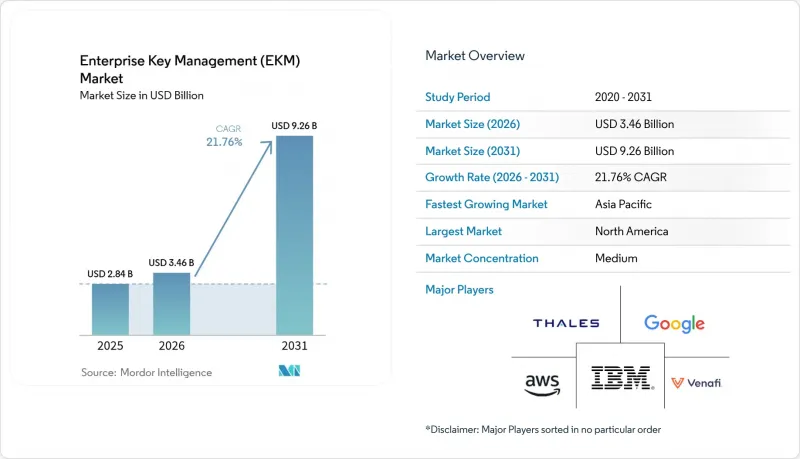
Mordor Intelligence에 의하면, 기업 키 관리(EKM) 시장 규모는 2025년 28억 4,000만 달러에서 2026년에는 34억 6,000만 달러로 확대되어 2026년부터 2031년까지 CAGR 21.76%로 성장하여 2031년에는 92억 6,000만 달러에 이를 것으로 예측됩니다.
본 보고서는 배포 방식(클라우드 및 On-Premise), 기업 규모(중소기업 및 대기업), 용도(디스크 암호화, 파일 및 폴더 암호화 등), 최종 사용자 산업(은행, 금융서비스 및 보험(BFSI), 의료, 정부·국방, IT 및 통신, 소매, 기타 최종 사용자 업종) 및 지역별로 분류되어 있습니다. 시장 예측은 금액(달러) 기준으로 제시되어 있습니다.
세계 기업 키 관리(EKM) 시장 동향 및 인사이트
산업 전반에 걸쳐 강화되는 데이터 암호화 관련 규제 요건
현재 전 세계 규제 당국은 암호화를 단순한 기능 강화가 아닌 기본적인 관리 조치로 간주하고 있습니다. 2024년, 유럽 데이터 보호 위원회(EDPB)는 총 16억 달러의 벌금을 부과했는데, 그 중 43%는 불충분한 암호화 관리가 이유로 꼽혔습니다. 이와 더불어, HIPAA 클라우드 지침의 업데이트와 입증 가능한 키 분리를 요구하는 PCI-DSS 및 SOX와 같은 중복된 금융 규제에서도 압박이 가해지고 있습니다. 따라서 다국적 기업들은 지역별로 상이한 법규 하에서 통일된 키 거버넌스를 구축해야 하며, 단일 제어 스택을 여러 감사 프레임워크에 매핑할 수 있는 플랫폼에 대한 수요가 가속화되고 있습니다. 주요 계약업체들이 조달 계약에 암호화 조항을 포함함에 따라 소규모 공급업체들도 이에 연루되고 있으며, 이로 인해 총 구매층이 확대되고 시장의 모멘텀이 더욱 강화되고 있습니다.
클라우드 및 IoT 워크로드로 인한 데이터의 폭발적인 증가
2024년, 기업의 데이터 양은 전년 대비 47% 증가했으며, 그중에서도 IoT 및 엣지 배포에서 발생하는 비정형 센서 출력에 의한 증가가 가장 급격했습니다. 이러한 규모에서는 어플라이언스 기반의 키 저장소는 실용적이지 않습니다. 수백만 대의 디바이스가 간헐적인 연결 환경에서도 저지연으로 인증 정보를 순환시켜야 하기 때문입니다. 현재 매일 테라바이트 규모의 텔레메트리 데이터를 수집하는 제조 공장이나 원격 환자 모니터링 시스템을 도입한 의료 시스템은 이 과제의 시급성을 여실히 보여주고 있습니다. 클라우드 네이티브 키 관리 서비스는 API 기반 확장성을 통해 이러한 부하를 처리하며, 마이크로서비스가 수동 개입 없이 컨테이너 인스턴스별로 단기 유효한 키를 생성할 수 있도록 합니다. 마이크로 세분화이 표준화됨에 따라, 이러한 서비스는 현대적인 DevSecOps 워크플로우에 필수적인 기반으로 부상하고 있습니다.
키 관리 솔루션 간의 상호 운용성 기준 부족
PKCS#11 및 KMIP가 존재하지만, 이들은 클라우드 네이티브 패턴이나 포스트 양자 알고리즘에는 부적합한 기본 기능만 다루고 있습니다. 독자적인 사양의 인터페이스는 기업을 단일 벤더의 스택에 묶어두어 마이그레이션 전략과 멀티 클라우드 배포를 복잡하게 만듭니다. 프로바이더 간 HSM에서 키를 마이그레이션할 때는 데이터 재암호화가 필요한 경우가 많으며, 이는 민첩성을 저해하고 총 소유 비용을 높이는 운영상의 장벽이 됩니다. 그 결과, 상호 운용성의 격차가 대규모 도입을 지연시키고 있으며, 조달 팀은 다년 계약을 체결하기 전에 개방형 표준에 기반한 로드맵을 요구하고 있습니다.
부문 분석
클라우드 배포는 2025년 매출의 62.54%를 차지하며, 기업 키 관리 시장의 핵심 부문으로서의 입지를 공고히 했습니다. 구매자들이 하드웨어 교체 주기보다 알고리즘의 민첩성과 유연한 확장을 더 중요하게 생각하기 때문에 이 부문은 2031년까지 연평균 성장률(CAGR) 23.62%를 나타낼 것으로 예측됩니다. 클라우드 네이티브 서비스는 DevSecOps 툴체인에 원활하게 통합되어, 컨테이너화된 워크로드에서 코드 커밋부터 인증 정보 발급까지의 시간을 단축합니다. 금융 기관들은 실시간 결제 플랫폼을 밀리초 미만의 키 획득을 보장하는 클라우드 기반 저장소로 전환함으로써 이러한 도입 추세를 잘 보여주고 있습니다. 중앙은행이 시스템상 중요한 금융 기관에 대한 클라우드 관리 정책을 승인하고, 오랜 기간 지속되어 온 규제 장벽이 제거됨에 따라 이러한 추세는 더욱 강화되고 있습니다.
데이터 주권이나 지연 시간 요구 사항으로 인해 로컬 키 보관이 필수적인 상황에서는 하드웨어 중심의 도입이 여전히 중요하지만, 이러한 환경에서도 전 세계적인 장애 조치(failover)를 위해 특정 키를 퍼블릭 클라우드의 HSM으로 라우팅하는 하이브리드형 페더레이션이 점점 더 많이 채택되고 있습니다. 통합된 콘솔 내에서 두 가지 패턴을 모두 지원하는 벤더는 조직이 레거시 시스템에 대한 투자를 유지하면서 선택적으로 현대화를 추진할 수 있게 해주기 때문에 우선적으로 선택되고 있습니다. 그 결과, 하이브리드 도입에 기인한 기업 키 관리 시장 규모는 확대되고 있지만, 클라우드는 여전히 가장 크고 가장 빠르게 성장하는 부문입니다.
2025년, 대기업은 기업 키 관리 시장 점유율의 57.12%를 차지하며, 이는 성숙한 규정 준수 의무와 탄탄한 보안 인력 체계를 반영한 것입니다. 반면, 중소기업은 암호화 요건을 하류로 파급시키는 공급망 규제의 뒷받침을 받아 연평균 성장률(CAGR) 23.55%로 성장하고 있습니다. 구독형 요금 체계는 자본 지출(CAPEX)의 장벽을 제거하는 한편, 관리형 서비스 제공업체는 기술 인력 부족을 보완하기 위해 규제 보고 기능을 패키지로 제공합니다. 의료 클리닉은 사내 암호화 기술자를 고용하지 않고도 HIPAA 준수를 보장할 수 있는 클라우드 볼트 구독을 채택함으로써 이러한 추세를 여실히 보여주고 있습니다.
규제 당국은 하청업체의 미비 사항에 대해 원청업체에 벌칙을 부과함으로써 간접적으로 중소기업으로의 확산을 가속화하고 있습니다. 이에 따라 Tier 1 기업들은 소규모 파트너를 위한 도입 지원 프로그램을 후원할 인센티브를 얻고 있습니다. 그 결과, 기업 키 관리 시장 규모에서 기존에는 기초적인 비밀번호 저장소에 의존하던 중견 기업의 점유율이 현재 증가하고 있습니다. 미리 패키지화된 규정 준수 템플릿이나 자동 로테이션 정책을 제공하는 벤더는 이 부문에서 타의 추종을 불허할 정도의 인지도를 확보하고 있습니다.
지역별 분석
북미는 2025년 매출의 38.35%를 차지하고 있으며, 그 배경에는 포스트 양자 표준에 있어 NIST의 주도적인 역할과, 2035년까지 양자 내성을 확보하도록 의무화하는 미국 연방 기관의 조기 예산 확보가 있습니다. 캐나다 기업들은 미국의 혁신 흐름에 편승하는 동시에 PIPEDA(개인정보보호법)의 제약에 맞추어 도입을 조정하고 있으며, 멕시코에서는 산업 부흥이 국경을 초월한 공급망 내 공장 라인 전반에 걸친 IoT 지원 비밀번호 관리 솔루션에 대한 수요를 견인하고 있습니다.
아시아태평양은 각국의 사이버 보안 정책이 정착됨에 따라 연평균 성장률(CAGR) 22.58%라는 가장 강력한 성장 궤도를 기록하고 있습니다. 중국의 ‘암호법’은 중요 인프라의 키를 국내에서 호스팅하도록 의무화하고 있으며, 이는 국내 벤더의 성장을 뒷받침하는 동시에 유럽 및 미국공급업체에게는 합작 투자 모델의 확립을 의무화하고 있습니다. 인도에서는 심의 중인 ‘개인 데이터 보호 법안’과 ‘디지털 인디아(Digital India)’ 구상이 금융 및 보험·증권(BFSI) 및 의료 분야에서의 도입을 촉진하고 있습니다. 한편, 일본의 ‘사회 5.0’ 구상은 공장 현장에 엣지 HSM 클러스터 도입을 가속화하고 있습니다. 한국의 선진적인 통신 인프라는 5G 엣지 노드에서 초저지연 키 획득에 대한 수요를 뒷받침하고 있습니다.
유럽에서는 GDPR(EU 개인정보보호규정)(일반 데이터 보호 규정)에 따른 과징금이 암호화 대책 미비로 인한 구체적인 비용을 부각시키고 있으며, 조만간 시행될 AI 법이 자동화된 의사결정 시스템에도 암호화 의무를 확대함에 따라 점진적인 확대가 이어지고 있습니다. 독일의 중견 기업(미텔슈탄트)은 머신 아이덴티티 거버넌스에 주력하고 있으며, 프랑스의 클라우드 주권 이념은 로컬 클라우드 HSM 생태계 육성을 뒷받침하고 있습니다. 영국은 브렉시트 이후의 데이터 보호 제도 하에서 규제 유연성을 활용하여 금융 서비스 분야에서 기밀 컴퓨팅 체계를 시범적으로 도입하고 있습니다. 이러한 요인들이 결합되어 지역별 매출 구성의 다각화를 뒷받침하며, 단일 시장 내 변동 위험을 헤지하고 있습니다.
기타 혜택:
- 엑셀 형식 시장 예측(ME) 시트
- 3개월간의 애널리스트 지원
자주 묻는 질문
목차
제1장 서론
제2장 조사 방법
제3장 주요 요약
제4장 시장 구도
제5장 시장 규모와 성장 예측
제6장 경쟁 구도
제7장 시장 기회와 향후 전망
JHS 26.09.09According to Mordor Intelligence, the enterprise key management market size is expected to grow from USD 2.84 billion in 2025 to USD 3.46 billion in 2026 and is forecast to reach USD 9.26 billion by 2031 at 21.76% CAGR over 2026-2031.
This report is Segmented by Deployment Type (Cloud, and On-Premises), Size of Enterprise (Small- and Medium-Sized Enterprises, and Large Enterprises), Application (Disk Encryption, File and Folder Encryption, and More), End-User Vertical (BFSI, Healthcare, Government and Defense, IT and Telecom, Retail, Other End-User Verticals), and Geography. The Market Forecasts are Provided in Terms of Value (USD).
Global Enterprise Key Management (EKM) Market Trends and Insights
Growing Regulatory Mandates for Data Encryption Across Industries
Global regulators now frame encryption as a baseline control, not a discretionary enhancement. In 2024 the European Data Protection Board issued USD 1.6 billion in fines, and 43% cited inadequate encryption controls. Parallel pressure comes from HIPAA cloud guidance updates and overlapping financial directives such as PCI-DSS and SOX that demand demonstrable key segregation. Multinational corporations must therefore orchestrate homogeneous key governance across diverging regional statutes, propelling demand for platforms capable of mapping a single control stack to multiple audit frameworks. Smaller suppliers are swept in as prime contractors embed encryption clauses into procurement contracts, broadening the total purchasing cohort and reinforcing market momentum.
Exponential Data Growth From Cloud and IoT Workloads
Enterprise data volumes climbed 47% year-over-year in 2024, with unstructured sensor output from IoT and edge deployments driving the steepest curve. Such scale renders appliance-based key stores impractical because millions of devices require low-latency credential rotation even in intermittent-connectivity scenarios. Manufacturing plants that now capture terabytes of telemetry daily and healthcare systems deploying remote patient monitors illustrate the urgency. Cloud-native key services counter this strain through API-driven elasticity, enabling microservices to generate short-lived keys per container instance without manual intervention. As micro-segmentation becomes standard, these services emerge as mandatory underpinnings of modern DevSecOps workflows.
Limited Interoperability Standards Among Key Management Solutions
Although PKCS#11 and KMIP exist, they cover baseline functions unsuited for cloud-native patterns and post-quantum algorithms. Proprietary interfaces lock enterprises into single-vendor stacks, complicating exit strategies and multi-cloud rollouts. Migrating keys between provider HSMs often requires data re-encryption, an operational hurdle that curtails agility and inflates cost of ownership. Interoperability gaps consequently decelerate large-scale deployments and inspire procurement teams to insist on open-standard roadmaps before signing multi-year agreements.
Other drivers and restraints analyzed in the detailed report include:
- Rising Cost of Data Breaches Elevating Board-Level Security Budgets
- Shift Toward Hybrid and Multi-Cloud Architectures Requiring Centralized Key Management
- Shortage of Cybersecurity Professionals Skilled in Cryptographic Key Management
For complete list of drivers and restraints, kindly check the Table Of Contents.
Segment Analysis
Cloud deployment generated 62.54% of 2025 revenue, cementing its status as the anchor segment within the enterprise key management market. The segment is forecast to record a 23.62% CAGR through 2031 as buyers favor algorithmic agility and elastic scaling over hardware replacement cycles. Cloud-native services integrate seamlessly into DevSecOps toolchains, shortening the interval between code commit and credential issuance for containerized workloads. Financial institutions exemplify adoption momentum by migrating real-time payment platforms to cloud-based vaults that guarantee sub-millisecond key retrieval. The trend intensifies as central banks approve cloud controls for systemically important institutions, removing a longstanding regulatory barrier.
Hardware-centric deployments remain relevant where data sovereignty or latency demands insist on local key custody, yet even these environments increasingly employ hybrid federations that route certain keys to public cloud HSMs for global failover. Vendors that support both patterns within a unified console gain preference because they allow organizations to preserve legacy investments while modernizing selectively. As a result, the enterprise key management market size attributable to hybrid deployments is expanding, although cloud remains both the largest and fastest growing slice.
Large enterprises retained 57.12% of enterprise key management market share in 2025, reflecting their mature compliance obligations and deep security staffing benches. Yet small and medium enterprises are advancing at a 23.55% CAGR, propelled by supply-chain mandates that cascade encryption requirements downstream. Subscription pricing removes capex barriers, while managed service providers bundle regulatory reporting to offset skills shortages. Healthcare clinics illustrate the pattern by adopting cloud-vault subscriptions that ensure HIPAA alignment without hiring in-house cryptographers.
Regulators indirectly accelerate SME penetration by penalizing prime contractors for subcontractor lapses, which incentivizes tier-1 firms to sponsor onboarding programs for smaller partners. Consequently, a growing share of enterprise key management market size now originates from mid-market accounts that historically relied on rudimentary password vaults. Vendors that offer pre-packaged compliance templates and automated rotation policies capture disproportionate mindshare among this cohort.
Complete Report Scope:
- By Deployment Type
- Cloud
- On-Premises
- By Size of Enterprise
- Small- and Medium-sized Enterprises
- Large Enterprises
- By Application
- Disk Encryption
- File and Folder Encryption
- Database Encryption
- Communication Encryption
- Cloud Encryption
- By End-user Vertical
- BFSI
- Healthcare
- Government and Defense
- IT and Telecom
- Retail
- Other End-user Verticals
- By Geography
- North America
- United States
- Canada
- Mexico
- Europe
- Germany
- United Kingdom
- France
- Russia
- Rest of Europe
- Asia-Pacific
- China
- Japan
- India
- South Korea
- Australia
- Rest of Asia-Pacific
- Middle East and Africa
- Middle East
- Saudi Arabia
- United Arab Emirates
- Rest of Middle East
- Africa
- South Africa
- Egypt
- Rest of Africa
- Middle East
- South America
- Brazil
- Argentina
- Rest of South America
- North America
Geography Analysis
North America held 38.35% of 2025 revenue, anchored by NIST's leadership in post-quantum standards and early budget commitments from U.S. federal agencies that require quantum-safe readiness by 2035. Canadian enterprises piggyback on the U.S. innovation stream while tailoring deployments to PIPEDA privacy constraints, and Mexico's industrial renaissance drives demand for IoT-grade vaults that span factory lines in cross-border supply chains.
Asia Pacific records the briskest trajectory at 22.58% CAGR as sovereign cybersecurity agendas take hold. China's Cryptography Law compels domestic hosting of keys for critical infrastructure, fueling indigenous vendor growth while obligating Western suppliers to establish joint-venture models. India's pending Personal Data Protection Bill and Digital India push prompt BFSI and healthcare rollouts, whereas Japan's Society 5.0 blueprint accelerates factory-floor deployments of edge HSM clusters. South Korea's advanced telecom infrastructure underpins demand for ultra-low-latency key retrieval at 5G edge nodes.
Europe sustains moderate expansion as GDPR fines demonstrate tangible cost for weak encryption and the forthcoming AI Act extends cryptographic duties to automated decision systems. Germany's Mittelstand industrial base focuses on machine identity governance, and France's cloud sovereignty doctrine nurtures local-cloud HSM ecosystems. The United Kingdom, operating under its post-Brexit Data Protection regime, leverages regulatory flexibility to pilot confidential computing constructs in financial services. Collectively, these forces uphold a diversified regional revenue mix and hedge against single-market volatility.
- Amazon Web Services, Inc.
- Venafi, Inc.
- Thales Group
- Google LLC
- International Business Machines Corporation
- Oracle Corporation
- Hewlett Packard Enterprise Company
- Quantum Corporation
- WinMagic Inc.
- Microsoft Corporation
- Dell Technologies Inc.
- HashiCorp, Inc.
- Micro Focus International plc
- Entrust Corporation
- Fortanix Inc.
- ESCRYPT GmbH
- Keyfactor, Inc.
- nCipher Security, LLC
- HyTrust, Inc.
- CipherCloud, Inc.
Additional Benefits:
- The market estimate (ME) sheet in Excel format
- 3 months of analyst support
TABLE OF CONTENTS
1 INTRODUCTION
- 1.1 Study Assumptions and Market Definition
- 1.2 Scope of the Study
2 RESEARCH METHODOLOGY
3 EXECUTIVE SUMMARY
4 MARKET LANDSCAPE
- 4.1 Market Overview
- 4.2 Market Drivers
- 4.2.1 Growing Regulatory Mandates for Data Encryption Across Industries
- 4.2.2 Exponential Data Growth From Cloud and IoT Workloads
- 4.2.3 Rising Cost of Data Breaches Elevating Board-Level Security Budgets
- 4.2.4 Shift Toward Hybrid and Multi-Cloud Architectures Requiring Centralized Key Management
- 4.2.5 Emergence of Post-Quantum Cryptography Readiness Programs
- 4.2.6 Integration of Hardware Security Modules With DevSecOps Pipelines
- 4.3 Market Restraints
- 4.3.1 Limited Interoperability Standards Among Key Management Solutions
- 4.3.2 Shortage of Cybersecurity Professionals Skilled in Cryptographic Key Management
- 4.3.3 High Initial Integration Complexity With Legacy Systems
- 4.3.4 Rising Cryptographic Sprawl Leading to Governance Challenges
- 4.4 Industry Value Chain Analysis
- 4.5 Impact of Macroeconomic Factors
- 4.6 Technological Outlook
- 4.7 Regulatory Landscape
- 4.8 Porter's Five Forces Analysis
- 4.8.1 Threat of New Entrants
- 4.8.2 Bargaining Power of Buyers/Consumers
- 4.8.3 Bargaining Power of Suppliers
- 4.8.4 Threat of Substitutes
- 4.8.5 Intensity of Competitive Rivalry
- 4.9 Impact of Macroeconomic Factors
- 4.10 Investment Analysis
5 MARKET SIZE AND GROWTH FORECASTS (VALUE)
- 5.1 By Deployment Type
- 5.1.1 Cloud
- 5.1.2 On-Premises
- 5.2 By Size of Enterprise
- 5.2.1 Small- and Medium-sized Enterprises
- 5.2.2 Large Enterprises
- 5.3 By Application
- 5.3.1 Disk Encryption
- 5.3.2 File and Folder Encryption
- 5.3.3 Database Encryption
- 5.3.4 Communication Encryption
- 5.3.5 Cloud Encryption
- 5.4 By End-user Vertical
- 5.4.1 BFSI
- 5.4.2 Healthcare
- 5.4.3 Government and Defense
- 5.4.4 IT and Telecom
- 5.4.5 Retail
- 5.4.6 Other End-user Verticals
- 5.5 By Geography
- 5.5.1 North America
- 5.5.1.1 United States
- 5.5.1.2 Canada
- 5.5.1.3 Mexico
- 5.5.2 Europe
- 5.5.2.1 Germany
- 5.5.2.2 United Kingdom
- 5.5.2.3 France
- 5.5.2.4 Russia
- 5.5.2.5 Rest of Europe
- 5.5.3 Asia-Pacific
- 5.5.3.1 China
- 5.5.3.2 Japan
- 5.5.3.3 India
- 5.5.3.4 South Korea
- 5.5.3.5 Australia
- 5.5.3.6 Rest of Asia-Pacific
- 5.5.4 Middle East and Africa
- 5.5.4.1 Middle East
- 5.5.4.1.1 Saudi Arabia
- 5.5.4.1.2 United Arab Emirates
- 5.5.4.1.3 Rest of Middle East
- 5.5.4.2 Africa
- 5.5.4.2.1 South Africa
- 5.5.4.2.2 Egypt
- 5.5.4.2.3 Rest of Africa
- 5.5.4.1 Middle East
- 5.5.5 South America
- 5.5.5.1 Brazil
- 5.5.5.2 Argentina
- 5.5.5.3 Rest of South America
- 5.5.1 North America
6 COMPETITIVE LANDSCAPE
- 6.1 Market Concentration
- 6.2 Strategic Moves
- 6.3 Market Share Analysis
- 6.4 Company Profiles (includes Global level Overview, Market level overview, Core Segments, Financials as available, Strategic Information, Market Rank/Share for key companies, Products and Services, and Recent Developments)
- 6.4.1 Amazon Web Services, Inc.
- 6.4.2 Venafi, Inc.
- 6.4.3 Thales Group
- 6.4.4 Google LLC
- 6.4.5 International Business Machines Corporation
- 6.4.6 Oracle Corporation
- 6.4.7 Hewlett Packard Enterprise Company
- 6.4.8 Quantum Corporation
- 6.4.9 WinMagic Inc.
- 6.4.10 Microsoft Corporation
- 6.4.11 Dell Technologies Inc.
- 6.4.12 HashiCorp, Inc.
- 6.4.13 Micro Focus International plc
- 6.4.14 Entrust Corporation
- 6.4.15 Fortanix Inc.
- 6.4.16 ESCRYPT GmbH
- 6.4.17 Keyfactor, Inc.
- 6.4.18 nCipher Security, LLC
- 6.4.19 HyTrust, Inc.
- 6.4.20 CipherCloud, Inc.