

|
시장보고서
상품코드
2118176
필드 마케팅 서비스 시장 : 시장 점유율 분석, 업계 동향 및 통계, 성장 예측(2026-2031년)Field Marketing Services - Market Share Analysis, Industry Trends & Statistics, Growth Forecasts (2026 - 2031) |
||||||
 Mordor Intelligence
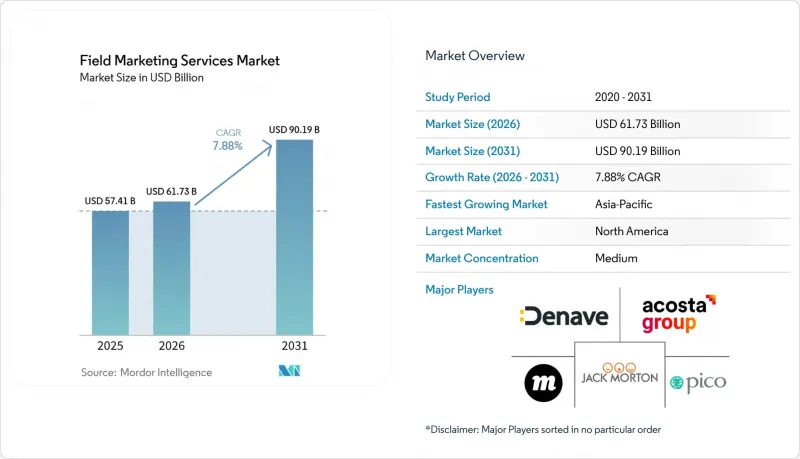
Mordor Intelligence에 의하면, 필드 마케팅 서비스 시장 규모는 2025년 574억 1,000만 달러로 평가되었고, 2026년에는 617억 3,000만 달러로 추정되고, 2026-2031년 CAGR 7.88%로 성장을 지속할 전망이며, 2031년에는 901억 9,000만 달러에 이를 것으로 예측됩니다.
본 보고서는 서비스 유형별(브랜드 활성화 및 체험형 캠페인, 제품 시연 및 샘플링 프로그램, 로드쇼 및 모바일 마케팅 투어 등), 최종 사용자 산업별(소매 및 전자상거래, 소비재 및 뷰티, 미디어 및 엔터테인먼트, BFSI, 헬스케어 및 생명과학 등), 그리고 지역별로 분류되어 있습니다. 시장 전망은 금액(달러) 기준으로 제시되어 있습니다.
세계의 필드 마케팅 서비스 시장 동향 및 인사이트
측정 가능한 옴니채널 활성화에 대한 브랜드 수요 증가
브랜드는 더 이상 방문자 수 집계나 사진 보고서로 끝나는 대면형 캠페인을 원하지 않습니다. 필드 마케팅 서비스 시장은 대면 접점을 판매 파이프라인, 디지털 액션 및 후속 전환 신호와 연결하는 프로그램으로 전환되고 있습니다. 광고주의 의향도 이러한 변화를 뒷받침하고 있으며, 광고 구매자의 41%가 2026년에 대면 및 체험형 마케팅에 대한 지출을 늘릴 계획이라는 점은 더 광범위한 캠페인 목표와 연계될 경우 대면 활성화에 여전히 예산적 지원이 이루어지고 있음을 보여줍니다. QR 코드를 통한 트리거, NFC를 통한 상호작용, 소셜 공유 기능, 디지털 컨텐츠 수집은 브랜드가 현장 참여를 측정 가능한 다음 단계로 연결하는 데 도움이 되므로 표준 활성화 계획의 일부가 되었습니다. 이로 인해 인력 배치, 제작, 측정을 단일 운영 모델 내에서 통합할 수 있는 현장 마케팅 서비스 시장의 대행사가 유리한 입지를 점하고 있습니다.
조직화된 소매의 확대와 모던 트레이드에서의 실행 필요성
조직화된 소매의 확대는 변화하고 있으며, 이는 현장 마케팅 서비스 시장 전반에 걸쳐 수요를 증가시키고 있습니다. 모던 트레이드의 형태가 인도의 2, 3선 도시로 확산되고, 중국에서는 디지털 결제, 소셜 커머스, 오프라인 매장 내 상품 진열의 통합이 진행되는 가운데, 브랜드에게는 더욱 일관되고 측정 가능한 매장 수준의 실행이 요구되고 있습니다. 모던 리테일 매장이 하나 늘어날 때마다 플래노그램 준수, 판촉물 설치, 재고 가시화, 현장 감사와 관련된 업무가 증가합니다. 이에 따라 리테일 실행 제공업체의 역할은 기본적인 머천다이징에 그치지 않고, 매장에서의 브랜드 성과를 위한 지속적인 운영 지원까지 확대되고 있습니다. 또한, 현장 마케팅 서비스 시장에서는 단일 프로그램 구조 하에서 모던 채널과 기존 채널 모두에서 활동할 수 있는 하이브리드 현장 팀에 대한 수요도 높아지고 있습니다.
여러 시장에 걸친 프로그램에서 발생하는 높은 인건비, 물류비, 행사장 비용
상승은 현장 마케팅 서비스 시장에서 여전히 가장 뚜렷한 제약 요인 중 하나입니다. 여러 도시에 걸친 프로그램에서는 인력 배치, 운송, 보관, 행사장 조정, 현지 실행이 필요하며, 특히 대도시권에서는 이러한 요소들이 실행 비용을 급격히 상승시킵니다. 이러한 압박은 로드쇼,대규모 샘플링 프로그램, 그리고 여러 시장에서 진행되는 신제품 출시에서 가장 두드러지며, 일정 차질이나 갑작스러운 변경은 추가 비용의 위험을 초래합니다. 그 결과, 대행사나 클라이언트는 프로그램의 이익률을 지키기 위해 매니지드 서비스 모델, 보다 견고한 직원 네트워크, 그리고 더욱 치밀한 실행 계획에 중점을 두게 되었습니다. 이러한 조정이 이루어지고 있음에도 불구하고, 현장 마케팅 서비스 시장은 훨씬 더 낮은 한계 비용으로 도달 범위를 확대할 수 있는 디지털 채널과의 비교에 여전히 반복적으로 직면하고 있습니다.
부문 분석
2025년에는 매장 내 머천다이징 및 소매 실행 서비스가 매출의 30.72%를 차지한 것으로 평가되었으며, 이 부문은 필드 마케팅 서비스 시장의 중심적인 위치를 계속 유지할 것입니다. 이러한 우위는 식료품점, 약국, 회원제 창고형 매장, 대형 할인점 등 전체 채널에서 진열대 규정 준수, 진열대 재고 확인, 판촉물 설치 및 실행의 정확성이 갖는 실무적 중요성을 반영합니다. 또한, 소매업체들은 진열 품질 및 플래노그램 준수에 대해 더욱 엄격한 요구를 하고 있어, 이에 따라 전문적인 실행 파트너에 대한 필요성이 더욱 높아지고 있습니다. 많은 브랜드에게 있어 현장 마케팅 서비스 시장의 이 분야는 매장 실적과 판촉 활동 준수를 직접 뒷받침하기 때문에 이벤트 주도형 업무에 비해 예산에 대한 재량권은 여전히 적은 상태입니다.
다른 분야들도 각 부문의 다양한 전환 목표 달성에 기여하고 있어 상업적으로 중요한 위치를 차지하고 있습니다. 실물 체험이 구매에 영향을 미치는 상황에서는 제품 시연 및 샘플링 프로그램이 계속해서 중요하며, 반면 금융 서비스 및 기타 전환 주도형 캠페인에서는 리드 생성 및 고객 확보 프로그램이 여전히 중요한 역할을 수행하고 있습니다. 브랜드 활성화 및 체험형 캠페인은 2031년까지 연평균 성장률(CAGR) 9.01%를 나타낼 것으로 예측되며, 이는 현장 마케팅 서비스 시장에서 브랜드 예산이 더 명확한 구매 의도를 이끌어내는 몰입형 형식으로 더 많이 배분되고 있음을 보여줍니다. 이벤트 스태프 파견 및 프로모션 인력 관리도 단순한 인력 공급의 범위를 넘어서는 추세이며, 점점 더 많은 클라이언트가 교육, 규정 준수 관리, 성과 벤치마킹을 동일한 서비스 패키지의 일부로 기대하고 있습니다.
지역별 분석
2025년, 북미는 현장 마케팅 서비스 시장 점유율의 26.93%를 차지하며 지역별로는 가장 큰 기여도를 보였습니다. 이 지역의 우위는 성숙하고 체계적인 소매 산업, 높은 활성화 지출, 그리고 대규모 다중 시장 프로그램을 조정하는 세계 대행사의 본사가 미국과 캐나다에 집중되어 있기 때문입니다. 소비재 프로그램, 식료품 및 대형 할인점에서의 실행, 스포츠 관련 활성화 예산이 여전히 대규모였기 때문에 미국은 주요 수익원으로 남아 있었습니다. 광고주의意向도 이 지역의 전망을 뒷받침하고 있으며, 미국 광고 구매자의 41%가 2026년에 대면 및 체험형 마케팅에 대한 지출을 늘릴 계획입니다. 이러한 요인들이 복합적으로 작용하여, 다른 지역의 성장률이 상승했음에도 불구하고 북미는 현장 마케팅 서비스 시장에서 주도적인 위치를 유지했습니다.
아시아태평양은 2031년까지 연평균 성장률(CAGR) 9.32%로 확대될 것으로 예상되며, 현장 마케팅 서비스 시장에서 가장 빠르게 성장하는 지역이 될 전망입니다. 이러한 성장은 인도의 조직화된 소매망 확대, 중산층의 소비 확대, 그리고 아시아 주요 시장 전반에 걸쳐 오프라인 매장 프로모션 활동과 디지털 상거래 간의 연계가 강화되고 있는 데 힘입은 것입니다. 중국은 현대적인 소매 형태가 소셜 커머스, 디지털 결제, 매장 내 머천다이징을 단일한 쇼핑 여정으로 통합하는 경향이 강해지고 있어 계속해서 두드러진 존재감을 보이고 있습니다. 일본, 한국, 동남아시아는 프리미엄 프로모션 활동에 대한 수요, 도시 지역의 높은 소매 밀도, 그리고 싱가포르가 주도하는 지역 허브 구조에 대한 대행사 투자의 확대를 통해 비즈니스 기회를 더욱 넓혀가고 있습니다.
유럽은 필드 마케팅 서비스 시장에서 2위의 지역 점유율을 차지하고 있으며, 독일, 영국, 프랑스가 소매 실행, 전시회 참여, 브랜드 체험 프로그램에 대한 지출을 주도하고 있습니다. 또한 영국에서는 주요 사업자들이 전문 기능을 흡수하고 브랜드 구조를 단순화함에 따라 눈에 띄는 통합이 진행되고 있습니다. 2026년 1월 스모란(Smolan)사가 영국 및 아일랜드 전역에서 실시한 브랜드 통합은 시장 전반에 걸친 서비스 제공의 규모 확대와 일관성을 위한 광범위한 노력을 반영한 것입니다. 남미는 계속해서 신흥 성장 지역이며, 브라질이 주도적인 역할을 하고 있습니다. 이 나라에서는 대규모 공공 행사가 일회성 스폰서십 기회라기보다는 브랜드 활성화를 위한 공식적인 플랫폼으로 취급되는 경향이 강해지고 있습니다. 중동에서는 아랍에미리트, 사우디아라비아, 카타르의 소매 및 엔터테인먼트 인프라를 통해 새로운 수요가 지속적으로 창출되고 있습니다. 한편, 아프리카는 남아프리카공화국, 나이지리아, 이집트가 주도하는 아직 초기 단계에 있는 기회 시장으로 남아 있습니다.
기타 혜택 :
- 엑셀 형식 시장 예측(ME) 시트
- 3개월간의 애널리스트 지원
자주 묻는 질문
목차
제1장 서론
제2장 조사 방법
제3장 개요
제4장 시장 구도
제5장 시장 규모 및 성장 예측
제6장 경쟁 구도
제7장 시장 기회 및 향후 전망
AJY 26.09.01According to Mordor Intelligence, the field marketing services market size is expected to grow from USD 57.41 billion in 2025 to USD 61.73 billion in 2026, and is forecast to reach USD 90.19 billion by 2031, at a 7.88% CAGR over 2026-2031.
This report is Segmented by Service Type (Brand Activation and Experiential Campaigns, Product Demonstrations and Sampling Programs, Roadshows and Mobile Marketing Tours, and More), End-User Industry (Retail and E-Commerce, Consumer Goods and Beauty, Media and Entertainment, BFSI, Healthcare and Life Sciences, and More), and Geography. The Market Forecasts are Provided in Terms of Value (USD).
Global Field Marketing Services Market Trends and Insights
Rising Brand Demand for Measurable Omnichannel Activation
Brands no longer want physical campaigns that end with a traffic count and a photo report. The field marketing services market is moving toward programs that connect physical touchpoints with sales pipelines, digital actions, and follow-up conversion signals. Advertiser sentiment has supported that shift, with 41% of advertising buyers planning to increase spending on in-person and experiential marketing in 2026, indicating that physical activation still carries budget support when tied to broader campaign objectives. QR triggers, NFC interactions, social sharing mechanics, and digital content capture have become part of standard activation planning because they help brands connect on-ground engagement with measurable next steps. This has favored agencies in the field marketing services market that can combine staffing, production, and measurement within one operating model.
Expansion of Organized Retail and Modern Trade Execution Needs
Organized retail expansion is changing, where demand is building across the field marketing services market. As modern trade formats spread into India's tier-2 and tier-3 cities and China continues to integrate digital payments, social commerce, and physical merchandising, brands need store-level execution that is more consistent and measurable. Each additional modern retail outlet adds work tied to planogram compliance, promotional installation, stock visibility, and field auditing. This has widened the role of retail execution providers beyond basic merchandising to include ongoing operational support for brand performance in stores. The field marketing services market is also seeing more demand for hybrid field teams that can work across both modern and traditional channels under a single program structure.
High Labor, Logistics, and Venue Costs in Multi-Market Programs
Cost inflation remains one of the clearest constraints on the field marketing services market. Multi-city programs require staffing, transport, storage, venue coordination, and local execution, which quickly raise delivery costs, especially in large urban markets. These pressures are most visible in roadshows, large sampling programs, and multi-market launches where timing errors or rush changes create additional cost exposure. The result is that agencies and clients are placing more emphasis on managed-service models, stronger staffing networks, and tighter deployment planning to protect program margins. Even with those adjustments, the field marketing services market still faces recurring comparison against digital channels that can extend reach at much lower marginal cost.
Other drivers and restraints analyzed in the detailed report include:
- Growing Preference for Product Trial and Immersive Brand Experiences
- Wider Use of Real-Time Analytics and Experience Measurement
- Limited Reach and Scaling Efficiency Versus Digital-Only Campaigns
For complete list of drivers and restraints, kindly check the Table Of Contents.
Segment Analysis
In-Store Merchandising and Retail Execution Services accounted for 30.72% of revenue in 2025, keeping this category at the center of the field marketing services market. Its lead reflects the practical importance of shelf compliance, on-shelf availability checks, promotional installation, and execution accuracy across grocery, pharmacy, club, and mass channels. Retailers have also become more demanding about display quality and planogram adherence, which strengthens the case for specialized execution partners. For many brands, this part of the field marketing services market remains less discretionary than event-led work because it directly supports store performance and promotional compliance.
The rest of the mix remains commercially important because it serves different conversion goals across sectors. Product Demonstrations and Sampling Programs continue to matter when physical trials influence purchase, while Lead Generation and Customer Acquisition Programs remain relevant in financial services and other conversion-led campaigns. Brand Activation and Experiential Campaigns are projected to grow at a CAGR of 9.01% through 2031, indicating that the field marketing services market is directing more brand spend toward immersive formats with clearer purchase intent outcomes. Event Staffing and Promotional Workforce Management is also moving beyond simple headcount supply, with more clients expecting training, compliance control, and performance benchmarking as part of the same service package.
Complete Report Scope:
- By Service Type
- Brand Activation and Experiential Campaigns
- Product Demonstrations and Sampling Programs
- In-Store Merchandising and Retail Execution Services
- Roadshows and Mobile Marketing Tours
- Lead Generation and Customer Acquisition Programs
- Event Staffing and Promotional Workforce Management
- Other Service Types
- By End-User Industry
- Retail and E-commerce
- Consumer Goods and Beauty
- Media and Entertainment
- IT and Telecom
- BFSI
- Healthcare and Life Sciences
- Other End-User Industries
- By Geography
- North America
- United States
- Canada
- Mexico
- South America
- Brazil
- Argentina
- Chile
- Rest of South America
- Europe
- Germany
- United Kingdom
- France
- Italy
- Spain
- Rest of Europe
- Asia-Pacific
- China
- Japan
- India
- South Korea
- Australia
- Rest of Asia-Pacific
- Middle East
- United Arab Emirates
- Saudi Arabia
- Qatar
- Rest of Middle East
- Africa
- South Africa
- Egypt
- Nigeria
- Rest of Africa
- North America
Geography Analysis
North America accounted for 26.93% of the field marketing services market share in 2025, which made it the largest regional contributor. The region's lead came from mature organized retail, high activation spending, and the concentration of global agency headquarters based in the United States and Canada that coordinate large multi-market programs. The United States remained the main revenue engine because consumer goods programs, grocery and mass-retail execution, and sports-linked activation budgets stayed large. Advertiser intent also supported the regional outlook, with 41% of US advertising buyers planning to increase spending on in-person and experiential marketing in 2026. That combination kept North America in a leading position in the field marketing services market, even as growth rates in other regions rose.
Asia-Pacific is projected to expand at a CAGR of 9.32% through 2031, making it the fastest-growing geography in the field marketing services market. Growth is being supported by organized retail expansion in India, rising middle-class consumption, and a stronger link between physical activation and digital commerce across major Asian markets. China continues to stand out because modern trade formats increasingly connect social commerce, digital payments, and in-store merchandising into a single shopper journey. Japan, South Korea, and Southeast Asia add to the opportunity set through premium activation demand, urban retail density, and growing agency investment in Singapore-led regional hub structures.
Europe held the second-largest regional position in the field marketing services market, with Germany, the United Kingdom, and France leading spend across retail execution, trade show engagement, and branded experience programs. The United Kingdom has also become a visible consolidation point as larger operators absorb specialist capabilities and simplify brand structures. Smollan's January 2026 brand unification across the United Kingdom and Ireland reflected that wider push toward scale and consistency in cross-market delivery. South America remained an emerging growth zone led by Brazil, where large public events are increasingly treated as formal platforms for brand activation rather than one-off sponsorship moments. The Middle East continued to build new demand through retail and entertainment infrastructure in the United Arab Emirates, Saudi Arabia, and Qatar, while Africa remained an earlier-stage opportunity led by South Africa, Nigeria, and Egypt.
- Acosta Group
- George P. Johnson Company
- Jack Morton Worldwide Inc.
- Pico Far East Holdings Limited
- Denave India Private Limited
- GMR Marketing LLC
- Momentum Worldwide Inc.
- Inspira Marketing Group LLC
- TRO Group Ltd.
- BDS Connected Solutions, LLC
- ASTOUND Group LLC
- NVE Experience Agency
- Sense Marketing Services Ltd.
- Evolve Activation LLC
Additional Benefits:
- The market estimate (ME) sheet in Excel format
- 3 months of analyst support
TABLE OF CONTENTS
1 INTRODUCTION
- 1.1 Study Assumptions and Market Definition
- 1.2 Scope of the Study
2 RESEARCH METHODOLOGY
3 EXECUTIVE SUMMARY
4 MARKET LANDSCAPE
- 4.1 Market Overview
- 4.2 Market Drivers
- 4.2.1 Rising Brand Demand for Measurable Omnichannel Activation
- 4.2.2 Expansion of Organized Retail and Modern Trade Execution Needs
- 4.2.3 Growing Preference for Product Trial and Immersive Brand Experiences
- 4.2.4 Wider Use of Real-Time Analytics and Experience Measurement
- 4.2.5 Shift Toward Micro-Experiences and Localized Community Activations
- 4.2.6 Creator-Led Commerce and Retailtainment Programs Requiring On-Ground Orchestration
- 4.3 Market Restraints
- 4.3.1 High Labor, Logistics, and Venue Costs in Multi-Market Programs
- 4.3.2 Limited Reach and Scaling Efficiency Versus Digital-Only Campaigns
- 4.3.3 Centralized Campaign Governance Weakening Local Relevance
- 4.3.4 Rising Promotional Talent Churn and Training Burdens
- 4.4 Industry Value Chain Analysis
- 4.5 Regulatory Landscape
- 4.6 Technological Outlook
- 4.7 Impact of Macroeconomic Factors on the Market
- 4.8 Porter's Five Forces Analysis
- 4.8.1 Threat of New Entrants
- 4.8.2 Bargaining Power of Buyers
- 4.8.3 Bargaining Power of Suppliers
- 4.8.4 Threat of Substitutes
- 4.8.5 Industry Rivalry
5 MARKET SIZE AND GROWTH FORECASTS (VALUE)
- 5.1 By Service Type
- 5.1.1 Brand Activation and Experiential Campaigns
- 5.1.2 Product Demonstrations and Sampling Programs
- 5.1.3 In-Store Merchandising and Retail Execution Services
- 5.1.4 Roadshows and Mobile Marketing Tours
- 5.1.5 Lead Generation and Customer Acquisition Programs
- 5.1.6 Event Staffing and Promotional Workforce Management
- 5.1.7 Other Service Types
- 5.2 By End-User Industry
- 5.2.1 Retail and E-commerce
- 5.2.2 Consumer Goods and Beauty
- 5.2.3 Media and Entertainment
- 5.2.4 IT and Telecom
- 5.2.5 BFSI
- 5.2.6 Healthcare and Life Sciences
- 5.2.7 Other End-User Industries
- 5.3 By Geography
- 5.3.1 North America
- 5.3.1.1 United States
- 5.3.1.2 Canada
- 5.3.1.3 Mexico
- 5.3.2 South America
- 5.3.2.1 Brazil
- 5.3.2.2 Argentina
- 5.3.2.3 Chile
- 5.3.2.4 Rest of South America
- 5.3.3 Europe
- 5.3.3.1 Germany
- 5.3.3.2 United Kingdom
- 5.3.3.3 France
- 5.3.3.4 Italy
- 5.3.3.5 Spain
- 5.3.3.6 Rest of Europe
- 5.3.4 Asia-Pacific
- 5.3.4.1 China
- 5.3.4.2 Japan
- 5.3.4.3 India
- 5.3.4.4 South Korea
- 5.3.4.5 Australia
- 5.3.4.6 Rest of Asia-Pacific
- 5.3.5 Middle East
- 5.3.5.1 United Arab Emirates
- 5.3.5.2 Saudi Arabia
- 5.3.5.3 Qatar
- 5.3.5.4 Rest of Middle East
- 5.3.6 Africa
- 5.3.6.1 South Africa
- 5.3.6.2 Egypt
- 5.3.6.3 Nigeria
- 5.3.6.4 Rest of Africa
- 5.3.1 North America
6 COMPETITIVE LANDSCAPE
- 6.1 Market Concentration
- 6.2 Strategic Moves
- 6.3 Market Share Analysis
- 6.4 Company Profiles (includes Global Level Overview, Market Level Overview, Core Segments, Financials as available, Strategic Information, Market Rank/Share, Products and Services, Recent Developments)
- 6.4.1 Acosta Group
- 6.4.2 George P. Johnson Company
- 6.4.3 Jack Morton Worldwide Inc.
- 6.4.4 Pico Far East Holdings Limited
- 6.4.5 Denave India Private Limited
- 6.4.6 GMR Marketing LLC
- 6.4.7 Momentum Worldwide Inc.
- 6.4.8 Inspira Marketing Group LLC
- 6.4.9 TRO Group Ltd.
- 6.4.10 BDS Connected Solutions, LLC
- 6.4.11 ASTOUND Group LLC
- 6.4.12 NVE Experience Agency
- 6.4.13 Sense Marketing Services Ltd.
- 6.4.14 Evolve Activation LLC
7 MARKET OPPORTUNITIES AND FUTURE OUTLOOK
- 7.1 White-Space and Unmet-Need Assessment


