
|
시장보고서
상품코드
2118178
규제 대상 AI 의료 소프트웨어 시장 : 시장 점유율 분석, 업계 동향 및 통계, 성장 예측(2026-2031년)Regulated AI Medical Software - Market Share Analysis, Industry Trends & Statistics, Growth Forecasts (2026 - 2031) |
||||||
 Mordor Intelligence
Mordor Intelligence에 의하면, 규제 대상 AI 의료 소프트웨어 시장 규모는 2025년에 25억 1,000만 달러로 평가되었고, 2026년 29억 6,000만 달러에서 2031년까지 67억 4,000만 달러에 이를 것으로 예측되며, 예측 기간(2026-2031년) CAGR은 17.90%를 나타낼 전망입니다.
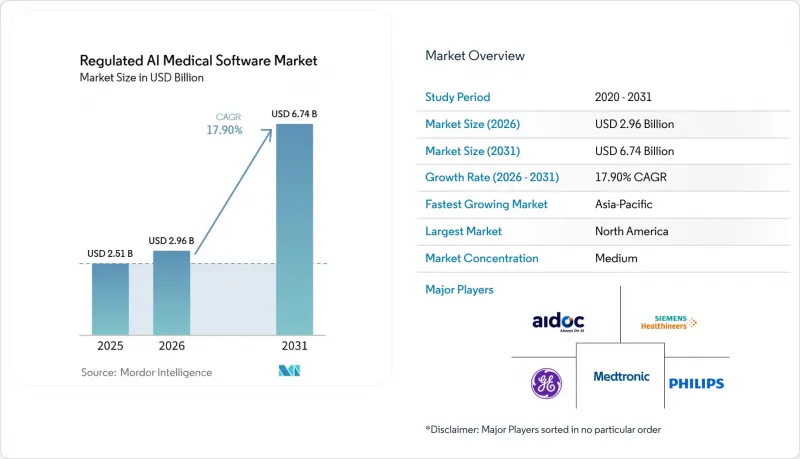
본 보고서는 제품 유형별(AI 탑재 진단 소프트웨어 등), 배포 방식별(온프레미스 등), 임상 기능별(스크리닝, 트리아지, 진단 및 분류 등), 최종 사용자별(병원 및 통합 의료 네트워크(IDN), 외래수술센터(ASC) 등), 지역별(북미, 유럽, 아시아태평양 등)로 분류되어 있습니다. 시장 전망은 금액(달러) 기준으로 제시되어 있습니다.
세계의 규제 대상 AI 의료 소프트웨어 시장 동향 및 인사이트
전문의 부족 및 진단 역량 부족
규제 대상 AI 의료 소프트웨어 시장은 많은 의료 서비스 제공업체에게 운영상의 제약이 되고 있는 임상의 부족으로 인해 혜택을 보고 있습니다. 세계보건기구(WHO)는 2030년까지 전 세계적으로 1,100만 명의 의료 인력이 부족할 것으로 예측하고 있으며, 이러한 부족 현상은 진단 및 전문 의료 분야에 집중되어 있습니다. 방사선과, 병리과, 순환기과에서는 전문의에 의한 검사 건수가 증가함에 따라 부담이 커지고 있습니다. 미국에서는 HRSA(보건자원서비스국)가 36개 전문 분야 중 26개 분야에서 2035년까지 8만 1,180명 분량의 전일제 상당 의사가 부족할 것으로 예측했습니다.
AI 탑재 의료기기의 규제 절차 성숙
규제가 명확해짐에 따라, 견고한 품질 관리 시스템을 갖춘 개발자들에게는 규제 대상인 AI 의료 소프트웨어 시장 진출이 점차 용이해지고 있습니다. FDA의 2025년 라이프사이클 지침은 AI 탑재 의료기기의 반복적인 업데이트에 대한 보다 명확한 접근 방식을 확립한 반면, 사전 결정 변경 관리 계획(PCCP)은 승인 후 특정 모델 변경을 관리하기 위한 체계적인 방법을 제조업체에 제공했습니다. GE 헬스케어는 2026년 6월, 임상 기능 확장에 관한 PCCP를 포함한 ‘MIM Contour ProtegeAI+2.0’에 대해 FDA의 510(k) 승인을 획득했습니다. 또한, 독일 연방네트워크청도 2026년 5월, AI 의료기기 규제와 관련된 의문점에 대한 지침을 발표했습니다.
전향적 임상 증거와 일반화 가능성의 과제
전향적 증거는 규제 대상인 AI 의료 소프트웨어 시장에 여전히 제약 요인으로 작용하고 있습니다. 이는 의사 결정권자가 그 성능이 모든 의료 현장에서 재현될 것이라는 확신을 필요로 하기 때문입니다. 후향적 연구에서는 기술적 성능을 입증할 수 있지만, 일반적인 시간적 제약이나 업무 흐름의 압박 속에서 임상의가 도구를 어떻게 사용할지는 보여주지 못할 가능성이 있습니다. 2026년에 수행된 전향적 연구에 따르면, AI 기반 입원 예측 도구를 통해 의사의 진료 건수는 일정하게 유지된 채 응급실 체류 시간의 중앙값이 12분 단축된 것으로 밝혀졌습니다. 의료 시스템과 보험사는 지역 병원, 전문 의료 센터, 그리고 서로 다른 환자 집단 간에 성과가 일관되게 유지되는지 여부를 여전히 평가하고 있으며, 광범위한 도입을 위해서는 지역별 검증 계획과 명확한 증거 패키지가 필수적입니다.
부문 분석
2025년 시점에서 AI 기반 진단 소프트웨어는 규제 대상 AI 의료 소프트웨어 시장 규모의 33.22%를 차지했습니다. 이러한 선도적 지위는 방사선과 및 심장 영상 진단 분야에서 조기에 도입된 것을 반영한 것으로, 이 분야에서는 의료 제공업체들이 영상 판독, 정량화 및 사례 우선순위 결정에 이러한 도구를 활용하고 있었습니다. 이 소프트웨어는 진료 과정을 대대적으로 재설계할 필요 없이 기존의 영상 판독 워크플로우에 통합될 수 있었으며, 또한 방사선과 의사들이 소프트웨어 지원 영상 진단에 이미 익숙해져 있었던 점이 진단 부문 전반에 걸친 더 광범위한 활용을 촉진했습니다.
AI가 탑재된 디지털 병리 및 체외 진단용 소프트웨어는 2031년까지 연평균 성장률(CAGR) 21.93%를 나타낼 것으로 예측됩니다. 디지털화된 슬라이드 라이브러리, 전체 슬라이드 이미징 시스템, 대량 검체 검토용 알고리즘이 검사실 전반에 걸친 보급을 촉진하고 있습니다. Tempus사의 보고에 따르면, Articulate Pro는 전립선 생검 사례의 5%에서 초기 진단 또는 등급 분류를 변경했으며, 그중 1.3%의 변경이 임상 관리에 영향을 미쳤습니다. 또한, 이 연구에서는 검사 결과 보고까지 소요되는 시간이 거의 하루가 단축된 것으로 보고되어, 표준화된 판독 워크플로우에 대한 검사실의 관심이 높아지고 있습니다.
2025년 기준으로, 규제 대상 AI 의료 소프트웨어 시장 규모의 36.23%를 클라우드 기반 도입이 차지했습니다. 초기 도입자들은 확장 가능한 연산 능력과 로컬 하드웨어 관리가 필요 없는 지속적인 업데이트를 이유로 클라우드 시스템을 선호했습니다. 이 모델은 온프레미스 인프라가 제한적인 영상진단센터나 검사실에 여전히 유용하며, 벤더 측에서도 분산된 의료기관 거점 간 소프트웨어 버전을 통일하기 위해 이를 활용했습니다.
하이브리드 배포는 2031년까지 연평균 성장률(CAGR) 19.67%를 나타낼 것으로 예측됩니다. 이 방식은 식별 가능한 환자 데이터를 병원 내 또는 국경 내에 보관하면서, 기밀성이 낮은 적절한 워크로드에 대해서는 클라우드 리소스 활용을 가능하게 합니다. 이러한 접근 방식은 독일, 인도, GCC 국가들의 데이터 저장 위치 관련 요건을 충족하는 동시에, 의료 기관이 접근 및 보존 기간을 보다 엄격하게 관리할 수 있도록 했습니다. 엣지 및 임베디드형 배포는 낮은 지연 시간이 필요하거나 연결 환경이 제한적인 영상 진단 하드웨어 및 중재 시술 시스템에서 계속해서 중요한 역할을 수행했습니다.
지역별 분석
2025년, 북미는 규제 대상 AI 의료 소프트웨어 시장 점유율의 39.76%를 차지했습니다. 이 지역은 선진적인 의료 제공업체용 시스템의 도입 기반이 광범위하고, 임상 소프트웨어 조달 수요가 활발하며, 규제 프로세스가 성숙해 있다는 이점을 누렸습니다. HHS는 2026년 6월, TEFCA를 통해 교환된 의료 기록이 10억 건을 돌파했다고 보고했으며, 이를 통해 임상 데이터의 연계 및 교환이 강화되어 의료 현장 간의 정보 격차가 축소되었습니다. 캐나다와 멕시코도 미국의 기술 생태계와 연계된 학술 의료 센터 및 대규모 병원 네트워크를 통해 지역 내 도입을 촉진했습니다.
유럽은 규제 대상 AI 의료 소프트웨어 시장에서 지역별 2위의 규모를 자랑합니다. 독일, 영국, 프랑스가 주요 도입국이며, 선진적인 의료 제공 체계와 적극적인 의료 기술 규제에 힘입고 있습니다. 이 지역의 벤더는 AI 및 데이터 거버넌스 의무 외에도 의료기기에 관한 요건도 관리해야 합니다. 2026년 5월 독일이 발표한 지침에서는 AI와 의료기기가 교차하는 영역의 과제가 명확히 제시되었습니다.
아시아태평양은 2031년까지 연평균 성장률(CAGR) 19.56%로 확대될 것으로 예측됩니다. 이러한 성장은 중국의 국내 소프트웨어 개발, 한국의 의료기기 규제, 그리고 일본의 건강 데이터 개혁에 힘입은 것입니다. 2025년 12월부터 2026년 4월까지 실시된 일본의 개혁에서는 의료 데이터, AI, 임상 연구가 대상이 되었습니다. 또한 2025년 8월에는 일본 의료기기 산업연합회가 AI를 활용한 프로그램 의료기기의 심사 기법에 대해 검토를 진행했습니다. 인도에서는 디지털 헬스 인프라가 정비됨에 따라 진단 및 의사결정 지원 소프트웨어에 큰 가능성이 기대됩니다. 한편, 남미, 중동 및 아프리카는 여전히 초기 단계 시장에 머물러 있습니다.
기타 혜택 :
- 엑셀 형식 시장 예측(ME) 시트
- 3개월간의 애널리스트 지원
목차
제1장 서론
제2장 조사 방법
제3장 주요 요약
제4장 시장 구도
제5장 시장 규모 및 성장 예측
제6장 경쟁 구도
제7장 시장 기회 및 향후 전망
AJYAccording to Mordor Intelligence, the regulated AI medical software market size was valued at USD 2.51 billion in 2025 and is estimated to grow from USD 2.96 billion in 2026 to reach USD 6.74 billion by 2031, at a CAGR of 17.90% during the forecast period (2026-2031).
This report is Segmented by Product Type (AI-Enabled Diagnostic Software, and More), Deployment Model (On-Premise, and More), Clinical Function (Screening, Triage, Diagnosis and Classification, and More), End User (Hospitals and IDNs, Ambulatory Surgery Centers, and More), and Geography (North America, Europe, Asia-Pacific, and More). The Market Forecasts are Provided in Terms of Value (USD).
Global Regulated AI Medical Software Market Trends and Insights
Shortage of Specialist Clinicians and Diagnostic Capacity
The regulated AI medical software market benefits from clinician shortages, which have become an operating constraint for many providers. The World Health Organization projects a global shortfall of 11 million health workers by 2030, with shortages concentrated in diagnosis and specialized care roles. Radiology, pathology, and cardiology face rising pressure as specialist review volumes increase. In the United States, HRSA projected a shortfall of 81,180 full-time equivalent physicians by 2035 across 26 of 36 specialty categories.
Regulatory Pathway Maturation for AI-Enabled Devices
Regulatory clarity is making the regulated AI medical software market more accessible for developers with robust quality systems. The FDA's 2025 lifecycle guidance established a clearer approach to iterative updates for AI-enabled devices, while Predetermined Change Control Plans gave manufacturers a structured way to manage certain model changes after authorization. GE HealthCare received FDA 510(k) clearance for MIM Contour ProtegeAI+ 2.0 in June 2026, including a PCCP for expanded clinical capabilities. Germany's Federal Network Agency also issued guidance in May 2026 on AI medical device regulatory questions.
Prospective Clinical Evidence and Generalizability Gaps
Prospective evidence remains a restraint for the regulated AI medical software market, as decision-makers need confidence that performance will transfer across care settings. Retrospective testing can establish technical performance, but it may not show how clinicians use a tool under normal time and workflow pressures. A prospective study in 2026 found that an AI admission-prediction tool reduced median emergency department length of stay by 12 minutes while physician volume remained constant. Health systems and payers still evaluate whether outcomes will remain consistent across community hospitals, specialist centers, and different patient populations, making local validation plans and clear evidence packages critical for broad adoption.
Other drivers and restraints analyzed in the detailed report include:
- Hospital Demand for Productivity and Throughput Improvement
- Public Investment in Interoperable Health Data Infrastructure
- Cybersecurity, Privacy, and Third-Party Model Dependency
For complete list of drivers and restraints, kindly check the Table Of Contents.
Segment Analysis
AI-enabled diagnostic software held 33.22% of the regulated AI medical software market size in 2025. This leadership reflected early adoption in radiology and cardiac imaging, where providers used these tools for image interpretation, quantification, and case prioritization. The software fit into established reading workflows without requiring major care pathway redesign, while radiologists' familiarity with software-assisted imaging supported broader use across diagnostic departments.
AI-enabled digital pathology and in vitro diagnostic software is forecast to grow at a CAGR of 21.93% through 2031. Digitized slide libraries, whole-slide imaging systems, and high-volume review algorithms support expansion across laboratories. Tempus reported that Articulate Pro changed the initial diagnosis or grade group in 5% of prostate biopsy cases, while 1.3% of changes affected clinical management. The study also reported a turnaround-time reduction of nearly one day, strengthening laboratory interest in standardized review workflows.
Cloud-based deployment accounted for 36.23% of the regulated AI medical software market size in 2025. Early adopters favored cloud systems for scalable computing capacity and continuous updates without local hardware management. The model remained relevant for imaging centers and laboratories with limited on-premise infrastructure, while vendors used it to manage consistent software versions across distributed provider locations.
Hybrid deployment is forecast to grow at a CAGR of 19.67% through 2031. It keeps identifiable patient data within hospital or national boundaries while allowing suitable non-sensitive workloads to use cloud resources. This approach addressed data residency expectations in Germany, India, and GCC countries and gave institutions stronger control over access and retention. Edge and embedded deployment remained important for imaging hardware and interventional systems that require low latency or operate with limited connectivity.
Complete Report Scope:
- By Product Type
- AI-Enabled Diagnostic Software
- AI-Enabled Monitoring and Predictive Analytics Software
- AI-Enabled Clinical Decision Support Software
- AI-Enabled Treatment Planning and Procedural Guidance Software
- AI-Enabled Digital Pathology and In Vitro Diagnostic Software
- AI-Enabled Therapeutic and Rehabilitation Software
- AI-Enabled Surgical and Robotic Software
- Others
- By Deployment Model
- On-Premise Deployment
- Cloud-Based Deployment
- Edge and Embedded Deployment
- Hybrid Deployment
- By Clinical Function
- Screening and Early Detection
- Triage and Prioritization
- Diagnosis and Classification
- Quantification and Measurement
- Prognosis and Risk Prediction
- Treatment Selection and Recommendation
- Treatment Planning and Navigation
- Monitoring and Recurrence Detection
- Others
- By End User
- Hospitals and Integrated Delivery Networks
- Ambulatory Surgery Centers
- Diagnostic Imaging Centers and Laboratories
- Physician Practices and Specialty Clinics
- Academic and Research Institutions
- Public Health and Government Providers
- Pharmaceutical and Biotechnology Companies
- By Geography
- North America
- United States
- Canada
- Mexico
- Europe
- Germany
- United Kingdom
- France
- Italy
- Spain
- Rest of Europe
- Asia-Pacific
- China
- India
- Japan
- Australia
- South Korea
- Rest of Asia-Pacific
- Middle East and Africa
- GCC
- South Africa
- Rest of Middle East and Africa
- South America
- Brazil
- Argentina
- Rest of South America
- North America
Geography Analysis
North America held 39.76% of the regulated AI medical software market share in 2025. The region benefited from a large installed base of advanced provider systems, strong clinical software procurement, and mature regulatory processes. HHS reported in June 2026 that TEFCA had surpassed 1 billion exchanged health records, strengthening connected clinical data exchange and reducing information gaps across care settings. Canada and Mexico also supported regional adoption through academic health centers and large hospital networks linked to United States technology ecosystems.
Europe is the second-largest regional market for regulated AI medical software. Germany, the United Kingdom, and France are key adopters, supported by advanced care delivery and active medical technology regulation. Vendors in the region must manage medical device requirements alongside AI and data governance obligations. Germany's May 2026 orientation guide clarified issues at the intersection of AI and medical devices.
Asia-Pacific is forecast to expand at a CAGR of 19.56% through 2031. Growth is supported by domestic software development in China, device regulation in South Korea, and health data reforms in Japan. Japan's reforms between December 2025 and April 2026 addressed health data, AI, and clinical research, while the Japanese Federation of Medical Devices Associations examined review approaches for AI-enabled program medical devices in August 2025. India offers strong potential for diagnostic and decision support software as digital health infrastructure develops, while South America, the Middle East, and Africa remain earlier-stage markets.
- Abbott Laboratories
- Aidoc Medical Ltd.
- Butterfly Network, Inc.
- Canon
- Cleerly, Inc.
- GE HealthCare Technologies Inc.
- Intuitive Surgical, Inc.
- iRhythm Technologies
- Koninklijke Philips
- Medtronic
- NVIDIA
- Owkin, Inc.
- Paige.AI, Inc.
- Shanghai United Imaging Healthcare Co., Ltd.
- Siemens Healthineers
- SOPHiA GENETICS SA
- Stryker
- Subtle Medical, Inc.
- Tempus AI, Inc.
- Viz.ai, Inc.
Additional Benefits:
- The market estimate (ME) sheet in Excel format
- 3 months of analyst support
TABLE OF CONTENTS
1 INTRODUCTION
- 1.1 Study Assumptions and Market Definition
- 1.2 Scope of the Study
2 RESEARCH METHODOLOGY
3 EXECUTIVE SUMMARY
4 MARKET LANDSCAPE
- 4.1 Market Overview
- 4.2 Market Drivers
- 4.2.1 Shortage of Specialist Clinicians and Diagnostic Capacity
- 4.2.2 Expansion of Multimodal Clinical Data and Precision Medicine
- 4.2.3 Hospital Demand for Productivity and Throughput Improvement
- 4.2.4 Public Investment in Interoperable Health Data Infrastructure
- 4.2.5 Regulatory Pathway Maturation for AI-Enabled Devices
- 4.2.6 Local Validation and Monitoring Requirements Creating Compliance Moats
- 4.3 Market Restraints
- 4.3.1 Prospective Clinical Evidence and Generalizability Gaps
- 4.3.2 Cybersecurity, Privacy and Third-Party Model Dependency
- 4.3.3 Workflow Integration and Reimbursement Friction
- 4.3.4 Model Drift, Change-Control and Post-Market Surveillance Burden
- 4.4 Value/Supply-Chain Analysis
- 4.5 Regulatory Landscape
- 4.6 Technological Outlook
- 4.7 Porter's Five Forces Analysis
- 4.7.1 Threat of New Entrants
- 4.7.2 Bargaining Power of Suppliers
- 4.7.3 Bargaining Power of Buyers
- 4.7.4 Threat of Substitutes
- 4.7.5 Competitive Rivalry
5 MARKET SIZE AND GROWTH FORECASTS (VALUE, USD)
- 5.1 By Product Type
- 5.1.1 AI-Enabled Diagnostic Software
- 5.1.2 AI-Enabled Monitoring and Predictive Analytics Software
- 5.1.3 AI-Enabled Clinical Decision Support Software
- 5.1.4 AI-Enabled Treatment Planning and Procedural Guidance Software
- 5.1.5 AI-Enabled Digital Pathology and In Vitro Diagnostic Software
- 5.1.6 AI-Enabled Therapeutic and Rehabilitation Software
- 5.1.7 AI-Enabled Surgical and Robotic Software
- 5.1.8 Others
- 5.2 By Deployment Model
- 5.2.1 On-Premise Deployment
- 5.2.2 Cloud-Based Deployment
- 5.2.3 Edge and Embedded Deployment
- 5.2.4 Hybrid Deployment
- 5.3 By Clinical Function
- 5.3.1 Screening and Early Detection
- 5.3.2 Triage and Prioritization
- 5.3.3 Diagnosis and Classification
- 5.3.4 Quantification and Measurement
- 5.3.5 Prognosis and Risk Prediction
- 5.3.6 Treatment Selection and Recommendation
- 5.3.7 Treatment Planning and Navigation
- 5.3.8 Monitoring and Recurrence Detection
- 5.3.9 Others
- 5.4 By End User
- 5.4.1 Hospitals and Integrated Delivery Networks
- 5.4.2 Ambulatory Surgery Centers
- 5.4.3 Diagnostic Imaging Centers and Laboratories
- 5.4.4 Physician Practices and Specialty Clinics
- 5.4.5 Academic and Research Institutions
- 5.4.6 Public Health and Government Providers
- 5.4.7 Pharmaceutical and Biotechnology Companies
- 5.5 By Geography
- 5.5.1 North America
- 5.5.1.1 United States
- 5.5.1.2 Canada
- 5.5.1.3 Mexico
- 5.5.2 Europe
- 5.5.2.1 Germany
- 5.5.2.2 United Kingdom
- 5.5.2.3 France
- 5.5.2.4 Italy
- 5.5.2.5 Spain
- 5.5.2.6 Rest of Europe
- 5.5.3 Asia-Pacific
- 5.5.3.1 China
- 5.5.3.2 India
- 5.5.3.3 Japan
- 5.5.3.4 Australia
- 5.5.3.5 South Korea
- 5.5.3.6 Rest of Asia-Pacific
- 5.5.4 Middle East and Africa
- 5.5.4.1 GCC
- 5.5.4.2 South Africa
- 5.5.4.3 Rest of Middle East and Africa
- 5.5.5 South America
- 5.5.5.1 Brazil
- 5.5.5.2 Argentina
- 5.5.5.3 Rest of South America
- 5.5.1 North America
6 COMPETITIVE LANDSCAPE
- 6.1 Market Concentration
- 6.2 Market Share Analysis
- 6.3 Company Profiles (includes Global Level Overview, Market Level Overview, Core Segments, Financials as available, Strategic Information, Market Rank/Share, Products and Services, Recent Developments)
- 6.3.1 Abbott Laboratories
- 6.3.2 Aidoc Medical Ltd.
- 6.3.3 Butterfly Network, Inc.
- 6.3.4 Canon Medical Systems Corporation
- 6.3.5 Cleerly, Inc.
- 6.3.6 GE HealthCare Technologies Inc.
- 6.3.7 Intuitive Surgical, Inc.
- 6.3.8 iRhythm Technologies, Inc.
- 6.3.9 Koninklijke Philips N.V.
- 6.3.10 Medtronic plc
- 6.3.11 NVIDIA Corporation
- 6.3.12 Owkin, Inc.
- 6.3.13 Paige.AI, Inc.
- 6.3.14 Shanghai United Imaging Healthcare Co., Ltd.
- 6.3.15 Siemens Healthineers AG
- 6.3.16 SOPHiA GENETICS SA
- 6.3.17 Stryker Corporation
- 6.3.18 Subtle Medical, Inc.
- 6.3.19 Tempus AI, Inc.
- 6.3.20 Viz.ai, Inc.
7 MARKET OPPORTUNITIES AND FUTURE OUTLOOK
- 7.1 White-Space and Unmet-Need Assessment