|
시장보고서
상품코드
2118199
법률 지식 관리 소프트웨어 시장 : 시장 점유율 분석, 업계 동향 및 통계, 성장 예측(2026-2031년)Legal Knowledge Management Software - Market Share Analysis, Industry Trends & Statistics, Growth Forecasts (2026 - 2031) |
||||||
 Mordor Intelligence
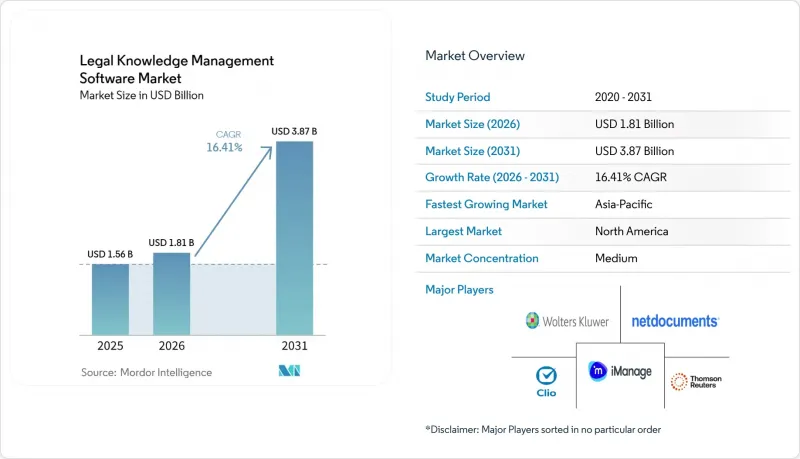
Mordor Intelligence에 의하면, 법률 지식 관리 소프트웨어 시장 규모는 2025년에 15억 6,000만 달러로 평가되었고, 2026년에 18억 1,000만 달러로 추정되고, CAGR 16.41%로 성장을 지속할 전망이며, 2031년까지 38억 7,000만 달러에 이를 것으로 예측됩니다.
본 보고서는 배포 방식별(클라우드 기반, 온프레미스형, 하이브리드형), 용도별(법무 조사 및 판례 관리, 문서·지식 저장소 관리 등), 기능별(지능형 검색·추출, 워크플로우 자동화 등), 최종 사용자 산업별(법률 사무소 등), 그리고 지역별로 분류되어 있습니다. 시장 예측은 금액(달러) 기준으로 제시되어 있습니다.
세계의 법률 지식 관리 소프트웨어 시장 동향 및 인사이트
AI를 활용한 법률 검색 및 정보 수집에 대한 수요 증가
법률 지식 관리 소프트웨어 시장은 키워드 검색에서 사건의 맥락, 변호사의 경험, 관련 업무 산출물을 인식할 수 있는 검색 기능으로의 전환에 따라 그 양상을 바꾸고 있습니다. 법무 팀은 이미 이러한 방향으로 나아가고 있으며, 2026년에는 법무 전문가의 92%가 매일 적어도 하나의 AI 도구를 사용하고 있다고 보고했고, 52%는 AI를 활용한 업무가 수익을 6%-20% 직접적으로 끌어올렸다고 응답했습니다. 이러한 추세로 인해 소프트웨어에 대한 수요가 변화하고 있습니다. 이는 구매자들이 현재 지식 관리 시스템에 대해 단순히 폴더나 파일의 위치를 파악하는 것뿐만 아니라, 내부 기록에서 실용적인 답변을 제공해 주기를 기대하고 있기 때문입니다. 이러한 이점은 AI에만 기인하는 것은 아닙니다. iManage의 보고서에 따르면, 지식 기반이 탄탄한 조직은 전년 대비 매출 성장을 보고할 확률이 거의 2배나 높았기 때문입니다. 따라서 법률 지식 관리 소프트웨어 시장은 단순한 백오피스 지원 도구라기보다는 핵심 AI 인프라에 가까운 위치를 차지하고 있습니다. 리포지토리 전체의 검색 정확도를 향상시키는 벤더는 더 많은 예산을 확보할 가능성이 높을 것입니다. 왜냐하면 검색 정확도(리콜)와 순위 지정 정확도가 향상되면, 청구 가능한 업무의 효율, 대응 속도, 그리고 과거 법무 업무의 재사용에 긍정적인 영향을 미치기 때문입니다.
사건 및 팀을 아우르는 지식 재사용 수요 증가
또한, 법률 지식 관리 소프트웨어 시장이 확대되고 있는 배경에는 로펌이나 법무 부서가 동일한 분석에 반복적으로 비용을 지출하기보다는 과거의 산출물을 재사용해야 한다는 압박이 있기 때문입니다. 법무 사건에서는 조항, 쟁점, 협상 이력, 사내 지침 등이 공통되는 경우가 많지만, 이러한 자료는 일반적으로 문서 관리 시스템,이메일, 로컬 스토리지 등에 분산되어 있으며, 메타데이터 관리 체계도 미흡합니다. iManage의 조사에 따르면, 72%의 조직이 향후 2년 이내에 새로운 문서 관리 또는 지식 관리 플랫폼에 대한 투자를 계획하고 있으며, 이는 시스템 업데이트 주기가 얼마나 광범위하게 진행되고 있는지를 보여줍니다. 재사용의 가치는 법무 부서가 반복적으로 발생하는 공급업체, 계약, 규제와 관련된 질문에 대해 보다 신속한 답변을 요구하는 상황에서 특히 두드러집니다. 따라서 법률 지식 관리 소프트웨어 시장은 단순한 저장 기능에 그치지 않고, 선례, 사건 이력, 노하우를 검색 가능한 구조로 연결하는 시스템으로 전환되고 있습니다. 또한 조달 기준도 엄격해지고 있어, 구매 담당자들은 거버넌스 및 감사 가능성을 나중에 별도의 도구로 추가하는 것이 아니라 지식 계층에 통합할 것을 점점 더 요구하고 있습니다.
데이터 보안 및 고객 기밀성에 대한 우려
법률 지식 관리 소프트웨어 시장이 여전히 직면하고 있는 가장 큰 장벽은 특권 정보 및 고객의 기밀 정보 취급과 관련된 것입니다. 관리상의 미비점이 발생하면 윤리적, 계약상, 규제상의 위험을 동시에 초래할 가능성이 있기 때문에 법무 부서의 구매 담당자들은 다른 많은 엔터프라이즈 용도보다 더 엄격하게 이러한 시스템을 평가했습니다. Wolters Kluwer의 조사에 따르면, 2026년에는 법무 AI를 도입하는 기업의 39%에게 윤리적 우려와 데이터 개인정보 보호가 가장 큰 과제가 될 것으로 나타났습니다. 이러한 우려는 기업이 방대한 양의 사건 이력을 통합해야 하는 경우 도입의 걸림돌이 됩니다. 왜냐하면 어떤 컨텐츠를 검색 가능하게 할지, 누가 접근할 수 있는지, 그리고 AI의 출력을 어떻게 감독해야 할지를 먼저 결정해야 하기 때문입니다. 따라서 특히 대형 로펌이나 규제 대상 기업 환경을 대상으로 하는 벤더의 경우, 인증 및 통제 조치의 입증이 기업의 구매 프로세스에서 점점 더 중요하게 여겨지고 있습니다. 법률 지식 관리 소프트웨어 시장에서는 검색의 편의성과 엄격한 기밀 유지 및 권한 보호를 동시에 달성할 수 있을지에 대해 구매자들이 여전히 확신을 갖지 못하고 있어, 도입 현황에 편차가 나타나는 상황이 지속될 것으로 보입니다.
부문 분석
2025년, 클라우드 기반 솔루션은 법률 지식 관리 소프트웨어 시장의 48.93%를 차지했으며, 이 카테고리 전체에서 주요 도입 모델이 되었습니다. 이러한 위상은 인프라 부담이 적고, 업데이트가 용이하며, 분산형 법무 업무에 대한 폭넓은 지원이 가능하다는 점에 기인합니다. 법률 지식 관리 소프트웨어 시장은 많은 구매자에게 있어 클라우드가 더 이상 실험적인 제공 모델로 취급되지 않는 단계에 도달했습니다. 현재는 많은 신규 도입 사례에서 클라우드가 기본 선택지가 되고 있으며, 온프레미스 환경은 규제가 엄격한 이용 사례로 제한되는 경향이 강해지고 있습니다. 또한, 벤더가 AI 기능, 보안 패치, 인터페이스 변경 사항을 대규모 고객 기반 전체에 신속하게 배포할 수 있다는 점도 구매자가 클라우드 도입을 선호하는 이유입니다.
하이브리드 도입은 2031년까지 연평균 18.13%의 성장이 예상되며, 이러한 성장세는 많은 기업이 단순한 클라우드 전환 이상의 것을 추구하고 있음을 보여줍니다. 하이브리드 아키텍처는 지식 기반의 일부를 관할권 관리 하의 환경에 남겨두어야 하는 반면, 다른 워크플로우에서는 공유 검색 및 협업의 이점을 누릴 수 있는 경우에 효과적입니다. 이러한 균형은 거주지나 기밀 유지에 대한 기대가 서로 다른 국경을 초월한 고객에게 서비스를 제공하는 기업에게 특히 중요합니다. 따라서 법률 지식 관리 소프트웨어 시장에서는 공통된 검색 경험과 강력한 위치 기반 제어를 결합할 수 있는 공급업체가 높이 평가받고 있습니다. 온프레미스 배포는 인프라를 완전히 통제하고자 하는 정부 기관이나 보수적인 기업 고객에게 여전히 중요하지만, 그 역할은 주류 선택지에서 전문적인 선택지로 점차 전환되고 있습니다.
2025년, 문서 및 지식 저장소 관리는 법률 지식 관리 소프트웨어 시장 규모의 39.71%를 차지했으며, 전체 용도 지출에서 중심적인 위치를 계속 유지했습니다. 이 부문이 여전히 핵심으로 남아 있는 이유는 로펌이 수년에 걸친 업무 산출물, 템플릿, 플레이북, 고객 기록을 보유하고 있으며, 이러한 자료들이 일상적인 법무 업무에서 가치를 발휘하기 위해서는 체계화가 필요하기 때문입니다. 이 범주의 많은 부분은 여전히 이러한 저장소 내의 태그 지정, 색인 생성 및 권한 설정의 품질에 의존하고 있습니다. 이러한 기반이 없다면 AI 도구는 표면적인 결과만 내놓거나, 사무소 내에 이미 존재하는 관련 자료를 간과할 가능성이 있습니다. 법률 지식 관리 소프트웨어 시장은 저장된 컨텐츠의 검색, 분류 및 대규모 재사용을 용이하게 하는 투자의 혜택을 지속적으로 누리고 있습니다.
사건 및 소송 지식 관리는 2031년까지 연평균 19.28%의 성장률이 예상되며, 시장에서 가장 빠르게 확장되고 있는 응용 분야입니다. 구매자들은 거래 내역, 소송 전략, 협상 패턴, 내부 결정을 더욱 중요하게 여기고 있습니다. 왜냐하면 그러한 지식은 단순한 일반 문서에 대한 접근보다 상업적으로 유용한 경우가 많기 때문입니다. 법률 지식 관리 소프트웨어 업계는 저장소의 컨텐츠를 진행 중인 사건의 사실 관계나 워크플로우와 연계할 수 있는 시스템으로 전환하고 있습니다. 이러한 변화는 벤더의 고객 유지 가치를 높이는 결과로 이어집니다. 사건과 연계된 인사이트력은 시간이 지남에 따라 로펌의 업무 및 학습 방식에 깊이 뿌리내릴 가능성이 있기 때문입니다. 법무 조사, 판례 관리, 그리고 기업 내 법무 협업은 내부 지식과 외부의 권위 있는 정보, 그리고 팀의 공동 실행을 연결하는 역할을 수행하므로 여전히 중요한 지원 역할을 담당하고 있습니다.
지역별 분석
2025년, 북미는 법률 지식 관리 소프트웨어 시장 점유율의 39.57%를 차지하며 계속해서 가장 규모가 큰 지역 기여자로 자리매김했습니다. 이 지역은 대형 로펌의 높은 집중도, 법무 기술에 대한 대규모 예산, 그리고 워크플로우 및 지식 도구에 대한 성숙한 구매 문화와 같은 이점을 누리고 있습니다. 많은 대형 로펌과 기업의 법무 부서가 미국에 거점을 두고 있어, 미국은 여전히 수요의 중심지입니다. 캐나다에서는 각 벤더들이 현지 판례와 신뢰할 수 있는 국내 데이터 세트를 기반으로 AI 기능을 구축하고 있어, 이 지역의 중요성이 높아지고 있습니다. Clio는 2026년 6월 Jurisage를 인수하여 캐나다의 법률 데이터 기반을 활용한 AI 주도형 법무 업무를 지원함으로써 해당 지역에서의 입지를 강화했습니다.
유럽은 규정 준수에 대한 기대가 다른 많은 지역보다 제품 설계에 더 직접적인 영향을 미치고 있기 때문에 법률 지식 관리 소프트웨어 시장에서 여전히 유력한 지역입니다. 이 지역의 구매자들은 관할 구역별로 특화된 호스팅, 감사 가능성, 그리고 관리형 AI에 대한 접근성을 더욱 중요하게 여깁니다. 이로 인해 기능의 폭넓음뿐만 아니라 거버넌스의 성숙도를 입증할 수 있는 벤더에게 유리한 환경이 조성되고 있습니다. 월터스 크루워는 2026년 3월, 동유럽 전역에서 ‘Libra’의 배포를 확대했습니다. 이는 지역적 규모 확대와 규정 준수를 중시하는 도입 방식이 유럽의 법률 기술 분야에서 얼마나 경쟁 우위를 확보할 수 있는지를 보여줍니다. 영국, 독일, 프랑스는 법률 서비스 생태계가 거대하고 규제 요건으로 인해 소프트웨어 선정이 더욱 엄격하기 때문에 여전히 특히 중요한 시장으로 남아 있습니다.
아시아태평양은 2031년까지 연평균 성장률(CAGR) 18.43%를 나타낼 것으로 예측되며, 법률 지식 관리 소프트웨어 시장에서 가장 빠르게 성장하는 지역 블록이 될 것입니다. 이 지역의 성장은 클라우드 도입 확대, 법무 업무 기능의 활성화, 그리고 AI를 활용한 법무 워크플로우에 대한 관심 증가에 힘입고 있습니다. 인도에서는 중소규모 로펌이 SaaS 도구에 쉽게 접근할 수 있게 된 것이 호재로 작용하고 있는 반면, 중국에서는 현지 소송 절차 및 언어적 요구 사항에 적합한 국산 법률 기술이 개발되고 있습니다. 호주, 일본, 한국은 보다 성숙한 수요 시장으로, 구매자들은 기존의 법률 기술 스택을 더욱 강력한 검색 기능과 거버넌스 기능으로 보강하고 있습니다. 남미에서는 도입이 아직 초기 단계에 있으며, 그 성장세는 대기업의 법무 부서와 국내 주요 로펌에 집중되어 있습니다. 중동 및 아프리카은 여전히 발전 단계에 있지만, 디지털 법무 업무가 확대됨에 따라 현지화된 법무 지식 인프라에 대한 미래 수요를 뒷받침하는 추세가 나타나고 있습니다.
기타 혜택 :
- 엑셀 형식 시장 예측(ME) 시트
- 3개월간의 애널리스트 지원
자주 묻는 질문
목차
제1장 서론
제2장 조사 방법
제3장 주요 요약
제4장 시장 구도
제5장 시장 규모 및 성장 예측
제6장 경쟁 구도
제7장 시장 기회 및 향후 전망
AJY 26.09.03According to Mordor Intelligence, the legal knowledge management software market size stood at USD 1.56 billion in 2025 and USD 1.81 billion in 2026 and is forecast to reach USD 3.87 billion by 2031 at a CAGR of 16.41%.
This report is Segmented by Deployment (Cloud-Based, On-Premises, and Hybrid), Application (Legal Research and Precedent Management, Document and Knowledge Repository Management, and More), Functionality (Intelligent Search and Retrieval, Workflow Automation, and More), End User Industry (Law Firms, and More), and Geography. The Market Forecasts are Provided in Terms of Value (USD).
Global Legal Knowledge Management Software Market Trends and Insights
Growing Demand for AI-Assisted Legal Search and Retrieval
The legal knowledge management software market is being reshaped by the move from keyword search toward retrieval that can recognize matter context, attorney experience, and related work product. Legal teams are already working in that direction because 92% of legal professionals reported daily use of at least 1 AI tool in 2026, and 52% said AI-assisted work directly lifted revenue by 6%-20%. That pattern is changing software demand because buyers now expect knowledge systems to return usable answers from internal records instead of only locating folders and files. The gain is not coming from AI alone, because iManage reported that organizations with stronger knowledge foundations were nearly twice as likely to report year-over-year revenue growth. The legal knowledge management software market, therefore, sits closer to core AI infrastructure than to a supporting back-office tool. Vendors that improve retrieval precision across repositories are likely to capture more budget because better recall and ranking affect billable efficiency, response speed, and reuse of prior legal work.
Rising Need for Knowledge Reuse Across Matters and Teams
The legal knowledge management software market is also advancing because firms and in-house teams are under pressure to reuse prior work instead of paying for the same analysis many times. Legal matters often share clauses, issues, negotiation history, and internal guidance, but that material is usually spread across document systems, emails, and local storage with weak metadata discipline. iManage found that 72% of organizations planned to invest in a new document or knowledge management platform within the next 2 years, which shows how broad the replacement cycle has become. The value of reuse is especially clear where legal departments want faster answers on recurring supplier, contract, and regulatory questions. That is why the legal knowledge management software market is moving beyond simple storage toward systems that connect precedent, matter history, and know-how in a searchable structure. Procurement standards are also becoming stricter, which means buyers increasingly want governance and auditability built into the knowledge layer rather than added later through separate tools.
Data Security and Client Confidentiality Concerns
The legal knowledge management software market still faces its strongest barrier in the handling of privileged and confidential client information. Legal buyers evaluate these systems more strictly than many other enterprise applications because a control failure can create ethical, contractual, and regulatory exposure at the same time. Wolters Kluwer found that ethical concerns and data privacy were the top challenges for 39% of legal AI implementers in 2026. That concern slows deployment when firms need to ingest large volumes of matter history, since they must first decide what content can be queried, who can access it, and how AI outputs should be supervised. Certification and proof of controls have therefore moved closer to the center of enterprise buying processes, especially for vendors trying to sell into large firms and regulated corporate environments. The legal knowledge management software market will keep seeing uneven adoption where buyers remain unconvinced that search convenience can coexist with strict confidentiality and privilege protection.
Other drivers and restraints analyzed in the detailed report include:
- Expansion of Cloud-First Legal Workflows
- Increasing Compliance and Auditability Requirements
- Integration Friction With Legacy Legal Systems
For complete list of drivers and restraints, kindly check the Table Of Contents.
Segment Analysis
Cloud-based solutions held 48.93% of the legal knowledge management software market in 2025, which made this the leading deployment model across the category. That position reflected the lower infrastructure burden, easier updates, and wider support for distributed legal work. The legal knowledge management software market has reached a point where cloud is no longer treated as an experimental delivery model for most buyers. It is now the default path for many new deployments, while on-premises setups are increasingly reserved for highly regulated use cases. Buyers also favor cloud deployments because they help vendors roll out AI features, security patches, and interface changes faster across large customer bases.
Hybrid deployment is projected to grow at 18.13% through 2031, and that pace shows that many firms want more than a simple cloud migration story. Hybrid architecture works well where part of the knowledge base must stay in a jurisdictionally controlled environment, while other workflows benefit from shared search and collaboration. This balance is especially important for firms serving cross-border clients with varied residency and confidentiality expectations. The legal knowledge management software market is, therefore, rewarding vendors that can combine common search experiences with strong location-based controls. On-premises deployments are still relevant for government agencies and conservative enterprise buyers that want full infrastructure control, but their role is shifting from mainstream choice to specialized option.
Document and knowledge repository management accounted for 39.71% of the legal knowledge management software market size in 2025, which kept it at the center of spending across applications. This segment remains the foundation because firms have years of work product, templates, playbooks, and client records that need structure before they can deliver value in daily legal work. Much of the category still depends on the quality of tagging, indexing, and permissioning within these repositories. Without that base, AI tools may produce shallow results or miss relevant material that already exists inside the firm. The legal knowledge management software market continues to benefit from investments that make stored content easier to search, classify, and reuse at scale.
Matter and case knowledge management is forecast to grow at 19.28% through 2031, which makes it the fastest-moving application area in the market. Buyers are placing more value on deal history, case strategy, negotiation patterns, and internal decisions because that knowledge is often more commercially useful than generic document access alone. The legal knowledge management software industry is moving toward systems that can connect repository content with the facts and workflow of a live matter. That shift also raises retention value for vendors, because matter-linked intelligence can become deeply embedded in how firms work and learn over time. Legal research and precedent management, along with enterprise legal collaboration, still play important supporting roles because they help connect internal knowledge with external authority and shared team execution.
Complete Report Scope:
- By Deployment
- Cloud-Based
- On-Premises
- Hybrid
- By Application
- Legal Research and Precedent Management
- Document and Knowledge Repository Management
- Matter and Case Knowledge Management
- Enterprise Legal Collaboration
- By Functionality
- Intelligent Search and Retrieval
- Workflow Automation
- Analytics and Reporting
- Content Governance and Version Control
- By End User Industry
- Law Firms
- Corporate Legal Departments
- Government Agencies
- Academic and Research Institutions
- Other End User Industries
- By Geography
- North America
- United States
- Canada
- Mexico
- South America
- Brazil
- Argentina
- Rest of South America
- Europe
- United Kingdom
- Germany
- France
- Rest of Europe
- Asia-Pacific
- China
- Japan
- India
- South Korea
- Australia
- Rest of Asia-Pacific
- Middle East and Africa
- Middle East
- United Arab Emirates
- Saudi Arabia
- Rest of Middle East
- Africa
- South Africa
- Kenya
- Rest of Africa
- Middle East
- North America
Geography Analysis
North America held 39.57% of the legal knowledge management software market share in 2025, which kept it as the largest regional contributor. The region benefits from a high concentration of large law firms, larger legal technology budgets, and a mature buying culture for workflow and knowledge tools. The United States remains the center of demand because many of the biggest law firms and enterprise legal departments are based there. Canada is gaining importance as vendors shape AI capabilities around local precedent and trusted domestic datasets. Clio strengthened that regional position in June 2026 when it acquired Jurisage to support AI-powered legal work in Canada with a Canadian legal data foundation.
Europe remains a strong region in the legal knowledge management software market because compliance expectations are shaping product design more directly than in many other regions. Buyers across the region place a heavier weight on jurisdiction-specific hosting, auditability, and controlled AI access. That creates a favorable environment for vendors that can prove governance maturity rather than only feature breadth. Wolters Kluwer expanded Libra across Eastern Europe in March 2026, which showed how regional scale and compliance-focused rollout can become a competitive advantage in European legal technology. The United Kingdom, Germany, and France remain especially important because their legal services ecosystems are large and their regulatory expectations make software selection more rigorous.
Asia-Pacific is projected to grow at an 18.43% CAGR through 2031, which makes it the fastest-growing regional block in the legal knowledge management software market. Growth in the region is supported by expanding cloud adoption, more active legal operations functions, and a rising interest in AI-supported legal workflows. India is benefiting from easier access to SaaS tools for smaller and mid-sized firms, while China is developing domestic legal technology suited to local procedural and language needs. Australia, Japan, and South Korea represent more mature demand pockets where buyers are extending existing legal technology stacks with stronger retrieval and governance features. South America remains earlier in adoption, with momentum concentrated in large corporate legal departments and leading domestic law firms. The Middle East and Africa is still nascent, but directionally it supports future demand for localized legal knowledge infrastructure as digital legal work expands.
- Thomson Reuters Corporation
- iManage LLC
- NetDocuments Software Inc.
- Clio Manage
- Wolters Kluwer N.V.
- LexisNexis Legal and Professional
- Litera Microsystems, LLC
- OpenText Corporation
- Knovos LLC
- Anaqua, Inc.
- Worldox (World Software Corporation)
- DocuWare Corporation
- The Access Group
- Everlaw, Inc.
- Mitratech Holdings, Inc.
- LegalSifter, Inc.
- PracticePanther Legal Software LLC
- Gavel and Gown Software Inc.
- World Software Corporation
- LEAP Legal Software Pty Ltd
- ContractPodAi
- SirionLabs
Additional Benefits:
- The market estimate (ME) sheet in Excel format
- 3 months of analyst support
TABLE OF CONTENTS
1 INTRODUCTION
- 1.1 Study Assumptions and Market Definition
- 1.2 Scope of the Study
2 RESEARCH METHODOLOGY
3 EXECUTIVE SUMMARY
4 MARKET LANDSCAPE
- 4.1 Market Overview
- 4.2 Market Drivers
- 4.2.1 Growing Demand for AI-Assisted Legal Search and Retrieval
- 4.2.2 Rising Need for Knowledge Reuse Across Matters and Teams
- 4.2.3 Expansion of Cloud-First Legal Workflows
- 4.2.4 Increasing Compliance and Auditability Requirements
- 4.2.5 Growth in Remote and Hybrid Legal Service Delivery
- 4.2.6 Rising Integration With Document Management and Practice Platforms
- 4.3 Market Restraints
- 4.3.1 Data Security and Client Confidentiality Concerns
- 4.3.2 Integration Friction With Legacy Legal Systems
- 4.3.3 High Switching Costs for Large Law Firms and Enterprises
- 4.3.4 User Resistance to Workflow Change and Knowledge Capture Discipline
- 4.4 Industry Value-Chain Analysis
- 4.5 Technology Outlook
- 4.6 Regulatory Landscape
- 4.7 Impact of Macroeconomic Factors on the Market
- 4.8 Porter's Five Forces Analysis
- 4.8.1 Threat of New Entrants
- 4.8.2 Bargaining Power of Buyers
- 4.8.3 Bargaining Power of Suppliers
- 4.8.4 Threat of Substitutes
- 4.8.5 Intensity of Competitive Rivalry
5 MARKET SIZE AND GROWTH FORECASTS (VALUE)
- 5.1 By Deployment
- 5.1.1 Cloud-Based
- 5.1.2 On-Premises
- 5.1.3 Hybrid
- 5.2 By Application
- 5.2.1 Legal Research and Precedent Management
- 5.2.2 Document and Knowledge Repository Management
- 5.2.3 Matter and Case Knowledge Management
- 5.2.4 Enterprise Legal Collaboration
- 5.3 By Functionality
- 5.3.1 Intelligent Search and Retrieval
- 5.3.2 Workflow Automation
- 5.3.3 Analytics and Reporting
- 5.3.4 Content Governance and Version Control
- 5.4 By End User Industry
- 5.4.1 Law Firms
- 5.4.2 Corporate Legal Departments
- 5.4.3 Government Agencies
- 5.4.4 Academic and Research Institutions
- 5.4.5 Other End User Industries
- 5.5 By Geography
- 5.5.1 North America
- 5.5.1.1 United States
- 5.5.1.2 Canada
- 5.5.1.3 Mexico
- 5.5.2 South America
- 5.5.2.1 Brazil
- 5.5.2.2 Argentina
- 5.5.2.3 Rest of South America
- 5.5.3 Europe
- 5.5.3.1 United Kingdom
- 5.5.3.2 Germany
- 5.5.3.3 France
- 5.5.3.4 Rest of Europe
- 5.5.4 Asia-Pacific
- 5.5.4.1 China
- 5.5.4.2 Japan
- 5.5.4.3 India
- 5.5.4.4 South Korea
- 5.5.4.5 Australia
- 5.5.4.6 Rest of Asia-Pacific
- 5.5.5 Middle East and Africa
- 5.5.5.1 Middle East
- 5.5.5.1.1 United Arab Emirates
- 5.5.5.1.2 Saudi Arabia
- 5.5.5.1.3 Rest of Middle East
- 5.5.5.2 Africa
- 5.5.5.2.1 South Africa
- 5.5.5.2.2 Kenya
- 5.5.5.2.3 Rest of Africa
- 5.5.5.1 Middle East
- 5.5.1 North America
6 COMPETITIVE LANDSCAPE
- 6.1 Market Concentration
- 6.2 Strategic Moves
- 6.3 Market Share Analysis
- 6.4 Company Profiles (includes Global Level Overview, Market Level Overview, Core Segments, Financials as available, Strategic Information, Market Rank/Share, Products and Services, Recent Developments)
- 6.4.1 Thomson Reuters Corporation
- 6.4.2 iManage LLC
- 6.4.3 NetDocuments Software Inc.
- 6.4.4 Clio Manage
- 6.4.5 Wolters Kluwer N.V.
- 6.4.6 LexisNexis Legal and Professional
- 6.4.7 Litera Microsystems, LLC
- 6.4.8 OpenText Corporation
- 6.4.9 Knovos LLC
- 6.4.10 Anaqua, Inc.
- 6.4.11 Worldox (World Software Corporation)
- 6.4.12 DocuWare Corporation
- 6.4.13 The Access Group
- 6.4.14 Everlaw, Inc.
- 6.4.15 Mitratech Holdings, Inc.
- 6.4.16 LegalSifter, Inc.
- 6.4.17 PracticePanther Legal Software LLC
- 6.4.18 Gavel and Gown Software Inc.
- 6.4.19 World Software Corporation
- 6.4.20 LEAP Legal Software Pty Ltd
- 6.4.21 ContractPodAi
- 6.4.22 SirionLabs
7 MARKET OPPORTUNITIES AND FUTURE OUTLOOK
- 7.1 White-Space and Unmet-Need Assessment